
Preparing Your Dog for a New Baby: The Complete, Science-Based Guide
From the day you find out through the toddler years, a force-free, evidence-based plan for a safe, calm home, written by a Certified Canine Behaviorist. Not a checklist. The whole picture, including the parts other guides skip.
Book a Free 15-Minute CallThe Guide That Does Not Stop at Homecoming
Almost every guide on dogs and babies walks you to the front door on homecoming day and then abandons you. This one does not. It covers the whole arc, from the day you find out through the crawling and toddler stages where the real risk actually lives, and it is built on the same behavioral science and force-free methods that guide professional behavior work. It is long because it is complete. Use the table of contents to jump to what you need, and come back for the rest.
A note on language and a promise. Throughout, you are a pet parent, never an owner, and your dog is family. And here is the promise this guide will not make: that every dog and every baby can share a home no matter what. Most can, and most families who prepare well do beautifully. But you deserve honesty about the hard cases too, and you will get it here, without shame.
What This Guide Covers
- Part OneHow to Think About This
- Part TwoEvaluate: Learning to See Your Dog
- Part ThreeArrange: Building a Safe Home
- Part FourSkill-Build: What to Teach, and How
- Part FiveEmotional Repatterning: Changing How Your Dog Feels
- Part SixThe Timeline: Putting It on a Calendar
- Part SevenThe Moments: Hospital, Homecoming, and 3am
- Part EightWhen the Baby Moves: Crawling and Toddler Stages
- Part NineThe Human Side: Guilt, Partners, and You
- Part TenKnowing When to Get Help
- Common QuestionsFrequently Asked Questions
How to Think About This
The Picture in Your Head
Let me start somewhere uncomfortable, because we do not have time to warm up.
You have already seen the picture. Almost every expecting pet parent has. The baby is asleep on a blanket, the dog is curled up alongside her with his chin near her feet, and everybody in the room has gone quiet because it is the loveliest thing they have seen all year. It shows up in your feed. Your sister texts it to you. It might be a small quiet part of why you are reading this at all.
I am going to ask you to put that picture down. Right now, in the first two minutes, before we do anything else. Because chasing it is one of the most reliable ways a loving family ends up with a child in an emergency room.
I want to be careful here, because that sentence could read as a scare tactic and it is not one. It is a description of how these injuries actually happen. In thirty-five years I have never once been called out to the family with the snarling dog on a chain in the backyard. Those families know what they have. The calls I get are from people who adored their dog, wanted the beautiful thing, and read a photograph as proof that they had it.
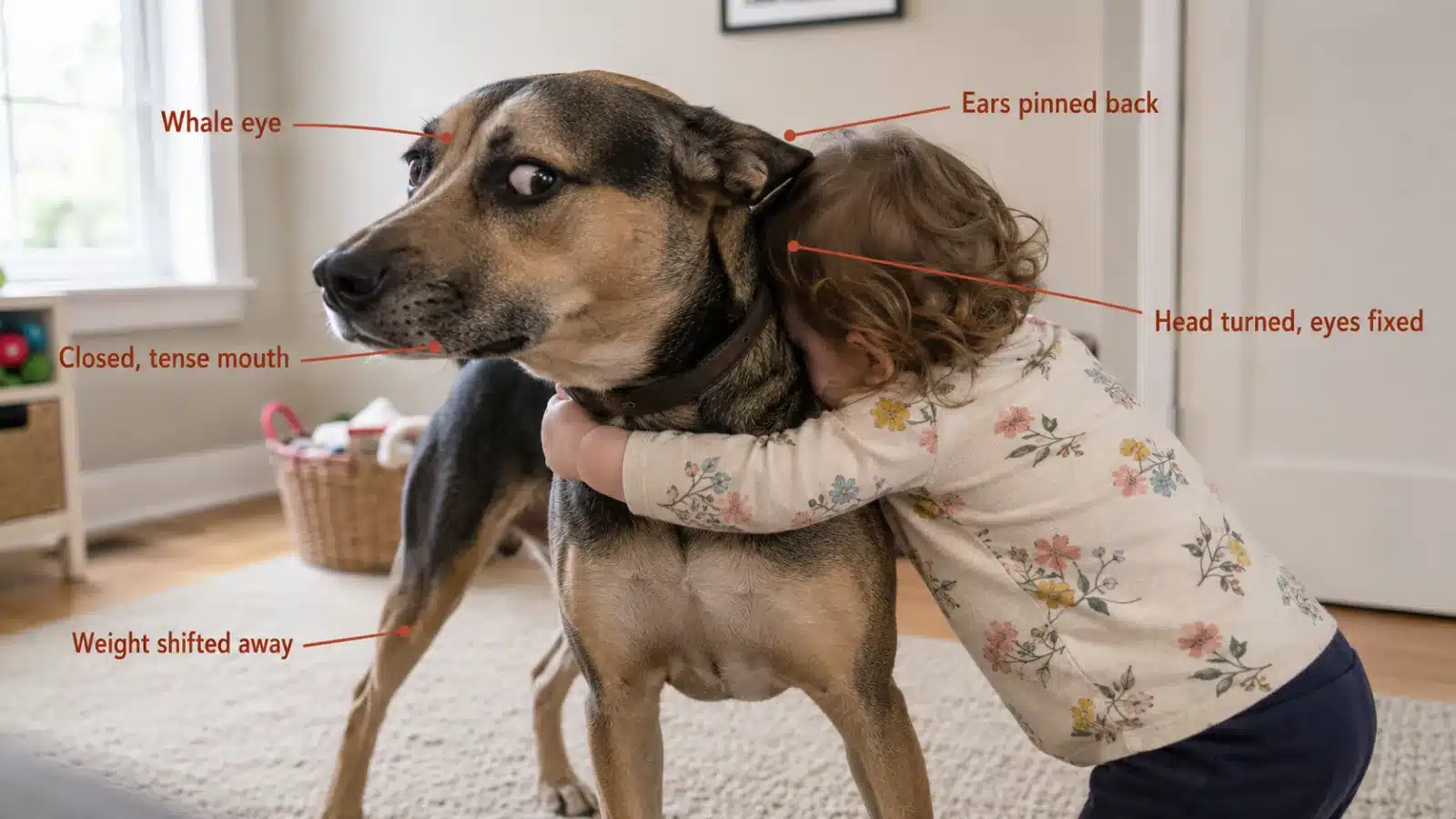
Your Goal Is a Dog Who Finds Your Baby Boring
Here is the reframe the whole guide sits on. Read it twice.
Your goal is not for your dog to love your baby. Your goal is for your dog to be comfortable, neutral, and safe.
Boring is the win.
I mean that literally. A dog who lifts her head when the baby cries, notes that the adults are handling it, and goes back to sleep is not a bonding failure. She is a triumph. She is exactly what I am aiming for with my own clients, and she is the dog who is still doing fine in five years, when your baby is a toddler with a fistful of fur in one hand and no impulse control whatsoever.
The affection, if it shows up, shows up later and shows up on its own. It is a gift, not a project. What you are building over the next nine months is not a friendship. It is a foundation of safety, predictability, and comfort. A friendship is one of the things that can grow on top of that foundation later. Nothing good grows on top of a dog who spent two years quietly enduring something nobody ever asked her about.
Now, why is the pretty aspiration actually dangerous? Because of what it does to you.
A pet parent who wants the photograph will let an interaction run past the point where her dog asked to stop. She will read stillness as contentment, because stillness is what the photo needs. She will reach for her phone at the exact moment she should be reaching for her child. That wish is not harmless. It quietly edits what you see and what you do, and it edits in the direction of not seeing and not doing.
So put it down. What I am handing you instead is easier, safer, and completely achievable: a dog who is fine. A dog for whom the baby is just another feature of a house he already understands. Aim at boring and you will get safe. Aim at beautiful and you may well get neither.
And honestly, there is some relief in this, so take it. Somewhere in the back of your mind you have been auditioning your dog for a role, and quietly panicking that he is failing. He is not failing. He was never auditioning.
Your Dog Does Not Know It Is a Baby
This is the most useful correction I can give you, and I almost never hear anyone say it out loud.
Your dog has no concept of a baby. None. He does not know this is a small human who will grow up. He does not know she is related to you, that she is permanent, or that she matters. He does not know she is a person in any sense you would recognize. There is no file in his head labeled "the family's new infant, to be protected and cherished." We put that file there. It is ours.
So what does he actually know?
Something arrived. It is loud in a way nothing has ever been loud in this house, at a pitch that genuinely hurts. It smells like nothing else here. It moves in jerks and lurches that no adult human moves in. It cannot be predicted, ever. And his people, the two humans whose behavior he has spent years learning to read as fluently as you read a familiar face, have gone strange. Exhausted. Tense. Unavailable. Moving fast. Using voices he has never heard before. The furniture moved. The schedule dissolved. Strangers keep coming to the door. Rules he understood perfectly well have quietly stopped applying, and nobody explained any of it, because nobody can.
Read that back and notice what it is. Every line is a description of unpredictability. And unpredictability is one of the most reliable ways to generate stress in any animal on earth, including you.
Once you see it this way, the whole project reorganizes itself. You are not introducing your dog to a new family member. You are helping an animal absorb the single largest environmental change of his life, on a deadline, with no way to explain it to him. That is a real clinical challenge. It deserves a real plan, which is what the rest of this is.
Behavior Comes From Emotion, Not From Character
The most expensive mistake in all of dog behavior is treating behavior as a statement about who the dog is.
She is not being spiteful. She is not being stubborn. She is not testing you, challenging you, or making a bid for status. She is not getting back at you for the baby. Dogs do not do any of that. Every hour you spend believing they do is an hour spent solving a problem that does not exist while the real one quietly gets worse.
Behavior comes from emotion. Fear, anxiety, stress, frustration, and pain drive the overwhelming majority of what pet parents call misbehavior. Every one of those is a state, not a personality. States change. Personalities do not, which is exactly why the character explanation is so corrosive: it tells you there is nothing to be done here except correct her harder.
And that has a consequence that runs through every page of this guide. If the behavior is driven by an emotion, then changing the behavior means changing the emotion. Suppress the behavior and leave the emotion sitting underneath it, fully intact, and you have not fixed anything.
You have hidden the evidence.
The Word "Jealous" Is Costing You
Nearly every family in this situation reaches for the same word, and I want to talk about it, because the word does real damage.
"He is jealous of the baby."
I understand why. It is intuitive, it is emotionally legible, and it fits what you are watching. He is pushy. He shoves in. He whines while you are nursing. He plants himself between you and the bassinet. It looks exactly like jealousy looks in a four-year-old, and you have seen a four-year-old.
But watch what that word does to you.
Jealousy is a motive. Motives invite correction. He is being jealous, so he needs to learn he cannot behave like that, so I will make behaving like that unpleasant for him. See how fast that happened? The word walked you to punishment in three steps, and it walked you right past the only question that actually helps.
Here is that question. What emotion is producing this, and what is the behavior trying to achieve?
Usually the answer is not jealousy. It is anxiety about a change he cannot make sense of. Or it is a learned association, because for eight weeks now the baby appearing has reliably predicted that his people become unavailable. Or it is frustration at losing access to things he has always had. Or, very often, it is a dog who has been asking quietly for three weeks, got nothing, and has finally escalated to asking loudly, because loudly is the thing that finally worked.
Every one of those has a treatment. "Jealous" has none. That is the whole problem with it.
Drop the word and watch what happens. You stop staring at your dog's supposed motives and start looking at his antecedents. What happened right before? What is he getting out of it? What is he trying to change? That is the beginning of thinking like a behaviorist about your own living room, and it is honestly the real skill this guide is teaching.
What Actually Changes When a Baby Arrives
When people say a dog is "adjusting," they are waving at something they have never actually looked at. So let us look at it.
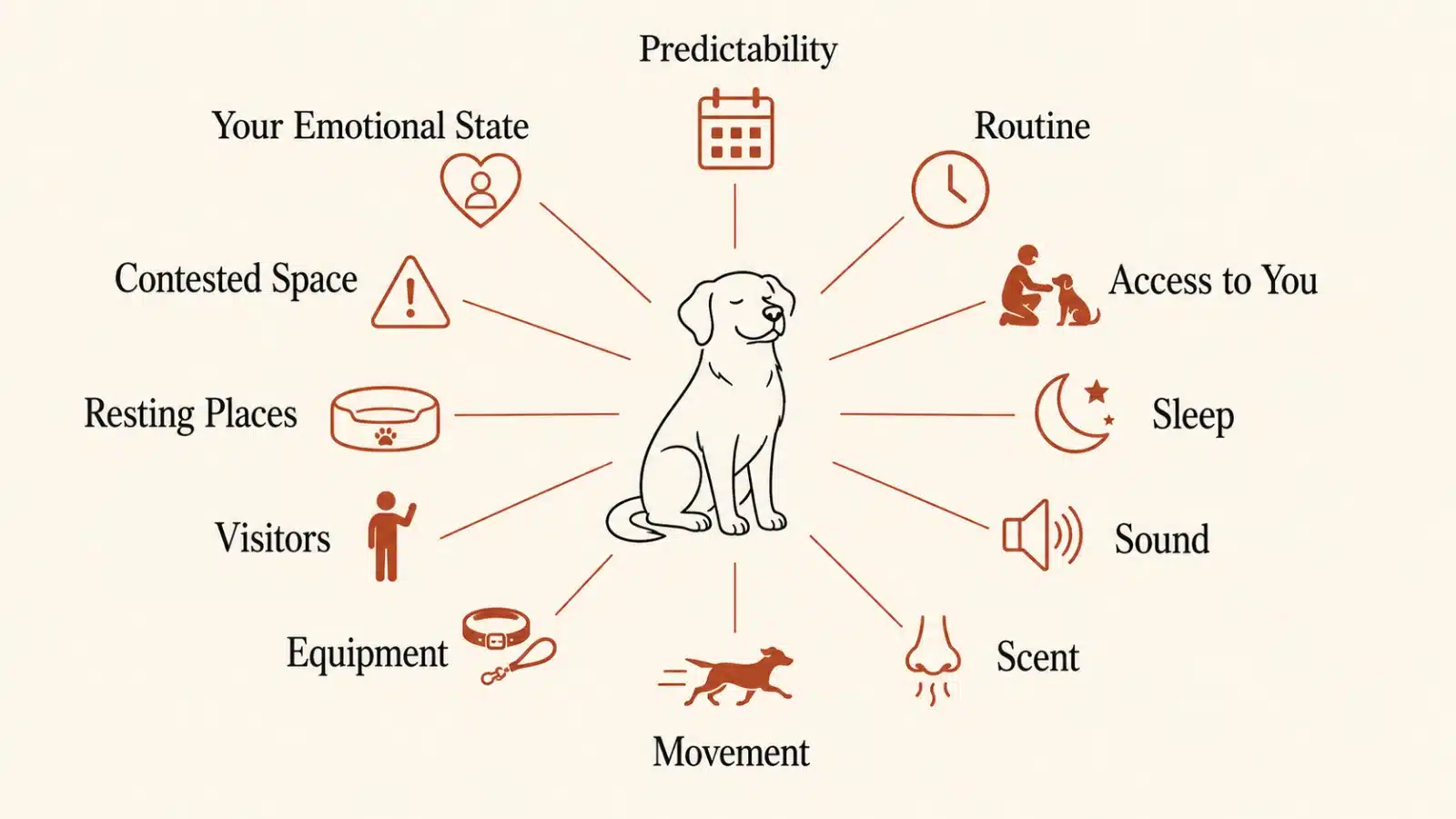
Here is what genuinely changes in your dog's world. Read it as a list of stressors, not a list of inconveniences.
Predictability collapses. Nothing happens when it used to happen.
Routine dissolves. Walks, meals, attention. All of it moves, and it moves differently every single day.
Access to you drops, sharply, without explanation, and it drops most from whichever person your dog is most attached to.
Sleep gets disrupted, hers as well as yours. A dog woken repeatedly at three in the morning is carrying a sleep debt, and sleep debt lowers tolerance in dogs the same way it does in you.
The sound environment changes completely. Infant crying is loud, sudden, high-pitched, and impossible to predict. The research here is not ambiguous: a crying infant measurably raises cortisol in dogs, not only in the humans listening to it.
The scent environment changes completely.
Movement changes. Nothing in your house has ever moved the way an infant moves. And later, nothing will move the way a crawler moves.
Equipment arrives. Objects that beep, rock, swing, hum, and vibrate.
Visitor traffic multiplies, often for weeks, often with no warning.
Resting places change. The spot she has slept in for six years is now the spot you walk through at three in the morning carrying something that is screaming.
Space gets contested. Doorways, hallways, floor space. All busier, all less negotiable.
And your own emotional state changes, which matters more than almost anyone expects. Stress in a household lands on the dog. Research measuring long-term cortisol in dog and human pairs has found the two synchronize: pet parents living with high stress tend to have dogs living with high stress. Your dog is downstream of you. That is not a guilt trip. It is a reason to take your own support seriously, and we will come back to it.
Now look back over that list. Not one item on it is about jealousy. Not one is about dominance, status, or character. Every single one is a change in the physical or emotional environment, and every single one can be planned for, softened, or rehearsed in advance.
That is the entire premise of this guide. It is also why we start nine months out instead of the week before.
The Growl Is Not the Problem. The Growl Is the Warning System.
If you take one thing out of this entire guide, take this one. Never punish your dog for growling at your baby.
I know exactly how that lands on a frightened parent. Your dog just growled at your child and every instinct you own is screaming that this has to be stopped right now, hard, unmistakably. I understand that instinct completely. It is also wrong, and understanding why it is wrong might be the single most important thing you learn here.
Start with what punishment actually does, because the mechanism decides everything.
Punishment suppresses behavior. That is the definition of it. Punish a growl and you absolutely can reduce the growling, and this is precisely why it looks like it worked. That is the whole trap.
But a growl is a behavior. The fear underneath it is an emotion. Punishment reaches the behavior. It does not touch the emotion. So your dog is still every bit as uncomfortable with your baby as she was ten seconds ago, and now she has learned one new thing on top of it: growling makes bad things happen.
So she stops growling.
You have not made your dog safe. You have made her quiet. The discomfort is completely intact and the warning has been deleted. What you are left with is a dog who is still frightened of your child and no longer tells you about it.
And the next time your baby crowds her and she hits her limit, there is no growl. There is no warning at all. The families who tell me the dog bit "out of nowhere, with no warning" are very often describing a dog whose warnings were trained out of her months earlier, by people who loved her and thought they were doing the right thing.
Turn it around and look at what a growl really is. A growling dog is a dog working hard not to bite. She is telling you the truth, early, at real cost to herself, and she is buying you time to act. That is not defiance. That is honesty, and it is generous, and it is the most valuable thing your dog can hand you in the years you are about to spend raising a child alongside her.
So when you hear it, do not correct it. Thank her silently. Get your baby calmly out of the situation. Then treat the growl as exactly what it is: information that something in your setup has failed and needs to change.
The growl is not the emergency. The growl is the smoke alarm. You do not fix a fire by taking the battery out.
The full picture of how warnings escalate, and why every dog runs through a whole ladder of quieter signals long before she ever growls, is in the distance-increasing signals guide. If a growl has already happened in your home, go read that page today, and then read the red flags section in this guide before you do anything else.
Suppression Is Not Change
The growl is the clearest example, but the principle is much bigger than the growl, and it governs basically every decision you are going to make over the next nine months.
You can suppress almost any behavior if you are willing to make a dog uncomfortable enough. The dog will stop. Onlookers will be impressed. Somebody will tell you it worked. And nothing whatsoever will have changed about how that dog feels, which means nothing has changed about what he might do when the pressure gets high enough and the suppression finally fails.
There is a further cost, and in a house with an infant it is not a small one. Aversive methods carry a documented association with increased aggression. Dogs trained with confrontational techniques respond aggressively at strikingly high rates. Dogs trained with aversive methods show substantially elevated risk of aggression toward family members.
Read that last phrase again, slowly. Family members. Then look at the very small person you are about to carry through your front door.
This is not a philosophical preference of mine. In a house with a baby, aversive training is a safety problem.
And before anyone hands you the false choice, let me close it off: the alternative is not permissiveness. The alternative is management, so the wrong thing cannot happen in the first place. Skills, so your dog knows what to do instead. And emotional change, so the feeling underneath the behavior genuinely shifts. Is that more work than a correction? Yes. It is also the only thing that survives contact with a toddler.
What This Guide Will and Will Not Do
This guide is going to teach you to run a structured behavior plan on your own home, on a deadline you cannot move.
You will learn to see what your dog is telling you. You will learn to build a house where the wrong thing cannot happen. You will learn the handful of skills that genuinely matter, and how to change the way your dog feels about the sounds, smells, movement, and equipment that are coming. And this guide stays with you past homecoming, through the crawling stage, and into toddlerhood, which is where the real risk actually lives and where nearly every other guide has already left you standing there alone.
What it will not do is promise you that every dog is fine.
Most are. Most families who prepare properly do well, and I want you to hold onto that, because the fear you are carrying right now is almost certainly bigger than the risk in your actual house. But some dogs need professional help. A smaller number need veterinary behavior medicine. And a small number of situations cannot be made safe for an infant, no matter how much anyone loves anyone. This guide will tell you honestly how to know which one you are looking at, and it will not shame you for any of it. Not for being scared, not for being exhausted, not for the thought you had at two in the morning that you have never said out loud.
Oh, and one more thing. This guide is not going to tell you to bring home a blanket from the hospital and let your dog sniff it.
We will get to that.
Start from the assumption that you are going to be fine, because you probably are. Then do the work anyway, because the work is the thing that makes it true.
Evaluate: Learning to See Your Dog
Before You Change Anything, Learn to See
Every plan in this guide depends on one skill that comes before all the others. You have to be able to look at your dog and know, in the moment, whether she is comfortable or whether she is quietly asking for the situation to stop.
That sounds simple. It is not, and I am going to tell you why in a way that might sting a little.
You are going to misread your own dog. Not because you are careless, and not because you love her any less than the experts do. You are going to misread her precisely because she is yours.
The research on this is uncomfortable and worth knowing. When you study how well pet parents recognize stress in their own dogs, the results are humbling; people miss the quiet signals constantly, and they are often most confident at the exact moments they are most wrong. And that is people looking at an ordinary dog on an ordinary day. Now add the single most emotionally loaded object that will ever enter your home, put your own baby at the center of the picture, and ask you to read your dog clearly across that. It gets harder, not easier.
Here is the mechanism, because the mechanism is the whole point. Love does not sharpen your perception. It bends it. You want the story to be good, so you find the version of events where it is good. The dog leaning in becomes affection. The stillness becomes calm. The tolerance becomes love. Every ambiguous signal gets quietly rounded up toward the answer you are hoping for, and you never feel it happening, because it does not feel like bias. It feels like knowing your own dog.
So the first move in this entire guide is to slow down and actually look, on purpose, against your own hopes. That is a learnable skill. Let me show you what it costs you when you skip it.
The Scenes You Will Recognize
I am going to walk you through the misreads I see most often. Not the dramatic ones. The quiet, loving, everyday ones, the kind that come from a good heart and get somebody hurt anyway. See if you recognize yourself in any of them. Most people find at least one.
"He is being so protective of the baby"
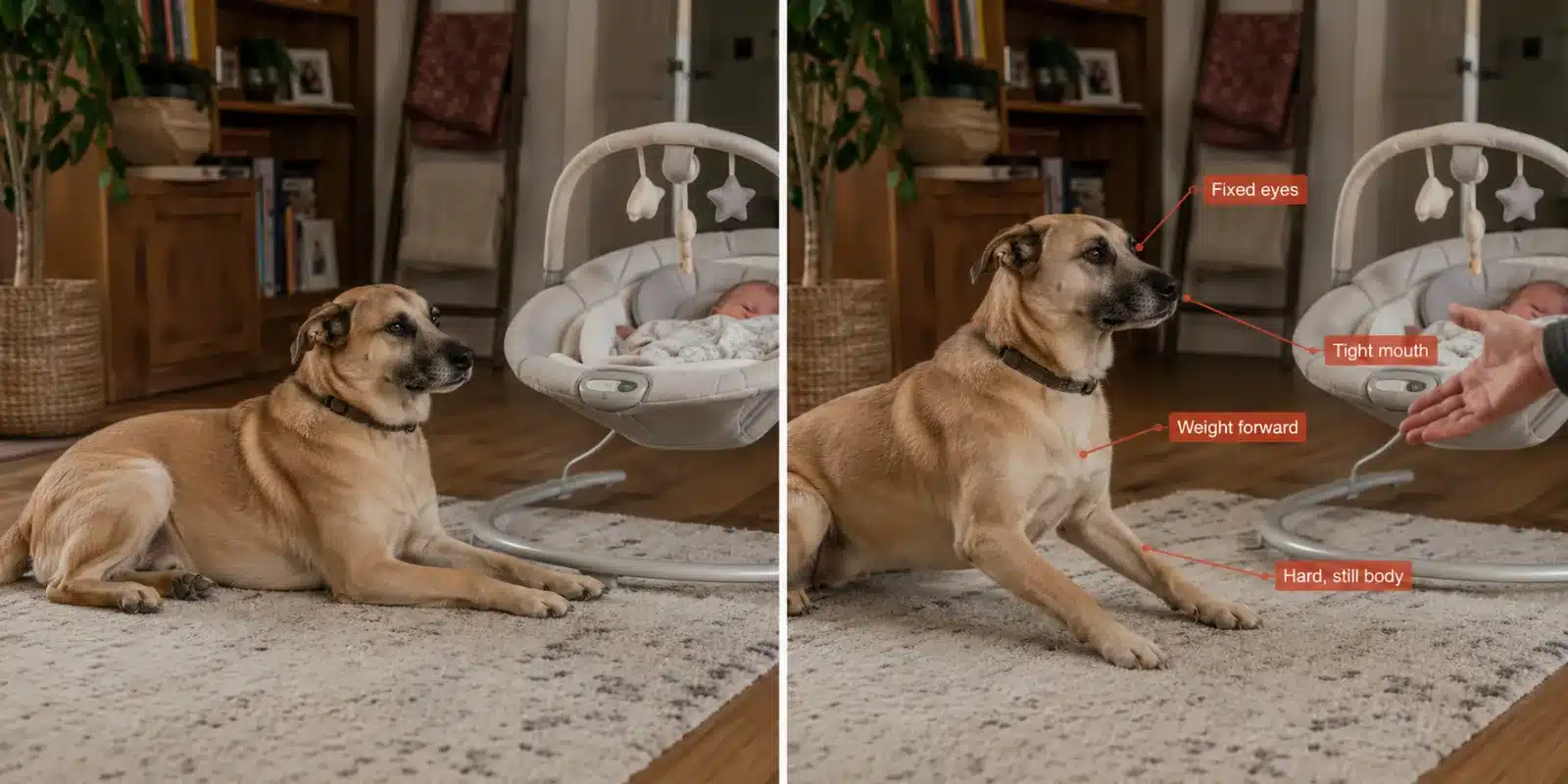
The baby is in the bouncer. Your dog is lying a few feet away, facing her, very still, tracking every person who comes into the room. When your mother-in-law reaches toward the baby, the dog gets up. Maybe there is a low sound in his chest. Everyone says the same warm thing. Look at him. He has appointed himself her guardian. He loves her already.
Slow down and look again.
A dog who stiffens, fixes, and positions himself between a resource and an approaching person is not usually feeling love. He is guarding. The baby has become a valued resource, and he is controlling access to her, and the fact that the resource is a human infant does not change the emotional machinery one bit. Guarding is not devotion. Guarding is a dog who has decided something is his to control, and it escalates, and one of the people it will eventually escalate against is you, the night you reach for your own crying child a half-second faster than he would like.
The tell you are missing is the stiffness. Affection is loose. This is not loose. Watch the body, not the proximity.
"She loves the baby, look how close she stays"
She will not leave the baby's side. Wherever you set the baby down, that is where she goes. She follows the bassinet from room to room. You find it deeply touching, and you tell people your dog has bonded with your daughter.
Maybe. But there is another reading, and you owe it a look before you settle on the sweet one.
A dog who cannot settle, cannot rest, and compulsively monitors a thing is not always in love with it. Sometimes she is worried about it. Vigilance and affection look identical from across the room and could not be more different underneath. The loving dog can leave. She chooses to be near the baby and she can also go flop in the other room without a second thought. The vigilant dog cannot let go. She is drawn back again and again, not by delight but by a low unresolved anxiety she cannot put down.
The question that separates them is simple. Can your dog relax somewhere else, easily, when the baby is safe and handled? The dog who can is probably fine. The dog who truly cannot rest while the baby exists in the house is telling you something, and it is not a love story. That inability to settle is often stress wearing a costume, and you can read more about how dogs ask for space and relief in the calming signals guide.
"He is so gentle, he lets her do anything"
This is the one that scares me most, so I am going to be very direct about it.
Your baby becomes a toddler. She pulls his ears. She grabs a fistful of fur and hangs on. She flops onto him while he sleeps. And he takes it. Every time. He never snaps, never grumbles, never moves away. Everyone marvels at how gentle he is, how patient, what a saint of a dog, and you relax, because clearly he does not mind.
Here is what you are actually looking at. A dog who endures escalating unpleasant handling without complaint is very often not a happy dog. He is a shut-down dog. He has learned that objecting does not work, or he has learned that objecting gets him in trouble, so he has stopped objecting. What looks like limitless tolerance is a dog quietly absorbing something he hates because he does not believe he has any other option.
Tolerance has a bottom. Every dog has a floor, and a dog who has been silently enduring is a dog whose floor you cannot see, because he stopped showing you where it was. The saint who "lets her do anything" is running out of room in a place you cannot watch, and the day he finally hits the bottom, it will look like it came from nowhere. It did not come from nowhere. It came from months of a dog telling you nothing because he had learned that telling you did not help.
A gentle dog should still be allowed to leave. If your dog never protests and never removes himself, that is not proof he is fine. That can be the loudest quiet signal in the house.
"His tail was wagging, so he was happy"
You saw the tail going and you relaxed. Almost everyone does. It might be the single most trusted signal in the entire human understanding of dogs, and it is one of the most misunderstood.
A wag is not a smile. A wagging tail means the dog is aroused, emotionally switched on, and that arousal can be delight or it can be conflict, tension, or the wound-up state right before a dog does something you wish he had not. The position matters. The speed matters. The stiffness matters. A high, fast, tight little wag over a hard, still body is not a happy dog. It is a dog near his limit, and if you filed the wag under happy, you just cleared a dog who was actually asking for help.
This one matters so much, and gets so many people bitten, that there is a whole guide dedicated to it: what a wagging tail actually means, alongside what different tail positions tell you. If you read only two of the body language pages before your baby arrives, read those.
"She is just playing with the baby"
The baby is on the floor now, crawling. Your dog gets excited when the baby moves, darts in, maybe mouths at a sleeve, bounces around, circles. You laugh, because she is playing, she wants the baby to be her friend.
Be careful with this one, because two very different things wear this same face.
Some of it may be play. But a dog who fixates on a fast, low, jerky moving thing, who darts and grabs and cannot easily be called off, may not be playing at all. She may be responding to movement the way dogs respond to movement, and a crawling infant produces exactly the kind of fast, erratic, low-to-the-ground motion and high-pitched sound that switches that response on. The herding breeds feel this most, but no breed is immune.
The line between play and something more serious is whether she can stop. Real play has pauses. It has give and take, little breaks, a dog who can be called away and come back. The response you need to worry about does not pause and does not call off easily. If you cannot interrupt it, it is not play, whatever it looks like, and you can learn to tell the genuine article from its lookalikes in the play signals guide.
"He barks at the baby, he just needs to get used to her"
Every time the baby cries, your dog barks. You have decided he will habituate, that he just needs exposure, that in a few weeks he will tune it out.
He might. Or the barking might be telling you the crying genuinely distresses him, and that "just getting used to it" through raw repeated exposure is the exact opposite of what he needs.
Remember what we covered in Part One: a crying infant measurably raises stress hormones in dogs. That sound is not neutral to your dog. It is aversive. Barking at it is a response to something that bothers him, and flooding him with more of it does not teach calm; it can teach him that the sound is even worse than he thought. There is a right way to change how your dog feels about crying, and it is slow and deliberate and we cover it in the emotional repatterning section. Bulldozing him with cry sounds until he gives up is not it. In the meantime, understanding what is actually driving the barking is worth your time, because barking is never just noise; it is several different messages wearing the same sound.
The One Question the Scenes Have in Common
Read back over those six scenes and notice what every correction had underneath it.
The loving reading looked at where the dog was, or what the dog let happen. The accurate reading looked at how the dog's body was actually holding, and whether the dog could stop, settle, or leave.
That is the shift. Stop reading proximity and permission. Start reading tension and choice. A dog who is comfortable is loose and has options. A dog who is in trouble is tight, or fixed, or unable to disengage, or has quietly given up on leaving. Once you are looking at the right things, most of these situations read themselves.
No single signal decides it, either. A lip lick alone means little. A yawn alone means little. What you are learning to see is the cluster: the lip lick and the turned head and the still body and the hard eye all arriving together, which is the difference between a dog who is fine and a dog who is not. Reading those combinations is a real skill and it has its own guide, reading signal clusters, which is the single most useful body language page for what you are about to do.
If you do nothing else in the Evaluate stage, spend real time in the complete body language guide before your baby arrives. It is the eyes you are going to be reading your dog with for the next eighteen years.
The Pain Question Almost Everyone Skips
Now step away from behavior for a moment, because there is a medical door you have to check before you walk any further, and nearly every guide walks right past it.
Before you decide your dog has a behavior problem, you have to rule out that your dog has a pain problem.
This is not a throwaway line. When you look closely at dogs referred to behavior professionals, a large share of them turn out to have an underlying painful condition contributing to the behavior; depending on the caseload the estimates run from roughly a quarter to a substantial majority. Pain lowers the threshold for everything. It makes a dog less tolerant of handling, quicker to startle, more irritable, more defensive about being touched or moved, and far less able to cope with the noise, unpredictability, and physical chaos an infant brings.
Think about what that means for your timeline. A dog in low-grade chronic discomfort, the kind that is easy to miss because she never limps and never cries out, is a dog running with no margin. Then the baby arrives, and the handling and the noise and the disrupted sleep pile on, and the dog who "suddenly" became snappy did not suddenly become anything. She was hurting the whole time, and the baby used up the last of her patience.
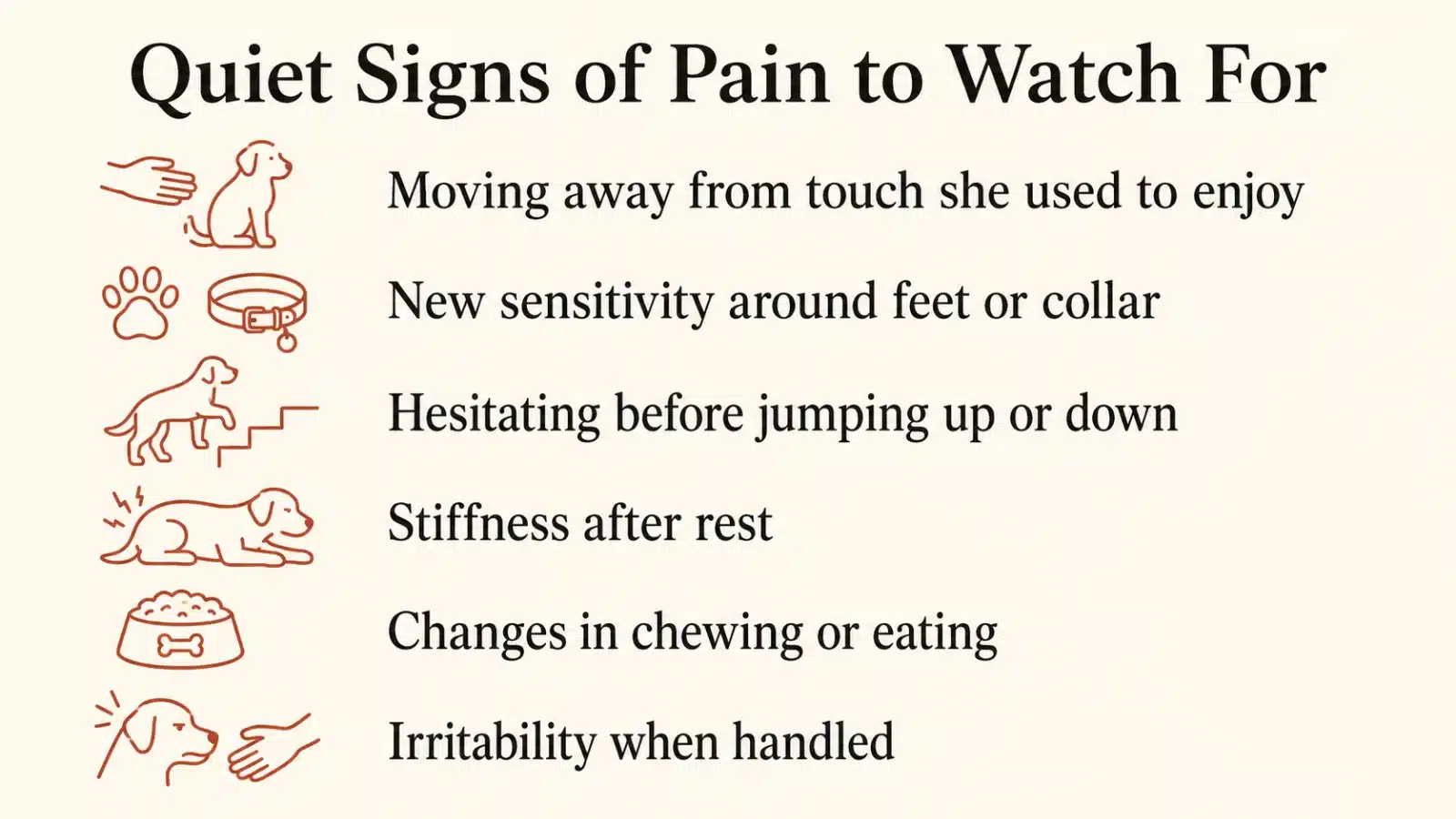
So here is the instruction. Sometime in early pregnancy, before you start the behavior work, take your dog to your veterinarian for an honest physical, and say plainly that you have a baby coming and you want to know whether your dog is in any pain or discomfort that could affect how she copes. Ask specifically about the quiet things: joints, back, teeth, ears, gut, skin. Watch for the soft signs at home too. A dog who used to love having her hindquarters scratched and now moves away. A dog who has gotten touchier about her feet, her collar, being picked up. A dog who used to jump onto the couch and now hesitates. Those are not personality changes. Those are often pain, and pain is treatable, and treating it can change your entire behavior picture before you have trained a single thing.
Do this first. A comfortable dog has room to cope. A hurting dog does not, and no amount of counterconditioning fixes a sore hip.
Now Meet Your Actual Dog
With the pain question handled, it is time for the most honest conversation in this whole process, and it is a conversation with yourself.
You have to look at the dog you actually have. Not the dog you wish you had, not the dog you are sure she will become once she meets the baby, not the dog she is ninety-five percent of the time with the five percent quietly set aside. The actual dog, including the parts you do not like to think about.
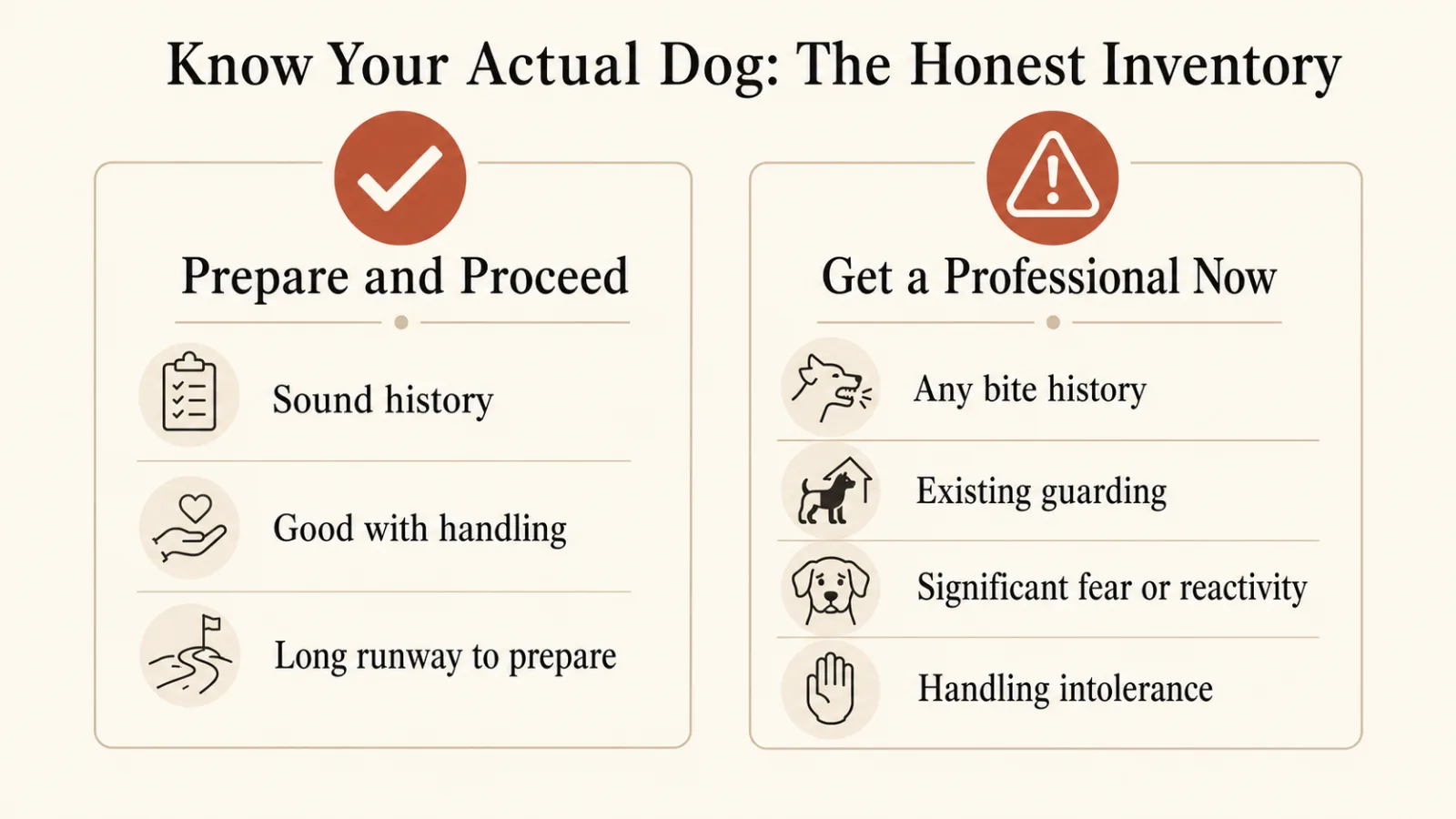
I am asking because this is the point where you sort yourself, quietly and privately, into one of two groups. Most families are in the first group: a fundamentally sound dog, no serious history, and a long runway to prepare. If that is you, the rest of this guide is your roadmap and you have every reason for optimism. A smaller number of families are in the second group, and for them the honest answer is that this needs a professional involved now, not later, and possibly needs more than a guide can give. The only way to know which group you are in is to answer some hard questions truthfully.
Has your dog ever bitten anyone? Not "attacked." Bitten, at any level, including the ones people explain away. A snap that connected. A bite that "did not break skin." A "nip" at a child who got too close. If there is any bite history at all, that is the single most important fact in your entire preparation, and it moves you toward professional help immediately. Past bites are the best predictor we have of future bites, and a home with an infant is not the place to find out whether it was a one-time thing.
Does your dog already guard things? Food, toys, chews, the couch, a person, a spot? Resource guarding does not stay in its lane. A dog who guards the couch today can guard the space near the baby tomorrow, and this is one of the highest-stakes behaviors in a baby home. Be honest about the small stuff, because the small stuff is where it starts.
Is your dog already frightened, anxious, or reactive? A dog who is scared of strangers, who lunges on leash, who cannot cope with novelty, who startles hard and recovers slowly, is a dog for whom the baby is one more large stressor stacked on a system that is already close to full. This does not mean the situation is hopeless. It means you start earlier, go slower, and get help sooner, and there is a whole science-based road map for exactly these dogs in the guide to fearful, anxious, and reactive dogs.
How does your dog handle being handled? Can you touch her paws, her collar, her back end, take something from her mouth, move her off the couch, without a problem? Because a baby, and then a toddler, is going to do all of those things without asking, and a dog who is touchy about handling now is a dog with a specific, trainable vulnerability you want to know about today.
Then the plainer facts, which matter more than people expect. How old is your dog, and is she heading into the years where arthritis and sensory loss quietly lower her tolerance? How big is she, both the giant who can knock a toddler flat without a shred of ill intent and the tiny one who can be stepped on or fall from a couch? Can she see and hear well, because a dog losing those senses startles more easily and a startled dog is a defensive dog? And if you have more than one dog, how do they behave together, because two dogs feed each other's arousal, and a baby changes the whole social picture in the house at once.
None of this is meant to frighten you. It is meant to locate you. Most of you, having answered honestly, will find you are exactly where you hoped: a good dog, a clean history, plenty of time. Breathe out. The rest of this guide is built for you. But some of you felt your stomach drop at one of those questions, and I would rather you feel that now, with nine months to act, than the week the baby comes home. If that was you, skip ahead and read the red flags section today, and then get a qualified professional involved. Not because your dog is bad. Because your dog, and your baby, deserve more than a website can safely give them alone.
Audit the Life You Are About to Change
One last piece before we start building, and it is the easiest to skip and one of the most useful.
Sit down, ideally with your partner if you have one, and map out honestly what your dog's daily life looks like right now, and then map what it is realistically going to look like once the baby is here. Not the idealized version. The real one, the one with the three in the morning feeds and the recovery from birth and the days nobody has the energy for a proper walk.
Where does your dog sleep now, and is that spot about to become a thoroughfare? When does she eat, and who feeds her, and will that person be awake and available in the newborn weeks? When and how does she get exercised, and who is going to do it when one of you is recovering and the other is holding a baby? Where does she spend her days? What are her rituals, the greeting at the door, the spot on the couch, the evening walk, and which of those are about to change or vanish?
Write it down. Two columns, now and after. The gap between those columns is your actual to-do list, and it is the thing the entire timeline in this guide is built to close. Almost every problem that shows up after a baby arrives is visible in that gap months ahead of time, which means almost every one of them can be prevented instead of managed. But only if you looked.
This audit also surfaces the conversation most couples put off far too long: who is actually going to take care of the dog when both of you are underwater. We are going to come back to that in the section on the human side of all this, because it matters more to how this goes than almost anything you will teach your dog. For now, just get the two columns on paper. You cannot prepare for a change you have not let yourself look at.
The Short Version, If You Skimmed
If you skimmed, or you are reading this at a moment when a full chapter is more than you have in you, here is Evaluate in one box.
You will misread your own dog, because you love her. Slow down and look against your own hopes.
Read the body, not the position. Comfort is loose and has options. Trouble is tight, or fixed, or cannot settle, or has stopped leaving.
The common loving misreads, corrected:
- "Protective" is usually guarding. Watch for stiffness.
- "Loves the baby, never leaves" can be vigilance, not affection. Ask whether she can relax elsewhere.
- "So gentle, lets her do anything" can be a shut-down dog running out of room you cannot see. A gentle dog should still be allowed to leave.
- "Wagging, so happy" is wrong. A wag means aroused, not happy. Read position, speed, and stiffness.
- "Just playing" with a crawler may be motion-driven arousal. The test is whether she can stop.
- "Barks at the baby, will get used to it" may be distress. Flooding makes it worse, not better.
Rule out pain before you diagnose behavior. A large share of behavior cases have a medical driver. See your vet early and ask specifically.
Meet your actual dog. Any bite history, existing guarding, or significant fear or reactivity means get a professional involved now, not later.
Audit the life. Two columns, now and after. The gap is your to-do list.
When you have looked honestly at all of that, you are ready to start building. That is next.
Arrange: Building a Safe Home
Management Is Not Cheating
Let me get ahead of something you are going to feel, because almost every good pet parent feels it.
Somewhere in the next few sections you are going to catch yourself thinking that all these gates and pens and closed doors feel like a cop-out. Like if you were really doing this right, if you trained well enough, you would not need to physically separate your dog from your baby with a piece of hardware. Like the barriers are an admission that your dog cannot be trusted.
Put that down too, right alongside the pretty picture from Part One. It is wrong, and it is one of the most dangerous ideas you can carry into this.
Management is not what you do instead of training. Management is the thing that keeps everyone safe while the training works, and the thing that catches you on the days the training is not enough, and there will be days the training is not enough, because you are about to be more tired than you have ever been in your life. A gate is not a confession of failure. A gate is a decision you make once, calmly, months in advance, so that you do not have to make a hundred good decisions in a row at three in the morning on no sleep. Nobody is that good at three in the morning. Not you, not me, not the dog.
Here is the principle underneath everything in this section, and I want you to hold it the whole way through. You are going to design your home so that the wrong thing cannot happen, rather than trusting that it will not. Those are completely different strategies. Hoping it will not happen depends on constant vigilance from an exhausted human and perfect self-control from a stressed dog, every single time, forever. Designing so it cannot happen depends on a gate that is either latched or not. One of those is a plan. The other is a wish with good intentions.
And there is a phrase I want you to tape to the inside of your own head for the newborn months: design for your worst self. Not your best self, the one reading this right now, rested and motivated and full of resolve. Your worst self. The version of you at week three, running on ninety minutes of broken sleep, holding a screaming baby in one arm, who has genuinely forgotten what day it is. The setup has to work for that person. If your plan only holds when you are sharp, your plan does not hold, because you are not going to be sharp. Build the house so that the tired, one-handed, half-asleep version of you cannot get it wrong, and you have built something real.
The Safe Zone Comes First
Before we talk about a single gate, we start with the most important space in the house, and it is not the baby's. It is the dog's.
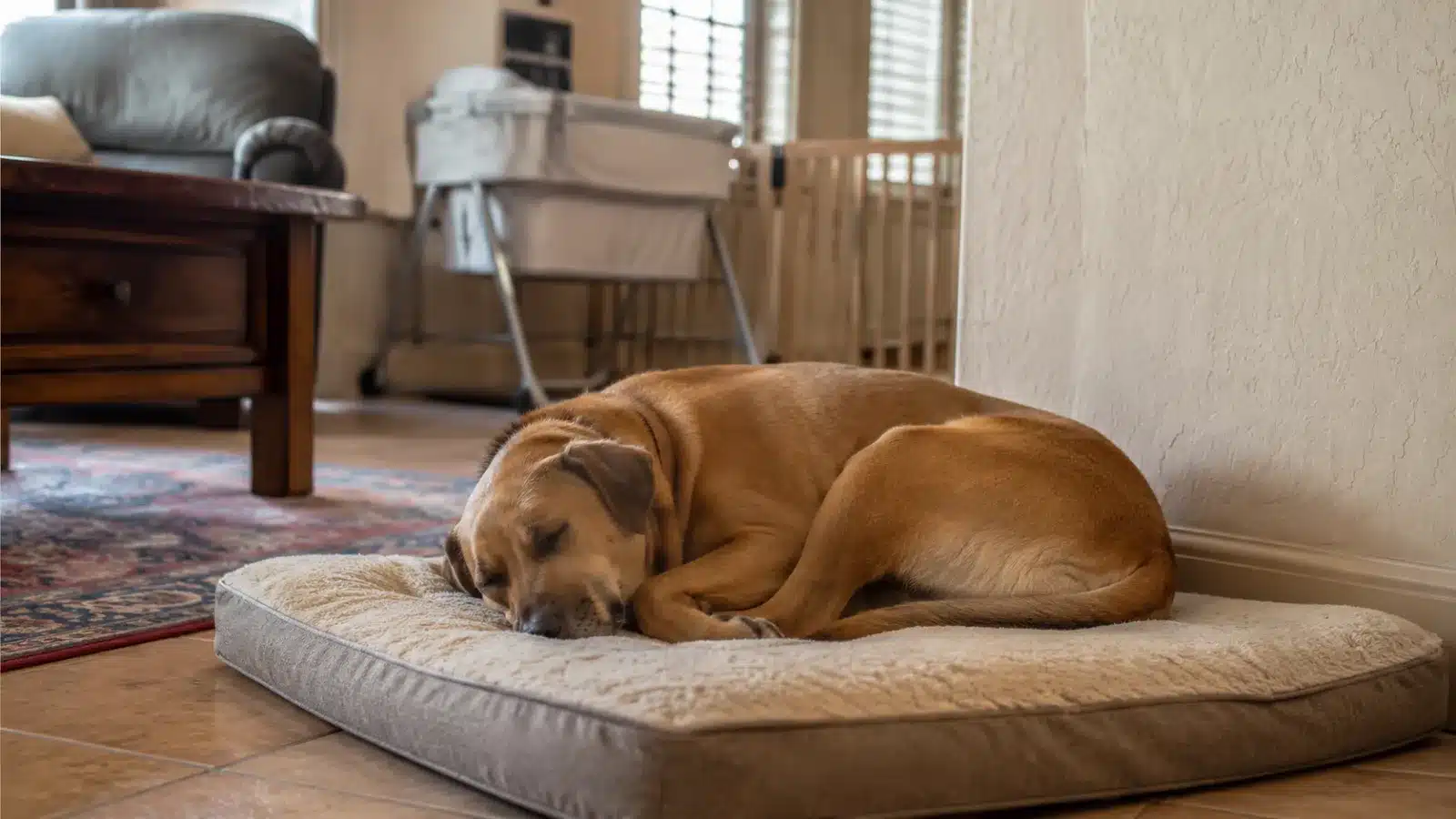
Your dog needs a place that is completely, reliably hers. A place where nothing bad ever happens, where no one reaches for her, where the baby never goes, where visitors do not lean over her, where she can take herself when the house becomes too much and know with total certainty that she will be left alone. Not a place you put her. A place she chooses.
That last distinction is the whole thing, so let me sit on it. A safe zone the dog chooses is a refuge. A safe zone you shove the dog into when you are frustrated is a punishment, and a dog can tell the difference instantly. If the only time your dog ends up in her crate is when she has done something you did not like and you are irritated, that crate is not a safe zone. It is a penalty box, and she will avoid it exactly when she most needs it. The goal is the opposite. The goal is a spot so genuinely pleasant, so reliably peaceful, that when the living room fills with cooing relatives and a crying newborn, your dog gets up on her own and goes there because it is the best place in the house to be.
You build that the same way you build anything good for a dog: you make the place pay. The best chews happen there and nowhere else. A comfortable bed, water, maybe something that muffles the household noise. Good things arrive there and nothing unpleasant ever does. You never call her out of it to do something she dislikes, and you teach everyone in the house, on pain of death, that when the dog is in her spot, the dog does not exist. No petting. No greeting. No "aww, come here." She is off the clock, and that is sacred.
Where you put it matters as much as what is in it. It needs to be somewhere the dog can actually relax, which means out of the main current of the house, not in the hallway everyone thunders through, not wedged next to the front door where every knock detonates, and specifically not on the path you are going to walk at three in the morning carrying a crying baby to and from the nursery. Think about that route now, before anything is built, and keep the dog's refuge off of it. A safe zone that the chaos walks straight through is not a safe zone.
For a lot of dogs the anchor of the safe zone is a crate, and if that is your dog, the crate has to be a genuinely happy place long before it is a necessary one. We will get into the mechanics of building that positive association in the skills section, because it is a real training project and not just a matter of buying the crate. For now the point is the concept: every dog in a baby home needs a legitimate retreat, built early, made wonderful, and protected by everyone.
Now Draw Your Actual House
Here is where this guide does something almost no other guide will do for you. We are going to plan your actual home, from above, like an engineer, because managing an environment is a spatial problem and it is almost impossible to solve in words alone.
Get a piece of paper. Sketch the rough floor plan of the part of your home where daily life happens: the rooms, the doorways, the hallways, where the furniture sits, where the dog sleeps, where the nursery is or will be. It does not have to be to scale or pretty. It just has to be yours, because the generic advice everyone gives, "use baby gates, create separate spaces," means nothing until it lands on the specific chokepoints of your specific house.
Then look at it the way I am about to teach you to look at it.
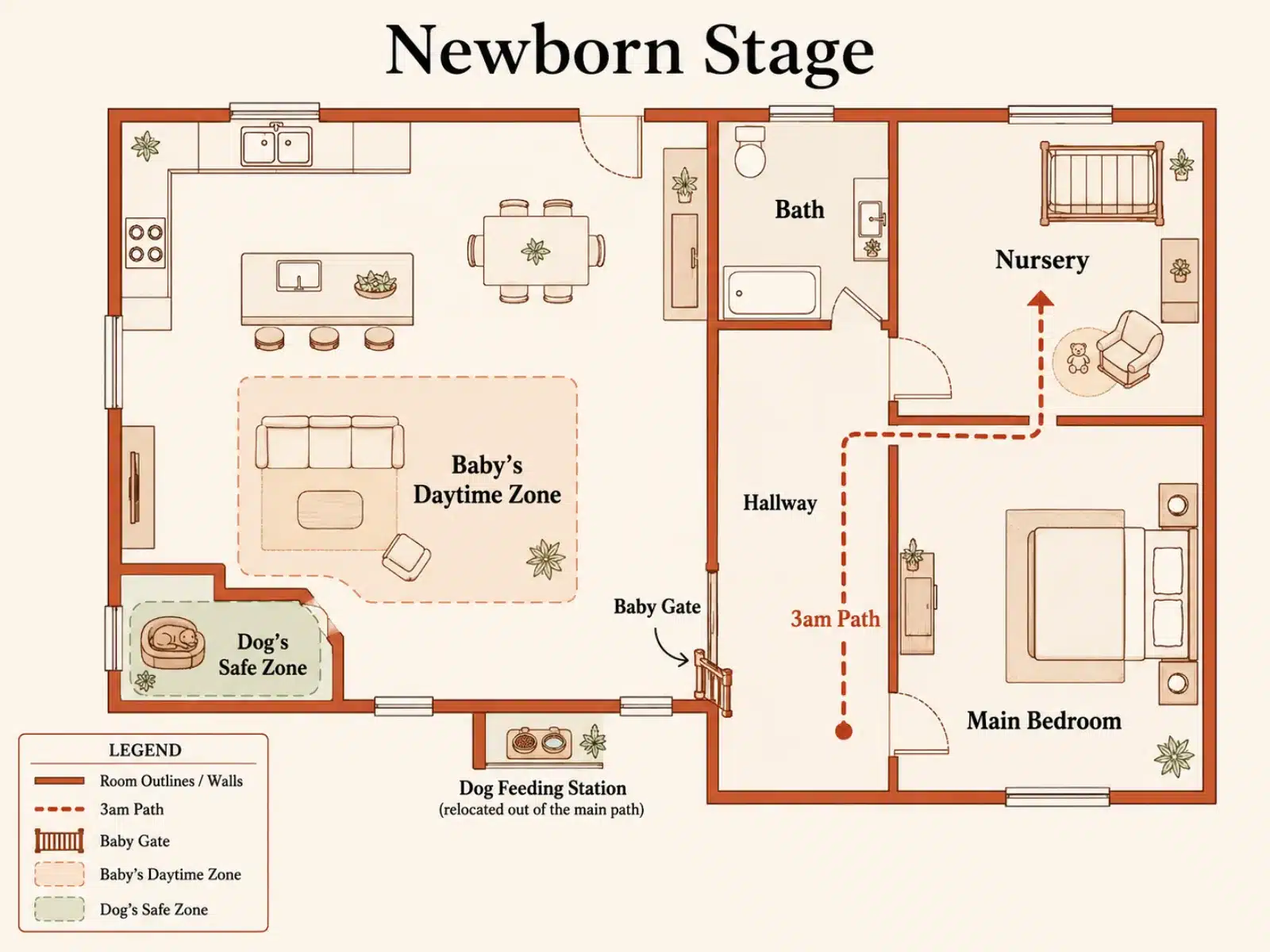
The newborn layout
In the newborn stage your baby does not move. This makes people complacent, because a stationary baby feels easy to manage, and in truth this is the easy stage. Use it to build the habits, because the hard stage is coming and you want the systems already running on muscle memory before it does.
What you are arranging for in these early months is not really the baby. It is everything around the baby. It is the feeding of the dog, the movement of tired adults, the flow of visitors, the three in the morning trips, and the simple guarantee that the dog and the baby are never in the same unmanaged space by accident. You want clear separation available instantly and without thought: a gated area, a pen, a closed door, something that goes between dog and baby the moment you cannot give both your full attention.
Look at your drawing and mark three things. Mark where the baby will be during the day, the main daytime landing spot, the living room floor, the bouncer, wherever the two of you will actually be. Mark where the dog's safe zone is. And mark the route between the bedroom and the nursery that you will walk half-asleep at night. Now make sure those three things do not collide. The dog's resting spot should not sit on the nighttime route. The daytime baby spot should have a clean way to put a barrier between it and the dog in one motion. If your drawing shows the dog's bed directly between your bedroom and the nursery, you have just found a problem you can fix today for free by moving a dog bed, instead of discovering it at 3am in week two.
The crawling layout: the same house, quietly rebuilt
Now here is the move nobody makes, and it is the reason most setups fail around month six. Your beautiful newborn arrangement has a hidden expiration date, and the date is the day your baby starts to move.
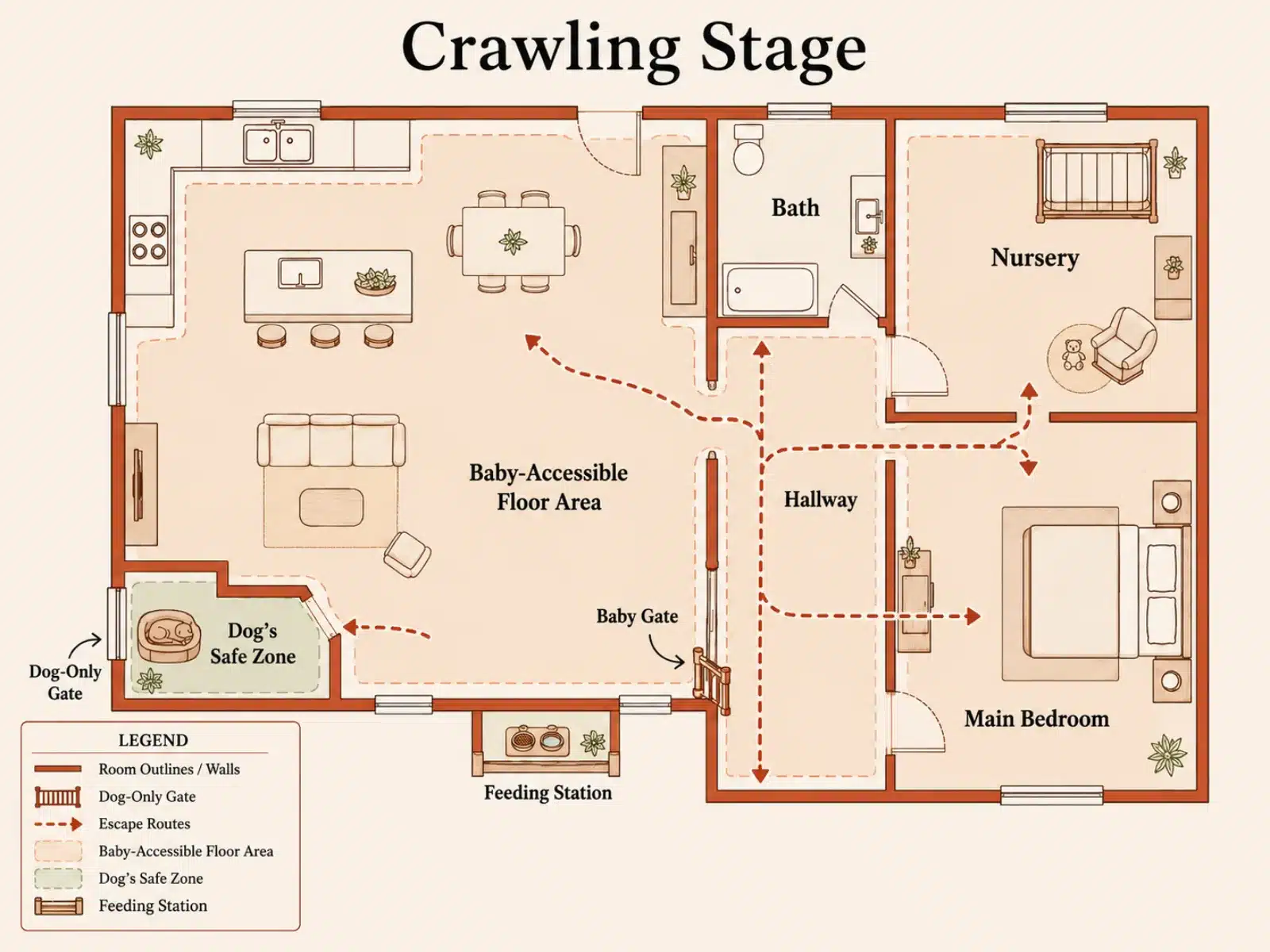
The instant your baby becomes mobile, every assumption in your first plan breaks. A stationary baby stayed where you put her. A crawler goes to the dog. She goes to the dog's safe zone, because it looks fascinating. She goes to the food bowl. She goes to the dog while the dog is asleep and vulnerable. She moves fast, low to the ground, at exactly the dog's eye level, in exactly the jerky unpredictable way that unsettles dogs most. The floor, which used to be neutral territory, becomes contested territory, and the dog who was flawless with a newborn is now dealing with something entirely new.
So you draw the house again, for the mobile baby, and the whole logic shifts from "keep the baby's area separate" to "the dog must always be able to get away from the baby, and the baby must never be able to reach the dog's refuge." The safe zone that was merely quiet in the first plan now has to be genuinely inaccessible to the baby, gated so the dog can get in and the crawler cannot follow. The food bowl comes up off the floor or moves behind a barrier entirely. The dog needs escape routes, ways to leave a room the baby has entered without being cornered, because a dog who cannot escape a pursuing infant is a dog being backed toward the only option you never want her to reach for.
This is the plan that saves you, and it is the plan almost nobody draws until it is too late. Draw it now, while it is theoretical, so that when your baby pulls up onto her hands and knees for the first time you are not scrambling. You are just moving to the plan you already made.
The pinch points: where trouble actually lives
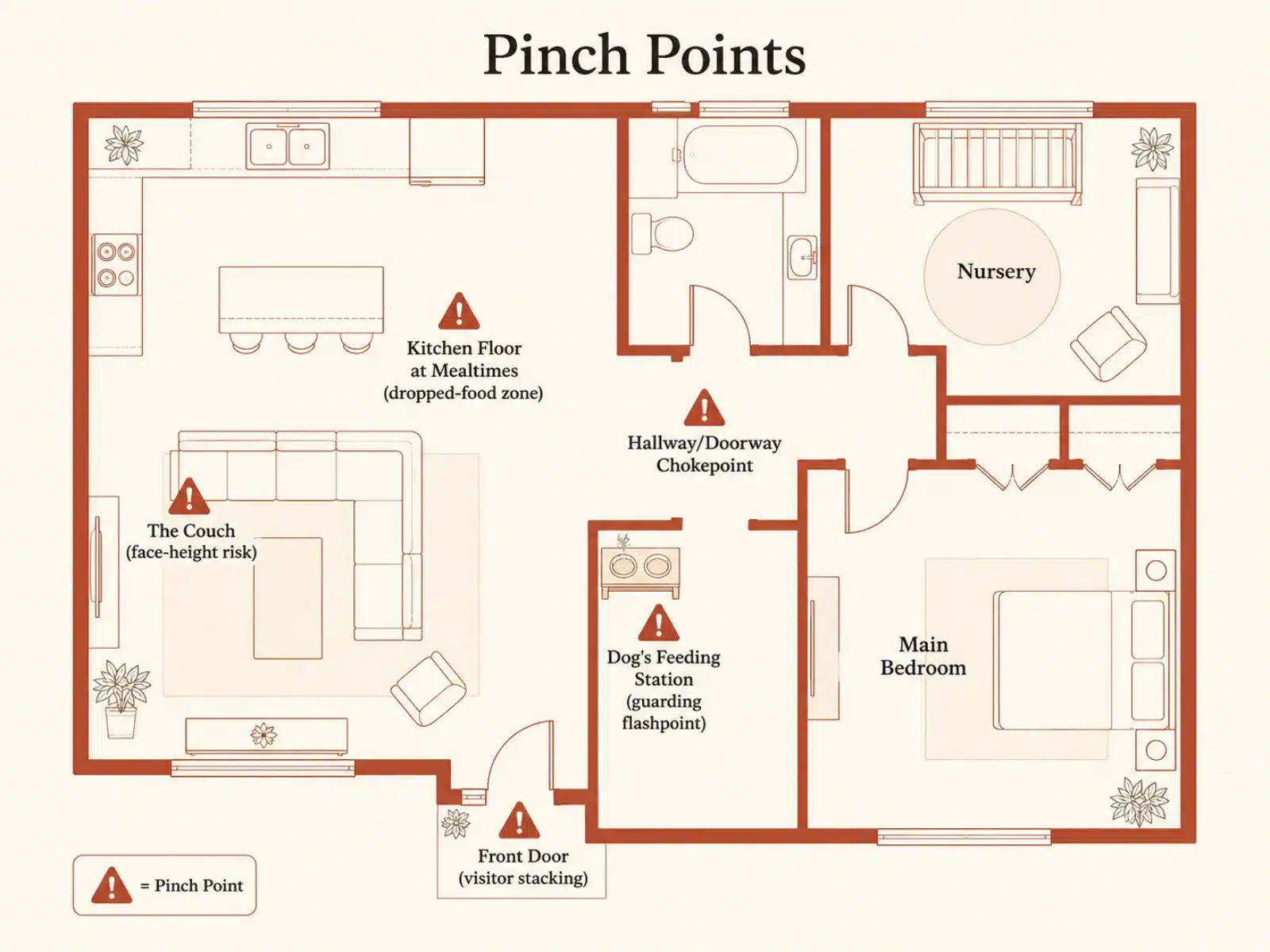
There is one more drawing, and it is less about zones and more about danger geography. Every home has a handful of specific spots where dog-and-child trouble concentrates, and once you learn to see them they are obvious. Mark these on your plan and treat them as permanent high-alert zones no matter the stage.
The doorway and the hallway chokepoint, where a dog can get trapped with no way past an approaching person, or where a dog and a person are forced into sudden close contact rounding a blind corner. The couch, which is its own whole question we will come to, because a dog resting up on furniture and a small child at exactly face height is a specific and common bite setup. The kitchen floor at mealtimes, where dropped food turns the ground into a resource and a crawler and a dog can collide over a fallen cracker. The dog's feeding station, where a dog eating and a baby approaching is a guarding flashpoint. And the front door, where the arrival of visitors stacks excitement, strangers, and a dog all into the tightest, most triggering few square feet in the house.
None of these are exotic. That is the point. Trouble is boringly predictable, and predictable means preventable. When you can look at your own floor plan and point to your chokepoint, your couch problem, your kitchen zone, and your door, you have turned a vague fear into a short, concrete list of places to manage.
The Tools, and an Honest Ranking of Them
You have a floor plan and you have found your pinch points. Now the hardware. There are more management tools than people realize, and they are not interchangeable, so let me rank them honestly, because the ranking is a safety matter and most guides blur it.
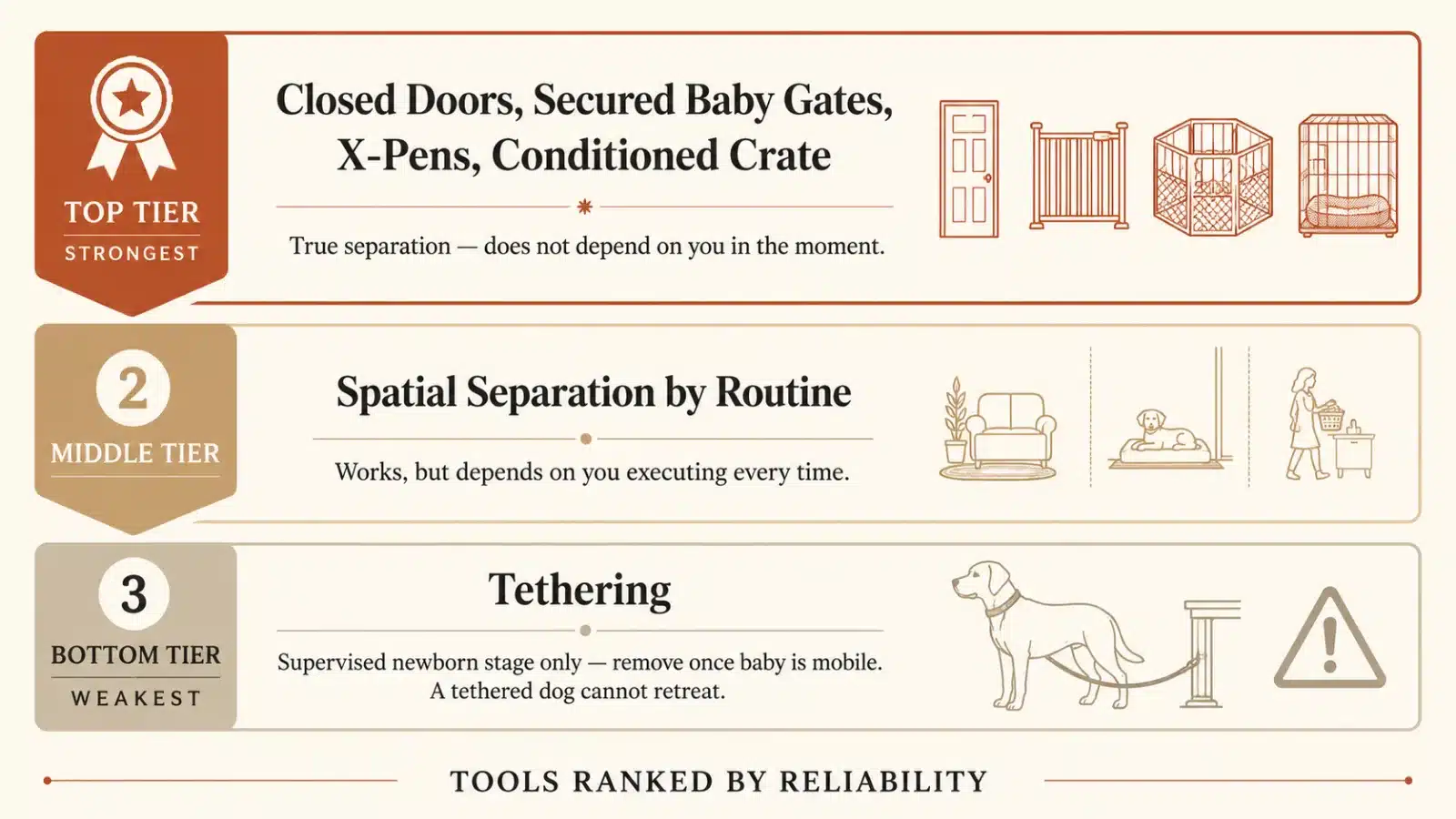
At the top, the tools that create true physical separation. Closed doors. Securely mounted baby gates. Exercise pens. A properly conditioned crate. These share the quality that makes them trustworthy: they do not depend on the dog's self-control or your attention in the moment. A latched gate is latched whether or not you are watching, whether or not the dog is having a good day. This is the category you build your plan around. When in doubt, this is what you reach for.
A rung down, and useful but limited, is spatial separation by routine and habit, the practice of simply keeping dog and baby in different parts of the house at different times through how you structure the day. This works and you will use it constantly, but understand its ceiling: it depends on you executing it every time, which means it degrades exactly when you are most tired. Lean on it, but do not let it be your only layer for anything that truly matters.
And now the tool I need to talk about carefully, because it appears in a lot of advice and it carries a specific hazard that the advice usually leaves out. Tethering, meaning clipping the dog by leash to a fixed anchor point so she stays in one spot near you.
A tether has real uses. In the newborn stage, with an adult right there and actively supervising, a tether can be a reasonable way to give a dog a defined place to settle in the room with you while you keep both hands and eyes available. Jennifer Shryock's work includes tethering among legitimate management options, and it is not wrong.
But here is the hazard, and it is not small. A tethered dog cannot leave. That is the entire function of a tether, and it is also its entire danger. The moment your baby is mobile, a tethered dog is a dog who can be approached by a crawling infant and physically cannot retreat. You have removed her only nonviolent option. A dog who could have walked away is now a dog whose sole remaining ways to create distance are the ones that involve her teeth. Everything else in this guide is built to preserve a dog's ability to escape, and a tether, by design, removes it.
So the tether has a strict expiration date, and I want it stated plainly: a tether is a supervised, adult-present, newborn-stage-only tool, and it comes out of your toolkit entirely the day your baby starts to move. Before that, useful in the right hands. After that, a trap. Never use a tether as a substitute for a gate, never leave a tethered dog unattended even for a moment, and never, ever have a tethered dog in a space a mobile baby can reach. When you want real separation, use the top-rung tools. The tether is a narrow convenience with a short shelf life, not a safety barrier.
Two Zones, Two Rules
Underneath all the hardware sits a simple concept that makes the whole system make sense to everyone in the house, including visitors. You are creating two kinds of protected space.
There is a dog-free zone, and there is a baby-free zone, and both matter equally.
The dog-free zone is the space that belongs to the baby, where the dog does not go: often the nursery, the changing area, the immediate floor space where the baby has tummy time. The dog learns that this space is simply not hers, calmly and without drama, the same way she has learned that the kitchen counter is not hers.
The baby-free zone is the flip side, and people forget it constantly, because their instinct is entirely about protecting the baby from the dog and not at all about protecting the dog from the baby. But a dog needs a guaranteed baby-free space every bit as much, and for the same safety reasons. That is what the safe zone we built earlier actually is: a space the baby, and later the toddler, is never permitted to enter. The dog gets a room the baby cannot invade, exactly as the baby gets a room the dog cannot invade. Fair, symmetrical, and easy for a tired brain to remember, because the rule is the same rule pointed in both directions: everyone gets a space that is only theirs.
This symmetry is not just tidy. It is protective. Most guides build only the first zone and quietly leave the dog with nowhere to go, and a dog with nowhere to go is a dog who eventually makes her stand somewhere you did not choose. Give her the room. It is one of the cheapest, most powerful things you will do.
Supervision Is Not What You Think It Is
Now we come to the most important idea in this entire section, and probably one of the two or three most important in the whole guide, because it corrects a belief that gets children hurt in homes full of loving, attentive, present parents.
The belief is this: "I would never leave my baby alone with the dog. I am always right there." And the belief feels like safety. It feels like the responsible answer. It is also, by itself, not nearly enough, and understanding why is the difference between supervision that protects and supervision that only feels like it does.
Being in the room is not the same as supervising. And "supervising" is not one thing. It is at least five different things, and only some of them keep a child safe.
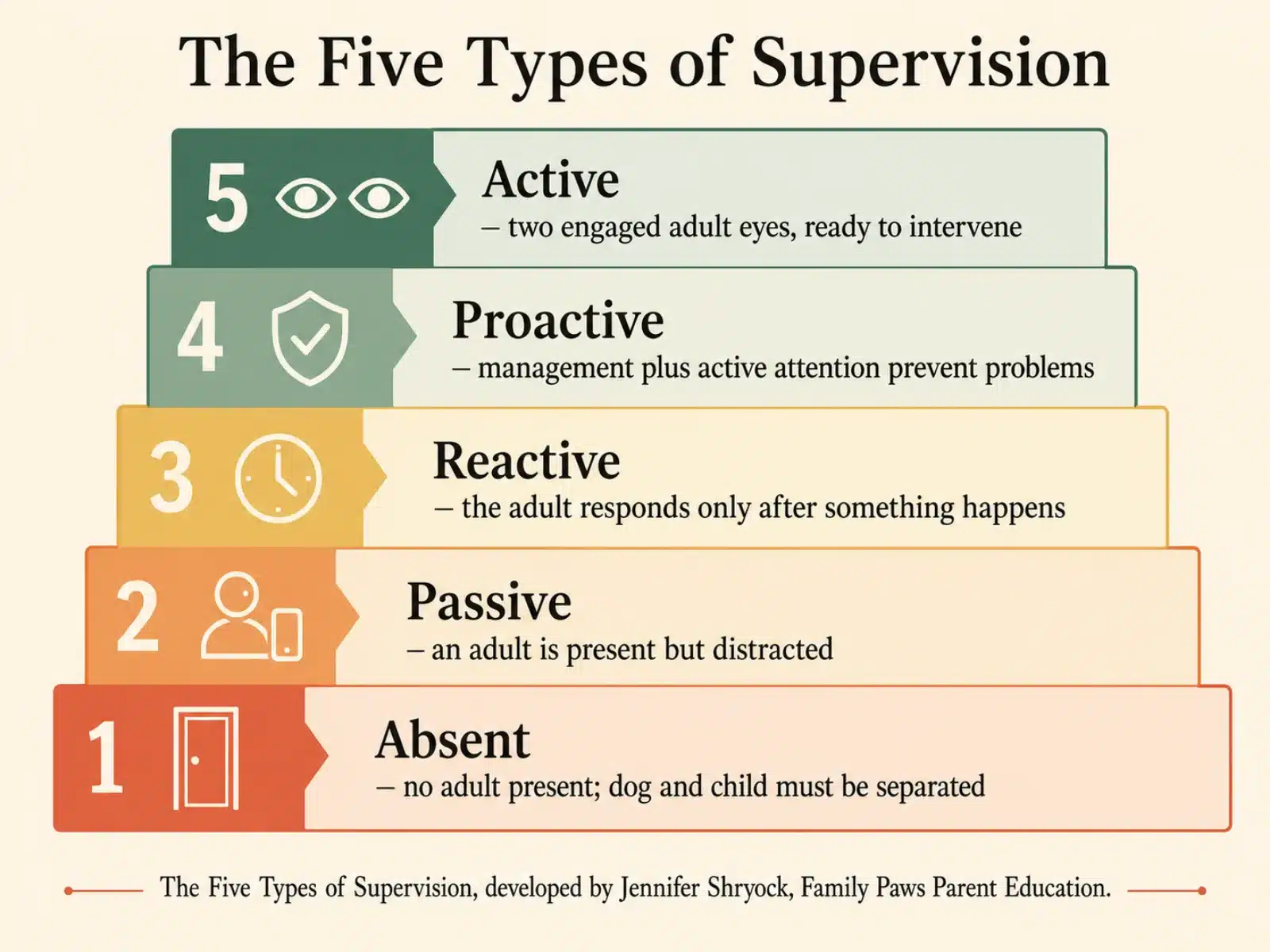
This framework comes from Jennifer Shryock, the founder of Family Paws Parent Education, who built her career on exactly this problem: the gap between how much parents supervise and how much protection that supervision actually provides. Her five types of supervision are the clearest tool I know for closing that gap, and every expecting parent should know them cold.
Absent supervision. No one is watching, because no adult is there. The dog and the child are in a space together and the responsible human is in another room, or asleep, or stepped out "just for a second." This is where the worst incidents happen, and the fix is not a subtle one: dog and baby are physically separated, by one of your top-rung tools, any time an engaged adult is not present. Absent supervision plus access equals the setup for tragedy. Remove the access, every time, no exceptions, and this category simply stops being able to hurt you.
Passive supervision. An adult is present, but their attention is elsewhere. You are in the room, but you are looking at your phone, doing dishes, folding laundry, nodding off on the couch. Your body is there and your attention is not. This is the sneaky one, because it feels like supervising. You are right there. But a dog can move through the entire ladder of warning signals and into a bite in less time than it takes you to look up from a text, and "I was right there" is exactly what the parents in those stories always say. Passive supervision is the most common kind in a house with a newborn, because you are constantly, legitimately busy, and it protects far less than it appears to.
Reactive supervision. You are watching, but only responding after something happens. The baby grabs the dog and then you intervene. The dog gets stiff and then you notice. You are engaged, but you are one step behind the situation, cleaning up problems instead of preventing them. Better than passive, because at least you are looking, but still built around the wrong moment, because in the interaction between a dog and a small child, the thing you are reacting to may already be the bite.
Proactive supervision. Now you are ahead of it. You are watching actively, you are reading the dog's body language in real time, and you are managing the situation before anything goes wrong, adding distance, redirecting the baby, giving the dog an exit, ending the interaction while it is still going well. This is real supervision. This is the level that actually prevents incidents, and it is only possible because you did the work in Part Two and can now see what your dog is telling you before it becomes a problem. Proactive supervision and body language literacy are the same skill wearing two hats.
Active supervision. The highest level, for the highest-stakes moments: two engaged adult eyes fully on the interaction, doing nothing else, ready to intervene instantly, with a management plan already in place. This is what any direct dog-and-baby proximity deserves in the early going, and it is not sustainable for hours at a time, which is precisely why you need all the gates and pens and zones. The barriers exist so that you only have to produce active supervision for the windows when it genuinely matters, instead of pretending you can maintain it around the clock, which no human can.
Read those five again and the uncomfortable truth jumps out. Most of what people proudly call supervision is passive or reactive, and neither reliably protects a child. The parents in the worst stories were, by their own account, supervising. They were home. They were in the room. What they were not doing, in that specific instant, was watching actively and reading the dog, because no one can do that every waking minute, which is the entire reason management has to carry the load that supervision cannot.
So here is how the two fit together, and it is the thought I most want you to leave this section with. Management is what protects your baby the ninety-something percent of the time when you cannot be actively supervising. Active supervision is what you produce for the small windows when dog and baby are genuinely together. You need both, because each one covers exactly the gap the other cannot. A parent who relies on supervision alone is trusting themselves to be perfectly attentive forever, and no one is. A parent who relies on management alone misses the connection and the training windows. Put them together and you have something that actually holds.
The Couch Question
I promised we would come back to the couch, and it deserves its own moment because it is one of the most common flashpoints and one people agonize over.
Here is the situation. Your dog has been allowed on the couch her whole life. It is one of her favorite things and one of yours, the two of you together on the sofa in the evening. Now there is a baby, and the couch is where you will sit to feed her, hold her, soothe her. So you have a dog and a newborn at the exact same height, in the exact same small space, at close quarters, often when you are exhausted and one-handed. And later you have a toddler climbing up onto that same couch toward a resting dog at face height, which is one of the classic bite configurations there is.
I am not going to tell you there is one right answer, because there is not, and anyone who barks a universal rule at you here is not thinking about your specific dog. But I will tell you how to think about it.
If your dog has any tendency to guard resting spots, any stiffness about being moved off the furniture, any history of resource guarding at all, the couch decision is close to made for you: the couch becomes off-limits, taught kindly and well in advance, long before the baby comes, so that it never becomes a battle with a newborn in your arms. If your dog is genuinely relaxed, has zero guarding history, reliably gets off when asked, and can settle calmly elsewhere, you have more latitude, and the workable middle path for many families is that the couch is available by invitation only, on your terms, and never when the baby is on it.
Whatever you decide, decide it now and teach it now. The one truly bad option is the one most people back into by default: changing the couch rules in the same week the baby arrives, so that in your dog's mind the loss of her favorite spot and the arrival of this loud new creature happen together, as a single event, cause and effect. That is how you teach a dog to resent a baby. If the couch rules are going to change, change them early, on their own, disconnected from the baby by weeks or months, so the dog never files them in the same drawer. That principle, making changes early and decoupled from the baby, runs through the whole next section, and the couch is its first and clearest application.
The Short Version, If You Skimmed
If you are skimming, here is Arrange in one box.
Management is not cheating. It keeps everyone safe while training works, and it catches you on the days training is not enough. There will be days training is not enough.
Design for your worst self. Build the house so the exhausted, one-handed, 3am version of you cannot get it wrong.
Build the dog a safe zone first. A refuge she chooses, made genuinely wonderful, off the household traffic and off the 3am path, protected by everyone. When she is in it, she does not exist.
Draw your actual house three times: newborn (instant separation, clear 3am path), crawling (the dog can always escape, the baby can never reach the refuge), and pinch points (doorway, couch, kitchen floor, feeding station, front door).
Rank your tools honestly. True separation (doors, gates, pens, conditioned crate) is what you trust. Routine separation works but depends on you. Tethering is a supervised, newborn-only tool that comes out the day the baby is mobile, because a tethered dog cannot retreat.
Two zones, two rules. A dog-free zone for the baby and a baby-free zone for the dog. Both matter. Everyone gets a space that is only theirs.
Supervision is five different things (Jennifer Shryock, Family Paws): absent, passive, reactive, proactive, active. Most "supervision" is passive or reactive and does not protect. You need proactive and active supervision for the windows that matter, and management to cover everything else.
Decide the couch now, and change the rules early and decoupled from the baby, never in the same week she arrives.
With the house built, we can teach the dog what to do inside it. That is next.
Skill-Build: What to Teach, and How
Skills Are What Your Dog Does Instead
We have looked honestly at the dog, and we have built the house. Now we teach the dog what to do inside it, and I want to frame this correctly before we start, because the framing changes how well it works.
Every skill in this section is really an answer to a single question: when the moment comes, what do you want your dog to do instead? A dog does not sit in a vacuum deciding to behave or misbehave. A dog does whatever has worked before, whatever the situation pulls out of her. If you have not taught her a better option, she will use the option she has. The baby drops food and the dog dives for it, because diving for food is the only plan she owns. The doorbell rings and the dog rockets to the door, because that is her one and only doorbell behavior.
Training is the work of giving your dog a better plan, rehearsed so many times, so far in advance, that it comes out automatically when the real moment arrives and there is no time to think. That last part matters enormously in a baby home, because the real moments come fast and you will not be able to coach her through them. You are going to have your hands full, literally. The behavior has to already be there.
So we are not training tricks. We are pre-loading responses, so that when the house gets loud and chaotic and you are underwater, your dog reaches for a calm, safe default instead of the frantic one. Let me show you the handful that matter most, starting with the one that matters more than all the others combined.
The Most Important Thing You Will Teach: Settle on a Mat
If you teach your dog only one thing before your baby arrives, teach her to settle on a mat. I am not exaggerating for effect. In a baby household this single behavior does more work than everything else in this section put together, and it is worth more of your time than any other thing on the list.
Here is why it carries so much. A dog who can go to a mat and genuinely relax gives you a calm, portable, off-switch you can use in almost every difficult moment you are going to face. Visitors arrive: dog goes to her mat. You need to feed the baby without a dog in your lap: dog goes to her mat. The house is loud and the dog is winding up: dog goes to her mat and comes down. It is the answer to a hundred different situations, and because it is one behavior, your tired brain only has to remember one thing.
But notice the word I keep using, because it is the whole game. Relax. This is not "lie on the mat and vibrate with tension, waiting to explode off it the second something happens." That is not settling, that is a dog in a down-stay who is still fully switched on, and it is worth very little to you. Real settling is an emotional state, not a position. The body goes soft. The weight rolls onto a hip. The breathing slows. The dog is not enduring the mat, she is resting on it. That distinction is the difference between a behavior that helps you and a behavior that looks right and does nothing.
So we teach the state, not just the shape, and we do it by rewarding calm rather than commanding stillness. The broad approach looks like this, and I will keep it to the concept rather than drowning you in repetitions, because the concept is what you need to hold.
You start with the mat as a specific, portable object, a towel or a small bed that means one thing and travels anywhere. Early on you simply reward your dog, generously, for any interest in the mat, then for stepping onto it, then for lying down on it. That part is easy and most people get there fast. The real work, the part that makes this behavior worth its weight, is what you reward next: not the down, but the relaxation. You watch for the moment the dog exhales, softens, shifts her weight onto a hip, rests her chin, and you quietly mark and reward exactly that. You are teaching her that calm itself is the thing that pays, that the way to make good things happen on this mat is to actually let go. Delivered slowly and low, the reward becomes part of the calm rather than an interruption to it. Over many short sessions the mat becomes a place that reliably produces a relaxed state, because relaxing there has been reinforced hundreds of times, until eventually the mat itself is a cue to downshift. That is the thing you are building. A physical object that turns your dog's arousal down.
Give this weeks, not days, and start early. It is the behavior most worth over-training, because you are going to lean on it constantly, and you want it so deep that it works even when the dog is a little stressed, which is exactly when you will need it and exactly when a shallow version falls apart.
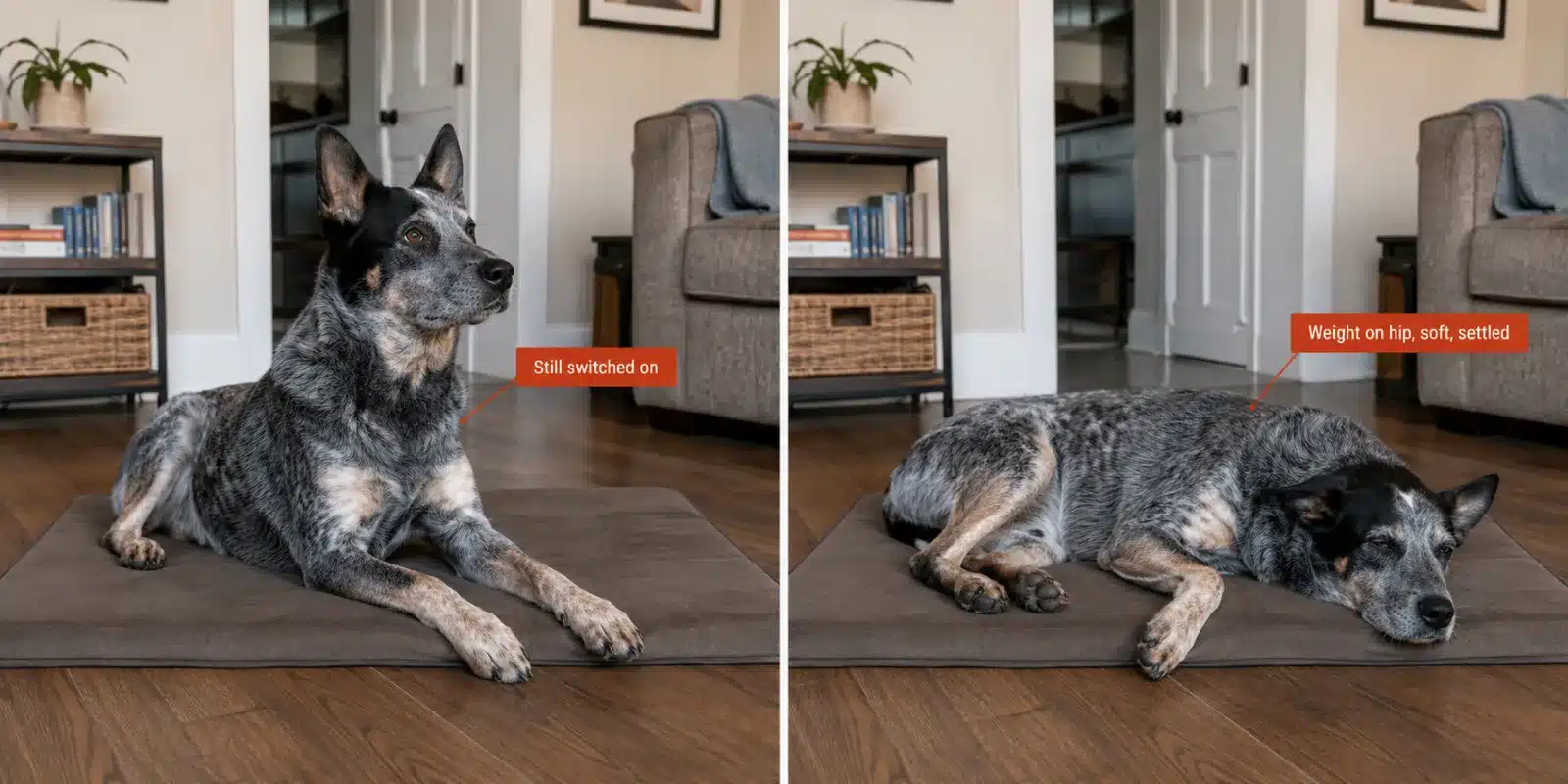
Boxed Protocol: Teaching Settle on a Mat, Step by Step
Use a towel or small flat bed that means only one thing. Keep sessions to two or three minutes and do several a day. Have small, soft treats you can deliver low and slow. Work through the stages below over weeks, not in one sitting, and only move to the next stage when the current one is easy.
Stage one, the mat pays.
- Set the mat down. The moment your dog looks at it, mark the moment with a quiet word or a clicker and place a treat on the mat.
- Repeat until she is drifting toward the mat on her own. Every time a foot lands on it, mark and pay on the mat.
- Keep paying for any contact with the mat until stepping onto it is her obvious first idea. Do not ask for anything yet. You are only teaching that the mat is where good things happen.
Stage two, lying down on the mat.
- Once she stands on the mat readily, wait. Do not cue anything. Give her a moment to offer more, and the moment she lies down, mark and pay, delivering the treat down between her front paws so her head stays low.
- Repeat, always paying low and on the mat, so that lying down on the mat becomes the default thing she does when she steps onto it.
Stage three, and this is the real work: paying calm, not position.
- With her lying on the mat, stop marking the down itself and start watching her body. Wait for one genuine sign of relaxation: a hip rolling to one side, a slow exhale, the chin lowering, the weight sinking. The instant you see it, mark softly and deliver the treat slowly and low, so the reward itself is calm.
- Reward relaxation repeatedly and quietly. Keep your own energy low; talk softly, move slowly. You are teaching that letting go is the thing that pays.
- Gradually let more time pass between rewards, so she is holding the relaxed state for longer before the treat arrives. Build duration slowly and unpredictably rather than counting to a fixed number.
Stage four, adding the cue and the release.
- Once she reliably walks to the mat and settles, begin saying your chosen word ("settle," "place," "bed") right as she steps onto it, so the word comes to predict the behavior. Add a clear, gentle release word ("okay," "free") that tells her the mat time is over.
- Practice sending her to the mat from a step away, then two, then across the room, paying well every time she goes and settles.
Stage five, proofing, which is what makes it real.
- Practice in easy conditions first, then gradually harder ones: a quieter room, then a busier one, then with mild distractions, then with the doorbell, then with baby sounds playing low (see Part Five). Lower your criteria whenever you raise the difficulty, and pay more generously when it is harder.
- Over weeks, work up to a settle that holds through real household activity. The version you can rely on at three in the morning is the one you deliberately practiced under difficulty, long in advance.
If it falls apart, you almost certainly raised difficulty too fast. Drop back to the last stage that was easy, succeed there several times, and rebuild. This is normal and not a setback. Ending a session one step back, on success, is always better than grinding on a step that is failing.
The Safety Cluster: Leave It, Drop It, and Trade
After settling, the behaviors that will save you the most grief are the ones that govern what goes into and comes out of your dog's mouth, because a baby household is essentially a machine for dropping small interesting objects onto the floor.
Think about what is coming. Pacifiers. Bottle nipples. Small toys. Dropped food from a high chair. Later, everything a toddler carries and discards every four seconds. Some of these are choking hazards for the dog, some are precious to the baby, and some become the exact objects a guarding dog will decide to defend. You need clean, reliable control over the mouth, and it comes in three related pieces.
Leave it is the skill of not picking something up in the first place, of disengaging from a thing before it is ever in the mouth. This is your first line, the cue that stops the dog from taking the dropped pacifier at all.
Drop it is the skill of releasing something already in the mouth, cheerfully and immediately, on cue.
And trade, which underlies both, is the emotional foundation that makes the other two trustworthy. Here is the single most important idea in this whole cluster: you want your dog to feel delight when you approach something she has, not dread. The way you teach drop it and leave it is by making the exchange a fantastic deal for the dog, every time, so that giving something up reliably predicts getting something better. A dog who has learned that human-approaching-my-stuff means something wonderful is about to happen is a dog who will happily spit out a pacifier and trot over to you. A dog who has learned that human-approaching-my-stuff means loss, because people have chased her down and yanked things from her mouth, is a dog who learns to guard, gulp, and run.
This is where I have to correct a piece of advice that seems clever and is actively dangerous. You will read, in more than one guide, that you should practice these skills using actual baby items so the dog gets used to them. Do not do this. Real pacifiers, bottle parts, and baby toys should be genuinely inaccessible to your dog, not rehearsal props. The instant you use real baby items as training objects, you have taught your dog that pacifiers are things that appear in fun training games and go in mouths, which is the precise opposite of what you want the day a real one hits the floor next to a real baby. Train these skills with neutral practice objects that have nothing to do with the baby. Keep the baby's actual belongings out of reach as a management matter. Prevention is the plan; the retrieval skill is the backup for when prevention fails, not a license to leave hazards lying around.
Never, ever chase your dog to get something back, and never punish her for having something she should not. Every chase and every scolding teaches her that the way to keep a prize is to run or to guard it, and you are building the opposite lesson. If she has something dangerous and you have not yet trained a solid drop, trade for it: cheerfully produce something better, and the moment she lets go of the object, she wins. That is not rewarding her for stealing. That is buying safety at a bargain price and depositing trust in an account you are going to draw on for years.
The Space Cluster: Off, Back Up, and Four on the Floor
The next group is about your dog's body in space, about her ability to move herself out of the way and keep her feet on the ground, which matters enormously when you are moving through the house holding something fragile.
Four on the floor is simply a dog who greets and exists without jumping up. It sounds minor until you are coming through the door with a car seat, or a sleeping newborn against your chest, and eighty pounds of happy dog launches at you. Teaching your dog that keeping all four feet on the ground is what earns attention, and that jumping earns nothing at all, is a gift to your future self carrying precious cargo.
Off is the skill of getting off of something, furniture, a bed, you, on a calm cue. Back up is the skill of creating distance on request, of moving away from you when asked. Both share a quality I want you to notice, because it runs against a common instinct. You are teaching your dog to move herself, with her own feet, on a verbal cue, rather than you physically hauling her around by the collar. This matters for a reason that is easy to miss: a dog you have to grab, push, and drag is a dog being handled in exactly the moments she is most aroused, and physically manhandling an excited or stressed dog is how handling-related bites happen. A dog who moves herself on a word never has to be grabbed. You keep your hands free and your dog keeps her sense of control, and both of those are worth a great deal at a busy threshold with a baby in your arms.
Recall, and Being Able to Move Together
Two more practical skills round out the working set, and both are about mobility.
A reliable recall, your dog coming to you when called, away from whatever she is doing, is a genuine safety behavior in a baby home. It is how you get her out of a developing situation without laying a hand on her, how you call her off the baby's area, how you bring her to you rather than going to fetch her when your hands are full. It needs to be trained to the point where it works under distraction, which is a real project and worth every minute.
And if you plan to walk your dog alongside a stroller, understand that this is its own specific skill and not a thing that simply happens. A stroller is a large, strange, rolling object moving at an unfamiliar pace, and it takes a dog time to learn to walk calmly beside it on a loose leash without weaving, lunging, or getting tangled. Practice it well before the baby is in the stroller. Push an empty stroller on your normal walks for weeks, rewarding your dog for staying in position beside it, so that by the time there is a baby aboard, the whole arrangement is old news. The last thing you want is to be learning stroller mechanics and managing a newborn and an over-aroused dog all in the same first outing.
The Skills That Are Really About Being Handled
There is a category of preparation that is not about obedience at all, and it is one of the most overlooked and most valuable things you can do: teaching your dog to be comfortable with, and even to actively participate in, being handled and confined.
Start with handling itself. A baby, and far more so a toddler, is going to touch your dog in every way a dog dislikes being touched. Grabbed. Poked. Leaned on. Hugged, which nearly all dogs dislike despite what the internet suggests. Reached for suddenly. You cannot rely on a small child to have gentle hands, so you prepare the dog. The approach is cooperative care, the practice of teaching a dog to accept and even enjoy handling by pairing gentle touch with good things and, crucially, by giving the dog ways to say yes and no rather than forcing it. You gradually and positively accustom your dog to having her paws touched, her collar grabbed, her body handled from all angles, her space entered, always paired with reward, always kept under threshold, never flooded. You are building a dog with a deep reservoir of tolerance for handling, and, just as important, you are learning to read when she has had enough, so you can advocate for her before a real child pushes her past it.
Then there is confinement, and this is where I make good on the promise from the last section: the crate, the pen, and the gate all need to be genuinely happy places long before they are necessary ones. A dog who loves her crate has a wonderful refuge. A dog who has been shoved into a crate as punishment, or only ever crated at the moment of abandonment, has a prison, and she will panic in exactly the moments you need her to settle. So you build the association deliberately and in advance. The crate is where the best chews live. Meals happen in there with the door open. Going in is always rewarded, coming out is calm, and nothing bad ever happens in that space. You want your dog choosing to go into her crate to relax, weeks before the baby arrives, so that when you do need to use it, you are using a place she already loves rather than a place you are suddenly imposing. The same goes for gates and pens: introduce them early, pair them with good things, and let being on the other side of a barrier from you become utterly ordinary and safe rather than a novel distress the week everything else is also new.
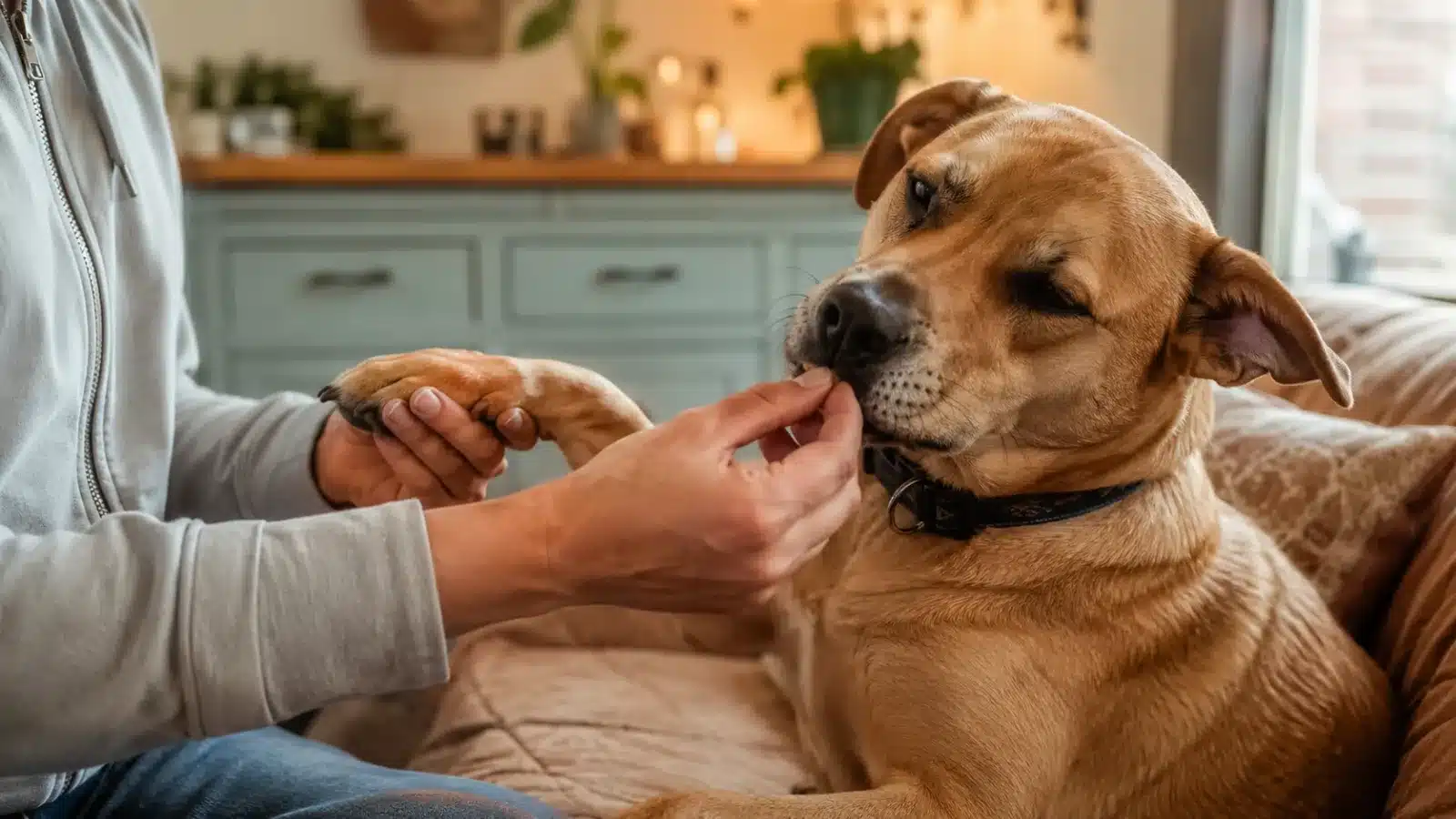
Muzzle Training Is a Gift, Not an Accusation
I want to give muzzle conditioning its own section, because it is one of the most misunderstood and most valuable things you can prepare, and because the flinch most pet parents feel at the word is exactly what stops them from doing something that could matter enormously down the line.
Let me clear the flinch out of the way first. Teaching your dog to wear a muzzle does not mean your dog is dangerous. It does not mean you expect the worst. It does not label her. A conditioned muzzle is a welfare tool and a safety option, in precisely the same way a seatbelt is not an accusation that you are a bad driver. You hope never to need it. You are glad it is there.
Here is why it belongs in a baby-preparation guide specifically. Life with a new baby brings a stack of situations where a muzzle can quietly protect everyone. There are the ordinary ones, like a stressful vet visit or an emergency where your dog is in pain and frightened and has to be handled fast. And there are the ones specific to your situation: a period of careful, managed introductions with a dog you are being cautious about, a stretch where you want an added layer of safety while you assess how things are going, a moment where a professional you are working with recommends one as part of a plan. In every one of those, the difference between a calm outcome and a traumatic one is whether the muzzle was made pleasant months earlier, or is being forced onto a scared dog for the very first time at the worst possible moment.
That is the whole case. A muzzle conditioned in advance, with patience and zero pressure, is a tool your dog actively likes wearing, produced calmly when you need it and creating no additional stress. A muzzle introduced in a crisis is one more frightening thing piled onto a dog who is already overwhelmed, and it teaches her to dread the sight of it forever. Same object, opposite outcomes, and the only variable is whether you did the gentle work ahead of time.
Use a basket muzzle, the kind that lets your dog pant, drink, and take treats, not a fabric sleeve that holds her mouth shut, which is only ever for very brief veterinary moments and is not what we are building here. Then take it slowly. The single most common mistake is rushing, strapping it on, and flooding the dog, which teaches her to hate it and sets you back to zero. Go at her pace, keep every step easy, and let her tell you when she is ready to move on.
Boxed Protocol: Conditioning a Basket Muzzle, Step by Step
Work in short, upbeat sessions of a minute or two. Use treats your dog loves that are soft enough to eat quickly. Move to the next step only when the current one makes her happy and eager, never when she is merely tolerating it. If she hesitates or backs off, you moved too fast; drop back a step. There is no prize for speed here, only for a dog who ends up loving the muzzle.
- Let the muzzle predict good things. Hold the muzzle out of the way at first. Every time you produce it, a treat appears. Put it away, treats stop. Repeat until the sight of the muzzle makes her look pleased and expectant. You are teaching that the muzzle means good things are coming.
- Feed through the basket. Hold the muzzle with the opening toward her and post a treat through the front so she has to reach her nose toward the opening to get it. Let her reach in on her own terms. Never push it onto her face.
- Build the nose-in. Keep feeding through the basket so she pushes her nose a little deeper each time to reach the treat. Let her pull her nose out whenever she wants; the choice staying with her is what keeps this positive. Repeat until she is actively pushing her nose into the muzzle to find the food.
- Add duration. Once her nose goes in willingly, let it stay in a beat longer before the treat arrives, feeding a stream of treats through the front while her nose rests inside. Slowly extend how long she keeps her nose in place while being fed.
- Introduce the straps, unfastened. With her nose in and happily eating, briefly bring the straps up toward her neck without fastening them, then release and treat. Repeat until the movement of the straps is nothing to her.
- Fasten for a moment. Fasten the strap, deliver a treat immediately, then unfasten. Keep the first fastened moments extremely short and paid well. Gradually extend the buckled time, always feeding, always keeping her comfortable.
- Add gentle movement and time. With the muzzle on and treats flowing, take a step, encourage her to move with you, drop a treat. Build up to her wearing it happily while walking around and doing easy things, still associating it with good stuff throughout.
- Generalize it. Practice putting it on in different rooms and situations so it is not tied to one spot, and occasionally put it on for pleasant reasons, a short sniffy walk, so it never exclusively predicts something the dog dislikes.
Keep the whole thing light and voluntary. A well-conditioned dog will start shoving her own nose into the muzzle the moment she sees it, the way she would shove into her harness before a walk. That is the goal: a muzzle she volunteers for.
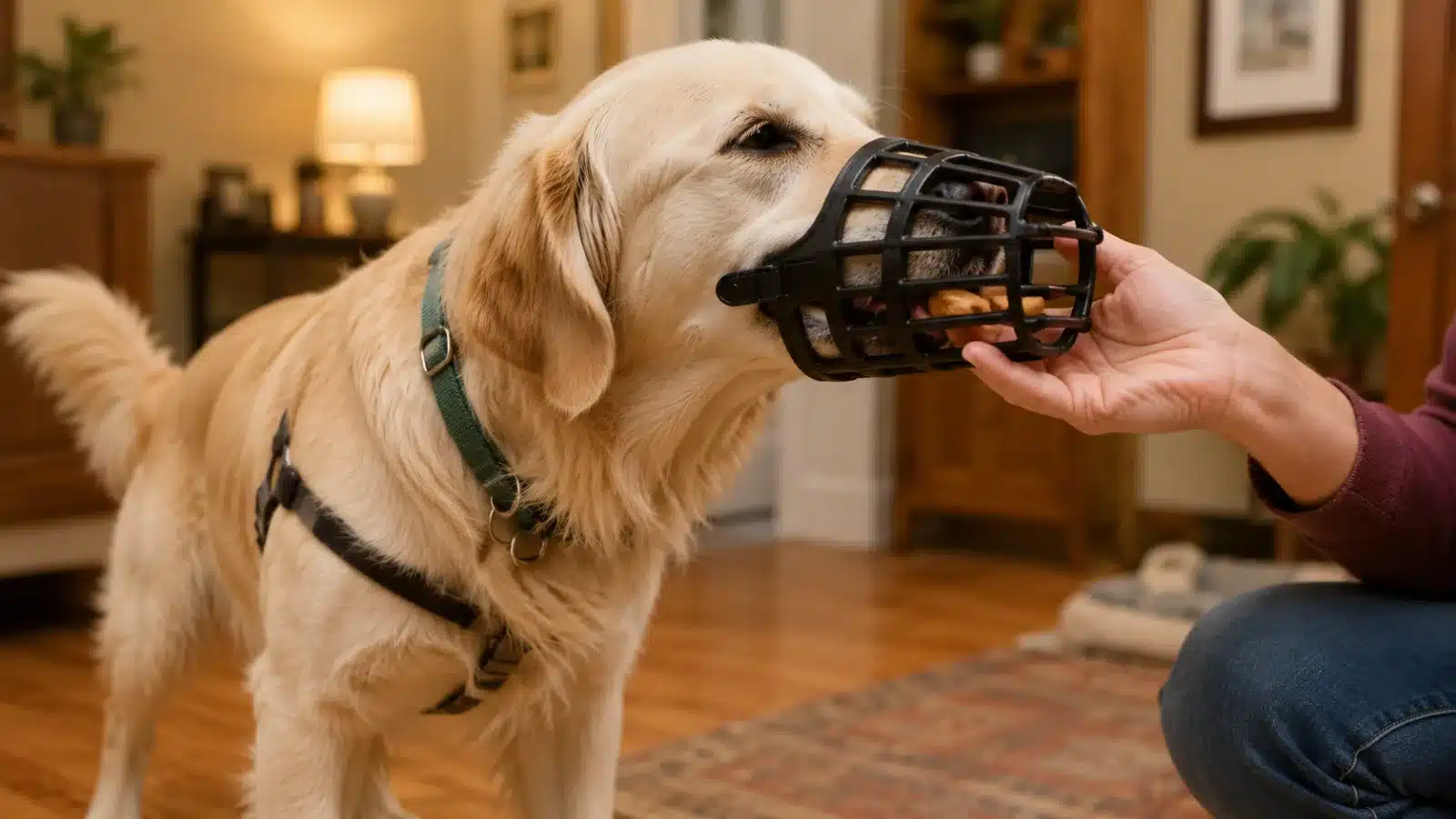
A conditioned muzzle is never a substitute for management, and it is never a substitute for actually changing how your dog feels, which is the work of the next section. If you decide to build this skill, my complete step-by-step walkthrough lives in the force-free positive muzzle conditioning guide, which covers fit, troubleshooting, and maintenance in more depth than we have room for here. It does not fix anything. It is a safety layer you build alongside the real work, an option in your back pocket you will be deeply grateful for if the day ever comes that you need it, and glad to have never used if it does not.
How to Teach Anything: The Part Nobody Explains
I have described what to teach in broad strokes rather than drilling every repetition, and that is deliberate, because if I hand you ten step-by-step recipes you will be able to teach exactly ten things. I would rather teach you the underlying mechanics, so you can teach your dog anything, including the situations I could never anticipate in your specific house. This is the meta-skill, and almost no guide bothers with it.
Reward what you want more of. This is the engine under everything. Behavior that gets reinforced happens more often. So the whole craft of training is really the craft of noticing the instant your dog does something you like and making sure something good follows, fast enough that she connects the two. Most training failures are really timing failures, a reward arriving a beat too late, so the dog learns to associate it with whatever she did next instead.
Split, do not lump. This is the single most common mistake I see, and fixing it will transform your training overnight. When you teach something, break it into pieces so small they feel almost too easy, and reward each tiny piece, rather than holding out for the whole finished behavior. Do not wait for your dog to walk to the mat, lie down, and relax before you reward. Reward a glance at the mat. Then a step toward it. Then a foot on it. Then lying down. Then the first sign of softening. Each step made easy and paid well. People fail because they lump, because they ask for the whole polished behavior at once and then get frustrated when the dog cannot produce it. The dog is not being difficult. The picture is too big. Make it smaller, always make it smaller, and the dog succeeds and you both keep going.
End on success. Stop each session while your dog is still doing well and still enjoying it, not after the repetition where it fell apart. You want her walking away from training thinking that was great, let us do that again, not that got hard and confusing. Short and frequent and upbeat beats long and grinding every time. A handful of two-minute sessions across a day will take you further than one exhausting twenty-minute slog, and it fits a pregnant or newborn schedule far better anyway.
And understand what "trained" actually means, because this is where people get an ugly surprise. Your dog doing a behavior perfectly in your quiet kitchen with a pocket full of treats is not a trained behavior. It is the very first rep of one. Dogs do not automatically generalize; a skill learned in the calm kitchen genuinely does not exist yet in the loud living room full of visitors, and it certainly does not exist with a screaming newborn in the room and your own stress leaking down the leash. Real training means proofing: practicing the behavior in gradually harder places, with gradually bigger distractions, until it holds up under the kind of pressure a baby brings. The behavior you can count on at 3am is the one you deliberately practiced under difficulty, over and over, long beforehand. This is exactly why we start months early. Not because the behaviors take that long to install in the kitchen, but because they take that long to become bombproof everywhere else.
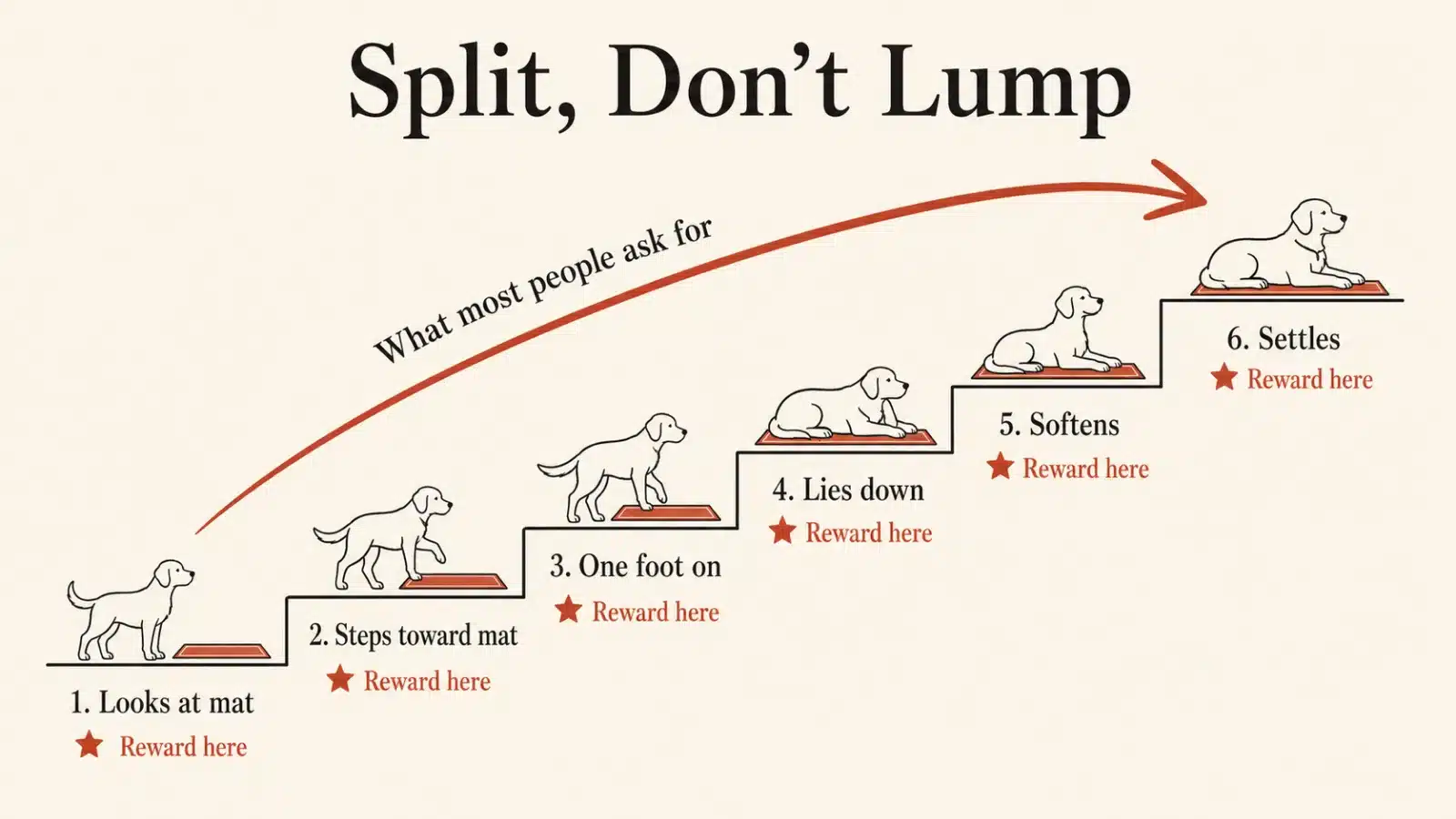
The Short Version, If You Skimmed
If you are skimming, here is Skill-Build in one box.
Skills give your dog a better plan to reach for automatically when the moment comes fast and your hands are full.
Settle on a mat is the most important thing you will teach. Teach the relaxed state, not just the down. It is your portable off-switch for a hundred situations. Over-train it and start early.
Mouth control saves you constantly: leave it (do not take it), drop it (release it), and trade (the exchange that makes both trustworthy). Make giving things up a fantastic deal, never a loss. Never chase, never punish for having something.
Train mouth skills on neutral objects, not real baby items. Keep the baby's belongings genuinely out of reach. Prevention is the plan; the skill is the backup.
Teach the dog to move her own body on cue: off, back up, four on the floor. A dog who moves herself never has to be grabbed while aroused.
Recall and calm stroller-walking are real safety and mobility skills. Train recall to work under distraction; practice with an empty stroller for weeks first.
Prepare the dog to be handled and confined: cooperative-care handling for the touching a child will do, and crate, pen, and gate made genuinely happy long before they are needed.
Condition a basket muzzle in advance, slowly and positively, as a no-pressure welfare tool you hope never to need. Muzzle training is a gift, not an accusation. Build it before a crisis, never during one.
The meta-skill: reward what you want, split into tiny steps instead of lumping, end every session on success, and remember that "trained" means proofed under pressure, which is why you start months early.
With the dog able to do the right things, we turn to the deepest part of the work: changing how she feels. That is next.
Emotional Repatterning
The Deepest Part of the Work
Everything up to now has been preparation for this section, and this section is where most guides quietly fall apart.
They fall apart because changing how a dog feels is genuinely harder than teaching a dog to sit, and it is far harder to write about honestly. So the typical guide waves at it. Play some baby sounds. Let the dog sniff some baby lotion. Get her used to the stroller. The instructions are not exactly wrong, but they are so vague and so shorn of the actual mechanics that a pet parent following them will very often do the precise opposite of what helps, with total confidence, and make the problem worse. I am going to give you the real thing instead, and the real thing starts with understanding what makes this different from training.
In Part Four you taught behaviors. A behavior is something a dog does, and you change it by reinforcing the version you want. This section is not about behaviors. It is about emotions, about the automatic feeling that fires in your dog before any behavior happens at all. When your dog hears a baby scream and her heart rate jumps and her body tenses, that is not a behavior she chose. It is an emotional response that happened to her, underneath thought, faster than any decision. You cannot obedience-train that away. You cannot cue it or correct it. You can only change it by changing the association that produces it, and that is a slower, subtler, more careful kind of work.
The good news is that it genuinely works, it is well understood, and once you grasp the two mechanisms underneath it you will understand what you are doing at every step rather than following a recipe you do not comprehend. Understand the mechanism, and the whole thing stops being mysterious.
The Two Mechanisms, in Plain Language
There are two tools at the heart of this, and they work as a pair. Their formal names are desensitization and counterconditioning, and I will use those names because they are worth knowing, but the ideas underneath them are simple.
Desensitization means starting with the trigger so weak that it does not bother your dog at all, and then increasing its strength so gradually that she never crosses over into distress. If a baby's cry frightens your dog, you do not start with a baby crying at full volume. You start with a recording of a cry played so quietly your dog can barely register it, at a level where she notices it but feels nothing much about it. That "feels nothing much about it" is the entire point. You are keeping her under what we call threshold, the line between coping and not coping, and you are only ever going to move that line outward at a pace that keeps her on the good side of it.
Counterconditioning means changing the meaning of the trigger by pairing it with something wonderful, so that the thing which used to predict discomfort now predicts delight. Every time the quiet cry plays, superb food appears. Not kibble. The good stuff, the chicken and the cheese, the things your dog almost never gets otherwise. You do this over and over, at that non-threatening volume, until your dog's emotional response to the sound of a cry begins to shift. The cry used to mean tension. Now the cry reliably predicts roast chicken, and a brain that hears the cry starts to feel something closer to anticipation than dread. You have not trained a behavior. You have changed what the sound means.
The two work together. Desensitization keeps the trigger weak enough that your dog stays under threshold and can actually learn. Counterconditioning changes the emotion while she is there. Weak trigger, wonderful thing, repeated patiently, strength increased only as fast as the good feeling can keep up. That is the whole method, and every protocol in this section is just that method applied to a different trigger. If you want the deep version of this science, how threshold works, how to read the exact moment your dog tips over it, how trigger stacking sabotages a good week, and how to run the protocol for any trigger, I have written a complete companion guide on counterconditioning and desensitization for dogs. This section gives you the baby-specific version; that guide gives you the whole method.
There is one detail in how you pair the trigger and the reward that people get backwards constantly, and getting it backwards quietly wrecks the whole thing. So it gets its own section.
The Detail Everyone Gets Backwards: Order Matters
Here is the single most common technical error I see, and it is invisible to the person making it.
The trigger has to come first, and the food has to follow it. In that order. Every time.
Cry sound starts, then chicken appears. The sound predicts the food. The order is the message. What you are teaching your dog is a sequence: this sound is the thing that makes chicken happen. When you run it in that order, the cry becomes a reliable little herald of good things, and your dog's brain learns to greet the sound with anticipation, because the sound has become the thing that pays.
Flip the order and you teach the opposite lesson, and most people flip it without noticing. They have the food out already, they are feeding the dog, and then the sound plays while the dog is eating. Now the sequence your dog learns is reversed: the food was already here, and then the unpleasant sound intruded on my nice meal. You have just taught her that good things get interrupted by the trigger, which makes the trigger a predictor of losing something good, which makes it worse, not better. Same sound, same chicken, opposite outcome, and the only difference was the order.
So burn this in. Trigger first, always. The trigger switches on, and its arrival is what causes the good thing to appear a moment later. The food stops when the trigger stops, too, so that the good thing is clearly tied to the trigger and not just to being in the room with you. Sound on, chicken. Sound off, chicken stops. The presence of the trigger is the on-switch for everything wonderful. Get that sequence right and the mechanism does its work. Get it backwards and you can practice diligently for weeks while slowly making your dog feel worse.
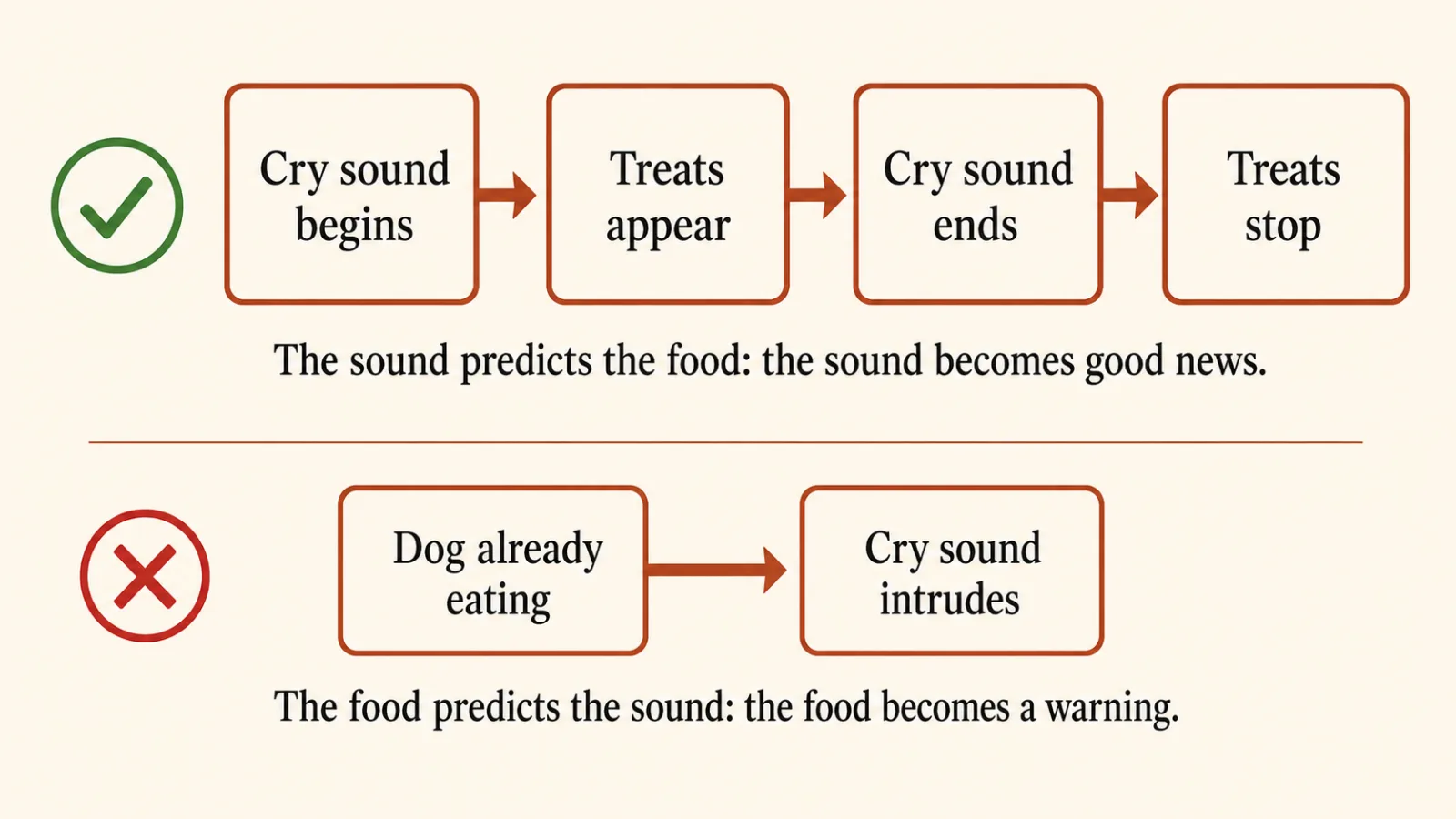
Why "Just Get Him Used to It" Is the Most Dangerous Advice in the Category
Now I have to take apart a piece of folk wisdom that sounds reasonable, gets repeated everywhere, and hurts dogs. You will hear it from well-meaning relatives, from other guides, maybe from a voice in your own head. It goes like this: just expose the dog to the thing, a lot, and she will get used to it.
Sometimes that is true. It is called habituation, and it is real: an animal exposed to a harmless, mild, repeated stimulus often does gradually stop reacting to it. If that is all it took, none of this section would be necessary.
But here is what that advice misses, and the miss is catastrophic. Habituation only works when the stimulus stays below threshold, when it is mild enough that the animal can settle in its presence. Push the stimulus above threshold, expose a frightened dog to the full-strength version of the thing that scares her and just hold her in it, and you do not get habituation. You get the opposite. You get sensitization, where each exposure makes the response bigger rather than smaller, and in the worst cases you get flooding, where an animal is trapped in overwhelming fear with no escape until she shuts down, and shutting down is not the same as being okay. It looks like calm. It is collapse.
This is the mechanism behind the advice to "just play the crying loudly until he stops caring." Play a cry at full volume for a sound-sensitive dog, over and over, and you are not building tolerance. You are teaching her that the sound is even more threatening than she thought, or you are pushing her into a shutdown you have mistaken for acceptance. Either way you have made a frightened dog more frightened while believing you were helping, and you have done it right before the real version of that sound moves into your house permanently.
The entire craft of this section is the discipline of staying under threshold. Everything, the quiet volumes, the gradual increases, the careful watching, exists to keep your dog on the coping side of that line, because that is the only side where the good change happens. The moment you cross it, you are not doing desensitization anymore. You are doing harm. Slower is not the cautious version of this work. Slower is the work.
Learning to See Threshold
All of this depends on your being able to see the line, to know when your dog is comfortable and when she is starting to tip. This is where the seeing skill from Part Two becomes not just useful but essential, because you cannot keep a dog under threshold if you cannot read where the threshold is.
You are watching for the early, quiet signs that your dog is moving from fine to not-fine, and you are treating the very first of them as your signal to back off, not the last. Long before a dog barks or bolts or growls, she tells you she is getting uncomfortable, in a low voice, through her body. The lip lick when there is no food. The yawn when she is not tired. The quick turn of the head away from the thing. The still freeze, even brief. The tightening of the mouth, the shift of weight backward, the ears going back or to the sides, the whites of the eyes showing. Any of these, arriving as the trigger plays, means you are at or near her limit and need to make the trigger weaker, quieter, farther away, or gone.
These early stress signals are the dial you tune the entire process by, and reading them fluently is worth every minute you spend on it. If you have not yet spent real time with the stress signals guide, do it before you run a single desensitization session, because that page is teaching you to read the exact gauge this whole section depends on. And because dogs also tell you a great deal through the sounds they make, a whine, a particular kind of bark, a groan, the guide to canine vocalizations is worth pairing with it, so that you can read both the silent signals and the audible ones while you work.
The rule that comes out of all this is simple to state and takes discipline to follow: if your dog cannot eat, you are over threshold. A dog who is too worried to take the roast chicken she loves is a dog who is past the line, full stop, no matter how calm she otherwise looks. The refusal of food is one of the clearest thresholds you have. When the good stuff comes out and she will not take it, or takes it hard and frantic instead of soft and easy, the trigger is too strong. Make it weaker and she will eat again, and when she is eating easily, you are back in the zone where change happens.
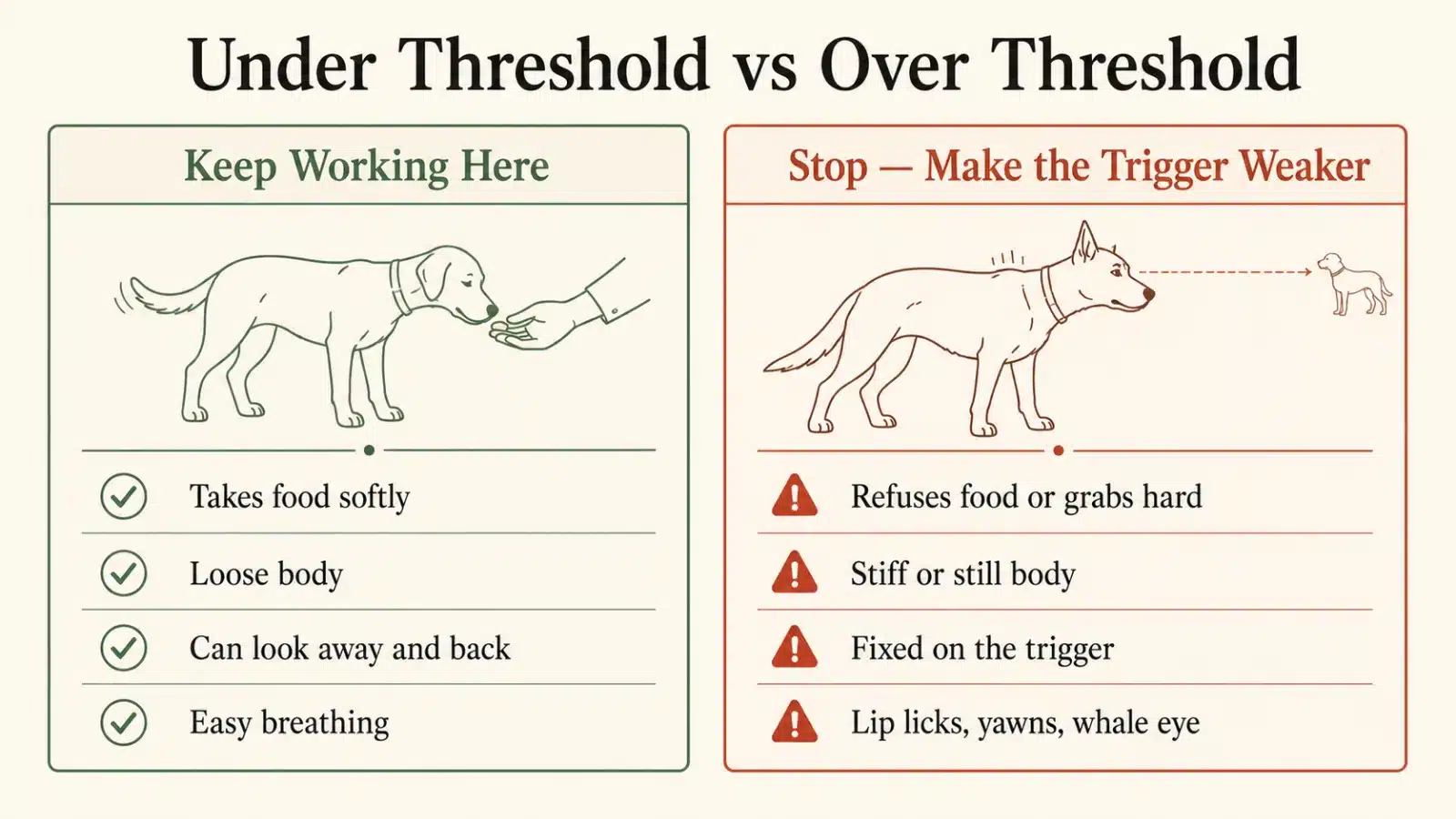
Protocol One: Baby Sounds
Sounds are the trigger most worth preparing, because a crying infant is loud, sudden, high-pitched, unavoidable, and, as we covered earlier, measurably stressful to dogs even before you factor in an individual dog's sensitivities. So we start here, and this is the template you will adapt for everything else.
First, get real recordings. You want genuine infant sounds, crying, fussing, wailing, the sharp sudden shriek, the long grizzle, and you can find long recordings of these easily. Variety matters, because a baby does not make one sound, and you want your dog comfortable with the whole range rather than habituated to a single clip.
Boxed Protocol: Desensitizing Your Dog to Baby Sounds
Begin weeks or months before your due date. Keep sessions short, a few minutes, several times a week. Use exceptional food reserved for this work. Have the recording on a speaker whose volume you can control finely.
- Find the starting volume. Play the cry recording at the lowest volume you can, so low it is barely audible. Watch your dog. If she notices it but stays relaxed and will happily eat, this is your starting level. If even this quiet version worries her, you need it quieter, or farther away, or shorter. Start where she is comfortable, wherever that is, even if it feels absurdly quiet.
- Pair, in the right order. The cry plays, and then you deliver a piece of superb food. Sound first, food second. Keep feeding while the sound continues. When you pause or lower the sound, the food stops.
- Watch and stay under threshold. Throughout, read her body. Soft, loose, eating easily means you are in the right place. Any early stress signal, or any hesitation to eat, means you are too loud and should drop back down.
- Raise the volume by tiny increments. Over many sessions, once she is reliably relaxed and happily eating at a given volume, nudge it up a hair. Not a jump. A hair. Then work at the new level until it too is easy and boring, then nudge again.
- Vary the sounds. As she gets comfortable, rotate through different cries and fusses, different pitches and durations, so the comfort generalizes to the whole range rather than one clip.
- Build toward realism, slowly. The goal over weeks is a dog who hears a genuine, full-volume, sudden infant scream and, rather than spiking, looks to you with a pleasant expectation, because that sound has meant good things a hundred times. That is a dog prepared for the real thing.
If she regresses, which is normal, simply drop back to a volume that is easy again and rebuild from there. Progress is not a straight line. A session that goes backward is information, not failure: it tells you the last step was too big.
The single most important warning bears repeating here in context: do not skip ahead, and do not ever "test" her by blasting a loud cry to see how she does. Testing at full volume is just flooding with a nicer name. You already know how she does at full volume, badly, which is why you are doing this. Trust the gradual process and let the real baby be the only full-volume, unpredictable cry she ever has to cope with, arriving after weeks of preparation rather than cold.
Protocol Two: Baby Smells
Scent is a smaller project than sound for most dogs, but it is worth doing, because a baby arrives smelling of a whole new chemistry: lotions, wipes, diaper creams, powder, milk, formula, the works. You want none of it to be startling or novel on homecoming day.
The approach is the same mechanism, applied gently. In the weeks before the birth, start using the products yourself, the baby lotion, the wash, the wipes, so that these smells become ordinary features of your home and your hands rather than sudden novelties tied to the strange new creature. Let your dog notice them in the course of normal life, and pair the newer, stronger ones with good things in the same trigger-first order: let her catch the scent, then food follows. Keep it low-key. You are not running intense sessions here so much as folding the new smells into the everyday background of the house well before they matter.
A note of honesty here, because you will read the opposite everywhere. The famous ritual of bringing home a hospital blanket for the dog to sniff before the baby arrives is not the powerful safety step it is made out to be, and we will take that apart properly in the homecoming section. For now, simply know that letting the baby's future smells become boring and ordinary over weeks, through normal daily exposure paired with good things, is worth far more than one dramatic sniff of a blanket the day before. Ordinary and gradual beats ceremonial and sudden, here as everywhere in this section.
Protocol Three: Baby Equipment
Your house is about to fill with objects that move, beep, rock, swing, hum, and vibrate, and to a dog a lot of these are genuinely strange: a swing that rocks on its own, a vibrating bouncer, a breast pump with its rhythmic sound, a monitor that chirps, a stroller that rolls, a bassinet, a high chair, a white noise machine that hisses all night. Novelty plus movement plus unfamiliar sound is exactly the combination that unsettles dogs, and the good news is that equipment is the easiest category to prepare because you control all of it completely.
The key is simply this: set the gear up early, and introduce it in its least alarming form first, then build. Get the equipment out of the boxes weeks ahead rather than assembling a fleet of strange moving objects in the same week as the baby. Let it sit, let your dog investigate it while it is still and silent and safe, and pair her calm interest in it with good things. Then, in stages, bring it to life. Let her see the swing rock while she is at a comfortable distance and getting fed. Let her hear the pump run from across the room, then closer, as she stays relaxed. Turn the monitor's chirp and the white noise machine on for increasing stretches, paired with normal pleasant life, so they become boring background rather than novel alarms.
Boxed Protocol: Introducing a Piece of Moving, Noisy Baby Gear
Use this for the swing, the bouncer, the pump, the stroller, the monitor, anything that moves or makes sound.
- Static and silent first. Set the item up, switched off, and simply let it exist in the house. Reward your dog for calm, curious investigation of it. Let it become a boring piece of furniture.
- Add the motion or sound at low intensity and distance. Turn it on at its gentlest setting, or run it briefly, with your dog at a comfortable distance where she stays relaxed. Pair its activation with food, trigger-first: it starts, then good things happen.
- Close the distance gradually. Over sessions, let her be a little nearer the moving, sounding object while she stays loose and eating. Back off the moment she tightens.
- Build duration and realism. Extend how long it runs, cycle through its settings, until the fully operational item at normal proximity is unremarkable to her.
- Never put the real baby in it as the introduction. The dog should be completely comfortable with the empty, operating gear long before there is ever a baby in the seat. The baby is the last variable added, not the first.
That last point is the one that carries the most safety, so hold onto it: your dog meets the moving swing, then the running swing, then the running swing up close, and only much later, once all of that is boring, is there ever a baby in it. You are never introducing your dog to the gear and the infant as a single overwhelming event.
Protocol Four: The Movement of a Small Human
This is the trigger guides forget entirely, and it is one of the most important, because nothing in your dog's prior life has moved the way a baby moves, and later, nothing moves the way a crawler and a toddler move. Sudden jerks. Flailing arms. Lurches. Fast, low, unpredictable scrambling across the floor at a dog's eye level. High-pitched squeals riding on top of erratic motion. To many dogs this movement is not just novel, it is activating, and for some dogs it taps into the machinery that responds to fast low moving things, which is the last machinery you want engaged around your child.
You cannot fully prepare a dog for infant and toddler movement in advance, because you do not have the moving child yet. But you can lay groundwork, and here I have to correct a suggestion that appears in my own earlier research and in plenty of guides, because it is subtly dangerous: the idea that you should get down and crawl toward your dog to simulate a baby.
Do not crawl toward your dog. A person advancing on hands and knees, head at the dog's eye level, coming straight at her, is a genuinely threatening picture to a dog, and it is a particularly bad one to rehearse with a fearful, guarding, resting, or pain-affected dog, precisely the dogs you most need to protect. Approaching a dog head-on at her own level is pressure, and pressure is what we spend this entire guide trying to remove.
So prepare for movement the safe way. Expose your dog to unusual human movement at a distance and off to the side rather than bearing down on her, and reward her for staying relaxed and, especially, for choosing to disengage and look away. If you want to accustom her to jerky, low, unpredictable motion, do it across the room, laterally, never as an approach, and keep her free to move away at any moment. The lesson you are building is that odd movement in the environment is no big deal and predicts good things, and that she always retains the option to remove herself, which is the option a mobile baby will one day threaten and which she must never learn she has lost. When the real crawler arrives, you will keep building on this with strict management and supervision, and we will return to it in depth in the stages section, because the mobile-baby phase is where this trigger gets real and where most families are caught unprepared.
A Word on Pace, Because It Governs Everything
Before the summary, one honest truth about all four protocols. The hardest part of this work is not technical. It is temperamental. It is the discipline to go slower than feels necessary, to resist the urge to skip ahead when a few sessions go well, to keep a session short when it is going great and you want to push, and to drop back without frustration when your dog has a bad day.
Everything in this section rewards patience and punishes hurry. The pet parent who spends ten weeks inching the volume up, staying under threshold the whole way, ends up with a dog who is genuinely fine with a screaming newborn. The pet parent who tries to do it in a week, who tests at full volume, who pushes when the dog is worried, ends up with a more frightened dog and no time left to fix it. Same information, same tools, opposite outcomes, and the only variable was the willingness to go slow. Start early precisely so that you can afford to go slow, because slow is the version that works.
The Short Version, If You Skimmed
If you are skimming, here is Emotional Repatterning in one box.
This section changes emotions, not behaviors. You cannot obedience-train away a fear response. You change it by changing what the trigger means.
Two mechanisms, working together. Desensitization: start the trigger so weak it does not bother her, raise it only as fast as she stays comfortable. Counterconditioning: pair the trigger with superb food so it comes to predict delight.
Order matters, and everyone gets it backwards. Trigger first, then food. The sound causes the chicken to appear. Feed only while the trigger is present. Reverse it and you teach the food to predict the trigger, making things worse.
"Just get him used to it" at full strength is flooding, and it harms. Habituation only works under threshold. Above threshold you get sensitization or shutdown. Staying under threshold is the entire craft.
Read the threshold. Early stress signals and refusal of food mean you are over the line. If she cannot eat, you are too close. Use the stress-signals and vocalizations guides to read the gauge.
Four protocols, one method: sounds (start near-silent, raise by hairs, vary the cries), smells (fold them into ordinary life early), equipment (static and silent first, motion later, real baby last), and movement (never crawl at your dog; expose to odd movement laterally, at distance, always leaving her an exit).
Pace governs everything. Go slower than feels necessary. Start early so you can afford to. Slow is not the cautious version of this work; slow is the work.
With the dog able to do the right things and beginning to feel differently about the baby's world, we can put it on a calendar. The timeline is next.
The Timeline
When to Start Is Now
Let me answer the question you are actually asking before you ask it. You are wondering whether it is too early to start, or whether you have left it too late, and the honest answer to both is the same: the best time to start was the day you found out, and the second best time is today.
I mean that plainly. There is no such thing as starting too early. A pet parent who begins the day the test comes back positive, with a full nine months of runway, is not being excessive or anxious. She is being smart, and she is giving herself the one resource this whole process depends on and cannot manufacture later, which is time. Everything in the five sections before this one takes time to do properly. Changing how a dog feels is measured in weeks. Proofing a behavior until it holds under pressure is measured in weeks. Doing any of it without crossing threshold, without rushing, without the frantic energy that leaks down the leash and undoes the work, requires that you are not in a hurry. And the only way to not be in a hurry is to have started early.
Here is the part that matters most, and it is the reverse of what people assume. The dogs who need the most runway are exactly the dogs whose families are most tempted to wait, because those families are anxious and avoidant about the whole subject. A dog with existing fear, reactivity, guarding, or a bite history is not a dog you prepare in the third trimester. That dog needs the longest lead time, the most gradual work, and quite possibly a professional involved from early on. If your honest inventory back in Part Two turned up anything that worried you, your timeline is not "start soon." It is "start now, and get help now." The dogs who are already fine can afford a later start. The dogs who are not are the ones who cannot, and they are the ones whose families delay. Do not be that family. If your stomach dropped at one of those questions, that drop was your start date, and it has already passed.
So the structure of this section is simple. I am going to walk you trimester by trimester through what to do when, and then I am going to give you a separate, honest plan for the reader who found this guide late and is reading it at thirty-six weeks with a knot in her stomach. Both are real. Both can work. Let us put it on a calendar.
First Trimester: Look, Don't Train Yet
The first third of a pregnancy is not when the heavy training happens. It is when the looking happens, and the looking is what makes everything else work, so do not skip it in your eagerness to start doing things.
This is when you run the honest evaluation from Part Two, properly and without flinching. Sit down, alone or with your partner, and answer the hard questions about the dog you actually have. Any bite history. Any guarding. Any existing fear, anxiety, or reactivity. How she handles being handled. Her age, size, senses, and, if you have more than one, how they are together. This is the assessment that sorts you into "prepare and proceed with confidence" or "get a professional involved now," and doing it early is the entire point, because if the answer is the second one, you want every available week to act on it.
This is also when the pain question gets handled, and it belongs in the first trimester specifically because it can change everything downstream and because it takes time to resolve. Book the veterinary visit we talked about. Get your dog physically checked, tell your vet a baby is coming, and ask directly whether there is any pain or discomfort that could be lowering her tolerance. If something turns up, a sore back, bad teeth, an achy joint, an itchy chronic skin problem, you want it diagnosed and being treated now, at the start, so that all the behavior work that follows is happening in a comfortable dog rather than a hurting one. A pain problem discovered in the first trimester is a gift. The same problem discovered the week the baby comes home is a crisis.
And this is when you do the life audit, the two columns, now and after. Map what your dog's daily life looks like today and what it will realistically look like once the baby arrives, and let the gap between them show you your actual to-do list. You will not act on all of it yet. You are just seeing it clearly, so that the changes you make over the coming months are deliberate and early rather than reactive and late.
If any of this surfaced something serious, this is the trimester to make the call to a qualified professional. Not in a panic, not as a last resort, but calmly and early, when there is the most time to help. A behavior consultant or veterinary behaviorist has far more to work with at week eight than at week thirty-eight, and if your dog is one of the ones who genuinely needs that help, the kindest thing you can do for everyone, dog and baby and yourself, is to start that relationship now.
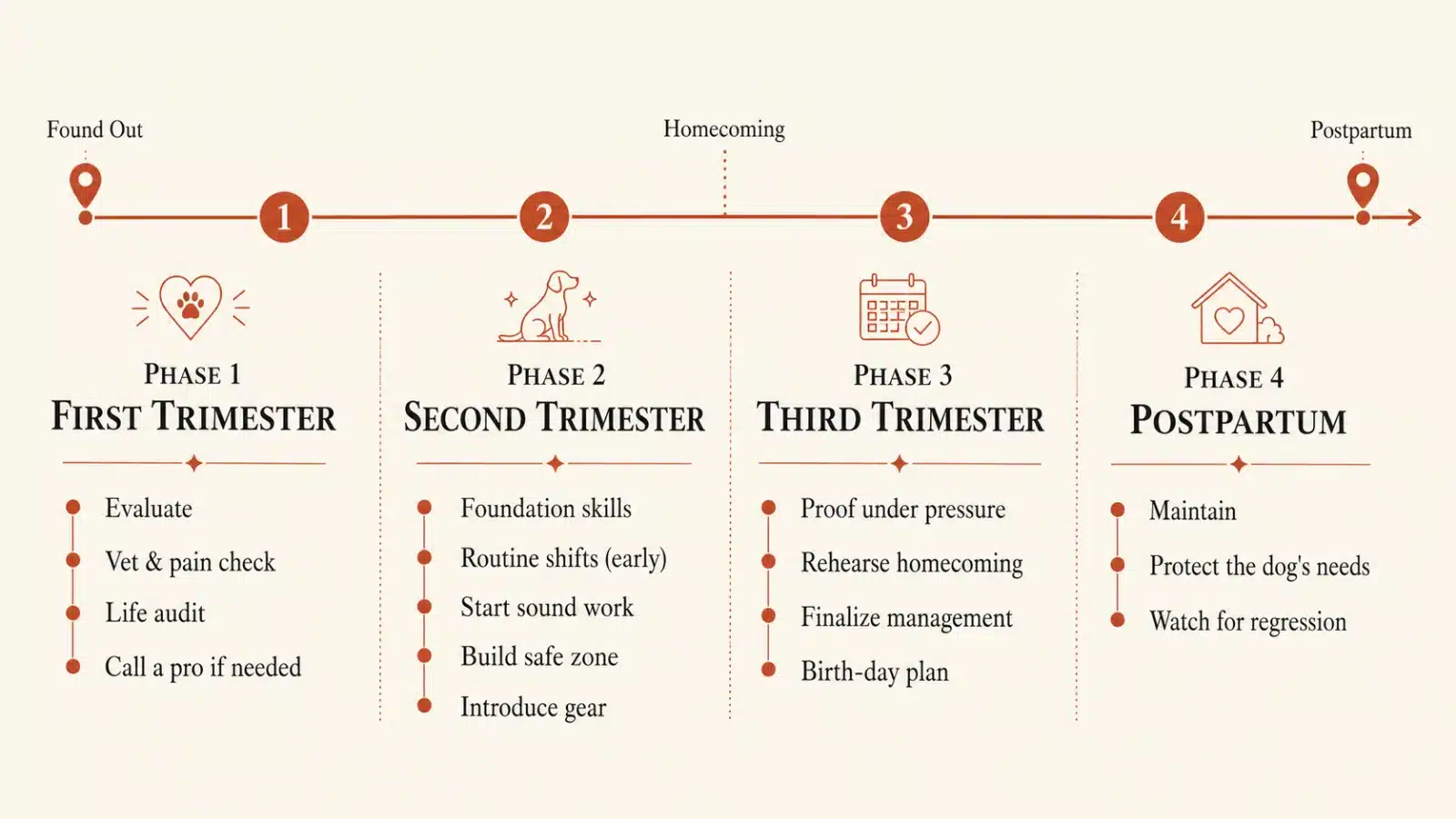
Second Trimester: The Building Months
The middle of the pregnancy is where the real work lives. You feel reasonably well, the due date is not yet breathing down your neck, and you have enough runway to do things slowly. This is the training and preparation heartland, and most of the five preceding sections get their start here.
Begin the foundation skills from Part Four. This is when you teach settle on a mat and start building it toward the deep, reliable, portable off-switch it needs to become, which takes weeks of short sessions, so starting in the second trimester gives it time to mature. This is when leave it, drop it, and trade get built, when off and back up and four on the floor get installed, when recall gets trained toward working under distraction, and when, if you plan to use one, the stroller gets walked empty on your daily outings until walking beside it is old news. None of these needs to be perfect yet. They need to be started, because started early means proofed by the time it counts.
This is when you begin the emotional work from Part Five, and sounds especially, because sound desensitization is slow and benefits enormously from a long runway. Start the baby-cry protocol now, at near-silent volumes, and let it inch upward across the whole rest of the pregnancy. A dog who begins hearing quiet, well-paired cries in the second trimester can be genuinely comfortable with a full-volume scream by the time the real one arrives. A dog who starts in the last two weeks cannot. Begin folding the new smells into the household, and as the baby gear arrives, set it up and start the equipment protocol rather than leaving a fleet of strange objects to appear all at once later.
Crucially, this is when the routine shifts begin, and there is a specific reason they belong here rather than later, so let me be clear about it. Every change your dog's life is going to undergo, you want to introduce early and, wherever possible, disconnected from the baby, so that your dog never files the change and the baby in the same drawer. If the walk is going to move to a different time, start drifting it now. If the dog is going to sleep somewhere new, move her now, weeks before there is a baby, so the new sleeping spot is just her normal spot by the time it matters. If she is going to get less of your undivided attention, begin varying that now, so that reduced attention is an old pattern rather than a sudden loss that arrives exactly when the baby does. The goal is that by the time the baby comes home, almost nothing about the dog's daily routine is actually changing on that day, because you already changed it, gradually, months earlier, when it could not be blamed on the baby.
And this is when you build the safe zone from Part Three into a genuine refuge, and begin the positive crate, pen, and gate conditioning, so that being comfortably separated behind a barrier is a well-established, pleasant, ordinary thing long before it is a necessary one. Start the couch decision here too if the rules are going to change, early and decoupled, exactly as we discussed.
That is a lot, which is why it lives in the trimester with the most capacity. You are not doing all of it in one week. You are starting all of it, in short and frequent sessions, across roughly three unhurried months, so that the third trimester can be about polishing rather than installing.
Third Trimester: Proof, Rehearse, and Get Ready
The final stretch is not for starting new things. It is for taking everything you began in the second trimester and making it bombproof, and for handling the logistics of the birth itself. Your energy is flagging, your due date is close, and the work now is consolidation, not construction.
This is when proofing matters most, in the sense we defined back in Part Four. The settle that works in the quiet kitchen now gets practiced in the busy living room, with distractions, with the doorbell, with the baby sounds playing, until it holds under exactly the kind of pressure the baby will bring. The recall gets harder challenges. The skills all move from "she can do it when it is easy" to "she does it when it is hard," because the version you will actually rely on is the proofed one, and this is the trimester to earn it.
This is when the sound work should be reaching realistic volumes, when the equipment should be fully operational and boring, when the smells should be old news. You are bringing every one of the Part Five protocols up toward the real thing, gradually, so that the actual baby is the only full-strength version of anything your dog has to meet cold.
This is when you finalize and install the management from Part Three. The gates go up and get conditioned. The pens get set. The floor plan you drew becomes the actual arrangement of your actual house. You want the whole management system physically in place and running smoothly before the baby arrives, not assembled in a hurry afterward, because afterward you will have no capacity for it.
And this is when you rehearse the homecoming and plan for the birth, which is important enough that the entire next section is devoted to it. In brief for now: decide who is caring for your dog during your hospital stay and get that arranged and, if it involves boarding or a sitter, trialed in advance rather than sprung on the dog during the most disrupted week of her life. Walk through the homecoming choreography so everyone knows their job. Stock up on the enrichment and the long-lasting chews you will lean on in the exhausted early weeks. Get the dog's needs set up to run on autopilot as much as possible, because your bandwidth is about to vanish.
Think of the third trimester as the difference between a dress rehearsal and opening night. Everything should already be built. Now you are running it until it is smooth, and getting the logistics locked down, so that when the real day comes you are executing a plan you have already practiced rather than improvising on no sleep.
"I Am Thirty-Six Weeks and I Just Found This Guide"
If that is you, take a breath. This part is written for you specifically, and you are not doomed. You have less time than the ideal, which means you triage: you do the things that matter most, you accept that some of the slow work will be partial, and you lean harder on management to cover what training cannot finish in time.
Here is how to spend the weeks you have.
First, do the evaluation immediately, today, not eventually. The honest inventory from Part Two matters more for you than for anyone, because you have the least time to react to what it finds. If it turns up a bite history, serious guarding, or significant fear or reactivity, then your single most important action is not a training exercise, it is a phone call: get a qualified professional involved right now, and read the red flags section today, because a genuinely concerning dog and a late start together mean this is beyond what a self-guided plan can safely carry, and honest is kinder than hopeful here.
Second, if your evaluation was reassuring, prioritize ruthlessly. With limited weeks, your highest-value efforts are management and settle. Get the management from Part Three fully in place, because a solid physical setup protects your baby on day one regardless of how far the training got, and it is the one thing you can install quickly and completely. And pour your training time into settle on a mat, because it is the single most useful behavior and even a partially trained version earns its keep. Those two, management and settle, are where a compressed timeline should spend its energy.
Third, start the sound work now even though you cannot do the full slow version. Some counterconditioning to baby cries, even compressed into a few weeks, is better than none, provided, and this matters more under time pressure not less, you still respect threshold. The temptation when you are short on time is to rush the volume up, and that is exactly when flooding happens. Do not. A smaller amount of correct, under-threshold work beats a larger amount of rushed work that sensitizes your dog. Go as far as you safely can and let management cover the rest.
Fourth, make the routine changes you still can, and simply accept that some of them will now coincide with the baby more than you would like. Move what you can move now. For the rest, do your best to soften the collision, and know that a dog whose routine shifts a bit abruptly is a manageable problem, not a disaster.
And fifth, extend your timeline past the birth. This is the reassuring truth for the late arrival: the work does not stop at homecoming, and much of it can continue afterward. You will keep counterconditioning, keep proofing, keep building, in the weeks and months after the baby comes, at whatever pace your new life allows. Homecoming is not a final exam you either pass or fail. It is one day in a long process, and if you arrived late, you simply do more of the process on the far side of it, with good management holding the line in the meantime.
A late start is a real disadvantage and I am not going to pretend otherwise. But it is a disadvantage you manage, not a verdict. Triage hard, lean on management, respect threshold even in a hurry, get help fast if you need it, and keep going after the baby arrives. That is a workable plan, and it is a great deal better than freezing because you did not begin nine months out.
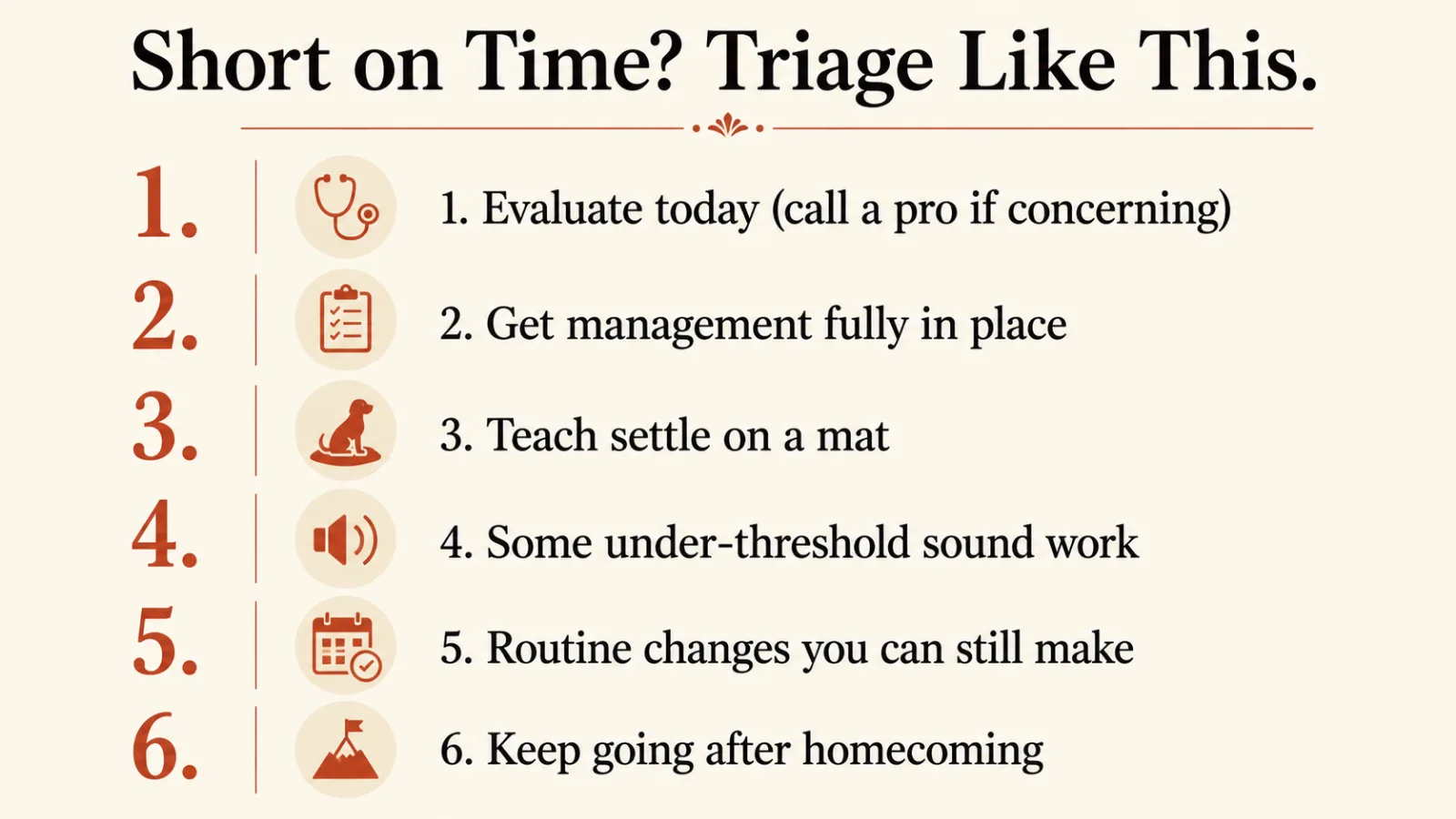
The Short Version, If You Skimmed
If you are skimming, here is the Timeline in one box.
There is no starting too early, and the dogs who need the most time belong to the families most tempted to wait. If your Part Two inventory worried you, your start date was then, and getting a professional involved is the first move, not the last.
First trimester: look, don't train yet. Run the honest evaluation, handle the vet and pain check, do the life audit, and call a professional now if anything serious turned up.
Second trimester: build. Start the foundation skills, begin sound desensitization at near-silent volumes, fold in smells and gear, and above all make the routine changes early and decoupled from the baby, so almost nothing about the dog's day actually changes on homecoming day.
Third trimester: proof, rehearse, and get ready. Make the skills bombproof under pressure, bring every protocol up toward realism, install and condition the full management system, and lock down the birth-day and homecoming plans.
If you found this late, triage: evaluate today and call a pro if needed, get management fully in place, pour training time into settle, do what under-threshold sound work you can without rushing, make the routine changes still available, and keep the work going after the baby arrives. A late start is a disadvantage you manage, not a verdict.
With the whole plan on a calendar, we can turn to the specific, high-stakes days everyone worries about most: the hospital stay and the homecoming. That is next.
The Moments
The Days Everyone Rehearses in Their Head
There are a handful of specific moments in this whole process that expecting parents lie awake picturing. The drive to the hospital and who has the dog. The front door opening and the dog meeting the baby for the first time. That first terrible night when the baby screams and the dog is right there. These are the scenes the worry attaches to, and they are the scenes almost every other guide either romanticizes or skips.
So this section is the choreography. Not vague reassurance, but who does what, in what order, on the actual days. And I am going to start by lowering the temperature on all of it, because here is the truth that runs underneath this entire section: if you have done the work in the last five sections, these moments are not the test. They are just the moments. The homecoming is not where your dog decides how she feels about the baby. She decides that over the weeks of preparation before it and the weeks of ordinary life after it. The single day matters far less than the culture around it makes you believe, and believing otherwise is how people turn a manageable day into a high-pressure event that their own anxiety then sabotages.
That said, the moments still deserve a plan, because a plan is what lets you stay calm inside them. Let us build one.
The Hospital Stay Nobody Plans For
Before the homecoming there is the birth, and the birth means you disappear for anywhere from a day to the better part of a week, and your dog's entire world stops without a word of explanation. This is the piece almost every guide forgets entirely, and it is a real disruption that deserves real preparation, because it lands right before the homecoming and can leave your dog rattled at exactly the wrong moment.
Think about it from the dog's side. Her people leave, sometimes in the middle of the night, sometimes in an obvious rush and state of tension. Then one or both of them simply do not come back for days. Her routine collapses. She may be cared for by someone less familiar, or moved to a different home, or boarded somewhere she has never been. And then everyone returns, exhausted and strange-smelling, carrying a small loud creature, into a house that has changed. If you have not planned the hospital stay, the dog meets the baby already frazzled from days of unexplained upheaval, which is the worst possible starting condition.
So plan it, and plan it early. Decide now who cares for your dog while you are at the hospital. The ideal is someone your dog already knows and likes, caring for her in her own home if possible, so that the disruption is minimized and at least her environment stays constant. If that is not possible and she will be boarded or sent to a sitter, then the single most important thing you can do is trial it in advance. Do not let the first time your dog is ever boarded be the day you go into labor. Do a practice stay, or several, well before the due date, so that wherever she ends up is a known and reasonably comfortable place rather than one more shock stacked onto the week. A dog who has happily boarded at that specific place three times already will take the birth-stay in stride. A dog dropped somewhere brand new during the most disrupted week of her life will not.
Build in flexibility, too, because births do not run on schedule. Your dog care plan needs a backup, and it needs to be able to stretch, since you might be gone longer than expected. Have the arrangements, the emergency contact, the food and medication and instructions all sorted and written down weeks ahead, so that when the day actually comes, dog care is one thing you do not have to think about. That is the goal for all of this: to have decided everything in advance so that the real day asks nothing of you but to execute.
The Homecoming, Built From Your Dog
Now the moment itself. And here I have to dismantle something, because the standard homecoming script is presented everywhere as though it were settled procedure, and much of it is ritual rather than method.
You have read the script. Exercise the dog hard beforehand. One parent goes in first to greet the dog while the other waits outside with the baby. Greet the dog, let her get the excitement out, then bring the baby in and let the dog sniff. It is recited with great confidence, and the trouble with it is that it treats every dog as the same dog, and your dog is not every dog. The right homecoming is built from the specific animal you have, and the honest version of the advice is a set of principles you apply to your dog, not a ceremony you perform regardless of her.
Start with the exercise question, because it is a good example of how the standard advice can be exactly backwards for a given dog. For some dogs, a calm walk and a chance to relieve themselves before the arrival genuinely helps take the edge off. But for an arousal-prone dog, a big exciting outing right before a chaotic homecoming is not draining, it is priming. You have wound her up and cranked her arousal higher right before you ask her to be calm, and now she meets the baby over-stimulated. So the principle is not "exercise the dog." The principle is "arrive at the homecoming with your dog in as calm and settled a state as possible," and you achieve that differently for a mellow dog than for a firecracker. Know which one you have, and choose accordingly.
The same goes for the greeting. The instinct to let the dog greet her people first, before the baby is introduced, is reasonable for many dogs, because a dog crowded by returning family while she is bursting with excitement is not in a state to meet anything new well. Letting that first wave of reunion happen, and settle, before the baby enters the picture is often sensible. But "often" is not "always." For some dogs, particularly the highly aroused or the ones who guard their people, the calmer plan is for the dog to stay behind a barrier during the initial arrival entirely, and to meet the situation only once the household has stopped moving and everyone has landed. There is no failure in that. A dog who watches the first chaotic minutes from behind a gate, calmly, and is included once things are settled, has had a better homecoming than a dog thrust into the middle of the commotion because a guide said to greet her first.
So here is the homecoming as principles rather than script. Arrive with your dog as calm as you can get her, by whatever means suits her temperament. Have your management fully ready, gates and mat and a stash of good food all in place, so you are executing a prepared setup and not improvising. Keep the very first introduction low-key, brief, and under control, with the baby held securely and the dog free to look but not to swarm, and with no pressure on the dog to interact at all. Let her investigate from a comfortable distance, on her own terms, and reward calm. Keep it short and end it while it is still going well, exactly as you would end a good training session, rather than letting it run until something tips. And read her the entire time, using every bit of the seeing skill from Part Two, so that you are responding to the actual dog in front of you rather than to a plan on a page.
Above all, do not stage it for a photograph. You know why by now. The moment you are managing the scene for the camera is the moment you stop managing it for safety.
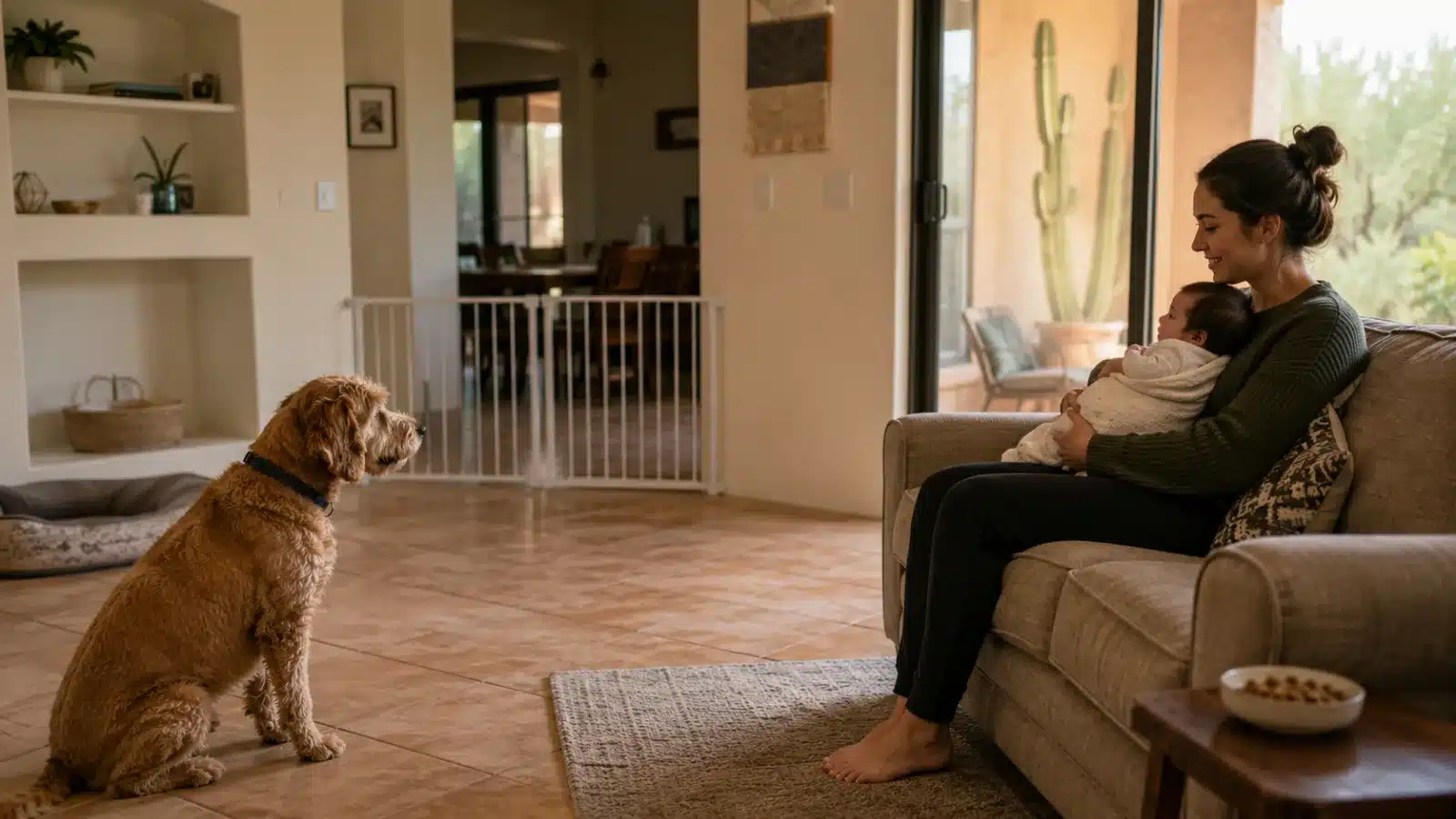
About That Blanket
I have promised twice now that we would deal with the blanket, so here it is.
The advice is nearly universal. Before you bring the baby home, have someone bring home a blanket or a hat the baby has worn, and let your dog sniff it, so she can "get to know the baby's scent" and be prepared to accept the baby. It is presented, over and over, as an important safety step, a key part of a proper introduction. And I want to be careful and honest here rather than glib, because the truth is more interesting than either the ritual or a flat dismissal of it.
There is no good evidence that the blanket ritual does what it is claimed to do. There is no controlled research showing that pre-exposing a dog to a newborn's scent on a blanket improves the dog's later acceptance of the baby or reduces any risk. It is folk wisdom, repeated so often and so confidently that it has taken on the appearance of established procedure, but the appearance is all it is. Even Family Paws Parent Education, the leading educators in this specific field, have questioned it openly. The scent of your household in late pregnancy already carries a great deal of the relevant chemistry, and a dog who has been living with a pregnant person for months is not meeting the baby's biology cold on homecoming day regardless of any blanket.
Worse, the ritual carries a subtle risk that its confident promotion never mentions. It can lull a family into a dangerous assumption. Present the blanket, watch the dog sniff it with mild interest, and it is terribly easy to conclude that the dog now "knows" the baby, that the introduction is handled, that acceptance has been secured, and to relax the vigilance and management that actually keep a baby safe. A calm sniff of a blanket tells you almost nothing about how the dog will respond to a living, moving, crying infant, and treating it as though it does is precisely the kind of false confidence that gets management dropped at the worst moment. The blanket is not the problem. The belief that the blanket accomplished something is.
So what should you actually do about scent? Exactly what we covered in Part Five, and it is the honest version of what the blanket ritual is fumbling toward. Over the weeks before the birth, fold the baby's future smells, the lotions and washes and products, into the ordinary background of your home, paired with good things, so they become boring long before the baby arrives. That is real scent preparation: gradual, early, woven into daily life, and never mistaken for a substitute for management. If someone brings a blanket home from the hospital and you want to let your dog notice it as one more ordinary scented object, there is no harm in it. Just do not believe it did any heavy lifting, and do not let it buy you one ounce of relaxed vigilance. The blanket is theater. The weeks of ordinary preparation are the work.
The First Seventy-Two Hours
The homecoming is one moment. The first few days are a different and in some ways more important stretch, because this is when your dog is forming her real, lasting impression of what this new arrangement actually means for her, and you have more influence over that impression than you might think.
The single most powerful thing you can do in these early days runs against every instinct you will have, so brace for it. Make good things happen for your dog in the presence of the baby, and make the baby's presence predict that your dog's life is still good. The natural, exhausted pattern is the opposite: the baby cries, you tend the baby, the dog is in the way, so the dog gets shooed off, ignored, or shut away, over and over, until the dog's own nervous system draws the obvious conclusion, which is that this creature's presence reliably predicts that all the good things stop. That is how a dog learns to resent a baby, not through jealousy, but through a simple, accurate association: when the baby is out, I lose. You want to build the reverse association, deliberately, from day one. When the baby is present and things are calm, that is when the dog gets a scattered handful of treats, a stuffed chew, a kind word, a moment of calm attention. The baby comes out, and good things happen for the dog too. Over and over, until the baby's presence predicts good, not loss.
You will not do this perfectly, and you do not need to. You are exhausted and overwhelmed and you will forget half the time. It does not have to be perfect to work; it just has to happen often enough that the overall pattern tilts toward the baby being good news rather than bad. Keep some treats stashed everywhere you will be sitting with the baby, so that in your foggy state the good stuff is always within reach and you can toss a few to the dog without getting up.
Beyond that association, these first days are about leaning hard on the management you built and protecting the dog's ability to opt out. Your safe zone earns its keep now. Let your dog retreat to it as much as she wants, and do not drag her into interactions she is declining. A dog who is allowed to approach and withdraw on her own terms, who is never cornered or forced into proximity, is a dog who gets to form her impression of the baby at her own pace, and that impression is far more likely to be a neutral-to-positive one. Forcing it does the opposite. Let her choose, keep the good things flowing, keep the management tight, and give it time.
Three in the Morning
I want to talk about the specific moment that ambushes more new-parent-and-dog households than any other, because if you see it coming you can plan for it, and if you do not it can do real damage to your relationship with your dog at the worst possible time.
It is the middle of the night. The baby is screaming. You are more tired than you have ever been. And your dog is barking at the crying, or pacing and whining, or underfoot, or all of it at once, and you are trying to soothe an inconsolable newborn while a dog adds to the chaos, and you feel a flash of real anger at the dog. That flash is the danger. That is the moment good people snap at a dog they love, or worse, and it is the moment that can teach a dog, in one ugly instant, that the baby's cries predict their person becoming frightening. Everything you have built can take a hit right there at 3am if you have not planned for it.
So plan for it, and the plan has two parts. The first is management, again, doing the work so that you are not depending on your own good behavior at your worst hour. This is exactly what "design for your worst self" from Part Three was for. If you know the nighttime feeds are coming, then before they start, the dog has a comfortable place to be that is not underfoot during them, whether that is her safe zone, a dog bed in the room positioned out of the traffic, or a settled spot behind a gate, established and made pleasant in advance so that at 3am she already has a default place to go and you are not inventing one while both a baby and a dog are melting down.
The second part is the sound work from Part Five, which is aimed squarely at this moment. A dog who has spent the whole pregnancy learning that cries predict good things, worked up gradually and under threshold to realistic volumes, is a dog far less likely to come unglued when the real 3am cry arrives, because that sound has been made familiar and even positive rather than alarming. This is the payoff for all those quiet sessions. The barking at 3am is, very often, a dog telling you the crying distresses her, and the antidote was built months earlier by changing what the crying means. If it is still hard in the early going, keep pairing calm behavior around the cries with good things, keep the management tight so no one gets hurt and no one gets snapped at, and let the association keep developing. And if the crying genuinely undoes your dog night after night despite all of this, treat that as useful information that your dog is struggling more than expected, and a reason to get a professional involved, rather than a reason to lean on her harder. Understanding what is behind the barking helps here too, since a bark in the night is a specific message and not just noise, which the guide to barking can help you decode.
The Short Version, If You Skimmed
If you are skimming, here are the moments in one box.
The single day matters less than the culture makes you think. Your dog forms her impression over the weeks around the homecoming, not in the one moment of it. Do not turn a manageable day into a high-pressure event.
Plan the hospital stay early. Decide who cares for your dog, keep her environment as constant as possible, and if she will be boarded or sat, trial it well in advance so it is not one more shock during the most disrupted week. Build in a flexible backup.
Build the homecoming from your dog, not from a script. Arrive with her as calm as her temperament allows (which for an arousal-prone dog may mean less excitement beforehand, not more). Have management ready. Keep the first meeting brief, low-key, distant, voluntary, and unstaged. Read her throughout. Never manage the scene for a photograph.
The blanket is theater. No good evidence supports the scent-blanket ritual, and its real danger is the false confidence it breeds. Do real scent work instead: fold the baby's smells into ordinary life over weeks, and never let a calm sniff buy you relaxed vigilance.
In the first 72 hours, make the baby predict good things for the dog. Good stuff happens when the baby is present, so the dog never learns that the baby means loss. Lean on management, protect the dog's right to opt out, and let her form her impression at her own pace.
Plan for 3am before it arrives. Management so you are not relying on your worst-hour self, and the pregnancy's sound work so the cries were made familiar long ago. If the nights genuinely undo her despite everything, that is a reason to get help, not to lean on her harder.
With the homecoming behind us, we reach the part almost every other guide skips entirely: what happens when the baby starts to move. That is next, and it is where the real risk lives.
When the Baby Moves
Where Every Other Guide Leaves You
Notice something about almost every article you have read on this subject. They end at the homecoming. The baby comes home, the dog meets the baby, everyone does well, roll credits. The guide walks you carefully up to that front door and then abandons you on the doorstep, as though the newborn were the whole challenge.
It is not. In fact, the newborn stage is the easy part, and the way these guides end there is not just incomplete, it is actively misleading, because it teaches families to exhale at exactly the wrong moment. The truth that the research on dog bites to children makes unavoidable is this: the risk to your child does not peak with the newborn. It climbs later, as the baby becomes mobile, and it is highest in the toddler years, and the family that relaxed its guard after a smooth homecoming is the family that gets caught out.
So this section covers the ground nobody else will walk with you. What happens when your baby starts to move, why it changes everything, and how to prepare for it before it arrives rather than scrambling after. If you read only one part of this guide that you could not have found elsewhere, make it this one.
Why a Newborn Is Easy and a Crawler Is Not
Let us be honest about why the newborn stage lulls people. A newborn does not move. She stays where you put her. She is in your arms, in the bassinet, on a blanket on the floor exactly where you set her down. From your dog's point of view, a newborn is a loud, strange-smelling object that does not pursue her, does not corner her, does not reach for her, and does not invade her space. Your dog can simply keep her distance, and most dogs do exactly that, and the family concludes that the dog is great with the baby.
Then, somewhere around six months and gathering speed from there, the baby changes from an object into an agent. She rolls. She scoots. She crawls. And now everything your dog understood about this small creature is wrong. The thing that used to stay put now comes toward her. It approaches her while she is resting. It follows her when she moves away. It heads straight for her food bowl, her bed, her chew, her safe space. It moves fast and low and in unpredictable jerks, exactly the motion we flagged back in Part Five as the most activating kind. And it does all of this at floor level, at the dog's own eye height, face to face, which is the most confrontational spatial relationship there is between a dog and a human, and a baby does it constantly, with no idea that she is doing anything at all.
This is a genuinely new animal to your dog, and a genuinely new challenge, and it arrives whether or not you prepared for it. The dog who was flawless with a newborn may be entirely unequipped for a crawler, not because anything went wrong, but because the crawler is a different problem that the newborn phase never tested. That is why the smooth homecoming is such a treacherous source of confidence. It certified the dog on the easy version and told you nothing about the hard one.
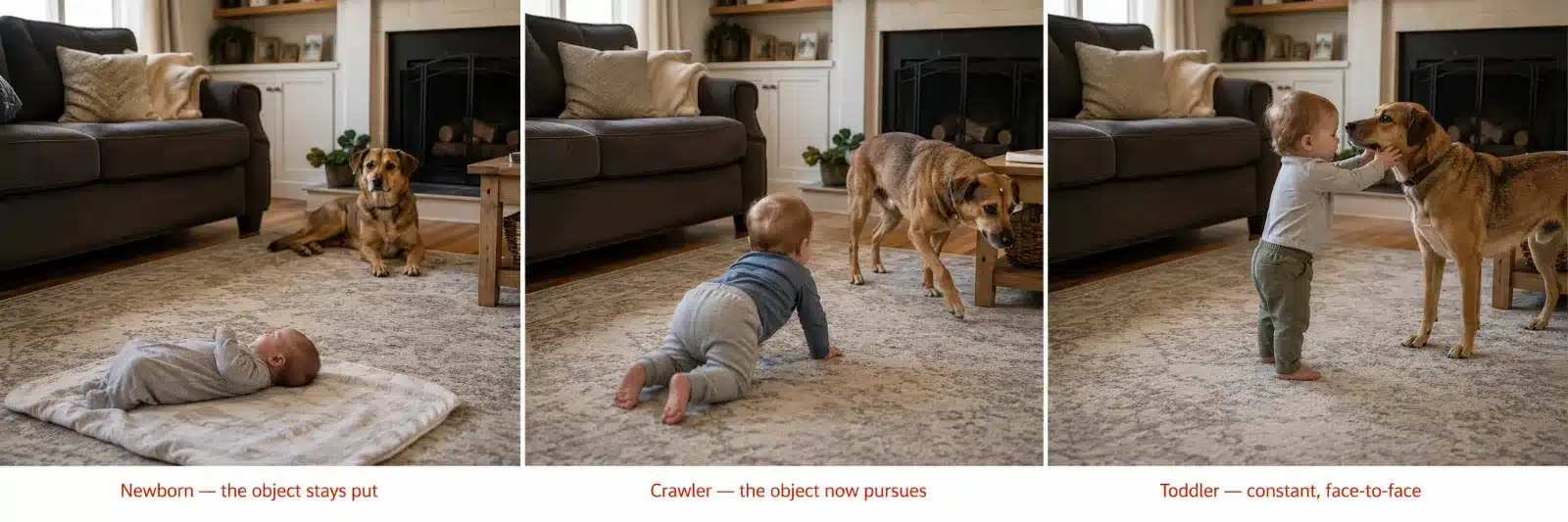
The Crawling Stage: Preparing Before It Arrives
The good news is that the crawling stage does not have to ambush you, because you can see it coming months away and prepare the ground before your baby ever moves. This is the whole reason we drew the crawling-stage floor plan back in Part Three rather than waiting. When your baby pulls up onto hands and knees for the first time, you do not want to be improvising. You want to be switching to a plan you already made.
The central shift, in one sentence, is this: the whole logic flips from keeping the baby's area separate to guaranteeing that your dog can always escape the baby, and that the baby can never reach the dog's refuge. Everything about managing a crawler follows from that sentence, so let me unfold it.
Your dog must always have an exit. A mobile baby who can corner a dog, in a room with no easy way out, is the single most dangerous ordinary configuration in a baby household, because a cornered dog who cannot create distance any other way is a dog left with only her teeth. So you arrange the space, and you supervise, so that your dog can always move away from an approaching baby and reach a spot the baby cannot follow into. This is not about giving the dog somewhere to be punished to. It is about guaranteeing her the option every dog needs and a crawler threatens: the option to leave.
The dog's safe zone, which was merely quiet during the newborn months, now has to be genuinely inaccessible to the baby. Gated so the dog can get in and the crawler physically cannot follow. If the baby can crawl into the dog's refuge, it is no longer a refuge, and you have removed the one place your dog could count on being left alone precisely when she most needs it. The food bowl comes up off the floor or behind a barrier, because a crawler heading for a dog's food while the dog is eating is a resource-guarding flashpoint waiting to happen. And the floor itself, which used to be neutral, is now shared territory that needs active management whenever both dog and baby are on it.
Supervision, in the sense we built in Part Three, becomes non-negotiable at this stage and has to be the proactive and active kind, not the passive presence that feels like supervising and is not. When your crawling baby and your dog are on the floor together, that is a two-engaged-adult-eyes situation, every time, with management ready to separate instantly. The reason is simple arithmetic: a crawler can close the distance to a dog in a couple of seconds, faster than a distracted adult can react, which means the only supervision that protects is the kind that is already watching and already ahead of it. This is exactly the moment the whole Part Two seeing skill and the whole Part Three supervision framework were built for.
And this is where you keep building the movement work from Part Five, now with the real moving baby, carefully and at a distance the dog is comfortable with, always rewarding the dog for calm and, above all, for choosing to disengage. You want your dog's practiced response to the baby's movement to be "look at the odd moving thing, then look away and go about my business," and you build that by reinforcing exactly that, over and over, while management guarantees that nothing goes wrong while she learns.
The Misreads That Show Up When the Baby Moves
The mobile stage brings its own crop of misread behaviors, different from the newborn ones in Part Two, and worth naming because a loving family will explain them away exactly the way they explained away the newborn signals.
Watch for the dog who keeps approaching the baby and then displaying a set of low, quiet, almost apologetic signals, the lowered body, the tucked posture, the flattened ears, the lip licking, the nervous little appeasing gestures. Families read this as the dog being sweet with the baby, being gentle, being submissive and loving. Sometimes it is benign. But this cluster of appeasement signals is often a dog who is uncomfortable and trying very hard to keep the peace with something that worries her, and a dog working that hard to appease a small child she cannot get away from is a dog under stress, not a dog in love. Learning to tell affectionate softness from anxious appeasement is exactly the discrimination the appeasement signals guide is built to teach, and this is the stage to master it.
Watch, too, for the opposite-looking pattern: the dog who is drawn to the baby constantly, who keeps closing the distance, who will not settle away from her. We met this in Part Two as the vigilance-versus-affection question, and it returns with force once the baby is mobile, because now the dog's approaching and the baby's approaching interact. A dog who keeps seeking out a moving baby may be doing so out of genuine friendliness, or out of an unsettled need to monitor, or out of an arousal she cannot regulate, and the distance-decreasing behaviors that look like devotion deserve the same honest second look here that they did before. If your dog keeps decreasing the distance to your crawler, ask what is actually driving it, and read the distance-decreasing signals guide to sharpen the read. The test is the same one from Part Two: can she settle elsewhere, easily, when the baby is safe and handled? A dog who can is probably fine. A dog who truly cannot is telling you something.
And watch for the herding pattern, the dog who circles, nips at, or fixates on the crawling or toddling baby's movement. In some dogs, particularly the herding breeds but by no means only them, fast low erratic motion switches on a motion-sensitive response that is not aggression and is not play, but is a problem around a child, because it involves chasing and mouthing a moving infant. We covered the "is it play or is it something else" test in Part Two, and it applies sharply here: real play pauses and can be interrupted; the motion-driven response does not pause easily and does not call off easily. If you cannot readily interrupt your dog's engagement with the moving baby, it is not a game, whatever it looks like, and it needs management and professional input rather than indulgence.
The Toddler Stage: The Hardest Chapter
If the crawler is a new animal to your dog, the toddler is a force of nature, and the toddler years are where the bite statistics are grimmest and where the most vigilance is required. I am not telling you this to frighten you. I am telling you because the families who understand it prepare for it, and the families who were told the story ends at homecoming do not.
Here is what a toddler is, from your dog's point of view. She is upright now, and mobile, and fast, and utterly without judgment or impulse control. She grabs. She pulls, ears, tails, fur, whatever is in reach, with a strong little fist and no concept that it hurts. She falls onto the dog, hugs the dog around the neck, sticks her face directly into the dog's face, corners the dog, climbs on the dog, takes the dog's things, and toddles up to the dog while it is eating or sleeping, all at exactly the height and the head-on orientation that dogs find most threatening, and all completely unpredictably. A toddler is, without meaning to be, a nearly perfect generator of the precise situations that produce bites, and she generates them all day long.
This is why the toddler years demand that everything in this guide stay switched on, not retired. The management does not come down because the newborn phase went well. The supervision stays proactive and active. The dog's guaranteed escape and inviolable safe zone matter more than ever, because a toddler can pursue and corner far more effectively than a crawler. And two new pieces of work come to the front at this stage, because now, for the first time, the child is old enough to be part of the solution.
The first is teaching the child, and you start it earlier than most people expect, as soon as the toddler can absorb any of it at all. Simple, consistent rules, modeled and enforced constantly: we are gentle, we do not climb on the dog, we do not take the dog's toys, we leave the dog alone when she is eating or sleeping or in her bed, we do not put our face in the dog's face. A toddler will not remember these reliably, which is exactly why adult supervision remains the real safety layer, but beginning to build the child's own understanding and gentleness is a long game worth starting early, and it protects the dog as much as the child.
The second is protecting the dog from the child, which people are strangely reluctant to do because it feels like taking the dog's side against their baby. It is not. It is safety for both of them. Your dog needs you to be her advocate, to intervene before your toddler climbs on her, to enforce her right to eat and sleep undisturbed, to give her the escape and the refuge that let her cope, and to never, ever leave her in the impossible position of having to solve a toddler problem herself, because the only tools she has for that are ones you never want used. A dog who trusts that you will manage the toddler, that you will step in before things get to be too much, is a dog who does not have to take matters into her own mouth. That trust is something you build by consistently having her back, and it is one of the most protective things in the whole arrangement.
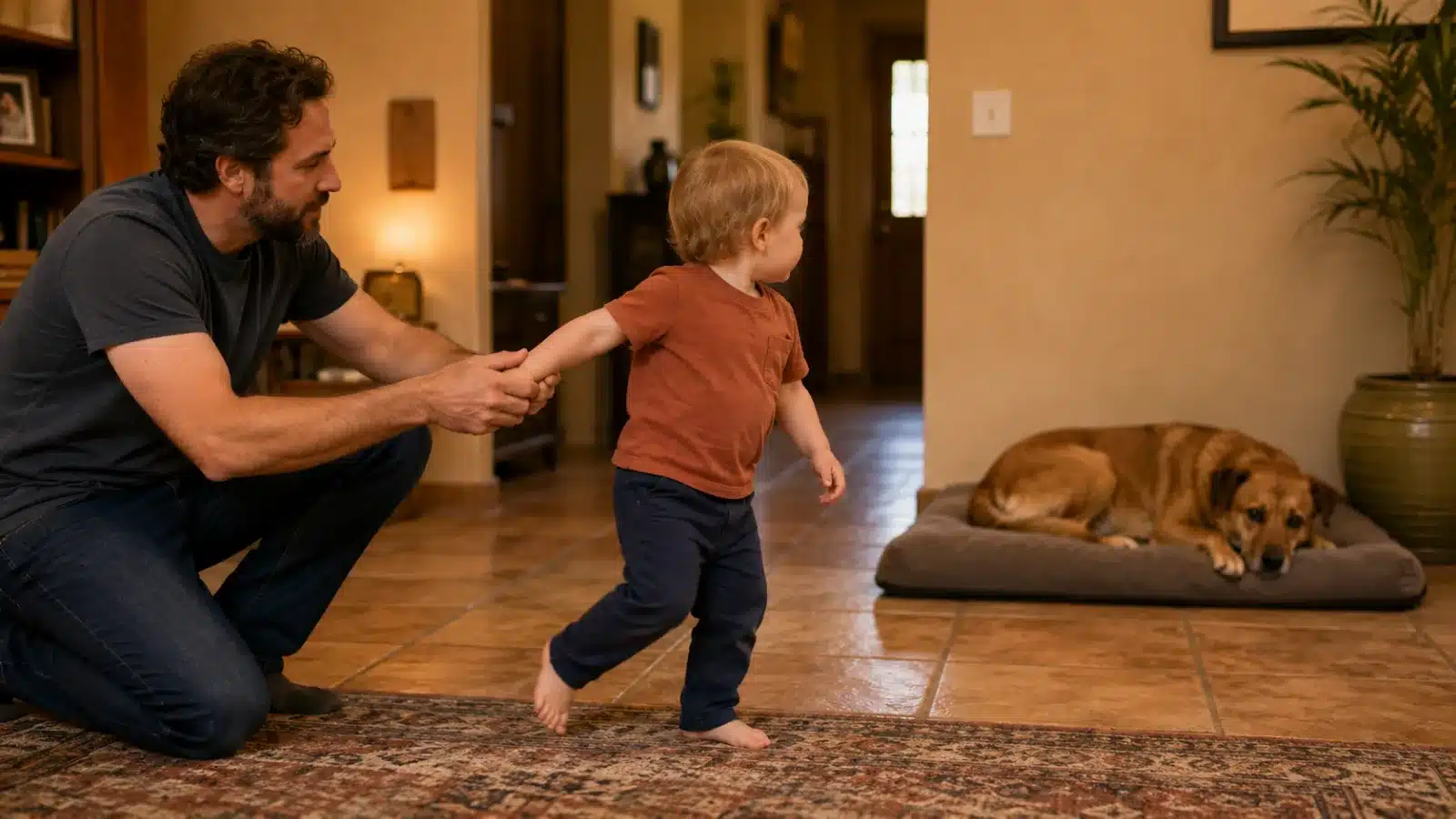
Reassess at Every Stage
Underneath the crawler and the toddler sits a principle that ties this whole section together, and it is one more thing no other guide tells you: the evaluation you did back in Part Two is not a one-time event. It is something you redo at every new stage, because at every new stage your dog is effectively meeting a different child.
The dog who was assessed as fine with a newborn was assessed against a stationary object. That assessment does not automatically carry forward to the crawler, and the crawler assessment does not automatically carry forward to the toddler, because each stage presents challenges the previous one never tested. So you look again, honestly, each time the baby's capabilities change. When she starts to move, watch how your dog actually responds to the moving baby, with the same clear eyes you used the first time, and adjust your management and your training and your expectations accordingly. When she starts to walk and grab and climb, look again. A dog who sailed through one stage may struggle at the next, and catching that early, by actually reassessing rather than coasting on an old verdict, is what lets you get ahead of a problem instead of being surprised by it.
This is also the point where you loop back to the honest inventory whenever something changes. If a new stage brings out stiffness, avoidance, appeasement, guarding, or any of the red flags we will detail in the next section, that is your signal to tighten management and, if it warrants it, get professional help, at that stage, rather than hoping the dog will simply adjust. Reassessment is not a lack of faith in your dog. It is the ordinary, ongoing vigilance that living safely alongside a growing child and a dog requires, and it continues, in a lighter form, for years.
The Short Version, If You Skimmed
If you are skimming, here is the mobile-baby stages in one box.
The risk does not peak at the newborn. It climbs as the baby moves and is highest in the toddler years. Guides that end at homecoming teach you to relax at exactly the wrong moment.
A newborn is an object that stays put; a crawler is an agent that pursues. Around six months the baby starts coming toward the dog, at floor level, face to face, in fast unpredictable motion. This is a new animal to your dog, and a smooth newborn phase did not test it.
For the crawler, the logic flips: the dog must always be able to escape, and the baby must never reach the dog's refuge. Gate the safe zone so the dog gets in and the baby cannot follow. Raise the food. Supervise proactively and actively whenever both are on the floor. Keep building the movement work with the real baby, rewarding disengagement.
Watch the new misreads: anxious appeasement mistaken for sweetness, distance-decreasing vigilance mistaken for devotion, and motion-driven herding mistaken for play. The test for the last one is whether you can interrupt it.
The toddler is the hardest stage: upright, fast, grabbing, climbing, face-to-face, unpredictable, and old enough to generate bite-producing situations all day. Keep everything switched on. Start teaching the child gentle rules early, but know that adult supervision is still the real safety layer. And be your dog's advocate: protect her from the toddler so she never has to protect herself.
Reassess at every stage. The Part Two evaluation is not one-and-done. Each new stage is a different child; look again with clear eyes and adjust.
With the whole arc from pregnancy through toddlerhood covered, we turn to the part of this that is about you and your family rather than your dog. The human side is next.
The Human Side
The Part That Is Not About Your Dog
Every section until now has been about your dog. This one is about you, and about the people around you, and I put it near the end not because it matters least but because by now you trust me enough to hear it, and because it is the part of this whole subject that other guides pretend does not exist.
Here is what they leave out. Preparing a dog for a baby is not only a training project. It is an emotional and logistical upheaval for the humans in the house, and how the humans hold up under that upheaval has as much to do with how this goes as anything you teach the dog. A stressed, exhausted, resentful, guilt-ridden household is a hard place for a dog to stay calm in, and a household that has thought honestly about the human side in advance is a household where the dog has a real chance. So we are going to talk about the guilt, the exhaustion, the division of labor, the partner who starts floating the idea of finding the dog a new home, the family pressure, and the thing nobody says out loud. You are allowed to find all of this hard. Let us treat it as real.
You Are Going to Feel Guilty, and You Are Not Alone in It
Let me start with the feeling that ambushes almost every new parent who loves their dog, because naming it and normalizing it is genuinely protective.
At some point, probably many points, you are going to look at your dog, the animal who was your first baby, who got walked twice a day and slept on the bed and had your full attention, and you are going to realize that she is now getting a fraction of what she used to, and you are going to feel a wave of guilt that lands like a physical thing. You will feel it when you skip her walk because you have not slept. You will feel it when you step over her to get to the baby. You will feel it in the moment you catch yourself, with a jolt, having half-forgotten she was there.
I want you to know two things about that guilt. The first is that it is nearly universal, and I do not mean that as a soft reassurance, I mean it as a documented fact. When researchers surveyed hundreds of families who had a young child and a dog they had before the baby, the guilt showed up in the majority of them: over half reported feeling guilty that they were not giving the dog enough time, that they should be doing more, that they lacked the energy to engage the way they used to. This is not a personal failing you happen to have. It is one of the most common experiences there is among people in exactly your situation. If you feel it, you are not a bad pet parent. You are a normal one.
The second thing is more important, and the same research points straight at it. In those families, the dog's behavior problems, the guilt, and the parents' own anxiety and depression were all tangled together, each connected to the others. That matters because it reframes what the guilt is for. The guilt is not a verdict to sit inside and suffer. It is a signal, and the useful response to it is not self-punishment but the ordinary, achievable maintenance we are about to talk about, plus a genuine dose of self-compassion, which the researchers named explicitly as one of the things that helps families through this transition. Being kind to yourself here is not indulgence. It is part of the plan, because a parent drowning in guilt and exhaustion has less left over for the dog, and cutting yourself some slack is what keeps you in the game.
So when the guilt comes, and it will, do not spiral into it. Notice it, let it point you toward a small good thing you can actually do for your dog today, forgive yourself for the walk you missed, and keep going. That is the healthy version, and it is far better for your dog than a parent driven by guilt into either burnout or resentment.
What Your Dog Actually Needs Is Smaller Than You Fear
Part of what drives the guilt is a belief that your dog needs the old life back, the two long walks and the constant attention, and that anything less is a kind of failure. So let me take some pressure off, because it is not true, and believing it makes the guilt worse than it has to be.
Your dog does not need her old life restored. She needs a few things reliably, and most of them are smaller and more achievable than the guilt tells you. She needs enough physical and mental activity to not be climbing the walls, and a lot of that can come from enrichment that does not require you to be out on a long walk: a stuffed frozen chew, a snuffle mat, a puzzle feeder, ten minutes of nosework in the living room, all of which tire a dog nicely and can happen while you sit with the baby. She needs some predictability, some things that still happen when they are supposed to. She needs her safe zone respected and her ability to opt out protected. And she needs some connection with you, which does not have to be an hour, it can be a few minutes of real attention, a bit of training, a calm hand while you both sit, delivered often enough to keep the relationship warm.
The bar is "good enough," reliably, not "everything she used to have." A dog whose needs are met at a good-enough level by a parent who is not destroying themselves with guilt is far better off than a dog whose parent is trying to maintain the old standard, failing, and marinating in shame about it. Aim for sustainable, not perfect, because sustainable is what your dog will actually receive across the long haul, and the long haul is what she needs.
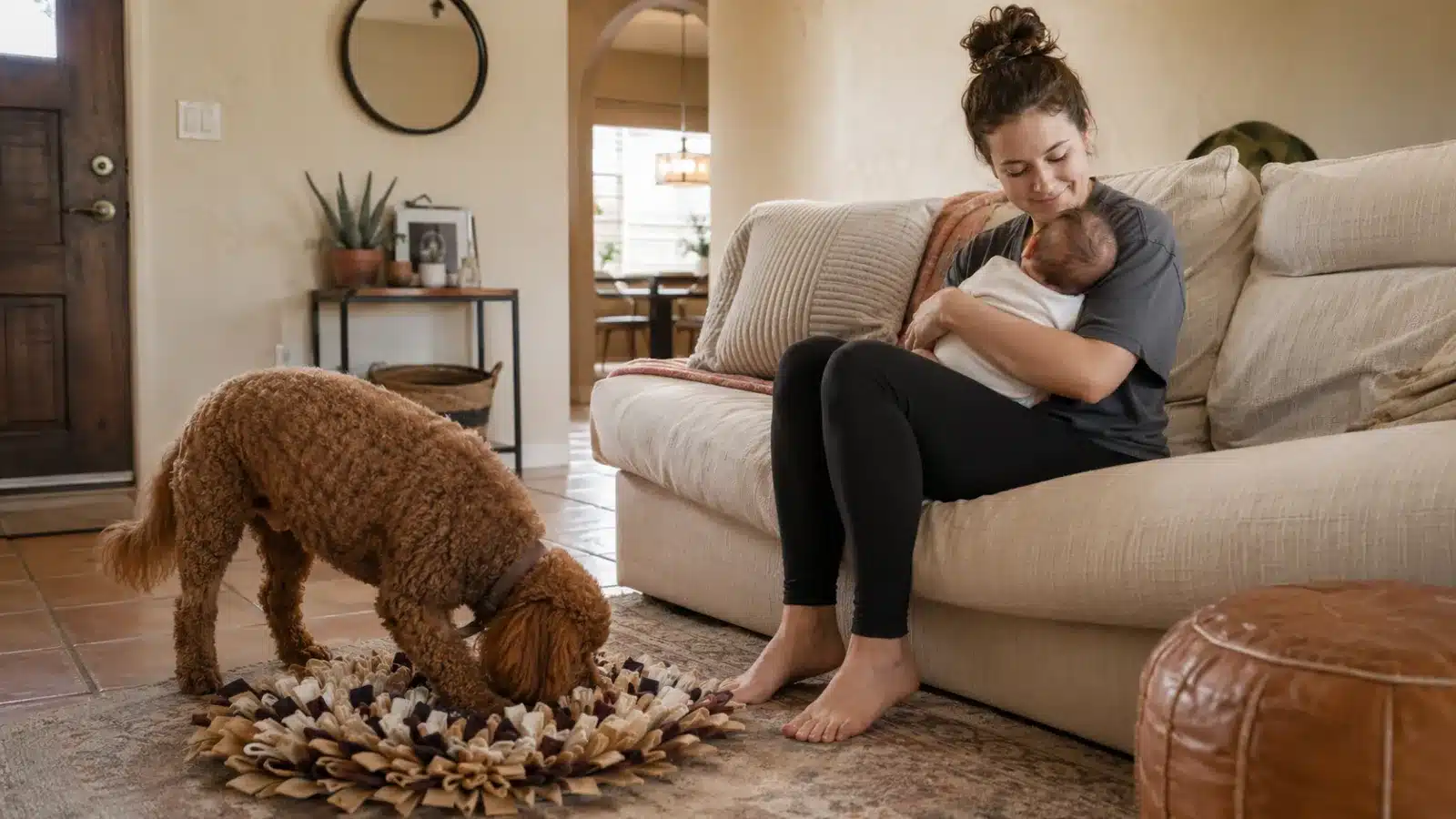
Divide the Labor Before the Baby, Not After
Now the logistics, and this is the most concretely useful thing in this section, so if you take one action from it, take this: decide who is responsible for the dog, specifically, before the baby arrives, and write it down.
Here is what happens otherwise, and it is one of the most common and most avoidable sources of resentment in a new-baby household. Nobody discusses it, so it defaults. And it defaults, overwhelmingly, onto whichever partner did not give birth or is not the primary feeder of the infant, and it defaults there in a fog of exhaustion and unspoken assumption, and within weeks one person is quietly furious that they are somehow doing all the dog care on top of everything else, and the other is quietly hurt because they are recovering from a birth or attached to a baby around the clock and did not realize the dog was being neglected or overloaded onto their partner. It curdles fast, and it curdles precisely because it was never actually decided, just absorbed.
So decide it, out loud, in advance. Who walks the dog, and when, in the newborn weeks? Who feeds her? Who handles the enrichment, the vet, the middle-of-the-night let-out? What is the backup when the designated person is underwater? Have this conversation while you are both still rested enough to have it well, and make it concrete, because "we'll share it" is not a plan, it is the absence of one, and the absence of a plan is what defaults into resentment. A dog-care division that is explicit, agreed, and realistic about the fact that one of you may be physically depleted for a while is one of the best gifts you can give both your relationship and your dog.
And build in slack, because you will both be more tired than you expect and life will not cooperate with the schedule. Line up help in advance if you can, a trusted dog walker for the hardest stretch, a friend or family member who can take the dog for a long walk now and then, even a well-vetted daycare for occasional days, and if you are going to use a daycare or a walker, arrange and trial it before the baby comes rather than scrambling for it in the depths of the newborn fog. Outside help is not a luxury or an admission of failure. It is often the thing that keeps the dog's needs met and the parents sane during the weeks when doing it all yourselves is simply not realistic.
The Partner Who Says "Maybe We Should Find Him a Home"
There is a specific, painful conversation that happens in a meaningful number of these households, and because it is painful, most guides will not touch it. I will, because pretending it does not happen helps no one, and because how you handle it can determine whether it becomes a real crisis or a hard moment you move through together.
At some point, one partner may say some version of it. Maybe the dog would be happier somewhere else. Maybe this is too much. Maybe we should find him a new home. It might come from the partner who was never quite as bonded to the dog. It might come out in a moment of total exhaustion and not really be meant. It might be a genuine, considered fear about safety. Or it might be the pressure valve on a person who is overwhelmed and has landed on the dog as the removable source of stress.
The first thing to do, if you are on the receiving end of it, is to not treat it as a declaration of war. Treat it as information about how overwhelmed your partner is feeling, because very often that is what it actually is, more a cry of "I cannot cope with this much" than a settled position on the dog. Meeting it with fury shuts down the conversation you actually need to have. Meeting it with curiosity, what is really feeling like too much right now, is this about safety or about exhaustion or about the dog specifically, opens it up. Sometimes the honest answer is that the load is unbearable and the fix is more help and a better division of labor, not a rehomed dog. Sometimes it is a specific fear about the baby's safety that deserves to be taken seriously and addressed directly, possibly with a professional, rather than dismissed. And sometimes, rarely, it turns out to be a genuine and considered conclusion that needs the honest, unshaming treatment we will give it in the next section.
What matters here is that this is a conversation between two overwhelmed people who need to get on the same side of the problem, not a battle between the person defending the dog and the person attacking it. The dog is not the enemy and neither is your partner. The exhaustion is the enemy, usually, and the exhaustion is addressable. Get help, fix the labor split, take any safety concern seriously and act on it, and give it time before anyone concludes anything permanent, because a great many of these conversations, handled with care instead of panic, turn out to be the low point rather than the ending.
The In-Laws, the Internet, and Everyone With an Opinion
You will also field pressure from outside the household, and it deserves a brief, clear-eyed word, because it can rattle you at a moment you are already stretched thin.
Once you have a baby and a dog, people will have opinions, and they will share them freely. A relative will tell you a dog and a baby cannot safely share a home. Someone will send you the article about the tragedy. An in-law will make pointed comments about the dog on the furniture, or announce that you will obviously have to get rid of him now. Some of this comes from real care and some from old myths and some from people who simply never liked the dog, and almost none of it comes from anyone who knows your specific dog or has done the work you are doing.
You do not owe every opinion a debate. What you owe yourself is a clear internal answer, which by now you have, because you have read this guide and you are doing the actual work: assessing honestly, managing the environment, teaching the skills, changing the emotions, getting professional help where it is warranted, and staying genuinely vigilant about safety. That is a far more serious and responsible approach than the person lobbing opinions has any idea about. You can let the pressure be what it is, external noise from people who are not in possession of the facts, and hold to your plan. The exception, always, is a safety concern that happens to be correct, wherever it comes from; a good plan takes real safety points on board no matter who raises them. But the blanket "you have to get rid of that dog" pronouncements are not safety analysis. They are noise, and you are allowed to treat them as noise.
Your Stress Lands on Your Dog, So Your Wellbeing Is Part of the Plan
I want to close this section with a fact that reframes self-care from something optional into something that is, genuinely, part of your dog's behavior plan.
Your emotional state does not stay inside you. It travels down the leash and into your dog. We touched on this back in Part One: research measuring long-term stress hormones in dogs and their humans has found that the two tend to synchronize, that people living with high stress tend to have dogs living with high stress. Your dog reads you constantly, far more closely than you read her, and a household running on fear, tension, and frayed nerves is a household your dog absorbs and reflects. This is not a reason for guilt, and I do not raise it to add one more thing to feel bad about. I raise it because it means the opposite of what guilt would tell you: taking care of yourself is not stealing time from your dog, it is caring for your dog, because a calmer you produces a calmer dog.
So the rest, the help, the self-compassion, the honest conversation with your partner, the walk you take for your own head as much as the dog's legs, the decision to let good-enough be good enough, all of it is not separate from your dog's preparation. It is part of it. You are one of the most important variables in your dog's emotional world, and tending to your own wellbeing is one of the most direct things you can do for hers. Put on your own oxygen mask. It turns out to be hers as well.
The Short Version, If You Skimmed
If you are skimming, here is the human side in one box.
The guilt is nearly universal, not a personal failing. In research on families with a young child and a dog, most reported exactly this guilt, and it was tangled up with the dog's behavior and the parents' own anxiety and depression. Treat the guilt as a signal, respond with small useful action plus real self-compassion, and do not spiral.
What your dog needs is smaller than you fear. Not the old two-walks-a-day life; enough enrichment to not climb the walls, some predictability, a respected safe zone, and a bit of real connection. Aim for good-enough and reliable, not perfect. Sustainable is what she actually receives.
Divide the dog-care labor before the baby, explicitly and in writing. Unspoken defaults curdle into resentment fast. Decide who does what, build in slack, and arrange and trial outside help in advance. "We'll share it" is not a plan.
If a partner floats rehoming, treat it as information about overwhelm, not a declaration of war. Get curious about what actually feels like too much, fix the load and the help, take any real safety concern seriously, and give it time before concluding anything permanent.
Outside pressure is mostly noise. You do not owe every opinion a debate. Hold to your plan; take on board only the safety points that are genuinely correct.
Your stress lands on your dog, so your wellbeing is part of her plan. Stress synchronizes between dogs and their humans. Caring for yourself is caring for your dog. Put on your own oxygen mask first.
With the human side addressed, we come to the hardest and most important judgment calls: the red flags, when to get professional help, medication, and the honest conversations about rehoming and about when a situation cannot be made safe. That is the final section.
Knowing When to Get Help
The Most Important Judgment You Will Make
This is the last section, and in some ways the most important, because everything else in this guide assumes a situation that self-guided preparation can actually carry, and part of being responsible is knowing when yours is not one of them.
The best pet parents are not the ones who handle everything themselves. They are the ones who know the edge of their own skill and call for help before they reach it, rather than after something has gone wrong. There is no failure in getting help. The failure is in needing it, sensing you need it, and pressing on alone because asking felt like an admission. With a baby in the house, that particular pride is a luxury you cannot afford, and the whole point of this section is to give you clear, honest markers for when to stop working the plan by yourself and bring in a professional, and, in the hardest cases, for when a situation cannot be made safe at all.
I am going to be direct in this section, more than anywhere else in the guide, because vagueness here does real harm. You need bright lines, not soft encouragement, so that is what I will give you.
The Red Flags: Stop and Get Help Now
Some behaviors are not part of the ordinary adjustment that training and time resolve. They are signals that the situation is beyond what a self-guided plan should be carrying, and that you need qualified professional help now, not after you have tried a few more things on your own. If you see any of these, directed at or occurring around your baby, stop working the plan solo and get a professional involved.
Any bite. Any bite at all, at any level, that made contact with your baby or with anyone in the home, including the ones that are easy to explain away, the "it didn't break skin," the "she was startled," the "he didn't mean it." A bite is the clearest line there is, and a bite in a home with an infant means you get expert help immediately.
Any snap or lunge toward the baby, the near-miss bite that did not connect. Do not wait for the one that does. A snap is a dog telling you, as loudly as a dog can without making contact, that she is at the end of what she can tolerate.
Growling directed at the baby. And here I have to be careful, because Part One told you never to punish a growl, and that stands completely. The growl is honest and valuable and you must never suppress it. But valuable information about a serious problem is still information about a serious problem. Do not punish the growl, and do not ignore it either. A dog growling at your baby is telling you the truth, which is that she is uncomfortable enough to warn, and the right response is to calmly protect the baby and bring in a professional to address what the growl is reporting, before it escalates.
Stiffening, freezing, or hard staring at the baby. These are the quiet, easily-missed signals that often precede the loud ones. A dog who goes rigid and still and locks a hard stare onto the baby is a dog in a serious state, and because it is silent, families miss it or mistake it for calm attention. It is not calm. It is one of the more concerning things on this list.
Guarding behavior around the baby, the mother, or resources near the baby. A dog who positions herself over the baby and stiffens when someone approaches, who guards the nursing mother, who becomes possessive of the baby's space or items, is showing a pattern that escalates and that belongs in professional hands.
Intense predatory-style interest, the fixation you cannot break: the hard focus, the stalking, the silent tracking of the baby's movement, the trembling or whining while locked onto the baby, the inability to disengage. This is among the most serious presentations there is around an infant, it is rare, and it warrants immediate separation and immediate professional help, no exceptions.
And escalating fear, a dog who is becoming more frightened over time rather than less despite your careful work, because fear that is worsening rather than improving is a sign that something is wrong with the current approach and needs expert eyes.
None of these mean your dog is bad, and none of them automatically mean the worst outcomes we will discuss later. What they mean is that you have reached the edge of what this guide can safely do for you alone, and that the responsible, loving next step is professional help. If any of this is describing your dog, the deepest treatment of the aggression itself, why it happens and how it is actually addressed, is in the guide to dog aggression, and reading it is a good next move, but it is a companion to getting hands-on professional help, not a substitute for it.
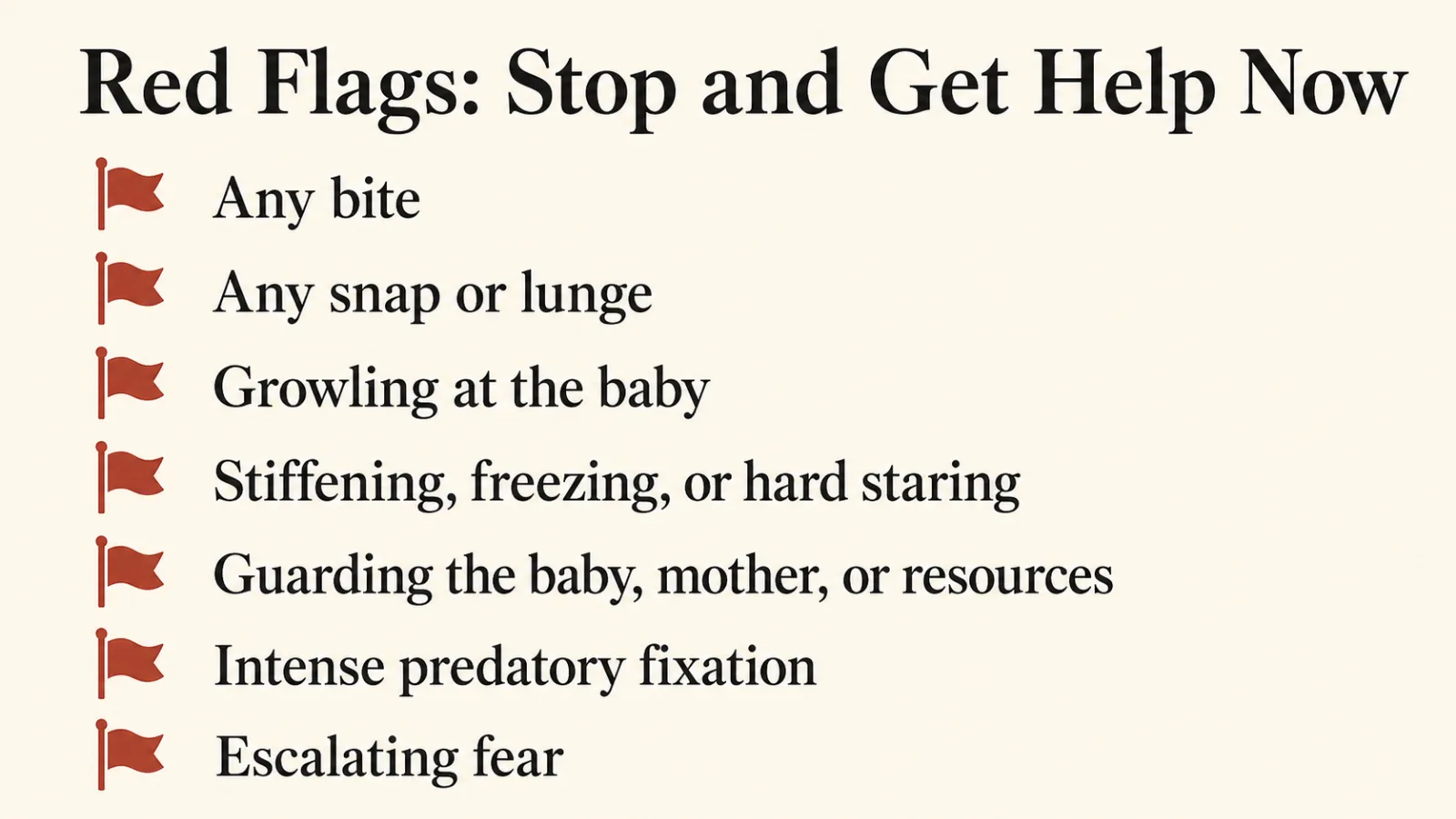
Tonight, or This Week? Triaging Urgency
Not every concern is the same size, and part of good judgment is knowing the difference between something that requires action this very moment and something that warrants a call in the next few days. So here is a simple way to sort it.
If there has been a bite, a snap, a lunge, or genuine predatory fixation toward your baby, that is a tonight-level situation. The immediate action is not training and it is not analysis, it is separation: your dog and your baby are physically and completely separated, using the management you built, so that there is zero possibility of contact, and they stay that way until a qualified professional has assessed the situation. This is not a punishment of the dog and it is not a verdict. It is simply the only responsible holding position while you get expert help, and it buys you the one thing you cannot afford to gamble with, which is your baby's safety in the interim. Then you make the calls: your veterinarian, and a qualified behavior professional, as soon as possible.
If instead you are seeing the quieter concerns, some stiffness, some avoidance, some worrying body language, a dog who is struggling more than you expected but has not snapped or bitten or fixated, that is a this-week situation. Tighten your management now so nothing can go wrong in the meantime, keep the dog under threshold and the baby safe, and get a professional consultation booked promptly rather than waiting to see if it resolves on its own. The distinction is essentially about whether there is an immediate risk of contact. Immediate risk means separate now and get help now. Elevated concern without immediate risk means manage tightly and get help soon. When you are genuinely unsure which one you are looking at, treat it as the more urgent one. Erring toward caution around an infant costs you very little and protects against the one kind of mistake you cannot undo.
What a Behavior Professional Actually Does, and How to Find a Good One
For a lot of pet parents the idea of hiring a behavior professional is vague and a little intimidating, so let me demystify it, because knowing what good help looks like is also how you avoid bad help, and in this field bad help can make things considerably worse.
A qualified behavior professional does, in a rigorous and experienced way, what this guide has walked you through in principle. They assess the whole picture, the dog, the history, the environment, the specific situation, and they build a structured, individualized behavior modification plan grounded in the same science this guide rests on. They identify what is actually driving the behavior, they design the management and the desensitization and counterconditioning to fit your specific dog, and they coach you through executing it, adjusting as they go, with a trained eye on details you would not know to watch. For the serious presentations, this is not a luxury. It is the difference between a plan built on guesswork and a plan built on expertise, around a baby, where the stakes could not be higher.
Now the part that matters most and that most pet parents do not know: this field is unregulated, which means anyone can call themselves a trainer or a behaviorist, and the methods on offer range from the genuinely science-based to the actively harmful. This is not a small caveat. A "trainer" who proposes to fix your dog's fear or aggression around the baby with prong collars, shock collars, alpha rolls, or any approach built on intimidation and punishment is not just using a different style, they are proposing something that the evidence associates with increased aggression, which is precisely the wrong risk to add to a home with an infant, exactly as we covered in Part One. Getting the wrong kind of help here is worse than getting none.
So screen for method. Look for professionals who describe their approach as reward-based, force-free, positive-reinforcement, or fear-free, and who are transparent and comfortable explaining exactly what they will do and why. Look for real, meaningful credentials rather than self-applied titles. And walk away, immediately, from anyone who talks about dominance, being the pack leader, or establishing yourself as alpha, or who wants to use tools or techniques that work by hurting or frightening your dog. Your instinct to protect your dog from that is correct, and you should trust it. If you feel the urge to check credentials and philosophy carefully before hiring, that urge is right, and a good professional will welcome the scrutiny rather than bristle at it.
Medication Is a Tool, Not a Surrender
There is one more form of professional help that deserves its own word, because pet parents so often resist it out of a misunderstanding, and the misunderstanding costs their dogs real relief.
For some dogs, particularly those with significant anxiety, fear, or reactivity that predates the baby, the right and kindest path includes a referral to a veterinary behaviorist, a veterinarian with specialist training in behavior, and it may include medication. And I want to meet the flinch head-on, the same way we did with the muzzle. Reaching for medication is not giving up on your dog, it is not a shortcut, and it is not a confession that you failed to train hard enough. For a dog whose baseline anxiety is high enough, that emotional state is a genuine physiological obstacle, and asking that dog to do the hard work of desensitization and counterconditioning while drowning in anxiety can be like asking someone to learn to swim in a storm. The right medication, prescribed by a qualified veterinary behaviorist, can lower the water enough that the learning can actually happen.
Medication is never a substitute for the management and the behavior work, and no responsible veterinary behaviorist would present it as one. It is an adjunct, a support that makes the real work possible for the dogs who need it, and for those dogs it is a welfare intervention, a way of relieving genuine suffering, not a chemical shortcut around good training. If your dog is carrying the kind of anxiety that this guide's methods alone are not reaching, a veterinary behavior consultation is one of the most compassionate calls you can make, and medication, if it is recommended, deserves to be considered on its merits rather than refused on principle. The anxiety and fear side of this, and how it is properly addressed, is covered in depth in the guide to fearful, anxious, and reactive dogs.
The Hardest Conversation, Held Honestly
Now the part that most guides will not touch at all, and that the ones which do touch it usually handle either by shaming people for considering it or by pretending it never has to be considered. I am going to do neither. If you are reading this because you are frightened that your situation might be one of the ones that does not have a happy resolution, you deserve honesty and you deserve to not be shamed, so that is what you will get here.
The truth is that most families who prepare well and get help when they need it are able to build a safe home for both their dog and their baby. That is the ordinary outcome, and if you have read this far you have already done more than most to secure it. But it is not every outcome, and being honest with you means saying that a small number of situations cannot be made safe for an infant, no matter how much everyone involved loves the dog and wants it to work. Pretending otherwise would not be kind. It would be dishonest in a way that could put a baby at risk, and I will not do that to you.
If you reach the point of wondering whether your dog can stay, please do two things before you conclude anything. First, get a genuinely qualified professional assessment, a veterinary behaviorist or a highly credentialed force-free behavior consultant, because this is not a judgment to make alone, in fear, at three in the morning, and because a good professional can often see options and a prognosis that you, in the middle of it, cannot. Some situations that feel hopeless are workable with the right expert help, and you owe your dog and yourself that assessment before any final decision. And second, if the honest professional conclusion is that the situation cannot be made safe, allow yourself to consider the remaining paths without shame, because a responsible, loving person can arrive here through no failure of their own.
Responsible rehoming, when it is the right answer, means finding the dog a genuinely appropriate new home, one without young children, with people who know the dog's full history because you told them honestly and completely, where the dog can live safely and well. This is not abandonment. Done honestly, it can be an act of love and responsibility toward both your dog and your child, placing the dog somewhere she can succeed rather than somewhere she is a daily danger. It is a painful decision and it is sometimes the right and ethical one, and a person who makes it thoughtfully, with full disclosure, deserves compassion rather than judgment.
And there is the hardest path of all, which I will name plainly because you deserve honesty even here. In the gravest cases, a dog with a serious bite history and a genuinely poor prognosis, where the dog is a real danger and cannot safely be placed anywhere and is often suffering profoundly themselves, behavioral euthanasia, guided by a veterinary behaviorist, is a legitimate and sometimes the most compassionate and responsible decision, terrible as it is. I am not raising this to frighten the great majority of readers for whom it will never be relevant, and it is not relevant to most of you. I am naming it because the tiny number of families facing it are often facing it in total isolation, drowning in guilt and grief and unable to find anyone willing to speak about it honestly, and they deserve to know that making this decision with veterinary guidance, out of genuine necessity and love, does not make them monsters. It makes them people carrying one of the heaviest things a pet parent can carry, and they deserve support and compassion, not judgment, in carrying it.
If you are anywhere near this territory, do not walk through it alone. Get the professional assessment. Lean on people who understand. And know that arriving at a hard outcome, after genuinely trying and with expert guidance, is not a moral failure. It is sometimes simply the hardest part of loving an animal responsibly.
A Brief, Honest Word on Liability
Before we close, a practical note that responsible pet parents should hear, offered as information and not as legal advice, because I am a behavior professional and not an attorney.
If you live in Arizona, as many readers of this guide do, you should know that Arizona is a strict-liability state for dog bites. Under Arizona law, a dog's owner is generally liable for damages if the dog bites someone who is lawfully present, including on the owner's own property, regardless of whether the dog has ever shown aggression before and regardless of whether the owner had any reason to expect it. In plain terms, the old idea of "one free bite" does not apply here; there is generally no legal grace period for a first bite. There are specific provisions and exceptions in the statute, and the details matter, so if you ever have a real liability question you should consult an actual attorney rather than rely on a summary. The reason I raise it at all is simply that it underscores, from yet another direction, the entire thesis of this guide: prevention and management are not optional niceties. They protect your child, they protect your dog, and they protect your family in ways that reach even into the legal realm. Everything this guide has asked you to do is, among other things, the responsible thing from a liability standpoint too.
When to Call Us
If you have recognized your own dog in the harder parts of this guide, or you simply want expert eyes on your situation before your baby arrives, that is exactly what we are here for. Working with a qualified professional early is one of the best decisions you can make, and it is the one that parents who have lived through this transition most often recommend to each other. There is no shame in it, and a great deal of wisdom.
Work With a Certified Canine Behaviorist in Phoenix
Every consultation begins with a full functional behavior assessment and ends with a clear, force-free, evidence-based plan built for your dog, your home, and your timeline. In-home consultations across Phoenix, Scottsdale, Mesa, Chandler, Gilbert, and the greater Phoenix metro area, and virtual consultations for pet parents anywhere. If your dog gives you any real concern, the best time to start is now.
The Whole Guide, in One Breath
You have read a long and thorough guide, so let me give you the entire thing compressed into what actually matters, the ideas to carry with you when the details blur.
Your goal is a dog who finds your baby boring, not a dog who loves your baby. Behavior comes from emotion, so you change how your dog feels, not just what she does, and you never punish the growl that is trying to warn you. You build a home where the wrong thing cannot happen, because management protects your baby in all the moments your attention cannot, and supervision, real proactive supervision, is not the same as being in the room. You teach the handful of skills that matter, settle above all. You change how your dog feels about the baby's sounds and smells and movement, slowly, under threshold, because slow is the work. You start early, because the dogs who need the most time belong to the families most tempted to wait. You prepare for the moments and then hold them lightly, because the day is not the test. You keep going after homecoming, through the crawling and toddler stages, because that is where the real risk lives and where everyone else stops. You take care of yourself and your family, because your calm is your dog's calm. And you know the edge of your own skill, and you get help before you reach it, without shame, because that is what the best pet parents do.
Do those things, and you give your dog and your baby the best possible chance at the life you are hoping for: an ordinary, safe, unremarkable life together, in which nothing dramatic happens, because you did the quiet work to make sure it never had to. That is the whole goal. Boring is the win. Go and earn it, starting today.
Frequently Asked Questions About Dogs and New Babies
My dog growled at my baby. What should I do?
Should I rehome my dog before my baby arrives?
Why is my dog barking when the baby cries?
Is my dog jealous of my new baby?
When should I start preparing my dog for a baby?
How do I introduce my dog to my newborn?
Is it safe to leave my dog alone with my baby?
Does bringing home a hospital blanket really help my dog accept the baby?
Why does bite risk to children increase after the newborn stage?
Do aversive tools like shock or prong collars help with a dog and a new baby?

Will Bangura, M.S., CAB-ICB
CBCC-KA, CPDT-KA, FDM, FFCP
Will Bangura, M.S., CAB-ICB, CBCC-KA, CPDT-KA, FDM, FFCP, is a Certified Canine Behaviorist with over 35 years of experience specializing in severe aggression, fear, anxiety, reactivity, phobias, and compulsive disorders in dogs. He holds a Master’s Degree in Psychology, has completed postgraduate studies in canine cognition through Harvard, and is accredited as a Certified Canine Behaviorist through International Canine Behaviorists, one of only three CAB-ICB Certified Canine Behaviorists in the United States and the only one in Arizona.
His additional credentials include Certified Behavior Consultant Canine (CBCC-KA) and Certified Professional Dog Trainer (CPDT-KA) through the Certification Council for Professional Dog Trainers, certification in Applied Ethology through Family Dog Mediation (FDM), and Fear Free Certified Professional (FFCP).
Will is the author of Sniff to Soothe, host of the Dog Training Today podcast, and a court-recognized expert witness in canine behavior. His clinical work is grounded in behavioral psychology, applied behavior analysis, learning theory, and affective neuroscience: every case begins with a functional behavior assessment and is treated through management, skill building, and evidence-based behavior modification using systematic desensitization and counterconditioning.
As the founder of Phoenix Dog Training, Will provides in-home behavior consultations throughout the Phoenix metro area, including Phoenix, Scottsdale, Mesa, Chandler, and Gilbert, and virtual behavior consultations for pet parents nationwide.
If Your Dog Gives You Any Real Concern, Start Early
Preparing a dog for a baby, especially a dog whose behavior worries you, is one of the best reasons there is to get expert eyes on your situation before the baby arrives. A behavior consultation starts with a full functional behavior assessment and ends with a clear, force-free, evidence-based plan built for your dog, your home, and your timeline. Serving Phoenix, Scottsdale, Mesa, Chandler, Gilbert, and the greater Phoenix metro area in person, and pet parents everywhere virtually.