
Barking, Howling, or Whining
Begins around your departure and continues while you are gone.


Will Bangura, M.S. | Certified Canine Behaviorist
If your dog panics the moment you leave, barking, howling, pacing, drooling, destroying the door, or having accidents when home alone, you are living with a kind of daily stress most people never see. Separation anxiety is driven by genuine fear and panic, not disobedience or spite, and that means it can change. As a Phoenix separation anxiety specialist, I help pet parents find the real cause and teach their dog to feel safe alone, using evidence-based, force-free behavior modification, systematic desensitization, and counterconditioning.
No shock collars. No prong collars. No crating a dog through panic. Will Bangura helps Phoenix pet parents with separation anxiety by identifying what is driving the panic and changing the underlying emotional response, not by suppressing the distress.

Will Bangura, M.S., CAB-ICB
CBCC-KA, CPDT-KA, FDM, FFCP
Arizona's only CAB-ICB Certified Canine Behaviorist through International Canine Behaviourists, and one of only three in the United States, with more than 35 years of experience working with fear, anxiety, separation-related panic, and complex canine behavior cases.
As a certified canine behaviorist serving Phoenix, Will evaluates the underlying emotional, environmental, medical, and learning factors that drive separation anxiety, fear, and other complex behavior problems.
By changing the underlying emotion, not just the behavior, Will helps pet parents across Phoenix teach their dogs to feel safe when left alone.
M.S.
Psychology
CAB-ICB
Certified Canine Behaviorist
CBCC-KA
Certified Behavior Consultant Canine
CPDT-KA
Certified Professional Dog Trainer
FDM
Applied Ethology / Family Dog Mediation
FFCP
Fear Free Certified Professional
You Are Not Alone
If you are reading this at the end of another hard day, you already know the sound. The bark that starts before you reach the car. The scratched door. The message from a neighbor. Maybe you have started planning your whole life around the few minutes your dog can tolerate before the panic sets in.
This is not your fault. You did not cause it by loving your dog too much, and your dog is not getting back at you. What you are living with has a name, separation anxiety, and it is one of the most treatable serious behavior conditions I work with. It does not respond to obedience or the usual tools. It responds to a structured, evidence-based plan that works with your dog's emotions instead of against them.
No shock. No prong. No fear.
Recognizing It
These cluster into a recognizable pattern. What matters is that they center on your absence, or the moments you prepare to leave.
Begins around your departure and continues while you are gone.

Doors, windows, blinds, and frames, rather than random chewing.

Drooling and restlessness the moment they sense you are leaving.

Even high-value treats they would normally never turn down.

Sometimes to the point of injuring paws, nails, mouth, or teeth.

Following you everywhere, and accidents from a house-trained dog, only when alone.
The Clinical Picture
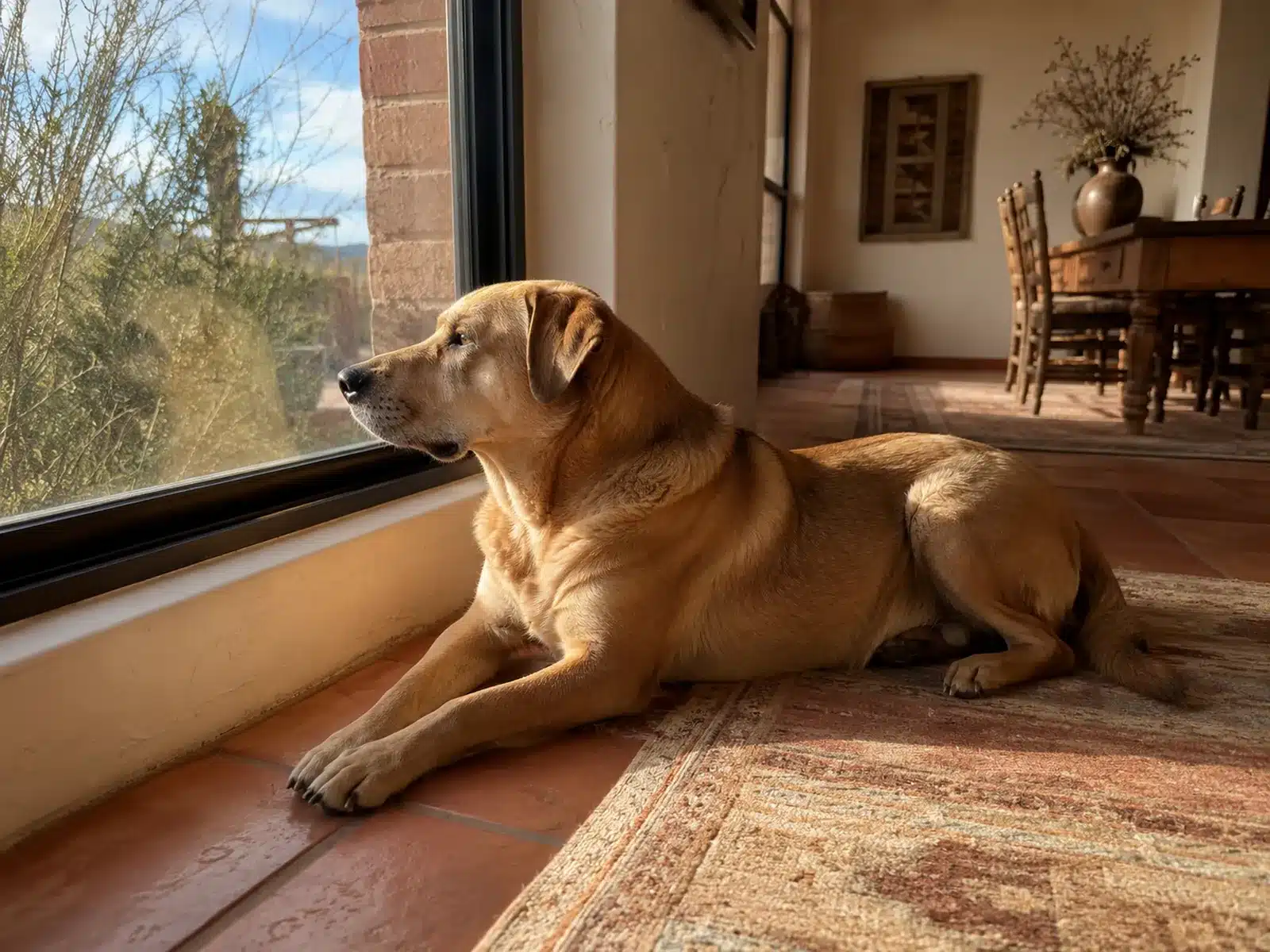
When a dog with separation anxiety is left alone, they do not feel bored or defiant. They experience something close to panic, a genuine distress response driven by the brain's fear systems. The barking, destruction, and soiling are not choices. They are the visible signs of a frightened animal.
You cannot correct panic, and you cannot command it away. A frightened animal is not in a state to learn obedience, and punishing the fear only adds a second problem. What changes separation anxiety is changing the underlying emotion. Behavior changes when emotion changes. That principle sits at the center of everything I do. Research supports it: in one controlled study, dogs treated for separation-related problems shifted toward a more optimistic underlying emotional state, not just fewer outward signs, though the sample was small (Karagiannis et al., 2015, doi.org/10.1186/s12917-015-0373-1).
The Misunderstanding That Keeps You Stuck
Dogs do not plan revenge, and they do not connect a mess made in a panic with your face at the door. The guilty look is appeasement, not guilt. This is a fear disorder, not a dog running the household. Once you let that go, the guilt lifts and the path forward finally makes sense.
What Does Not Work, and Why
For a dog already frightened of being alone, confinement can intensify the panic. Some injure themselves trying to escape. A crate is not a treatment for separation panic, and for many dogs it makes things worse.
The distress is about the absence of their person, not a lack of any company. A second dog usually does nothing for the anxiety, and now you are managing two.
Flooding a panicking animal past what it can tolerate does not teach calm. It deepens the fear and erodes trust. Effective work keeps your dog under threshold, never pushed into panic and left there.
Separation anxiety happens in your home during real absences, so sending your dog away does not transfer. A bark collar suppresses the signal, not the fear. If a tool works, it is because it is aversive, and adding aversives to a frightened dog is the wrong direction.
The Method
Structured, individualized, and paced to your dog. Each stage sets up the next, and your dog only advances when genuinely ready.
A functional assessment of antecedents, behavior, and consequences, so we know exactly where calm tips into distress.
Prevent absences that push your dog over threshold, so every day stops reinforcing the fear while we build tolerance.
Graduated alone-time paired with counterconditioning, so being alone comes to predict safety instead of fear.
Difficulty rises only when your dog meets clear criteria, which keeps the work sub-threshold and moving forward.
The Program
Recommended after the assessment confirms separation anxiety, built around your dog's threshold. Not a one-size package.
Honest about outcomes: many dogs become genuinely comfortable alone, but this is not a quick fix. Mild cases can move in weeks; moderate to severe often take months.
You have seen how the work is structured, step by step and paced to your dog. The next move is simple: a conversation about what your dog is going through, with no pressure and no judgment.
Prefer to talk now? Call (602) 769-1411
Real Results, Real Pet Parents
These are real Google reviews from Phoenix pet parents whose dogs struggled with separation anxiety, reactivity, and fear.

Sasha: From Panic to Peace
Our Pitbull Sasha suffered from debilitating separation anxiety and reactivity. We were at our wits' end until we found Will Bangura at Phoenix Dog Training. Will's expertise in positive reinforcement was exactly what she needed. He taught us how to create a safe and calm environment for Sasha reducing her anxiety significantly. She was able to stay alone without panic, and her reactive behavior has diminished greatly. Will is a certified dog behaviorist who truly cares about the dogs he works with. We can't thank him enough.

From Fear to Confidence
I can't recommend Will Bangura enough! My dog had severe fear aggression, as well as crippling anxiety and separation anxiety. After trying several other trainers with no success, I found Will, a certified dog behaviorist, and our lives have changed completely. He truly understands the complexities of dog aggression and anxiety and works from a science-based approach that made all the difference. Within just a few sessions, Will helped my dog feel more confident and less reactive. He taught me how to read my dog's signals and how to manage situations that would usually trigger fear or anxiety. Now, my dog is much calmer and happier, and the fear-based aggression is significantly reduced. His separation anxiety, which used to cause so much stress for both of us, is no longer a major issue. Will's expertise in dealing with aggressive dogs with anxiety is unparalleled, and I'm so grateful for his guidance. If you're dealing with dog aggression or a dog with anxiety, I highly recommend working with Will Bangura. His professionalism, knowledge, and care for both the dog and the pet parent are outstanding.

Max: From Chaos to Calm
Life-Changing Dog Training, Will Bangura and Phoenix Dog Training Transformed Our Aggressive French Bulldog. I can't say enough about the incredible experience we had with Phoenix Dog Training and Certified Dog Behaviorist Will Bangura. We brought our 4-year-old French bulldog, Max, to Will because of severe aggression and reactivity towards people and other dogs, as well as debilitating separation anxiety. From the very first consultation, it was clear that Will's expertise and compassionate approach set him apart. He took the time to thoroughly understand Max's history, behavior triggers, and our concerns as pet parents. His knowledge and experience were evident as he explained the science-based techniques he would use to help Max. Will implemented a comprehensive behavior modification plan tailored specifically to Max's needs. His step-by-step guidance and positive reinforcement strategies made a world of difference. Within a few sessions, we noticed a significant reduction in Max's aggression and reactivity. Will's methods not only helped Max become more relaxed and confident around people and dogs but also strengthened our bond with him. One of the most challenging issues was Max's separation anxiety. Will provided us with practical and effective strategies to ease Max's anxiety when left alone. His approach was gradual and thoughtful, ensuring that Max was comfortable every step of the way. Thanks to Will, Max can now stay calm and relaxed even when we're not home, something we never thought possible. What truly sets Will apart is his dedication and genuine care for his clients. He was always available to answer our questions and provide support throughout the process. His passion for helping dogs and their families is evident in every interaction. If you're looking for a certified dog behaviorist who delivers real, lasting results, look no further than Will Bangura at Phoenix Dog Training. He has transformed our lives and given Max the chance to be a happy, well-adjusted dog. We highly recommend Will to anyone struggling with dog behavior issues. Thank you, Will, for your outstanding work and for giving us the gift of a harmonious life with Max!
Who Should Help
None of these is "bad." They occupy different scopes, and separation anxiety fits some better than others.
| General trainer | Board-and-train | CSAT / SA Pro | Certified Canine Behaviorist | Veterinary behaviorist | |
|---|---|---|---|---|---|
| Assesses panic and fear | Sometimes | Rarely | Yes, for SA | Yes, across conditions | Yes |
| Builds sub-threshold plans | Not typically | Not typically | Yes | Yes | Yes |
| Screens comorbid anxiety | Limited | Limited | Limited to moderate | Yes | Yes |
| Coordinates with your vet | Sometimes | Rarely | Refers | Yes, collaborates | Yes |
| Can prescribe medication | No | No | No | No, collaborates | Yes |
| Best fit | Basic training | Usually not primary for SA | Straightforward SA | Complex or medication-relevant SA | Diagnosis and prescription |
Manners and cues. Panic assessment sometimes. Best for basic training goals.
Off-site work that does not recreate home absences. Usually not the primary treatment for SA.
Specialized in SA protocols. A strong choice for straightforward cases.
The full behavior picture, comorbidity screening, and veterinary collaboration. Best for complex, failed-before, or medication-relevant cases. This is the role I fill.
Diagnoses and prescribes. Best when medication or a medical work-up is needed.
I fill the Certified Canine Behaviorist role, and because I also hold professional training credentials, I can carry a case from assessment through the hands-on plan and into veterinary collaboration when it is needed.
What Every Pet Parent Should Understand
The behavior is driven by fear, not by a lack of obedience or a bid for control.
Silencing the barking with an aversive leaves the fear intact, and suppressed fear can surface as aggression.
A frightened dog cannot learn. Every step is built to keep your dog calm enough to take in something new.
For moderate to severe cases, the strongest evidence supports combining behavior modification with veterinary-prescribed medication, which can help a dog stay under threshold long enough to learn (Simpson et al., 2007, pubmed.ncbi.nlm.nih.gov/17447222; Landsberg et al., 2008, doi.org/10.1016/j.jveb.2007.09.001). It is not a substitute for the work, and not every dog needs it.
Small, daily, sub-threshold repetitions change the emotion. Dramatic exposures set it back.
Where We Work
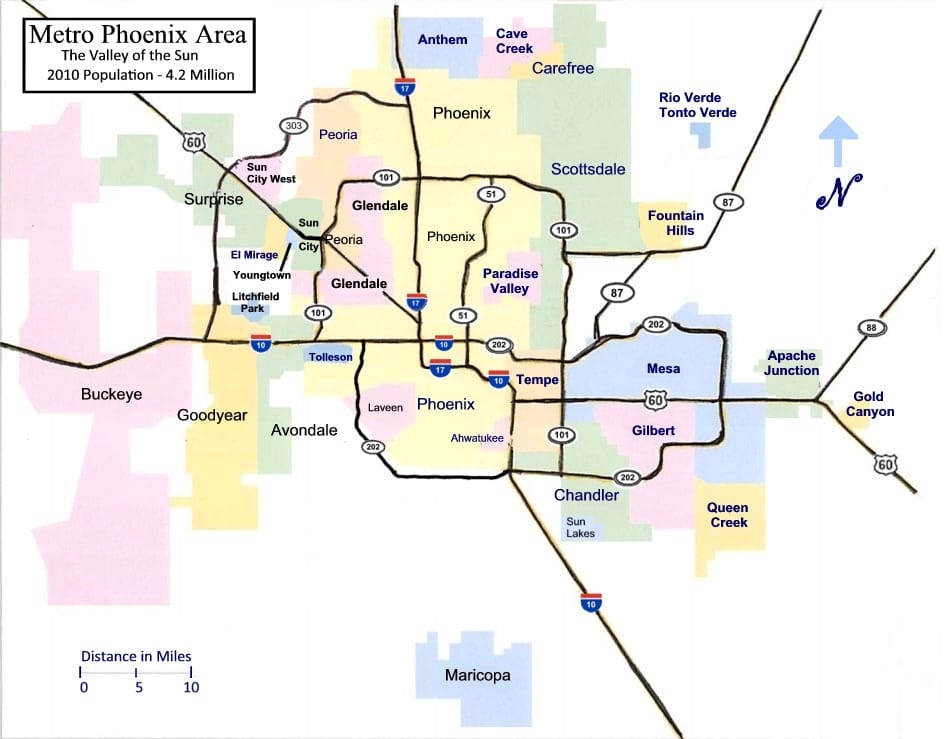
Because separation anxiety centers on what your dog does when alone, much of this work is virtual, which lets me observe the real behavior. In-home consultations are available across the Valley when they are the right fit.
Phoenix, Scottsdale, and Paradise Valley. Including Arcadia, the Biltmore corridor, and North Scottsdale communities.
The East Valley. Mesa, Chandler, Gilbert, and Tempe.
And beyond. Peoria, Queen Creek, Desert Ridge, McCormick Ranch, Grayhawk, DC Ranch, Troon, Kierland, Ahwatukee, and Ocotillo.
Two of the communities I work in most are Scottsdale and Paradise Valley. You can also explore my dog training in Scottsdale and dog training in Paradise Valley.

Meet Your Behaviorist
A Certified Canine Behaviorist with a Master's degree and more than 35 years of experience with fear, anxiety, reactivity, and separation-related panic. One of only three CAB-ICB certified canine behaviorists in the United States and the only one in Arizona, and a Fear Free Certified Professional (CBCC-KA, CPDT-KA, FDM, FFCP).
Author of Sniff to Soothe, host of the Dog Training Today podcast, and an expert witness in canine behavior cases. Every plan rests on one conviction: lasting change comes from changing how a dog feels, not from suppressing what a dog does.
Getting Started
No pressure, no judgment, and no long wait to feel like you finally have a plan. Here is how it works.
Book a free 15-minute call or a consultation. We talk through what your dog is doing when alone, what you have already tried, and what you are hoping to change.
A 90 to 120 minute assessment where we map your dog's history, departure cues, and panic threshold, and build a plan shaped around your specific dog and household.
Weekly private sessions and daily support between them, with the plan adjusted as your dog progresses and difficulty rising only when your dog is genuinely ready.
Questions, Answered
Separation anxiety is treated by changing the underlying fear, not by obedience or punishment. The core method is management to prevent panic rehearsal, followed by systematic desensitization to being alone in small steps kept below the dog's panic threshold, paired with counterconditioning so that alone-time comes to feel safe. In moderate to severe cases, a veterinarian may add medication to support the process. Progress is measured against clear criteria, and the dog advances only when genuinely ready.
It depends on severity and consistency. Mild cases can improve in a matter of weeks, while moderate to severe cases often take several months of structured work. The early goal is not long absences. It is helping your dog stay calm below threshold so learning can happen. Any professional promising a guaranteed fix in a set number of days is not being honest about how fear-based behavior changes.
For some dogs, no, and it can make things worse. A dog who is already relaxed in a crate may be fine, but a dog who panics when confined can escalate, sometimes injuring themselves trying to escape. Crating is a management tool for certain problems, not a treatment for separation-related panic. The decision should be based on your individual dog's response, not on a rule.
Usually not as a treatment. For most dogs with separation anxiety, the distress is about the absence of their specific person, not a lack of any company, so a second dog often does not resolve it and can add new challenges. A companion animal is a big, permanent commitment to make in the hope of solving a problem that has a more direct, evidence-based solution.
No. Dogs do not act out of spite or connect a mess made hours ago with your return. Destruction during your absence is a panic response, and the guilty look is appeasement to your body language, not evidence of guilt. Understanding this is often the turning point, because it shifts the focus from correcting a choice your dog never made to treating the fear that is actually driving the behavior.
Many dogs improve dramatically and go on to relax comfortably when alone. Whether cure is the right word depends on the dog, because outcomes vary with severity, consistency, the home environment, and whether medication is part of the plan. The realistic and honest goal is a dog who feels safe alone, with relapse prevention built in so progress holds.
A CSAT, or Certified Separation Anxiety Trainer, is a professional who has specialized specifically in separation anxiety training protocols. A Certified Canine Behaviorist holds broader clinical qualifications and assesses separation anxiety within the wider picture of fear, learning history, comorbid anxiety, household factors, and veterinary collaboration when medication may help. For a straightforward case a skilled CSAT is an excellent choice; for a complex or medication-relevant case, a behaviorist is the higher tier of care.
Yes, and for this condition it is often especially appropriate. Because separation anxiety happens when your dog is alone in the home, working by video lets me observe your dog's real departure cues and true alone-time behavior, which a stranger physically in the room would change. The same structured program, weekly sessions, and daily support are delivered virtually.
Rarely on their own. Untreated separation anxiety tends to persist and often worsens, because every panicked absence rehearses and strengthens the pattern. Some young dogs improve as they mature and learn independence, but true separation anxiety usually needs structured help. Waiting typically makes the work harder, not easier.
Not always. Many mild cases improve with behavior modification alone. For moderate to severe separation anxiety, veterinary-prescribed medication can help a dog stay under threshold long enough to learn, and the strongest evidence supports combining behavior modification with medication in those cases. Medication is not a substitute for training and not every dog needs it. I do not prescribe; I recognize when the conversation is worth having and coordinate with your veterinarian.
Cost depends on severity, the level of support your dog needs, and whether the case calls for a consultation, follow-up, or the full six-week private program. The first step is the 90 to 120 minute initial behavior consultation, so the plan and the investment are based on your dog's actual needs rather than a guess. A free 15-minute call is available first if you want to understand fit before scheduling.
I serve the entire Phoenix metro area, including Phoenix, Scottsdale, Paradise Valley, Mesa, Chandler, Gilbert, Tempe, Peoria, and Queen Creek, with in-home consultations where appropriate. Because separation anxiety work is so well suited to video, I also work with pet parents nationwide through the virtual program.
Living with a dog who panics the moment you leave is exhausting, and waiting rarely makes it better. Whether your dog's separation anxiety feels manageable or hopeless, the first step is the same: a conversation.
Prefer to talk now? Call (602) 769-1411