
← Dog Body Language: The Definitive Guide
The Definitive Guide · Tail PositionsDog Tail Positions: What the Height Says Before the Wag Begins
Before a tail ever moves, its carriage is already broadcasting the dog's emotional state. High, neutral, low, or tucked: four positions, four different messages, and one rule that makes them all readable, because every dog's baseline is different.
The Tail as a Barometer, Calibrated to Each Dog
The tail is one of the most expressive instruments on a dog's body, and its resting height, its carriage, is a running readout of emotional state, entirely separate from whether it is wagging. As a broad rule, tail height tracks confidence and arousal: a tail carried high signals high arousal and assertiveness, a tail at its natural mid-level signals a relaxed baseline, a tail dropped low signals uncertainty or unease, and a tail tucked between the legs signals fear. Four positions, arranged along a single emotional axis, and once you learn to see them, you can read a dog's state from across a park before you can make out a single feature of his face.
But here is the fact that makes tail reading genuinely skilled rather than mechanical, and skipping it is the most common mistake people make with tails: there is no universal neutral. Breed anatomy varies enormously. A husky or a pug carries its tail curled up over the back all day as a matter of structure, not arousal. A greyhound or a whippet carries its natural, relaxed tail low, tucked-adjacent, as ordinary anatomy. A beagle's happy baseline rides higher than a borzoi's ever will. Read a sighthound's naturally low tail as fear, or a spitz breed's naturally high curl as assertive arousal, and you have misdiagnosed anatomy as emotion. The positions on this page describe departures from an individual dog's own baseline, not absolute angles measured against some imaginary average dog.
That gives you the single piece of homework this page asks of you, and it costs nothing: learn your own dog's neutral. Watch where his tail sits on a lazy evening at home, fully relaxed, nothing happening. That carriage is his zero point, and every meaningful tail signal for the rest of his life will be a movement above or below it. A dog whose tail rides two inches higher than his baseline is aroused, whatever the absolute angle. A dog whose tail drops below his baseline is uneasy, even if it never goes anywhere near his legs. Docked tails complicate all of this honestly and considerably, removing much of the instrument, which places more weight on ears, eyes, mouth, and posture, the rest of the cluster this whole guide teaches. And that is the standing rule here as everywhere: the tail is one word in the sentence, and the sentence is the whole dog, read in context. The foundation is in the main guide, and the tail's motion, as opposed to its position, has its own complete guide.
The High Tail: Arousal, Alertness, and Assertion
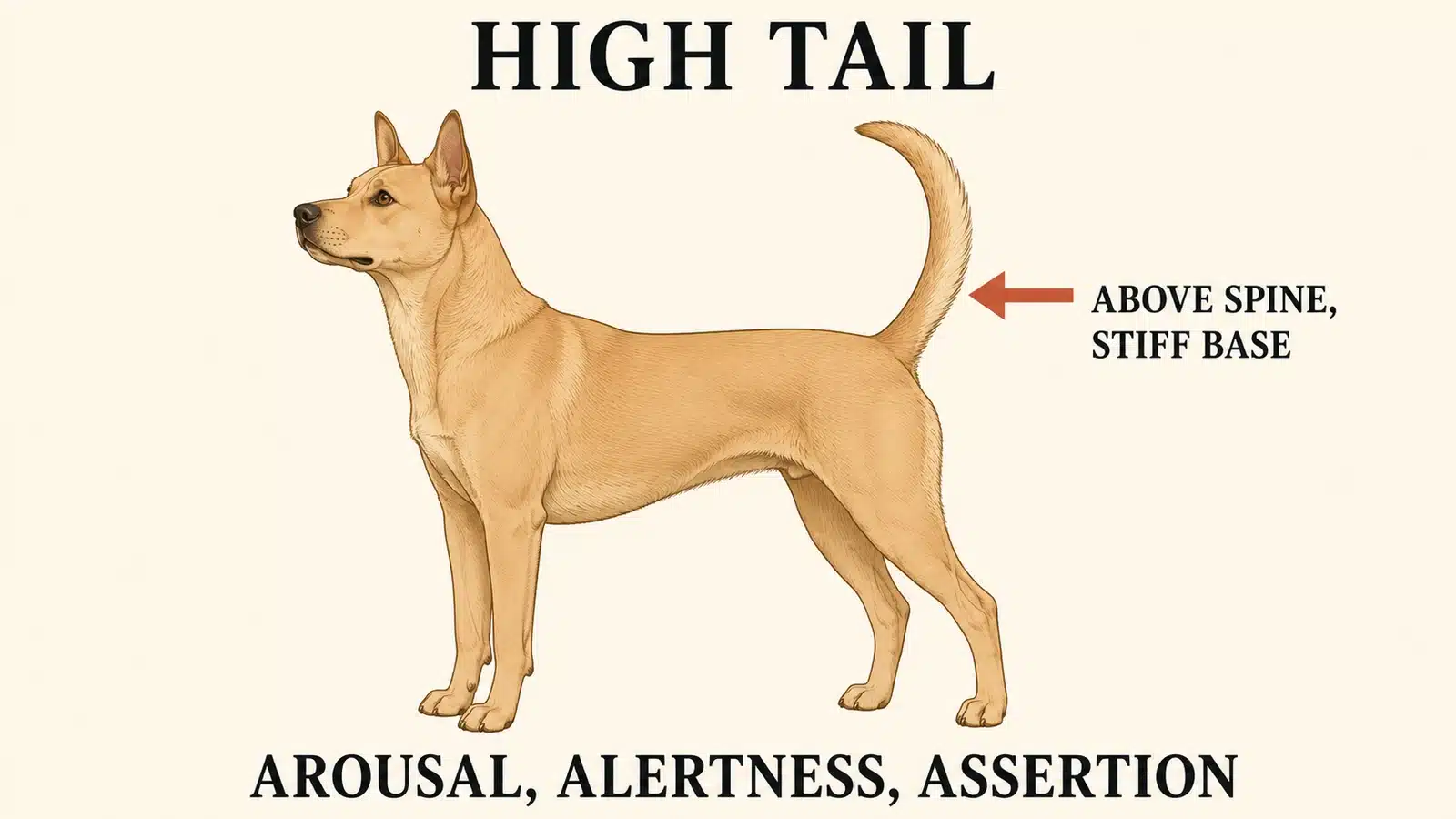
A tail carried above the dog's natural baseline, raised over the level of the spine, sometimes arched up and over the back, signals elevated arousal, alertness, and, at its higher and stiffer extremes, assertiveness or dominance display. The mechanism is partly practical: a raised tail lifts the scent glands of the hindquarters higher into the air, broadcasting the dog's chemical signature more widely, which is exactly what a confident, engaged, socially forward dog does. The high tail says: I am here, I am alert, and I am not retreating.
The critical variable inside this position is stiffness, because a high tail spans everything from cheerful engagement to serious warning. A high tail with a loose, softly waving quality on a wiggly, bright-eyed dog is confident, happy arousal. The same height with a rigid base, held stiff or vibrating in a tight quiver, on a stiff, hard-eyed, forward-loaded body, is the flagged tail covered in the warning signals guide, and it means assertion and potential escalation, not friendliness. Height tells you the arousal is up. The base and the body tell you what kind of arousal it is. When you see a high, stiff tail on a rigid dog, give room and read carefully before assuming anything warm.
The Neutral Tail: The Baseline Everything Else Is Measured Against
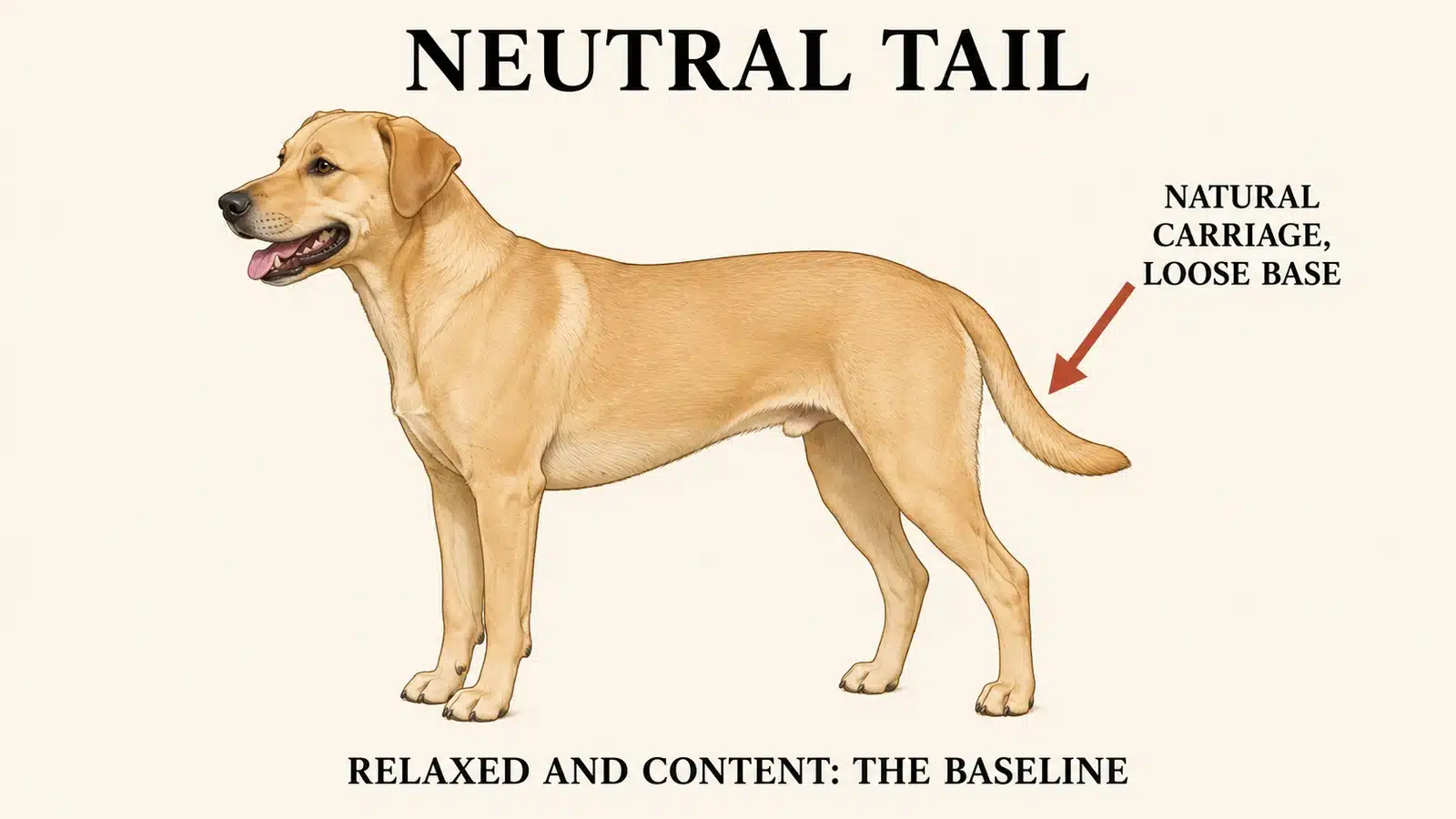
The neutral tail is the least dramatic position on this page and by far the most important, because it is the reference state every other tail signal is measured against. In neutral, the tail hangs in its natural, anatomically determined carriage, loose and unengaged at the base, neither lifted by arousal nor pressed down by worry. For one dog that neutral is a gentle downward curve; for another it is a relaxed saber; for a spitz breed it is a soft curl over the back. Whatever the shape, the defining quality is looseness: a neutral tail is a tail with no emotional job to do, on a dog who is relaxed and content.
This is the position to study deliberately, and it is genuinely worth an evening of your attention. Spend unhurried time watching your dog at rest until you can picture his neutral carriage precisely, because from that moment forward you own an early warning system that never switches off. Every meaningful tail signal is a departure from this baseline, and departures are only visible to someone who knows the baseline cold. A tail creeping above neutral tells you arousal is building before anything else on the body announces it; a tail sinking below neutral tells you confidence is draining while the dog still looks superficially fine. This is the same quiet homework the calming signals guide assigns for ears, and together the two baselines, ears and tail at rest, form the foundation of reading your individual dog rather than a textbook diagram of one.
The Low Tail: Uncertainty Before It Becomes Fear
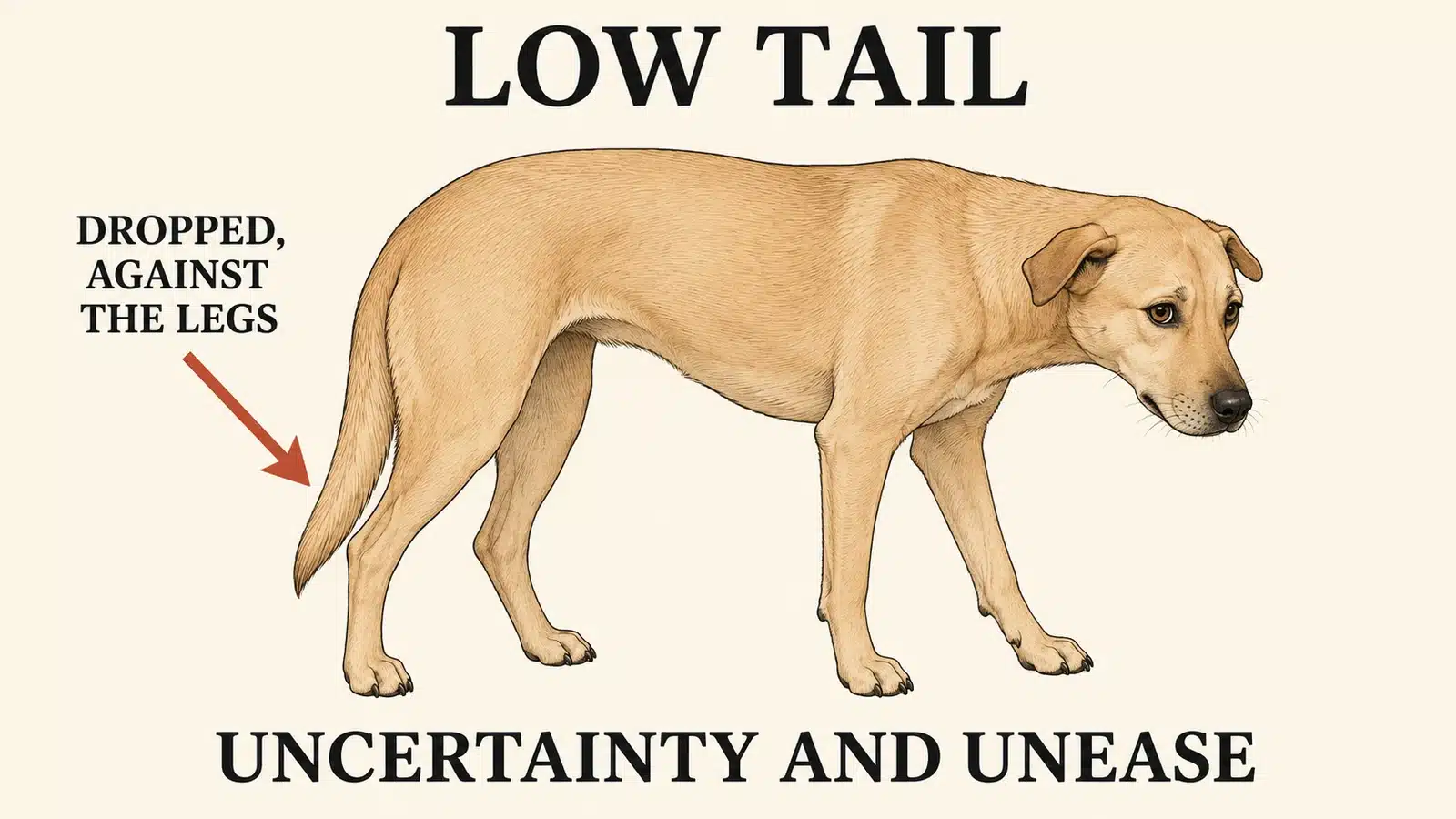
A tail dropped below the dog's baseline, hanging low and often close against the back of the hind legs but not yet clamped between them, signals uncertainty, unease, mild anxiety, or deference. It is the intermediate position on the downward side of the emotional axis, the tail of a dog whose confidence is ebbing but who has not yet arrived at outright fear. You will see it in dogs entering unfamiliar environments, meeting people or dogs they are unsure about, hearing something they cannot place, or absorbing a pet parent's tense mood. Often the tail is simply still and limp; sometimes it carries the small, slow, tentative wag of appeasement described in the appeasement signals guide.
The low tail earns more attention than it usually gets, precisely because it is undramatic. A tucked tail announces fear loudly enough that most people notice; the low tail whispers the same message earlier and gets missed. For a pet parent who has done the baseline homework, a tail sinking below neutral is one of the most useful early indicators there is, a signal that the current situation is beginning to exceed the dog's comfort while there is still ample time to respond easily. The response is the standing one for every below-baseline signal in this guide: identify what changed in the environment, lower the pressure or add distance, and let the dog regain his footing. Catch the low tail and act on it, and you will rarely meet the tucked one.
The Tucked Tail: Fear, Written in Anatomy
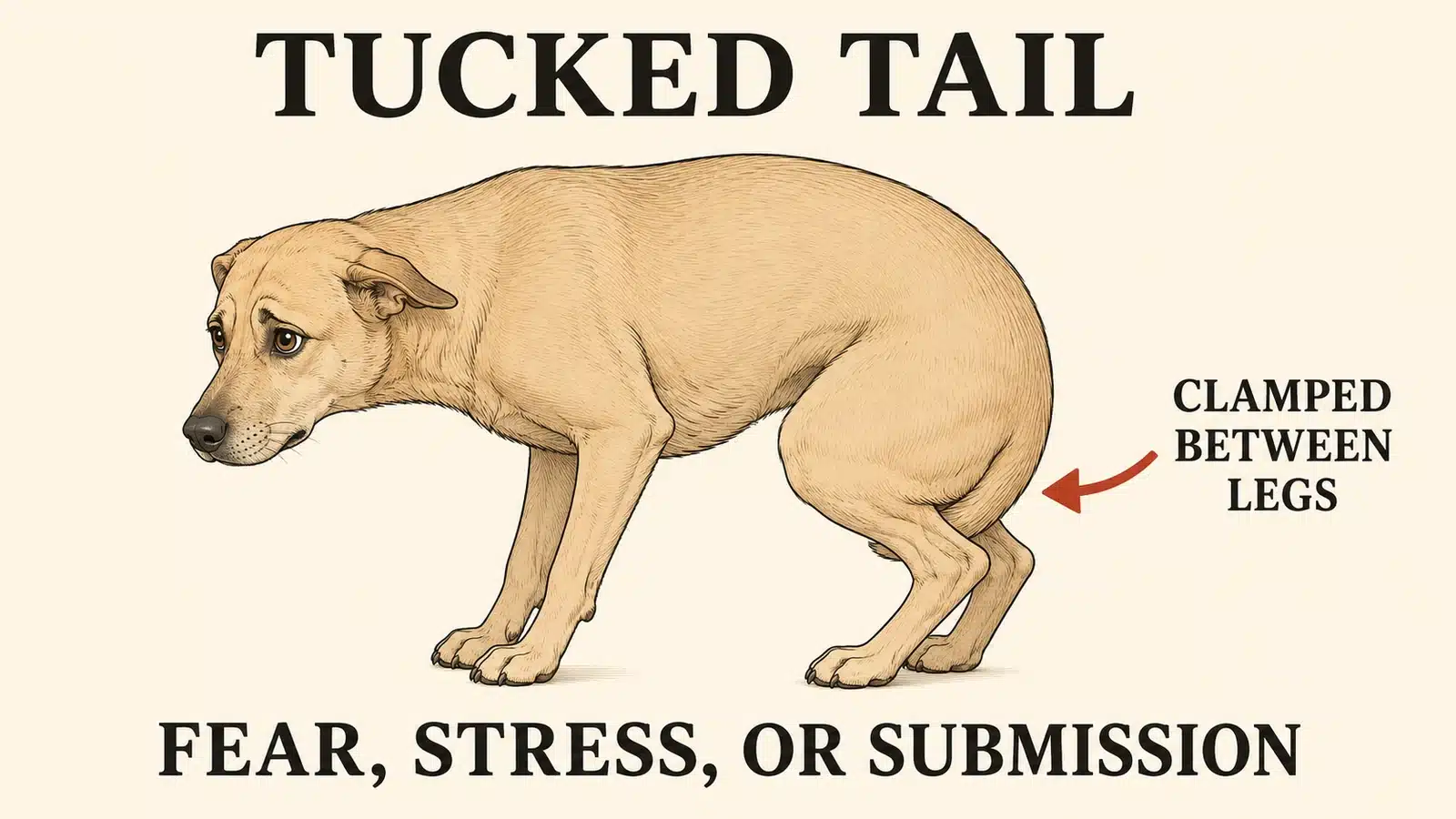
The tucked tail is the far end of the axis: the tail clamped down between the hind legs, often with the tip curling forward beneath the belly, on a dog whose hindquarters are frequently dipped and whose whole posture is compressing. This is fear, stress, or profound appeasement, and the anatomy of the posture explains itself. Tucking protects the vulnerable underside, physically shuts down the scent broadcast a raised tail amplifies, and completes the body-shrinking project that the pinned ears and lowered posture began. Where the high tail advertises presence, the tucked tail is an attempt to withdraw from the conversation entirely.
Degree matters, and reading it as a spectrum keeps you calibrated: a tail pressed lightly against the thighs is strong unease, a tail clamped hard between the legs is real fear, and a tail wrapped beneath the belly on a crouched, trembling dog is a five-alarm emotional state. The response at every degree is the same in kind and scales in urgency: something in the environment has exceeded what this dog can handle, and your job is to find it and reduce it, through distance, through ending the interaction, through getting the dog out of the situation, not to coax or drag him through it. A dog who tucks repeatedly in the same contexts, the clinic, the groomer, around particular people or dogs, is drawing you a map of a conditioned fear, and conditioned fears are precisely what systematic desensitization and counterconditioning exist to change. The stress-cluster context around the tucked tail is covered in depth in the stress signals guide.
The Tail Position Spectrum: Four Heights, One Axis
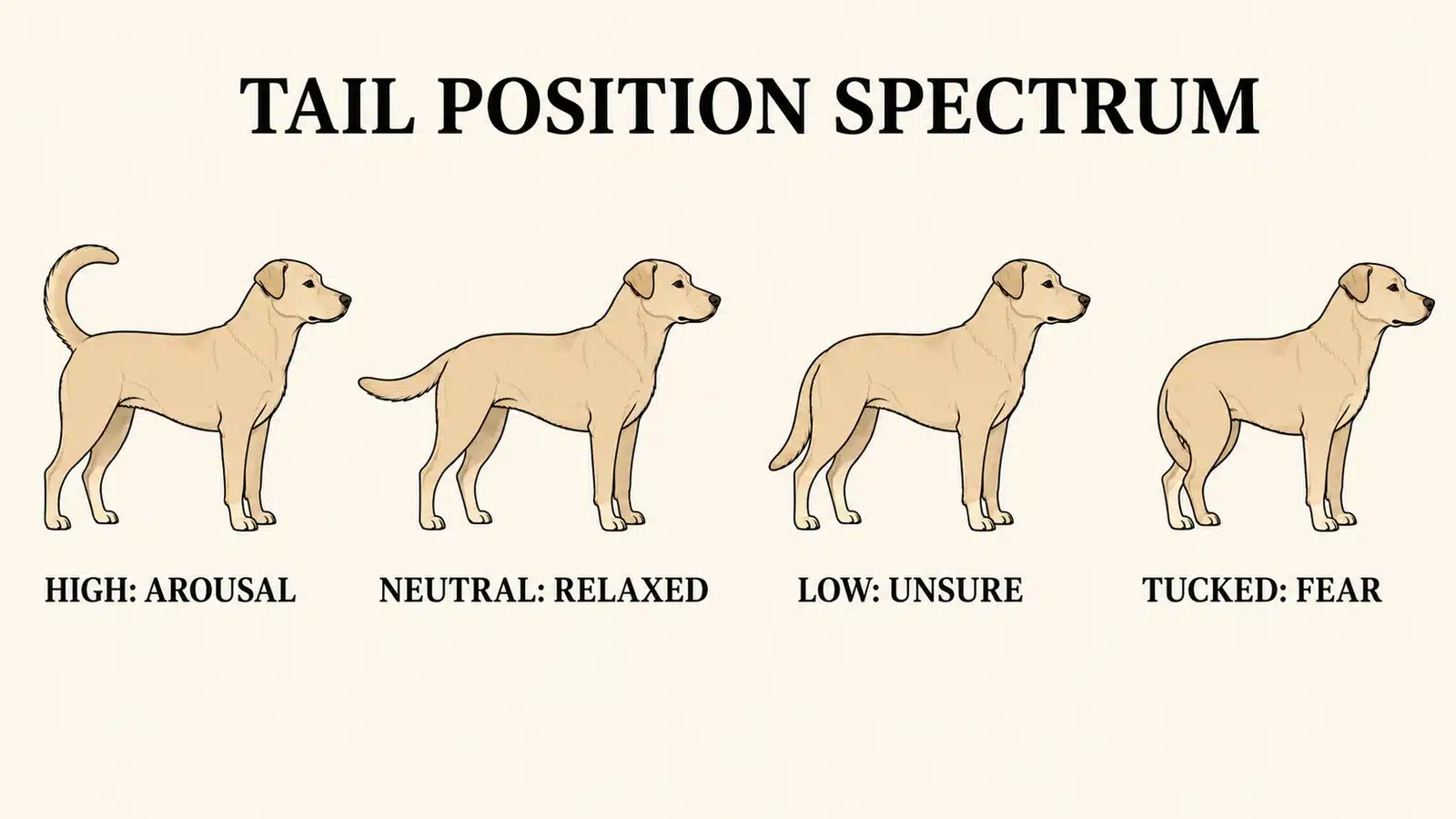
Seen side by side, the four positions resolve into a single clean instrument: one axis running from high arousal and assertion at the top, through the relaxed neutral baseline, down through uncertainty, to fear at the bottom. This is the value of the spectrum view, and it is worth committing the chart above to memory, because in the field you will never be reading a static diagram. You will be reading a moving tail on a moving dog, and what matters most is not the absolute position but the direction of travel. A tail rising from neutral means arousal is building. A tail sinking from neutral means confidence is draining. The trend is often more informative than the position itself, and it is visible seconds before anything else changes.
Two final calibrations complete the skill. First, remember that the spectrum floats on each dog's individual anatomy: the whole axis sits higher on a spitz and lower on a sighthound, which is why the baseline homework from earlier on this page is not optional. Second, remember that position is only half of what the tail reports, because a tail at any height can also be moving, and motion carries its own complete grammar of speed, width, looseness, and even left-right bias, covered fully in the tail wagging guide. Position tells you the emotional altitude; motion tells you the emotional weather. Read them together, against the whole dog, and the tail becomes exactly what it has always been for the dogs reading each other: one of the most honest instruments in the language.
From Reading Tails to Responding Well
The practical protocol for tail carriage is short enough to carry in your head. Learn your dog's neutral first, because without the baseline nothing else is readable. Then watch for direction of travel rather than waiting for extremes: a tail drifting above baseline means arousal is climbing, and depending on the rest of the body that may mean joy, alertness, or trouble building, so read the cluster. A tail drifting below baseline means the situation is starting to cost the dog confidence, and the earlier you respond, by adding distance, lowering pressure, or changing the situation, the easier the response is. The extremes, the rigid flag and the hard tuck, are late-stage signals; the drift is where the skilled reading happens.
Docked and naturally short tails deserve an honest word, because they remove a genuine channel of communication, both for you and, importantly, for other dogs, who lose one of their clearest ways to read your dog at a distance. There is nothing to be done about the anatomy, but there is something to be done about your reading: shift your weight onto the rest of the cluster. Ears, eyes, mouth, weight distribution, muscle tone, and movement quality carry the same emotional information the tail would have, and every one of them has its own section in this guide. A dog with no tail is not unreadable; he simply requires a reader who never depended on one body part in the first place, which is the discipline this entire guide has been teaching all along.
And as with every category here, the tail is most valuable as an early-warning instrument feeding a larger practice. In my clinical work, tail carriage is one of the continuous measures I track during behavior modification, because it reports threshold in real time: a tail sinking below baseline during a desensitization session tells me the intensity has crept too high before the dog ever whines, freezes, or tries to leave, and a tail returning to a loose neutral across sessions tells me the underlying emotional response is genuinely changing. Within the EASE Method, that is Evaluate working continuously through Emotional Repatterning: the tail as one of the honest instruments by which you verify, moment to moment, that a dog is learning below threshold, where all durable behavior change happens.
Dog Tail Positions: Questions, Answered
What does a high tail mean on a dog?
A tail carried above the dog's natural baseline signals elevated arousal, alertness, and at its higher, stiffer extremes, assertiveness. The key variable is stiffness: a high, loose, softly waving tail on a wiggly dog is confident, happy arousal, while a high, rigid, tightly quivering tail on a stiff, hard-eyed body is a warning of potential escalation. Height tells you arousal is up; the base and the rest of the body tell you what kind.
My dog's tail naturally curls over his back. Is he always aroused?
No. Breeds like huskies, pugs, and other spitz-type dogs carry a curled, high tail as ordinary anatomy, not as an emotional signal. There is no universal neutral tail position, which is why the essential homework is learning your individual dog's relaxed baseline. Every meaningful tail signal is a departure from that baseline, up or down, not an absolute angle measured against some average dog.
What does it mean when a dog's tail is down but not tucked?
A tail dropped below baseline but not clamped between the legs signals uncertainty, unease, or deference, the intermediate stage before outright fear. It is one of the most useful early indicators there is, because it whispers what the tucked tail later shouts. When you see it, identify what changed in the environment, lower the pressure or add distance, and let the dog regain his footing. Catch the low tail early and you will rarely see the tucked one.
Why do dogs tuck their tails when scared?
Tucking protects the vulnerable underside, physically shuts down the scent broadcast that a raised tail amplifies, and completes the body-shrinking posture that pinned ears and a lowered body begin. It is fear, stress, or profound appeasement, and the tighter the clamp, the stronger the emotion. A dog who tucks repeatedly in the same contexts is showing you a conditioned fear, which is exactly what systematic desensitization and counterconditioning are designed to change.
How do I read a dog with a docked tail?
Honestly: a docked tail removes a real channel of communication, so you shift your reading onto the rest of the cluster. Ears, eyes, mouth, weight distribution, muscle tone, and movement quality carry the same emotional information, and each has its own section in this guide. A dog without a tail is not unreadable; he just requires a reader who never depended on a single body part, which is the core discipline of body language fluency anyway.
Next: Barking
From the silent language of the tail to the loudest signal a dog has: five distinct barks, five different messages, and five different responses that actually work.
 About the Author
Will Bangura, M.S., CAB-ICB, CBCC-KA, CPDT-KA, FDM, FFCP, is a Certified Canine Behaviorist with over 35 years of experience specializing in severe aggression, fear, anxiety, reactivity, phobias, and compulsive disorders in dogs. He holds a Master's Degree in Psychology and is accredited as a Certified Canine Behaviorist through International Canine Behaviorists, one of only three CAB-ICB Certified Canine Behaviorists in the United States and the only one in Arizona. His additional credentials include Certified Behavior Consultant Canine (CBCC-KA) and Certified Professional Dog Trainer (CPDT-KA) through the Certification Council for Professional Dog Trainers, certification in Applied Ethology through Family Dog Mediation (FDM), and Fear Free Certified Professional (FFCP).
Will is the author of Sniff to Soothe, host of the Dog Training Today podcast, and a court-recognized expert witness in canine behavior. His clinical work is grounded in behavioral psychology, applied behavior analysis, learning theory, and affective neuroscience: every case begins with a functional behavior assessment and is treated through management, skill building, and evidence-based behavior modification using systematic desensitization and counterconditioning. He is a national advocate for force-free, science-based training and a published voice on the welfare risks of aversive training methods.
As the founder of Phoenix Dog Training, Will provides in-home behavior consultations throughout the Phoenix metro area and virtual behavior consultations for pet parents nationwide.
If Your Dog's Tail Is Telling You He's Struggling
A tail that lives low or tucked is a dog living with fear or anxiety, and both are treatable. A professional behavior consultation begins with a full functional behavior assessment and ends with a clear, evidence-based plan. Schedule a Behavior Consultation, or start with a free call.