
← Dog Body Language: The Definitive Guide
The Definitive Guide · Distance-Increasing SignalsDog Warning Signals: The Language of "Please, Give Me Space"
Growls, hard stares, raised hackles, and air snaps are not a dog being bad. They are a dog asking for distance in the clearest words it has. Learn to read all 14, understand why they exist, and you will understand the single most important rule in dog behavior: never punish a warning.
Every Warning Is a Request for Distance
Distance-increasing signals are exactly what the name says: behaviors whose function is to create space between the dog and something the dog wants moved away. That is the entire purpose. A growl, a hard stare, a raised lip, a stiffened body, these are not expressions of a bad temperament or a bid for control. They are communication, and the message is remarkably consistent across all of them: I am uncomfortable, please stop, I need more room. A dog who produces these signals is not failing to cope. He is coping, in the most socially responsible way available to him, by warning instead of biting.
This reframing is not a matter of being generous to dogs. It is a matter of mechanism. The overwhelming majority of these behaviors are driven by fear, anxiety, stress, and frustration, not by dominance or stubbornness, which are folk explanations that modern behavior science abandoned decades ago because they neither describe the emotional reality nor predict what actually changes behavior. When a dog growls over a bone, he is not staging a coup. He is afraid of losing a valuable resource. When a dog air-snaps at a reaching hand, he is not being dominant. He is frightened and has run out of quieter ways to say so. Read warnings as fear made visible, and both your interpretation and your response will finally line up with reality.
These signals live on the upper rungs of what behavior professionals call the ladder of escalation. Dogs move through their warning repertoire in a rough sequence, starting with the subtle stress and calming signals covered elsewhere in this guide and climbing only as those quieter messages go unanswered. The signals on this page are what comes after the whispers have been ignored. That single fact drives the most important rule you will read anywhere in this guide, and the closing section of this page is devoted to it: because warnings are the system that prevents bites, punishing them does not make a dog safer. It makes him far more dangerous. If you have not read the main guide on the escalation ladder and reading the whole dog, it is the foundation everything here rests on.
The Growl: The Most Honest Sound a Dog Makes
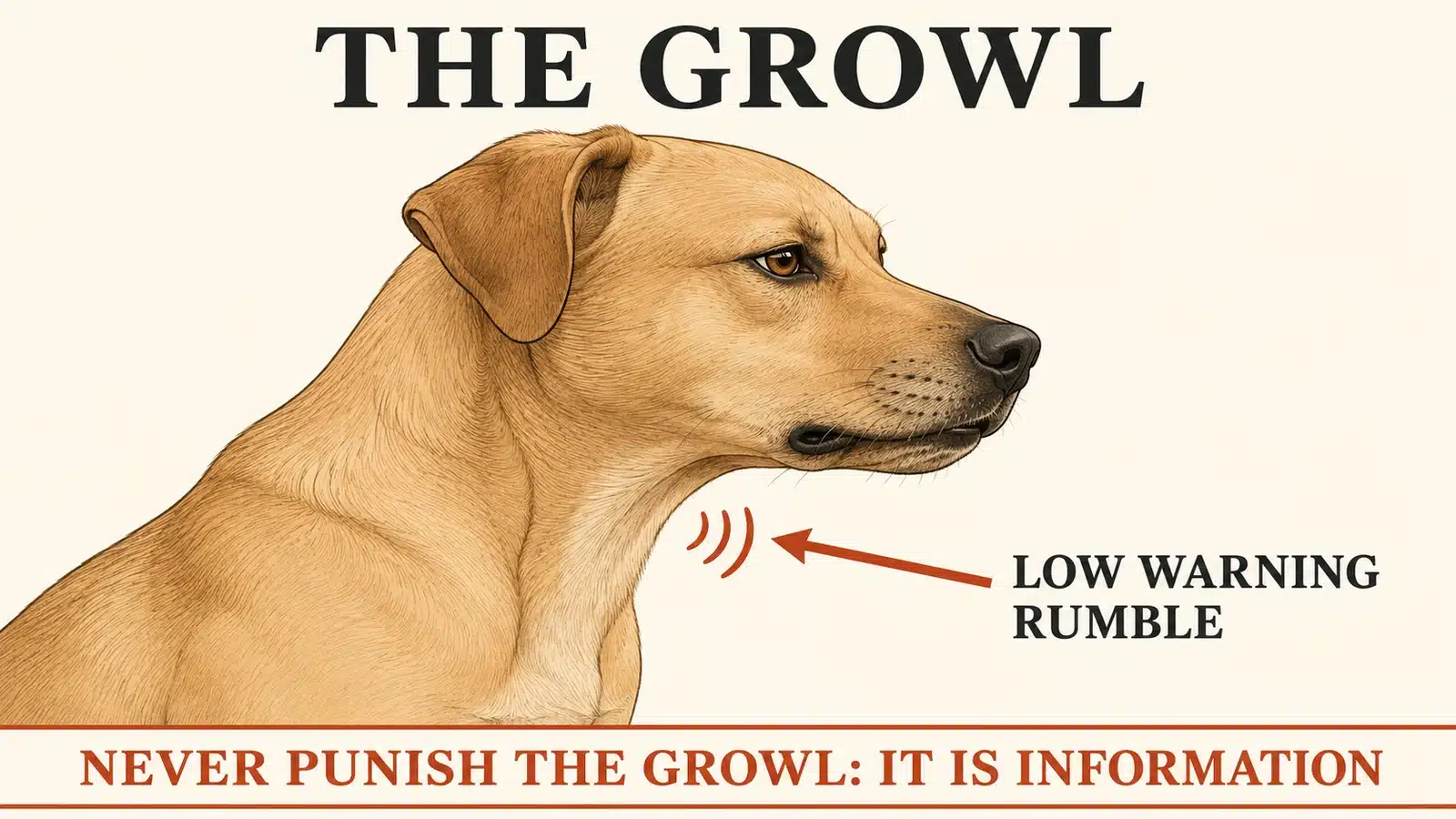
The growl is the most valuable single signal in this entire guide, and the most tragically punished. A low, rumbling vocalization, usually riding on a stiffening body with a hard eye and a closed or tensing mouth, the growl is a dog communicating clearly and early: this is too much for me, and I need it to stop before something worse happens. It is honest, it is generous, and it is given well before the dog resorts to teeth. A growling dog is a dog working hard to avoid biting.
Understand the mechanism, because the mechanism dictates the response. If you punish a growl, you may well suppress the growl, that is simple positive punishment, and it often appears to work in the short term. But punishment suppresses the behavior without touching the emotion beneath it. The fear that produced the growl is still there, fully intact, now stripped of its warning system. What you have created is not a calmer dog but a quieter one, a dog who has learned that growling gets him in trouble and so skips it, moving straight from silent discomfort to a bite with no audible warning in between. These are the dogs whose bites genuinely do seem to come from nowhere, and in nearly every case a human taught them to go silent. So the rule is absolute: never punish a growl. Thank the dog for the information, calmly increase distance or end whatever is causing the discomfort, and then address the underlying fear through desensitization and counterconditioning. The growl is not the problem. The growl is the smoke alarm, and you do not fix a fire by removing the battery.
Baring Teeth: A Clear Line Drawn in the Sand
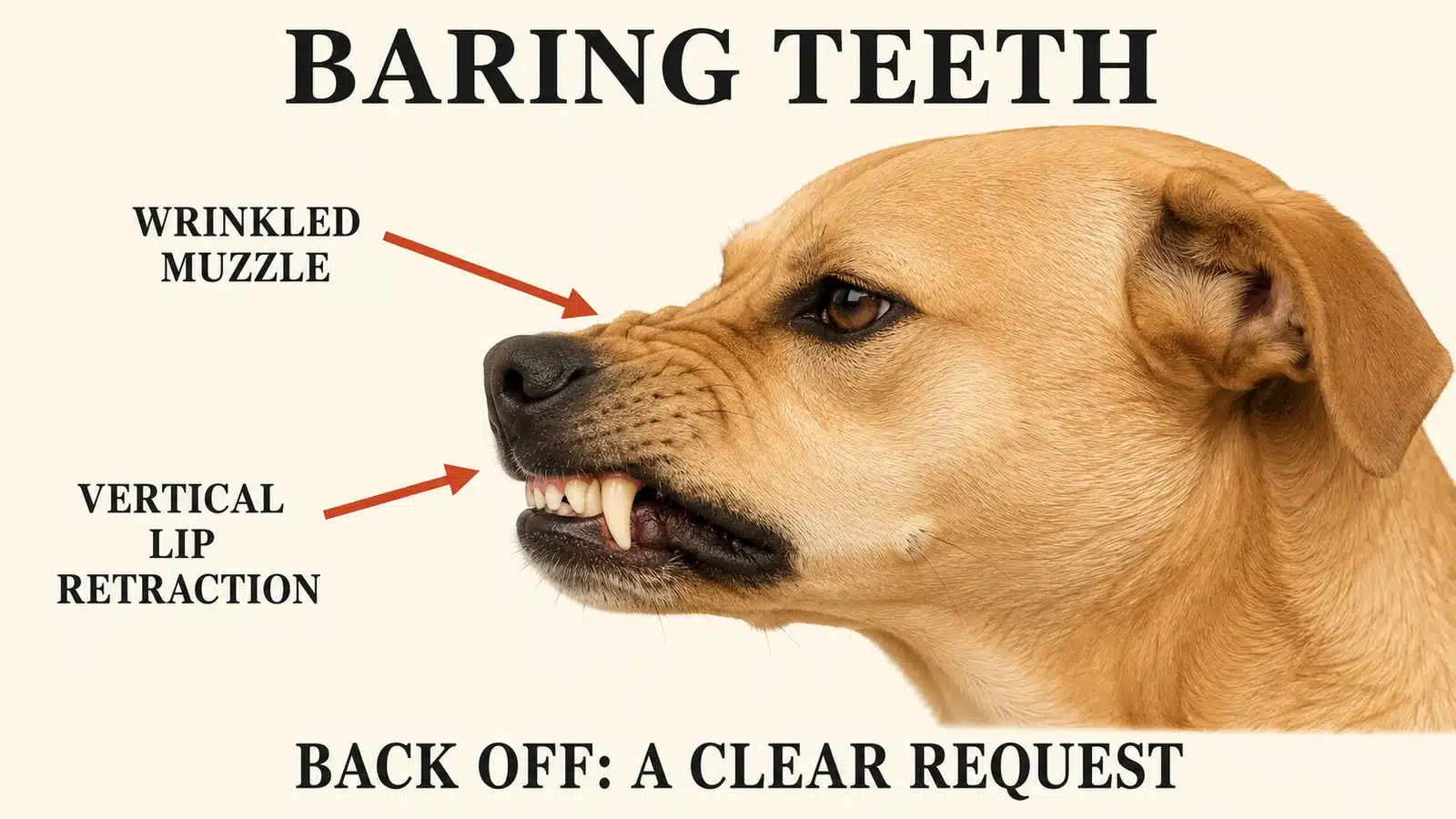
When a dog lifts the upper lip vertically to expose the canines and front teeth, often with a wrinkled muzzle, he is drawing a line and showing you the tool he would prefer not to use. This is a defensive threat display, a warning that sits a rung above the growl and frequently travels with it. Displaying the teeth is a dog saying, as plainly as canine anatomy allows: I have weapons, I do not want to use them, and I am asking you to make that unnecessary.
One critical distinction protects both you and the dog, and it is a distinction people get lethally wrong: the vertical lip lift of a threat is not the same as the horizontal lip retraction of the submissive grin covered in the appeasement signals section of this guide. A threatening tooth display lifts the lip upward, wrinkles the muzzle, and rides on a tense, hard-eyed, forward or stiff body. The submissive grin pulls the lips back horizontally, comes with squinty eyes and a loose, wiggly, lowered body, and means almost the opposite, an anxious, appeasing bid for acceptance. Confusing the friendly grin for a threat gets appeasing dogs punished for trying to be polite, and confusing a genuine threat for a grin gets people bitten. As always, do not read the teeth in isolation. Read the whole body around them, and the two become impossible to mistake.
The Snarl: The Growl and the Teeth, Together
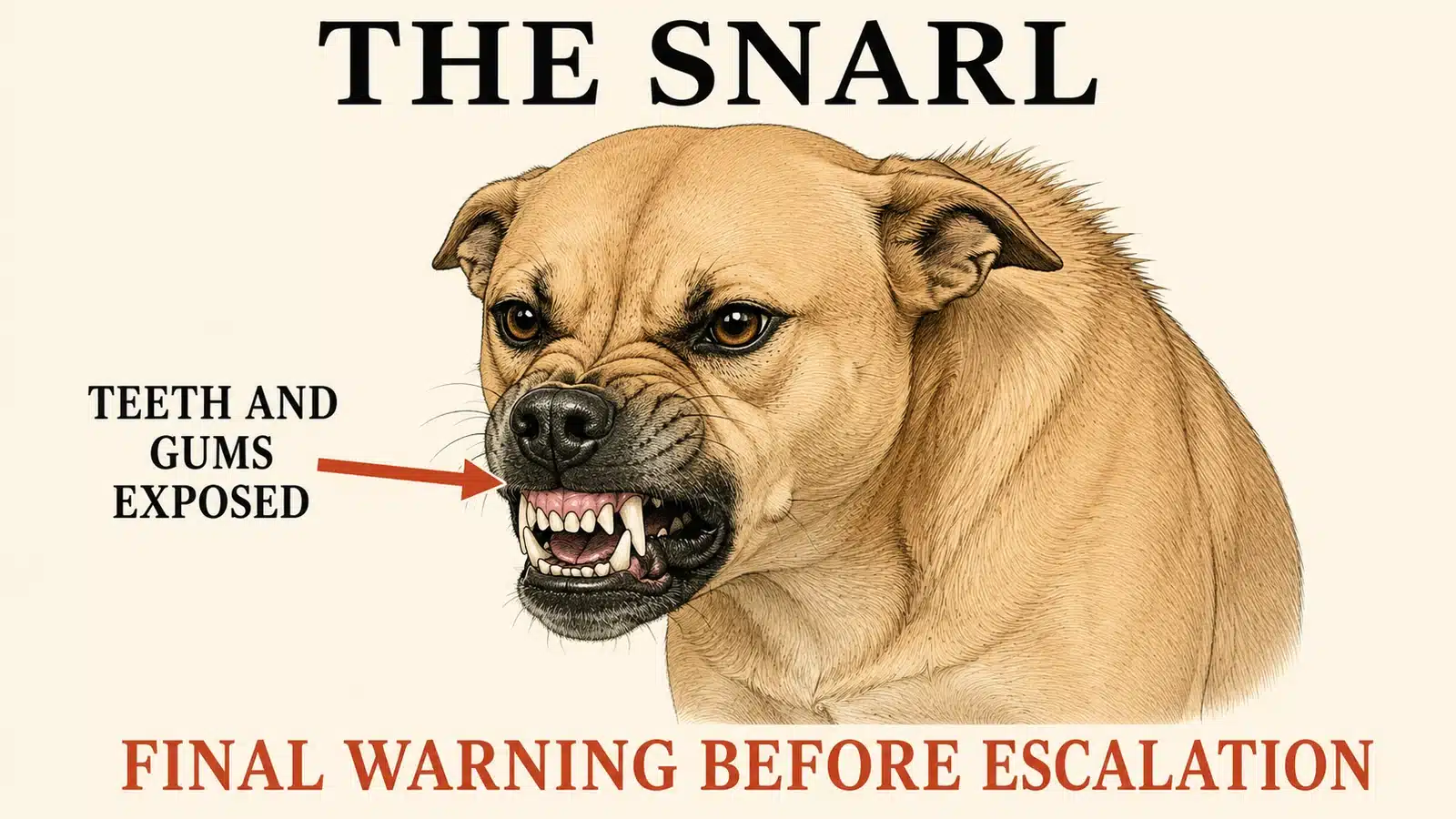
The snarl combines two warnings into one: the audible growl and the visual display of bared teeth, usually delivered together with pinned ears, a hard stare, deep muzzle wrinkles, and a lowered or forward-loaded head. This is a compound, high-intensity warning, and its layering is precisely the point. The dog is stacking his signals to be unmistakable, because the quieter versions have already failed to produce the space he needs. A snarl means the situation is serious and the dog is close to the top of his ladder.
A snarl demands an immediate, calm response, and the operative words are immediate and calm. Stop whatever is happening, do not lean in, do not reach forward, do not lock eyes, and create distance without turning the moment into a confrontation. Sudden movements or your own escalation can tip a snarl into a bite. And once again, resist every instinct to punish, because a snarl is still, fundamentally, a warning, a dog choosing display over contact. Punishing it teaches the dog that displaying is dangerous and pushes him toward skipping the display entirely. A dog snarling at people or at other household dogs on any kind of regular basis is well past the threshold for professional help. That pattern warrants a full functional behavior assessment, not a correction.
The Hard Stare: The Warning People Miss Most Often
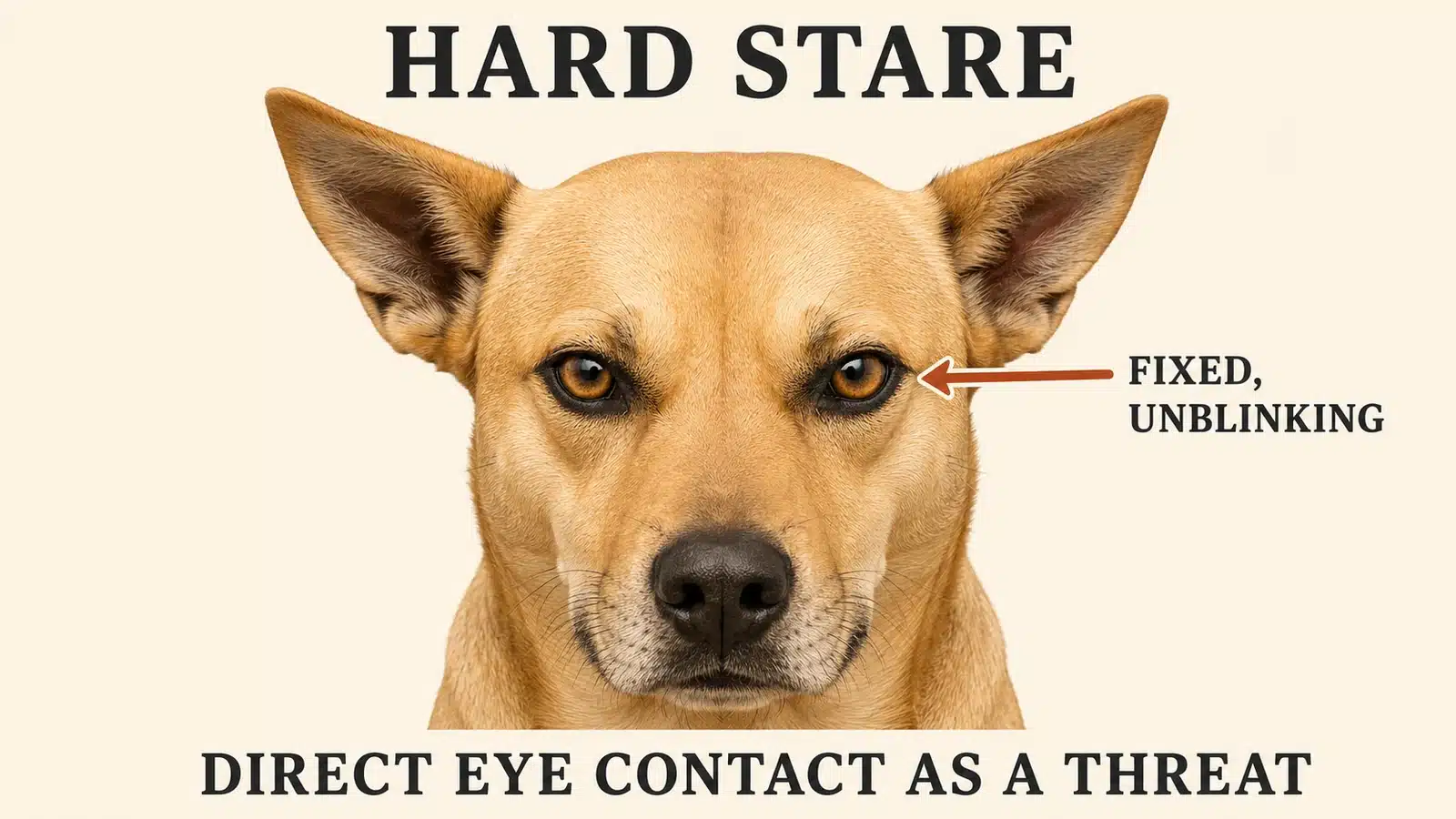
A direct, fixed, unblinking stare is one of the clearest threats in the canine repertoire and one of the most frequently missed by humans, because to us a look feels like so much less than a growl or a snap. To a dog, sustained direct eye contact is confrontational, and a hard stare, round unblinking eyes locked onto a target, brow tense, body gone still behind it, is a serious warning to back off. It often comes earlier than the growl, which makes it enormously valuable to anyone who learns to catch it, and dangerous to those who do not.
You will see the hard stare most often in resource guarding, over food, a bone, a toy, a stolen item, a favored resting spot or person, and it is frequently the very first outward sign that a dog is guarding, appearing before any growl. Because people miss it so reliably, they walk straight into the space the dog was warning them to stay out of, and the situation escalates. Learn to distinguish the hard stare from the soft, blinking, relaxed gaze of a comfortable dog described in the calming signals section: hardness, fixity, and stillness are the markers. When you meet a hard stare, do not return it, that reads as accepting a challenge, and instead soften your own eyes, avoid looming, and calmly create space. A hard stare over resources in your own dog is an early, treatable sign, and catching it early is exactly what keeps it from becoming a bite.
Raised Hackles: Arousal, Not Necessarily Aggression
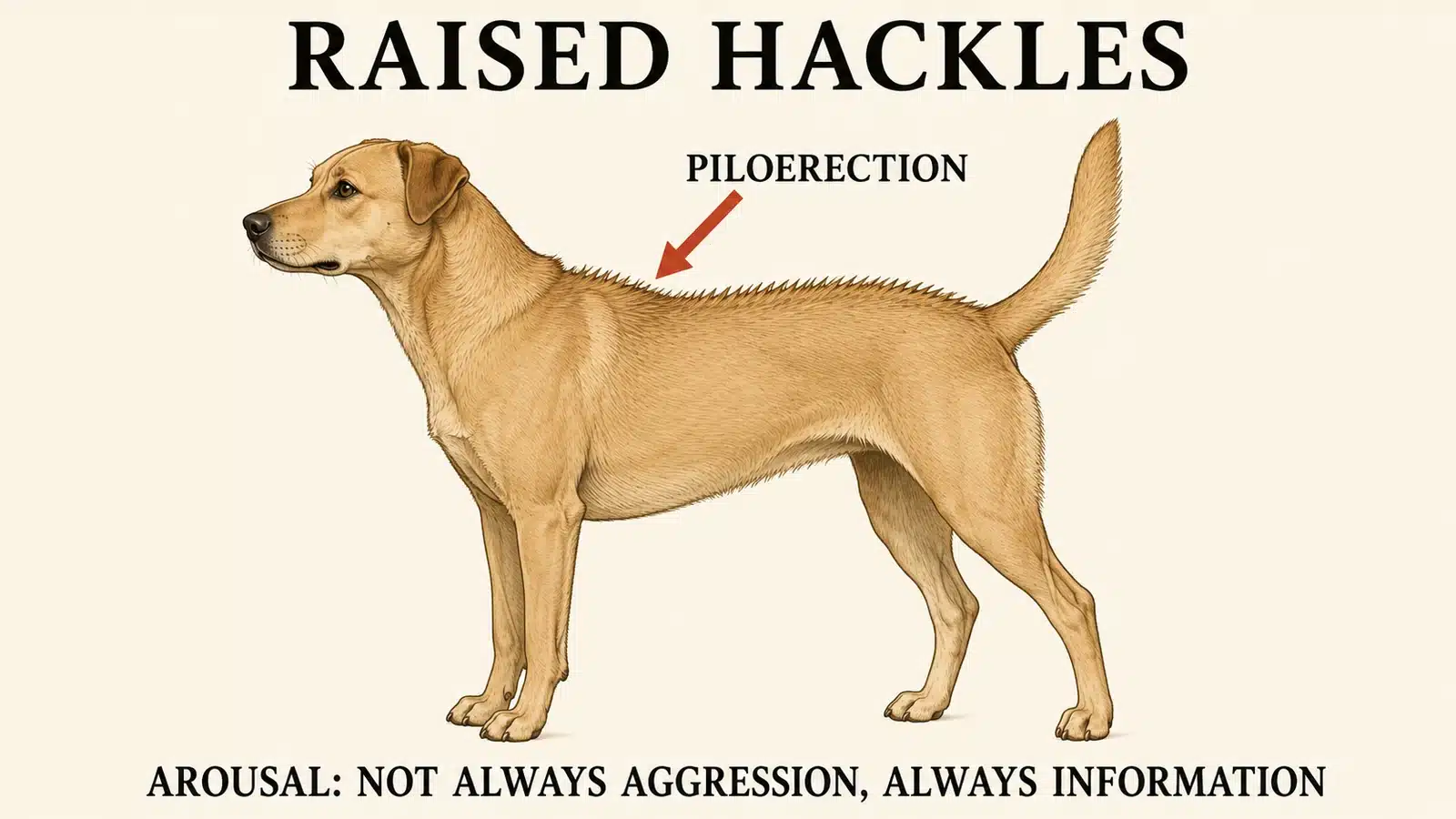
Raised hackles, the ridge of hair standing up along the neck, shoulders, and spine, is one of the most misunderstood signals in dog behavior, and getting it right matters. The technical term is piloerection, and here is the crucial fact: it is involuntary. Hackles are the canine equivalent of human goosebumps, driven by the sympathetic nervous system, which means a dog cannot choose to raise them any more than you can choose to get chills. What piloerection reliably indicates is heightened arousal or emotional intensity. What it does not reliably indicate, on its own, is aggression.
This is where careful reading protects you from a costly error in both directions. A dog can raise his hackles from fear, from insecurity, from overexcitement in play, or from the arousal of a novel or startling situation, not solely from the intent to threaten. Assuming raised hackles always mean imminent aggression can cause you to misread a merely excited or frightened dog, while assuming they are harmless can cause you to miss genuine threat arousal. The resolution is the one this whole guide keeps returning to: hackles tell you the volume is up, and the rest of the body tells you the emotion. Raised hackles on a stiff, hard-eyed, forward-loaded dog point toward threat. The same hackles on a loose, bouncy, play-bowing dog point toward excitement. Read the hackles as information about intensity, then read the body to learn what that intensity means.
The Stiff Body: The Tension Underneath Every Warning
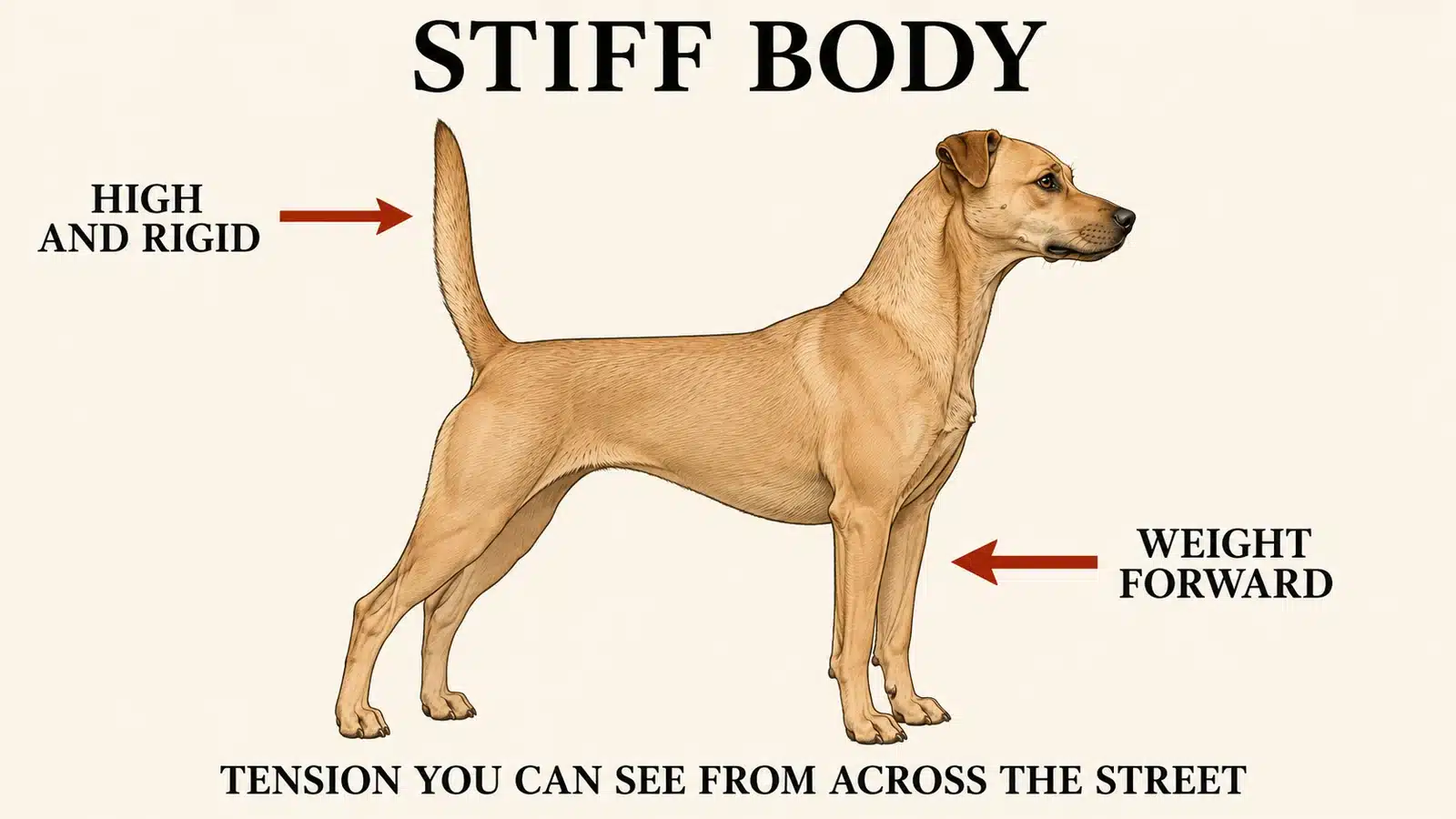
Underneath nearly every warning signal on this page sits one common denominator: body stiffness. A dog preparing to defend himself or hold his ground goes rigid, legs planted and squared, weight often shifted forward over the front end, neck arched, tail held high and stiff, the whole frame tightening into readiness. This full-body tension is both a warning in its own right and the physical foundation that gives every other warning signal its meaning, which is exactly why looseness versus stiffness is the master variable running through this entire guide.
Learning to see stiffness is one of the highest-value skills a pet parent can develop, because it is visible from a distance and it often precedes the louder signals, giving you a precious early window. A dog who suddenly goes stiff and still, especially with weight loaded forward, is telling you his emotional state has shifted toward threat, and he is telling you before he growls, snarls, or lunges. The contrast that trains your eye is play: the loose, wiggly, bouncy body of a dog having fun is the exact opposite of this rigid, economical, loaded posture, as detailed in the play signals guide. When a body that was loose suddenly goes hard, believe the change. That transition is one of the most reliable early warnings you will ever learn to read.
Lunging: A Big Display, Usually Built on Fear
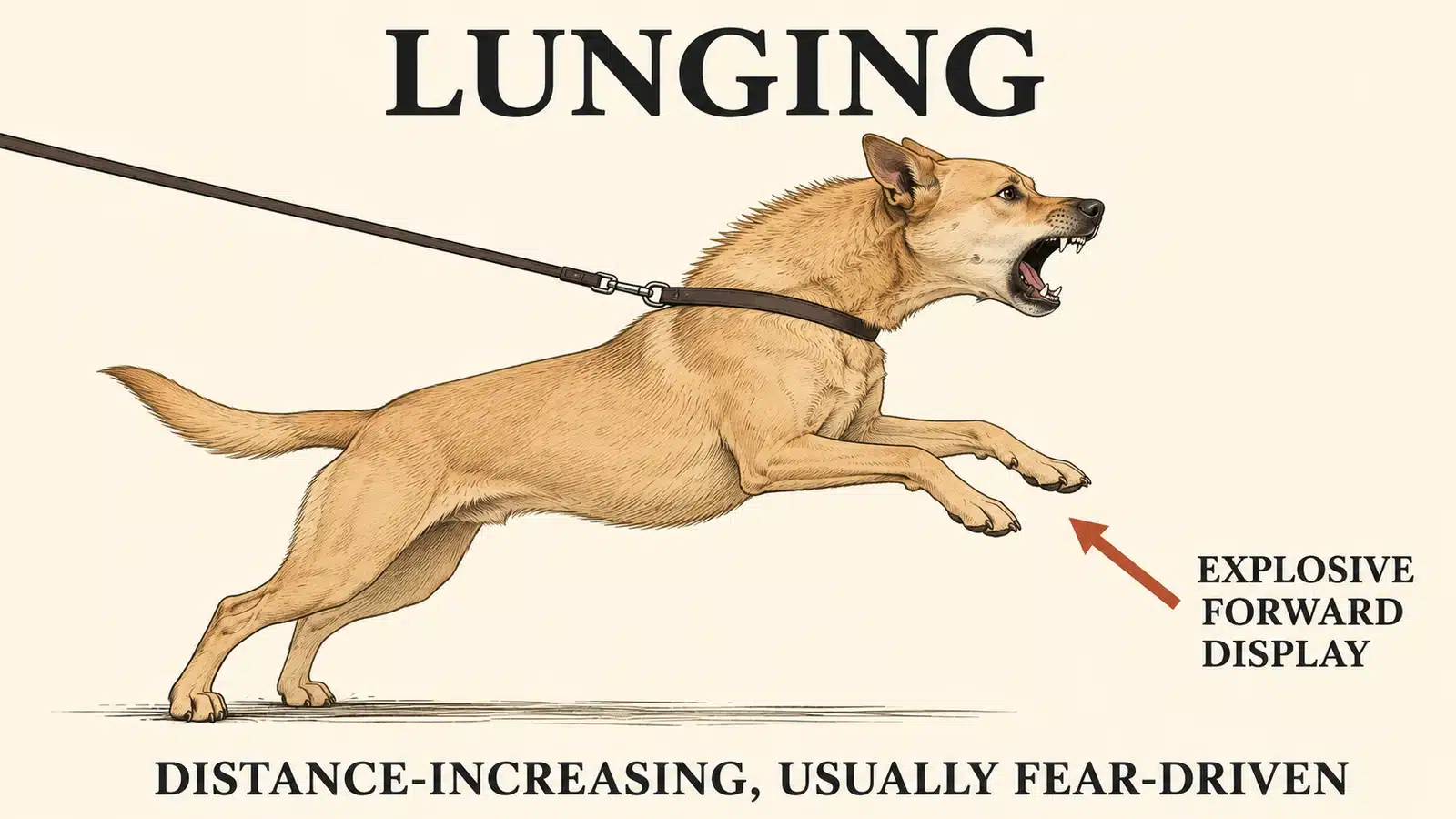
Lunging is a sudden, explosive forward movement toward a trigger, and it looks so aggressive that it is almost universally misread as pure offense. In reality, most lunging, and nearly all leash lunging, is distance-increasing behavior driven by fear, not by a genuine desire to make contact. The logic is counterintuitive but sound: a frightened dog on leash cannot flee, so the flight option is off the table, and the dog is left with the other half of the defensive repertoire. He makes himself big and loud and explosive in a desperate bid to drive the frightening thing away. It frequently works, the other dog or person retreats, which reinforces the lunging and makes it more likely next time.
This is the mechanism at the heart of most leash reactivity, and understanding it changes everything about how you treat it. A lunging dog is not a dominant dog who needs to be corrected into submission; he is a scared dog whose emotional response to a trigger needs to be changed. This is also why aversive tools are so counterproductive here, and the reasoning is worth stating plainly through mechanism: adding pain or startle, through a leash correction, a prong, or a shock, in the presence of the trigger teaches the dog to associate that trigger with something even more unpleasant. You have just confirmed his fear that other dogs, or strangers, or bicycles, predict bad things, which tends to intensify the underlying emotion and can escalate the aggression even when it briefly suppresses the outward behavior. The evidence-based path runs the other direction entirely: keep the dog far enough from the trigger to stay under threshold, and systematically change his emotional response through desensitization and counterconditioning, so the trigger comes to predict good things instead of threat.
Defensive Barking: Loud on the Outside, Scared on the Inside
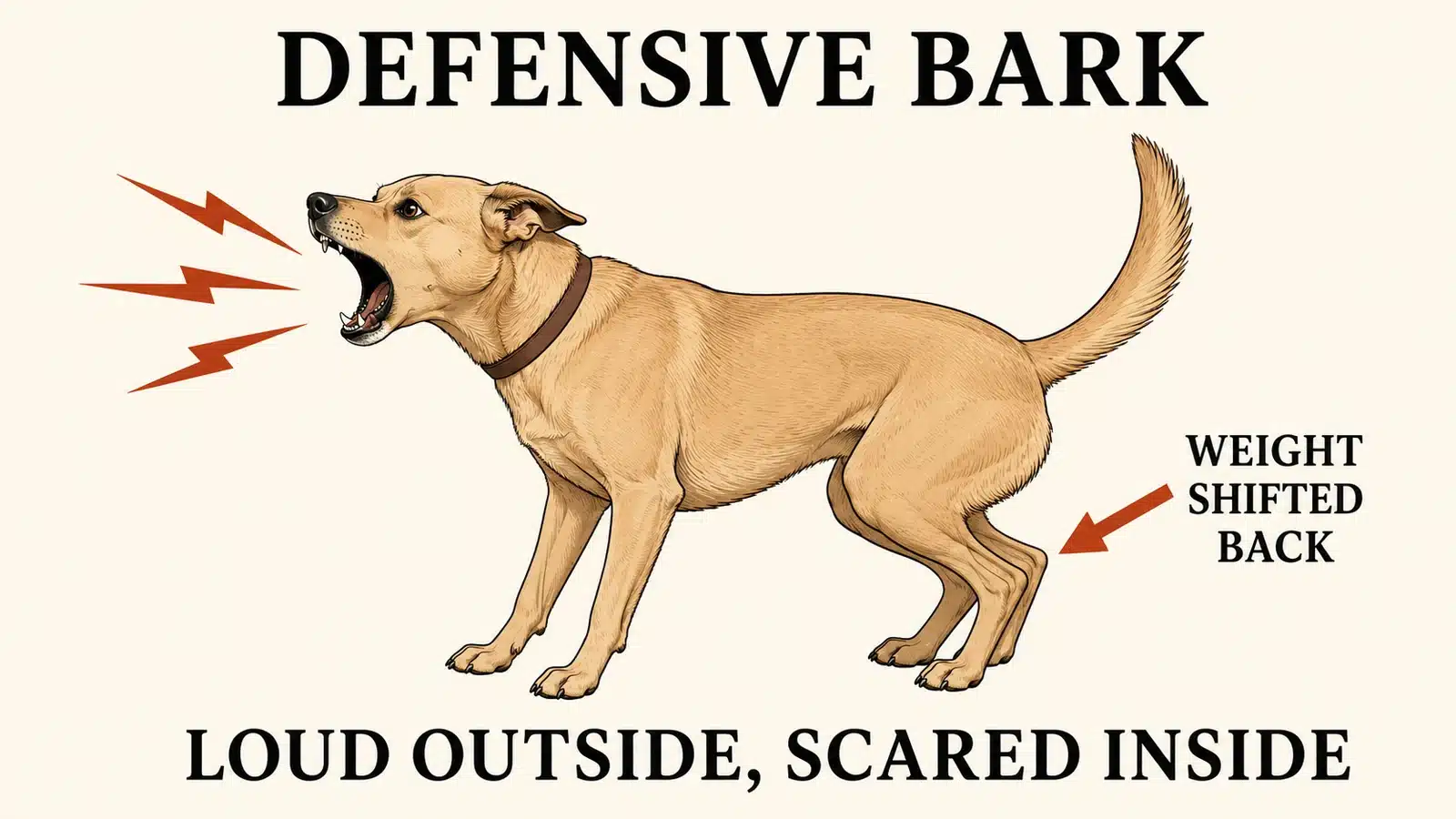
Not all barking is a warning, and the barking category of this guide covers the full range, but the defensive, distance-increasing bark has a specific and readable signature. It is often lower-pitched and delivered in sustained bursts, and, most tellingly, it rides on a body caught in conflict: the dog barks forward while his weight shifts backward, the rear legs coiled as if ready to retreat even as the front end blusters. That contradiction, forward voice and backward weight, is the visible signature of a dog who is bluffing, making noise to create space precisely because he is afraid.
Reading that internal conflict is what separates a useful interpretation from a harmful one. A confident, offensively motivated dog leans in; a defensive, fearful dog leans out even while sounding fierce, and the vast majority of reactive barking is this second kind, fear wearing an intimidating costume. The response follows directly from the mechanism: punishing the bark does nothing to resolve the fear driving it and, worse, layers an unpleasant consequence onto the presence of the trigger, deepening the negative association exactly as with lunging. The productive path is to reduce the intensity of the trigger, get the dog under threshold, and change the emotional response underneath the noise. For the full spectrum of barks, including the ones that are not warnings at all, see the barking guide.
The Flagged Tail: High, Stiff, and Not At All Happy
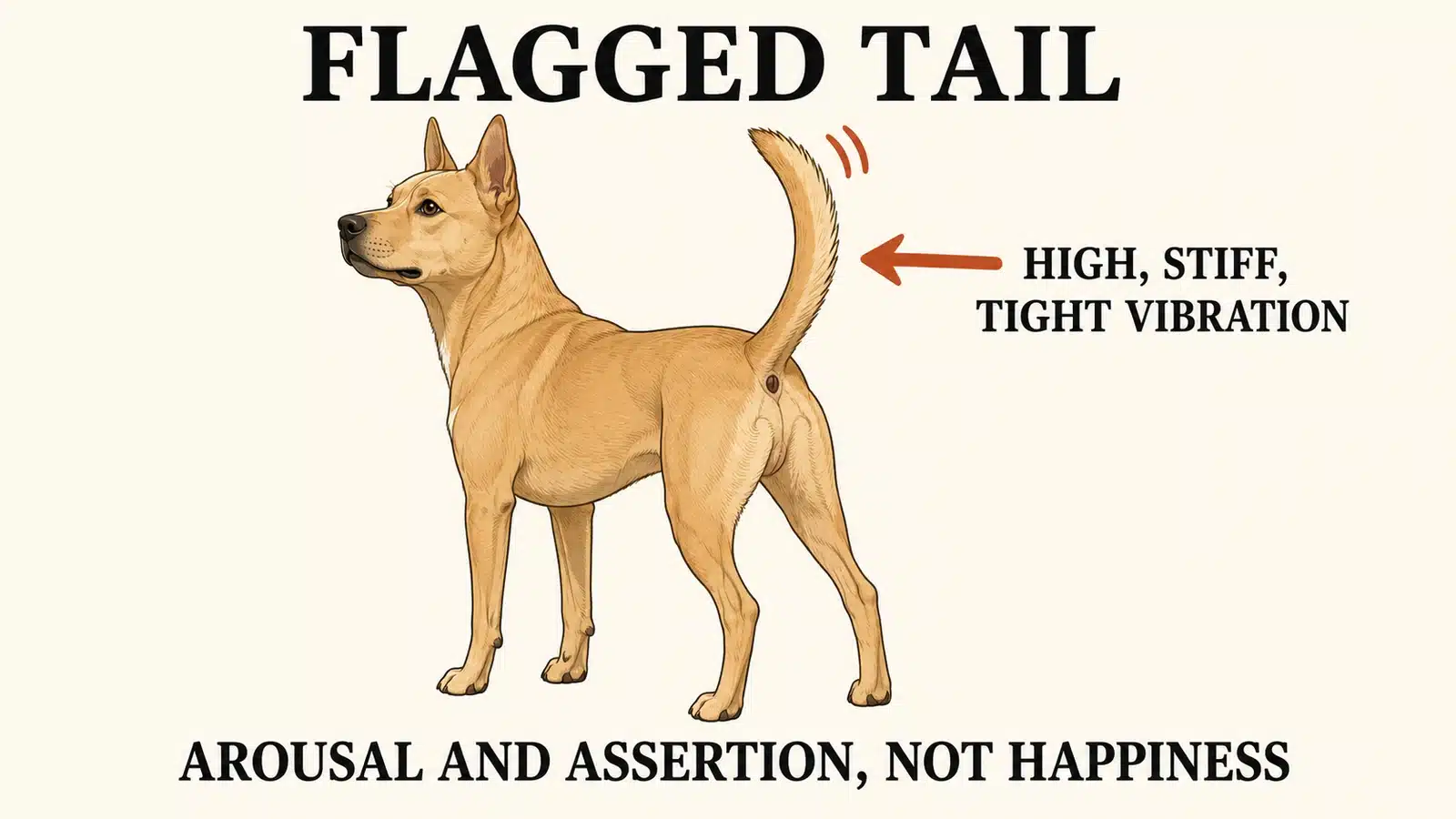
A tail held high and stiff over the back, sometimes vibrating in a tight, rapid quiver, is a signal of arousal and assertiveness, and it is one of the most dangerously misread tails there is, because the quivering motion gets mistaken for a happy wag. It is not a happy wag. This flagging tail carriage rides on a confident, aroused, often forward-loaded body, and the high, stiff base is the giveaway. Where a friendly wag is low-to-mid and loose, the flag is high and rigid, and that rigidity signals a dog who is prepared to hold his ground or escalate.
The tight vibrating flag in particular is often mistaken for excitement or friendliness by people who watch only the tail and not the base or the body, and that misreading is exactly how a person or another dog walks into a warning. The full grammar of tail carriage, height, stiffness, and the wag types that mean well versus the ones that do not, is laid out in the tail positions guide and the tail wagging guide, but the rule that keeps you safe here is short: a high, stiff tail is a caution flag, however it is moving. When you see it, read the rest of the body before you assume anything friendly, and give the dog room.
Standing Tall: Making the Body Big
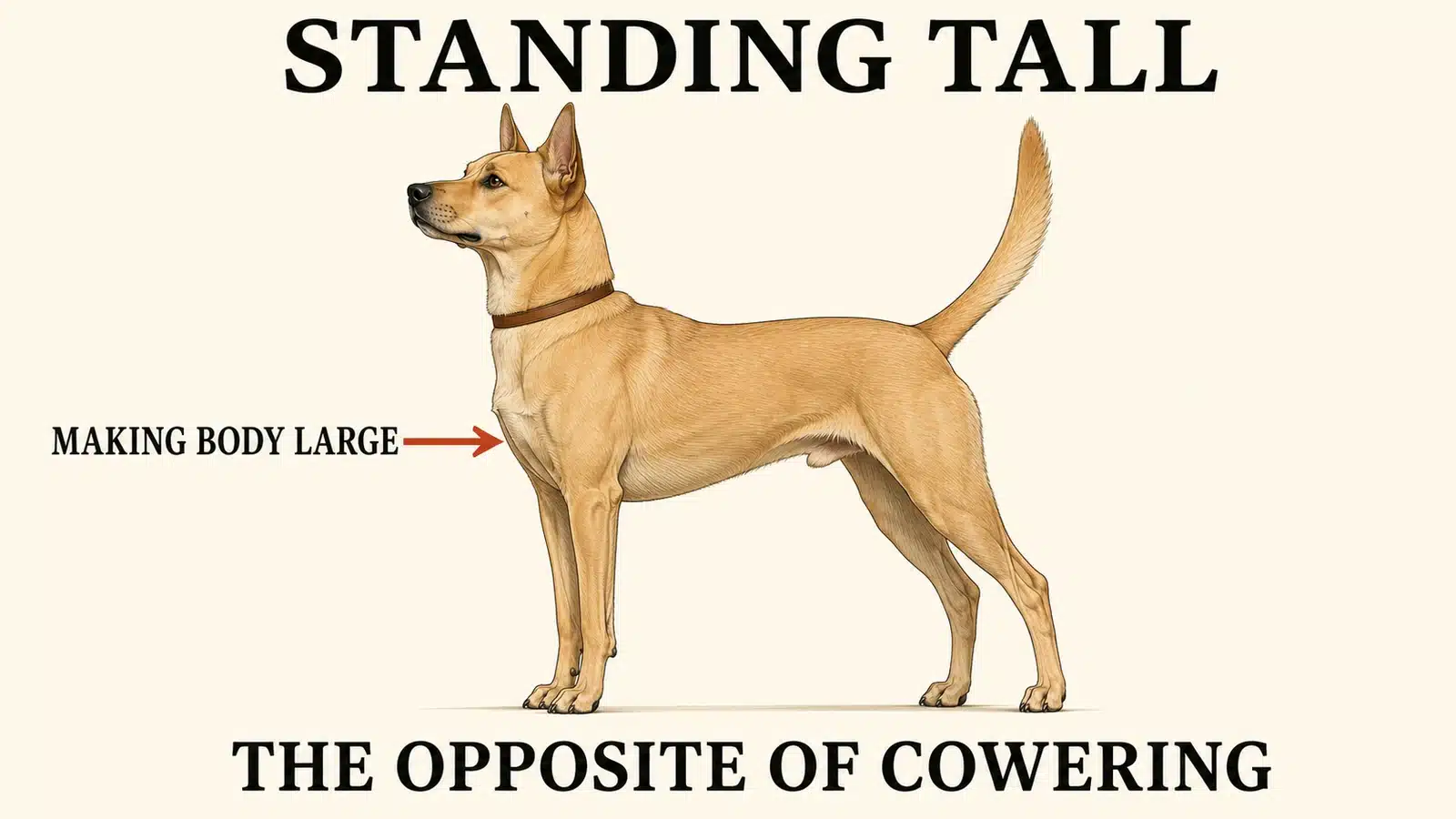
When a dog wants to project confidence or issue a warning, he makes himself as large as possible: weight up on the toes, legs straight and tall, chest pushed out, neck arched, head and often the tail held high, ears forward. This is the precise mirror image of the fearful dog's project of making himself small through cowering and crouching, and the contrast is a useful teaching pair. Where fear shrinks the silhouette, assertive warning inflates it. The dog is using his body size as a message: I am big, I am confident, do not push this.
Standing tall rarely appears alone, and that is what makes it readable in context. It typically clusters with other assertive, distance-increasing signals, the high stiff tail, forward ears, a hard stare, raised hackles, weight loaded onto the front end, and the cluster together paints an unmistakable picture of a dog who is prepared to defend his position. Important nuance worth stating clearly, because the old framing gets this wrong: this posture is about confidence and warning in the moment, not about a dog asserting rank in some imagined dominance hierarchy over you. Reading it as a bid for social space and safety, rather than as a challenge to your authority, is both more accurate and far more useful, because it points you toward reducing the dog's need to warn rather than toward a confrontation you cannot win and should not want.
Body Blocking: Controlling Space Without Teeth
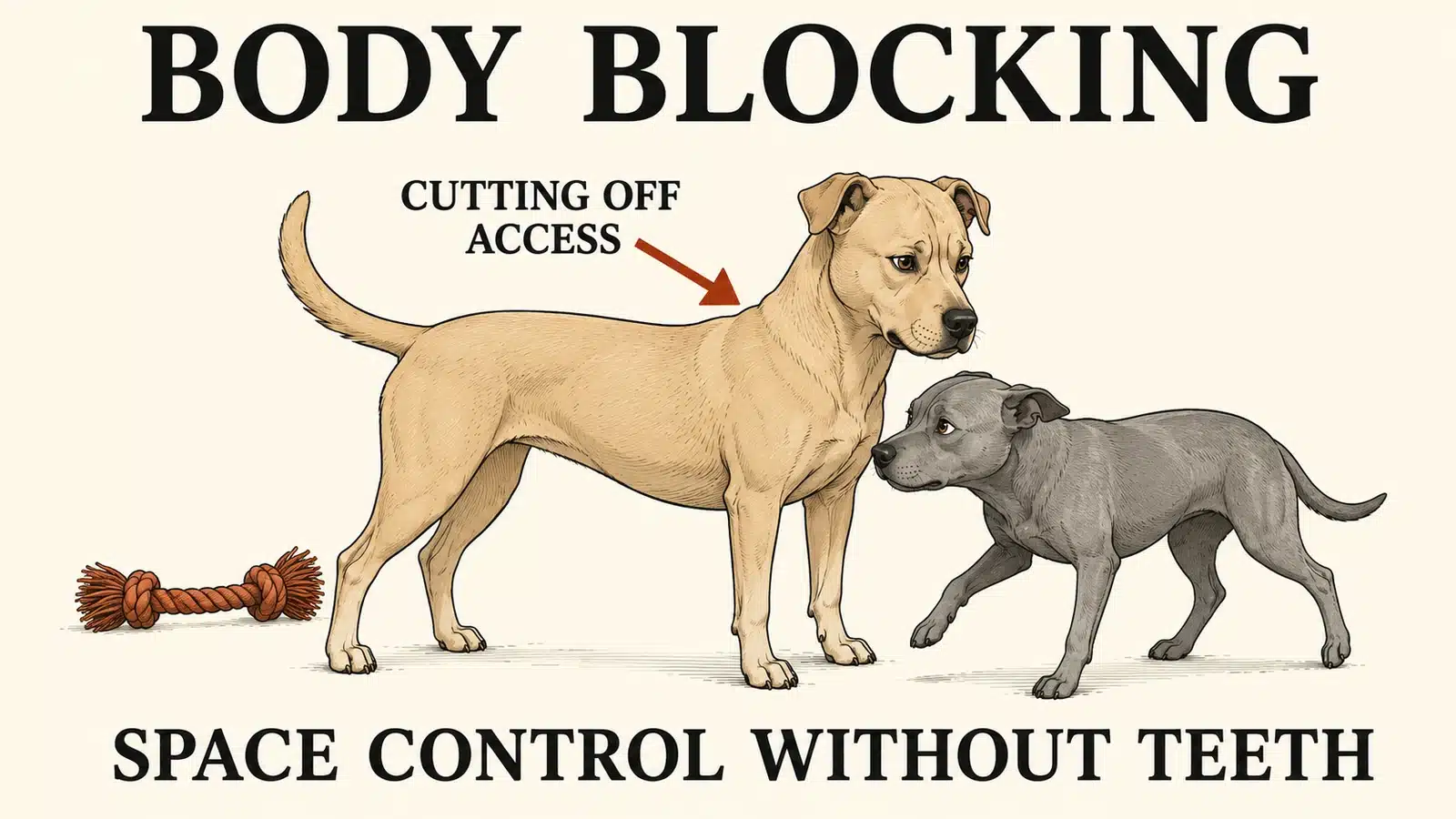
Not every distance-increasing behavior is loud or toothy. Body blocking is a quieter, physical form of space control: a dog positions himself to cut off another dog's access to a resource, a doorway, a person, or a path, using his body as a barrier, sometimes with a deliberate shoulder-check or a perpendicular stance across the other dog's line. It is assertive and it is controlling, but it is also, importantly, a relatively low-intensity way of managing space without any escalation to threats or contact. In well-socialized dogs, body blocking is often a piece of ordinary, healthy communication.
Reading it correctly means watching the response of the dog being blocked, because that response tells you whether the interaction is benign or heading somewhere concerning. If the blocked dog simply accepts the boundary and moves on, this is normal social negotiation and nothing to worry about. If the blocking becomes persistent, if it escalates toward stiffer postures and harder eyes, or if it starts to cluster with other guarding signals around a specific resource, it can be an early component of resource guarding or a brewing conflict between dogs in the home. The intervention there is not punishment of the blocking dog but management of the resource and a proper assessment of the relationship, so the underlying tension gets addressed rather than merely suppressed.
The Quick Head Turn: The Whip-Around Most People Miss
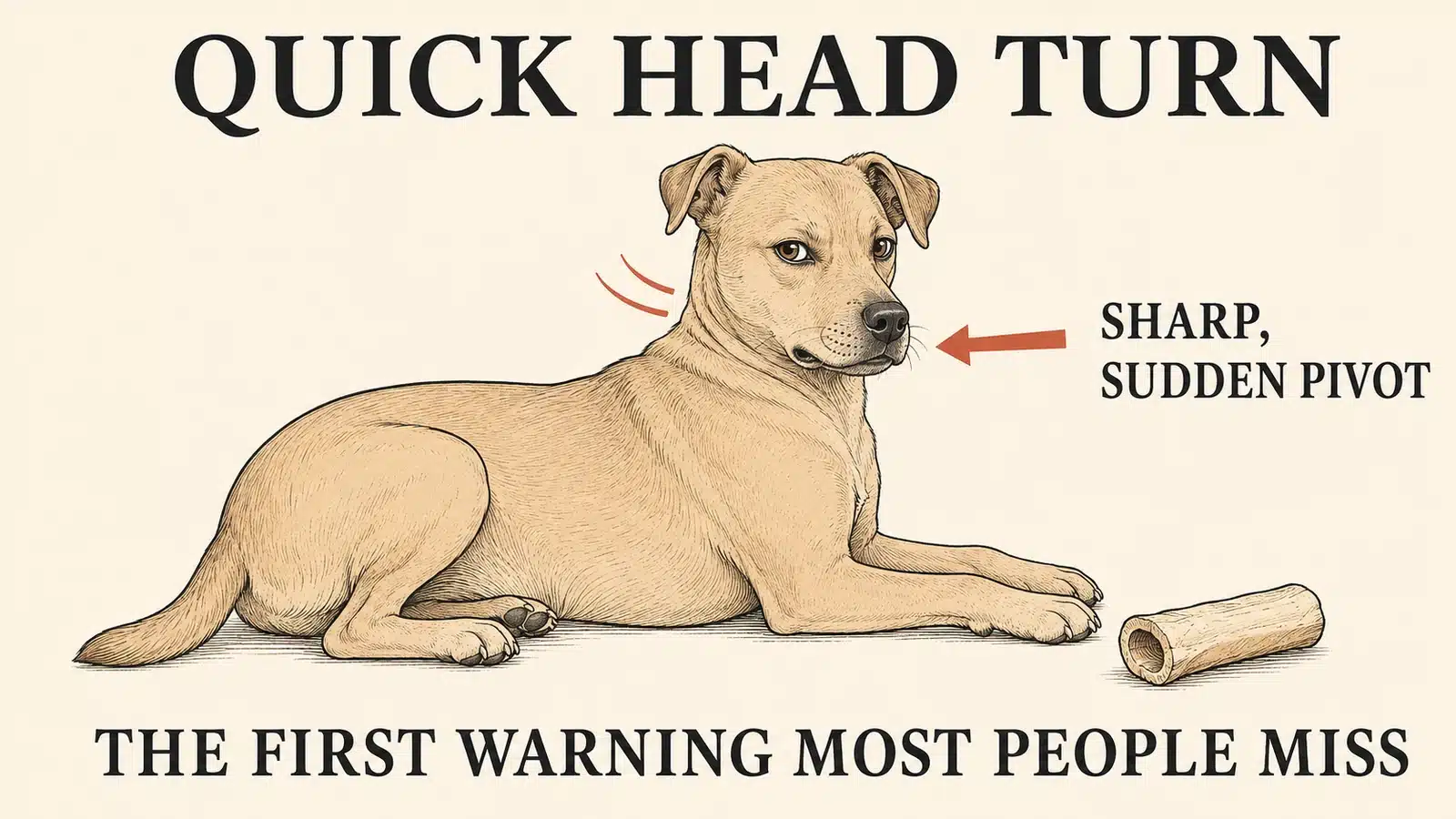
A sudden, sharp turn of the head toward an approaching hand, person, or dog is a subtle but genuine warning, and it is frequently the very first sign that a dog is uncomfortable, particularly around a valued resource. It is the whip-around a dog gives when a hand reaches toward his bowl, his bone, or his chew, sometimes paired with a brief freeze or a hard eye, and it says, in the smallest possible gesture, stop, do not come closer to this. Because it is so quick and so quiet, it is one of the most commonly missed warnings on the entire ladder.
This signal deserves particular attention precisely because of how early it comes and how easily it is overlooked. In resource guarding, the sequence often runs from a quick head turn, to a freeze, to a hard stare, to a growl, to a snap, and a pet parent who learns to catch that first head turn can intervene while the situation is still trivially easy to manage, long before it becomes a growl or a bite. When you see your dog whip his head toward you as you approach something he values, do not push in to prove a point or to test him; that teaches him that warnings do not work and that he must escalate. Instead, back off, give him space, and recognize that you have just been shown the earliest rung of a guarding sequence, which is exactly the moment a professional would want to begin a proper functional behavior assessment.
The Warning Freeze: Stillness With Teeth Behind It
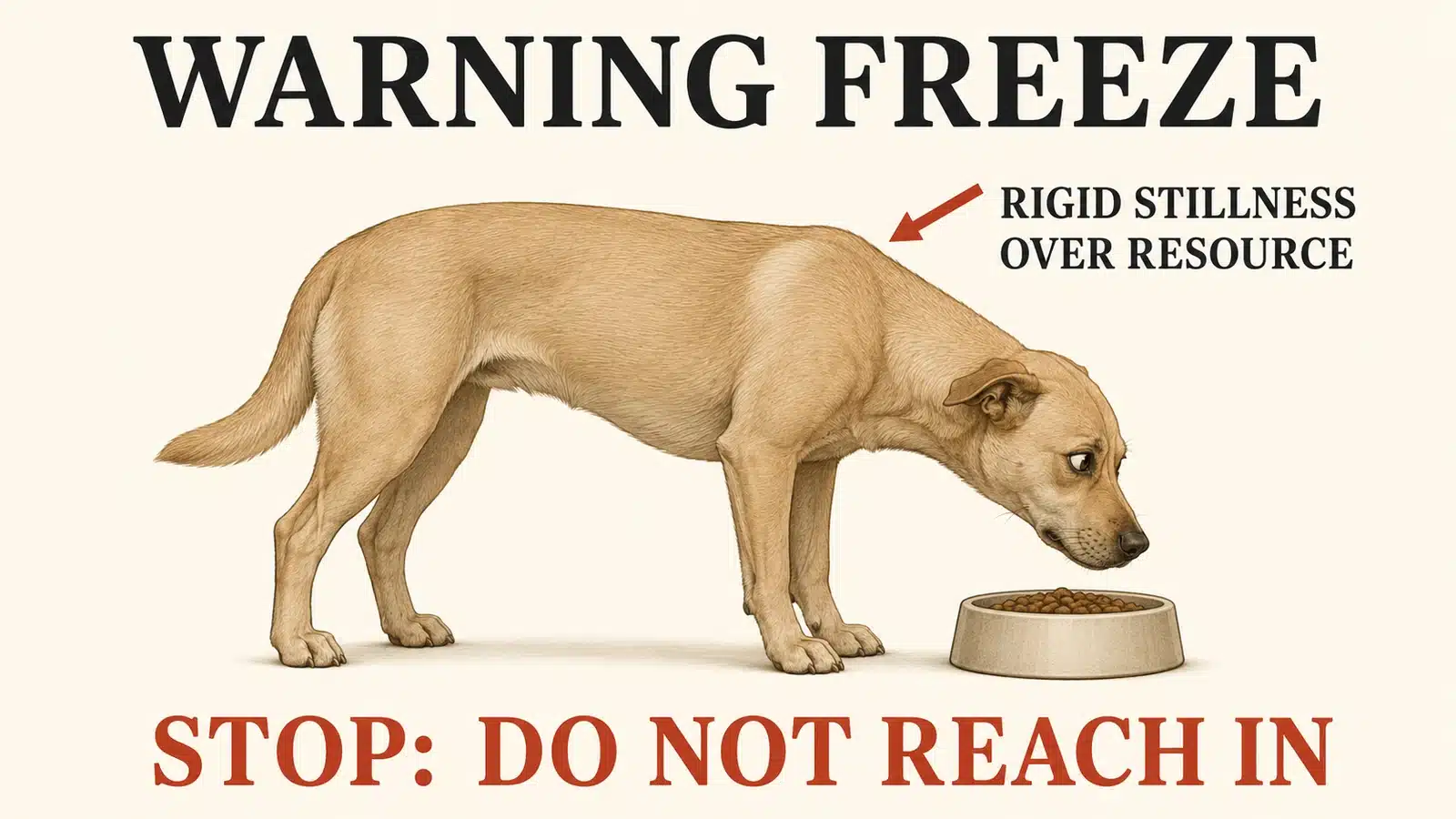
Freezing appears in this guide's stress signals as a critical marker, and it earns its place here too, because in the context of guarding and defense the freeze is one of the most serious warnings a dog can give. A sudden, total stillness, the dog going rigid over a resource, muscles locked, shoulders stiff, often with a hard eye or a rotated-back whale eye, is a dog at a decision point, and the decision on the table is whether to escalate to a bite. The freeze sits directly below the bite on the ladder, and in the context of a resource it should stop you cold.
This is the signal to respect above almost all others, because it so often immediately precedes a bite, and because in dogs whose earlier warnings have been punished into silence, the freeze may be the only warning left. If a dog freezes over food, a bone, a toy, or a resting spot as you approach, stop moving instantly, do not reach in, do not lean over, and calmly back away to create space. Do not test it, and never try to physically take the resource from a frozen, guarding dog; that is how serious bites happen. A dog who freezes over resources is signaling a guarding problem that has reached a genuinely dangerous rung, and that is unambiguously a situation for professional help through a structured behavior modification plan, not for confrontation.
The Snap: The Last Warning Before Contact
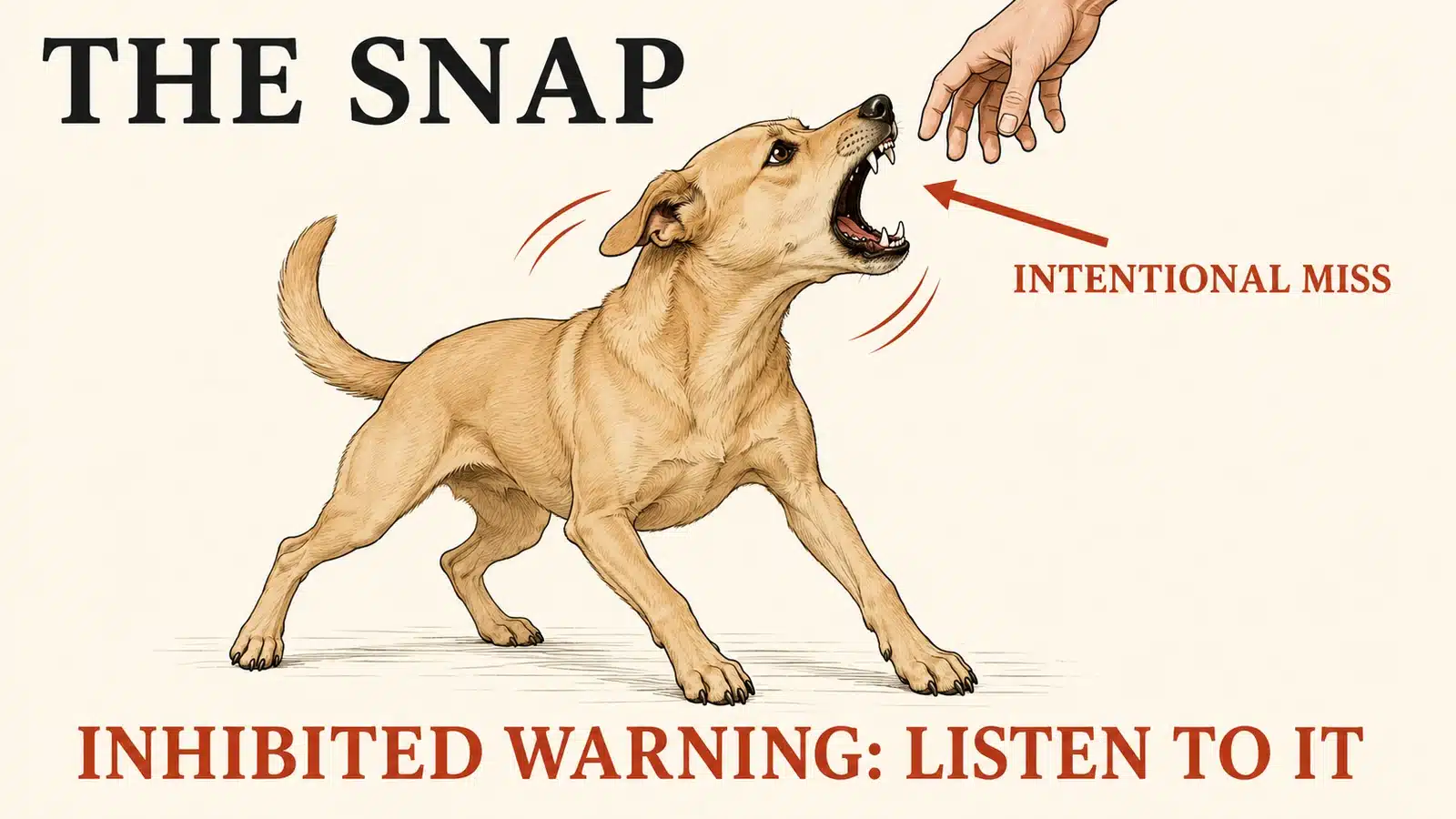
A snap is a fast, open-mouthed bite that deliberately makes no contact, and it is the final rung on the warning ladder, the last thing a dog does before an actual bite. It is essential to understand what a snap actually represents, because people get it exactly backwards. Given the precision of a dog's jaws, a dog who snaps and misses did not miss. He chose not to connect. The snap is a deliberately inhibited warning, an extraordinary act of restraint from an animal who could have bitten and pointedly did not, giving one final, unmistakable chance to create the space he needs.
The response to a snap must be immediate and completely non-punitive, and the reasoning is the same mechanism that has run through this entire page, now at its highest stakes. Stop everything, create space, and do not punish, because a snap is the dog's last warning, and punishing the last warning is how you get a dog who skips it and goes straight to a connecting bite next time. Think that through: the snap is the final gift of information before teeth meet skin, and a dog who learns that even this warning brings punishment has been left with nothing between silence and injury. That is the mechanism by which suppression manufactures the very bites people fear. A dog who is snapping at people or at other dogs is communicating that he is at the absolute limit of his ability to cope, and that is an urgent situation requiring immediate management to prevent rehearsal and a professional behavior assessment, without delay.
Never Punish a Warning: The Mechanism, Start to Finish
If you take one thing from this entire guide, take this: never punish a dog for warning you. Not the growl, not the snarl, not the snap. It is the most important rule in dog behavior, and it is not a matter of being soft or sentimental. It is a matter of how learning actually works, and the mechanism deserves to be spelled out completely, because once you see it clearly you will never again be tempted to correct a growl.
Start with what punishment does and does not do. Punishment, by definition, suppresses behavior. Apply something unpleasant when a dog growls and you can absolutely reduce the growling, and this is exactly why punishment-based approaches look effective in the moment, which is the whole trap. But behavior and emotion are two different things. The growl is a behavior. The fear that produced it is an emotion, a learned emotional response driven by classical conditioning, and punishment does nothing to change it. Suppress the growl and the fear remains, fully intact, now disconnected from its warning. You have not made the dog feel safe. You have made the dog go quiet.
Now follow the consequence to its end. The dog still feels exactly as threatened as before, but he has learned that warning brings punishment, so he stops warning. The subtle signals, the growl, the snarl, the snap, all get suppressed. And when the next situation exceeds what he can tolerate, and it will, he has nothing left between silent discomfort and a bite. He goes straight to teeth, with no audible or visible warning, because a human systematically removed every earlier rung of his ladder. This is the precise origin of the dog who bites without warning, and it is almost always manufactured, not born. The warnings were punished out of him.
So here is what to do instead, and it is both simpler and harder than punishment. When your dog warns, treat it as the valuable information it is. Stop what is happening, calmly increase distance or end the interaction, and feel genuine gratitude that your dog chose to communicate rather than bite. Then, crucially, address the cause, because making the warning safe to give does not fix the fear underneath it. That is the work of a proper behavior plan: a functional behavior assessment to identify the triggers and the emotional drivers, management to prevent rehearsal of the situations that provoke warnings, skill building to give the dog better options, and systematic desensitization and counterconditioning to change the underlying emotional response so the dog no longer feels the need to warn in the first place. This is the arc of the EASE Method, Evaluate, Arrange, Skill-Build, and Emotional Repatterning, and it is the difference between a dog who has been silenced and a dog who has genuinely been helped. Preserve the warning. Change the emotion. That is the entire game.
Dog Warning Signals: Questions, Answered
Should I punish my dog for growling?
No, never. A growl is a warning, and punishing it suppresses the warning without changing the fear underneath. That is straightforward positive punishment: it reduces the growl while leaving the emotion fully intact, which teaches the dog to skip the warning and go straight to a bite. Dogs who "bite without warning" were very often taught to stop warning. When your dog growls, calmly add distance, then address the underlying fear through desensitization and counterconditioning.
Do raised hackles mean my dog is aggressive?
Not by themselves. Raised hackles are piloerection, an involuntary sign of heightened arousal driven by the nervous system, like human goosebumps. A dog can raise hackles from fear, overexcitement, or play, not just from a threat. Hackles tell you arousal is up; the rest of the body tells you what the arousal means. Hackles on a stiff, hard-eyed, forward-loaded dog point toward threat, while the same hackles on a loose, bouncy, play-bowing dog point toward excitement.
Why does my dog lunge and bark at other dogs on walks?
Most leash reactivity is distance-increasing behavior driven by fear, not dominance. On leash the dog cannot flee, so he does the opposite: he makes himself big and loud to drive the scary thing away, and when the other dog passes, the lunging appears to "work," which reinforces it. Adding pain or corrections in the presence of the trigger deepens the fear and can worsen the aggression. The evidence-based approach keeps the dog under threshold and changes his emotional response through desensitization and counterconditioning.
My dog freezes and stares when I go near his food. What does that mean?
That is early resource guarding, and the freeze and hard stare are serious warnings that sit just below a bite. Stop approaching, do not reach for the food, and back away to give space. Do not test him or try to take the resource, which teaches him that warnings fail and that he must escalate. Resource guarding responds well to a structured behavior plan, and catching it at the freeze-and-stare stage, before any growl or snap, is exactly when it is easiest to address. This is a good time to bring in a professional.
Is a snap the same as a failed bite?
No. Given how precise a dog's jaws are, a snap that makes no contact did not miss, it was deliberately inhibited. The snap is the last warning before a real bite, and it represents remarkable restraint from a dog who could have connected and chose not to. Respond immediately by creating space, and never punish it, because punishing the final warning is how you get a dog who skips straight to a connecting bite. A dog who is snapping needs immediate management and a professional assessment.
Next: Appeasement Signals
If warnings say "give me space," appeasement signals say "please, I mean no harm." They are the language of deference, and they are misread as guilt, and sometimes as aggression, more often than any other signals.
 About the Author
Will Bangura, M.S., CAB-ICB, CBCC-KA, CPDT-KA, FDM, FFCP, is a Certified Canine Behaviorist with over 35 years of experience specializing in severe aggression, fear, anxiety, reactivity, phobias, and compulsive disorders in dogs. He holds a Master's Degree in Psychology and is accredited as a Certified Canine Behaviorist through International Canine Behaviorists, one of only three CAB-ICB Certified Canine Behaviorists in the United States and the only one in Arizona. His additional credentials include Certified Behavior Consultant Canine (CBCC-KA) and Certified Professional Dog Trainer (CPDT-KA) through the Certification Council for Professional Dog Trainers, certification in Applied Ethology through Family Dog Mediation (FDM), and Fear Free Certified Professional (FFCP).
Will is the author of Sniff to Soothe, host of the Dog Training Today podcast, and a court-recognized expert witness in canine behavior. His clinical work is grounded in behavioral psychology, applied behavior analysis, learning theory, and affective neuroscience: every case begins with a functional behavior assessment and is treated through management, skill building, and evidence-based behavior modification using systematic desensitization and counterconditioning. He is a national advocate for force-free, science-based training and a published voice on the welfare risks of aversive training methods.
As the founder of Phoenix Dog Training, Will provides in-home behavior consultations throughout the Phoenix metro area and virtual behavior consultations for pet parents nationwide.
If Your Dog Is Growling, Snapping, or Guarding
Warning signals mean your dog is asking for help, not discipline. Aggression and resource guarding are treatable through evidence-based behavior modification. A professional consultation begins with a full functional behavior assessment and ends with a clear, structured plan. Schedule a Behavior Consultation, or start with a free call.