
Will Bangura, M.S. | Certified Canine Behaviorist
Aggressive Dog Training in Mesa, AZ
If your dog lunges, growls, snaps, bites, reacts on leash, guards food or toys, or fights with another dog at home, you are living with a kind of stress most people never see. Most aggression is driven by fear, anxiety, or frustration, not defiance, and that means it can be changed. As a Mesa dog aggression specialist, I help pet parents find the real cause and build a calmer, safer life together, using evidence-based, force-free dog aggression training, reactive dog training, and behavior modification.
No shock collars. No prong collars. No leash corrections. Will Bangura helps Mesa pet parents with aggressive and reactive dogs by identifying what is driving the behavior and changing the underlying emotional response, not by suppressing warning signs.

Will Bangura, M.S., CAB-ICB
CBCC-KA, CPDT-KA, FDM, FFCP
Arizona's only CAB-ICB Certified Canine Behaviorist through International Canine Behaviourists, and one of only three in the United States, with more than 35 years of experience working with severe aggression, reactivity, and complex canine behavior cases.
As a certified dog behaviorist in Mesa, Will evaluates the underlying emotional, environmental, medical, and learning factors that can drive aggression, reactivity, fear, anxiety, guarding, and other complex behavior problems.
By improving emotional regulation, Will helps pet parents across Mesa build safer, calmer, and more predictable relationships with their dogs.
M.S.
Psychology
CAB-ICB
Certified Canine Behaviorist
CBCC-KA
Certified Behavior Consultant Canine
CPDT-KA
Certified Professional Dog Trainer
FDM
Applied Ethology / Family Dog Mediation
FFCP
Fear Free Certified Professional
Help for Aggressive and Reactive Dogs in Mesa
If your dog lunges, barks, growls, snaps, or has bitten, you are probably exhausted, on edge, and a little embarrassed. Maybe you cross the street when you see another dog. Maybe you warn guests before they come in. Maybe two dogs who used to be fine in your home now have to be kept apart. None of that makes you a bad pet parent, and it does not mean your dog is bad. It means your dog is struggling with something, and that behavior can be assessed and addressed with a plan.
Will Bangura helps Mesa pet parents with the full range of aggressive and reactive behavior: barking and lunging on walks through neighborhoods like East Mesa or Dobson Ranch, growling at strangers or guests, snapping over food or toys, dog-to-dog aggression, and dogs fighting in the same home. As a Certified Canine Behaviorist, he works these cases for a living, and the goal here is not to punish the behavior out of your dog. It is to understand why it is happening and address it at the source.

Fear-Based Aggression
Most aggression is driven by fear and anxiety, not dominance or defiance. A dog who feels threatened may growl, snap, or bite to make the scary thing go away. Fear aggression responds best to behavior modification that changes how your dog feels, not corrections that only mask it.

Leash Reactivity
If your dog barks, lunges, and spins at other dogs or people on walks, that is leash reactivity, and it is usually fear or frustration boiling over, not bad manners. Reactive dog training in Mesa lowers that arousal and teaches calmer responses, so walks stop feeling like a battle.

Aggression Towards Other Dogs
Dog-to-dog aggression can show up on leash, at the fence, or off leash at the park. Lunging, growling, and snapping at unfamiliar dogs is often rooted in fear or past bad experiences. The work is to rebuild how your dog feels about other dogs, safely and below threshold.

Aggression Towards People
When a dog growls at guests, snaps at strangers, or is aggressive toward visitors and even family, it is frightening and isolating. Aggression toward people is almost always fear-based, not spite. We reduce the fear and build safer, calmer responses around the people who worry you most.

Resource Guarding
Resource guarding is tension over food, toys, chews, space, or even a favorite person. A dog who stiffens, growls, or snaps when approached is asking for room, not being bad. Through counterconditioning, your dog learns that people coming near their things predicts good outcomes, not loss.

Dogs Fighting at Home
When two dogs who live together keep fighting, home stops feeling safe. Maybe they never clicked, or maybe they used to get along and now they do not. Dogs fighting in the home needs careful assessment, management, and a plan that targets the real triggers, not just the latest fight.
What Many Pet Parents Call Aggression Is Often Fear, Anxiety, Frustration, or Reactivity

Here is the shift that changes everything. What looks like aggression is almost never about dominance, stubbornness, or a dog trying to run the house. What you see on the surface, the barking, lunging, growling, and biting, is only the tip of the iceberg.
Underneath sits what is really driving the behavior: fear, anxiety, stress, and frustration, and sometimes undiagnosed pain or learned associations from a past bad experience. Those surface behaviors are distance-increasing signals, a dog's way of saying please stop or please back away, usually after quieter signals went unnoticed.
This matters because it tells you what actually works. Punishing the behavior on top does nothing about the fear underneath, and it often makes that fear worse. Real change comes from behavior modification that lowers the emotion, so your dog no longer feels the need to react. That is the difference between a dog who is simply suppressed and a dog who is genuinely better.
When aggression is part of a larger pattern of fear, anxiety, hypervigilance, separation distress, compulsive behavior, or difficulty settling, the broader Mesa dog behaviorist page explains how a behaviorist-level assessment looks at the whole dog, not just the visible outburst.
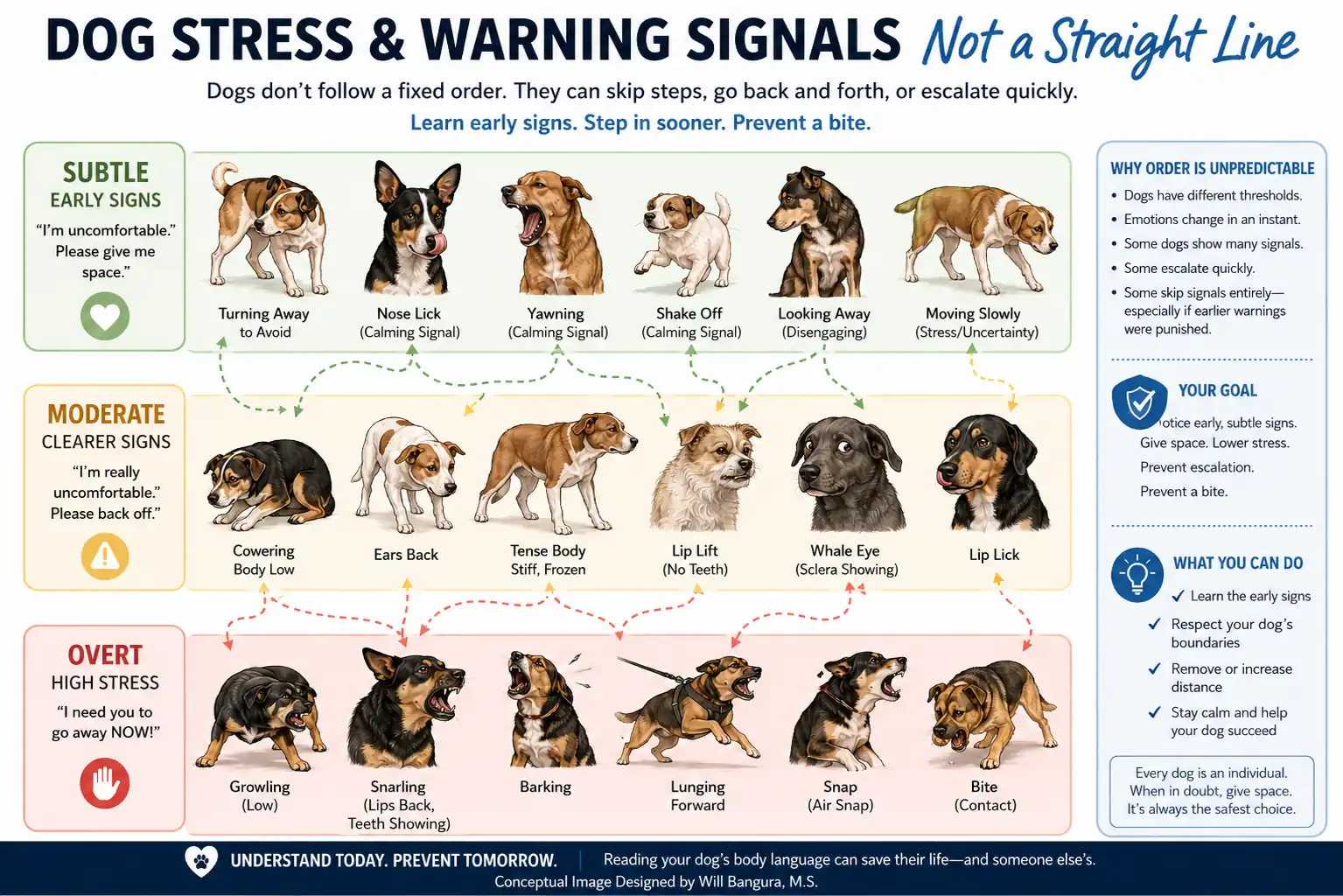
Most Dogs Warn Long Before They Bite
Dogs almost always communicate stress before they ever growl or snap, but the early signals are quiet and easy to miss: looking away, licking the lips, yawning, a stiff body, or the whites of the eyes showing. Learning to read them lets you add distance and lower your dog's stress before the behavior escalates.
These signals also do not follow a fixed order. Some dogs move through them in seconds, and some skip the early warnings entirely, especially when those warnings have been punished before. That is why punishing a growl is so risky, and why behavior modification works to keep your dog's warning system intact while changing how it feels underneath.
It's Fear, Not Dominance

In this short video, Will Bangura explains why most dog aggression is driven by fear, anxiety, and frustration rather than dominance, and why understanding that difference is the key to changing the behavior safely and humanely.
Read the transcript
If your dog growls at visitors, lunges at strangers, or has bitten somebody, your dog is not trying to dominate people. Your dog is most likely afraid. I'm Will Bangura, certified canine behaviorist and founder of Phoenix Dog Training in Phoenix, Arizona. One of the biggest myths in dog training is the idea that aggressive dogs need harsher corrections, more punishment, or stronger control. In reality, most aggression toward people is rooted in fear, anxiety, stress, conflict, or negative emotional conditioning. Your dog's nervous system is reacting to perceived danger.
That means if training focuses only on suppressing the outward behavior, growling, barking, lunging, snapping, you may stop the warning signs without changing the emotional state that's driving the aggression. That's dangerous. Real behavior modification changes the underlying emotional response.
If you're searching for help with dog aggression, dog reactivity, or any severe behavior problems, I'm Will Bangura, certified dog behaviorist with Phoenix Dog Training. Be sure to visit my website at phoenixdogtraining.com and follow me for more evidence-based dog behavior help.
Dog Aggression Training in Mesa Without Shock Collars, Prong Collars, or Harsh Corrections
Every aggression case here is handled force-free. That means no shock collars, prong collars, choke chains, or leash corrections, not because it sounds gentler, but because with an aggressive dog those tools are risky and often make things worse. Aggression is driven by fear and frustration, and adding pain or intimidation to a dog who is already over threshold feeds the very emotions causing the behavior.
The professional consensus in behavior science, including the position of the American Veterinary Society of Animal Behavior, is that aggression and fear are best treated with reward-based, force-free methods. That is the approach here. We change your dog's emotional response to its triggers through counterconditioning and desensitization, kept at a distance and intensity where your dog stays under threshold and can actually learn.

Straight From the Source
The American Veterinary Society of Animal Behavior recommends reward-based, force-free methods for all dog training, including the treatment of aggression and fear, and advises against tools that rely on pain or intimidation. Read the full statement, with its research citations, for yourself.
Download the Position Statement (PDF)Force-Free and Reward-Based
No shock collars, no prong collars, no choke chains, and no leash corrections, ever.
Treats the Cause, Not the Symptom
We lower the fear and frustration driving the behavior instead of just suppressing how it looks.
Safer With Aggression
Punishing a growl can suppress the warning without changing the fear, leaving a dog who bites with no warning at all. Force-free keeps that early-warning system intact.
Built on Trust
Your dog learns to feel safe, which is the opposite of what pain and intimidation teach.
Grounded in Behavior Science
Counterconditioning, desensitization, and sub-threshold learning, matched to your dog's specific triggers.
Lasting, Not Just Suppressed
A dog who is genuinely calmer, not one who has simply shut down.
Suppression Versus Behavior Modification

In this short video, Will Bangura explains the difference between suppressing an aggressive behavior, which only hides it and can strip away a dog's warning signals, and behavior modification, which changes the underlying fear or frustration so the behavior genuinely resolves.
Read the transcript
Hi, I'm Will Bangura, certified canine behaviorist with Phoenix Dog Training. Got a quick message for everybody. If you've been told that your dog needs to be corrected, shocked, or held accountable for barking, lunging, growling, snapping, panicking when left alone, guarding food, or reacting to other dogs, I want you to pause for a second, because the biggest confusion that I see, and it's everywhere, is that people are calling obedience training and corrections behavior modification. And those are not the same thing, not even close.
Behavior modification is not just making the behavior stop. Behavior modification is changing why the behavior is happening in the first place. That's the whole point. So let me put this in plain language. If your dog sees another dog and loses it, whether they're on leash or off leash, maybe they're barking, lunging, growling, what you're looking at is the outward behavior. That is what you can see. But there's always something underneath that behavior driving it: fear, anxiety, frustration, conflict, sometimes pain or discomfort, sometimes a history of bad experiences, sometimes a dog who has learned that other dogs predict something unpleasant. That underlying emotional response is what powers that behavior.
If you only attack the outward behavior and you never change what the dog feels about the trigger, you haven't modified the behavior. You've only suppressed it. And suppression is a word that pet parents almost never hear, so let me explain it clearly. Suppression is when the dog looks better on the outside, but nothing has been resolved on the inside. The fear is still there. The anxiety is still there. The dog is still overwhelmed. You just taught the dog that they can't express that.
That is why I always say you have to be really careful with the word correction. Correction sounds like you're fixing something, like you're correcting a spelling mistake. But in the real world, correction is usually just punishment with better marketing. And here's the problem with punishment. Punishment in behavior cases might stop a behavior, absolutely. It can reduce barking, reduce lunging, reduce growling, reduce snapping. But stopping a behavior is not the same thing as changing a behavior, because the emotional engine can still be running full speed under the surface.
Now I'm going to give you a real example. Let's say you have a dog who is dog reactive on walks. So you're out there, another dog appears, your dog stiffens, your dog barks, your dog lunges. You take an electronic collar or a prong collar or a leash correction and you punish the explosion. The dog quiets down and the trainer says, "See, it worked. We modified the behavior." No, you didn't. You suppressed the symptoms. Because in that moment, what did the dog actually learn?
This is the part most people don't understand. Dogs are association machines. They learn what predicts what. They don't just learn, I barked, so I got corrected. They also learn what was happening in the environment right before the correction happened. So if the correction happened when another dog appears, the dog can very easily learn something like this: other dogs predict pain, other dogs predict discomfort, other dogs predict something bad. And if the dog already thought other dogs were scary, now you have made other dogs even more scary. Because now dogs don't just bring fear. Dogs bring pain. Dogs bring corrections. That is not behavior modification. That is making the underlying problem worse through association.
So now, over time, what happens? At first the dog might look better, quieter, less dramatic, but inside you're building a pressure cooker, because the fear is still there. The anxiety is still there. The dog is still struggling. The dog is just not allowed to show you. And when you have a dog living in that pressure cooker, it becomes unstable. It becomes unpredictable, because you're not changing the emotional response. You're just clamping the lid down.
This is where things can get dangerous, and I need pet parents to hear this clearly. If you punish growling, maybe you call it correcting. If you correct growling, you can get less growling. That's true. But growling is communication. It's information. It's a warning. If you punish the warning and the fear remains, you don't get a safer dog. You often get a dog that learns to skip that warning. And that means the dog may learn to bite without growling first. The dog may learn to bite without warning. That's not an opinion. That's a known risk. And it is one of the reasons why major veterinary behavior guidance warns that punishment can suppress warning signals while leaving the emotional state unchanged. So if somebody tells you, "I corrected the growl," what I hear is, "I removed the smoke alarm, but I did nothing about the fire."
Now let's talk about what real behavior modification actually looks like, because I don't want you walking away thinking I'm just criticizing. I want you to understand what to look for. Real behavior modification starts with a clear definition of the behavior. Not labels, not he's dominant, not he's stubborn, not he's trying to control you. It's observable, specific. What does the dog do? When does it happen? What triggers it? Then we look at function. What is the behavior accomplishing for the dog? Does barking and lunging create distance? Does growling make hands go away? Does snapping create distance? Does guarding keep people away from food? Because if you don't understand what the behavior is doing for the dog, you can't build an effective plan.
Then comes management, and pet parents misunderstand this all the time. Management is not giving in. Management is how we stop the dog from rehearsing the problem over and over while we teach new skills and change emotional learning. Rehearsal is practice. Practice strengthens behavior. So we prevent unnecessary explosions while learning is happening.
Then we teach replacement behaviors. This is huge. If you punish a behavior but you never teach the dog what to do instead, you're leaving the dog with a vacuum. You're basically telling them, "Don't do that," while giving them no solution for how to cope. So we teach functional alternatives. That might be orienting to the handler, moving behind the handler, a station behavior, a U-turn, a pattern game, a hand target, a structured sniffing task, something the dog can actually do in the real world when the trigger appears.
And here's the heart of it. We change the dog's emotional association with the trigger. If the dog is afraid of other dogs, we do controlled exposure at a distance where the dog can still think. We pair that exposure with something the dog genuinely values. And we repeat those experiences in a way that changes what the trigger predicts. Over time, the dog goes from dogs are scary to dogs predict safety and good outcomes. That is behavior modification.
Now, I want to show you two quick visuals, because they make this easy. First is the iceberg. What you see above the water is barking, lunging, growling, snapping. That is the stuff people try to shut down. But under the water is the real driver: the conditioned emotional response, the negative predictions, the learning history, the stress load, the lack of coping skills. If you don't change what's under the surface, the iceberg doesn't go away. You just hide it.
Second is the pressure cooker. Suppression is the pressure cooker. The dog looks calmer outside, but inside the fear and anxiety are building. Warning signals fade and the risk of a bigger explosion rises. Real behavior modification releases pressure, because you are changing emotions and teaching skills, not clamping the lid down with corrections.
And that brings me to the simplest way that I can say this. If a plan is mostly corrections, it's usually just suppression. If a plan changes the setup, changes consequences, teaches a functional alternative behavior, and changes the dog's emotional response over time, that is behavior modification.
So if you're a pet parent looking for help, here are the questions that I want you to ask any trainer or any behavior professional before you hire them. Ask them to define behavior modification in plain language. If they can't, well, that tells you something. Ask what they think triggers the behavior. Ask what they think maintains it. Ask how they will keep your dog under threshold while learning happens. Ask what they will teach your dog to do instead. Ask how they will change what your dog feels about the trigger. And ask whether they use punishment, negative reinforcement, shock collars, prong collars, or choke chains. If they do, ask how they prevent suppression of warning signals, and how they protect the relationship between you and your dog.
Because your dog doesn't need pain to learn. Your dog needs a plan. Your dog needs skill building. Your dog needs emotional change. Your dog needs safety and clarity. And if you want a real rule of thumb that you can take with you, here it is. If it looks like progress, but your dog is more tense, more shut down, less expressive, or more explosive later on down the road, it wasn't behavior modification. It was suppression. Real behavior modification makes the dog feel safer, behave safer, and trust you more, not less.
Every aggression case starts by understanding what is driving the behavior, then building a plan that changes it. Book a behavior consultation, or start with a free 15-minute call.


Reactive Dog Training for Barking, Lunging, and Leash Reactivity
If your dog turns into a different animal the moment a trigger appears on a walk, barking, lunging, and pulling so hard you dread leaving the house, that is leash reactivity. For one dog it is other dogs. For another it is a jogger or a cyclist on the Eastmark paths, a delivery driver at the door, or the dogs barking from behind the walls and fences in Las Sendas. It looks like aggression, and sometimes it overlaps with it, but most reactivity is fear or frustration that boils over the instant a trigger gets too close. Your dog is not giving you a hard time. Your dog is having a hard time.
The work is not to correct the barking or yank the leash, which only piles stress onto a dog who is already over the edge. Reactive dog training in Mesa is built on changing how your dog feels about the trigger, and that depends almost entirely on one thing: distance. There is a zone where your dog can see the other dog and still stay calm enough to learn. Find that zone and you can shift the emotional response. Cross it, and learning stops.
The Arizona heat pushes most of these walks into the early morning and the evening, which is one more reason this work is done on your real routes and in your home during the cooler hours, rather than by sending your dog to a board-and-train kennel for the summer.


Too Far
Your dog has not noticed the trigger yet. Relaxed, but there is nothing to work on.

The Learning Zone
Your dog notices the trigger and still stays under threshold. This is where real change happens.

Too Close
Over threshold. Barking, lunging, and too flooded with stress to take anything in.
Reactive training starts in that middle zone and slowly closes the distance as your dog grows more comfortable. Push too close too fast, and you are right back to barking and lunging.
Dog-to-Dog Aggression and Dogs Fighting in the Home

Dog-to-dog aggression can flare between dogs who have never met, but some of the hardest cases happen between two dogs who live under the same roof and keep fighting no matter what their pet parents try.
Two dogs fighting in the same home is one of the most stressful situations a pet parent can face, especially when they used to get along. Household conflict usually builds around specific flashpoints: food, chews, toys, doorways, favorite resting places, tight spaces, arousal, access to a person, or a rise in household stress. Sometimes a single scary fight rewrites how the dogs feel about each other, and the tension never resets on its own.
This work starts with safety and management to reduce the risk of injury while we work. The first goal is not to make the dogs interact. The first goal is to stop rehearsals and create safety. From there we rebuild calm, predictable interactions where that is realistic. Some multi-dog homes return to comfortable cohabitation. Others do best with a structured separation-and-rotation plan. An honest assessment tells us which path fits your dogs, and you will not be sold a guarantee of reunification that may not be realistic.

Management is not giving up. A predictable routine with gates and rotation keeps everyone safe and takes the pressure off while the behavior work happens, and most dogs settle into it more easily than their pet parents expect.
Do not keep putting your dogs together to see what happens. Rehearsed fights can increase risk and make behavior change harder.
Resource Guarding, Growling, Snapping, and Bite-Risk Concerns

For many Mesa pet parents, guarding first shows up as growling or snapping over food, a toy, a favorite spot, or a close call with a bite.
Resource guarding is when a dog protects something it values, food, a bone, a stolen sock, a spot on the couch, a doorway, sometimes a person, by stiffening, growling, snapping, or biting if approached. It is common, it comes from insecurity rather than spite, and many cases respond well to the right plan. The worst thing you can do is punish the growl, because the growl is the warning that keeps everyone safe.
We address guarding by changing what your dog predicts when a person approaches its valued things, so it no longer feels it has to defend them, using safe trades and structured exchanges rather than confrontation. Alongside that, we put management in place to prevent rehearsals and reduce bite risk while the behavior changes, and we teach the household what not to do. When a dog guards a person, the issue is the dog controlling access to a valued person or space, not the dog heroically protecting you, and the plan treats it as guarding like any other resource. If children or visitors are part of the picture, that shapes the safety plan.
While a structured behavior plan is being built, these handling guidelines help keep everyone safer:
Aggression Toward Visitors, Strangers, Children, or Family Members

For Mesa pet parents, aggression aimed at people can feel like the highest-stakes problem of all, and it is the one where a careful, honest plan matters most.
Aggression directed at people is frightening, and it carries real stakes, so it is handled with care and honesty. A dog that growls at guests, lunges at strangers, or has shown aggression toward a child or a family member is usually communicating fear, discomfort, or a feeling of being cornered, not a desire to harm. Triggers may include visitors entering the home, people reaching or making direct eye contact, children moving quickly, strangers approaching, petting, handling, or restraint.
The plan combines three things: management and supervision so everyone stays safe, a behavior-change protocol that shifts how your dog feels about people, and clear household rules so you are not guessing. We do not tell visitors to just hand over treats with no plan, we do not flood your dog with exposure, and we do not force greetings. Cases involving children or bites toward family members deserve a thorough, in-person assessment and realistic expectations. The honest goal is a safer, calmer dog and a clear plan, not a promise that risk disappears overnight.
Around visitors and children, structure and supervision come first. Do not force greetings, and do not count on your dog to tolerate approaches, reaching, or handling that it is not ready for. Set the environment up so your dog is never put in a position to make a mistake.
Is Board-and-Train a Good Idea for an Aggressive Dog?
For Mesa pet parents weighing a board-and-train for an aggressive dog, here is an honest look at what it can and cannot do.
Board-and-train can look appealing when you are exhausted and afraid of making a mistake, and a good program can build obedience skills. But aggression and reactivity are not just obedience problems, and they do not happen in a vacuum. Your dog's triggers, the home environment, the other dogs in the household, the walking routes, the visitors, and the way the household responds all shape the behavior. Sending the dog away may change how it acts in a different setting for a while, but it usually does not teach you how to keep the dog safe or how to continue the behavior work at home, which is where the behavior actually happens.
For aggression and reactivity, the safer starting point is assessment, management, pet-parent coaching, and a plan built around the real situations your dog struggles with. That is why the work here is in-home and virtual, building your skills alongside your dog's progress, rather than handing the dog back after a few weeks and hoping it holds.
What Board-and-Train Cannot Teach You

In this short video, Will Bangura explains why a few weeks at a board-and-train facility rarely transfers to real life with an aggressive or reactive dog, and why building your own handling and management skills, in the home where the behavior actually happens, is the more reliable path to lasting, humane change.
Read the transcript
Hi, I'm Will Bangura. I'm a certified dog behaviorist and the founder of Phoenix Dog Training, and for more than 35 years I've helped pet parents resolve aggression, reactivity, anxiety, fears, phobias, separation anxiety, and other serious behavior problems. Today we're talking about board and train programs. Should you send your dog away for training? For most dogs, my answer is no. In fact, for dogs struggling with aggression, reactivity, anxiety, fears, phobias, or separation anxiety, board and train is often one of the worst decisions a pet parent can make. Let me explain why.
The biggest problem with board and train has nothing to do with the dog. It has everything to do with the pet parent. The person who most needs training is you. Your dog is going to spend the rest of its life living with you, not the trainer. You need to learn how to read body language. You need to understand stress signals. You need to know how to prevent problems, manage situations, and reinforce the behaviors you want. Those are skills that last a lifetime. When a dog is sent away for training, the pet parent misses much of the learning process. That's a huge mistake. Training isn't just about changing your dog's behavior. It's about teaching you how to communicate and build a better relationship with your dog.
The second major problem is that board and train programs promise results in a very short amount of time. One week, two weeks, three weeks, maybe four. That sounds appealing, but serious behavioral problems don't change that quickly. Aggression is not an obedience problem. Reactivity is not an obedience problem. Fear and anxiety are not obedience problems. They're emotional problems, and emotions don't change in a couple of weeks. Real behavior modification takes time. It requires changing how a dog feels, not just what a dog does.
That's where many board and train programs run into trouble, because they're under pressure to produce rapid results. The fastest way to stop behavior is often punishment. Electronic collars, prong collars, harsh leash corrections, flooding, intimidation. These methods can suppress behavior quickly. A dog may stop barking. A dog may stop lunging. A dog may stop reacting. But stopping behavior isn't the same as changing emotion. The fear may still be there. The anxiety may still be there. The stress may still be there. The behavior has simply been suppressed.
Over the years, I've heard the same story from pet parents over and over again. Their dog goes away for training because of aggression or reactivity. The dog comes home looking great. Everything seemed fixed. Then two weeks later, or a month later, maybe two months later, the problem starts returning, and often it's worse than before. Why? Because the underlying emotional problem was never addressed. The symptoms were suppressed. The emotions remained.
Now, not every board and train program is abusive. Not every trainer is inherently causing harm. But board and train creates another concern: lack of transparency. You're not there. You don't see every training session. You don't know exactly what's happening when your dog is out of sight. Unfortunately, every year we continue to see stories of dogs being mistreated, injured, or traumatized in board and train facilities. Most pet parents never think it could happen to their dog until it does.
So is there ever a place for board and train? In my opinion, yes. If a pet parent is physically unable to participate in training because of a significant disability or medical condition, it may be a reasonable option. But those situations are the exception, not the rule. For most dogs, especially dogs with behavioral issues, the best outcomes happen when pet parents are actively involved in the process.
The goal shouldn't be to send your dog away and hope someone fixes it. The goal should be to learn alongside your dog. That's how lasting change happens. That's how trust develops. That's how relationships improve. And that's how real behavior modification works. If there's one thing I want you to remember from today's episode, it's this: training is not something that gets done to your dog. Training is something that you and your dog learn together. I'm Will Bangura from Phoenix Dog Training. Thanks for joining me today, and I'll see you in the next episode.
In-Home and Virtual Aggression Consultations for Mesa Pet Parents
Behavior work is available both in-home across Mesa and virtually. In-home sessions let us see your dog in the real environment where the behavior happens, which is valuable for many aggression and multi-dog cases. Virtual sessions can be just as effective for assessment, planning, coaching, and many reactivity and household cases, and for some aggression and stranger-reactive dogs, starting virtually is not a downgrade. It is often the safest first step, because your dog does not have to face a stranger before a plan exists.
Virtual works well for reviewing history, management, video of the behavior, thresholds, triggers, household layout, and safety planning, and hybrid plans suit many stranger-reactive cases. During your consultation we will recommend the format that fits your dog and situation. Either way, you work directly with Will Bangura on a plan built for your specific case.

In the real environment where the behavior actually happens, valuable for many aggression and multi-dog cases.

Just as effective for assessment and coaching, and often the safest place to start for stranger-reactive dogs.
For some aggressive or stranger-reactive dogs, starting virtually is not a downgrade. It may be the safest and most humane first step.
A Severe Aggression Case Others Had Given Up On

In this video, a pet parent shares what happened after she was told that euthanasia was the recommendation for her dog's aggression. She found Will, and together they built a force-free behavior plan focused on safety, managing triggers, and gradually changing how her dog felt, rather than suppressing the behavior. It is one family's candid account of what committed, science-based behavior work can look like over time.
This is one client's story. Every dog is different, and outcomes depend on the dog's history, safety risks, environment, medical factors, and consistency with the plan.
Read the transcript
Audrey: Hi, my name's Audrey, and this is Dylan. He is a rescue dog out of Texas, a Catahoula mix. We went through training, just basic training, with another trainer, and that trainer actually told us to put Dylan down. That broke our heart, because he's a very good dog, but apparently he's got some fears and phobias that other standard trainers can't deal with. Today, Dylan is the most incredible dog. He's got a lot to learn, we have a lot to learn, because this is a team effort, and if I don't do the work, he doesn't learn anything. So we've come a long way, and we've got a long way to go. But today, I'm so happy I didn't listen to that other trainer, because if I ever walked down an alley or into a strange place, I want this dog right next to me.
Will: What was he doing that the other trainer told you you needed to euthanize the dog?
Audrey: Whenever something would scare Dylan, he'd bite another dog. It didn't matter, because he was so afraid. He was very reactive.
Will: So at this point, you feel like you've got the ability to really manage and control him better, and he's a dog that you can keep without having to euthanize?
Audrey: I have all the right tools. We're working on that, and we have not had any problems since we've been training.
Will: If you liked this video, be sure to give it a thumbs up, and don't forget to subscribe to this YouTube channel. If you have a problem with your dog's behavior and training, contact Phoenix Dog Training at 602-769-1411, or visit us on the web at phoenixdogtraining.com. Those outside of Arizona, be sure to check out our online training options.

Will Bangura, M.S.
CAB-ICB, CBCC-KA, CPDT-KA, FDM, FFCP
Will Bangura is a Certified Canine Behaviorist, Applied Ethologist, and behavior consultant specializing in severe dog aggression, reactivity, anxiety, fear, phobias, separation anxiety, and complex canine behavior problems. With more than 35 years of experience, he works with pet parents throughout the Phoenix metropolitan area and worldwide through virtual behavior consultations.
Will is Arizona's only CAB-ICB Certified Canine Behaviorist through International Canine Behaviorists, and one of only three professionals in the United States to hold this credential. He holds a Master of Science degree in Psychology and completed postgraduate studies in canine cognition through Harvard University.
In addition to his behaviorist credentials, Will is certified through the Certification Council for Professional Dog Trainers (CCPDT) as both a Certified Behavior Consultant Canine (CBCC-KA) and Certified Professional Dog Trainer (CPDT-KA). He is also a Fear Free Certified Professional (FFCP) and certified in Applied Ethology through Kim Brophey's Family Dog Mediation (FDM) program.
Will is the founder of Phoenix Dog Training, host of the Dog Training Today podcast, published author, public speaker, and expert witness in dog behavior and aggression cases. His work focuses on evidence-based, force-free behavior modification that addresses the underlying emotional causes of canine behavior problems rather than simply suppressing behavior through punishment.
Verified and Accredited
Professional Credentials & Affiliations
Science-based training, behavior expertise, continuing education, and professional membership, all grounded in the credentials and experience Will Bangura brings to every case.
Certifications




Continuing Education

Professional Memberships



Schedule Dog Aggression Training in Mesa
You do not have to keep managing this alone, and you do not have to choose between living with the behavior and using methods that scare your dog. If your dog is barking, lunging, growling, snapping, biting, guarding resources, or fighting with another dog in the home, the next step is a behavior consultation with Will Bangura, a Certified Canine Behaviorist who works these cases every day. We will assess what is driving your dog's behavior and give you a clear, humane, science-based plan for improving safety and changing the behavior over time.
You do not have to wait for the behavior to get worse before asking for help.
Call 602-769-1411