
← Dog Body Language: The Definitive Guide
The Definitive Guide · BarkingDog Barking: Five Barks, Five Messages, Five Different Answers
Barking is not one behavior. It is five different behaviors wearing the same sound, each with its own trigger, its own emotional driver, and its own solution. Treat them all the same and nothing improves. Learn to tell them apart and everything does.
Stop Asking How to Stop the Barking. Start Asking What It's For.
"How do I stop my dog from barking" is one of the most common questions in all of dog behavior, and it is the wrong question, which is why the usual answers fail. Barking is not a single behavior with a single fix. It is a communication channel carrying at least five distinct messages, alarm, demand, play, frustration, and fear, and each one has a different trigger, a different emotional engine, and a different solution. Apply the fix for one type to a bark of another type and you get nothing, or worse. The right first question is never how to stop it. The right first question is what this particular bark is for.
That question is a functional behavior assessment in miniature, and you can run it yourself with three observations. First, the antecedent: what happens immediately before the barking starts? A figure passing the window, a pet parent sitting down to dinner, a leash appearing, a dog on the other side of a fence. Second, the acoustics: pitch, rhythm, and repetition genuinely differ across bark types, and the sections below describe each signature. Third, and most decisive, the body: the posture underneath the bark, forward or retreating, loose or stiff, tells you the emotional state driving the sound, which is why every bark on this page comes with its body cluster attached. Sound alone is the least reliable channel a dog has, a lesson the play growl already teaches; the bark is no different. If you have not read the main guide on reading the whole dog, it is the foundation everything here stands on.
One position stated plainly before we begin, because this page is where the worst products in the dog industry live: bark collars, shock, vibration, spray, or ultrasonic, are not a solution to any bark type on this page, and the closing section explains the mechanism of why in full. The short version is that they punish the sound while leaving the reason for the sound completely intact, and a dog silenced without being helped is not a success story. It is a suppressed one. Every solution offered below works the other way: identify the function, address the emotion or the reinforcement maintaining it, and the barking resolves because the reason for it did.
The Alarm Bark: "Something Is Out There"
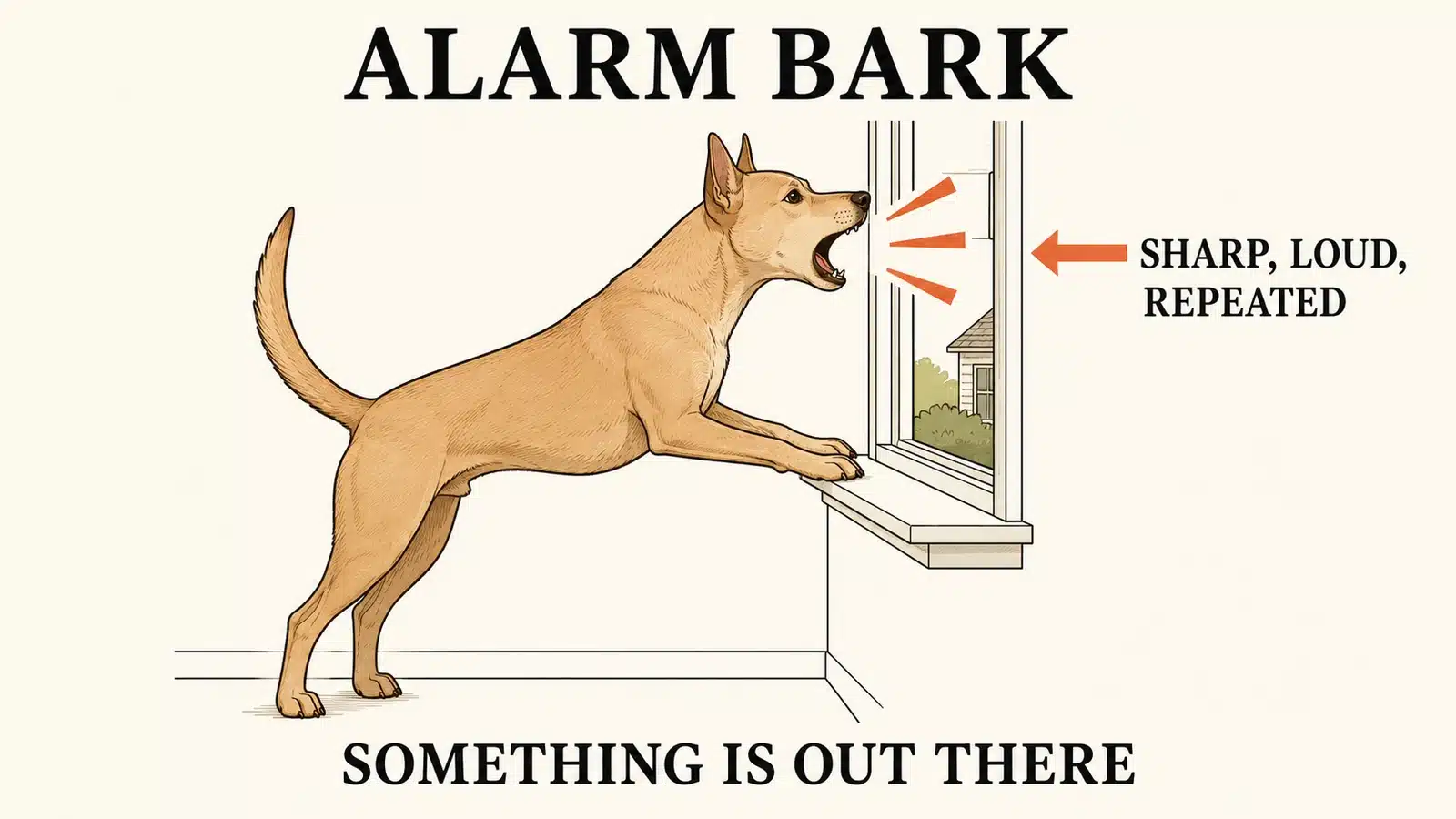
The alarm bark is the sentry's bark: sharp, loud, delivered in repeated bursts, aimed at something the dog has detected, a passerby, a delivery driver, a sound the house made, another dog crossing the property line. The body underneath it is alert and oriented hard at the trigger: tall posture, ears pricked forward, weight forward or up on the window sill, tail up. Functionally this is threat detection and announcement, one of the oldest jobs dogs have held in human households, and a certain amount of it is completely normal. The dog is doing exactly what thousands of years of partnership shaped him to do: noticing, and telling you.
Alarm barking becomes a problem through rehearsal and reinforcement, and understanding that loop is the whole treatment. Every time the mail carrier arrives, the dog barks, and the mail carrier leaves. From the dog's perspective, the barking worked, every single day, which is a reinforcement schedule most trainers would envy. The fix runs on two tracks. Management first: cut off the rehearsal by controlling the dog's access to the trigger, window film on the barking windows, a gate that keeps the front room off limits during peak foot traffic, background sound that masks the audio triggers. Then teach an alternative: acknowledge the alert calmly, thank the dog in a genuinely relaxed voice, and cue him to you for reinforcement, so the sequence becomes notice, announce once, disengage, and get paid. For dogs whose alarm barking carries real agitation at specific triggers, the deeper work is desensitization and counterconditioning to those triggers, changing what the mail carrier predicts from intrusion to good things. What never works is yelling, which, from the dog's side of the glass, sounds like you joining the alarm.
The Demand Bark: "Hey. Hey. Hey. Look at Me."
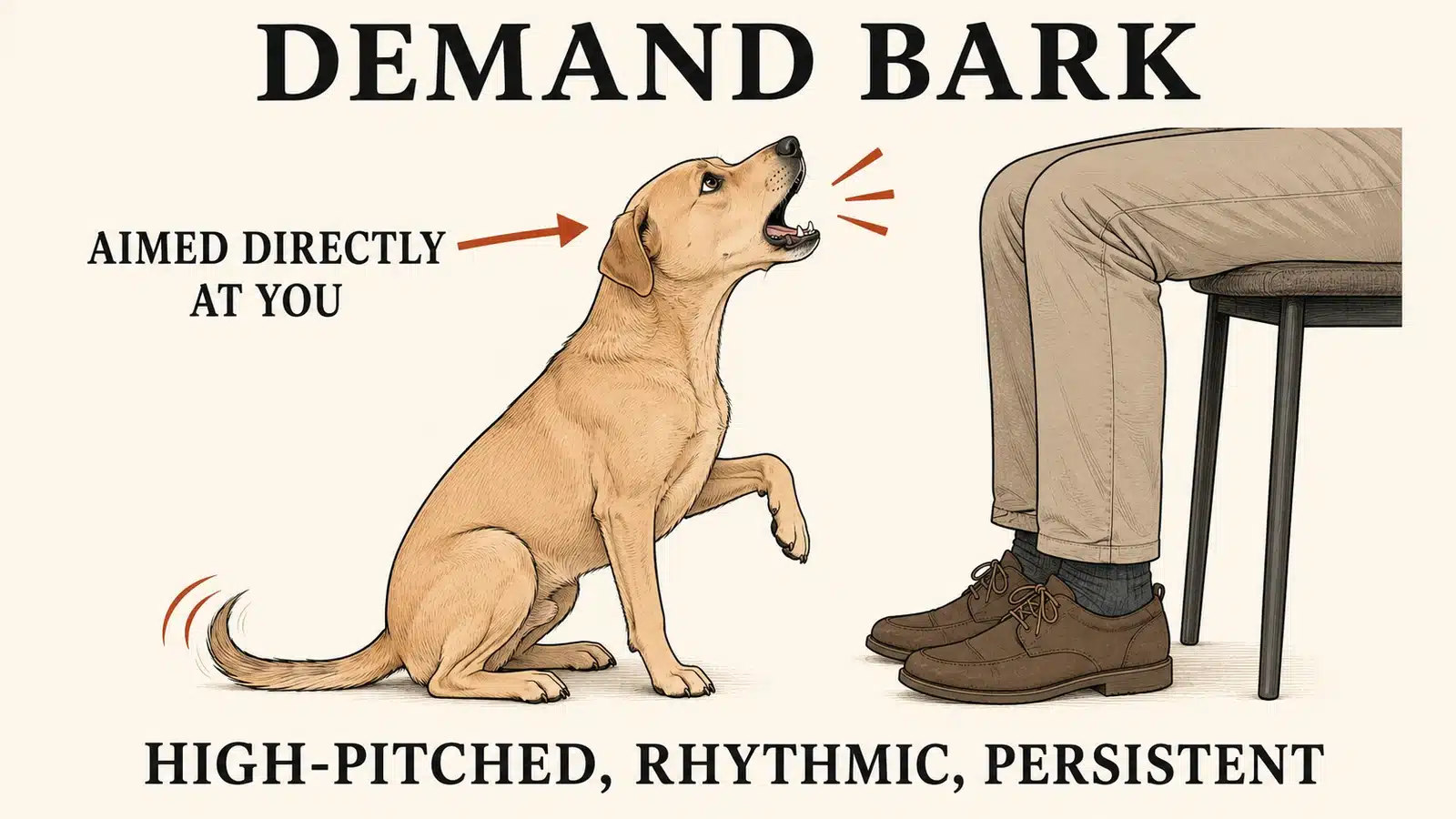
The demand bark, also called attention-seeking barking, is unmistakable once you know its signature: higher-pitched, rhythmic, persistent, and aimed squarely at a person, often from a sit directly in front of you, sometimes garnished with a lifted paw or a head tilt. The antecedents give it away every time: you sat down to eat, you picked up your phone, you stopped throwing the ball, you started a conversation with someone who is not the dog. This bark is pure operant behavior, a learned strategy for producing a specific outcome, and it exists for one reason only: at some point, it worked. Somebody looked, laughed, scolded, or handed something over, and the dog's accounting department recorded the transaction.
The treatment follows directly from the mechanism, and it has two halves that must run together. The first half is removing the payment: demand barking that never again produces attention, food, or play will eventually extinguish, because behavior that stops working stops happening. Two honest warnings about that process. Expect an extinction burst, a temporary escalation where the barking gets louder and more insistent before it fades, which is the dog testing whether the old strategy just needs more volume; if you cave during the burst, you have taught him that persistence pays, and the behavior comes back stronger. And be ruthless about consistency, because intermittent reinforcement, caving one time in ten, does not weaken a behavior, it strengthens it, on exactly the schedule that makes slot machines addictive. The second half matters just as much: pay a better behavior instead. Reinforce the dog generously for sitting quietly, for settling on a mat, for offering calm, so the honest route to your attention is wide open and reliably profitable while the barking route is permanently closed. Extinction without an alternative just creates a frustrated dog; extinction plus a well-paid alternative creates a polite one.
The Play Bark: The Soundtrack of a Good Time
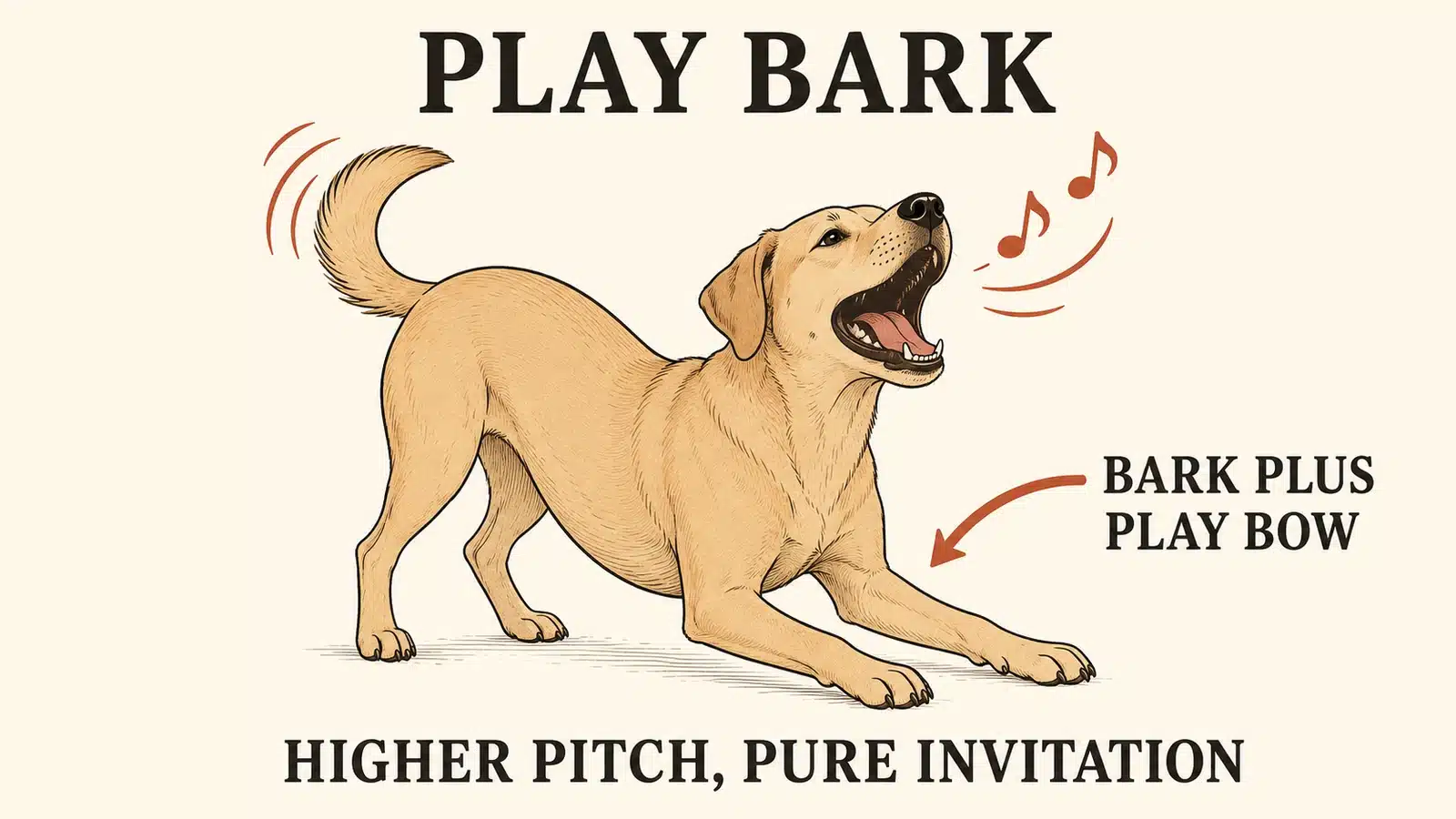
The play bark is the happiest sound on this page: higher-pitched than the alarm bark, often coming in bouncy single bursts or short volleys, and delivered from a body that removes all doubt, a play bow, a wiggling rear end, floppy ears, bright eyes, the whole loose apparatus of a dog having or soliciting fun. Dogs bark in play to invite a game, to restart a stalled one, to spectate excitedly while other dogs wrestle, or simply as overflow when joy exceeds the container. Read against its body, this bark needs no fixing, because there is nothing wrong. It is the soundtrack of one of the best things dogs do, covered fully in the play signals guide.
Two practical notes keep this section honest. First, the play bark is your cleanest daily proof that sound alone cannot classify a bark, because acoustically it overlaps with barks that mean trouble, and only the loose, bouncy body certifies it as play; that is worth internalizing as a reading habit. Second, volume and arousal are worth watching even in joy. Some dogs, particularly herding breeds, become relentless play-barkers whose arousal climbs with every volley, and a dog spiraling upward in excitement can tip past the point where play stays healthy, the transition described in the play guide's section on telling play from trouble. The answer is not punishment, it is arousal management: brief cheerful breaks, a scatter of treats to bring noses down and heart rates with them, and resuming before frustration builds. A play bark is a celebration. Your only job is making sure the party does not get out of hand.
The Frustration Bark: Blocked From a Goal, and Saying So
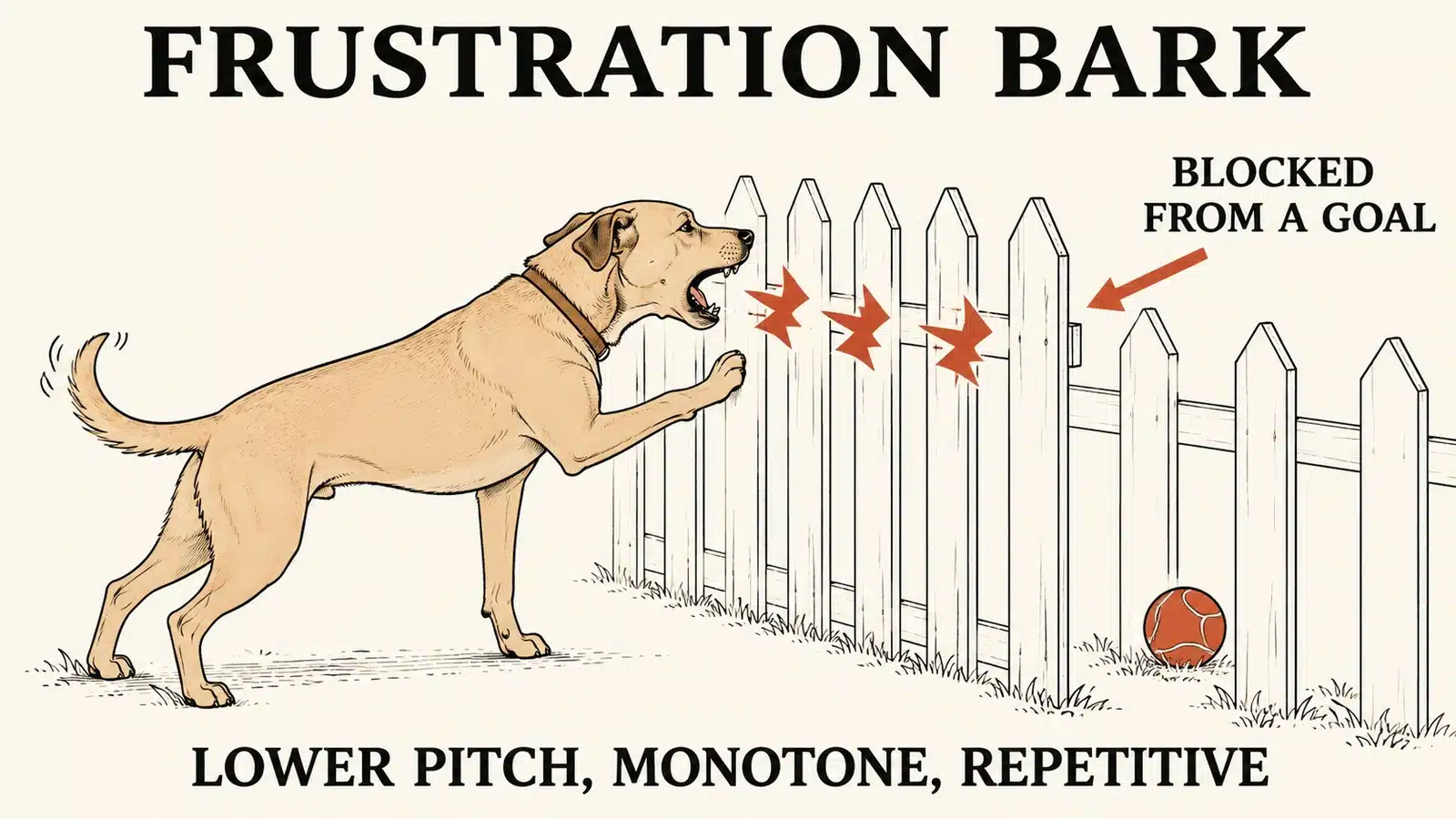
The frustration bark is the sound of a dog blocked from something he wants: the ball that rolled under the couch, the squirrel on the far side of the window, the dog friend across a fence line, the person he can see but cannot greet. Acoustically it tends lower-pitched, flatter, and grindingly repetitive, a monotone drumbeat that can go on far longer than an alarm burst, and the body pairs it with pressure at the barrier: pressed against the fence, pawing at the glass, oriented hard at the blocked goal. The emotional engine here is frustration itself, one of the four core drivers of problem behavior, and it deserves to be taken seriously rather than dismissed as noise.
Frustration barking matters beyond the annoyance because of what repeated barrier frustration does over time, and this is where it connects to some of the most serious behavior problems I treat. A dog who spends every day fence-running and barking at dogs he can never reach is rehearsing an emotional cocktail of high arousal and thwarted access, and that rehearsal is a well-known contributor to barrier reactivity and to leash reactivity, where the leash itself becomes the barrier. The treatment is therefore twofold. Immediately: stop the rehearsal through management, blocking the sightlines, ending unsupervised yard time along the fence, and meeting the underlying need directly, since a frustrated dog is very often an under-exercised, under-enriched dog whose species-typical needs for sniffing, chewing, shredding, and problem-solving are going unmet. Longer term: build frustration tolerance deliberately, teaching the dog through structured games that calm behavior, not barking and lunging, is what opens doors, produces balls, and starts greetings. A dog with a low frustration threshold is not a bad dog. He is a dog nobody ever taught how to wait, and waiting is a trainable skill.
The Fear Bark: Loud Outside, Terrified Inside
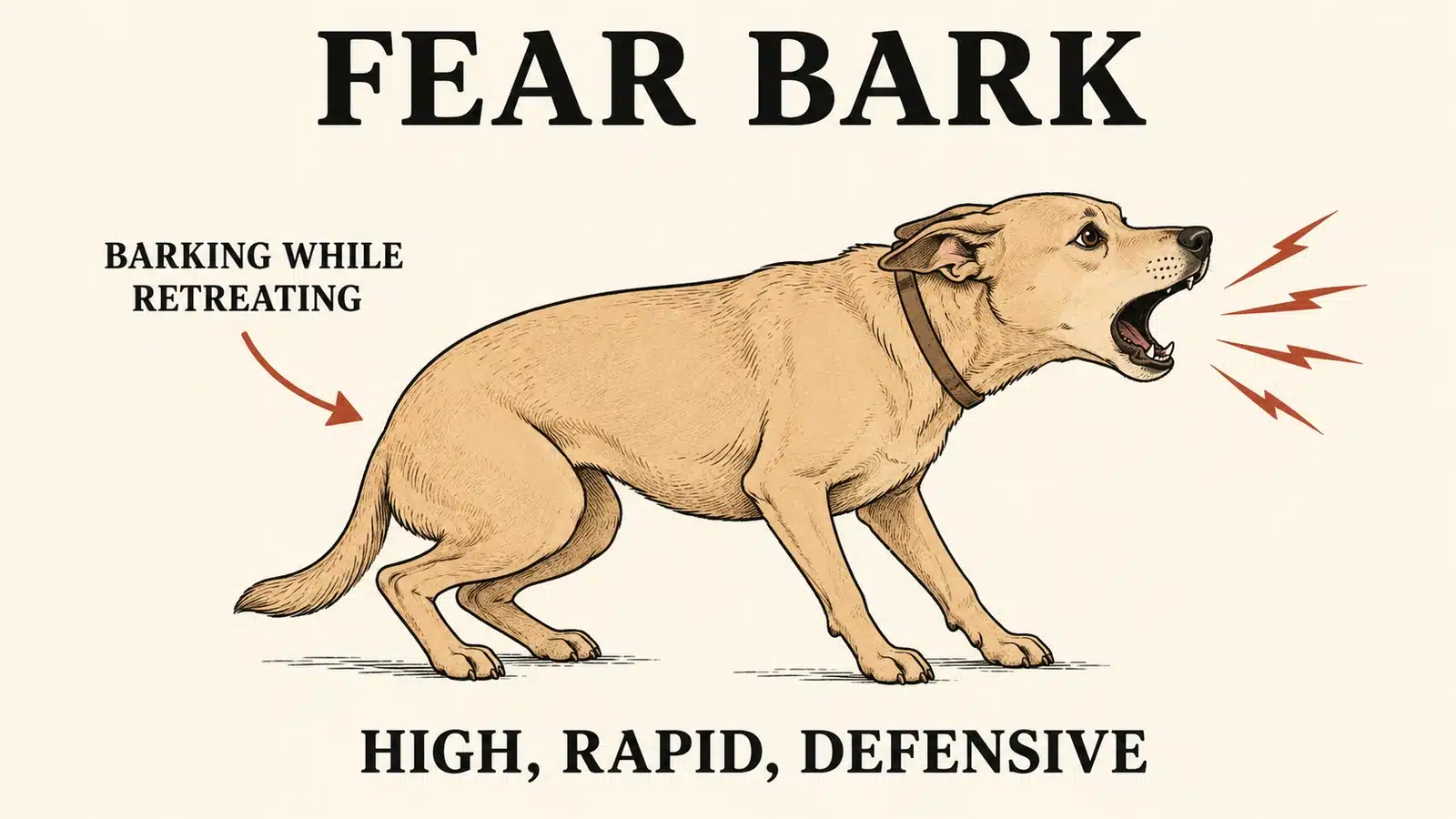
The fear bark is the one that gets misread with the highest stakes, because it sounds aggressive and is driven by the opposite. Acoustically it runs rapid and high-pitched, often in frantic clusters, and the body tells the real story through contradiction: the dog barks toward the trigger while everything else retreats, weight rocked back, hindquarters low, tail down, ears pinned, the whole frame coiled for escape even as the mouth fires. That conflict, forward voice on a backward body, is the signature of a dog who is frightened and using noise as his defense, the same fear-driven distance-increasing strategy explained in the warning signals guide. He is not trying to start something. He is trying, loudly, to make something go away.
Getting the diagnosis right matters because getting it wrong makes the dog worse, and the mechanism is worth spelling out. Punish a fear bark, with yelling, leash corrections, or any aversive, and you have added something unpleasant to the presence of the very trigger the dog already fears, deepening the negative association while suppressing the warning. You get a quieter dog who is more afraid, which is the exact recipe for the dog who one day escalates without any bark at all. The real treatment goes at the fear itself: identify the triggers precisely, manage distance so the dog stays under threshold, and run systematic desensitization and counterconditioning so the scary thing comes to predict good things instead of threat. Fear barking is not a noise problem, it is a fear problem that happens to be audible, and when the fear resolves, the barking goes with it. A dog fear-barking regularly at people, dogs, or handling is a dog who needs a proper functional behavior assessment, not a correction.
Why Bark Collars Backfire: The Mechanism, Start to Finish
Every pet store and every online marketplace will sell you a device that promises to stop barking: shock collars, vibration collars, citronella spray collars, ultrasonic boxes. They all share one design principle, delivering something unpleasant when the dog barks, and one honest description of how they operate: positive punishment. Something aversive is added to suppress a behavior. Sit with the logic of that for a moment, because it contains its own indictment. If the device works, it is because the sensation is unpleasant enough to suppress behavior, which means it carries the stress, welfare, and fallout costs of an aversive. If the sensation is genuinely not unpleasant, then it has no mechanism for changing behavior at all, and it does not work. There is no third option where the tool is both effective and benign. The marketing lives entirely in that nonexistent third option.
Now run each bark type from this page through the device, and watch what actually happens. The fear barker gets something unpleasant delivered in the presence of the thing he fears, which deepens the fear association, exactly the wrong direction, while stripping away the vocal warning that told you he was struggling. The alarm barker gets punished for a hardwired alerting behavior while every trigger keeps arriving on schedule; often the punishment itself becomes associated with the triggers, and a dog who once announced the mail carrier now feels worse about the mail carrier. The frustration barker gets his frustration compounded with pain or startle, arousal stacked on arousal. Even the demand barker, the one case that is purely operant, learns only that barking is dangerous, not that quiet behavior pays, and suppression without an alternative leaves the original need unmet and hunting for a new outlet. Across every function, the pattern is identical: the sound is suppressed, the reason survives intact, and the emotional state underneath frequently deteriorates. Suppression is not resolution. A silent dog is not necessarily a better-off dog, and in behavior work the silenced ones are often the cases that arrive later and worse, sometimes as the dog who bit without warning because every warning had been trained out of him.
The alternative is not complicated, it is just honest work in the right order, and it is the same clinical sequence that runs through every page of this guide. Identify the function, which this page has equipped you to do. Manage the environment so the barking stops being rehearsed while you work. Meet the unmet needs, because a startling share of problem barking dissolves when a dog's exercise, enrichment, and social needs are genuinely met. Then change what needs changing: reinforcement patterns for the operant barks, emotional responses through desensitization and counterconditioning for the fear-driven ones. That is the arc of the EASE Method, Evaluate, Arrange, Skill-Build, and Emotional Repatterning, applied to the loudest signal a dog owns. Barking is information. Turn the information off and you have learned nothing. Answer it, and the noise takes care of itself.
Dog Barking: Questions, Answered
Why does my dog bark at everything that passes the window?
That is alarm barking, a hardwired alerting behavior, and it persists because it gets reinforced daily: the dog barks, the passerby leaves, and from the dog's perspective the barking worked. Treat it with management first, window film, blocked access to the barking posts, masking sound, then teach an alternative sequence: notice, announce once, come to you, get paid. For dogs with real agitation at specific triggers, desensitization and counterconditioning changes what those triggers predict. Yelling never helps, because to the dog it sounds like you joining the alarm.
Do bark collars work?
They can suppress the sound, and that is precisely the problem. Bark collars operate through positive punishment: if the sensation is unpleasant enough to change behavior, it is an aversive with real welfare costs, and if it is not unpleasant, it has no mechanism for working at all. Either way, the reason for the barking survives untouched. For fear-driven barking they actively deepen the fear association, and across every bark type they suppress the signal while leaving the cause intact. Identify the function and treat it instead; the noise resolves because the reason did.
How do I stop my dog from barking at me for attention?
Two halves, run together. First, the barking must never again produce attention, food, or play, and be warned about the extinction burst: the barking will temporarily get louder as the dog tests whether persistence pays, and caving during the burst makes it stronger. Absolute consistency matters, because giving in one time in ten strengthens the behavior on the same schedule that makes slot machines addictive. Second, pay a better behavior generously: quiet sits, settling on a mat, calm check-ins. Close the barking route and open a well-paid honest one.
Why does my dog bark and lunge at dogs behind our fence?
That is barrier frustration, and it deserves attention beyond the noise, because daily fence-running rehearses a cocktail of high arousal and thwarted access that contributes to barrier reactivity and leash reactivity, where the leash becomes the barrier. Manage it now: block the sightlines and end unsupervised fence time. Then meet the underlying needs with real exercise and enrichment, and build frustration tolerance through structured games that teach calm behavior, not barking, is what opens doors and starts greetings.
My dog barks at strangers but backs away at the same time. What does that mean?
That contradiction, barking forward while the body retreats, is the signature of fear barking. The dog is not trying to start a confrontation; he is using noise to make a frightening thing go away. Never punish it, because adding something unpleasant in the presence of the feared trigger deepens the fear while removing the warning. The treatment targets the fear itself: manage distance to keep him under threshold, and use systematic desensitization and counterconditioning so strangers come to predict good things. Regular fear barking warrants a professional functional behavior assessment.
Next: Vocalizations
Beyond the bark lies the rest of the canine voice: howling, whining, crying, and whimpering, each carrying its own message, and one of them warranting a call to your veterinarian.
 About the Author
Will Bangura, M.S., CAB-ICB, CBCC-KA, CPDT-KA, FDM, FFCP, is a Certified Canine Behaviorist with over 35 years of experience specializing in severe aggression, fear, anxiety, reactivity, phobias, and compulsive disorders in dogs. He holds a Master's Degree in Psychology and is accredited as a Certified Canine Behaviorist through International Canine Behaviorists, one of only three CAB-ICB Certified Canine Behaviorists in the United States and the only one in Arizona. His additional credentials include Certified Behavior Consultant Canine (CBCC-KA) and Certified Professional Dog Trainer (CPDT-KA) through the Certification Council for Professional Dog Trainers, certification in Applied Ethology through Family Dog Mediation (FDM), and Fear Free Certified Professional (FFCP).
Will is the author of Sniff to Soothe, host of the Dog Training Today podcast, and a court-recognized expert witness in canine behavior. His clinical work is grounded in behavioral psychology, applied behavior analysis, learning theory, and affective neuroscience: every case begins with a functional behavior assessment and is treated through management, skill building, and evidence-based behavior modification using systematic desensitization and counterconditioning. He is a national advocate for force-free, science-based training and a published voice on the welfare risks of aversive training methods.
As the founder of Phoenix Dog Training, Will provides in-home behavior consultations throughout the Phoenix metro area and virtual behavior consultations for pet parents nationwide.
If the Barking Is Running Your Household
Chronic barking has a function, and functions can be found and treated. A professional behavior consultation begins with a full functional behavior assessment and ends with a clear, evidence-based plan, no shock, no spray, no suppression. Schedule a Behavior Consultation, or start with a free call.