
Resource Guarding in Dogs: Force-Free Help for Guarding Food, Toys, and People
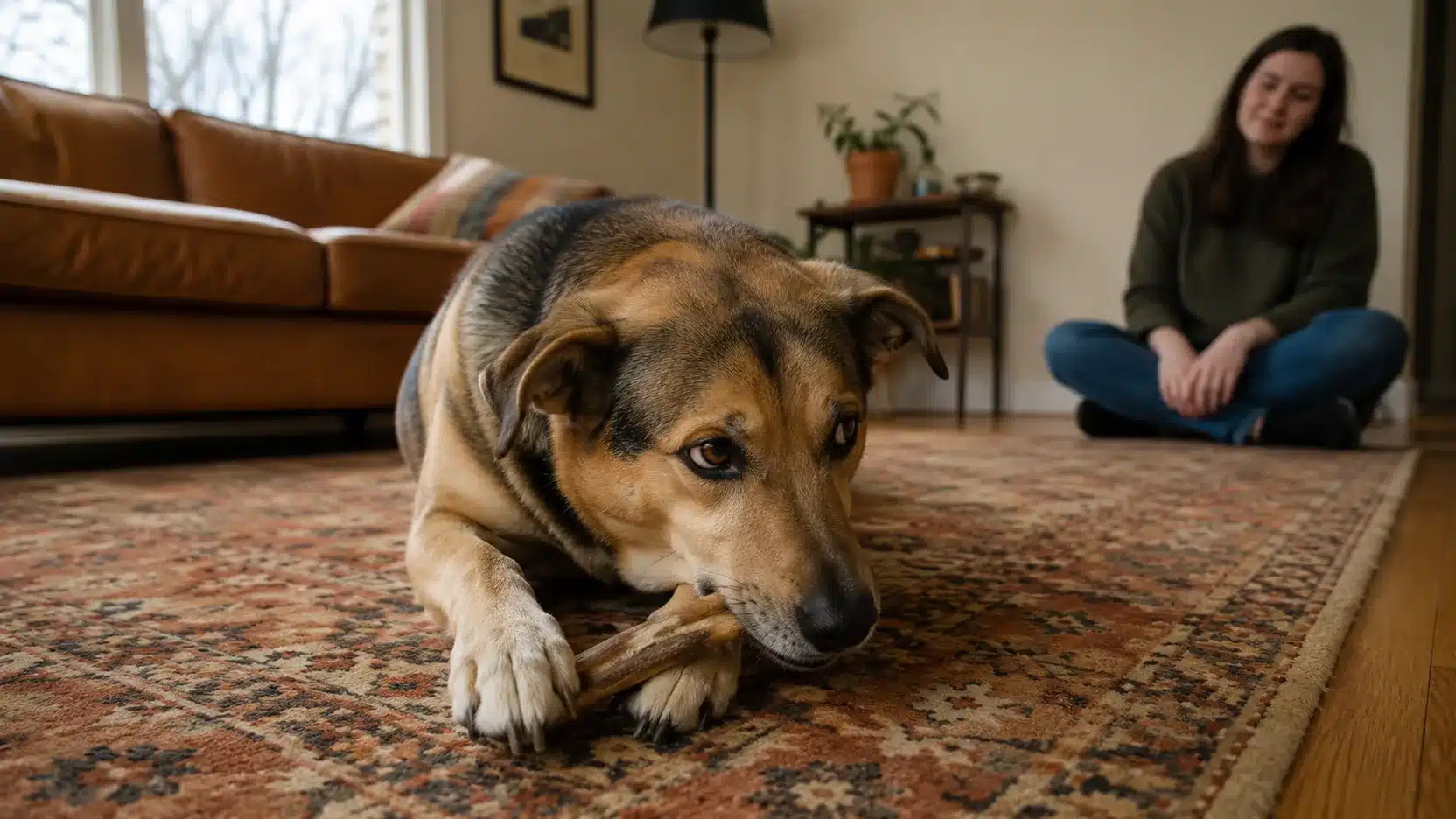
Your dog goes still over the bowl. The head drops, the body stops, and one eye rolls back far enough that you catch a crescent of white while the muzzle stays down. Maybe it has already gone further than that. A growl when someone walked past the couch, a snap over a bone, a moment you have not stopped replaying since. You are not imagining it, and your dog is not being spoiled, possessive, or dominant. What you are watching is resource guarding, and it runs on anxiety about losing something valuable, not on defiance.
I am Will Bangura, a Certified Canine Behaviorist holding a Master's Degree in Psychology, with more than 35 years devoted to severe behavior cases. Guarding is one of the most treatable serious behavior problems in dogs when the plan matches what is actually driving it, and one of the most dangerous when it does not. Confronting a guarding dog, taking the bowl away to make a point, or correcting the growl removes the warning and leaves the fear in place. Through force-free, evidence-based behavior modification, in your home or over live video, I treat the emotion underneath the behavior, and that is why the results hold.
No shock. No prong. No fear.

Arizona's only CAB-ICB Certified Canine Behaviorist through International Canine Behaviourists, and one of only three in the United States, with more than 35 years of experience working with severe aggression, fear, anxiety, reactivity, and complex canine behavior cases. Will holds a Master of Science in Psychology and is certified in Applied Ethology, a Certified Behavior Consultant Canine and Certified Professional Dog Trainer through the CCPDT, and a Fear Free Certified Professional.
By identifying the underlying causes of aggression, anxiety, and other behavior problems and improving emotional regulation, Will helps pet parents across Phoenix and the surrounding metro area build safer, calmer, and more predictable relationships with their dogs. He is the author of Sniff to Soothe and the host of the Dog Training Today podcast.
M.S.
Psychology, Behavioral Focus
CAB-ICB
Certified Canine Behaviorist
CBCC-KA
Certified Behavior Consultant Canine
CPDT-KA
Certified Professional Dog Trainer
FDM
Applied Ethology / Family Dog Mediation
FFCP
Fear Free Certified Professional
What People Are Saying


Most Pet Parents See the Growl. The Guarding Started Long Before It.
It usually begins as something you almost miss. Your dog stops chewing for a second when you walk past. The head lowers a fraction closer to the bowl. The eating speeds up as someone crosses the kitchen. One eye rolls back far enough that you catch a crescent of white at the corner while the muzzle stays down.
All of that is communication, and it is happening well before anything you would call aggression. By the time most families call me, the behavior has moved on to growling, lip lifting, snapping, or a bite that nobody saw coming. What they describe as sudden almost never was. The early signals were there for months, and they were quiet.

A dog holding still over a bowl. The body has stopped, the head has dropped, and the eye has turned back. This is guarding, and it is happening before any sound is made.
Here is the part that surprises families most. How dramatic the display looks tells you very little about how serious the problem is. A dog who freezes silently can be closer to biting than a dog who growls loudly, because a growl is a warning and a freeze can be a dog who has already learned that warnings do not help. If anyone has been correcting your dog for growling, that is often exactly what happened.
Guarding also spreads well beyond the food bowl. If you want help reading the quiet end of it, the stress signals guide and the section on reading signal clusters go through it in detail.
What Dogs Guard
- The food bowl and mealtimes
- Bones, chews, and long-lasting treats
- Toys, both favorite and random
- Stolen socks, tissues, and household objects
- The couch, the bed, and sleeping spots
- Doorways and narrow spaces
- A favorite person
- Guarding from the other dog in the home
Guarding Is Not a Character Flaw. It Is an Emotion With a Learning History.
A guarding dog has learned something specific: valuable things disappear when someone comes close. That is the whole engine. It is not a bid for household status, it is not disrespect, and it has nothing to do with your dog deciding who is in charge.

Ears back, tension around the eyes and muzzle, a fixed and watchful expression. What is driving guarding is anxiety about loss, not defiance.
The behavior gets stronger because it works. Your dog stiffened and someone paused. Your dog growled and a hand pulled back. Your dog snapped and the room emptied. When a behavior reliably produces the outcome an animal wanted, that behavior gets reinforced and it grows. This is why guarding almost always escalates over months. Your dog is not becoming meaner. Your dog is doing what has been paying off.
Sitting underneath the learning is the emotion, and it is usually some blend of anxiety, conflict, and frustration. Sometimes there is genuine competition in a multi-dog home. Sometimes there is a history of scarcity, though plenty of dogs raised in comfortable homes guard anyway, so a hard past is not required and its absence proves nothing.
Pain deserves its own mention. A dog whose mouth, neck, hips, or gut hurt can become far less tolerant of anyone nearby. Any guarding that appears suddenly in a dog who never showed it before earns a veterinary workup before behavior work begins, and I will tell you that on the phone rather than taking your money first.
You can suppress a growl with a correction and the dog will stop growling. Nothing about how the dog feels has changed. The anxiety is intact, the warning is gone, and you have made the next bite harder to see coming. Every plan I build changes the emotion first, because that is the only version of progress that holds.
Where Guarding Shows Up in Real Homes

Guarding Food and the Bowl
The version with the highest daily exposure, because it happens in the busiest room in the house at the same time every day with children and other pets moving through. What families call food aggression covers everything from eating faster when someone enters to a bite over a dropped piece of chicken. The same treatment logic applies across that whole range. What changes is the starting distance and how much management has to be locked down first.

Guarding Toys, Chews, and Stolen Items
Often dismissed longest, because the objects seem trivial. A dog curled around a plush toy looks endearing until you try to walk past. Stolen items deserve particular attention, because chasing a dog who has taken something teaches that possession triggers pursuit, which raises the value of everything they pick up. A great many object guarders were accidentally taught by a household that turned every theft into a chase.

Guarding a Person
The version families find hardest to talk about. Your dog goes rigid when your spouse walks in, places themselves between you and your own child, or is fine with everyone until you sit down. It carries more household strain than any other form, because one of you is being guarded and does not fully see it while the other is being growled at in their own home. It is also entirely workable, though the plan has to be built around routines rather than objects.

Guarding Between Dogs in the Home
Most households adapt around this long before anyone calls it a problem. Feeding gets staggered, chews come out only sometimes, somebody develops a habit of standing between them. What makes it different is that the second dog is part of the picture. A dog who backs off politely is keeping the peace and absorbing stress every time. This one is also frequently mistaken for a hierarchy issue, which sends families down the road of supporting one dog's status over the other, and that reliably makes it worse.
A Growl Is the Cheapest Safety Device Your Dog Owns
Almost every family I work with has been told at some point that a growl is unacceptable and must be stopped. It is one of the most damaging pieces of advice circulating in dog training, and it has put more people in emergency rooms than any tool I can think of.

An early warning, clearly given. This dog is telling you something useful, and it costs nothing to listen.
Think about what a growl actually is. Your dog has a conflict, has decided against biting, and has chosen to tell you instead. That is an animal working very hard to avoid hurting you. It is also free information about exactly where the threshold sits, which is the single most useful number in the entire treatment plan.
Punish it and the growl goes away. The conflict does not. What you have built is a dog who still feels threatened and no longer announces it, and the next escalation arrives without a step in between. Families describe those bites as coming out of nowhere, and from where they are standing that is exactly true.
So the rule in my plans is simple and it never changes. Nobody punishes a growl. If your dog growls, something in the setup was wrong, and the answer is to adjust the setup. The guide to distance-increasing signals covers the full ladder, including everything that comes before the sound.
Taking It Away to Prove a Point Makes Guarding Worse
A lot of advice tells pet parents to reach into the bowl, take the food away, or otherwise demonstrate that the dog does not control the resource. Some of it is framed as leadership. Some is framed as proving to the dog that nothing bad will happen. Both versions fail for the same reason.

The hand is still well short of the bowl and the dog has already frozen. From here, one more inch is a decision the dog makes, not the person.
From your dog's point of view, the exact thing they were worried about just happened. The food really did disappear. Whatever anxiety was driving the guarding has now been confirmed by direct experience rather than contradicted, and the behavior that follows is stronger than the one that came before.
The research on this is not ambiguous and it is not new. Herron and colleagues surveyed pet parents of dogs presented for behavior problems and found that confrontational techniques, including physically taking items away, produced aggressive responses in a substantial proportion of the dogs they were used on. Ziv reviewed the broader literature on aversive methods and found consistent associations with stress and increased aggression across studies.
This is also where the argument about tools collapses. If a shock collar or a prong collar stops a guarding dog, it stopped the dog by being unpleasant enough to override the conflict. That is the mechanism, and it is the only mechanism available. If the tool were not aversive, it would not have worked. So either it carries welfare and bite-risk costs, or it is not what produced the change. There is no third option, and the full argument is laid out in The Scientific Case Against Aversive Dog Training.
I did not always see it this way. I spent a long stretch of my career as a balanced trainer using those tools, and I changed my mind because the results kept falling apart underneath. Aggression cases where the growling stopped and the biting did not. That pattern got too consistent to keep explaining away.
The Signals That Come Before Anything Loud
The most useful skill I can hand a family is the ability to see guarding while it is still quiet, because everything in the treatment plan depends on staying below the point where your dog reacts.

A crescent of white at the corner of the eye while the head stays down. Small, easy to miss, and one of the most reliable early markers there is.
What to watch for is the moment something stops. Chewing pauses. The tail stops moving. The body goes quiet in a way that is different from relaxed. Eating speeds up. The head lowers a fraction. The eye turns back without the head following it. Any one of those means you are at the edge, and the correct response is always to add distance rather than to push a little further.
Families who learn to read this get results faster than families who do not, and it is not close. The dog body language guide walks through the full vocabulary if you want to build the skill deliberately.
What an Actual Resource Guarding Plan Looks Like
There is no generic protocol that fits every guarding dog, which is why I assess before I prescribe. But the shape of the work is consistent, and it moves through five stages in this order for a reason.
Assessment
A functional behavior assessment. What happens before the guarding, what the guarding achieves, what your dog is actually feeling, where the threshold sits, and what any bite history tells us.
Management
Arranging the household so the guarding stops being rehearsed. This lowers risk immediately, and it is why the first week usually feels better than families expected.
Skill Building
Teaching your dog behaviors that are incompatible with guarding, plus the engagement and impulse control the rest of the plan runs on.
Behavior Change
Systematic desensitization and counterconditioning below threshold, changing what an approach predicts, so the emotion moves rather than the behavior being held down.
Progression
Increasing difficulty on clear written criteria, generalizing across people, rooms, and items, with a defined standard for advancing rather than guesswork.

Working at a distance your dog is comfortable with, so that a person appearing predicts something good arriving. Notice how far apart they are. That distance is the whole method.
The engine of the plan is counterconditioning and desensitization. Right now, a person approaching predicts loss. The work makes it predict gain, reliably, at a distance where your dog stays relaxed from start to finish. Your dog sets that distance, not the plan and not the calendar.
Nowhere in that sequence does anyone approach the bowl, touch the bowl, take the item, or handle the dog while they are eating. Those steps belong to an older approach, and they are the confrontation this plan exists to avoid. Where there is a bite history, a properly conditioned muzzle often goes on as a safety layer while the work is done.
What You Can Do Before We Even Speak
Management is the step almost everyone skips and the one that reduces risk fastest. It is not avoidance and it is not giving up. Every time your dog rehearses the sequence of freeze, growl, and successful retreat, that pattern gets stronger, so stopping the rehearsals is what buys you the room to do the real work.

Fed behind a gate, undisturbed, start to finish. Unglamorous, and it lowers risk on day one.
Feed your dog behind a closed door or a baby gate, in a room nobody needs to walk through. Put the bowl down, leave, and let your dog finish alone. Collect the bowl later, after your dog has walked away from it on their own. Pick up the chews, bones, and food puzzles when they are not being actively supervised. In a multi-dog home, feed in genuinely separate spaces rather than at opposite ends of one room.
Stop taking things away to test whether the problem is still there, because that is a rehearsal, not a test. And make sure every adult in the house knows the plan, because one person deciding to prove a point can undo a month of progress in an evening.
Children and Guarding: The Configuration I Worry About Most
A dog who guards in a house with children is the situation that gets people hurt, and it is the one where I will tell you to stop reading and book something rather than working through it yourself.

Distance, an adult positioned between, and a child occupied with something else. This is what supervision actually looks like.
The reason is not that children are careless. It is that children move unpredictably, make sudden noises, approach at face height, and reliably miss every early signal an adult would catch. A dog who has been giving quiet warnings for months will give the same quiet warning to a four-year-old, and the four-year-old will keep walking.
Children should never run guarding exercises, supervised or otherwise. What they should be taught is much simpler. Nobody goes near the dog while the dog has food, nobody touches the bowl, nobody takes a chew, and if the dog has something, you leave the room and find an adult. In a home with children, feeding behind a closed door is not a training phase. It stays.
How to Get Started
Every case begins with an assessment, because a plan built without one is a guess. I look at what precedes the behavior, what it achieves, the emotional driver underneath, your dog's threshold, bite history, medical history, the layout of your home, and the routines of everyone living in it. What comes out of that is a written plan built around your household rather than a protocol pulled off a shelf.
Virtual Behavior Consultation
$350
A full functional behavior assessment and written behavior plan, delivered over live video, available anywhere in the world. For guarding cases this works unusually well, because most of the assessment is about routines, layout, and what happens in the seconds before the behavior rather than about handling your dog directly.
In-Home Behavior Consultation
$595
The same assessment and written plan, conducted in your home across the Phoenix metro area, where I can see the actual rooms, doorways, feeding stations, and routines the guarding is happening in. For multi-dog households and cases involving children, being in the room is often worth it.

The goal is not a dog who tolerates you nearby. It is a dog who has no reason to care that you are.
What will never appear in a plan I write: confrontation, intimidation, forced exposure, alpha rolls, shock collars, prong collars, choke chains, or letting dogs sort it out between themselves. None of it is necessary to resolve guarding, and all of it raises the risk of a bite in a case where a bite is already on the table.
If you are not sure whether this is the right fit, start with the free call. Fifteen minutes, no assessment, and a straight answer about whether I can help.
In-Home Across the Phoenix Metro, Virtual Everywhere Else
In-home behavior consultations are available throughout the Phoenix metro area. Virtual consultations are available nationwide and worldwide. If you are looking for behavior help in your specific city, the Phoenix dog behaviorist hub lists every area I serve.
ContactTell Me What Is Happening
Send me the details and I will tell you honestly whether this is something I can help with.
Frequently Asked Questions
What is resource guarding in dogs?
Resource guarding is a pattern of behavior a dog uses to keep control of something valuable when a person or another animal comes near. The item can be food, a chew, a toy, a stolen sock, a resting place, or a person. It runs on a spectrum from freezing and eating faster at one end to growling, snapping, and biting at the other. The driver is an emotion, usually anxiety about losing access, combined with a learning history in which the behavior has successfully made approaches stop.
Why does my dog growl when I come near his food?
Because it has worked. At some point your dog felt conflicted about your approach, growled, and you paused or backed away. That outcome reinforced the growl, and behavior that gets reinforced gets repeated. Underneath it sits genuine anxiety about the food disappearing. The growl itself is your dog choosing to communicate rather than escalate, which is worth taking seriously and never worth punishing.
My dog guards me from my husband. What is happening?
Your dog has come to treat proximity to you as a resource worth defending, usually because tension around your spouse's approach has been building for a while and the guarding behavior has been working. It is not jealousy in the human sense and it is not your dog choosing sides. This version tends to be harder on the household than any other, because the person being guarded often does not see it while the person being growled at is losing patience. It is very workable, but the plan has to be built around your household's routines rather than around an object.
Can resource guarding be fixed, or will my dog always be this way?
Most guarding cases improve substantially, and many resolve to the point that the family no longer thinks about it. What determines the outcome is how early the work starts, how consistent the household is with management, whether there is a bite history, and how many different things your dog guards. I will give you an honest read on your specific case after an assessment rather than a promise before one.
Should I punish my dog for growling over food?
No, and this is the single most important thing on this page. Punishing a growl suppresses the warning without touching the emotion underneath. You end up with a dog who still feels threatened and no longer tells you, which means the next escalation arrives with no step in between. Families describe those bites as coming out of nowhere, and from where they are standing that is exactly what it looked like.
How do I stop food aggression in my dog?
Start with management so the behavior stops being rehearsed, which usually means feeding behind a closed door or a gate and letting your dog finish undisturbed. Then the behavior work changes what an approach predicts, done at a distance where your dog stays completely relaxed, with something better than the meal arriving and the person leaving again. What is not part of it: approaching the bowl, touching the bowl, taking the food, or handling your dog while eating.
Is resource guarding the same thing as aggression?
Guarding is a subtype of aggression, but it is a distinct clinical pattern with its own antecedents and its own treatment plan, which is why it gets its own page rather than being folded into general aggression work. A dog who guards food may be entirely comfortable with strangers, other dogs, handling, and everything else. Treating it as general aggression tends to produce plans that miss the actual trigger.
My dog guards things from our other dog. What do I do?
Manage first. Feed in separate spaces rather than at opposite ends of a room, and pick up chews, bones, and puzzles when they are not being supervised. Do not let the dogs work it out, and do not try to support one dog's status over the other, which is a common recommendation that reliably makes things worse. If there has been a fight or a bite between them, please get an assessment rather than continuing to manage indefinitely.
Should I take my dog's food away to show him I am in charge?
No. From your dog's point of view, the exact thing they were anxious about just happened, which confirms the worry rather than resolving it. Research on confrontational techniques found that physically taking items away produced aggressive responses in a substantial proportion of dogs it was used on. Household hierarchy is not what is being negotiated here, and treating it that way is how guarding cases turn into bites.
Is my dog resource guarding because he was a rescue?
Possibly, but do not assume it. A history of scarcity or competition can contribute, and it does show up in some rescue histories. Plenty of dogs raised in comfortable homes from eight weeks old guard anyway, and plenty of rescues never guard at all. The history is useful context for the assessment, but it does not change the treatment plan and it does not predict the outcome.
My dog guards the couch and the bed. Is that the same problem?
Yes. Guarding a resting place works the same way as guarding an object, with the space itself as the resource. The common mistake is treating it as a rule violation and escalating the confrontation by pulling the dog off or physically insisting. That is exactly the approach most likely to produce a bite, because the dog is already conflicted and now has nowhere to go.
How long does resource guarding training take?
Management lowers risk immediately, usually within the first few days, which is why the first week often feels better than families expect. The behavior change underneath takes longer, commonly a few months, and longer again where there is a bite history or several guarded items. Progress depends far more on staying below your dog's threshold than on how many repetitions you run, and pushing the pace is the most reliable way to lose ground.
Is my child safe around a dog who guards?
A dog who guards in a home with children needs professional help now rather than eventually, and management needs to be permanent rather than a training phase. Children should never run guarding exercises, supervised or not, because they move unpredictably and miss the quiet warning signals adults would catch. What children should learn is simple: nobody approaches the dog with food, nobody touches the bowl, nobody takes a chew, and if the dog has something, leave and get an adult.
How much does a dog behavior consultation cost?
A virtual behavior consultation is $350, and an in-home behavior consultation is $595. Unsure which fits your dog? The free 15-minute call settles it quickly, with no obligation attached.
Meet Your Certified Canine Behaviorist
Will Bangura, M.S., CAB-ICB
CBCC-KA, CPDT-KA, FDM, FFCP
Will Bangura is a Certified Canine Behaviorist and behavior consultant with advanced training in applied ethology, specializing in severe dog aggression, reactivity, anxiety, fear, phobias, separation anxiety, and complex canine behavior problems. With more than 35 years of experience, he works with pet parents throughout the greater Phoenix metropolitan area, and worldwide through virtual behavior consultations.
Will is Arizona's only CAB-ICB Certified Canine Behaviorist through International Canine Behaviorists, and one of only three professionals in the United States to hold this credential. He holds a Master of Science degree in Psychology and completed postgraduate studies in canine cognition through Harvard University.
In addition to his behaviorist credentials, Will is certified through the Certification Council for Professional Dog Trainers (CCPDT) as both a Certified Behavior Consultant Canine (CBCC-KA) and Certified Professional Dog Trainer (CPDT-KA). He is also a Fear Free Certified Professional (FFCP) and certified in Applied Ethology through Kim Brophey's Family Dog Mediation (FDM) program.
Will is the founder of Phoenix Dog Training, host of the Dog Training Today podcast, published author, public speaker, and expert witness in dog behavior and aggression cases. His work focuses on evidence-based, force-free behavior modification that addresses the underlying emotional causes of canine behavior problems rather than simply suppressing behavior through punishment.
Ready for Real Help With Resource Guarding?
By the time most pet parents find this page, they have been working around it for months: feeding in shifts, warning visitors, keeping the kids on the other side of the room, and quietly hoping the next warning is not the one that turns into a bite.
You do not need more tips about hand feeding. You need a clinical assessment, a plan matched to your actual dog and your actual home, and a specialist who has spent more than 35 years inside severe behavior cases. It all starts with one conversation, and the first fifteen minutes are free.
Or call (602) 769-1411