
← Dog Body Language: The Definitive Guide
The Definitive Guide · VocalizationsDog Vocalizations: The Voice Beyond the Bark
Howling, whining, crying, and whimpering: four sounds, four different messages, from the ancient long-distance contact call to the quietest signal a dog makes. One of them should always prompt a call to your veterinarian.
Four Sounds, and a Rule That Protects Your Dog
The bark gets all the attention, and it has its own complete guide, but the rest of the canine voice deserves equal fluency. Howling, whining, crying, and whimpering each carry distinct messages, run on distinct emotional engines, and call for distinct responses. As with everything in this guide, the sound alone is the least reliable channel: the body around the vocalization, and the context it arrives in, do most of the interpretive work. A whine at the door and a whine at the food bowl and a whine from a dog lying unusually still are three different sentences that happen to share a sound.
One rule sits above everything else on this page, and it is the reason vocalizations get their own section rather than a footnote: sudden changes in vocalization are a medical flag before they are a behavioral one. A dog who begins crying, whining, whimpering, or howling in a way that is new for him, without an identifiable trigger, has earned a veterinary examination before any behavioral interpretation, because pain, illness, sensory decline, and, in senior dogs, cognitive dysfunction all speak through the voice. Behavior professionals hold this rule firmly for a reason: treating a pain cry as a training problem fails the dog twice, once by missing the medicine and again by adding pressure to an animal who is hurting. Rule out the body first. Always.
With that rule in place, the four vocalizations below each get the full treatment: what the sound is, what drives it, what the body around it tells you, and what to actually do. If you have not read the main guide on reading the whole dog, it is the foundation for all of it.
The Howl: The Oldest Long-Distance Call There Is
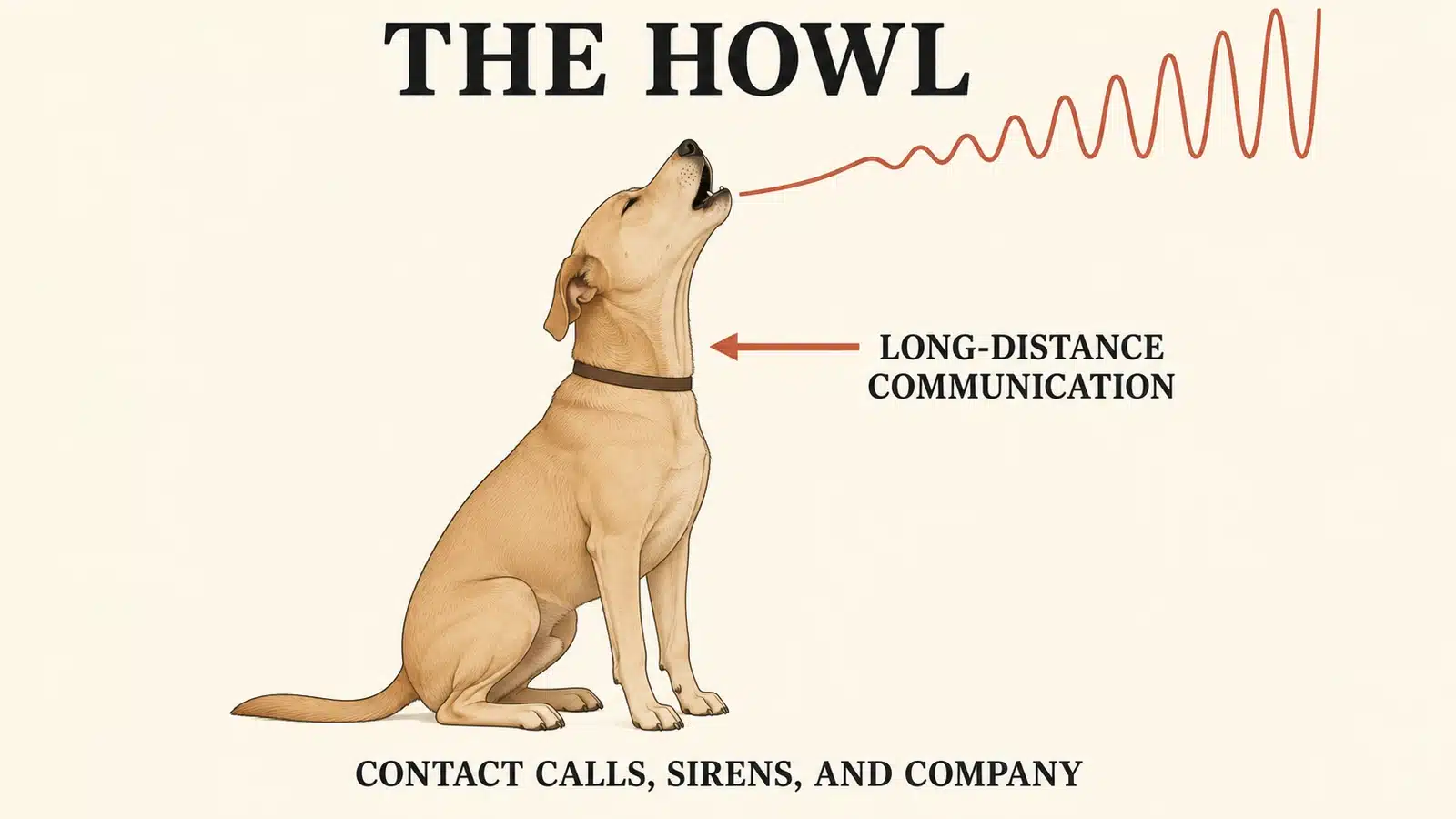
The howl is the most ancient sound in the canine repertoire, inherited directly from the wolf, and its original function explains almost every modern use: it is a long-distance contact call, a sound engineered by evolution to carry across miles and say here I am, where are you, this is us. Domestic dogs howl to answer other dogs, to join a chorus, to respond to howl-like sounds in the environment, which is why sirens, certain music, and even a pet parent's imitation howl so reliably set dogs off, and, in some breeds far more than others, simply because the equipment and the inclination are wired in. Huskies, malamutes, hounds, and other vocal breeds howl the way retrievers retrieve: it is who they are, and a certain amount of it is completely normal and needs no fixing at all.
The howl that does deserve your attention is the one tied to absence. A dog who howls primarily when left alone, reported by neighbors, caught on camera, often paired with pacing, door-scratching, destruction near exits, or house soiling that only happens in your absence, is not serenading the neighborhood. He is producing a contact call aimed at you, the missing member of his social group, and that pattern is one of the recognized signs of separation anxiety, a genuine panic condition rather than a nuisance behavior. The distinction matters enormously for treatment, because separation-related howling does not respond to being ignored, corrected, or waited out; it responds to a structured behavior program that changes how the dog experiences being alone. If the howling maps to your departures, set up a camera, gather the evidence, and treat it as the emotional condition it is. And as always with a sudden onset: a dog who has never howled and begins doing so, particularly a senior, sees the veterinarian first, since hearing changes, pain, and cognitive decline can all turn up the voice.
The Whine: The Swiss Army Knife of the Canine Voice
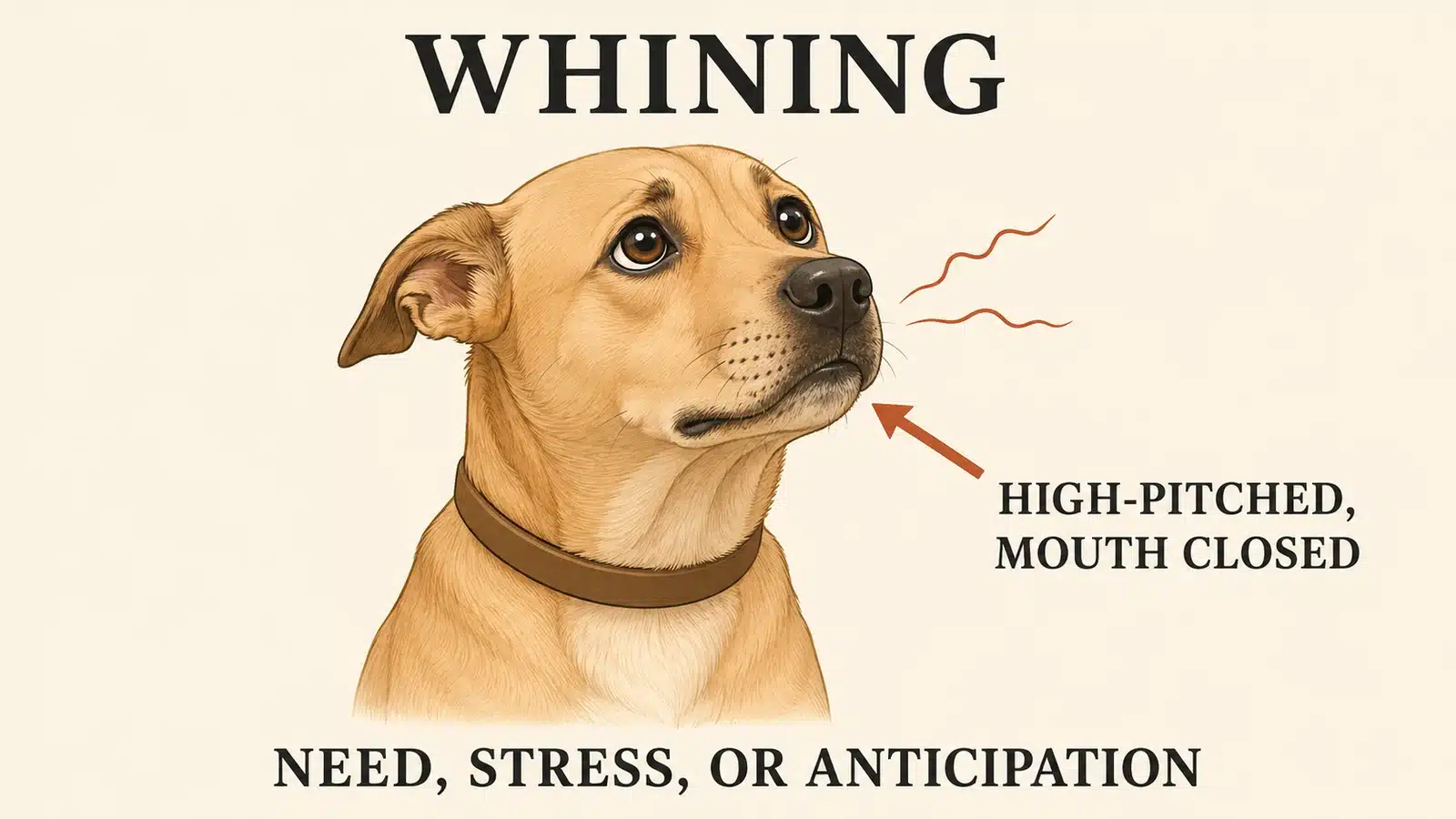
The whine is the most versatile and therefore the most context-dependent vocalization a dog produces: a high-pitched sound made with the mouth closed or barely open, inherited from puppyhood, where it was the original tool for summoning maternal care. Adult dogs whine in anticipation, at the window as the leash comes out, beside the door before a walk, at the food bowl while dinner is prepared. They whine in stress and anxiety, in the car, at the clinic, during storms. They whine as appeasement in social encounters, whine for attention because it has worked before, and whine in pain. Same sound, six different sentences, which is why the whine, more than any other vocalization, cannot be read without its body and its context.
Sorting the whine is a functional exercise, and the antecedents plus the body do the work. Anticipatory whining arrives with bright eyes, a forward, bouncy body, and an obvious upcoming event; it usually needs no treatment beyond, perhaps, not rewarding the noisiest version of the wait. Attention-maintained whining is aimed at you, follows the withdrawal of your attention, and stops the instant it pays; it responds to exactly the extinction-plus-alternative approach detailed for the demand bark in the barking guide, with the same warnings about extinction bursts and the slot-machine trap of caving intermittently. Stress whining travels with the cluster from the stress signals guide: pinned ears, lowered posture, lip licks, trembling, and it is treated by treating the stressor, through distance, management, and desensitization and counterconditioning, never by punishing the sound. And the whine with no story, no trigger, no event, no audience, especially in a dog lying still, moving oddly, or guarding a body part, is a pain candidate and a veterinary call. When in doubt about a whine, do not guess. Check the body, check the context, and check with the vet.
The Distress Cry: The Sound That Goes to the Vet First

The distress cry sits apart from every other sound on this page because its first stop is medical, not behavioral. It is an irregular, often broken vocalization, yelping, crying out, sustained moaning or keening, typically riding on a body that confirms something is wrong: hunched posture, tension through the face, reluctance to move, guarding of a body part, tail wrapped in, the dog drawn in on himself. A yelp on being touched in a specific spot, a cry when rising from bed or taking stairs, vocalizing during handling that was previously tolerated: these are pain speaking, and pain is a veterinary matter today, not a training plan next week.
The rule to internalize is simple and absolute: sudden, unexplained crying warrants a veterinary visit, full stop. Dogs are famously stoic, shaped by evolution to conceal weakness, which means that by the time pain is loud enough to hear, it has usually been present for a while, and a vocal dog is often a dog whose discomfort has exceeded his considerable capacity to hide it. This matters for behavior work too, and it is a principle I hold firmly in my own practice: pain is one of the great hidden drivers of behavior change, and a startling share of sudden aggression, irritability, handling sensitivity, and withdrawal cases resolve or improve dramatically once an underlying medical issue is found and treated. A dog who cries out and then snaps when touched near the hips is not developing a behavior problem. He is hurting, and he told you twice. Take the first telling seriously and the second never has to happen. Only after medicine has been genuinely ruled out does the distress cry become a behavioral question, and at that point it is read like everything else here: against the body, against the context, and against the dog's own baseline.
The Whimper: The Quietest Signal a Dog Makes

The whimper is the whine's quieter, sadder relative: soft, low-volume, often intermittent, and easily lost under household noise, which is precisely what makes it worth training your ear for. Where the whine projects, the whimper barely escapes, and it tends to come from a dog who is also making his body small: curled in a corner, head low, ears flat, eyes worried and upward, the postures of fear, uncertainty, and submission covered throughout this guide. A whimpering dog is not demanding anything. He is leaking distress at the lowest volume he has, and the very softness of the signal is information: this is a dog whose strategy is to shrink, not to broadcast.
Because the whimper is so quiet, it is disproportionately missed, and the dogs who rely on it are often exactly the soft, shut-down, conflict-avoidant dogs whose distress goes unnoticed the longest. Respond to a whimper the way you would respond to any fear signal: do not loom, do not scold, and do not drag the dog out of whatever refuge he has chosen. Lower the pressure, identify what in the environment changed, give him space and a safe retreat, and let him decompress. A dog who whimpers in specific, repeatable contexts, during storms, when a particular person visits, at the clinic, is mapping a conditioned fear for you, and conditioned fears are treated the same way every fear in this guide is treated: management to stop the rehearsal, then gradual desensitization and counterconditioning below threshold. And the standing rule applies here too: whimpering with no identifiable trigger, particularly in a dog behaving unusually in other ways, goes on the veterinary list, because quiet pain and quiet fear can sound identical.
The Voice Is the Smallest Part of the Message
Across the bark guide and this page, nine distinct vocalizations have now been cataloged, and one lesson unifies all of them: the voice is the least reliable channel a dog has, and it was never designed to work alone. Every sound on this page changes meaning with the body underneath it and the context around it. The howl of a husky greeting a siren and the howl of a panicked dog alone in an apartment are acoustically cousins and emotionally strangers. The whine of anticipation at the leash hook and the whine of a dog in pain share a pitch and nothing else. This is why the reading protocol never changes: antecedent, body, context, then interpretation, in that order, every time. A pet parent who reads sound through the body will almost never be wrong; a pet parent who reads sound alone will be wrong constantly, and sometimes expensively.
The second unifying lesson is the medical-first rule, and it bears repeating one final time because it protects dogs from a failure mode that is entirely preventable: any sudden change in a dog's vocal behavior, new sounds, more sound, louder sound, sound at strange hours, is a veterinary question before it is a behavioral one. This is especially true at the two ends of life. Puppies vocalize plenty, but a puppy whose crying is inconsolable warrants a check. And senior dogs who begin vocalizing at night, pacing, seeming disoriented, or howling into rooms are showing a pattern that deserves a veterinary workup for pain and for canine cognitive dysfunction, both of which are manageable when they are found. Behavior work built on top of untreated pain fails, and it fails while the dog suffers. Medicine first is not a disclaimer. It is the first step of the assessment.
And when medicine is clear and the sound is genuinely behavioral, the path is the one that runs through this entire guide. Identify the function the vocalization serves, which the sections above equip you to do. Manage the environment so the sound stops being rehearsed and reinforced while you work. Meet the needs underneath it, because a well-exercised, well-enriched, emotionally secure dog simply has less to say at volume. Then change what needs changing: reinforcement patterns for the operant sounds, emotional responses through desensitization and counterconditioning for the fear-driven ones. That is the arc of the EASE Method, Evaluate, Arrange, Skill-Build, and Emotional Repatterning, applied to the canine voice. A dog's sounds are questions. Answer them, and the volume takes care of itself.
Dog Vocalizations: Questions, Answered
Why does my dog howl at sirens?
The howl is an ancestral long-distance contact call inherited from the wolf, and sirens fall squarely inside the acoustic range that triggers an answering howl. Your dog is not in pain and not frightened; he is responding to what his ears process as another howler and joining the chorus. It is normal, harmless, and more pronounced in vocal breeds like huskies and hounds. No treatment needed unless the frequency becomes a genuine problem, in which case management of the sound exposure is the gentle fix.
My dog howls when I leave the house. Is that separation anxiety?
Howling that maps specifically to your departures, especially alongside pacing, destruction near exits, door scratching, or house soiling that only happens in your absence, is one of the recognized signs of separation anxiety, which is a panic condition rather than a nuisance behavior. Set up a camera to gather evidence of what happens after you leave. Separation-related howling does not respond to being ignored or corrected; it responds to a structured behavior program that changes how the dog experiences being alone.
How do I stop my dog from whining for attention?
First confirm it is actually attention-maintained: it is aimed at you, follows the loss of your attention, and stops the moment it pays. Then treat it like demand barking: the whining must never again produce attention, expect a temporary extinction burst where it gets louder before it fades, never cave intermittently, because occasional payoffs strengthen the behavior, and generously reinforce a better alternative like settling quietly on a mat. If the whining does not fit that pattern, reread it: stress whining and pain whining are different problems with different answers.
My senior dog has started vocalizing at night. What's going on?
New nighttime vocalizing in a senior, especially with pacing, restlessness, disorientation, or howling into empty rooms, warrants a veterinary workup before any behavioral interpretation. The two leading candidates are pain, which often worsens at night when the dog settles, and canine cognitive dysfunction, a dementia-like condition of aging dogs. Both are manageable when identified, and neither responds to training. Medicine first, always, with sudden vocal changes in an older dog.
When is a dog's crying an emergency?
Treat sudden, unexplained crying as a same-day veterinary matter, and treat crying with collapse, difficulty breathing, a distended abdomen, inability to rise, or crying on being touched as an emergency, immediately. Dogs are stoic by design, so by the time pain is audible it has usually been present for a while. A yelp when touched in a specific spot, crying when rising or on stairs, or new vocalizing during previously tolerated handling all mean pain until a veterinarian proves otherwise.
Next: Reading Signal Clusters
You now know every signal in the language. The final chapter teaches the skill that makes them all work: reading the whole dog at once, the escalation ladder, and the clusters that keep everyone safe.
 About the Author
Will Bangura, M.S., CAB-ICB, CBCC-KA, CPDT-KA, FDM, FFCP, is a Certified Canine Behaviorist with over 35 years of experience specializing in severe aggression, fear, anxiety, reactivity, phobias, and compulsive disorders in dogs. He holds a Master's Degree in Psychology and is accredited as a Certified Canine Behaviorist through International Canine Behaviorists, one of only three CAB-ICB Certified Canine Behaviorists in the United States and the only one in Arizona. His additional credentials include Certified Behavior Consultant Canine (CBCC-KA) and Certified Professional Dog Trainer (CPDT-KA) through the Certification Council for Professional Dog Trainers, certification in Applied Ethology through Family Dog Mediation (FDM), and Fear Free Certified Professional (FFCP).
Will is the author of Sniff to Soothe, host of the Dog Training Today podcast, and a court-recognized expert witness in canine behavior. His clinical work is grounded in behavioral psychology, applied behavior analysis, learning theory, and affective neuroscience: every case begins with a functional behavior assessment and is treated through management, skill building, and evidence-based behavior modification using systematic desensitization and counterconditioning. He is a national advocate for force-free, science-based training and a published voice on the welfare risks of aversive training methods.
As the founder of Phoenix Dog Training, Will provides in-home behavior consultations throughout the Phoenix metro area and virtual behavior consultations for pet parents nationwide.
If Your Dog's Voice Is Telling You Something Is Wrong
Once your veterinarian has ruled out pain, chronic whining, howling, and distress vocalizing are treatable behavioral conditions. A professional consultation begins with a full functional behavior assessment and ends with a clear, evidence-based plan. Schedule a Behavior Consultation, or start with a free call.