


Aggression Toward People
Growling, lunging, snapping, biting, defensive aggression, and aggression toward strangers, visitors, or family members.
Dog aggression training in Mesa
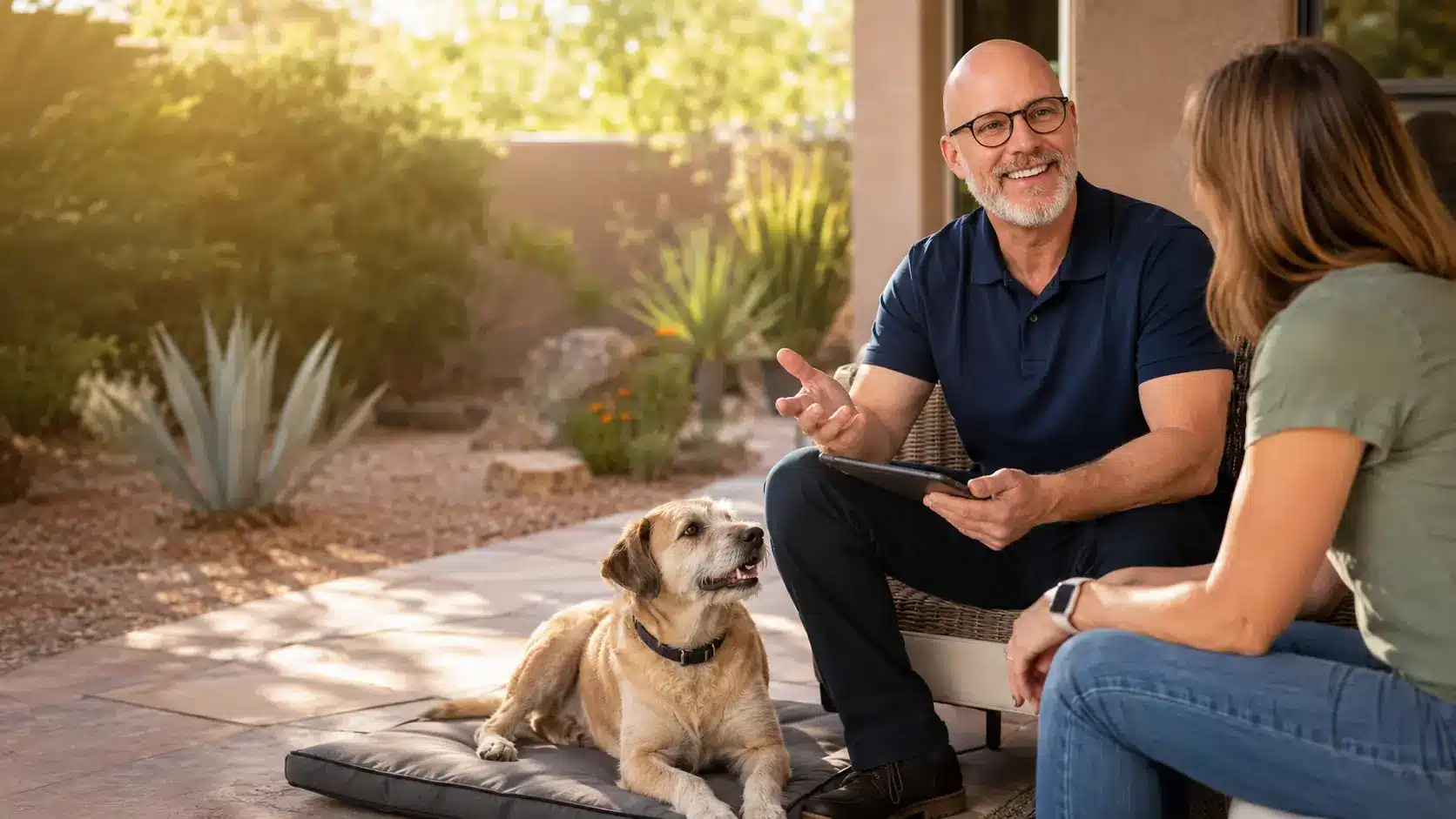
Some dogs do not need more obedience drills. They need a careful behavior assessment, a safety plan, and a structured behavior modification plan that addresses the emotional and environmental conditions driving the behavior.
If your dog in Mesa, Arizona is dealing with aggression, reactivity, anxiety, fear, phobias, separation anxiety, resource guarding, or dogs fighting in the home, this is behaviorist-level work, not a basic training class. Dog training teaches skills. Behavior modification changes the emotional, environmental, and learning conditions driving the behavior.
Evidence-based. Force-free. Assessment-driven.

Will Bangura, M.S., CAB-ICB
CBCC-KA, CPDT-KA, FDM, FFCP
A certified canine behaviorist, certified behavior consultant, Family Dog Mediator, and Fear Free Certified Professional with more than 35 years of experience helping dogs with aggression, anxiety, fear, reactivity, separation anxiety, phobias, and complex behavior problems.
You work directly with Will, using science-based, force-free behavior modification. No shock collars, prong collars, choke chains, or intimidation.
A dog trainer teaches skills. A dog behaviorist evaluates why the behavior is happening and changes the conditions driving it. Knowing which one you need is the most important decision you will make for your dog.

A dog trainer teaches your dog what to do: sit, stay, leash walking, recall, place, polite greetings, and puppy foundations. Those skills have real value, and for many families they are exactly what is needed. A certified dog behaviorist works at a different level. The behaviorist evaluates why a behavior is happening, what triggers it, what maintains it, whether fear, anxiety, frustration, or conflict are involved, what safety risks exist, and what environmental or medical factors may be contributing. Behaviorist-level cases often require management, desensitization, counterconditioning, reinforcement-based skill building, environmental changes, and sometimes veterinary collaboration.
If your primary goals are puppy training, manners, obedience, leash walking, recall, or polite greetings, visit our private dog training in Mesa page. If the behavior involves fear, anxiety, aggression, reactivity, panic, resource guarding, separation anxiety, or a bite history, a behaviorist-level consultation is usually the more appropriate starting point.
Dog training teaches skills. Behavior modification changes the emotional, environmental, and learning conditions driving the behavior.
Most pet parents searching for a dog behaviorist in Mesa, Arizona are not dealing with basic manners. They are dealing with fear, panic, aggression, bite risk, dogs fighting in the home, or behavior that has not improved with ordinary training. This page is built for those cases.
Growling, lunging, snapping, biting, defensive aggression, and aggression toward strangers, visitors, or family members.
Dog aggression training in Mesa
Reactive or aggressive behavior toward unfamiliar dogs, neighbor dogs, or dogs on walks, often driven by fear, frustration, or learning history.
Dog aggression training in Mesa
Multi-dog household conflict, guarding between dogs, arousal-related fights, sibling conflict, and repeated fights that escalate.
Intra-household aggression help
Barking, lunging, pulling, spinning, or explosive behavior toward dogs, people, bikes, or other triggers during walks.
Reactive dog training in Mesa
Generalized anxiety, hypervigilance, fear of strangers, fear of environments, handling sensitivity, and dogs who cannot relax.
Anxiety behavior modification
Panic when left alone, destruction, vocalization, escape attempts, self-injury, indoor elimination, and pre-departure anxiety.
Separation anxiety treatment
Guarding food, toys, chews, resting places, people, rooms, or stolen objects with growling, freezing, snapping, or biting.
Resource guarding help
Dogs whose aggressive displays are rooted in fear, defensive arousal, trauma history, or repeated triggering with no safe outlet.
Dog aggression training in Mesa
Panic responses to thunderstorms, monsoon weather, fireworks, gunfire, vacuum cleaners, garbage trucks, or other intense sounds.
Fearful dog behavior modificationMore specialized cases and entry points pet parents in the East Valley reach out for.

Dogs whose behavior has not improved, or has gotten worse, after board-and-train, e-collar, or punishment-based training.

Tail chasing, flank sucking, excessive licking, shadow chasing, pacing, and other repetitive behaviors that interfere with daily life.

Dogs who panic, freeze, snap, or bite at the veterinarian, groomer, or during nail trims, handling, and husbandry care. Cooperative care and Fear Free protocols rebuild safety.

Recently adopted and trauma-history dogs adjusting to a new home, supported with confidence building and a careful, low-pressure plan.

Chronic over-arousal and an inability to rest, addressed through arousal regulation, decompression, and nervous-system recovery work.
Dogs labeled stubborn or dominant after a program that suppressed warning signs or worsened the behavior, who need a behaviorist-level reassessment.
A large share of the behavior problems pet parents in Mesa describe are not defiance or stubbornness. They are fear and anxiety wearing different costumes, from a dog who flinches at sounds to one who can never quite settle.
Fear and anxiety are not the same thing, though they overlap. Fear is a response to something present and identifiable, a stranger reaching over the dog's head, a thunderclap, a slick floor. Anxiety is the anticipation of something that might happen, a low hum of threat that keeps the nervous system braced even when nothing is wrong. Both push the dog into a defensive state, and in that state learning narrows, the body floods with stress chemistry, and ordinary obedience cues stop working. This is why telling an anxious dog to sit and stay rarely helps. The dog is not choosing to disobey. The dog cannot access calm behavior because the emotional state underneath it has not changed.
For some dogs it shows up as generalized anxiety, a baseline of unease that never fully lifts. For others it is specific: fear of strangers, fear of men, fear of children, fear of the veterinarian or groomer, fear of car rides, or panic during monsoon storms and fireworks. Some dogs are hypervigilant, unable to lie down and rest because they are always scanning. Some startle violently at ordinary household sounds. The common thread is an emotional system stuck in a state of threat, and the goal of behavior modification is to change that underlying feeling, not simply to suppress the outward behavior it produces.
Dogs who cannot settle, who pace, scan, or stay braced even in a calm home, supported with arousal regulation, decompression, and predictable routines.
Fear of strangers, men, children, visitors, or being touched and handled, rebuilt gradually through desensitization and counterconditioning at a safe distance.
Panic during thunderstorms, monsoon weather, fireworks, and sudden sounds, addressed with a sound plan, safe spaces, and where appropriate, veterinary support.
Dogs who shut down on walks, freeze at new surfaces, or cannot cope with unfamiliar places, helped to build confidence one small success at a time.
You cannot obedience-train your way out of an emotion. When the driver is fear or anxiety, the behavior only changes when the underlying feeling changes, and that is the work behavior modification is built to do.
For a closer look at this work, see dog anxiety and fear behavior modification.
Separation anxiety is not a dog being spiteful or under-exercised. It is genuine panic, a true distress response to being left alone, and it is one of the most treatable problems when the plan is built correctly.
When a dog with separation anxiety is left alone, the body responds the way any mammal does to a real emergency. Heart rate climbs, stress hormones surge, and the dog enters a state of panic that it cannot think its way out of. The barking, howling, destruction, pacing, drooling, and house soiling that pet parents come home to are not misbehavior. They are the visible signs of an animal in distress. This is why punishment makes separation anxiety worse, not better. Coming home to scold a panicking dog only adds fear of your return to the fear of your leaving.
Many pet parents are told their dog is bored, needs more exercise, or is acting out for attention. Sometimes a crate is recommended, and for a truly panicked dog, confinement can intensify the panic and lead to injury from frantic escape attempts. The behavior looks like a training problem, so people reach for training solutions, and nothing changes, because the driver is an emotional one. Effective treatment works at the level of the dog's emotional response to being alone, rebuilt gradually and systematically so that absence stops predicting danger.
The foundation of evidence-based separation anxiety work is graduated, systematic exposure to alone time kept below the threshold where panic begins. Departures are broken into pieces small enough that the dog stays relaxed, then extended slowly as the dog's comfort grows, always staying under the level that would trigger distress. Management is layered on top so the dog is not left alone beyond its current ability while the plan progresses. It takes patience and consistency, but the results can be genuinely life-changing for both the dog and the household.
Panic triggered specifically by being left alone, even for short absences, with distress that begins around or before departure.
Dogs who cope when any person is present but panic when left completely alone, a closely related and very treatable pattern.
Mounting stress at the cues that signal you are about to leave, keys, shoes, a coat, addressed by changing what those cues predict.
Frantic distress and self-injury in a crate or closed room, where confinement intensifies rather than soothes the underlying fear.
Separation anxiety is panic, not disobedience. It does not respond to correction or more exercise. It responds to a gradual, systematic plan that teaches the dog, in pieces small enough to stay calm, that being alone is safe.
For more on this work, see dog separation anxiety treatment.
There is a reason this practice does not use shock collars, prong collars, or intimidation. It is not only an ethical stance. It is what the science of how dogs actually learn points to, and it is what protects the results you are working so hard to get.
When a dog growls, lunges, or panics, it is tempting to go straight at the behavior and try to shut it down. Aversive tools can appear to do that. A shock or a leash correction can interrupt the growl, and for a moment it can look like progress. But stopping a behavior is not the same as resolving what caused it. The growl was a warning that the dog felt threatened. Silence the warning and the fear underneath is still there, only now the dog may have lost its way of telling you before it escalates.
 The behavior you see grows from causes beneath it.
The behaviors that bring pet parents to a behaviorist are the part that shows. The growling, lunging, biting, and panic sit at the top. Underneath them are the actual drivers: fear, anxiety, frustration, pain or illness, and a learning history that taught the dog the world is not safe.
This is why two dogs doing the very same thing can need completely different plans. The visible behavior is only the surface. The reason it keeps happening lives below it, and that is the part a careful assessment is built to find.
Press on the surface and the behavior tends to come back, because the root was never touched. Change what is feeding it underneath, and the behavior changes with it. That is the difference between managing a symptom and resolving a problem, and it is the whole reason method matters.
Here is the part the equipment marketing leaves out. A shock collar, prong collar, or choke chain works only to the degree that it is unpleasant. That is the mechanism. If the sensation were neutral, the dog would have no reason to change what it is doing. So either the tool is aversive enough to matter, which means it carries the welfare and fallout risks that come with fear and pain, or it is not aversive at all, in which case it is not what is changing the behavior. There is no version where it both works and is free of those costs. And the documented fallout is real: increased fear and anxiety, damage to the relationship between dog and pet parent, and a heightened risk of aggression, because a frightened animal that cannot escape is more likely to defend itself.
Evidence-based, force-free behavior work changes the underlying emotion so the behavior no longer has a reason to fire. Through systematic desensitization and counterconditioning, the dog is exposed to its triggers at an intensity low enough to stay calm, while good things are paired with what used to feel threatening. Over time the emotional response itself shifts. Alongside that, the dog is taught what to do instead, reinforced and built up so it has a reliable alternative to the old behavior. The result is not a dog that has learned to suppress a warning out of fear of punishment. It is a dog that genuinely feels differently, which is the only kind of change that holds up under pressure and over time.
Behavior is driven by emotion and consequence. Change the emotional response and the reinforcement history, and the behavior changes at its source instead of being held down.
Across multiple studies, methods, and species, aversive methods are linked to greater stress, fear, and risk, with no advantage in effectiveness over reward-based work.
Suppression fades and can rebound. Genuine emotional change holds up in new places and under stress, which is exactly where fragile training tends to fall apart.
If a tool works, it is because it is aversive. If it is not aversive, it is not what changed the behavior. There is no setting where it both works and is free of the costs of fear and pain.
Real behavior change is not a single technique or a quick fix. It is a structured process that moves in a deliberate order, each stage setting up the next, so that progress is built on a stable foundation instead of luck.

Every dog and every household is different, so no two plans look exactly alike. What stays consistent is the structure underneath them. Behavior modification follows a clear sequence: understand what is really happening, make the situation safe, build the skills the dog is missing, change the emotion driving the behavior, and then carefully expand that progress into real life. Skip a stage or rush ahead, and the work tends to stall or unravel. Move through it in order, at the dog's pace, and change holds.
It starts with a functional behavior assessment: identifying the antecedents, the behavior itself, the consequences, and the emotional and medical factors driving it. The plan can only be as accurate as the assessment behind it, so this is where everything is anchored.
Next comes preventing the dog from rehearsing the unwanted behavior. Every repetition makes a behavior stronger, so the environment and the triggers are controlled to stop the practice while the real work begins. Management is not the cure, but without it nothing else can take hold.
With safety in place, the dog is taught what to do instead. Alternative behaviors are reinforced, impulse control is developed, and engagement and focus are built up, giving the dog reliable, rewarding options to replace the old response under pressure.
This is where the emotion itself shifts. Through systematic desensitization and counterconditioning, the dog meets its triggers at an intensity low enough to stay under threshold, while the feeling attached to those triggers is gradually changed from threat to safety.
Difficulty is increased gradually, with clear criteria for when to advance and when to hold steady. Progress is then proofed across new places, people, and situations, so the change is not fragile but holds up in the real world where you actually need it.
The whole process is paced by the dog in front of us, not a fixed timeline. Pushing too fast re-triggers the fear we are working to resolve. Steady, sub-threshold progress is slower in the moment but far faster to a result that genuinely lasts.
Progress happens below threshold, at the dog's pace. Kept calm enough to learn, a dog changes how it feels. Pushed past that line, it only rehearses the fear. Slower is very often faster.
If you have already tried classes, board-and-train, or correction-based methods, or you have been told your dog is dominant, hopeless, or should be put down, please read this before you make any decision. The right help looks different from what you have likely been offered.

By the time many pet parents in Mesa reach out, they are exhausted and discouraged. They have spent money on programs that did not work, followed advice that made things worse, and lived with a level of stress and worry that is hard to describe to anyone who has not been through it. Some have been told their dog is stubborn or dominant. Some have been warned that the only options left are to rehome or to euthanize. If that is where you are, the first thing worth saying is that you are not a failure, and neither is your dog.
Very often the reason previous attempts did not work is that they targeted the wrong thing. Programs aimed at obedience or at suppressing the behavior left the fear, anxiety, or frustration underneath it untouched, so the behavior came back, or shifted into something new. A behaviorist-level reassessment frequently reveals that a case labeled hopeless was simply never assessed and addressed at the level it required.

Real help does not promise miracles or a guaranteed cure, because no ethical professional can promise that. What it offers instead is a careful assessment, a clear and realistic picture of what is driving the behavior, and a structured plan to improve it as far as that dog can go.
For many dogs, that means a genuine and lasting change in quality of life for the whole household. For some, where safety risks are serious, it means an honest conversation about management, realistic expectations, and what responsible, humane decisions look like. Either way, you will not be left guessing, and you will not be pushed toward methods that add fear to a dog who is already struggling.
The dog came home compliant, then regressed, or returned more shut down or more reactive than before. The underlying emotion was never addressed.
The behavior was suppressed for a while, then resurfaced, escalated, or showed up somewhere new. Suppression is not resolution.
An outdated label that misreads fear and anxiety as defiance, and points toward methods that tend to make frightened dogs worse.
Before rehoming or euthanasia is treated as the only path, a thorough behaviorist assessment is worth doing, so any decision is fully informed.
A case called hopeless is very often one that was never assessed at the level it needed. Honest hope is not a promise of a cure. It is a real plan, built on a real assessment, to take your dog as far as your dog can go.
You can work with Will Bangura in person across Mesa, Arizona and the surrounding East Valley, or virtually from anywhere in the country. Both deliver the same science-based, force-free behavior modification, matched to what your case needs.

For aggression, reactivity, fighting in the home, and complex cases, seeing the dog in its own environment matters. Behavior happens in context, so assessing your dog where it actually lives, in your home and your neighborhood in Mesa and the East Valley, gives the most accurate picture and the most practical plan.
Many cases are handled remarkably well over video, and some, like separation anxiety, are especially suited to it since the dog stays calm without a stranger in the home. Virtual sessions let you work directly with Will from anywhere in the United States, with the same structured guidance and follow-up.
Not sure which format fits your situation? That is one of the things a brief first conversation sorts out. Some cases start virtually and move to in-home, or the reverse. The goal is simply to put the right eyes on your dog in the setting that gives the clearest read on what is happening and the best footing to start changing it.
In-home behavior consultations across Mesa and the neighboring East Valley communities of metro Phoenix, in Maricopa County, Arizona.
Mesa neighborhoods and areasThis practice serves Mesa, Arizona, in the East Valley of the Phoenix metro area, not La Mesa, California. Virtual behavior consultations are available to pet parents anywhere in the United States.
When the problem is serious, who you work with matters as much as the method. Will Bangura brings credentials, experience, and a force-free standard that are difficult to find together in one professional, and in Arizona, genuinely rare.
Will Bangura, M.S., CAB-ICB
CBCC-KA, CPDT-KA, FDM, FFCP
Will Bangura is a certified canine behaviorist with more than 35 years of experience helping dogs with aggression, reactivity, fear, anxiety, phobias, separation anxiety, and complex behavior problems. He holds the CAB-ICB credential through International Canine Behaviorists, and is one of only three CAB-ICB certified behaviorists in the United States, the only one based in Arizona. He is also a published author, the host of the Dog Training Today podcast, a public speaker, and an expert witness in dog behavior cases.
His work is grounded in behavioral psychology, applied behavior analysis, learning theory, and affective neuroscience, and it is fully force-free. No shock collars, prong collars, choke chains, or intimidation. When you hire Will, you work directly with Will, not a junior trainer handed your case.
The CAB-ICB is held by only three behaviorists in the country. It reflects assessed, accredited expertise in behavior, not a weekend certificate in an unregulated field.
More than 35 years working hands-on with the hardest behavior problems, including the cases other trainers decline or were unable to help.
Evidence-based behavior modification with no shock, prong, choke, or fear. The methods protect your dog's welfare and the results that come from it.
Author of the book Sniff to Soothe and host of the Dog Training Today podcast, translating behavior science into guidance pet parents can use.
Called on as an expert witness in dog behavior cases, a level of professional standing that speaks to the depth behind the work.
Your case is handled by Will himself from assessment through follow-up, not passed off to an assistant partway through the plan.
You get a credentialed behaviorist working your case directly, using methods that are humane and evidence-based, with the experience to take on the cases others have given up on.
 The book
Will's book on how scent work and nose-based enrichment help calm the canine brain and reduce reactivity, written for pet parents and professionals alike.
Explore the book The podcast
Will's podcast translating behavior science into clear, practical guidance, covering aggression, anxiety, reactivity, body language, and force-free behavior change.
Listen to the podcast