
← Dog Body Language: The Definitive Guide
The Definitive Guide · Appeasement SignalsDog Appeasement Signals: The Language People Mistake for Guilt
The lowered body, the averted eyes, the nervous grin: these are not signs of a guilty conscience, and one of them is not a smile of aggression either. Appeasement signals are a dog's way of keeping the peace and asking for acceptance, and almost everyone reads them wrong.
The Peace Offering, Not the Guilty Conscience
Appeasement signals are the behaviors a dog uses to communicate deference, to signal that he means no harm, and to defuse potential conflict by making himself smaller and less threatening. They are close cousins of the calming signals covered elsewhere in this guide, but with a slightly different emphasis: where calming signals work broadly to lower tension in any social situation, appeasement signals are more specifically directed at a perceived social superior, whether another dog or a human, and carry the message please accept me, I am no threat, let us not have a conflict. Far from being a sign of a problem, a rich appeasement vocabulary is a sign of a socially skilled dog.
Here is where accuracy matters most, because this is the single most misinterpreted category of canine communication, and the misinterpretation has a name: the guilty look. Every pet parent has seen it. You come home, something has been destroyed, and the dog is slinking low, ears back, eyes averted, tail tucked, maybe offering that anxious half-grin, and it looks for all the world like a confession. It is not. Careful behavioral research, including well-known experimental work by Alexandra Horowitz, found that the so-called guilty look is not tied to whether the dog actually did anything wrong at all. The look appeared just as readily in dogs who had done nothing, and it tracked one thing reliably: the pet parent's behavior. Dogs produced more of the guilty look when scolded, regardless of guilt or innocence.
Follow the mechanism, because the mechanism dissolves the myth completely. Guilt requires a complex understanding of having violated a moral rule in the past and connecting a present reaction to that past transgression, and there is no good evidence dogs experience it in the human sense. What is actually happening is far simpler and far more useful to understand: the dog has learned, through ordinary association, that certain cues, your posture, your tone, your face, the specific sight of shredded cushion plus you, predict unpleasant things coming his way. So he does what any socially intelligent animal does in the face of an incoming threat from a valued individual. He appeases. The guilty look is not remorse. It is a fear-driven attempt to avoid conflict, and reading it as a confession leads pet parents straight into punishment that damages trust and teaches the dog nothing except that your homecoming is dangerous. Read appeasement as what it is, an anxious bid for peace, and both your interpretation and your response will finally serve the dog instead of harming him. If you have not read the main guide on reading the whole dog, that is the foundation this page builds on.
Appeasement Licking: The Puppy Language That Never Leaves
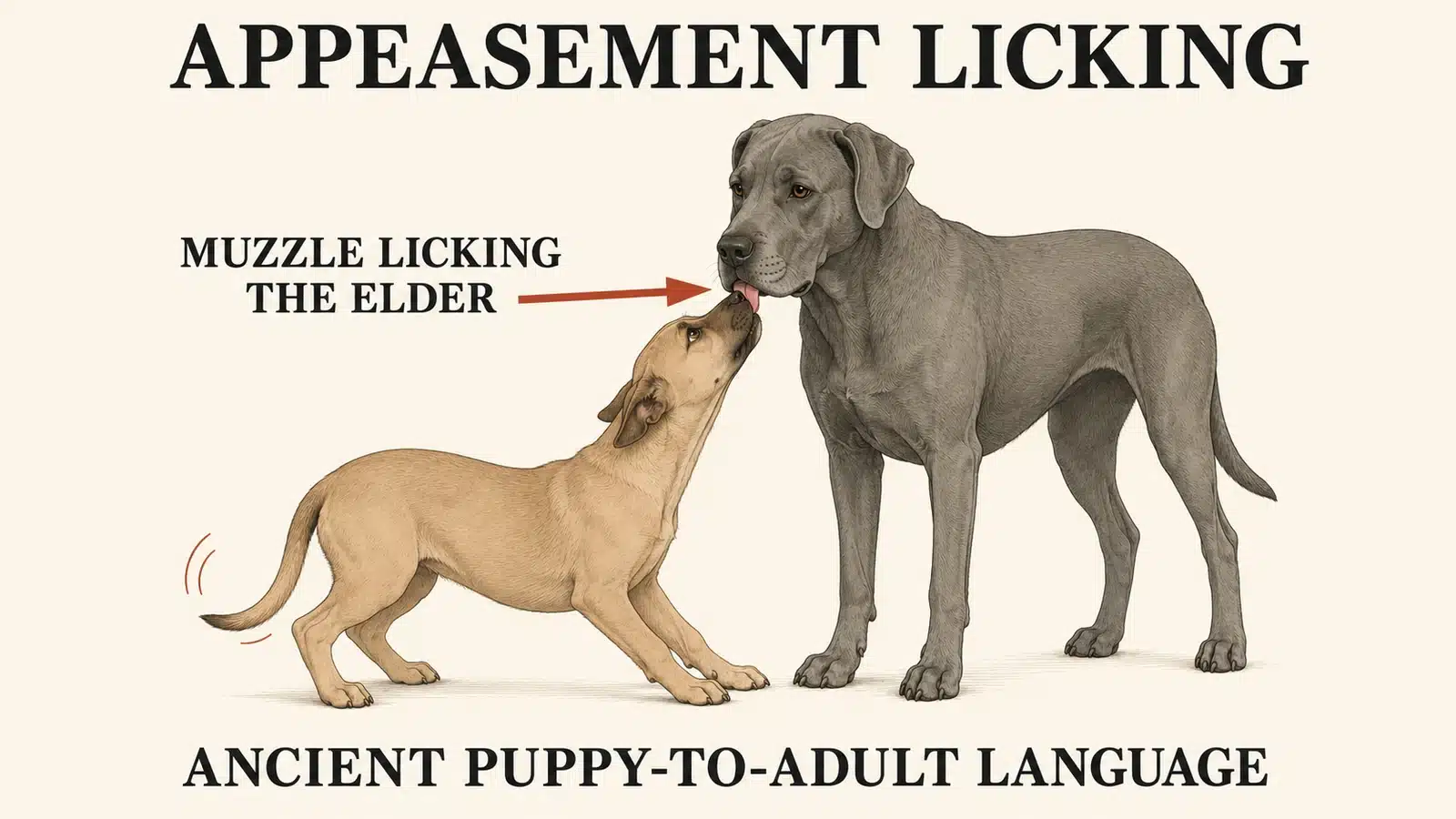
When a dog licks at another dog's muzzle, or reaches up to lick a person's face and hands, from a low, deferential posture with ears back and a soft body, he is speaking one of the oldest dialects in the canine language. The behavior traces directly to puppyhood, where pups lick at the mouths of adult dogs, a signal historically linked to soliciting food and care. Carried into adulthood, muzzle licking becomes a deference and appeasement gesture, a way of acknowledging another individual's higher social standing and requesting friendly acceptance rather than conflict.
For pet parents, the practical value is in distinguishing this appeasing lick from its look-alikes, because licking shows up in several different emotional states and the context does the sorting. The appeasing lick comes from a lowered, soft, slightly anxious body aimed at a face or muzzle, and it is a request for acceptance. That is different from the loose, joyful face-licking of an excited friendly greeting, and different again from the compulsive, repetitive self-licking or surface-licking that can signal stress or even gastrointestinal discomfort, as noted in the stress signals guide. Read the body posture around the lick, and the message becomes clear: low and deferential means appeasement, loose and wiggly means friendly enthusiasm.
The Low Tail Wag: A Wag That Asks Rather Than Celebrates
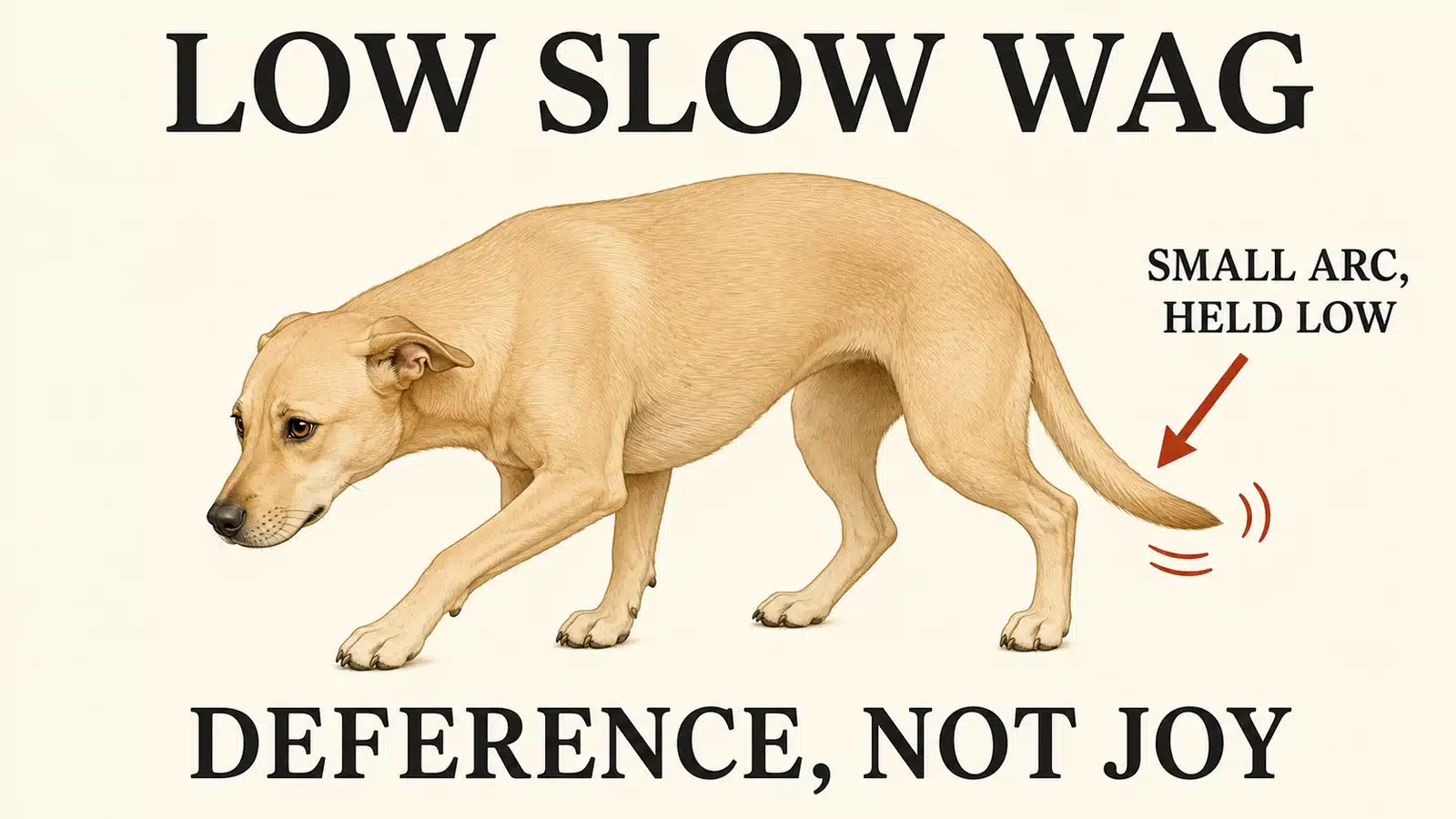
Not every wag is a happy wag, and the appeasement wag is one of the clearest proofs of it. A tail held low, sometimes with the whole rear end lowered, moving in small, often quick arcs, paired with a generally lowered and softened body, is a wag that asks rather than celebrates. It signals non-threatening, deferential intent, a wish to be accepted and to avoid trouble, and it is easily and commonly misread as simple happiness by people who see the wagging and stop looking there.
The reason this matters is that the low deferential wag is telling you something a happy wag is not: this dog is slightly anxious and is working to keep the peace. The full grammar of what tail height and wag style reveal is laid out in the tail wagging guide, but the appeasement version follows the master rule, that tail height reflects confidence and emotional state while the rest of the body confirms the meaning. When you see this low, quick, deferential wag from a softened, lowered dog, respond by lowering the social pressure rather than by looming or reaching over him. Meet an anxious bid for acceptance with reassurance, and you help the dog feel safe rather than confirming that he was right to worry.
The Submissive Grin: The Signal That Gets Dogs Punished for Smiling
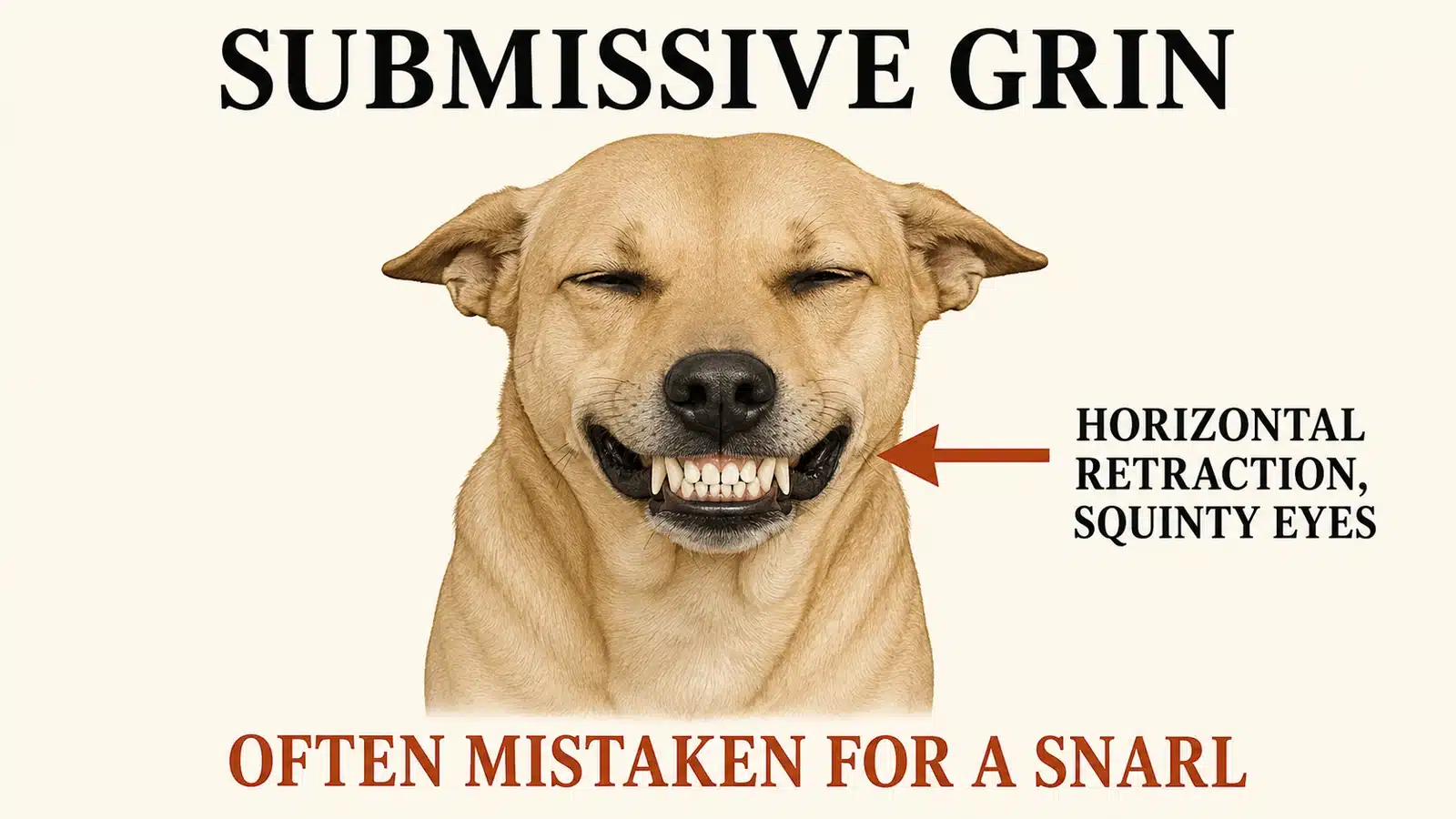
The submissive grin is one of the most fascinating and most dangerously misread signals a dog produces, because it displays the teeth in what looks alarmingly like a snarl and actually means very nearly the opposite. In the submissive grin, the dog pulls his lips back horizontally to expose the front teeth, but everything around that display screams friendliness: squinty or averted eyes, ears back, a lowered head, and a loose, wiggly, wriggling body, often the whole rear end wagging. It is an appeasement gesture, a nervous, deferential, sometimes almost apologetic bid for friendly acceptance, and some dogs offer it eagerly to their favorite people.
Getting this right is not academic, it is a safety issue in both directions, and it comes down to a distinction this guide keeps returning to: horizontal versus vertical. The submissive grin retracts the lips horizontally and rides on a loose, squinty, wiggly, lowered body. The genuine threat display of baring teeth, covered in the warning signals guide, lifts the lip vertically to expose the canines, wrinkles the muzzle, and rides on a tense, hard-eyed, stiff or forward body. Confuse the two and the consequences are real: mistake a friendly grin for a threat and you punish an anxious dog for making a peace offering, teaching him that even his most conciliatory gesture brings trouble, and mistake a genuine threat for a grin and you get bitten. As always, do not read the teeth alone. Read the eyes, the ears, and the whole body, and the friendly grin and the real snarl become impossible to confuse.
The Passive Rollover: Not Every Belly Is a Belly Rub Request
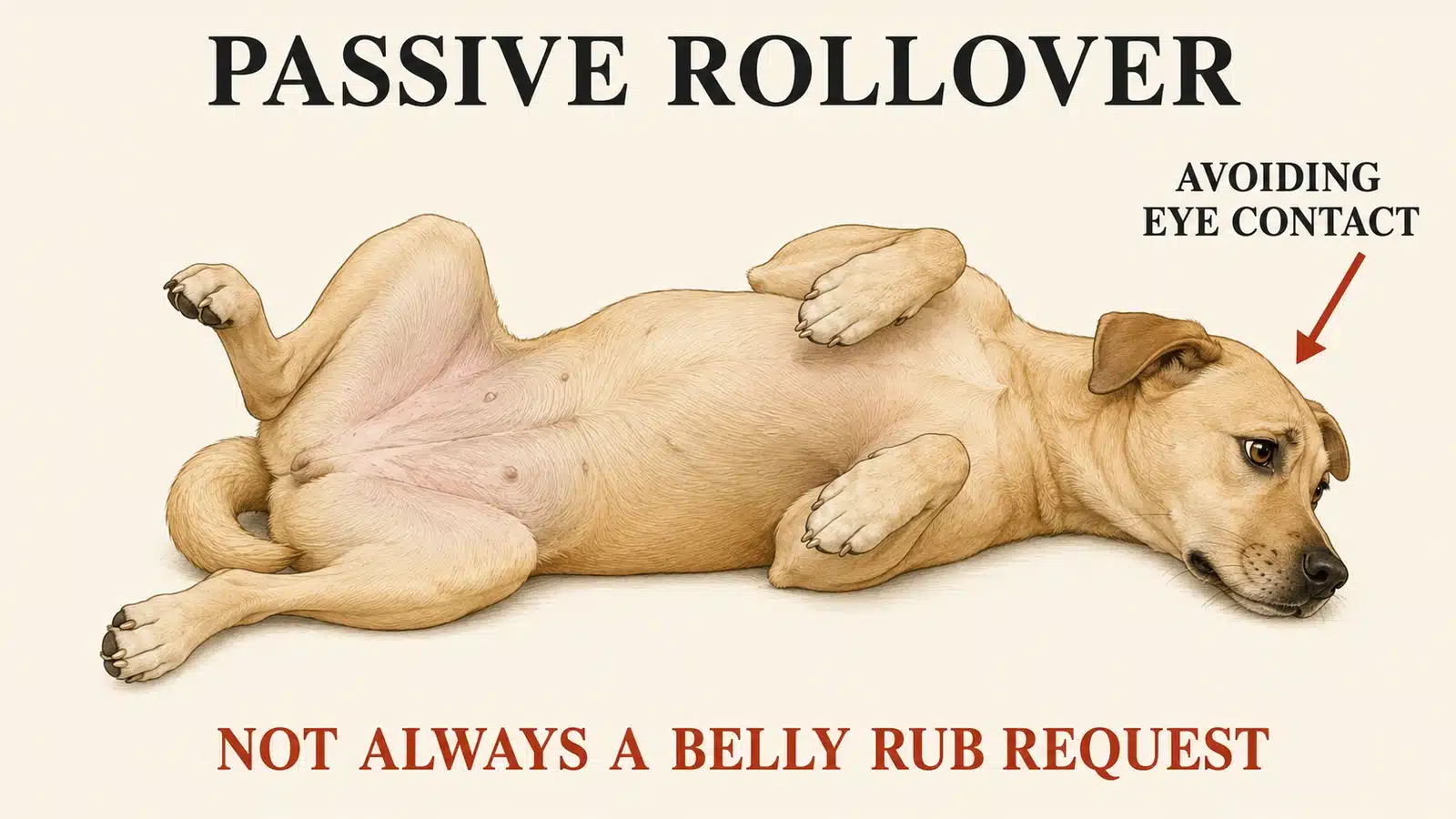
A dog rolling onto his back to expose his belly is one of the most commonly misread postures in the entire canine repertoire, because it has two completely different meanings that share the same basic shape. In its appeasement form, the passive rollover is an act of deference and a request that an interaction stop or soften: the dog exposes his most vulnerable area to communicate total non-threat, effectively saying I submit, please do not escalate. The tells that mark it as appeasement rather than an invitation are all about tension: a stiff rather than loose body, a head turned away, a closed mouth, a tucked tail, and worried eyes.
This distinction has real consequences, because the friendly, relaxed belly-up of a dog soliciting a belly rub, loose, wiggly, floppy, mouth open, is genuinely different from the tense, appeasing, please-stop rollover, and people routinely reach in to rub the second belly with the best of intentions. When they do, they are ignoring a clear request for space, and a dog whose appeasement is repeatedly overridden may eventually escalate to a growl or a snap to make the point his rollover failed to make. This is exactly the dynamic that unfolds when a crawling or toddling child keeps approaching a deferential dog, which is why my complete guide to preparing your dog for a new baby treats reading these quiet signals as a core safety skill. The contrast with the loose play roll is covered in the play signals guide, and the rule is simple and worth building into a habit: before you rub any exposed belly, read the body. Loose and wiggly is an invitation. Stiff and averted is a request to back off.
The Appeasement Crouch: Approaching Small
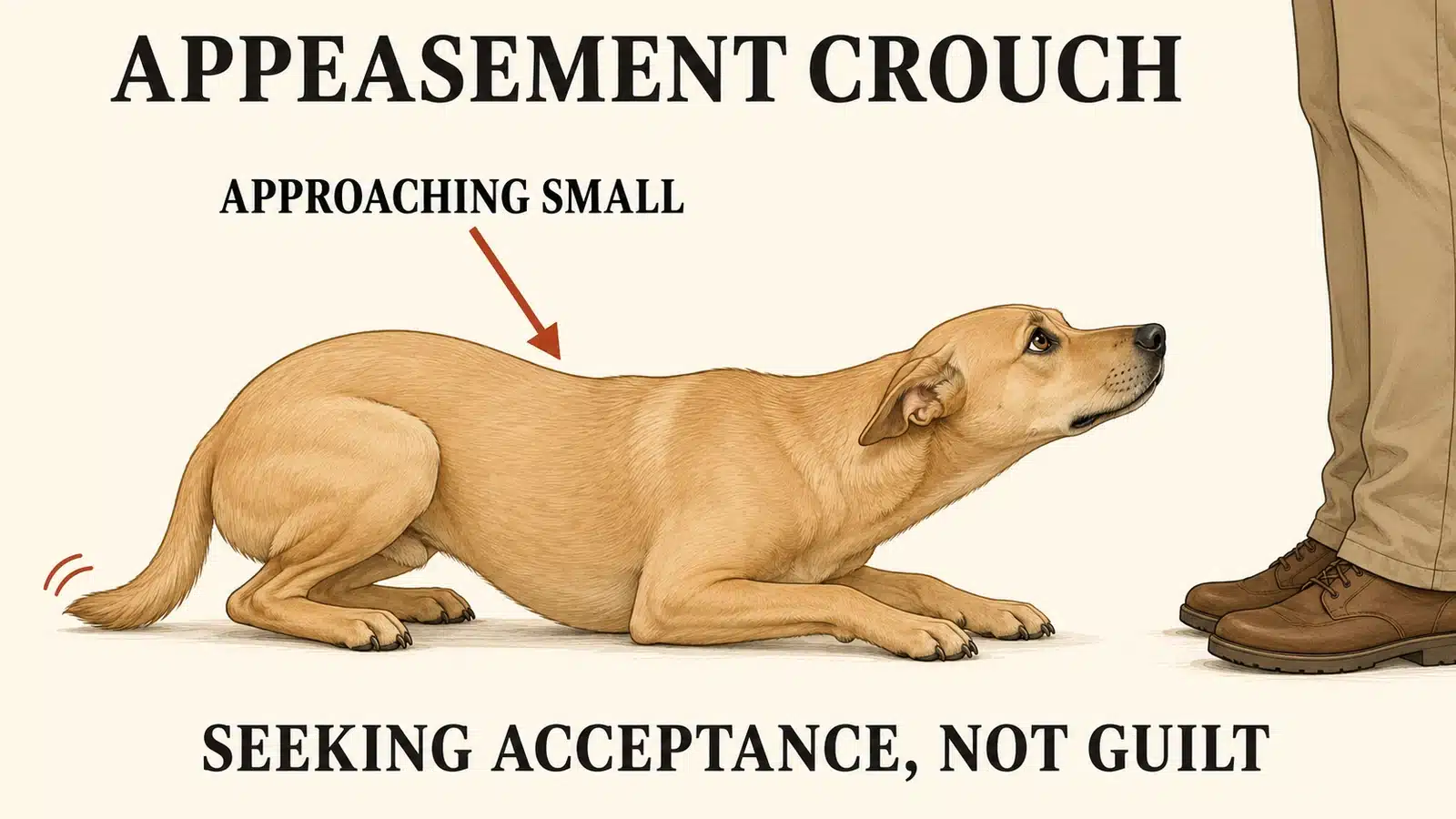
The appeasement crouch is a dog making himself small while approaching, lowering his whole body toward the ground, often creeping forward with the neck extended and the tail low but softly wagging, ears back, eyes soft and upward. Every element of the posture works to reduce the dog's apparent size and threat, and the message is a deferential request: I come in peace, please accept me, I am no challenge to you. It is common in dogs greeting someone they find slightly intimidating and in naturally softer, more sensitive dogs during ordinary social approaches.
Reading the crouch correctly means recognizing it as a communication of deference and mild social anxiety rather than as anything to correct or worry about, and responding in the way that helps. A crouching, appeasing dog is asking for the social pressure to come down, so the productive response is to soften: crouch to his level rather than looming over him, angle your body sideways, avoid reaching over his head, and let him complete the approach in his own time and gain confidence. This is closely related to the cowering described in the stress signals guide, and the difference is largely one of degree and context, with the appeasement crouch tending to be a social, approach-oriented gesture and cowering a more fear-saturated withdrawal. Both call for the same fundamental response: reduce the pressure, and let the dog feel safe.
Averting the Gaze: Looking Away as an Act of Deference
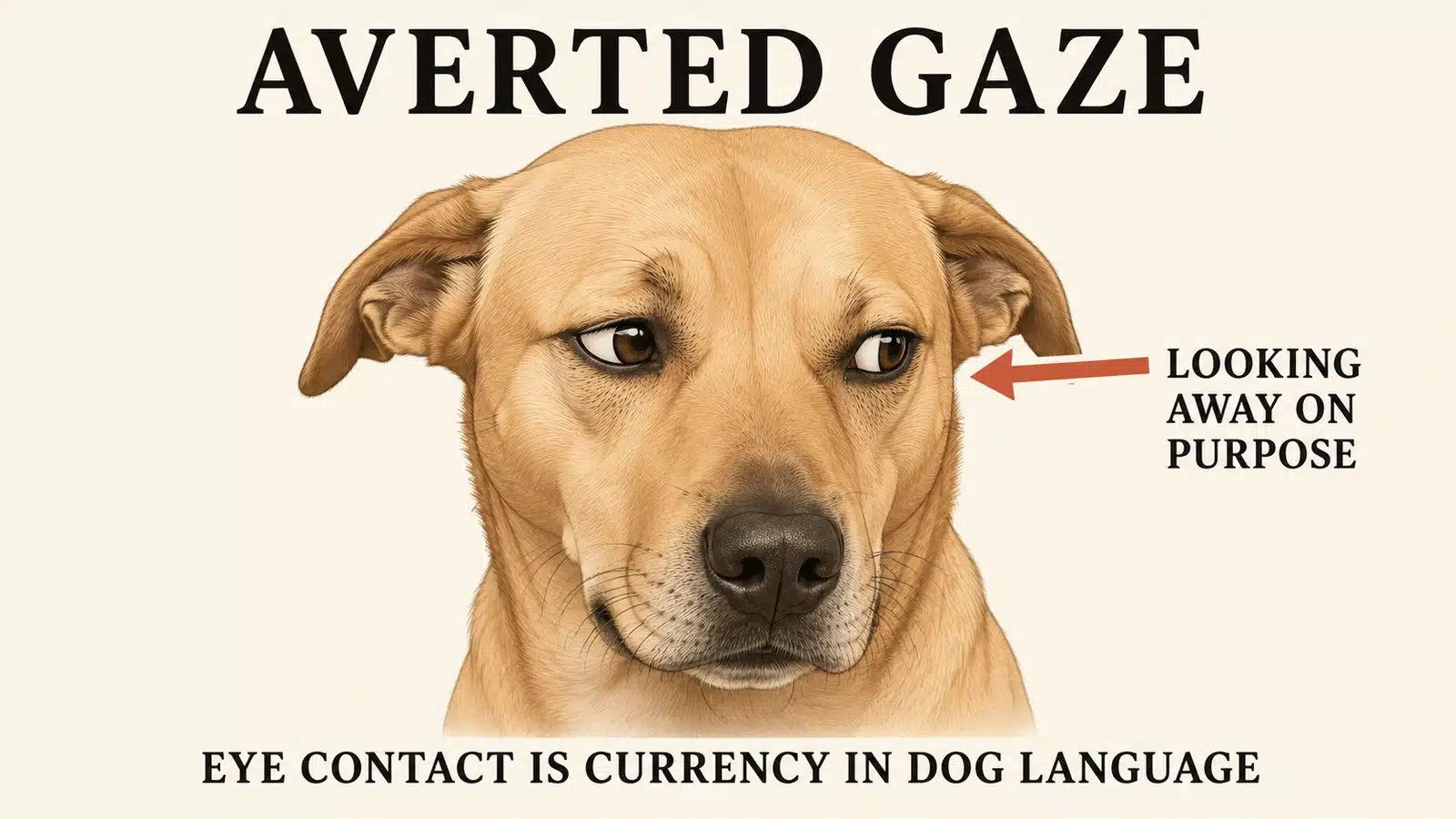
Because direct eye contact is confrontational in canine language, deliberately breaking it and looking away is a meaningful act of deference and appeasement. A dog who averts his gaze, turning his eyes or his whole head away from a person or another dog, is declining a challenge and signaling non-threatening, peaceful intent. It is the polite, conflict-avoiding thing to do in a dog's social world, and it frequently accompanies the other appeasement signals on this page as part of a larger deferential cluster.
This carries a genuinely useful lesson for how humans interact with dogs, and especially with fearful ones. When your dog looks away from you, he is very often being polite, not being difficult or ignoring you, and forcing eye contact, by holding a dog's face and making him look at you, is far more confrontational than most people realize. It is worth understanding this deeply, because so much well-meaning human behavior gets it backwards: we treat a dog's averted gaze as a problem to be corrected when it is actually a courtesy being extended. The kinder and more effective move, particularly with an anxious dog, is to soften and avert your own gaze in return, which lowers the social pressure and tells the dog you have received his message. The related calming version of looking away is covered in the calming signals guide.
Soft Ears Back: The Friendly Version of Flattened Ears
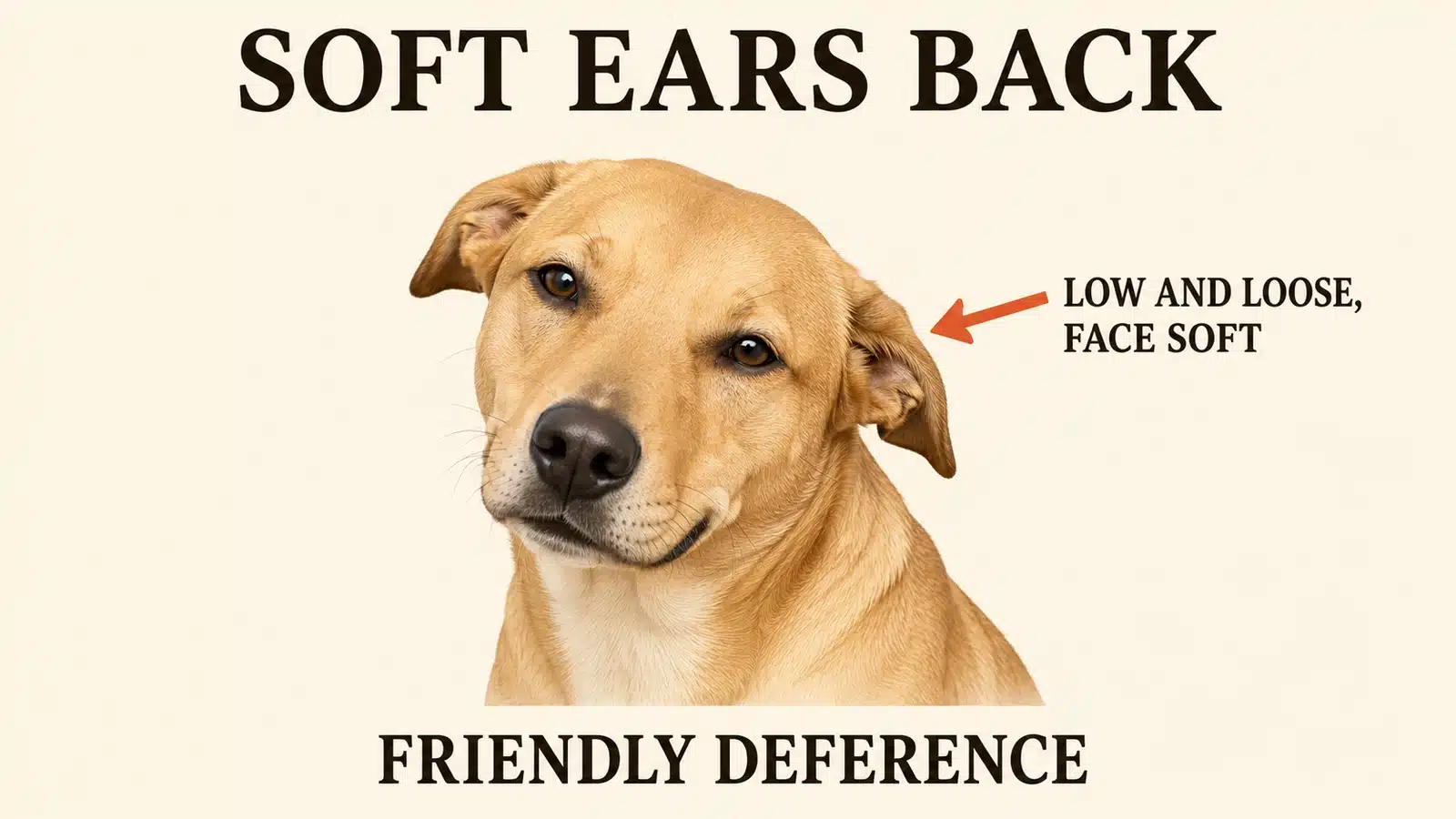
Ears drawn back against the head appear in more than one emotional state, and learning to tell the versions apart is a genuine mark of body language fluency. In its appeasement form, the ears are pulled back and low, but the rest of the face is soft: squinty, friendly eyes, a relaxed or slightly grinning mouth, a gentle overall expression, often a small head tilt and a wiggly body. This is a friendly, deferential gesture, a piece of the appeasement cluster that says I am no threat and I would like to be friends, and many dogs offer it during affectionate greetings with people they love.
Contrast this deliberately with the pinned, flattened ears of fear or the ears-back component of a genuine threat, both of which ride on tense rather than soft faces, as detailed in the stress and warning signal guides. The difference lives entirely in the tension of everything around the ears. Soft ears back come with a soft face and a loose body and mean friendly deference; hard ears back come with a tight face and a stiff body and mean fear or threat. This is the whole discipline of body language in miniature: the same ear position carries opposite meanings depending on the cluster it sits inside, which is exactly why you can never read a single feature in isolation.
Offering a Paw: A Gesture of Peace, Not a Trained Trick
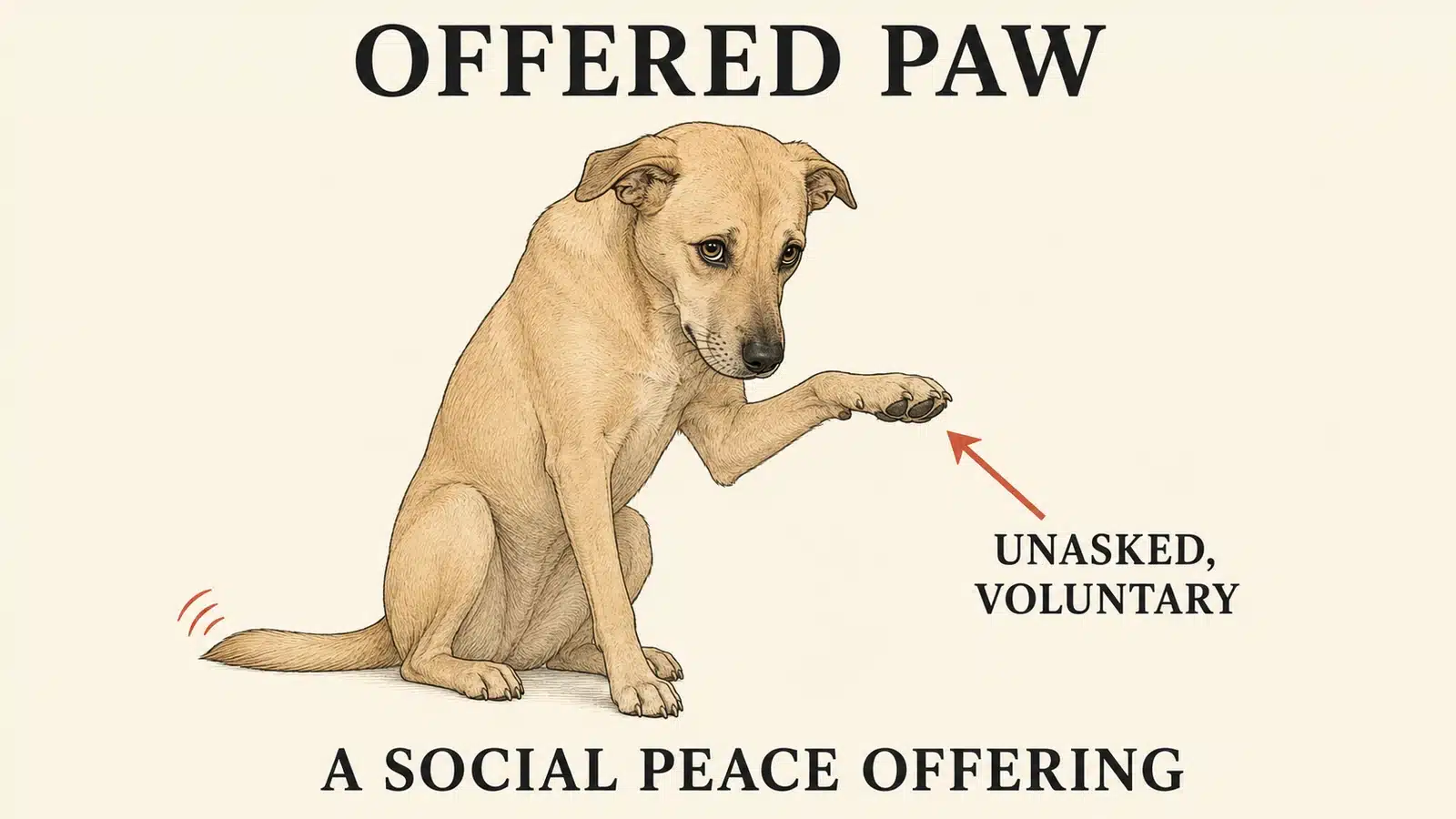
Lifting and offering a front paw is a common appeasement and deference gesture, distinct from the trained shake that many dogs learn. When it arises naturally, unasked for, from a dog with a lowered head, soft or averted eyes, ears back, and a generally deferential posture, the offered paw is a conciliatory gesture, a bid for friendly interaction and social acceptance. It is the appeasement relative of the calming paw lift, and it carries the same undertone of hesitation and a wish to keep things peaceful.
The reading task, as with every behavior in this guide, is context. The natural appeasement paw comes from a soft, lowered, slightly anxious body and functions as a peace offering. That is different from the trained shake a dog performs on cue, different from the insistent, repeated pawing some dogs use to demand attention, and different from the tense, uncertain paw lift of the calming signals section covered in the calming signals guide. When your dog spontaneously offers a paw from a soft, deferential posture, recognize it for the small social kindness it is, and meet it with gentle, unhurried acceptance rather than with pressure.
Submissive Urination: Involuntary, Emotional, and Never to Be Punished
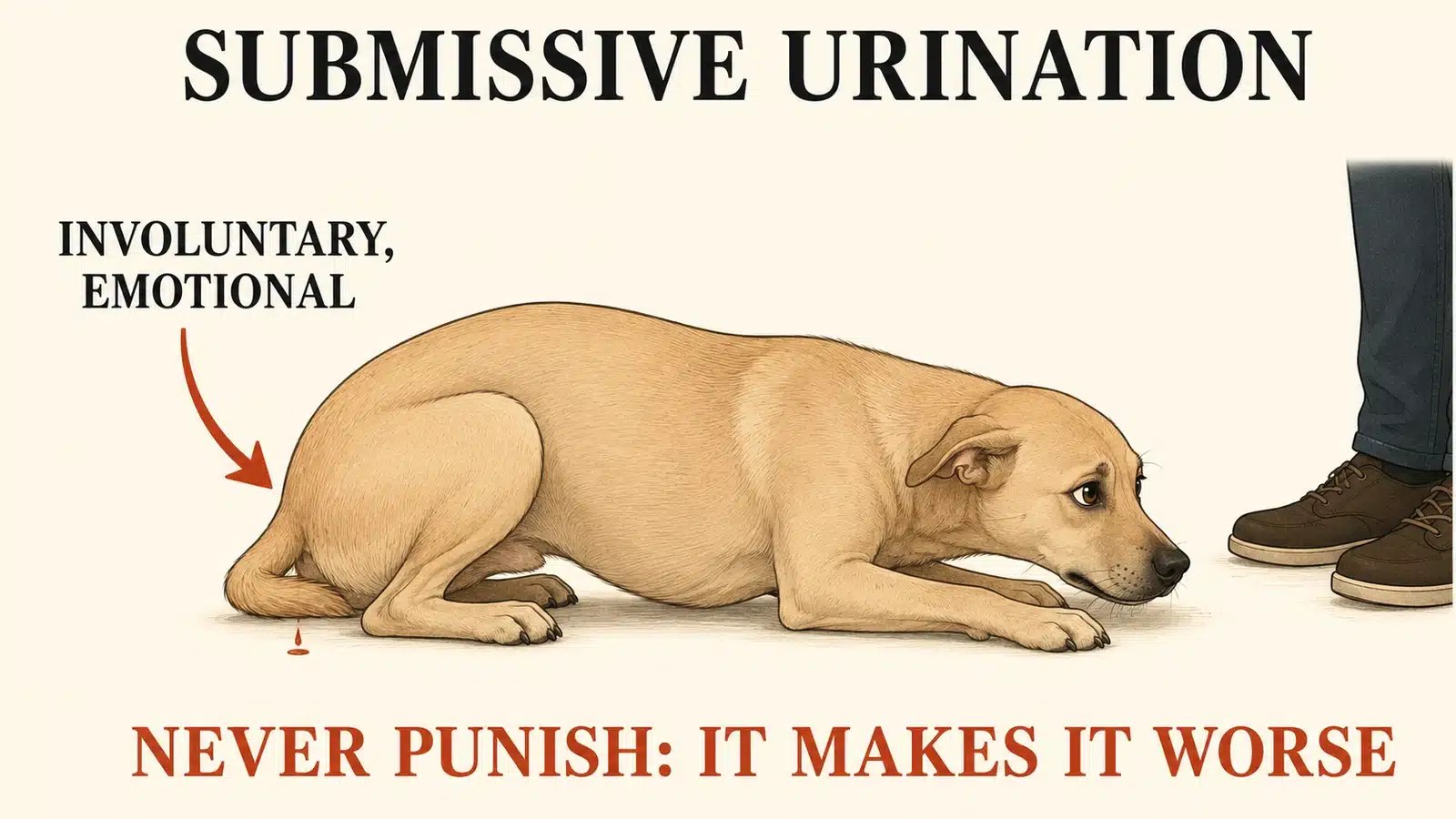
Submissive urination is the involuntary release of a small amount of urine during a greeting or an interaction the dog finds overwhelming, and it is critical to understand that it is not a housetraining problem and not a deliberate act. It is an extreme appeasement response, most common in puppies and young, soft, or anxious dogs, and it typically accompanies a deep appeasement posture: a lowered or crouched body, tucked tail, flattened ears, and averted eyes. The dog is not misbehaving and has no real control over it. His emotional system, faced with an interaction that feels like too much, has produced the most extreme deference signal in his repertoire.
The single most important thing to understand here is what not to do, because the intuitive human response makes the problem dramatically worse, and the mechanism explains exactly why. Submissive urination is driven by the dog feeling overwhelmed, anxious, or intimidated, so punishing it, scolding, looming, showing frustration, adds precisely the emotional pressure that caused it in the first place, which reliably increases the behavior rather than reducing it. Punishment here is not just ineffective, it is actively counterproductive, and it can entrench the problem for the long term. The effective approach runs the opposite direction: reduce the emotional intensity of greetings. Keep arrivals calm and low-key, avoid looming over the dog or making direct eye contact during greetings, approach from the side and crouch down, and let the dog come to you. Most young dogs outgrow submissive urination as their confidence grows, and a calm, pressure-free approach speeds that along. When it persists into adulthood or is severe, it points to an underlying confidence and anxiety issue worth addressing with a proper behavior plan.
Gentle Muzzle Mouthing: Ritual, Not Aggression
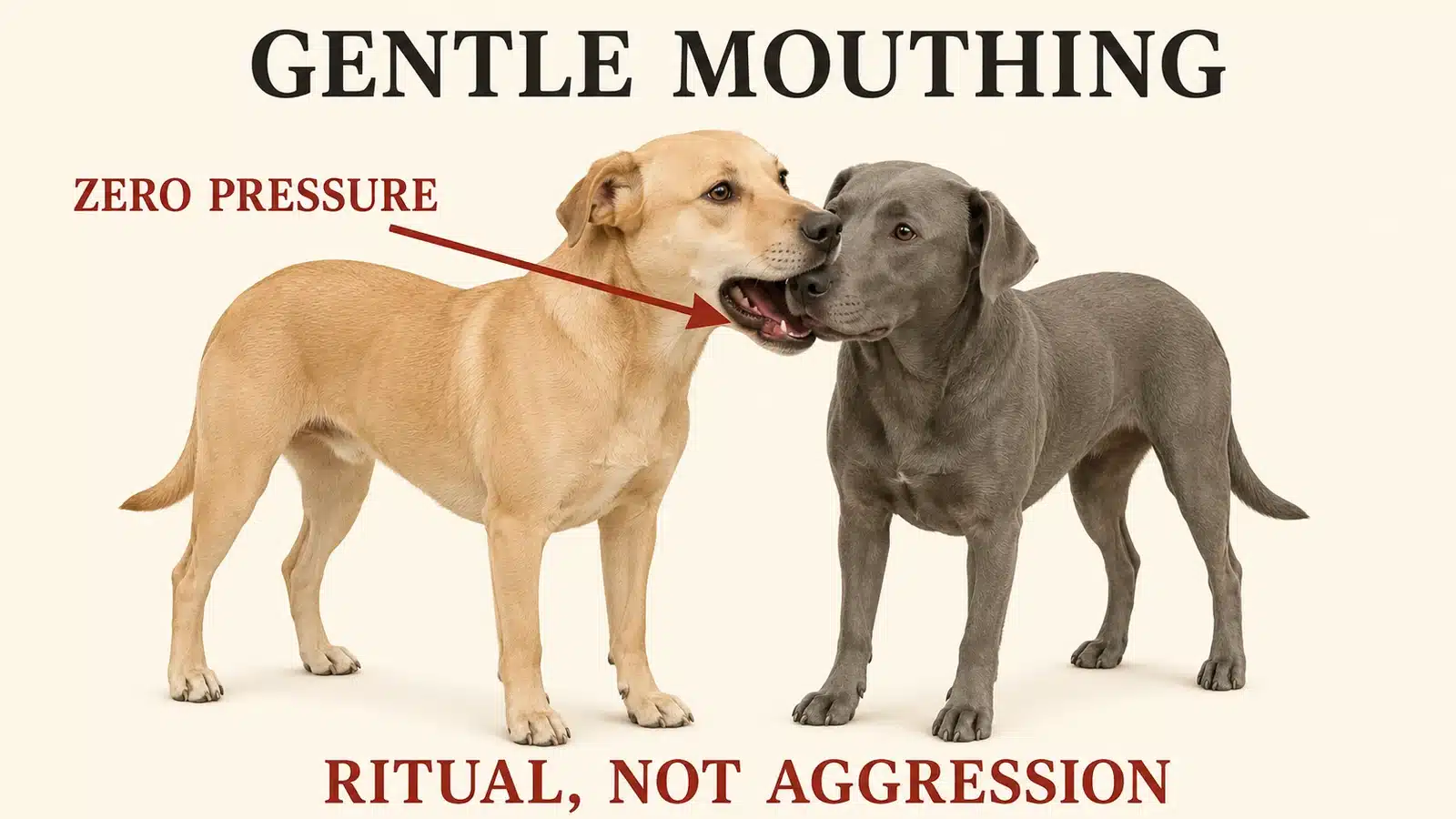
Gentle mouthing is a soft, deliberately inhibited, zero-pressure use of the mouth on another dog's muzzle, or sometimes on a person's hand, and it functions as a ritualized appeasement and affiliative gesture rather than as anything aggressive. The defining feature is the complete absence of pressure: the mouth is soft, the jaw does no work, the whole interaction is loose and unbothered, and the dog on the receiving end typically stays relaxed. Like appeasement licking, it echoes early puppy behavior and carries a message of deference and friendly social connection.
The reading task is to separate this gentle, ritualized mouthing from genuine warning or bite behavior, and the distinction is not subtle once you know to look for it: it is all in the pressure and the surrounding bodies. Appeasement mouthing is soft and loose, on relaxed bodies, with no tension and no intent to harm. A warning or a bite involves tension, stiffness, hard eyes, and real or threatened pressure, as covered in the warning signals guide. Understanding this prevents a common misread in which perfectly normal, affiliative canine communication gets mistaken for aggression and interrupted or punished unnecessarily. When two loose, relaxed dogs engage in soft muzzle mouthing, they are being friendly, not fighting, and the skill of reading the pressure and the bodies is what lets you tell the difference with confidence.
What Appeasement Asks of You, and What It Reveals
Across all ten signals on this page runs a single request, and answering it correctly is most of what you need to know. When a dog offers appeasement, he is telling you he feels some social pressure, some intimidation, some anxiety about how an interaction is going, and he is asking, in the most peaceful way he knows, for that pressure to ease. The productive response is therefore always the same in spirit: lower the pressure. Soften your posture, angle your body sideways instead of squaring up, avoid looming or reaching over the head, break off direct eye contact, slow down, and let the dog approach and gain confidence at his own pace. Meeting appeasement with reassurance tells the dog his communication worked, which is exactly what builds a confident, trusting animal.
Just as important is what you must never do, and it ties every misread on this page together. Do not punish appeasement, and do not punish the behaviors that so often accompany it. This is the deep error hiding inside the guilty look: a pet parent comes home to a mess, sees the slinking, averted, grinning, crouching dog, reads it as a guilty confession, and delivers a scolding. But the dog is not confessing, he is appeasing, responding to the cues that predict your anger, and the scolding does not teach him anything about the chewed shoe he destroyed hours ago. What it teaches him is that your arrivals are threatening and that his peace offerings do not work, which erodes trust and, over time, can push a dog toward abandoning appeasement in favor of signals much higher up the escalation ladder. The chewing itself, meanwhile, is a separate behavior with its own real causes, often boredom, under-stimulation, or separation-related anxiety, none of which is touched by punishing an appeasing dog on your doorstep.
Finally, learn to read what appeasement reveals about your dog over time, because the pattern is clinically meaningful. Occasional, situational appeasement is entirely normal and healthy, the mark of a socially skilled dog navigating his world. But a dog who is constantly appeasing, who moves through life perpetually crouched, grinning, and deferential, is often a dog living with chronic anxiety or low confidence, and that is a welfare matter worth taking seriously rather than mistaking for a well-behaved, submissive temperament. Within the clinical framework I use, reading appeasement accurately belongs to the Evaluate stage of the EASE Method, because a dog's baseline level of appeasement is real data about his emotional state, and building his genuine confidence through management, skill building, and counterconditioning is often a central goal of the behavior work that follows. A dog should not have to spend his life apologizing.
Dog Appeasement Signals: Questions, Answered
Does my dog look guilty because he knows he did something wrong?
No. Research, including well-known work by Alexandra Horowitz, found that the guilty look is not tied to whether a dog actually did anything wrong. It appeared just as readily in innocent dogs and tracked one thing reliably: the pet parent's behavior, showing up more when the dog was scolded. The look is not remorse but a fear-driven appeasement response to cues that predict your displeasure. Punishing it teaches the dog that your homecoming is threatening, not that the chewed item was wrong.
My dog pulls his lips back and shows his teeth but seems friendly. Is that aggression?
That is very likely a submissive grin, an appeasement gesture, not a threat. The key is horizontal versus vertical. A submissive grin retracts the lips back horizontally and comes with squinty eyes, ears back, and a loose, wiggly, lowered body. A genuine threat lifts the lip vertically to expose the canines, wrinkles the muzzle, and rides on a tense, hard-eyed, stiff body. Read the whole body, and the friendly grin and the real snarl are easy to tell apart.
My dog rolls over for a belly rub, but sometimes he seems tense. What's the difference?
There are two different belly-up postures. A friendly belly-rub solicitation is loose, wiggly, and floppy, with an open mouth. A passive appeasement rollover is stiff, with the head turned away, a closed mouth, a tucked tail, and worried eyes, and it means please stop, not pet me. Reaching in to rub that tense belly overrides a request for space. Before you rub any exposed belly, read the body: loose and wiggly is an invitation, stiff and averted is a request to back off.
How do I stop my puppy from submissive urination?
Never punish it, because punishment adds the emotional pressure that causes it and reliably makes it worse. Submissive urination is an involuntary appeasement response to feeling overwhelmed, not a housetraining failure. Reduce the intensity of greetings: keep arrivals calm and low-key, avoid looming and direct eye contact, approach from the side and crouch, and let the puppy come to you. Most young dogs outgrow it as their confidence grows. If it persists into adulthood or is severe, it points to an underlying confidence issue worth a proper behavior plan.
Is it a bad sign if my dog appeases a lot?
Occasional, situational appeasement is normal and healthy, the mark of a socially skilled dog. But a dog who is constantly appeasing, perpetually crouched, grinning, and deferential across everyday situations, may be living with chronic anxiety or low confidence, which is a welfare matter rather than simply a well-behaved temperament. Building genuine confidence through management, skill building, and counterconditioning is often a central goal of behavior work, because a dog should not have to spend his life apologizing.
Next: Distance-Decreasing Signals
If appeasement asks for acceptance, distance-decreasing signals are the warm invitations: the friendly approaches, the leaning, the nudging, the offered toy. The ways a dog says come closer, and means it.
 About the Author
Will Bangura, M.S., CAB-ICB, CBCC-KA, CPDT-KA, FDM, FFCP, is a Certified Canine Behaviorist with over 35 years of experience specializing in severe aggression, fear, anxiety, reactivity, phobias, and compulsive disorders in dogs. He holds a Master's Degree in Psychology and is accredited as a Certified Canine Behaviorist through International Canine Behaviorists, one of only three CAB-ICB Certified Canine Behaviorists in the United States and the only one in Arizona. His additional credentials include Certified Behavior Consultant Canine (CBCC-KA) and Certified Professional Dog Trainer (CPDT-KA) through the Certification Council for Professional Dog Trainers, certification in Applied Ethology through Family Dog Mediation (FDM), and Fear Free Certified Professional (FFCP).
Will is the author of Sniff to Soothe, host of the Dog Training Today podcast, and a court-recognized expert witness in canine behavior. His clinical work is grounded in behavioral psychology, applied behavior analysis, learning theory, and affective neuroscience: every case begins with a functional behavior assessment and is treated through management, skill building, and evidence-based behavior modification using systematic desensitization and counterconditioning. He is a national advocate for force-free, science-based training and a published voice on the welfare risks of aversive training methods.
As the founder of Phoenix Dog Training, Will provides in-home behavior consultations throughout the Phoenix metro area and virtual behavior consultations for pet parents nationwide.
If Your Dog Seems Anxious or Lacks Confidence
A dog who is always appeasing may be living with chronic anxiety. Confidence can be built through evidence-based behavior work. A professional consultation begins with a full functional behavior assessment and ends with a clear, structured plan. Schedule a Behavior Consultation, or start with a free call.