
← Dog Body Language: The Definitive Guide
The Definitive Guide · Distance-Decreasing SignalsDog Friendly Signals: How a Dog Says "Come Closer"
The loose wag, the lean, the offered toy, the wiggly approach: these are the invitations, the ways a dog reaches out and asks for connection. They are the happiest signals in the language, and even they come with rules worth understanding.
The Invitations: Signals That Say Come Closer
Distance-decreasing signals are the mirror image of the warnings covered elsewhere in this guide. Where distance-increasing signals work to push something away, distance-decreasing signals work to draw someone in. They communicate friendly intent, a wish to interact, and an invitation to close the gap, whether that gap is between two dogs or between a dog and a beloved person. These are the signals of connection and affiliation, and they are, plainly, the most pleasant part of the whole language to read, because a dog offering them is a dog who feels safe enough to want company.
That last point is worth sitting with, because it turns these signals into something more than a catalog of happy behaviors. A dog only reaches out to decrease distance when he feels secure, so distance-decreasing signals are a genuine barometer of emotional wellbeing. A relaxed, confident dog offers them freely. A fearful, anxious, or stressed dog offers them rarely, because his nervous system is too busy managing threat to invite connection. This makes the friendly signals clinically meaningful in a way that is easy to overlook: when a frightened dog begins, for the first time, to lean in, to offer a toy, to close the distance willingly, that is not a small thing. In behavior work it is often one of the clearest signs that a dog's emotional state is genuinely improving.
There is one more idea that shapes how this whole category should be read, and it protects both dogs and people: even friendly signals have rules, and connection in the canine world is a negotiation, not a free-for-all. Polite dogs decrease distance through a structured ritual of curves, sniffs, and check-ins, and healthy interaction depends on both parties consenting and on either being free to add distance again at any time. A great deal of avoidable trouble, from overwhelmed dogs to bad greetings to bites, comes from humans overriding that negotiation, forcing friendly contact that a dog was trying to decline, or misreading a friendly invitation as license to ignore the dog's ongoing feedback. So even here, in the warmest part of the language, the master rule holds: read the whole dog, honor the negotiation, and let consent run both directions. If you have not read the main guide on reading the whole dog, it is the foundation this page rests on.
The Friendly Wag: Loose, Mid-Height, and Whole-Body
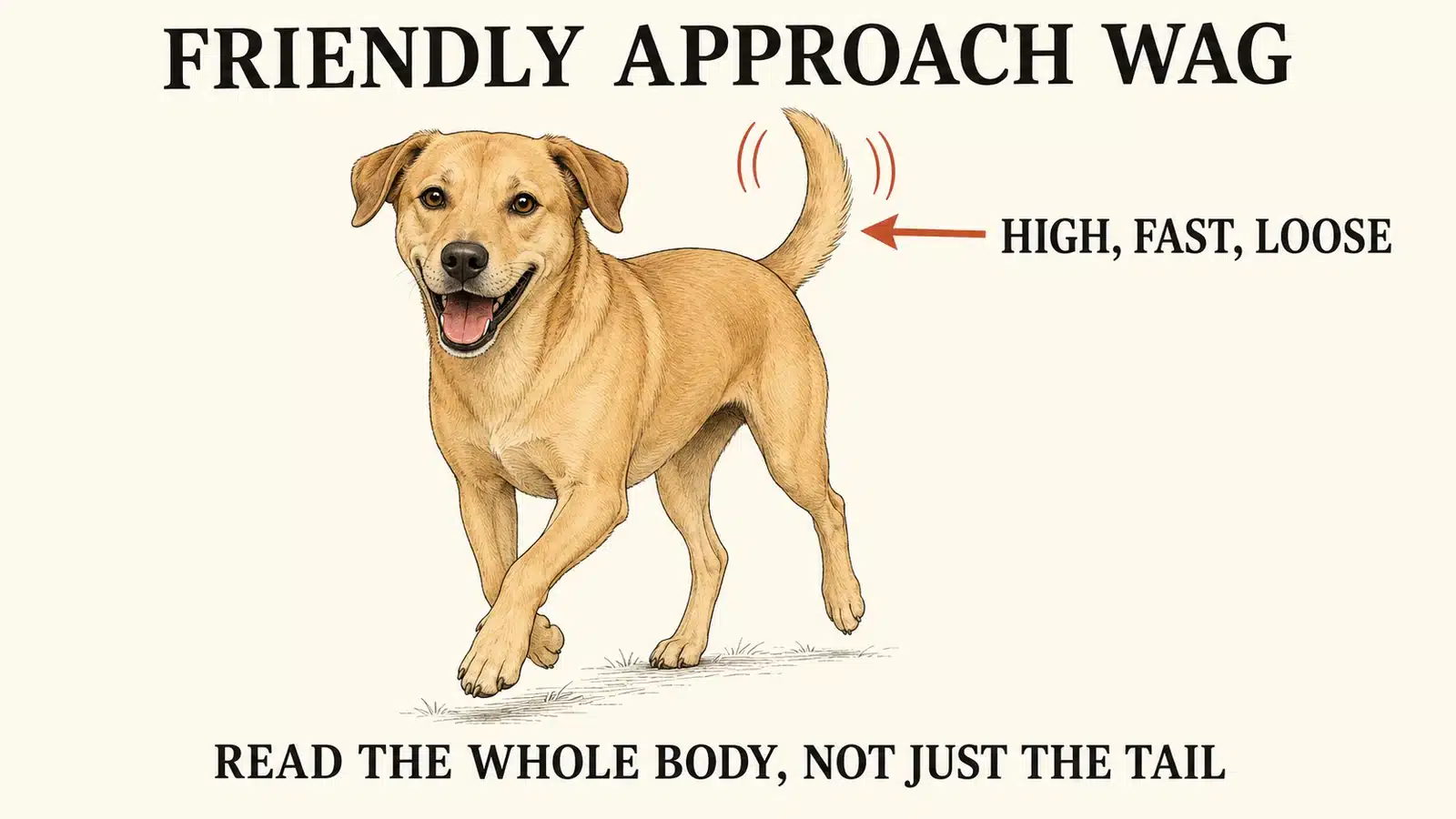
The friendly, distance-decreasing wag is the one people picture when they imagine a happy dog, and for once the picture is roughly right, provided you read the whole thing. It is a wag that recruits the entire body: the tail moving in loose, sweeping arcs, often with the hips and rear end swinging along, the spine softening, and, crucially, the rest of the body relaxed and inviting, with soft eyes and a loose, often open mouth. This is a genuine invitation to approach and interact, and the looseness is what certifies it as friendly.
The reason this bears repeating, even on the friendly-signals page, is that the wag is the single most misread signal in all of dog behavior, and the difference between a friendly wag and an aroused, warning wag lives entirely in the body around it. The full breakdown of how height, speed, width, and looseness change a wag's meaning is laid out in the tail wagging guide, and the short version is this: a loose, whole-body wag on a soft, relaxed dog is a true friendly invitation, while a high, stiff, tight wag on a rigid, hard-eyed dog is not, even though both involve a tail in motion. When you see the loose, wiggly, whole-body version, you are looking at a dog genuinely asking to decrease the distance, and you can answer in kind.
The Relaxed Approach: Soft, Loose, and Curved
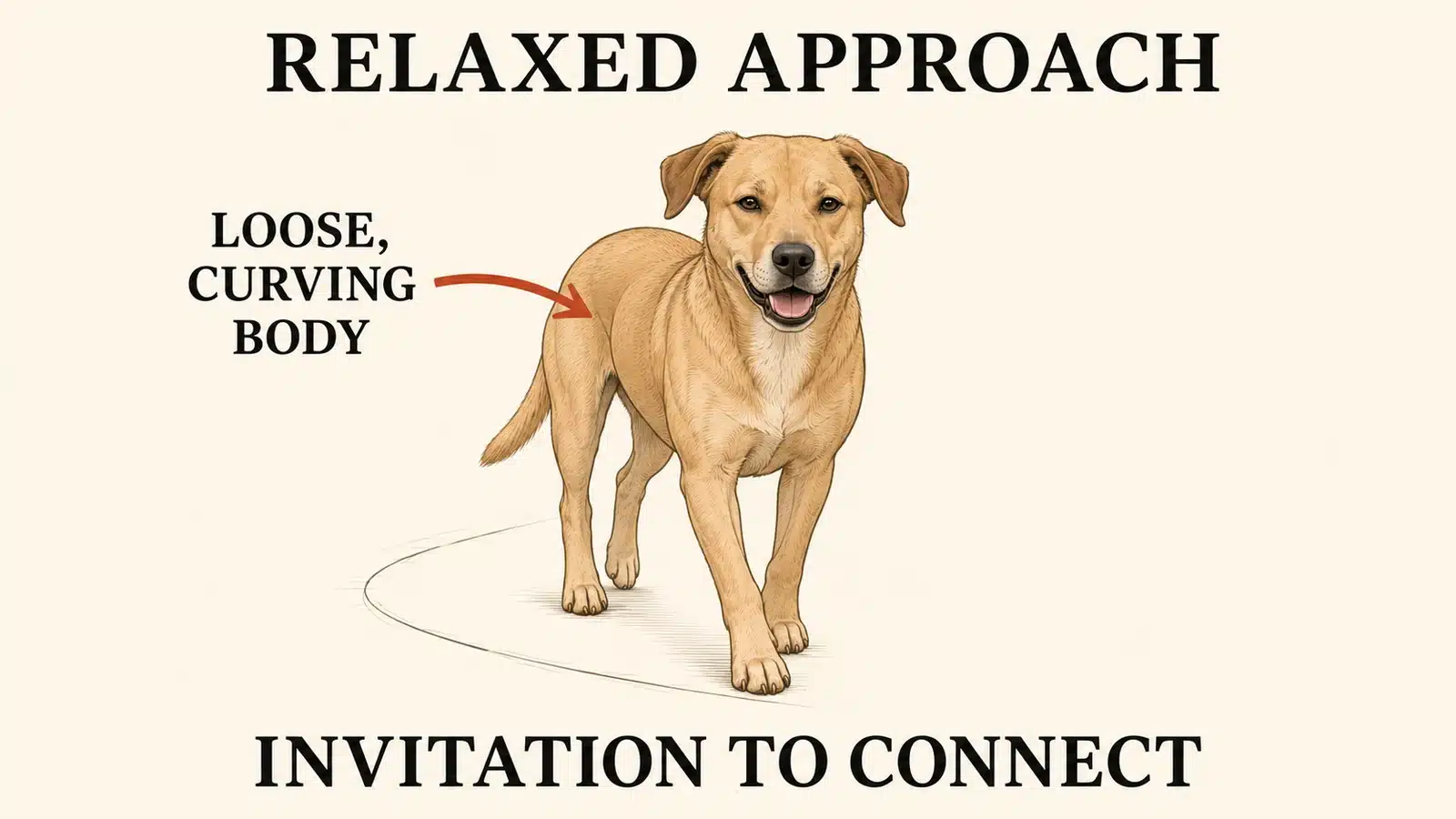
How a dog approaches tells you almost everything about his intent before he ever arrives, and the friendly approach has an unmistakable quality once you learn to see it. The body is loose and often gently curved rather than rigidly straight, the movement is soft and unhurried rather than hard and driving, the eyes are soft, the mouth relaxed, and the whole animal reads as an invitation in motion. A dog approaching this way is signaling friendly, non-threatening intent and a wish to interact.
The curve is the detail worth emphasizing, because it connects directly to canine etiquette. A polite, friendly dog tends not to march straight at another dog head-on, since a direct, linear approach is confrontational in dog language, as explained in the calming signals guide. Instead the friendly approach arcs, softens, and often includes a look-away or a ground sniff along the way. This is genuinely useful for humans to borrow: when you approach an unfamiliar or nervous dog, do not walk straight at him with your body squared and your eyes locked on. Angle your approach, soften your gaze, and slow down. You will read as far friendlier and less threatening, and you will get better first meetings for it.
The Nose-to-Nose Greeting: Brief, Polite, and Then Onward
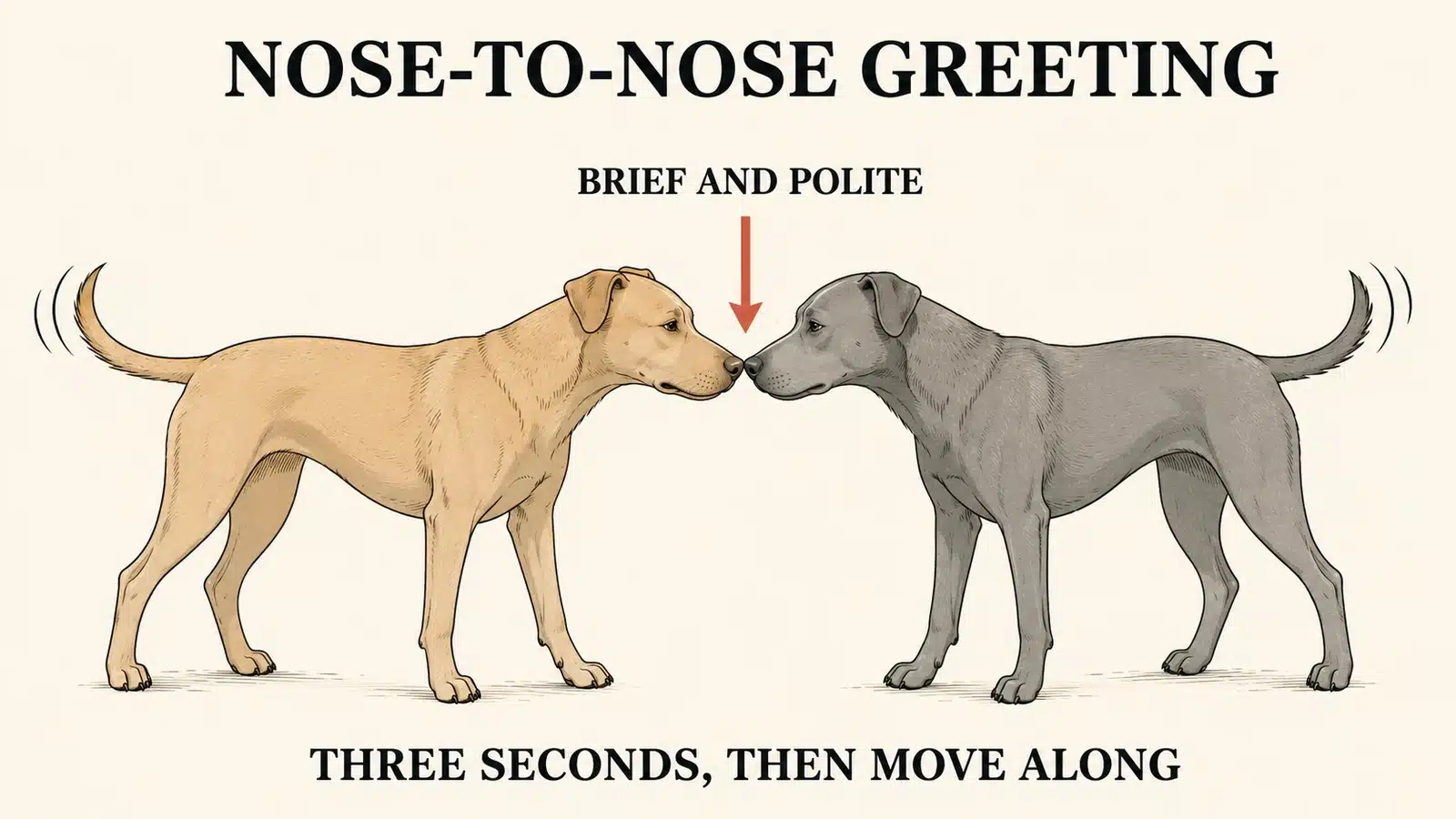
Two dogs touching noses, necks gently extended, bodies often angled slightly sideways rather than squared off, tails at a relaxed mid-height, is a common friendly greeting behavior, an initial, information-gathering hello that gives each dog a first read on the other. When the greeting is genuinely friendly, everything about it is soft and brief: loose bodies, soft eyes, neutral ears, and, importantly, a short duration before the dogs move on to the next phase of the greeting or disengage entirely.
That brevity is the part people most need to understand, because the polite nose-to-nose is meant to be a quick opening line, not a prolonged staredown, and a healthy greeting flows onward rather than freezing in place. When a nose-to-nose greeting stalls, when it stops being brief and loose and hardens into a sustained, stiff, unblinking face-to-face, the emotional tone has shifted from friendly hello toward tension or challenge. This is exactly the kind of moment where knowing the difference lets a watching pet parent relax during a normal greeting and step in calmly during a stalling one. A good greeting is a moment, not a standoff, and it should keep moving.
The Lean: Trust You Can Feel
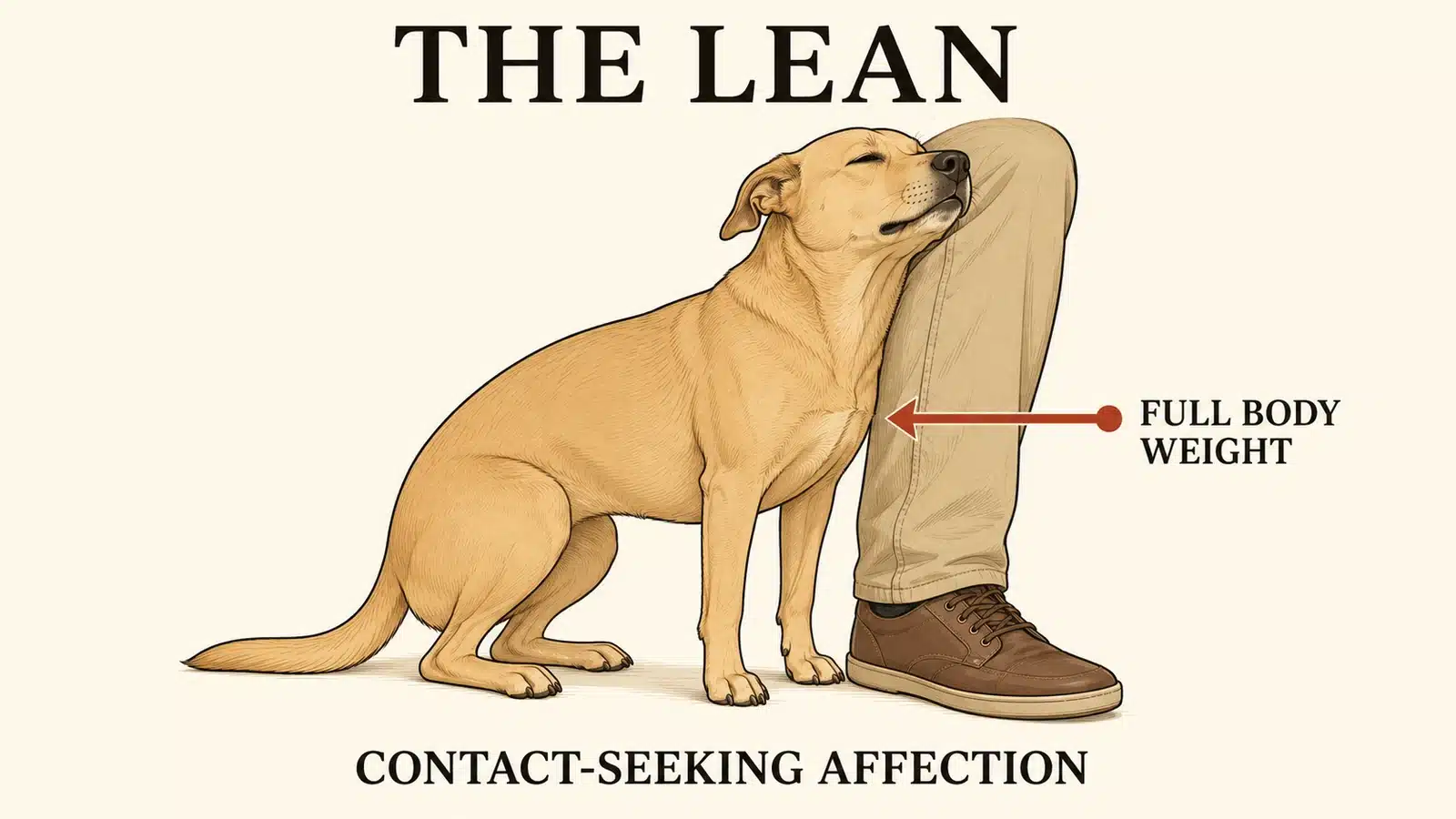
When a dog leans his full body weight against your legs, presses his shoulder and ribs into you, and settles there with a soft, relaxed body, he is engaging in contact-seeking behavior, a distance-decreasing signal of affection, trust, and a desire for closeness. To lean into someone is to make yourself briefly dependent on them for balance, and dogs reserve that easy physical trust for individuals they feel genuinely safe with. Combined with soft, squinty eyes and a relaxed posture, the lean is one of the warmest signals a dog offers a person.
One honest caveat keeps this reading accurate rather than sentimental, because leaning does have a second, very different form. The affectionate lean comes from a soft, relaxed, content body and means closeness and trust. A tense, anxious lean, where a worried dog presses hard into his person during storms, fireworks, or frightening situations, means something else entirely: it is the clinginess and reassurance-seeking of a stressed dog, covered in the stress signals guide. The difference, as always, lives in the rest of the body. A loose, soft, happy dog leaning into you is asking for affection and connection. A tense, worried dog pressing into you is asking for safety. Both deserve a warm response, but reading which one you are getting tells you whether your dog is content or in need of comfort.
The Bouncy Hop: Loose, Springy, "Let's Interact"
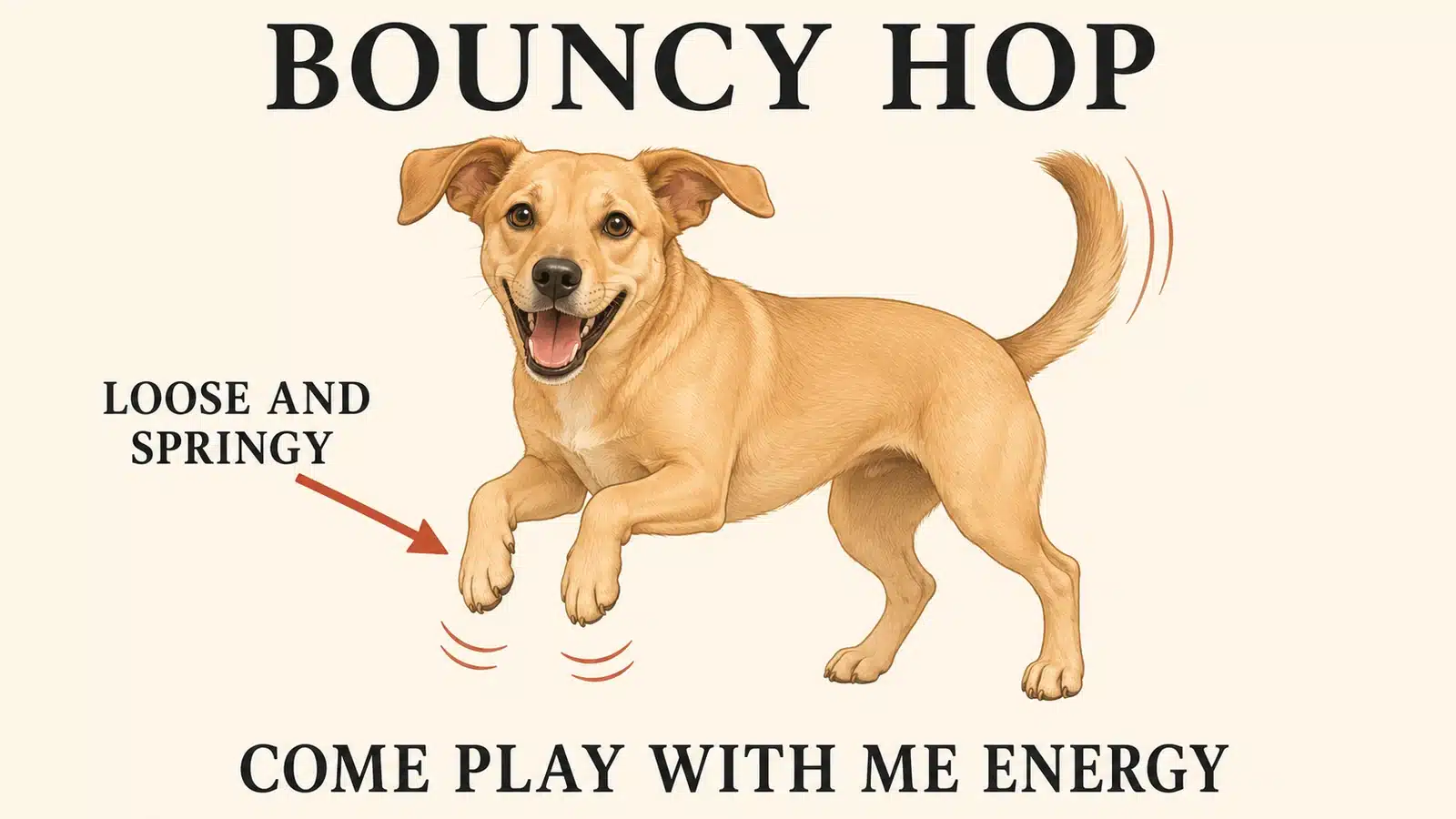
Light, bouncy, springy movement, a dog hopping in place or toward you with a loose, wiggly body, floppy ears, and an open, happy mouth, is an expression of friendly excitement and an invitation to engage. It shares its essential quality with the bouncy movement of play covered in the play signals guide: looseness and exaggeration. The hop is inefficient, joyful, and completely unlike the tight, economical movement of a tense or threatening dog, which is exactly what makes it such a reliable marker of friendly, positive arousal.
The one thing worth naming here is that bouncy friendly excitement, delightful as it is, can tip into over-arousal, and reading that tipping point is a useful skill. A dog who is bouncing and wiggling with a loose body is having a wonderful time and inviting you to join him. But excitement is a form of arousal, and very high arousal, even happy arousal, can spill into jumping, mouthing, or an inability to settle, particularly in young dogs and during greetings. This is not a problem to punish; it is an opportunity to help the dog learn to regulate, channeling that friendly energy into an appropriate outlet and reinforcing calmer choices. The bounce itself is pure friendliness. The skill is helping an exuberant dog stay just below the threshold where happy tips into frantic.
Mutual Grooming: The Bond Between Friends
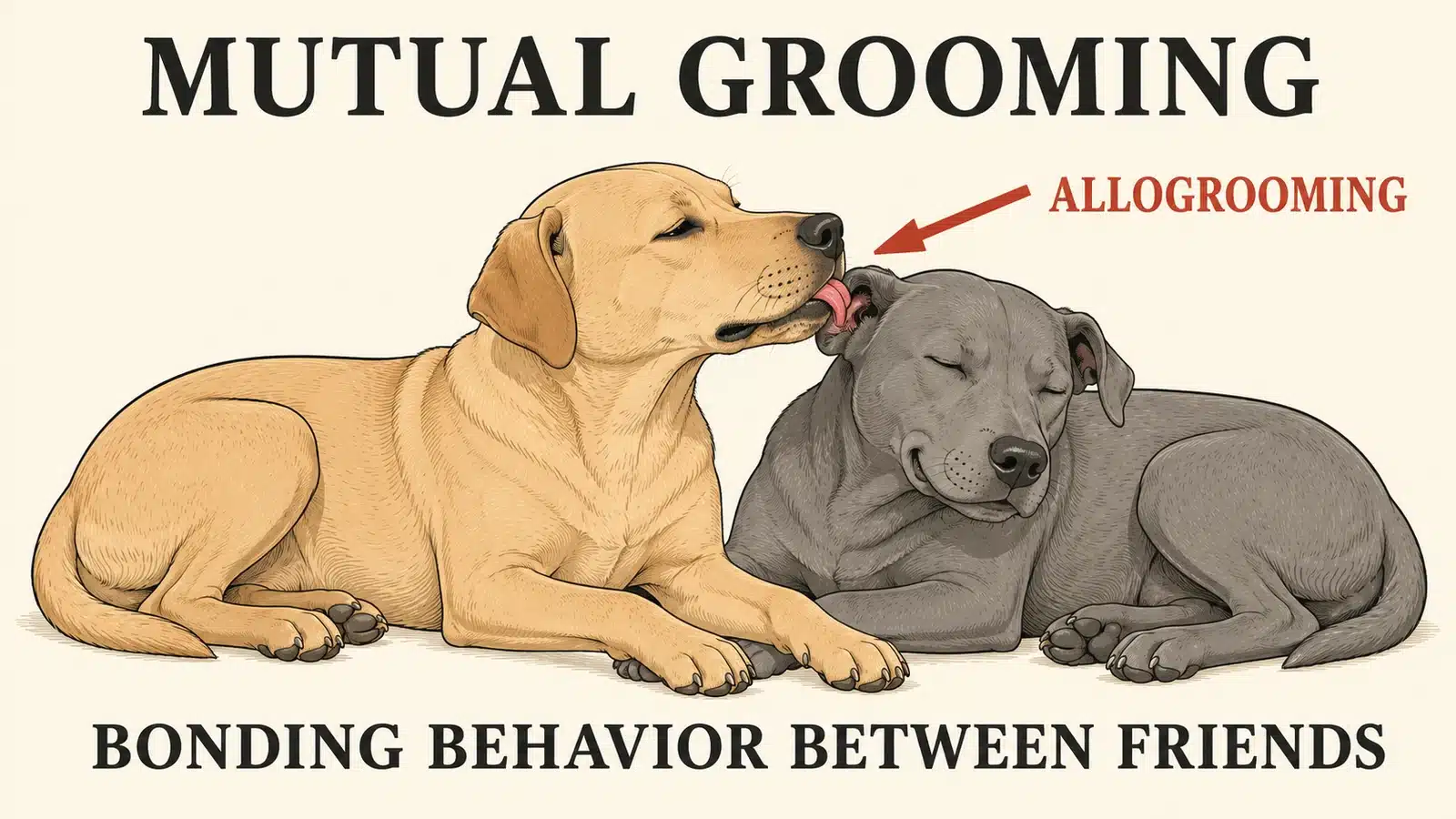
When two dogs lie close and gently groom each other, licking faces, ears, and necks with relaxed, contented bodies, they are engaging in allogrooming, a genuine affiliative and bonding behavior. This is not a dominance ritual or a bid for control; it is one of the clearer expressions of a real social bond between two dogs who are comfortable and affiliated with one another. The whole scene is soft: loose bodies, half-closed eyes, no tension, a mutual and unhurried exchange of care.
For pet parents with more than one dog, mutual grooming is worth recognizing as the positive relationship indicator it is, a sign that the dogs in the home genuinely like each other and share an affiliative bond, which matters when you are assessing the overall health of a multi-dog household. It is the warm counterweight to the tension signals, the body blocks, the guarding, the stiff standoffs, that would tell you a relationship is strained. Dogs who willingly groom each other, rest in contact, and move through the home at ease around one another are dogs whose relationship is working, and that is genuinely good news worth being able to read.
Offering a Toy: A Structured Invitation to Connect
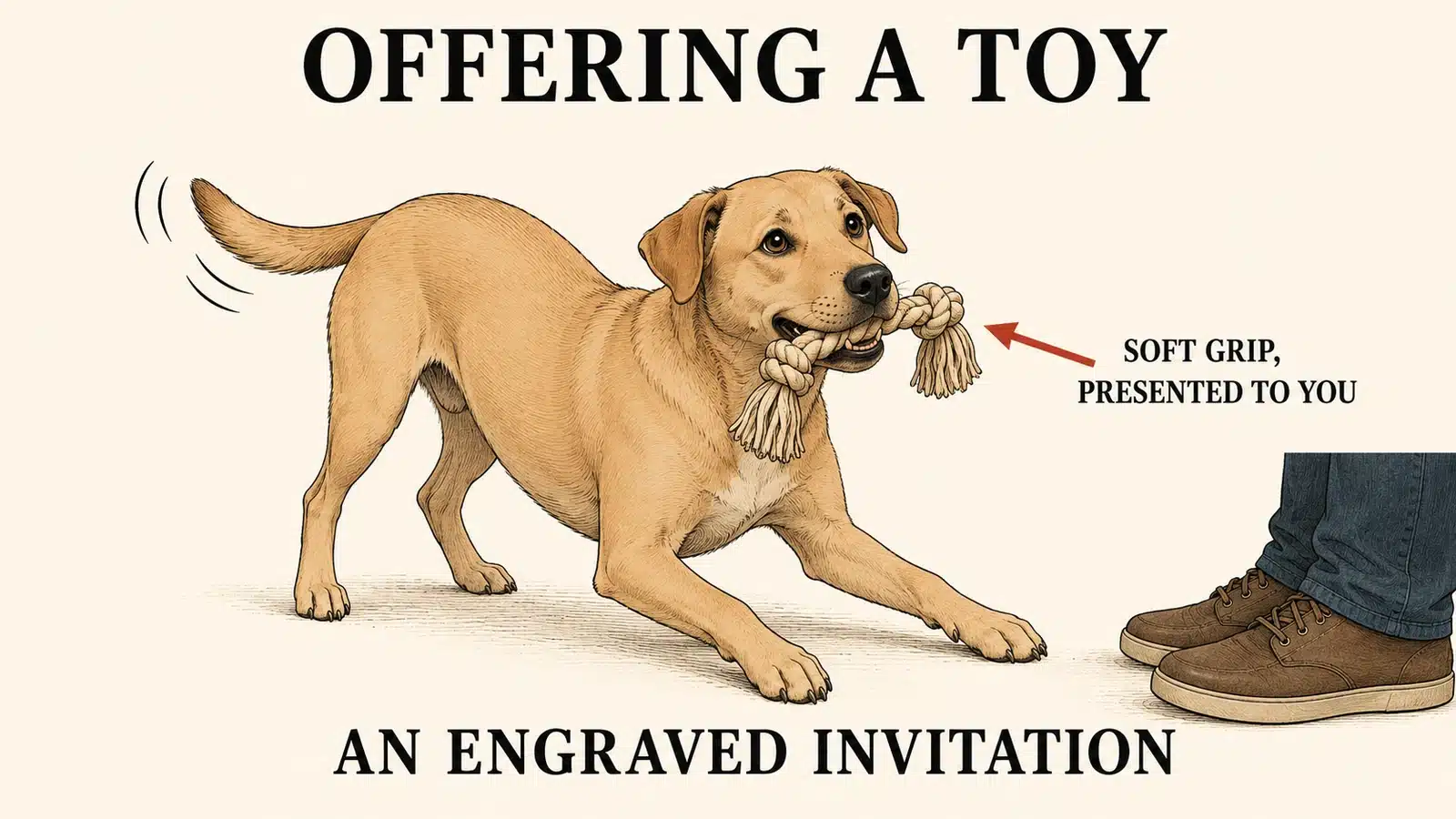
A dog who brings you a toy and offers it, tail wagging, body loose and inviting, sometimes with a little play-bow tilt or a hopeful glance between you and the toy, is issuing a friendly, distance-decreasing invitation to interact. Offering a toy is a deliberate, affiliative bid for connection and shared activity, and it is a particularly meaningful one because it is directed specifically at you. The dog is not just feeling friendly in general; he is choosing you as his partner and proposing that you do something together.
This signal carries real clinical weight, which is why it is worth more than the simple charm of the moment. Offering a toy to a person requires trust and a positive emotional state, because a dog solicits shared activity only when he feels safe and connected, which makes it a genuine barometer of the human-dog relationship. In behavior work with fearful and anxious dogs, the first time a dog spontaneously brings a toy to a person he was previously wary of is a milestone worth celebrating, a concrete sign that the dog's emotional state has shifted from guardedness toward trust. When your dog offers you a toy, he is paying you one of the higher compliments in his language. Take him up on it.
The Swaying Walk: Relaxation You Can See in Motion
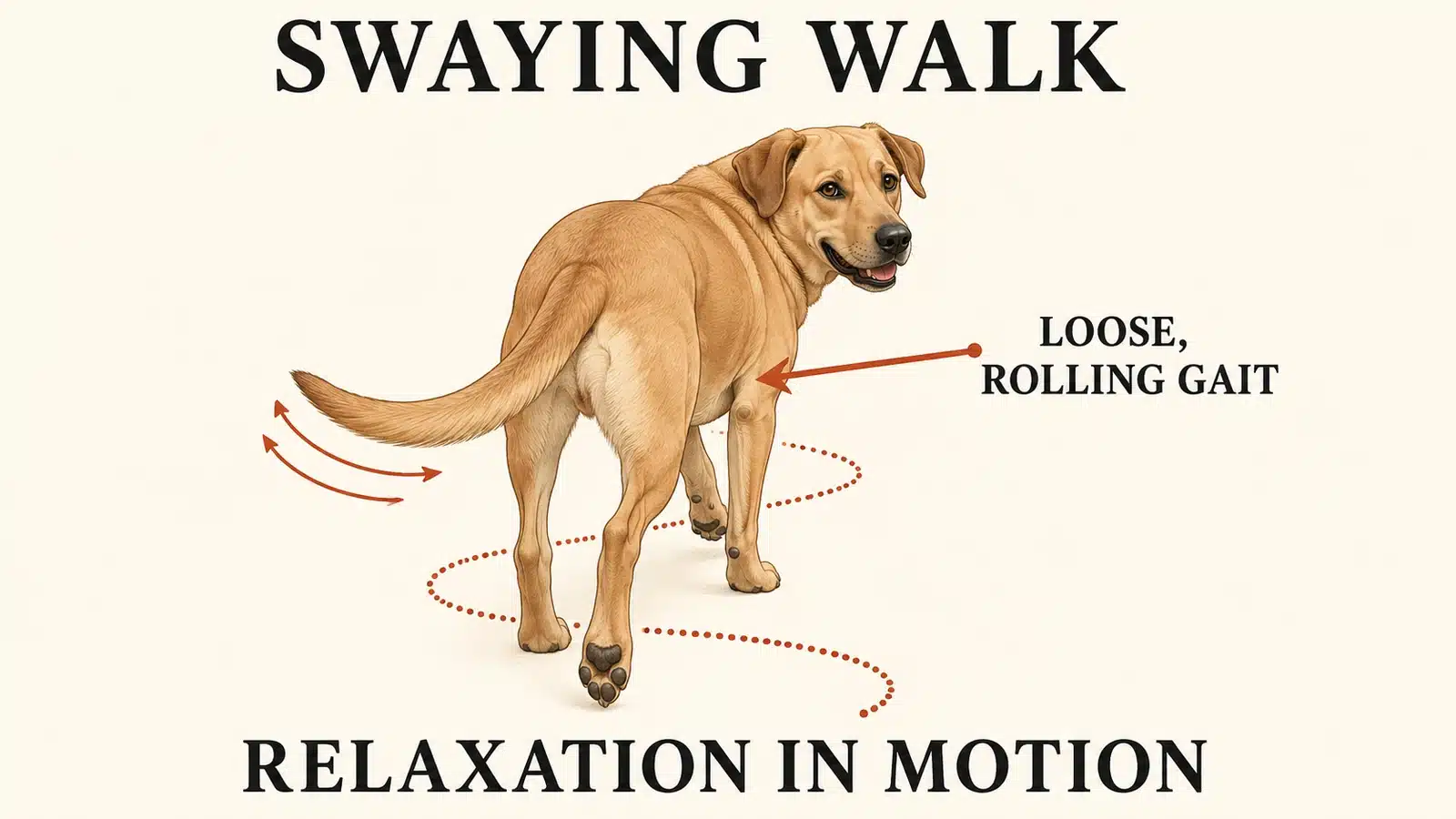
A loose, swaying, almost rolling gait, with the hips swinging freely side to side and the tail sweeping in a soft, low-to-mid arc, is friendliness expressed as movement. Where a tense dog moves stiffly, with a rigid, economical, braced gait, a relaxed and friendly dog moves loosely, and that looseness travels all the way through the body into a distinctive swaying walk that signals a comfortable, non-threatening, affiliative emotional state. It is the gait of a dog who has nothing to defend and nowhere he urgently needs to be.
This ties back to the master variable that runs through this entire guide: looseness versus tension. Reading a dog's gait is one of the quieter but more reliable ways to gauge his emotional state at a distance, before you can see his eyes or his mouth clearly. A loose, swaying, rolling walk tells you the dog is relaxed and friendly from across a park, while a stiff, hard, deliberate gait tells you to look closer and read the rest of the body before assuming anything friendly. Learning to see the difference in how a dog moves, not just how he holds a single body part, is a genuine step toward fluency.
The Circling Greeting: The Sniff That Is Actually Good Manners
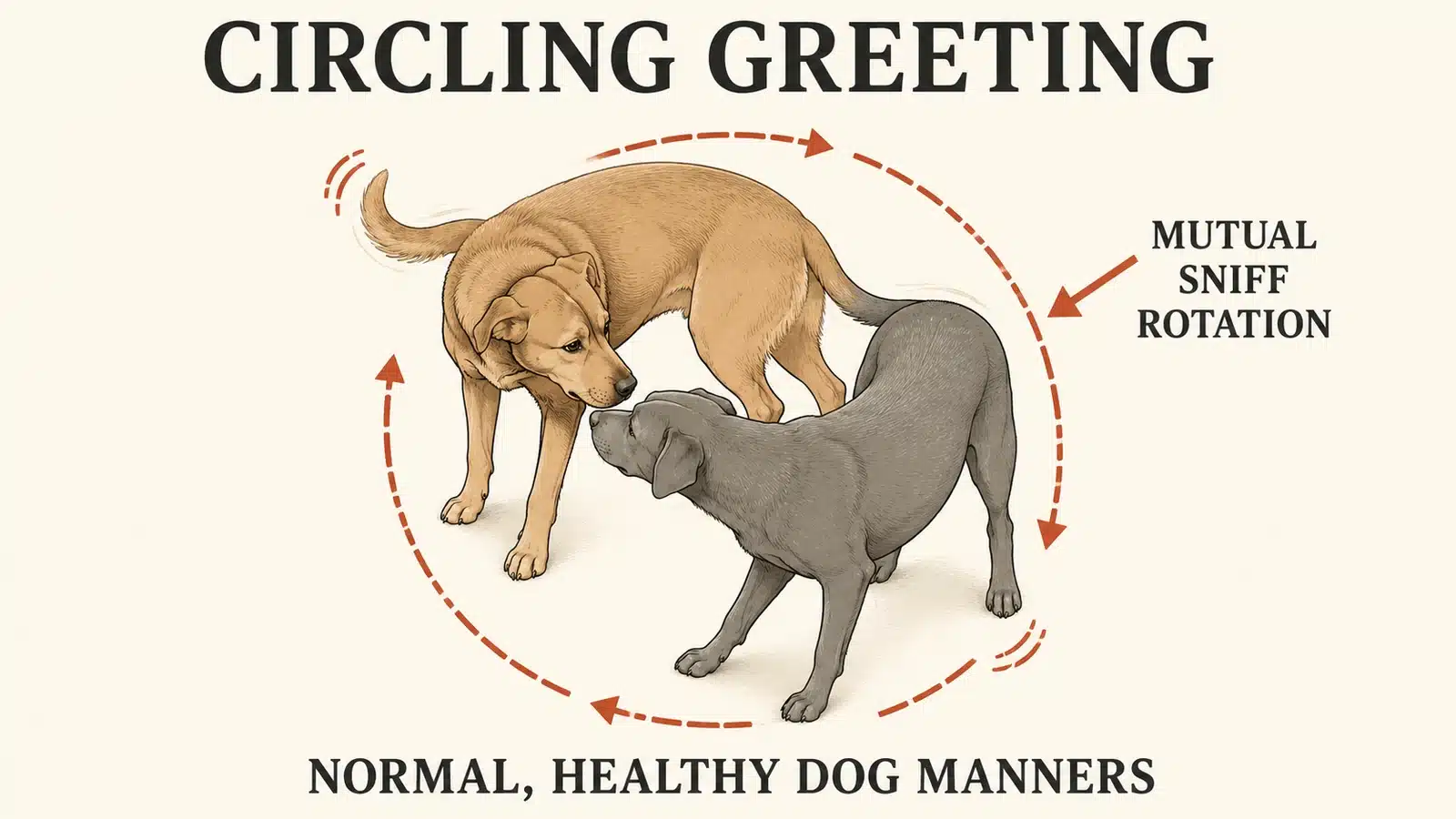
The classic canine greeting, in which two dogs circle and sniff each other, curving around toward each other's hindquarters in a loose, rotating dance, is normal, healthy, and polite dog behavior. Far from being rude, the rear-end sniff is the heart of a proper greeting, because a dog's most information-rich scent signals come from that area, and the circling that facilitates it is a piece of good manners, not bad. When both dogs are loose, curved, and taking turns, this is exactly what a healthy greeting is supposed to look like.
Understanding this helps pet parents avoid two opposite mistakes, and both are common. The first is interrupting normal, healthy greeting behavior out of misplaced concern, yanking a dog away from a perfectly polite sniff because it looks impolite to human sensibilities, which denies the dogs the information exchange a greeting exists to provide. The second is failing to notice when a greeting is actually going wrong. A healthy circling greeting stays loose and mutual and keeps flowing; if the bodies stiffen, if one dog freezes or tries to escape, or if the loose circling hardens into a tense standoff, the greeting has soured and it is time to calmly intervene. The skill is telling the two apart: loose, mutual, flowing circling is good manners in action, while stiff, frozen, or one-sided interaction is the signal to step in.
The Nudge: A Request for Contact, and a Lesson in Consent
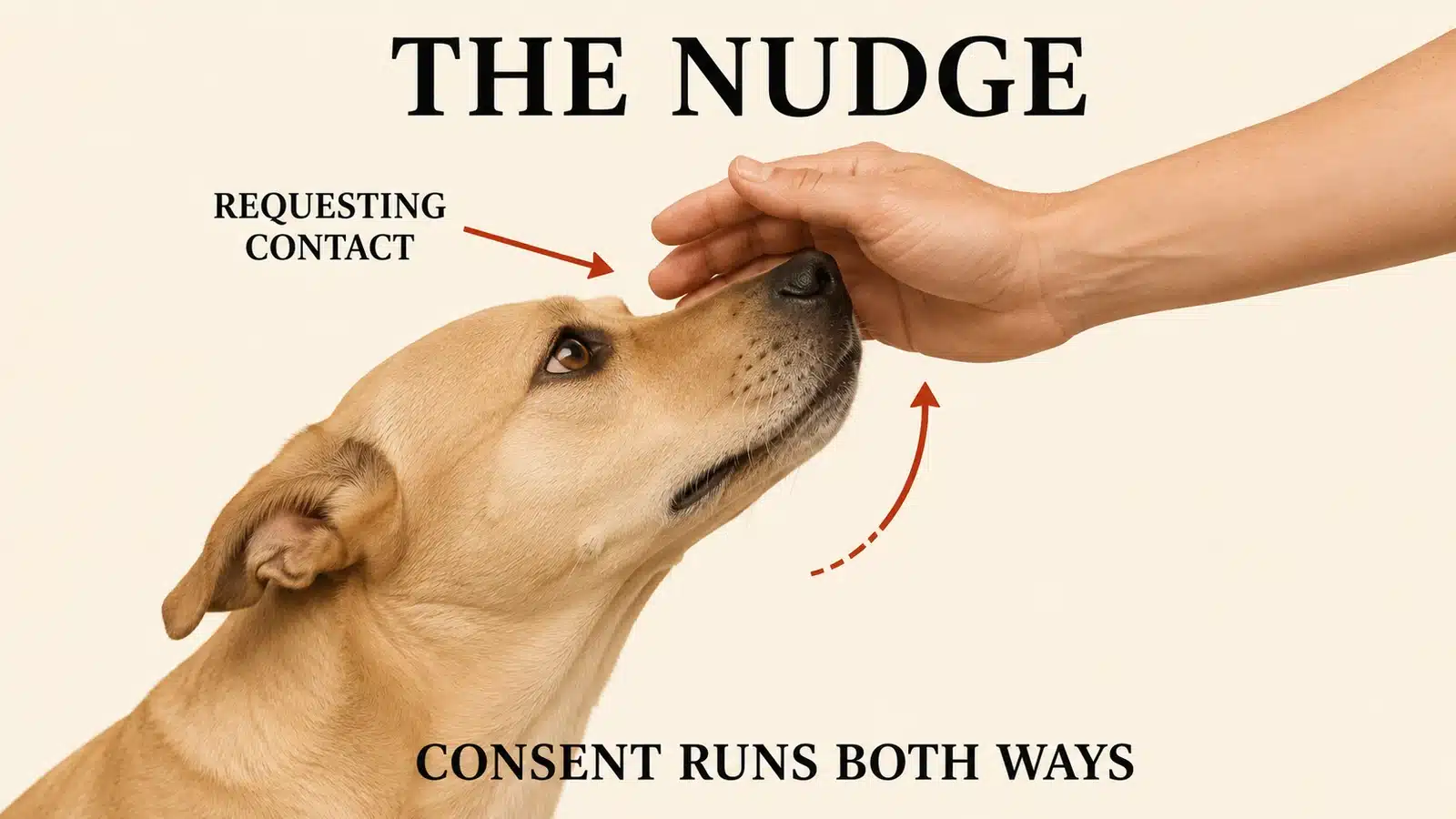
When a dog pushes his nose or muzzle against your hand, arm, or leg, gently lifting your hand or bumping into you with a soft, relaxed body and hopeful eyes, he is making a direct, friendly request for attention and contact. The nudge is one of the clearer distance-decreasing signals a dog aims at a person, an unambiguous bid for interaction, affection, or petting, and it is genuinely lovely, because it means the dog is actively choosing to connect with you.
The nudge also offers a perfect entry point into one of the most valuable concepts in the whole language, and it is worth ending the friendly signals here because it reframes all of them: consent runs in both directions. A dog nudging you for contact is giving consent, actively asking to be petted, and that is your cue to enjoy the interaction. But the same principle means you must also honor the reverse: when a dog stops nudging, moves away, leans back, or offers the avoidance and calming signals of a dog who has had enough, that is a withdrawal of consent, and it deserves the same respect as the request. This is the foundation of the consent test that skilled handlers use constantly: pet a dog briefly, then stop and see whether he asks for more by nudging in again, or whether he takes the pause as a chance to disengage. Petting that continues past a dog's withdrawn consent is how well-meaning affection becomes something the dog has to tolerate, and, over time, something he may start to actively avoid. Read the nudge as the friendly invitation it is, and read its absence just as carefully.
Even Friendly Signals Have Rules
It is tempting to treat the friendly signals as the one part of the language where you can relax and stop reading carefully. Resist that temptation, because the most common way friendly interactions go wrong is precisely when a human assumes friendliness means anything goes. Connection in the canine world is a negotiation, structured by etiquette and governed by ongoing consent, and the pet parents who understand that get better greetings, safer dog parks, and dogs who trust them more.
Start with greetings between dogs, because this is where good intentions cause the most trouble. Healthy greetings are brief, loose, curved, and mutual: dogs approach on an arc rather than head-on, keep the initial nose or rear sniff short, stay loose in the body, and either flow onward into play or disengage. The forced, head-on, leashes-tight, face-to-face greeting that humans so often orchestrate, dragging two dogs directly at each other and holding them nose-to-nose, is the opposite of polite canine etiquette, and it manufactures tension out of what should have been an easy hello. If you want good greetings, let dogs greet on their own terms: keep it short, keep leashes loose, approach at an angle, and let either dog add distance when they choose. A useful rule of thumb many professionals teach is the brief greeting, a few seconds of sniffing, then cheerfully moving along, before arousal has a chance to build.
Then apply the same thinking to contact between dogs and people, where consent is everything. The single most useful tool here is the consent test, and it is simple enough for a child to learn: pet a dog for a few seconds, then stop, take your hands away, and watch what he does. If he leans back in, nudges your hand, or otherwise asks for more, he is consenting, and you can continue. If he moves away, looks away, shakes off, or shows any of the avoidance and calming signals covered elsewhere in this guide, he has had enough, and the kind and correct response is to stop. This one habit prevents an enormous share of the situations where affection becomes something a dog merely tolerates, and it is especially important to teach children, since so many bites to kids happen during petting or hugging that the dog was trying to decline.
Finally, read the friendly signals as the emotional barometer they are, because this is where they connect to the clinical work I do. A dog's willingness to offer distance-decreasing signals is a direct readout of how safe he feels, which makes these signals a meaningful measure of progress in any behavior program. When I work with fearful, anxious, or reactive dogs, watching for the return of genuine friendly signals, the loose approach, the offered toy, the willing lean, is part of how I track whether a dog's underlying emotional state is actually changing, not just whether his outward behavior is being managed. Within the EASE Method, this belongs to Evaluate: reading these signals accurately tells you where a dog truly is emotionally, and their gradual return is one of the most honest signs that the emotional repatterning at the heart of good behavior work is taking hold. A dog rediscovering his capacity to reach out and connect is a dog getting better.
Dog Friendly Signals: Questions, Answered
How can I tell if a dog genuinely wants to greet me?
Look for looseness and an invitation in the whole body: a loose, whole-body wag at mid-height, soft eyes, a relaxed or open mouth, a curved rather than head-on approach, and often a nudge or a lean. A genuinely friendly dog moves loosely and invites contact. Approach him the same way in return: angle your body sideways rather than squaring up, soften your gaze, move slowly, and let him close the last of the distance himself.
Why does my dog lean against me?
Usually it is a distance-decreasing signal of affection and trust. Leaning makes a dog briefly dependent on you for balance, and dogs reserve that easy physical trust for people they feel safe with, so a soft, relaxed lean is a warm bid for closeness. Read the body, though: a tense, hard lean during storms or fireworks is a stressed dog pressing into you for safety rather than affection, and that dog is asking for comfort, not just company.
Is it rude when dogs sniff each other's rear ends?
No, it is the opposite. Rear-end sniffing is the heart of a polite canine greeting, because a dog's most information-rich scent comes from that area, and the circling that goes with it is good manners rather than bad. Interrupting a normal, loose, mutual sniff denies dogs the information exchange a greeting exists for. Just watch that it stays loose and flowing; if the bodies stiffen or one dog freezes or tries to leave, that is the time to calmly step in.
My dog brings me toys constantly. What does that mean?
It is a friendly, affiliative invitation to interact, and a meaningful one, because offering a toy requires trust and a positive emotional state. The dog is choosing you as his partner and proposing shared activity. In behavior work with previously fearful dogs, the first spontaneous toy offering is a milestone, a concrete sign of a shift from guardedness toward trust. When your dog offers you a toy, he is paying you a real compliment.
How do I know when a dog wants me to stop petting him?
Use the consent test. Pet the dog for a few seconds, then stop, take your hands away, and watch. If he leans in, nudges your hand, or asks for more, he is consenting and you can continue. If he moves away, looks away, shakes off, or shows avoidance or calming signals, he has had enough, and you should stop. Petting that continues past a dog's withdrawn consent is how affection becomes something a dog merely tolerates, which is why this habit is especially important to teach children.
Next: Tail Positions
So much of what you have read here comes back to the tail. The companion guide breaks down what tail height alone, before any wagging, reveals about a dog's emotional state.
 About the Author
Will Bangura, M.S., CAB-ICB, CBCC-KA, CPDT-KA, FDM, FFCP, is a Certified Canine Behaviorist with over 35 years of experience specializing in severe aggression, fear, anxiety, reactivity, phobias, and compulsive disorders in dogs. He holds a Master's Degree in Psychology and is accredited as a Certified Canine Behaviorist through International Canine Behaviorists, one of only three CAB-ICB Certified Canine Behaviorists in the United States and the only one in Arizona. His additional credentials include Certified Behavior Consultant Canine (CBCC-KA) and Certified Professional Dog Trainer (CPDT-KA) through the Certification Council for Professional Dog Trainers, certification in Applied Ethology through Family Dog Mediation (FDM), and Fear Free Certified Professional (FFCP).
Will is the author of Sniff to Soothe, host of the Dog Training Today podcast, and a court-recognized expert witness in canine behavior. His clinical work is grounded in behavioral psychology, applied behavior analysis, learning theory, and affective neuroscience: every case begins with a functional behavior assessment and is treated through management, skill building, and evidence-based behavior modification using systematic desensitization and counterconditioning. He is a national advocate for force-free, science-based training and a published voice on the welfare risks of aversive training methods.
As the founder of Phoenix Dog Training, Will provides in-home behavior consultations throughout the Phoenix metro area and virtual behavior consultations for pet parents nationwide.
Helping a Fearful Dog Learn to Connect Again
When a fearful dog begins offering friendly signals again, that is real progress. If your dog struggles with fear, anxiety, or reactivity, evidence-based behavior work can help. A professional consultation begins with a full functional behavior assessment and ends with a clear, structured plan. Schedule a Behavior Consultation, or start with a free call.