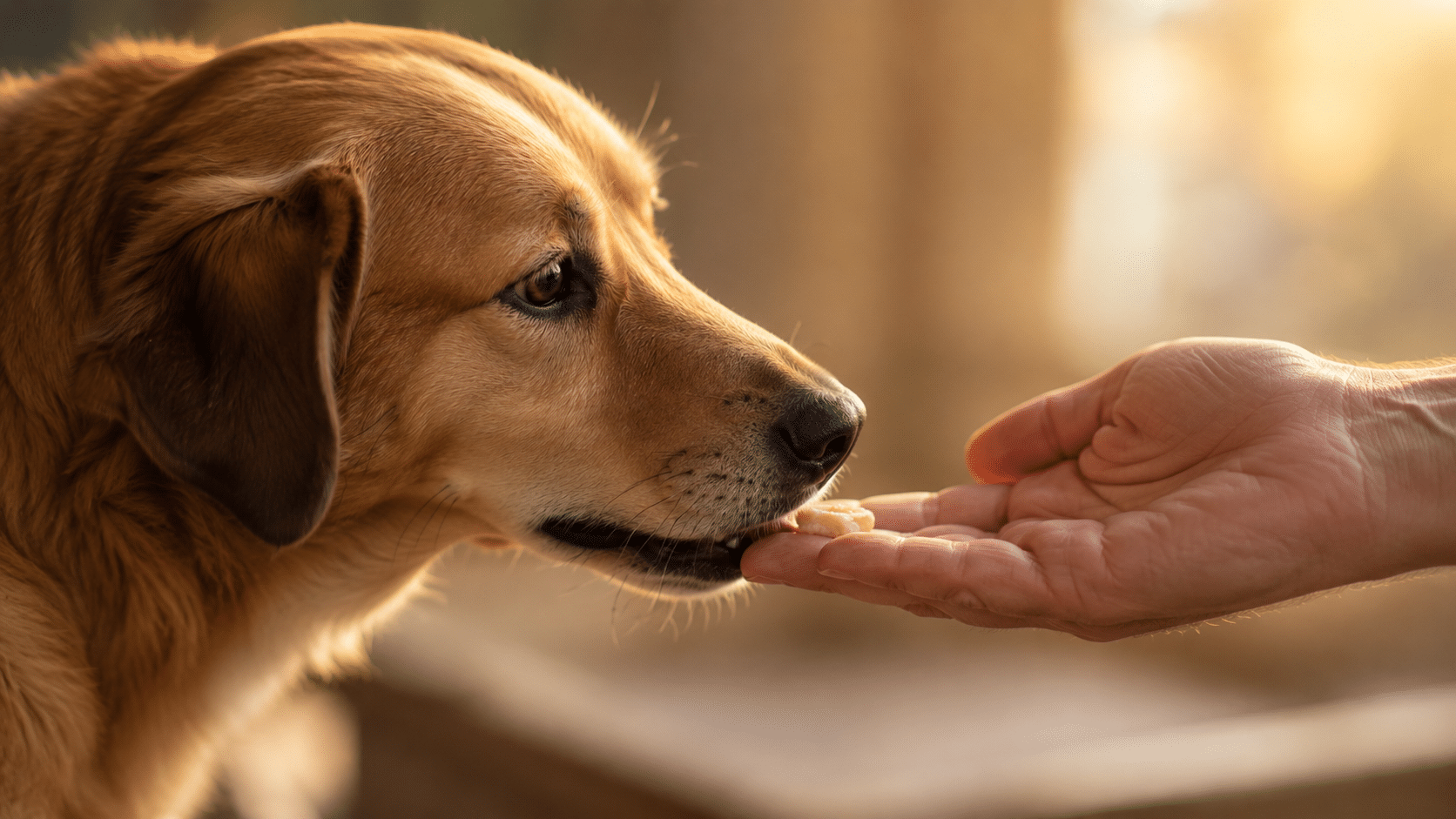
Behavior modification done right is not a quick fix. It is a slow rebuild.
Let me start with something you probably need to hear, even if no one else has said it to you yet. If your dog is reactive, aggressive, fearful, or phobic, you are not failing your dog. Your dog is not broken. Your dog is not dominant. Your dog is not trying to manipulate you, embarrass you, or make your life harder.
Your dog has an emotional system that has learned to expect something unpleasant, and the body is doing what brains and bodies do under threat. That is it. That is the whole story underneath every leash explosion, every panic at the sound of thunder, every growl at the mail carrier, every dog who slinks into the corner when the doorbell rings.
I have spent more than three decades working with these dogs, and the one thing I can tell you with complete confidence is this: you can change how your dog feels. You really can. It takes time. It takes patience. It takes a method that respects what is actually happening inside your dog’s brain instead of fighting against it. But it works. I have watched it work with thousands of dogs, including dogs that other trainers had already given up on, and dogs whose previous trainers had recommended behavioral euthanasia.
This guide is the most thorough resource I have ever put together on classical counterconditioning and desensitization, the gold standard for changing emotional responses in dogs with fear, anxiety, reactivity, aggression, and phobias. I wrote it specifically for pet parents. I wrote it assuming you have no background in behavior science, no training experience, and no idea what half the technical words mean. By the time you finish reading, you will understand what is going on inside your dog’s brain better than the average dog trainer.
I also wrote it as one part of a complete picture. There are other excellent protocols and methods in the force-free, science-based world: Look At That (LAT), Behavior Adjustment Training (BAT), engage-disengage, Leslie McDevitt’s pattern games, and others. Many of these are operant approaches that work beautifully alongside the classical work in this guide. But the foundation, the layer of the cake that makes everything else even possible, is classical counterconditioning and desensitization. That is what you are going to learn here.
A Note on What This Is Not
This guide does not replace a qualified, force-free behavior consultant or veterinary behaviorist, especially for severe aggression or severe noise phobia. Some cases need professional eyes, video review, custom protocols, and sometimes veterinary behavioral medication. The section toward the end on bringing in professional help tells you when. Use this guide as your foundation, and bring in help when you need it.
Part One
The Foundations
Read this section first, in order. Each idea builds on the one before it.
Foundations · One
Why Behavior Begins With Emotion
Behavior, in the dogs we work with, almost always begins here.
Here is the single most important sentence in this entire guide, and I want you to read it twice.
The Core Idea
Behavior change in fearful, anxious, reactive, and aggressive dogs starts with emotional change. Everything else is downstream of that.
If your dog is exploding at the sight of another dog on a walk, you are not really dealing with a barking problem or a lunging problem. You are dealing with a dog whose emotional system has decided the sight of another dog is dangerous, and whose body is now doing exactly what evolution designed bodies to do under threat. Get loud. Look big. Try to make the threat go away. The barking and lunging are the symptoms. The emotion is the engine.
This is why traditional obedience approaches do not solve these problems. You can teach a fearful dog to sit politely while a stranger walks past. You have not, however, changed what the dog feels about the stranger. The moment the structure of the session falls apart, the moment the stranger speaks loudly, or reaches out, or moves quickly, the emotion is still there. And so is the behavior.
If we want real, lasting change, we have to go upstream. We have to work at the level of the emotion, not the level of the behavior.
What Is a Conditioned Emotional Response?
The clinical name for what we are working with is a Conditioned Emotional Response, often shortened to CER. The CER is what your dog feels, automatically and involuntarily, the instant a trigger appears. It happens before your dog has time to think. It is faster than thought, because it is the body responding to a prediction the brain has already made.
Your dog’s brain is, at all times, a prediction machine. That is essentially what learning is. Every experience your dog has had attaches an emotional label to the things, people, places, sounds, and situations involved in that experience. The next time those things show up, the emotional label shows up first.
If the previous experience was unpleasant, painful, scary, or overwhelming, the brain tags the predictor with negative valence. The next time the predictor appears, your dog’s nervous system gets ready for the bad thing before the bad thing has even happened. That is a CER in action. It is the dog freezing when she hears a car door slam, because two months ago a car door slam preceded a panic. It is the dog who lunges at every man in a baseball cap, because a man in a baseball cap once frightened her. It is your dog’s body running an automatic, ancient program to keep her alive.
Why You Cannot Punish or Correct Your Way Out of an Emotion
You cannot tell a dog, “stop being scared.” You cannot correct a dog out of fear, any more than you can correct a person out of a panic attack. You cannot punish anxiety into compliance. The dog is not choosing to be afraid. The body is responding to a prediction the brain made, and that prediction lives in the amygdala and the broader threat-detection circuitry, one of the most evolutionarily ancient and powerful systems in any mammal’s nervous system.
When trainers try to use corrections, leash pops, prong jabs, or electronic stimulation to “stop” a reactive dog, what they are actually doing is layering another aversive event on top of an already aversive prediction. The dog’s brain takes notes. The next time the trigger appears, the dog’s brain says, “here comes that thing, and last time it showed up I also got pain.” The behavior may stop in the short term. The underlying emotion gets worse. Sometimes much worse. We will spend the next section on this, because it is that important.
So What Do We Do Instead?
We change the prediction. That is, in one sentence, the entire job of classical counterconditioning and desensitization. We take a trigger that currently predicts something unpleasant in your dog’s nervous system, and we systematically, patiently, and carefully teach your dog’s brain that the trigger now predicts something wonderful.
Predictability. Safety. Positivity. Those three words describe the emotional experience we are building, repetition by repetition, session by session. When your dog’s nervous system trusts those three things in the presence of a trigger, the behavior takes care of itself. The lunging dissolves. The barking dissolves. The hiding dissolves. Not because we suppressed them, but because we removed the emotional fuel underneath them.
The Takeaway
Every behavior problem rooted in fear, anxiety, reactivity, or aggression starts with an emotion. The clinical name for that emotion is a Conditioned Emotional Response, and you cannot correct or punish it away. You can, however, change it.
Foundations · Two
Why I Will Never Use Punishment, Prong Collars, Choke Chains, or Electronic Collars
Tools the science has moved past.
I want to be direct with you here, because I have been doing this work for over three decades and I have seen what these tools actually do to dogs. This is the section where some people get uncomfortable, and that is fine. I am not here to make you comfortable. I am here to tell you the truth, because your dog cannot read the marketing pages on a prong collar website, and your dog cannot watch the YouTube videos of trainers who say a shock is just a “tap on the shoulder.” Your dog only knows what the dog feels.
The Mechanism: How These Tools Have to Work
For any correction, tool, or aversive stimulus to suppress behavior, it has to function in one of two ways. Either it adds something the dog finds unpleasant in order to reduce a behavior (the technical name is positive punishment), or it removes that unpleasantness when the dog complies (negative reinforcement, also called escape and avoidance learning). Both rely on the exact same underlying mechanism. The dog has to find the stimulus aversive. If the dog does not find it aversive, the tool does nothing.
This produces a cleanly logical either/or, and it is worth sitting with for a moment.
Either the tool is aversive and carries the welfare costs of aversive stimulation, or it is not aversive and is not responsible for the behavior change being credited to it.
The False Dichotomy
There is no magical third category where the tool is unpleasant enough to change behavior but not unpleasant enough to harm the dog. Marketing language about “communication,” “gentle reminders,” or a “tap on the shoulder” does not change the underlying mechanism. Function determines category, not name.
The Second Association Problem
Now think about what aversive correction means specifically for a dog who is already afraid, anxious, frustrated, or reactive.
The trigger already predicts something the dog wants to avoid. The other dog, the stranger, the mail carrier, the doorbell, whatever it is, already makes the dog’s nervous system tighten up. Now you are layering an additional unpleasant event right at the moment the trigger appears. Your dog’s brain, doing what brains do, forms the predictable new association:
When the other dog appears, something painful happens to my neck.
When the doorbell rings, I get a shock.
When that stranger walks in, my person yanks the leash.
And this is where the part most pet parents never see coming becomes painfully obvious once you understand it. The correction does not happen in a vacuum. The leash transmits force directly from your hands. The remote sits in your pocket. The prong collar is on your dog’s neck while you are standing right there on the other end of it. Even though a dog cannot “blame” you in a human, narrative way, the brain is forming exactly that kind of association at the level it forms all associations. Trigger plus pet parent equals pain.
Trust erodes silently. A dog who once looked to you for reassurance now braces when you reach for the leash. A dog who used to settle in your presence now scans, vigilant. Some dogs eventually become reactive or aggressive toward the very person delivering the corrections, because their nervous system has decided this person is now part of the threat picture. None of this is “dominance.” It is a predictable, scientifically explainable consequence of pairing pain with the most important social relationship in your dog’s life.
What the Research Actually Shows
I do not build arguments on single studies. I build arguments on the convergence of evidence across multiple studies, multiple research groups, multiple countries, and multiple disciplines. On the question of aversive training methods and welfare, the convergence is consistent and pointed in the same direction.
Aversive-based training is associated with significantly more stress behaviors during and after training, and dogs trained with these methods score worse across multiple welfare indicators (Vieira de Castro and colleagues, 2020).
Dogs trained with confrontational or aversive techniques show notably higher rates of aggressive responses to those techniques, including aggression directed at their own pet parents (Herron and colleagues, 2009).
Dogs whose pet parents report using two or more aversive methods score as significantly more pessimistic on validated cognitive-bias tests. A pessimistic cognitive bias is one of the most robust markers we have for underlying negative emotional state in animals (Casey and colleagues, 2021).
When electronic-collar training has been compared head to head with reward-based training under controlled conditions, the reward-based group performed at least as well, and often better, without the welfare costs (Cooper and colleagues, 2014; China, Mills and Cooper, 2020).
Comprehensive literature reviews reach the same overall conclusion: aversive methods carry meaningful welfare risks, offer no efficacy advantage, and impose real costs on the human-dog relationship (Ziv, 2017).
This is not one study. This is the convergence of evidence across the entire field. Full citations and tappable DOI links are at the end of this article.
The Quiet Damage of “No”
A sharp verbal “no” delivered at the moment a trigger appears is, functionally, a verbal correction. Done repeatedly, in moments of high arousal, in the presence of a trigger, that word becomes part of the threat picture. It pairs you, the trigger, and the verbal aversive together in the dog’s brain. It is not the same magnitude as a shock or a prong pop, but it operates on the same mechanism. While you are doing counterconditioning, your job is to be the predictor of safety, of food, and of good things. Nothing more. The word “no,” said in that tone, in that context, does not belong in the protocol.
Force-Free Is Not the Softer Choice. It Is the Effective Choice.
I want to push back on a narrative I hear constantly: that force-free, science-based training is somehow soft, permissive, or only for easy dogs. That is not what the evidence shows, and it is not what my experience shows. I work with severe aggression every single week. The dogs in my caseload are not easy dogs. They are the dogs other trainers gave up on. And the methods in this guide are the methods I use to help them.
Force-free, evidence-based behavior modification is the alternative supported by the data. The other option is the one supported by tradition, marketing, and the comfort of trainers who learned a certain way and never updated. Your dog deserves better than that.
The Takeaway
Aversive tools work only if the dog finds them aversive, which means they always carry welfare costs. They also create a damaging second association where you, the pet parent, become tied to the unpleasant event in your dog’s mind. The published research is consistent and clear.
Foundations · Three
Classical Counterconditioning and Desensitization, Explained
Where the work actually happens.
Now we get to the heart of the work. By the end of this section, you will understand the science underneath everything you do in the rest of this guide.
The Two Kinds of Learning You Need to Know About
All learning in dogs, and in us for that matter, falls into two big categories. They are happening all the time, and they are happening together, but they do different jobs.
Classical Conditioning
This is the kind of learning that builds associations. You may have heard of Pavlov, the Russian scientist who noticed that his lab dogs started drooling when they heard the footsteps of the person who fed them, before any food was actually visible. The footsteps predicted the food, so the body started preparing for food the moment the prediction arrived. That is classical conditioning in its simplest form. One thing predicts another, and the body responds to the prediction.
Classical conditioning is the kind of learning that builds emotional responses. If your dog has learned that the leash coming out predicts a walk, your dog gets excited the moment you reach for it. If your dog has learned that men in baseball caps predict pain or fear, your dog gets defensive the moment a baseball cap appears. Both are classical conditioning.
Operant Conditioning
This is the kind of learning that shapes voluntary behavior through consequences. If a behavior produces something the dog likes (food, praise, play, access), that behavior happens more often. If a behavior produces something unpleasant, or simply produces nothing, that behavior happens less often. Operant conditioning is what you are doing when you teach your dog to sit for a treat. Sit produced food, sit happens more.
Both kinds of learning happen at the same time in real life. You almost cannot separate them in any given training moment. But understanding the difference matters, because it tells you which kind of learning you should be aiming at for a given problem.
The Key Distinction
Classical conditioning changes how your dog feels. Operant conditioning changes what your dog does. For fear, anxiety, reactivity, aggression, and phobias, the emotion is the engine. So we work primarily with classical conditioning. Operant tools come in later, as the emotion changes.
Classical Counterconditioning: Rewriting the Prediction
Counterconditioning is exactly what it sounds like. We are conditioning the opposite of what was previously learned. If a trigger currently produces fear, frustration, or aggression in your dog, we set up a deliberate series of experiences where the trigger now predicts something the dog finds wonderful. Practically, that almost always means high-value food.
Food is not arbitrary, by the way. There is a physiological reason we use it. The act of eating with appetite is incompatible with full-blown fight, flight, or freeze response at the body level. A dog who is genuinely chewing, licking, and swallowing is, by definition, not in a maxed-out sympathetic threat state. Food gives us a foothold into the parasympathetic nervous system. It is one of the most powerful and most underappreciated tools in behavior modification.
The mechanism we are using is the same one that built the negative CER in the first place. Classical conditioning. The trigger used to predict something bad, and the dog’s nervous system learned to brace for it. Now, repetition by repetition, the trigger predicts something good, and the dog’s nervous system learns to anticipate it differently. Done correctly, the emotional response actually changes. You will see it in your dog’s body. The soft eyes. The loose mouth. The willingness to look back to you.
Desensitization: Working at an Intensity the Brain Can Handle
Counterconditioning sounds simple in theory. Show the trigger, give the dog food, repeat. In practice, it has one massive prerequisite that most people get wrong, and getting it wrong is the single biggest reason this work fails: the dog has to be able to actually learn during the session.
You cannot rewrite a prediction in a brain that has gone into full threat mode. When the amygdala has taken over, when cortisol and adrenaline are flooding the body, when the thinking, problem-solving prefrontal cortex has gone offline, your dog cannot eat normally, cannot make eye contact with you, and cannot form the new pleasant association you are trying to build. Food refusal is one of the clearest signs you are working too close, too loud, or too intense.
Desensitization is the gradual, systematic process of exposing the dog to the trigger at an intensity low enough that the dog’s threat system does not fully activate. You stay just under that line. The line is called threshold, and it is so important the next section is dedicated to it entirely.
When you put these two together, you have what most behavior consultants call DS/CC. The desensitization gives you a brain that can still learn. The counterconditioning rewrites what that brain learns. The two are inseparable in practice. Without desensitization, counterconditioning has no foothold. Without counterconditioning, desensitization is just repeated exposure, and repeated exposure to something scary can actually make it worse, a phenomenon called sensitization. Done apart, they fail. Done together, they change lives.
Is This the Only Method? No. Is It the Foundation? Yes.
Classical counterconditioning and desensitization is the foundation of behavior modification for emotional issues. It is the bedrock. But it is not the only protocol you will ever hear about, and other approaches can be excellent additions or substitutes depending on the dog and the situation.
You may hear about Leslie McDevitt’s Look At That game (LAT), Grisha Stewart’s Behavior Adjustment Training (BAT), Kellie Snider and Jesus Rosales-Ruiz’s Constructional Aggression Treatment (CAT), engage-disengage games, pattern games, and others. Most of these are operant approaches, which means they work primarily by reinforcing voluntary behavior in the presence of a trigger. They are wonderful tools, and many force-free behavior consultants use a combination of classical and operant methods in a single training plan.
What I teach in this guide is the underlying classical work. It is what you build first, because it changes the emotion, and the emotion is the engine. Once the emotional response starts to shift, layering in operant approaches becomes much easier and much more effective. But you cannot skip the foundation, and that is what we are building here.
The Takeaway
Classical counterconditioning rewrites the emotional response. Desensitization keeps the trigger at an intensity the dog’s brain can handle. Together they form the gold standard for fear, anxiety, reactivity, aggression, and phobia work.
Foundations · Four
Threshold, the Single Most Important Concept in This Process
Enough room to think.
If you remember only one technical concept from this entire guide, I want it to be this one. Threshold is the concept that, more than any other, separates pet parents whose dogs make real progress from pet parents whose dogs stall out, regress, or get worse. The protocol does not work without it.
What Threshold Actually Is
Your dog’s threshold is the point at which the trigger becomes intense enough to push your dog’s nervous system from “noticing, but still able to think” into “reacting, no longer able to think.” Below threshold, your dog can see, hear, or otherwise perceive the trigger, but the threat system is staying manageable. The dog can still take food. The dog can still glance at you. The dog can still learn. Above threshold, all of that is gone. The amygdala has hijacked the system, the prefrontal cortex has gone quiet, and what your dog does next is automatic, not chosen.
Pet parents often picture threshold as a single line, like a tripwire that fires when a dog hits a certain distance. The reality is a little more nuanced. Threshold is influenced by many things at once: distance, intensity, novelty, duration, movement, what else happened that day, how the dog slept, even the weather. Threshold is real, it is measurable in your dog’s body, and it tells you where the work happens.
Sub-Threshold Is the Working Zone
We do almost all classical counterconditioning just below threshold. This is the place where your dog notices the trigger but is not yet overwhelmed by it. Body language is alert but soft. Eating is normal. Re-engagement with you is possible. This is the only zone where real counterconditioning happens.
Many pet parents come in thinking the goal is to keep their dog from noticing the trigger at all. It is not. If your dog never notices the trigger, the brain has nothing to re-pair the food with. We do want your dog to notice. We just do not want them to be overwhelmed by what they notice. We want a dog who sees the trigger and stays connected enough to learn from the experience.
Over Threshold Is Not Training. It Is Damage Control.
Once your dog crosses threshold, the counterconditioning session is functionally over. Anything you do beyond that point is not training. It is damage control. Continuing to push food at a dog who has tipped into reactivity does not counter-condition the trigger. At best it does nothing. At worst, you are pairing the food with the panic state, and over many repetitions, you can actually condition the food to predict panic.
The correct response when your dog goes over threshold is immediate. Calmly increase distance. Lower the intensity. Get out of there. Make it easier. You are not failing when this happens. You are gathering information. Your dog has just told you, in the clearest way possible, that this particular setup was too much.
How to Know You Are Over Threshold
There are several signs, and most of them are unmistakable once you know what to look for.
Your dog will not take food, or grabs food in a sharp, snatchy way.
Your dog cannot disengage from the trigger. The eyes lock on, and stay locked on.
Your dog cannot make eye contact with you, even when you say their name.
Body language shifts hard. Stiff posture. Closed mouth. Tail held abnormally high or low.
If you see any of these, the trigger is too intense. Increase distance, lower volume, change angle, or simply leave the situation. You have not lost the day. You have gained data.
The Working Rule
If your dog cannot eat normally, cannot disengage from the trigger, or cannot look at you when you say their name, your dog is over threshold. Get further away. Lower the intensity. Reset. Then start the next session at a slightly easier setup than the one that failed.
Threshold Is Not Fixed. It Moves With You.
Here is one of the encouraging things about this work. Your dog’s threshold is not a fixed property. It is a state. It changes with training. It changes with stress level. It changes with what happened earlier in the day. Over months of correctly applied classical counterconditioning, it shifts in the direction you want. The trigger that used to set off your dog at fifty feet may eventually be tolerable at twenty, then ten, then five. The volume of fireworks that used to trigger panic at recording-level four may eventually be tolerable at recording-level eight. That is the work. That is the change you are building.
Threshold can also move in the wrong direction on bad days. A stressful event earlier in the morning, a poor night’s sleep, a recent flare-up of medical pain, all of these will lower your dog’s threshold temporarily. We will talk about this more when we cover trigger stacking. For now, just know that threshold is dynamic, not static, and your job is to be honest with yourself about where it is on any given day.
The Takeaway
Threshold is the line between a brain that can learn and a brain that has gone offline. Almost all of your real work happens just below it. If you cross it, the session is over and you adjust.
Foundations · Five
Reading Your Dog, a Body Language Primer
The look away is a whole sentence.
You cannot work threshold accurately if you cannot read your dog. This is the skill most pet parents need to develop most urgently, and the one that pays back the most. Your dog is talking to you in continuous, fine-grained detail. Most of that communication happens long before the barking, the lunging, or the growling. By the time the obvious behavior starts, you have already missed five or six earlier signals.
I tell pet parents to learn the early stuff. The whisper, not the shout. If you respond to the whisper, you rarely have to hear the shout.
The Early, Subtle Stress Signals
These are the signs that your dog is noticing something and beginning to feel uncomfortable. They are easy to miss because they are small and brief. Train yourself to see them, and you will start spotting stress in your dog you never knew was there.
Lip licks. A quick flick of the tongue, often when nothing is being eaten.
Yawns out of context. Not tired, not just waking up.
Head turns or whole-body turns away from the trigger.
Sniffing the ground suddenly when there is nothing especially interesting to sniff.
Shaking off as if wet when your dog is bone dry.
Slowed movement, freezing in place for a beat, or accelerated, jittery movement.
Wider eyes with more white showing at the corners, sometimes called whale eye, often visible at the caudal canthus.
Mouth shifting from loose and slightly open to closed and tense.
A subtle shift of the commissure (the corner of the mouth) forward into a hard, tight line, or pulled far back.
Pupils dilating, ears repositioning forward into hard alert or back and low into appeasement.
Tail position shifting higher and stiffer, or tucking lower than usual.
Piloerection (raised hackles) along the shoulders, spine, or hips.
Any one of these on its own may mean nothing. Two or three of them clustering together as a trigger comes into view is a clear sub-threshold signal. That is the exact moment we want to be doing the work. That is the window.
Distance-Increasing Signals
When the early signs are ignored or the trigger keeps closing in, dogs escalate to behaviors designed to make the trigger go away. A growl is one of the most useful signals your dog can give you. It is honest, it is clear, and it is non-injurious. Punishing a growl teaches your dog that warning does not work, and only sets you up for a dog who skips straight to a bite. Never punish a growl. Listen to it. Your dog is telling you the trigger is too close or too intense.
Hard, sustained stare with stiff body.
Growl, low or rising.
Lip lift, showing teeth.
Air snap or muzzle punch.
Lunging, barking, snapping, biting.
Once a dog is in this escalation range, you are at or past threshold. Get out. Make it easier next time.
Fear Versus Arousal
Not every reactive dog is afraid. Many dogs cross threshold because of frustration or over-arousal rather than fear. The body language overlaps but is not identical.
Aroused, frustrated dogs are often loose in the front end, hyper-mobile, with a forward-leaning weight shift and a tail held high and fast. Fearful dogs more often show a weight shift backward, lower body posture, tucked tail, ears back, and attempts to retreat. Some dogs flip between the two, especially on leash. A dog who really wants to greet another dog but cannot reach because of the leash can look almost identical to a fearful dog from a distance.
The protocol is fundamentally the same for both fear and frustration. You still work sub-threshold, you still pair the trigger with food, and you still go slow. The threshold itself may be set by a different mix of variables, and the reinforcer you choose may need to be calmer for arousal-driven dogs.
Watch the Whole Dog, Not Just One Part
One of the most common mistakes pet parents make is reading a single body part instead of the whole picture. A wagging tail does not mean a happy dog. A wagging tail means an aroused dog. The wag could be paired with stiff legs, a closed mouth, and a hard stare, in which case the wag is part of an escalation, not a greeting. The opposite is also true. A loose, full-body wiggle with a soft mouth and squinty eyes is a very different message from a high, stiff tail and a forward weight shift, even though both technically involve a wagging tail.
Train your eye on the whole picture: posture, weight distribution, mouth, eyes, ears, tail, breathing, and movement quality. Watch dozens of dogs at a distance with this lens. After a few weeks, your eye will sharpen, and you will start seeing things you never noticed before. Your own dog will become a much clearer communicator to you. That is one of the quiet gifts of this work.
The Takeaway
Learn the early, subtle signals. Respect the growl. Watch the whole dog, not isolated parts. Spot the moment your dog notices a trigger but still has access to the thinking brain. That is the window where the work happens.
Foundations · Six
The Trigger Has Many Faces, It Is Not Just Distance
Distance is one variable. There are many.
When pet parents start working sub-threshold, they often default to distance as the only variable. Distance matters, often a lot, but it is one variable in a system of many. If you only adjust distance, you will run out of room very quickly and miss easier ways to soften the trigger. Every trigger has multiple components, and we can almost always dial down at least one of them to find a workable starting point.
Walk through this list every time you set up a session. Ask yourself which version of the trigger your dog could actually tolerate today.
Distance
How far away is the trigger? The further away, the lower the intensity for most dogs. Distance is your single most useful lever for visual triggers, but it is also the one most pet parents over-rely on.
Intensity or Magnitude
How big, how loud, how fast, how unpredictable is the trigger? A small dog at twenty feet is a different trigger than a Great Dane at twenty feet. A jogger at twenty feet is a different trigger than a person walking calmly at twenty feet. A child shrieking at thirty feet is a different trigger than a quiet adult at thirty feet. Intensity often matters more than distance, and you can sometimes get a much easier session by choosing a lower-intensity version of the trigger at the same distance.
Duration
How long is the trigger present? A car that passes in two seconds is easier than a car that idles in your driveway for two minutes. Brief, controlled exposures are almost always easier to work with than sustained ones. If you can shorten exposure, do it.
Movement and Direction
A trigger moving toward your dog is dramatically more intense than the same trigger moving away or moving laterally. A trigger that is stationary is often easier still. When in doubt, set up so the trigger is moving away from your dog, or perpendicular, not toward.
Novelty Versus Familiarity
A new unfamiliar dog is more intense than the neighbor’s dog your dog has seen daily. A new sound is more intense than a familiar one. You can sometimes find a workable starting point simply by selecting a more familiar version of the trigger.
Number of Triggers
One trigger is one trigger. Two triggers stacked is not double, it is often multiplicative. A dog who can handle one approaching person at twenty feet may completely come apart at two approaching people at thirty feet. Working dogs in environments with multiple potential triggers is much harder than working a single, predictable one.
Environmental Context
A trigger in a quiet park is a different trigger than the same trigger on a noisy street. Surfaces underfoot, lighting, smells in the air, traffic, ambient noise level, and how trapped your dog feels (narrow sidewalk versus open field) all matter. Choose your environments deliberately.
Your Own State
This one surprises pet parents. Your tension travels down the leash and into your dog’s nervous system. Held breath, tight grip, raised voice, leaning forward, all of these push your dog’s arousal up. Loose leash, relaxed shoulders, steady breathing, and a low, calm voice push it down. You are part of the trigger picture, for better or for worse.
Trigger Stacking: Why Yesterday’s Work Sometimes Falls Apart Today
Stress hormones do not reset in minutes. They take hours, sometimes a full day or more. A dog who had a hard encounter on Monday morning has a lower threshold for everything else for the rest of Monday, and sometimes into Tuesday. Pet parents are constantly surprised by what looks like sudden regression. The dog was doing great last week. Why is the dog falling apart today?
The answer is almost always trigger stacking. Multiple smaller stressors piling up across hours or days, none of them individually big enough to cause a problem, but adding up to a saturated nervous system that has nothing left in the tank. The list of things that can stack is longer than most pet parents realize: a hard vet visit, a stressful walk, a noisy day in the neighborhood, a missed nap, a new household stressor, hormonal changes, ambient barometric pressure changes, even the trainer or behavior consultant’s session itself. All of those add up.
If your dog has just had a tough event, that is not the day for a training session. Recovery is the work on those days. A long sniff walk in a quiet place, a chew session at home, decompression time. Stress hormones need to clear. Pushing through is not training. It is digging a hole. I wrote about this at length in my book Sniff to Soothe, because scent work is one of the most powerful decompression tools we have.
Take-Home Idea
Distance is rarely the only thing you can adjust. Before you give up on a setup, ask: can I shorten the duration, decrease the intensity, choose a calmer environment, work with stationary instead of moving, or pick a more familiar version of the trigger? You almost always have more options than you think.
Foundations · Seven
Your Counterconditioning Toolkit
The tools of trust.
Before we get into the protocol itself, let me walk you through the equipment. The tools are simple and inexpensive, but how you use them matters. There are reasons I choose each of these. I want you to understand the reasons, not just copy the list.
A Clicker, or a Conditioned Verbal Marker
A marker is a signal, a brief, clear cue that tells your dog the exact instant they got it right. It is a bridge between behavior and reinforcement. The marker lets your dog know, “yes, that was it,” even before the food arrives.
In classical counterconditioning, the thing we are marking is not really a behavior in the obedience sense. It is the moment of noticing the trigger without flipping into reactivity. The instant your dog’s eyes find the trigger and the body stays loose, we mark, then we feed. The mark turns a fuzzy, hard-to-time event into a precise one. Precision is what changes emotion.
I prefer a clicker for this work. A clicker is acoustically distinct, it sounds exactly the same every time, and it carries no emotional content from your voice. Your “yes” on a hard day sounds different than your “yes” on a good day. A click is a click. Dogs respond beautifully to that consistency. For pet parents whose hands are too full for a clicker, a calm, neutral verbal marker like “yes” works as long as you keep it consistent.
Why I Use a Clicker
Sharper, faster, and far more consistent than a verbal marker. The dog’s brain hears the same sound every time, in any tone of voice, on any day. That consistency is exactly what classical conditioning needs.
High-Value Food
For counterconditioning, your dog’s ordinary kibble is rarely enough. The reinforcer has to be something your dog finds genuinely wonderful, not merely acceptable. The point is to create a strong positive emotional value that the trigger will eventually predict.
Soft, meat-based training treats with low crumb so they go down fast.
Food paste or wet food in a squeeze tube.
Save these special foods for counterconditioning sessions. They are not table scraps. They are clinical-grade reinforcers, and they retain their special status only if you reserve them for the work.
Food Paste and the Squeeze Tube
Food paste, delivered from a refillable squeeze tube or a silicone squeeze bottle, is one of the most useful pieces of equipment in this entire protocol, and most pet parents have never heard of it.
For dogs prone to arousal, the way the food is delivered matters as much as the food itself. Tossed treats, fast hand-fed treats, and high-velocity delivery push arousal upward. A dog who is already a hair under threshold and then gets a frenzied stream of small treats can end up tipping over the edge from the reinforcement itself.
Licking, by contrast, is a calming behavior. The act of sustained licking activates the parasympathetic nervous system, slows breathing, lowers heart rate, and produces a measurable shift toward calm. We use this to our advantage. A dog who is licking paste from a tube during a controlled exposure to a trigger is, physiologically, doing something incompatible with full sympathetic threat response. The licking helps regulate the dog while the trigger is being re-paired.
Practical Points for the Squeeze Tube
Fill with a soft, pasty food your dog loves. Liver paste, salmon paste, plain canned dog food, plain yogurt with a meat topping, soft cheese, or commercial training pastes all work well.
A silicone refillable tube, often sold as a camping food tube or baby-food pouch, is washable and reusable. You can also use small purpose-built training pouches.
Keep one tube in the freezer for hot weather and one in the refrigerator for everyday work. Cold paste flows more slowly, which can be useful for very aroused dogs because slower delivery means longer licking time.
Hand your dog the nozzle when the trigger appears. Allow several seconds of licking, then withdraw the tube when the trigger leaves the scene.
For reactive and aggressive dogs, calm is not just a goal. It is a vehicle.
Equipment You Should Not Use
Just as important as what you should use is what you should avoid. While doing classical counterconditioning, do not use:
Prong collars, choke chains, or pinch collars.
Electronic collars (shock collars, e-collars, stim collars, bark collars), regardless of how the brand markets them.
Slip leads tightened around the upper neck.
Head halters used with leash corrections (head halters can be fine as a tool for safety, but never with corrections).
Any tool that delivers an unpleasant consequence when the dog reacts.
Standard equipment for this work is a flat collar or a properly fitted Y-front harness, a six-foot leash (longer is fine in open spaces), a treat pouch on your hip, a clicker around your wrist, and a paste tube in your dominant hand if you are using one. That is the entire kit.
Foundations · Eight
How to Condition Your Marker
The smallest tool. The largest leverage.
Before your marker can do its job in a counterconditioning session, your dog has to learn what it means. We do this through a separate, dedicated little exercise in a quiet room, with no triggers around. It takes only a few minutes a day for a few days, and it is the foundation everything else rests on. If you skip this step, the rest of the protocol does not work as cleanly. So please, do not skip it.
How to Condition a Clicker (or Verbal Marker)
Get a small bowl of high-value treats, your clicker, and your dog. Sit somewhere quiet, no distractions. No television, no kids running through, no other dogs.
Click your clicker once, in a calm and neutral way. Do not look at your dog. Do not say anything else. Just click.
Immediately, within half a second, deliver a small treat to your dog.
Pause five to ten seconds. Do nothing. Let the moment settle.
Click again. Treat again. Pause again.
Repeat for ten to fifteen reps. End the session. Come back later or the next day for another set.
You are not asking for a behavior. You are not waiting for your dog to do anything in particular. The click predicts food, period. This is pure classical conditioning. After two or three short sessions, your dog will perk up the instant they hear the click, looking for the treat. That is the sign that the marker is conditioned. Now you have a tool you can use anywhere.
If you are using a verbal marker like “yes” instead of a clicker, the process is identical. The word predicts food, every single time, in exactly the same neutral tone. Do not contaminate the word by also using it casually around the house.
Common Mistakes in Marker Conditioning
Skipping reps. Ten to fifteen quality reps over a couple of days is the minimum.
Asking for a behavior. We are not training sit yet. Just click and feed.
Inconsistent tone, if using a verbal marker.
Long delays between click and treat. The treat must follow within half a second.
Treating before clicking, or simultaneously. The order matters. Click predicts treat.
How to Tell the Marker Is Conditioned
After a few short sessions, click your clicker when your dog is not paying particular attention to you. The instant your dog hears the click, what happens? If your dog’s head whips toward you, ears forward, eyes bright, expecting a treat, the marker is conditioned. You have built a small but powerful predictor in your dog’s nervous system. That predictor is going to do real work for you.
Foundations · Nine
The Step-by-Step Counterconditioning Protocol
The work itself.
Now we are ready for the work itself. This is the protocol you will run, with adjustments for setup, for every trigger your dog has. Read it through twice before your first session. Once it is in your bones, you will run it automatically.
Step One: Setup
Choose the trigger you are going to work on. Be specific. Not “dogs.” This particular kind of dog (size, color, breed type, body language type), in this particular kind of environment.
Choose an environment where you can control the trigger’s appearance. A park where dog-walking is predictable. A quiet street near a school where a friend can walk a calm dog past on cue. A driveway where you can stage controlled passes.
Identify your dog’s working distance, intensity, or volume. This is where, after walking through the trigger components, you have a setup your dog can notice but not be overwhelmed by. If you have never tested this, start with what you believe is far too easy and work back from there.
Prepare your gear. Clicker around your wrist. Treats in a pouch on your hip, or paste tube in your dominant hand. Leash short enough for safety, long enough not to be tight. A flat collar or a Y-front harness. No prong, no choke, no e-collar, ever.
Bring water. Bring something for you. These sessions can be longer than you think.
Step Two: The Core Sequence
Here is the heart of the protocol. Burn this into memory.
That order is not arbitrary. Each piece has a job.
Trigger appears first. Your dog notices the trigger before anything else happens. The trigger is the predictor. Predictors must come first.
You mark immediately, the instant your dog’s eyes find the trigger while the body is still soft. Click, or say “yes,” in a calm tone.
Food follows the mark, within a second. If you are hand-feeding, deliver a piece. If you are using paste, present the tube and let your dog lick for a few seconds.
Trigger continues to be present. Food continues to be delivered, intermittently or continuously, depending on the dog and the setup.
Trigger disappears. The food stops, cleanly. The tube goes away. Hands stop dispensing.
Step five is the part most pet parents skip, and it is the part that does the most work. The trigger has to predict the food. That requires the food to also stop when the trigger stops. If you keep handing out treats after the trigger has left the picture, you blur the prediction. Your dog’s brain has a harder time learning that the trigger specifically is what makes the food happen.
Step Three: Session Length and Repetitions
Short and frequent beats long and infrequent. A typical session is five to ten minutes of real working time, with perhaps eight to fifteen trigger presentations. If your dog can only manage three presentations before getting tired or jittery, stop at three. Three good repetitions are worth more than ten sloppy ones.
Plan to do this several times a week, sometimes daily if you can stage the setup. Consistency matters more than volume. Your dog’s brain needs time between sessions to consolidate the learning, and your dog’s body needs time to clear stress hormones from any near-threshold moments.
Step Four: Ending the Session
End on a good rep. Always. Before your dog gets tired, before the trigger gets too intense, before anything goes wrong. Pet parents often try to squeeze in one more rep, and the one more rep is almost always the one that pushes things over threshold. Resist this.
After the session, give your dog a chance to decompress. Sniffing is one of the most powerful decompression tools we have. A leisurely sniff walk in a calm environment after a counterconditioning session helps your dog’s nervous system come fully down.
A Common Question: What If My Dog Will Not Take Food at All?
If your dog will not take food in the presence of a particular trigger, it is almost always because you are too close, the intensity is too high, or your dog is already trigger-stacked. Three options:
Increase distance dramatically. Sometimes that means moving until you can barely see the trigger, then trying again.
Decrease intensity. If you cannot increase distance, find a quieter, slower, or smaller version of the trigger.
End the session. Walk away. Try again tomorrow with a setup at least one notch easier than the one that failed.
A dog who will not take food is not being stubborn. The dog is over threshold. The right response is to make it easier, not to push through.
Foundations · Ten
How to Know When to Make It Harder
This is what change looks like.
This is one of the most common questions pet parents ask, and one of the easiest places to go wrong. Going too fast is the single most reliable way to wreck the work you have just done. Going too slow rarely causes problems. When in doubt, go slower than you think you need to.
The Conditioned Emotional Response Check
Here is the marker that tells you progress is real. When the trigger appears at the current working level, your dog should turn to you for the food before the click. Your dog has learned the contingency. Trigger predicts food, so trigger now triggers expectation of food. You will literally see your dog’s head swing from the trigger to your hand, with a soft face and a wagging or relaxed tail.
When you see this consistently, across multiple sessions, across different days, with relaxed body language and clean food acceptance, that is the green light. You can now make the trigger slightly harder.
The Pavlovian Tell
When your dog sees the trigger and immediately looks to you with happy anticipation, the CER is changing. That look is the most important signal in this entire process. It tells you the prediction has flipped.
How Much Harder?
Small steps. Move five feet closer, not twenty. Add one new variable at a time, not three. The principle is to keep the new setup easy enough that your dog can still produce the same calm, food-engaged response. If your dog regresses, you went too far too fast. Back up.
A realistic progression on a typical case might look like this:
Week one: trigger at sixty feet, stationary, brief duration, in a quiet environment.
Week two: trigger at fifty feet, stationary, longer duration, same environment.
Week three: trigger at forty feet, slow lateral movement, same environment.
Week four: trigger at thirty feet, slow movement away, in a slightly busier environment.
Week five: same as week four with two reps where the trigger moves laterally toward and then away.
These are illustrative numbers only. Your dog will dictate the actual pace. Some dogs move faster than this. Many move slower. Both are fine. There is no prize for finishing early. The prize is a dog whose emotional life with the trigger has actually changed.
What Regression Looks Like, and What to Do
Regression is normal. Most dogs do not progress in a straight line. You will have days where your dog has a setback, refuses food, or reacts at a distance they were handling well a week ago. The most common cause is something outside your session. A stressful event earlier in the day. A bad night’s sleep. A new household stressor. A medical issue brewing. Stress is cumulative, and stress accumulation is invisible until it tips you over.
When you see regression, do three things, in this order:
Back up to a level your dog can handle. Make the setup easier. Distance further, intensity lower, duration shorter.
Audit recent days. Has anything else been hard? A vet visit, a thunderstorm, an unfamiliar guest, a flare-up of joint pain, a heat cycle, a new puppy in the home?
Give your dog a recovery period. Sometimes the right response is two or three days of low-key sniff walks and rest, with no working sessions at all.
The Takeaway
Advance only when your dog is consistently showing the Pavlovian tell at the current setup. Advance in small increments. Audit recent days when you see regression, and respect the role of trigger stacking and recovery.
Part Two
Real-World Scenarios
Find your dog. Apply the protocol. The principles transfer across triggers; only the setup changes.
Scenarios
If Your Dog Is Reactive to Other Dogs on Leash
The walk you've been waiting for.
This is the single most common case I see. The walk that should be the best part of your dog’s day has become the worst part of yours. You spot another dog half a block away, and you brace. You scan side streets for escape routes. You time your walks for 5 a.m. so you do not have to see anyone. If that is your reality, you are in the right place.
What You Are Probably Seeing
Leash reactivity to other dogs usually shows up as some mix of barking, lunging, growling, whining, hackles up, and pulling so hard that the leash is doing the work of a brake cable. Some dogs add air-snapping. Some try to retreat. Some flip between forward and backward as their nervous system tries to pick a strategy.
What Is Probably Driving It
The two most common emotional drivers are fear and frustration, and they often coexist in the same dog. Fearful dogs are trying to make the other dog go away. Frustrated dogs want to greet but cannot, and the leash itself becomes a source of conflict.
If your dog plays beautifully off leash but explodes on leash, frustration is probably a big piece. If your dog avoids other dogs even off leash, fear is more likely. If your dog has a bite history with other dogs, treat it as fear-based aggression until proven otherwise, and please bring in professional support.
Setup for a First Session
Pick a location where dogs walk past predictably. A bike path, a sidewalk near a dog park, the parking lot of a busy pet store. Do not go inside. Stay on the outskirts where you can control distance.
Find your working distance. Start much further away than you think you need to. For many reactive dogs, this is fifty to one hundred feet on day one.
Position yourself perpendicular to the path the other dog will travel. Trigger moving away from you, or laterally, is much easier than trigger moving toward you.
Have your clicker, treats, and paste tube ready before you even arrive.
Running the Protocol
When a dog appears at your working distance, the instant your dog’s eyes find that dog, click and feed. If your dog is calm and engaged, you can shift to the paste tube for the duration of the trigger’s presence. The instant the trigger leaves the visual field (passes a tree, rounds a corner, walks far enough away), the paste comes away. Food disappears. Reset.
If your dog reacts at all (stiffens, hard stare, vocalizes), the distance is too close. Move further away immediately. Do not yank, do not say “no,” do not correct. Just create distance, calmly, and let your dog reset.
Common Variations and Complications
On-leash to off-leash dogs: an off-leash dog approaching your on-leash dog is one of the worst triggers in this category. If you are working in a park where this happens, scout the area first and have an exit plan.
Specific breed or size triggers: many leash-reactive dogs are not reactive to all dogs equally. They may be fine with small dogs and explode at large ones. Treat each subset as its own working trigger if needed.
Reactivity that only appears on certain streets: your dog may have a learned association with a specific dog that lives there. Treat the location itself as a contributing trigger.
Tools to Pair With This Work
Once the CER starts to shift, you can layer in operant approaches: Look At That (LAT), engage-disengage, or a pattern game like Leslie McDevitt’s 1-2-3. These are not substitutes for the classical work. They are layers you add on top once the emotional response is no longer hijacking everything.
Scenarios
If Your Dog Is Aggressive Toward Other Dogs
Safety is part of the work.
There is a meaningful difference between leash reactivity and true dog-dog aggression, even though the surface behavior can look similar. Reactivity is a loud distance-increasing display. Aggression is the intent and capacity to make contact with damage. Many dogs do both at different times. If your dog has a bite history with another dog (any history, even a single incident), you are working with a higher-stakes case.
Read This Before You Do Anything Else
Safety: A reactive or aggressive dog should be muzzle-conditioned. A basket muzzle (such as a Baskerville) that allows full open-mouth panting, drinking, and treat-taking is not a punishment. It is a piece of safety equipment, and it lets you work in places you otherwise could not. The Muzzle Up Project has excellent free resources on positive muzzle conditioning.
Management: While you are working, your dog should not be put in situations where another aggressive incident can happen. Every incident sets the work back. Manage the environment carefully. Walk in low-traffic areas, at low-traffic times, with eyes constantly scanning for surprises.
Professional support: For dogs with a meaningful bite history toward other dogs, please work with a qualified force-free behavior consultant or veterinary behaviorist alongside this guide.
The Protocol Is the Same. The Stakes Are Higher.
The good news is that the underlying behavior modification is identical. Classical counterconditioning works on dogs with aggression, including severe aggression. I have used it on dogs that other trainers recommended euthanizing, and I have watched those dogs become functional, even if not always fully “social” in the ordinary sense.
What changes with aggression cases:
Working distances are much greater on day one. Often two hundred feet or more for some dogs.
Pace is slower. Plan months, not weeks.
Trigger stacking matters more. Recovery days are even more important.
Medication, prescribed and managed by a veterinarian or veterinary behaviorist, is often part of the picture. Anti-anxiety medication does not “drug your dog into compliance.” It changes the underlying neurochemistry enough that learning becomes possible. For some dogs, medication is the difference between making progress and spinning your wheels.
Realistic Outcomes
I want to be honest with you. A dog with serious dog-dog aggression rarely becomes a dog you can take to a dog park. That is not the goal. The goal is a dog who can pass another dog at a manageable distance without reacting, who can walk in public spaces, who can be safe to live with, and who can have a good life. Many aggression cases reach this goal. Some surpass it. Some require lifelong management. All of them can be improved with the right work, the right team, and the right expectations.
Scenarios
If Your Dog Is Reactive or Fearful of Strangers on Walks
Yellow asks for space.
Stranger reactivity on walks is its own animal. The trigger is people, not dogs, and people are surprisingly hard to control. They wave. They call out, “hi puppy.” They reach in. They make eye contact. They run at your dog with their child in tow asking, “can we pet your dog?”
What Is Probably Driving It
Most stranger-reactive dogs are fearful, not aggressive in the predatory sense. The dog’s nervous system has decided that strangers are unsafe. Common contributing factors: a poor early socialization period, a frightening experience with a stranger at some point, undersocialization to specific kinds of people (men with beards, people in uniforms, people in wheelchairs), or general anxiety that makes new humans intolerable.
Setup
Pick a location with predictable foot traffic but enough space to control distance. Quiet neighborhood streets, the perimeter of a park, the outside of a strip mall.
Find your working distance. Many stranger-reactive dogs need fifty to one hundred feet to start.
Choose strangers you can control if possible. Recruit friends to be stooges. Have them walk past at a predetermined distance, not making eye contact with your dog, not reaching out, not speaking.
If you must use uncontrolled strangers, position yourself well off the path. Have a clear escape route in case someone approaches.
The Hard Part: When Strangers Will Not Stay Where They Belong
Strangers do not respect your training plan. They will approach. They will reach. They will say things. Here are tools for managing this in the real world:
A bright yellow leash, vest, or bandana with the words “in training” or “do not pet” signals strangers to stay back. It works more often than you would expect.
A polite verbal script ready to deploy: “we’re working on a behavior plan, please don’t engage with my dog.” Practice it. Use it without apology.
Position yourself between your dog and the stranger. Your body is a barrier.
If someone closes the distance against your wishes, calmly move your dog further away. Do not let strangers force you into a session you did not plan.
Scenarios
If Your Dog Is Fearful or Reactive to Guests at Home
Management makes guests possible.
This is one of the highest-stakes scenarios because it happens in the place your dog should feel safest, and it often involves people you love. The doorbell rings, your dog explodes, your guests are uncomfortable, and you feel terrible.
What Is Probably Driving It
Home-guest reactivity is almost always a combination of territoriality, fear, and over-arousal at the doorbell and entry routine. The doorbell itself, the knock, the hand on the doorknob, the door opening, the new human entering, and the social interactions that follow are all potential triggers. They stack together every single time a guest arrives.
Break the Trigger Into Pieces
Trying to counter-condition “guest arriving” as one trigger is too big. You break it into components and work them separately, then chain them back together.
The doorbell as a sound. Use a recording at low volume to build a positive CER to the bell itself.
The knock as a sound. Same approach.
The sight of someone at the door, with no entry attempt.
Someone entering the home, with no interaction with the dog.
Someone in the home, sitting calmly, with the dog at distance.
Eventually, someone in the home interacting normally with you, ignoring the dog.
Setup for Live Guest Sessions
Recruit a willing friend who will follow your instructions. Brief them. They are not visiting socially. They are helping you train.
Set up management. Your dog is behind a baby gate, in a crate they love, or on leash with you. Your dog cannot rehearse the reactivity sequence during the session.
The friend arrives, comes in, sits down, ignores the dog. You feed your dog continuously while the friend is visible.
Sessions are short. Five to ten minutes of actual exposure work, then guest leaves or goes elsewhere for decompression.
Critical Rule
Guests do not feed your dog. Guests do not look at your dog. Guests do not speak to your dog. Guests do not reach for your dog. Not in early sessions, not in middle sessions, not until your behavior consultant tells you so, or you have months of solid progress and your dog’s body language is consistently relaxed.
Scenarios
If Your Dog Is Fearful of Children
The work begins far away.
Children are a uniquely difficult trigger because they move unpredictably, vocalize at unusual pitches, have less impulse control around dogs, and are more likely to do things adults would not (lunge, grab, hug, scream). I treat this combination with great care, because the consequences of getting it wrong include bites that can permanently scar a child’s face and end a dog’s life.
A Safety Conversation, First
Adults supervise every single interaction. “The dog has never bitten” is not a safety plan. Many first bites happen during what adults thought was supervised play.
Teach your children dog body language at an age-appropriate level. The Family Paws Parent Education resources are excellent.
Use management. Baby gates. Crates. Separate rooms. Tethering. Whatever it takes to make sure your dog and children cannot have an unsupervised meeting.
If your dog has growled at, snapped at, or bitten a child, work with a qualified force-free behavior consultant immediately. This is not a DIY situation.
The Counterconditioning Work
Same protocol. The setup is the challenge. Where do you find calm, stationary, predictable children to work with?
Outside elementary schools at drop-off or pick-up time, from a long distance, parked in your car or at the edge of a parking lot.
Outside playgrounds, again from a long distance with a clear line of sight.
In your own neighborhood at predictable times when children walk to school or ride bikes.
With recruited helpers (friends with children) who will follow strict rules: stationary, not approaching your dog, not making noise.
Realistic Goals
Many fearful dogs can become tolerant of children at a distance. Fewer become dogs that you would trust unsupervised with children, and that is not the goal anyway. The goal is a dog who can be calmly present in a household or neighborhood that has children in it, who can be safely managed during family visits, and who does not feel like a threat is in every room.
Scenarios
If Your Dog Reacts to Bicycles, Skateboards, Scooters, or Joggers
Speed is just another variable.
Fast-moving humans on wheels or on foot are a triggering category all their own. The combination of speed, height, sound (especially with skateboards), and unpredictability tends to push dogs over threshold faster than slow-moving people do. Some dogs have a fear response, some have a prey-drive response, and some have both.
What Is Probably Driving It
Fear: the speed and noise of the trigger are overwhelming, and the dog is trying to make it go away.
Prey drive: the movement triggers a chase response. This is more common in herding and sighthound breeds, and it can look very different from fear (excitement, hard staring, low forward posture, sometimes silent).
Frustration: the dog wants to engage with the trigger (chase it, run with it, greet it) but cannot. The leash itself is part of the trigger picture.
Running the Protocol
Same core sequence, with one key adjustment. Fast triggers are present for very short periods (a bicyclist might be in your sight for two to four seconds). That means your timing matters even more. Have your clicker ready in your hand. Click the instant you see the trigger appear and your dog notice it, feed immediately, and continue feeding for the few seconds the trigger is visible. As soon as the trigger passes out of sight, food stops.
For prey-driven dogs, paste from a squeeze tube is especially helpful because the sustained licking competes physiologically with the chase response.
A Note on Skateboards Specifically
Skateboards combine fast visual movement with a uniquely arousing rolling sound. Many dogs are reacting more to the sound than the sight. If your dog seems to spike before they see the skateboard, it is the sound doing the work. Treat the rolling-wheel sound as its own auditory trigger to be desensitized in a controlled setting. YouTube has hours of skateboard rolling sounds you can use as recordings.
Scenarios
If Your Dog Has Noise Phobia (Thunder, Fireworks, Gunshots)
Frightened mammals benefit from presence.
Noise phobia is one of the most heartbreaking conditions I see. A dog who is calm and confident in every other situation can completely come undone at the first distant rumble of thunder, leaving pet parents helpless in their own living rooms. The good news is that systematic desensitization to sound is one of the most well-validated applications of this protocol.
Important Note
Severe noise phobia often benefits from anti-anxiety medication prescribed by your veterinarian or a veterinary behaviorist, especially during the storm or fireworks season itself. Medication does not replace the behavior modification work. It makes the behavior modification work possible by lowering baseline anxiety enough that learning can happen. For dogs whose distress extends beyond specific noise triggers, comprehensive canine anxiety help from a qualified behavior consultant addresses the broader nervous system state that makes specific phobias worse.
Setup: The Recording-Based Protocol
Acquire high-quality recordings of the specific sound your dog fears. For thunder, find recordings with real, deep low-frequency rumble. For fireworks, find recordings with the full range, from distant pops to overhead explosions. If you do not already have good recordings, I maintain a free library of trigger sound recordings for canine desensitization work that covers the most common phobia triggers.
Use good speakers. Tinny phone speakers do not reproduce the low frequencies that most dogs are actually responding to.
Find your starting volume. This is the volume at which your dog notices the sound but does not show fear behaviors. For severely phobic dogs, that starting volume may be barely audible to you. That is fine. That is where the work happens.
Pair the sound with high-value food. Sound on, food rains. Sound off, food stops. Same protocol.
Pacing
Increase volume slowly. Often only a notch every several days, sometimes longer for severe cases. Plan months. Some dogs respond in a few weeks, but most severe noise phobia cases take six to twelve months of consistent work to produce meaningful real-world change.
Generalizing From Recording to Real Event
The recording is not the real thing. The real storm has barometric pressure changes, ionization in the air, visual lightning flashes, and other components your speakers cannot reproduce. Your dog will respond more to the real event than to the recording, even after the recording itself is no longer triggering. Plan for that.
Managing the Uncontrolled Real Event
A safe place: a windowless interior room, a closet, a bathroom, somewhere with white noise, calming music, and a cozy spot.
Pressure wraps such as the Thundershirt help some dogs, though research is mixed.
White noise, calming music, or specialty audio designed for anxious dogs can mask the worst peaks of the noise.
Veterinary anti-anxiety medication, prescribed in advance, for known events.
Your presence, calm and matter-of-fact. You will not “reinforce fear” by comforting your dog. That is an outdated myth. You can comfort a frightened dog.
Scenarios
If Your Dog Reacts to Household Sounds (Doorbell, Vacuum, Smoke Alarm)
Same protocol, different room.
Household sounds are a daily quality-of-life issue. The vacuum becomes a once-a-week event that traumatizes your dog. The doorbell becomes the cue for a five-minute meltdown. The smoke alarm chirps at 3 a.m. and now your dog refuses to go anywhere in the house. These are completely workable cases.
The Doorbell
Get a doorbell-sound recording, or use a friend who can press your doorbell on command from outside.
Start with the recording at very low volume. Your dog should hear it but show no fear or arousal response.
Bell, then food. Repeat eight to fifteen times per session, with several seconds between reps.
Gradually increase volume across sessions until you can match the volume of the actual doorbell.
Once volume is matched, switch to the actual doorbell, starting with a friend pressing it briefly while you are working with your dog inside.
The Vacuum
The vacuum is a combined trigger: a loud sound, a moving object, and often a sudden onset that startles dogs. Break it into components.
Recording of vacuum sound at low volume.
The vacuum sitting in the room, not running. Pair its presence with food.
The vacuum being moved by you while not running. Pair the movement with food.
The vacuum running briefly at a distance, while your dog is in another room with a high-value chew or food puzzle.
Gradually reduce distance and increase the duration of vacuum running.
The Smoke Alarm Chirp
This one is tricky because the chirp is sudden, sharp, and unpredictable in real life. Most dogs cannot be fully desensitized to a real smoke alarm. But you can desensitize to recordings of similar high-pitched chirps and reduce the magnitude of the response significantly. Combined with prompt battery replacement (and a household policy of never letting a smoke detector chirp for more than a few seconds), most dogs become manageable around this trigger.
Scenarios
If Your Dog Has Car Phobia or Car Ride Anxiety
Before the engine, the trust.
Some dogs love car rides. Some hate them. Pet parents whose dogs hate them know what I am about to describe: the shaking, the drooling, the vomiting, the refusal to get in, the panic if the car even starts. Car ride anxiety is one of the more daily, life-impacting conditions because it limits everything from vet visits to family travel.
The Chain of Triggers
The car is not actually one trigger. It is a chain. Walk through the typical sequence and you will see how many predictors are stacked:
Pet parent picks up keys.
Dog put on leash and led to the door.
Approach to the vehicle.
Door opens.
Dog asked to jump in or is lifted.
Door closes.
Engine starts.
Vehicle begins to move.
Acceleration, deceleration, turns.
Stop, door opens, dog exits at destination.
Each of these is a separate predictor. Most car-phobic dogs have problems with several. The work breaks them apart.
Setup
Start with the components that come earliest in the chain. Keys: pick them up at random times, treat your dog, put them down. The keys themselves predict food, not the entire dreaded car ride.
Approach the car: walk to the car with your dog, treat heavily, walk away. No entry. Repeat over several sessions until your dog is happy to walk to the car.
Open the door, treat heavily, close the door, walk away. Still no entry.
Invite your dog into the car (or lift them in), feed a high-value treat or paste tube while in the car, lift them out, walk away. Engine off. Door open.
Once your dog is comfortable being placed in the parked car, close the door briefly, treat, open. Increase duration.
Add the engine starting for one second, treat, engine off. Build duration.
Eventually, short drives. Around the block. Then longer.
Common Variations
Motion sickness: not all car-distressed dogs are phobic. Some are physically motion sick. Talk to your veterinarian. Anti-nausea medication can be transformative. Once the nausea is treated, the behavioral conditioning to dread the car often resolves on its own.
Trauma-based aversion: if your dog’s car phobia began after a specific event, the work is the same but expect the chain to take longer to rebuild.
Dogs who only do well at the destination: some dogs hate the journey but love the park you drive them to. Use the destination as the reinforcer, but only once the early chain components are stable.
Scenarios
If Your Dog Is Fearful at the Vet, Groomer, or During Handling
The chin rest is the dog's yes.
This is one of the most rewarding areas to work, because the changes you produce show up in real medical and grooming events that benefit your dog’s health and your relationship. It is also an area with its own specialized field of training called cooperative care or husbandry training.
The Core Idea: Consent-Based Handling
Most vet and grooming fear comes from one root cause: dogs being held still for things they did not consent to and could not escape. A nail trim with a struggling dog reinforces fear of the nail trim. A blood draw with a held-down dog reinforces fear of the vet. We change this by giving the dog a way to participate, a way to communicate “yes” and “no,” and a way to opt out without punishment.
Building Foundation Behaviors
Chin rest: teach your dog to rest their chin in your cupped palm or on a small pillow. The chin rest becomes your dog’s “yes, you can proceed.” When the chin is on the target, the procedure may continue. When the chin lifts off, you stop immediately. This gives your dog real, functional consent.
Bucket game (developed by Chirag Patel): the dog watches a bucket of food. As long as the dog looks at the bucket, you can do things to the dog’s body. The moment the dog looks at you, you stop. Again, real consent.
Station behaviors: teach your dog to settle on a mat or platform during procedures.
Counterconditioning the Specific Triggers
Each piece of vet and grooming care is its own trigger to counter-condition:
Nail clippers presented at a distance, then closer, then touching paws, then trimming one nail tip, then more.
Brushes on the body briefly, then for longer, then over sensitive areas.
Stethoscope touch (you can buy a cheap one for practice).
Ear handling, lip handling, paw handling.
Restraint: a hand around the muzzle for a half-second, then longer.
The car ride to the vet, the waiting room, the exam table itself.
Working With Your Veterinarian and Groomer
Talk to your veterinarian about your behavior plan. Many vet clinics now have Fear Free certified staff and protocols. Ask for low-stress handling. Bring your dog’s favorite high-value food. Schedule longer appointments. Use the parking lot for desensitization visits where nothing medical happens.
For grooming, consider grooming at home or with a force-free, Fear Free certified groomer until your dog can handle a full grooming environment. Avoid groomers who use restraints, scruffing, or alpha-rolls. Run, do not walk, away from any groomer who tells you they will “show your dog who is boss.”
Scenarios
If Your Dog Reacts to Specific Objects (Umbrellas, Hats, Brooms, Suitcases)
Same principle, different shape.
Object-specific fear is a common and often overlooked subcategory. Some dogs are terrified of umbrellas opening. Some bark uncontrollably at the broom. Some flatten to the ground at the sight of a backpack. These are usually classical-conditioning histories the dog has built, sometimes after a single startling event, and they respond beautifully to the same protocol.
Objects do not move on their own, do not vocalize, do not approach unpredictably, and can be staged in any environment. That means you have more control over the trigger than in most other scenarios. Take advantage.
Setup
Place the object at a distance where your dog notices it but is not reactive. For umbrellas, that means closed and stationary at first.
Pair the object with food. Object visible, food rains. Object out of sight, food stops.
Gradually decrease distance over sessions.
Add motion. The umbrella tipped slightly, then more. Eventually a slow opening.
Add the dynamic. The umbrella opening fully, several feet away. Then closer. Then while you are holding it. Then carrying it.
Common Object Triggers and Their Quirks
Umbrellas: the opening motion is the trigger more than the umbrella itself. Work the open and closed states as separate components.
Hats: the issue is usually the change in human silhouette. Practice with hats on, off, different styles.
Brooms: the motion of sweeping is usually the trigger. Work the broom stationary, then with small movements, then with full sweeping motion at distance.
Suitcases and backpacks: these are often “leaving” triggers, paired with the dog being left behind. Work them out of context. Combine with separation anxiety work if relevant.
Scenarios
Surface Sensitivities, Frustration, and Mixed Cases
Even the ground can be worked.
This section is a catch-all for several presentations that do not fit cleanly into the earlier scenarios but share underlying mechanisms.
Slippery Floors and Floor Sensitivities
Tile, hardwood, polished concrete, and metal grates are common triggers, especially in older dogs. Sometimes the underlying issue is physical (arthritis, joint pain, weakness), sometimes it is purely behavioral, often it is a mix. Always consider a veterinary exam to rule out pain. Then work the surface as a desensitization trigger:
Place a runner or yoga mat as a bridge across the slippery surface.
Counter-condition the edge of the surface: dog steps onto the edge of the slippery floor briefly, gets paid heavily, steps back.
Toenail length matters. Long nails dramatically reduce traction on slippery surfaces. Keep them short.
Frustrated, Over-Aroused Dogs
Some dogs cross threshold not from fear but from over-arousal. They are excited, frustrated, or so eager to engage that they tip into a non-thinking state. The body language looks different from fear (forward weight, hard mouth, often silent intense staring before the explosion), and the reinforcer choice matters more.
Paste tubes for sustained licking, which activates parasympathetic regulation.
Lower-value food, paradoxically. Very high-value food can spike arousal in already aroused dogs.
Slow, deliberate movement on your part. Your energy regulates theirs.
Earlier interventions in the arousal curve. Frustrated dogs spike fast. Get in early.
Dogs With Multiple Stacked Triggers
Many of my real-world cases are dogs with several triggers happening at once, not one cleanly defined trigger. Dog-reactive plus stranger-reactive plus thunder-phobic plus separation anxiety, all in the same dog. This is normal. Behavior modification is rarely tidy.
For these cases, prioritize. Pick the one or two triggers that most impact daily life and start there. Stabilize them, even partially, before adding more triggers to active work. Keep the household environment as calm as possible during behavior modification, because trigger stacking from non-target triggers will absolutely undermine your work on target triggers.
Part Three
Putting It All Together
The pieces that make the work sustainable for the long haul.
In Practice
Common Mistakes That Slow Progress
After three decades working these cases, I have seen the same handful of mistakes again and again. Each one is fixable. Each one, when corrected, opens up real progress. Read through this list before every working session for the first few weeks. Then again periodically when you feel stuck.
Working too close.
The most common mistake by far. Pet parents underestimate how far away they need to be on day one. Better to start at one hundred feet and move closer over weeks than to start at thirty and blow your dog over threshold.
Feeding too late.
The food must follow the click within a second. If you are fumbling with treat pouches, opening packaging, or rummaging, you are not pairing the food with the trigger. Practice the mechanics without your dog before sessions.
Using food as a lure or bribe.
Pet parents sometimes wave food in their dog’s face hoping to distract from the trigger. That is luring, and it is not counterconditioning. Trigger appears first. Then food. Always in that order.
Inconsistent pairing.
Some pet parents pair the trigger with food in some sessions and not in others. That dilutes the contingency. Your dog’s brain needs the rule to be reliable. Every time the trigger appears at working intensity, the food follows. Every time.
Mixing counterconditioning with aversive tools.
If you are doing classical counterconditioning on weekday afternoons and using a prong collar on weekend walks, you are working against yourself in a way that almost guarantees no progress. The aversive equipment comes off and stays off. Period.
Skipping marker conditioning.
Some pet parents jump straight into counterconditioning without first conditioning a marker. The click then has no meaning, the timing is fuzzy, and the work is much slower than it needs to be. Do the marker conditioning.
Ignoring trigger stacking.
A dog who had a hard day already is not the same dog who is well-rested and calm. When stress is high, prioritize recovery, not training.
Trying to move faster than the dog.
You are not on a timeline. You are on the dog’s nervous system’s timeline. Let the dog set the pace.
Treating this as a quick fix.
Classical counterconditioning is the gold standard, but it is not a six-week program. Meaningful change for moderate cases often takes months. Severe cases take longer. The shortcuts being marketed trade short-term apparent compliance for long-term welfare costs and frequent rebound. Real change is built, not installed.
Not bringing in help when it is needed.
Some cases need professional eyes. Severe aggression. Severe noise phobia. Multi-trigger dogs with complex histories. Pride is not a treatment plan.
In Practice
Tracking and Measuring Progress
If you do not track, you cannot see progress. And without seeing progress, pet parents lose heart and stop the work. Tracking is not optional. It is one of the most reliable predictors of which pet parents will follow through to lasting change.
A Simple Session Log
For every working session, write down:
Date and time.
Weather and any environmental factors.
Trigger worked, with as much specificity as possible (e.g., “medium black dog, on leash, walking laterally, at fifty feet”).
Working distance and intensity at the start of the session.
Number of trigger presentations.
Body language notes (relaxed, alert but soft, stiffening).
Did the dog take food normally throughout?
Pavlovian tell observed?
Any over-threshold moments?
How did the session end?
Anything happening earlier in the day that could affect threshold.
A spiral notebook works fine. A spreadsheet works better if you are inclined that way. A note in your phone is fine if it actually gets filled in. The point is to have data to look back on. When you feel like you are not making progress, the log will tell you the truth.
Weekly Review
Once a week, sit down with your log and ask:
Has the average working distance moved closer over the last two weeks?
Has the average duration of trigger presence at which the dog stays under threshold increased?
Has the rate of Pavlovian tells gone up?
Has the rate of over-threshold moments gone down?
Has body language softened on average?
If yes to most or all of these, you are making real progress. Keep going. If no, audit the common mistakes section, consider whether you need professional eyes on the case, and adjust.
In Practice
When to Bring in Professional Help
This guide gives you the foundation to make real progress with most fear, anxiety, and reactivity cases. It does not replace a qualified professional, and some situations call for one immediately.
Bring in Help If:
Your dog has bitten, broken skin, or caused injury to a human or another animal.
Your dog is showing aggression toward family members or household resident dogs.
Your dog’s behavior is escalating despite consistent application of this guide for several weeks.
You are not seeing the Pavlovian tell after two months of consistent work and you cannot identify what is missing.
Multiple triggers are stacking in ways you cannot manage.
There is a sudden change in your dog’s behavior. Sudden onset of new fears, aggression, or anxiety should always trigger a veterinary exam first to rule out medical causes.
You feel out of your depth, overwhelmed, or unsafe. Trust that.
How to Choose a Force-Free Behavior Consultant
The dog training industry is unregulated. Anyone can call themselves a trainer. When you decide to bring in outside support, seeking a qualified behavior consultation with someone properly credentialed is worth the extra effort. Here is what to look for.
Credentials that mean something:
CAB-ICB through International Canine Behaviorists.
CBCC-KA or CPDT-KA through the Certification Council for Professional Dog Trainers.
ACAAB or CAAB through the Animal Behavior Society.
DACVB (Diplomate of the American College of Veterinary Behaviorists). This is the highest credential in the field.
KPA-CTP through Karen Pryor Academy.
CTC through The Academy for Dog Trainers.
Red flags:
Promises of fast fixes for behavior problems.
Use of prong collars, choke chains, electronic collars, or any tool that delivers an unpleasant consequence.
Language about “dominance,” “alpha,” “pack leadership,” or “showing the dog who is boss.”
Refusal to let you observe their methods or watch a session before you commit.
Board-and-train programs for aggression cases. These rarely produce lasting results and frequently rely on suppression.
Trainers who say they can fix your dog without your involvement.
The Role of the Veterinary Behaviorist
A veterinary behaviorist (Diplomate of the American College of Veterinary Behaviorists, or DACVB) is a board-certified veterinary specialist in behavior. They can diagnose behavioral disorders, prescribe behavioral medications, and coordinate behavior modification protocols with the rigor of medical specialists. For serious anxiety, severe phobia, complex aggression, or any case where medication may be appropriate, this is the gold standard professional partner.
Many behavior modification cases benefit from anti-anxiety medication during the active modification work. The medication does not replace the behavior work. It lowers baseline anxiety enough that the behavior work can actually take hold. For severe cases, refusing medication is, in my professional opinion, refusing to give the dog the best chance at recovery.
Closing
Why This Work Matters
If you have made it this far, I want to thank you. Not for reading my guide, although I appreciate that, but for the work you are about to put in for your dog. Most of the world does not take dogs seriously as emotional beings with internal lives that matter. Most of the dog training industry still believes some version of the alpha story, or sells shortcuts that look like results from the outside. You have just chosen something harder, slower, and infinitely more honest.
The dog you are trying to help did not choose to be reactive, fearful, anxious, or aggressive. The dog’s nervous system learned what it learned, and the body is doing exactly what evolution designed it to do. None of it is the dog’s fault. None of it is yours, either. What you do next, however, is yours. And the choice to do this work, the way I have laid it out, is the choice that gives your dog a real future.
I have watched a thousand reactive, fearful, anxious, and aggressive dogs become softer over months and years of patient, evidence-based work. I have watched pet parents go from dreading walks to looking forward to them. I have watched dogs whose previous trainers wanted them dead become functional, even calm, even joyful. Behavior modification done right is not a quick fix. It is a slow rebuild. And the dogs at the end of it are, quite literally, different dogs in many of the ways that matter most.
Your dog is worth this. So are you. The investment you make in understanding the science, in working the protocol with care, in advocating for your dog in a world that does not always understand what you are doing, is one of the most valuable things you can do for the relationship between you. Behavior modification is not just behavior modification. It is the relationship modification that makes the rest of your life with your dog possible.
Go slowly. Trust the protocol. Read the dog. Track the data. Bring in help when you need it. And do not let anyone, no matter how confident or how many followers they have, talk you into compromising on the foundation: trigger predicts safety, predictability, food, calm. That is the work. Everything good follows from it.
Behavior modification done right is not a quick fix. It is a slow rebuild. And the dogs at the end of it are, quite literally, different dogs.
Personalized Behavior Consultations
Need help with your dog?
I work with severe behavior cases every day: dogs with serious bite histories, dogs whose previous trainers recommended euthanasia, dogs whose pet parents have run out of options. In-person consultations throughout the greater Phoenix, Arizona area. Virtual consultations worldwide.
Moderate cases of leash reactivity often show meaningful change in eight to sixteen weeks of consistent work. Severe aggression, severe noise phobia, and multi-trigger anxiety cases routinely take six months to a year or more. Pet parents whose dogs change the most are pet parents who measure progress in months rather than days.
My dog will not take food during sessions. What should I do?
Food refusal is one of the clearest signs your dog is over threshold. Increase distance, lower intensity, shorten duration, or simply end the session and try again the next day with an easier setup. If your dog refuses high-value food in low-stimulation environments at home, talk to your veterinarian to rule out medical issues.
Can I use kibble for counterconditioning?
Almost always no. Counterconditioning requires reinforcers that are genuinely high-value to your dog. For the work, use fresh meats, cheese, freeze-dried meat treats, or commercial soft training treats. The value of the reinforcer is part of the contingency.
My dog has been on a prong collar for years. Should I take it off?
Yes. Transition to a flat collar or properly fitted Y-front harness. For dogs who pull severely, a front-clip harness or a head halter (introduced gradually and never used with corrections) can provide management while you work on the underlying issue. The aversive equipment is undermining everything else you do.
Is it okay to comfort my dog when they are scared?
Yes, absolutely. You will not reinforce fear by comforting a frightened dog. That myth has been thoroughly debunked. Fear is an emotion, not a behavior, and you cannot reinforce an emotion by attending to it. Provide calm, steady presence.
Should I use a no-pull harness, a head halter, or a flat collar?
Use whatever provides safety and humane management. A properly fitted Y-front harness is my usual starting recommendation. Head halters can be useful for dogs with strong pulling tendencies, but they must be introduced gradually with positive conditioning and never used with leash corrections. Avoid harnesses that tighten or pinch.
My dog is on anti-anxiety medication. Will the behavior modification still work?
Yes. In many cases the medication is what makes the behavior modification work possible. Anti-anxiety medication lowers baseline arousal and improves the dog’s ability to learn during sessions. Talk to your veterinarian or veterinary behaviorist about the right combination.
How do I find a behavior consultant in my area?
Search the directories of the Certification Council for Professional Dog Trainers (CCPDT), International Canine Behaviorists (ICB), and the American College of Veterinary Behaviorists (ACVB). Many qualified behavior consultants also offer virtual consultations, which means geographic distance is not always a barrier.
Can you help me with my dog?
Yes. I work with severe behavior cases including aggression, reactivity, anxiety, fears, phobias, separation anxiety, resource guarding, and compulsive behaviors. I see clients in person throughout the Phoenix, Arizona area, including Mesa, Scottsdale, Chandler, Gilbert, Tempe, Paradise Valley, Glendale, and Peoria. I also offer virtual behavior consultations to clients anywhere in the world.
References & Further Reading
This guide is grounded in convergent peer-reviewed research from multiple disciplines. The following are some of the foundational and most-cited works that support the methodology and the position on aversive equipment described throughout.
Aversive Methods & Welfare
Vieira de Castro, A. C., et al. (2020). Does training method matter? Evidence for the negative impact of aversive-based methods on companion dog welfare. PLOS ONE. https://doi.org/10.1371/journal.pone.0225023
Cooper, J. J., et al. (2014). The welfare consequences and efficacy of training pet dogs with remote electronic training collars in comparison to reward based training. PLOS ONE. https://doi.org/10.1371/journal.pone.0102722
China, L., Mills, D. S., & Cooper, J. J. (2020). Efficacy of dog training with and without remote electronic collars vs. a focus on positive reinforcement. Frontiers in Veterinary Science, 7, 508. https://doi.org/10.3389/fvets.2020.00508
Casey, R. A., et al. (2021). Dogs are more pessimistic if their owners use two or more aversive training methods. Scientific Reports, 11, 19023. https://doi.org/10.1038/s41598-021-97743-0
Herron, M. E., Shofer, F. S., & Reisner, I. R. (2009). Survey of the use and outcome of confrontational and non-confrontational training methods in client-owned dogs showing undesired behaviors. Applied Animal Behaviour Science, 117(1-2), 47-54. https://doi.org/10.1016/j.applanim.2008.12.011
Neuroscience of Threat, Stress & Avoidance Learning
Limbachia, C., et al. (2021). Controllability over stressor decreases responses in key threat-related brain areas. Communications Biology, 4, 42. https://doi.org/10.1038/s42003-020-01537-5
LeDoux, J. E. (2014). Coming to terms with fear. Proceedings of the National Academy of Sciences, 111(8), 2871-2878. https://doi.org/10.1073/pnas.1400335111
Maier, S. F., & Watkins, L. R. (2005). Stressor controllability and learned helplessness: The roles of the dorsal raphe nucleus, serotonin, and corticotropin-releasing factor. Neuroscience & Biobehavioral Reviews, 29(4-5), 829-841. https://doi.org/10.1016/j.neubiorev.2005.03.021
Animal Cognition, Welfare & Emotion
Mendl, M., Burman, O. H. P., & Paul, E. S. (2010). An integrative and functional framework for the study of animal emotion and mood. Proceedings of the Royal Society B, 277(1696), 2895-2904. https://doi.org/10.1098/rspb.2010.0303
Books
Bangura, W. Sniff to Soothe: Scent Work as a Tool for Emotional Regulation in Anxious Dogs.
McConnell, P. (2007). For the Love of a Dog: Understanding Emotion in You and Your Best Friend. Ballantine Books.
Stewart, G. (2016). Behavior Adjustment Training 2.0. Dogwise Publishing.
McDevitt, L. (2007). Control Unleashed: Creating a Focused and Confident Dog. Clean Run Productions.
Yin, S. (2009). Low Stress Handling, Restraint and Behavior Modification of Dogs and Cats. CattleDog Publishing.