
Dog Behaviorist in Peoria, AZ for Aggression, Anxiety, and Reactivity
If your dog is growling at guests, lunging at dogs or cyclists on the New River Trail, panicking when left alone, trembling through monsoon storms, or if two dogs you love are fighting inside your home, you are not dealing with a training problem. You are dealing with an emotional one. Obedience commands do not fix fear, anxiety, or aggression, because these behaviors are driven by how your dog feels, not by what your dog knows.
I am Will Bangura, a Certified Canine Behaviorist with a Master's Degree in Psychology and more than 35 years of experience. I help Peoria pet parents resolve the most serious behavior problems dogs present, using force-free, evidence-based behavior modification that changes the emotion driving the behavior.
No shock. No prong. No fear.

Will Bangura is a Certified Canine Behaviorist accredited through International Canine Behaviorists, a Certified Behavior Consultant Canine and Certified Professional Dog Trainer through the CCPDT, a Family Dog Mediator, and a Fear Free Certified Professional. He is one of only three CAB-ICB credentialed professionals in the United States, the only one in Arizona.
He is the author of Sniff to Soothe, host of the Dog Training Today podcast, and has spent more than 35 years working with severe aggression, reactivity, anxiety, and complex behavior cases. He works with Peoria families in their homes and with pet parents nationwide by virtual consultation.
M.S.
Psychology, Behavioral Focus
CAB-ICB
Certified Canine Behaviorist
CBCC-KA
Certified Behavior Consultant Canine
CPDT-KA
Certified Professional Dog Trainer
FDM
Applied Ethology / Family Dog Mediation
FFCP
Fear Free Certified Professional
What People Are Saying


A Certified Behaviorist for the Cases Trainers Turn Away
A dog behaviorist is a specialist in why dogs do what they do. Where a trainer teaches skills like sit, stay, and come, a behaviorist assesses and treats the fear, anxiety, frustration, and panic that drive aggression, reactivity, and compulsive behavior. That distinction matters, because a frightened dog does not need a firmer command. A frightened dog needs the fear treated. I provide in-home and virtual behavior consultations throughout Peoria, and my caseload is made up almost entirely of the problems families lose sleep over: bites and near misses, dogs fighting under the same roof, guarding, lunging on leash, and dogs who fall apart when left alone.
I work with families across every part of Peoria: Vistancia, Northpointe, Trilogy, and Blackstone in the north; Westwing Mountain, Sonoran Mountain Ranch, and Terramar in the foothills; Fletcher Heights, Parkridge, Camino a Lago, Tierra del Rio, and Coldwater Ranch through the center; Dove Valley Ranch and Pleasant Valley to the south; and Westbrook Village, Ventana Lakes, Country Meadows, and Old Town Peoria to the west, covering ZIP codes 85383, 85382, 85381, 85373, and 85345.
Behavior Problems I Specialize In
These are the problems Peoria pet parents bring to me most often. If you recognize your dog in any of them, help exists, and it does not involve pain, fear, or intimidation.

Aggression Toward People
Growling at visitors, snapping at family members, lunging at strangers, or a bite that already happened. Aggression toward people is almost always fear wearing a frightening mask, and it responds to treatment, not punishment.

Aggression Toward Other Dogs
The freeze, the hard stare, the explosion. Whether it happens at the dog park, through the fence, or on a narrow sidewalk, dog-to-dog aggression is treated by changing what other dogs predict, at a distance where your dog can still think.

Fear Aggression
A dog who growls, snaps, or bites when cornered, reached for, or startled is defending itself from something it perceives as a threat. Punishing fear aggression confirms the threat. Treating the fear removes the reason to bite.

Dogs Fighting in the Home
When housemate dogs start fighting, every doorway, meal, and toy becomes a flashpoint, and the family lives on eggshells. This is one of my deepest specialties, treated as a two-patient case with structure, safety, and staged reintroduction.

Resource Guarding
Freezing over the food bowl, growling when you reach for a chew, guarding the couch or even a person. Guarding is anxiety about losing something valuable, and it worsens when things are taken by force. Modern protocols resolve it without confrontation.

Leash Reactivity
Barking, spinning, and lunging at dogs, bikes, or people on walks. Your dog is not giving you a hard time; your dog is having a hard time. Reactivity resolves when triggers stop predicting threat and start predicting good things.

Generalized Anxiety
Pacing, panting, scanning, startling at nothing, never truly resting. An anxious dog runs threat detection around the clock. Treatment calms the nervous system underneath the behavior instead of just managing the symptoms.

Fears and Phobias
Monsoon thunder, fireworks, gunshot-like sounds, strangers, or specific places. True phobias do not fade with exposure alone; dogs do not simply get used to it. Systematic desensitization rebuilds a genuine sense of safety.

Separation Anxiety
Howling, destruction at doors and windows, house soiling, or panic that starts the moment you pick up your keys. Separation anxiety is panic, not spite, and it cannot be crated away. Structured protocols build genuine calm alone time.

Compulsive Behavior
Spinning, tail chasing, light and shadow chasing, fly snapping, or licking that cannot be interrupted. These are genuine compulsive disorders, not quirks, treated with behavior modification and close collaboration with your veterinarian.

When Training Has Failed
If board-and-train, obedience classes, or an e-collar program did not fix the problem, that is not your failure. Behavior problems are emotional, and emotions need treatment, not more commands. Many of my clients arrive after two or three trainers.

Fear of the Vet and Groomer
When exams and grooming become wrestling matches, cooperative care changes everything. As a Fear Free Certified Professional, I teach dogs to opt in to handling instead of enduring it, which makes every future vet visit safer.

Puppy Behavior Red Flags
A puppy who freezes, hides, growls, or panics is waving a flag worth taking seriously. Early behavioral intervention during the developmental window is the single best investment a family can make in a behaviorally healthy adult dog.

Blind and Deaf Dogs
Blind, deaf, and double-merle dogs are not harder to teach. They learn through different channels: touch cues, hand signals, and scent. I help families open communication and treat the anxiety that sensory loss can create.

Senior Dogs and Cognitive Decline
New nighttime pacing, staring at walls, getting stuck in corners, or sudden anxiety in a steady older dog can signal canine cognitive dysfunction. I provide behavioral support for senior dogs, always coordinated with your veterinarian.
Aggression Is Treated, Not Corrected
What actually fixes dog aggression? A functional assessment to identify what triggers the behavior and what emotion drives it, management to stop the rehearsals, and systematic desensitization and counterconditioning to change how your dog feels about the trigger. Aggression is almost never dominance and almost never stubbornness. In the overwhelming majority of cases it is fear, anxiety, or frustration expressed through teeth.
That is why punishment-based approaches so often make aggressive dogs more dangerous. Suppress the growl with a shock or a leash correction and you have not treated the fear underneath it; you have only silenced the warning system. The dog who used to growl before biting becomes the dog who bites without warning. Real treatment works in the opposite direction: it lowers the fear until the growl is no longer needed at all.
- Aggression toward strangers and visitors
- Aggression toward family members
- Fear and defensive aggression
- Territorial aggression at doors and fences
- Dog-to-dog aggression on and off leash
- Resource guarding of food, items, and people
- Redirected aggression
- Aggression with a bite history

The engine of the work is sub-threshold learning: close enough to the trigger to learn, far enough away to stay calm. At that distance we pair the trigger with things your dog genuinely values, over and over, until the emotional response itself changes. Whether the aggression is directed at strangers at the door, children in the family, or other dogs on the street, the treatment arc is the same: assess, manage, recondition, and progress with clear criteria before difficulty ever increases. Every aggression case in Peoria begins with a full behavior assessment, because the plan has to fit the dog in front of me, not a template.
You can read my complete guide to dog aggression, including the different types, what actually causes it, and how treatment works step by step, on my main dog aggression training page.
When Your Own Dogs Cannot Be Trusted Together
What should you do when dogs in the same household start fighting? Separate them fully and immediately, stop all unsupervised contact, and get a professional assessment before attempting any reunion. Every fight your dogs rehearse makes the next fight more likely and more intense, so the first job of treatment is to make fighting impossible while we work.
Housemate aggression is one of the most painful problems a family can face, because there is no leaving it at the park. It lives in your kitchen, your hallway, your bedroom doorway. It often begins around a predictable flashpoint: food, a chew, a doorway, a person, or the arrival of social maturity in a younger dog. And it is genuinely a two-patient case. Both dogs have learned something about the other, and both emotional responses have to change.

Treatment starts with a structured management plan (gates, rotations, and safe zones designed for your actual floor plan), a functional assessment of both dogs, and identification of every trigger and every early warning sign the fights have taught you to miss. From there, the dogs are reintroduced in carefully staged, sub-threshold steps, where calm behavior around the other dog is heavily reinforced and no step is taken until the previous one is genuinely easy. Families are often told their only options are rehoming or living permanently divided. In most cases, that is simply not true.
Leash Reactivity: The Walk You Stopped Enjoying
What is leash reactivity, and how is it fixed? Reactivity is an emotional overreaction, usually fear or frustration, to a trigger your dog cannot escape or reach because of the leash. It is fixed by working at a distance where your dog notices the trigger without exploding, and repeatedly pairing that trigger with good outcomes until the emotion changes. Distance, repetition, and reinforcement do what corrections never can.
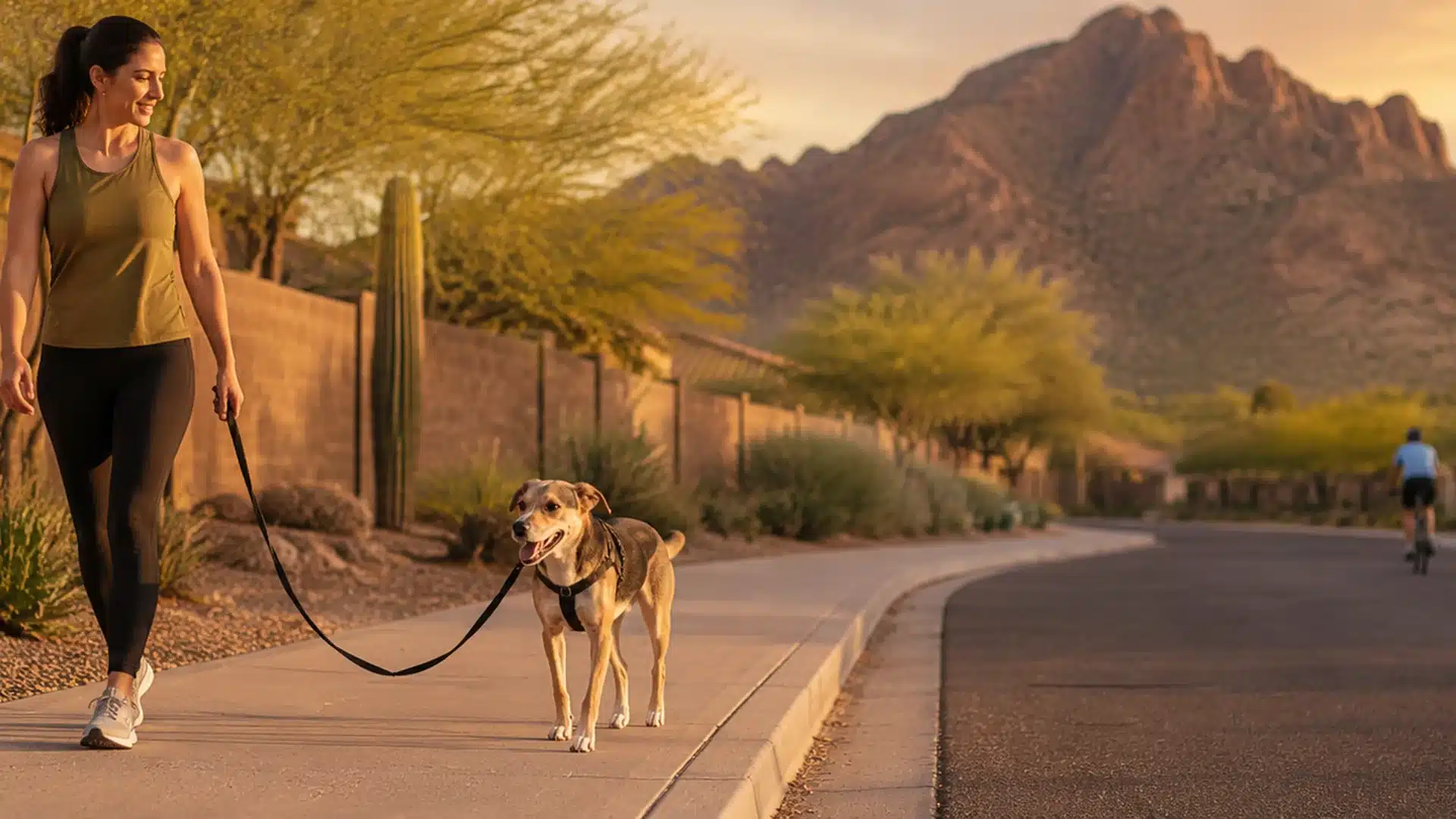
Peoria is a challenging place to walk a reactive dog, and pet parents here know it. The New River Trail and its connection to the Skunk Creek Trail carry a steady stream of cyclists, runners, scooters, and other dogs, often appearing fast and close. Neighborhood sidewalks run between block walls where another dog can materialize at a corner with no warning. The off-leash areas at parks like Paloma and Pioneer are wonderful for social dogs and a minefield for reactive ones. None of this means a reactive dog in Peoria is stuck. It means the training plan has to be built around real Peoria conditions, which is exactly what an in-home consultation does.

Progress looks like this: your dog notices a cyclist far down the trail, and instead of loading up for an explosion, glances back at you. That voluntary check-in is not obedience. It is evidence that the emotion itself has changed, and it is the foundation every calm walk after it is built on.
For the full science behind this approach, read my guide to helping fearful and reactive dogs, which walks through why fear drives reactivity and how real behavior change works.
Anxiety, Fears, and Phobias: Calming the Nervous System
Can an anxious or fearful dog actually get better? Yes. Anxiety, fear, and phobias are treated with systematic desensitization and counterconditioning: gradual, carefully controlled exposure at an intensity the dog can handle, paired with things the dog loves, until the trigger loses its power. What does not work is flooding, forcing, or waiting for the dog to get over it. Phobic dogs do not habituate on their own; without treatment, phobias typically deepen.
Peoria hands anxious dogs plenty of material. Monsoon season brings thunder, dust storms, and pressure changes. Fireworks echo across the West Valley several times a year. Military aircraft train overhead. Coyotes travel the washes and greenbelts at dawn and dusk, and many dogs can smell and hear them long before their pet parents notice anything. A fearful dog in this environment is not being dramatic. Their alarm system is firing at real signals; it is simply calibrated wrong, and calibration is precisely what behavior modification changes.

The goal of treatment is a nervous system that can finally stand down: a dog who rests deeply, recovers quickly after a startle, and moves through the world with curiosity instead of vigilance. When anxiety is severe, I coordinate with your veterinarian, because sudden behavior change can have medical causes and because medical support is sometimes what allows behavioral treatment to succeed. Diagnosis and medication decisions always belong with your veterinarian; the behavior work belongs with me, and the two together are more powerful than either alone.
For a deeper look at how fear, anxiety, and phobias are treated, including the most common ways they show up in dogs, visit my complete guide to dog anxiety training.
Separation Anxiety: Panic, Not Spite
Can separation anxiety in dogs be fixed? Yes, with a structured, gradual protocol that expands your dog's genuine tolerance for being alone, one sub-threshold step at a time. What does not fix it: crates, bitter spray, tiring the dog out, another dog for company, or punishment after the fact. Separation anxiety is panic, and panic cannot be punished or waited out of a dog.
The signs are hard to miss once you know them: howling or barking that starts minutes after you leave, destruction concentrated at doors and windows, drooling, pacing, house soiling from an otherwise reliable dog, and distress that begins with your departure cues, the shoes, the keys, the garage door. Neighbors mention the crying. Cameras confirm the rest. And because the problem only happens when nobody is home, video is the deciding vote in both diagnosis and progress.

Separation anxiety is also the problem best suited to virtual consultation, because the treatment happens at your door, on your schedule, with your camera as the measuring instrument. Whether we work in your Peoria home or over video, the protocol is the same: find the duration your dog can genuinely handle, even if it is thirty seconds, and grow it systematically, with your dog's own body language and video record setting the pace. The destination is a dog who hears the keys and goes back to sleep.
You can learn more about my structured separation anxiety training program and how the protocol builds genuine calm alone time step by step.
Dog Trainer vs. Dog Behaviorist: The Difference Matters
What is the difference between a dog trainer and a dog behaviorist? A trainer teaches skills: sit, stay, come, loose-leash walking. A behaviorist assesses and treats emotional and behavioral disorders: aggression, anxiety, phobias, compulsive behavior. If your dog does not know what to do, hire a trainer. If your dog is too afraid, too aroused, or too reactive to do what it already knows, you need behavior treatment, because the problem is emotional, not educational.
Here is what most pet parents do not know: "behaviorist" is not a legally protected title. Anyone can print it on a business card, and in Arizona, many do. So check credentials, and check who issued them. My certifications include CAB-ICB (Certified and Accredited Canine Behaviorist), CBCC-KA (Certified Behavior Consultant Canine, Knowledge Assessed), CPDT-KA, Family Dog Mediator, and Fear Free Certified Professional, alongside a master's degree in psychology and more than 35 years of casework. I am one of only three CAB-ICB credentialed professionals in the United States, the only one in Arizona.
It is equally important to know what I am not. I am not a veterinarian and not a veterinary behaviorist. I do not diagnose medical conditions and I do not prescribe medication; those decisions belong with your veterinarian, and I collaborate with Peoria veterinarians whenever a case calls for it. A professional who is clear about the edges of their scope is a professional you can trust inside it.
Why I Will Never Put a Shock or Prong Collar on Your Dog
Every method I use is force-free and grounded in the science of how dogs actually learn: classical and operant conditioning, systematic desensitization, counterconditioning, and reinforcement of the behavior we want more of. This is not a philosophy or a branding choice. It is what the convergence of evidence across behavioral science, veterinary behavior, and affective neuroscience supports, and it is the position of every major professional body in the field.
Consider the logic of aversive tools for a moment. Shock, prong, and choke collars work, when they work, through pain, discomfort, or startle. That is positive punishment and escape-avoidance learning; it is the entire mechanism. So the sales pitch collapses on itself: either the tool is aversive, in which case it carries documented costs in fear, stress, and increased aggression risk, or it is not aversive, in which case it is not doing anything. There is no third option in which the collar works and the dog does not pay for it. And for the fearful, anxious, aggressive dogs I treat, adding pain to a scared dog does not create a calm dog. It creates a scared dog who has also learned that warning signs get punished.
If a training tool works, it is aversive. If it is not aversive, it is not what changed the behavior. Behavior change without welfare cost comes from changing the emotion, and that is done with desensitization, counterconditioning, and reinforcement, never with pain.
Force-free does not mean permissive, and it does not mean slow. It means the plan changes how your dog feels, so the behavior change holds when the equipment comes off, because there is no equipment.
Working With Your Veterinarian
Behavior and health are not separate subjects. Pain, thyroid disease, gastrointestinal problems, sensory decline, and neurological conditions can all present as behavior problems, and sudden behavior change in an adult dog is a medical question before it is a behavioral one. When your dog's history suggests a possible medical contributor, I will ask you to involve your Peoria veterinarian early, and I provide detailed behavioral observations your veterinary team can actually use.
The collaboration runs in both directions. When anxiety or panic is severe enough that a dog cannot learn, your veterinarian may consider medical support, and behavioral treatment is what turns that support into lasting change. You do not need a referral to work with me, and I am glad to coordinate with any veterinary practice you already trust.
Behavior Consultations in Peoria
Every case begins with a comprehensive behavior consultation: a full history, a functional assessment of the behavior, immediate management and safety planning, and the first stage of your treatment plan. Choose the format that fits your situation.
In-Home Behavior Consultation
$595
I come to your Peoria home, because that is where the behavior lives. I observe your dog in the environment where the problems happen, assess triggers in real time, and build the management plan around your actual floor plan, gates, yard, and routines. The strongest choice for aggression, dogs fighting in the home, and resource guarding.
Schedule an In-Home ConsultationVirtual Behavior Consultation
$350
The same assessment, history, and treatment planning over live video. Virtual work is highly effective, and for some problems it is actually superior: separation anxiety is treated remotely by design, and dogs who react to visitors are often easier to assess when there is no stranger in the house changing the behavior.
Schedule a Virtual ConsultationLiving With Dogs in Peoria
Behavior lives in context, and Peoria has a context all its own. The newer neighborhoods of north Peoria, from Vistancia to Sonoran Mountain Ranch, are built around shared block walls, and if your dog spends the day fence fighting with the neighbor's dog, that daily rehearsal feeds reactivity everywhere else. The New River and Skunk Creek trails, the Vistancia Discovery Trail, and the WestWing Mountain preserve loops are magnificent, and they are also fast-moving corridors of bikes, runners, and dogs where a reactive dog gets no room to breathe. The off-leash areas at Paloma and Pioneer community parks are a gift for social dogs and a setback factory for fearful ones.

Add the desert itself: coyotes moving through the washes at dawn and dusk, monsoon storms that rattle windows all summer, fireworks over Lake Pleasant, and pavement that pushes walks to the edges of the day. None of this causes behavior problems by itself, but all of it shapes how problems show up and how treatment has to be built. A plan written for your dog in your neighborhood, around your walls, your trails, and your schedule, is the plan that actually works. That is why I treat dogs where they live.
Tell Me About Your Dog
The form below is the fastest way to reach me. Tell me what is happening, how long it has been going on, and what worries you most. I read every submission personally, and nothing you describe will shock me. Growling, biting, panic, dogs who cannot be in the same room: this is what I do all day, every day, throughout Peoria.
Frequently Asked Questions
What does a dog behaviorist do?
A dog behaviorist assesses and treats the emotional causes of problem behavior: fear, anxiety, frustration, and panic. The work begins with a functional behavior assessment to identify triggers and drivers, followed by management to prevent rehearsal of the behavior, and a treatment plan built on desensitization, counterconditioning, and reinforcement. The goal is changing how your dog feels, because behavior follows emotion.
How do I find a certified dog behaviorist in Peoria, AZ?
Check credentials, and check who issued them, because "behaviorist" is not a legally protected title and anyone can claim it. Look for recognized certifications in behavior consulting, a commitment to force-free methods in writing, and experience specifically with your dog's problem. I am a Certified and Accredited Canine Behaviorist (CAB-ICB), one of only three in the United States and the only one in Arizona, and I serve every Peoria neighborhood in home and virtually.
Is my dog aggressive or just afraid?
Usually both, because fear is the most common driver of aggression. Growling, snapping, and biting are frequently a frightened dog's attempt to make a scary thing go away. That distinction changes everything about treatment: a fearful dog who is punished becomes more dangerous, while a fearful dog whose fear is treated no longer needs aggression at all. A behavior assessment identifies what is actually driving your dog's behavior.
My dogs suddenly started fighting with each other. Why?
Common triggers include social maturity in a younger dog, pain or illness in either dog, competition over food, chews, resting spots, or people, and a first fight that taught both dogs to expect the next one. Sudden fighting also warrants a veterinary check, because pain is a frequent hidden contributor. Separate the dogs completely, stop all unsupervised contact, and get a professional assessment before attempting reintroduction.
Can dogs who fight in the same home ever live together peacefully again?
In most cases, yes. Treatment requires strict management so no further fights are rehearsed, a functional assessment of both dogs, treatment of each dog's emotional response to the other, and a staged, sub-threshold reintroduction with clear criteria at every step. It takes structure and patience, but families are told to rehome far more often than is actually necessary.
Do you use shock collars, prong collars, or choke collars?
Never. Those tools work through pain, discomfort, or startle when they work at all, and for fearful and aggressive dogs they add fear to a dog who is already afraid, suppress warning signs, and increase bite risk. Every method I use is force-free and evidence-based: desensitization, counterconditioning, and reinforcement. No shock, no prong, no fear, with no exceptions.
Can separation anxiety be fixed?
Yes. Separation anxiety is panic, and it is treated with a structured protocol that grows your dog's genuine tolerance for alone time from whatever duration your dog can currently handle, verified on camera at every stage. Crates, toys, a second dog, and punishment do not treat panic. Gradual, sub-threshold exposure does, and it is the problem best suited to virtual consultation.
What should I do right now if my dog bit someone?
First, make sure the person receives appropriate medical care, and secure your dog away from all guests and triggers. Arizona has bite reporting requirements, so follow the guidance of medical providers and Maricopa County Animal Care and Control. Then get a professional behavior assessment before the next visitor, the next walk, or the next incident. A bite is a serious event, and it is also a treatable one; the worst plan is hoping it will not happen again.
How long does behavior modification take?
Management and safety improve immediately, often within the first week. Emotional change is more gradual: meaningful progress commonly appears within several weeks of consistent work, while deeply rehearsed aggression, phobias, and separation anxiety typically take months of systematic treatment. The honest answer depends on your dog's history, the problem, and consistency, and I will give you a realistic assessment after evaluating your dog rather than a slogan before it.
Do I need a referral from my veterinarian?
No referral is needed; you can contact me directly. If your dog's history suggests a medical contributor, especially sudden behavior change in an adult dog, I will ask you to involve your veterinarian, and I coordinate with veterinary teams whenever a case calls for it. Diagnosis and medication decisions belong with your veterinarian; behavior assessment and treatment are my role.
What is the difference between a dog trainer and a dog behaviorist?
A trainer teaches skills. A behaviorist treats emotional and behavioral problems. If your dog does not know how to walk nicely on a leash, that is training. If your dog explodes at other dogs on the leash, panics when left alone, guards the food bowl, or has bitten someone, that is a behavior problem, and more obedience will not fix it because the cause is emotional, not educational.
Are virtual behavior consultations as effective as in-home?
For many problems, yes, and for some they are better. Separation anxiety is treated remotely by design, since the problem happens when nobody is home and cameras are the measuring instrument. Dogs who react to strangers are often easier to assess with no stranger in the house. For housemate fighting and complex aggression cases, in-home assessment is usually the stronger starting point. The free call is the fastest way to decide.
Why did my dog's previous training not work?
Most likely because the problem was never a training problem. Obedience teaches behaviors; it does not treat fear, panic, or frustration, and tools that suppress behavior leave the emotion intact, which is why problems return or resurface in new forms. If you have already tried classes, board-and-train, or an e-collar program, nothing is wrong with you or your dog. The problem simply needs treatment instead of commands.
Which areas of Peoria do you serve?
All of Peoria: Vistancia, Northpointe, Trilogy, Blackstone, Westwing Mountain, Sonoran Mountain Ranch, Terramar, Fletcher Heights, Parkridge, Camino a Lago, Tierra del Rio, Coldwater Ranch, Dove Valley Ranch, Pleasant Valley, Westbrook Village, Ventana Lakes, Country Meadows, and Old Town Peoria, across ZIP codes 85383, 85382, 85381, 85373, and 85345, with in-home consultations throughout the city and virtual consultations available everywhere.
Meet Your Certified Canine Behaviorist
Will Bangura, M.S., CAB-ICB
CBCC-KA, CPDT-KA, FDM, FFCP
Will Bangura is a Certified Canine Behaviorist, Applied Ethologist, and behavior consultant specializing in severe dog aggression, reactivity, anxiety, fear, phobias, separation anxiety, and complex canine behavior problems. With more than 35 years of experience, he works with pet parents throughout the Phoenix metropolitan area and worldwide through virtual behavior consultations.
Will is Arizona's only CAB-ICB Certified Canine Behaviorist through International Canine Behaviorists, and one of only three professionals in the United States to hold this credential. He holds a Master of Science degree in Psychology and completed postgraduate studies in canine cognition through Harvard University.
In addition to his behaviorist credentials, Will is certified through the Certification Council for Professional Dog Trainers (CCPDT) as both a Certified Behavior Consultant Canine (CBCC-KA) and Certified Professional Dog Trainer (CPDT-KA). He is also a Fear Free Certified Professional (FFCP) and certified in Applied Ethology through Kim Brophey's Family Dog Mediation (FDM) program.
Will is the founder of Phoenix Dog Training, host of the Dog Training Today podcast, published author, public speaker, and expert witness in dog behavior and aggression cases. His work focuses on evidence-based, force-free behavior modification that addresses the underlying emotional causes of canine behavior problems rather than simply suppressing behavior through punishment.
Your Dog Is Not a Lost Cause
The growling, the lunging, the fights, the panic when you leave: these are treatable conditions, not character flaws, and not reasons to give up on a dog you love.
You have already done the hardest part by looking for real help. Take the next step today.