
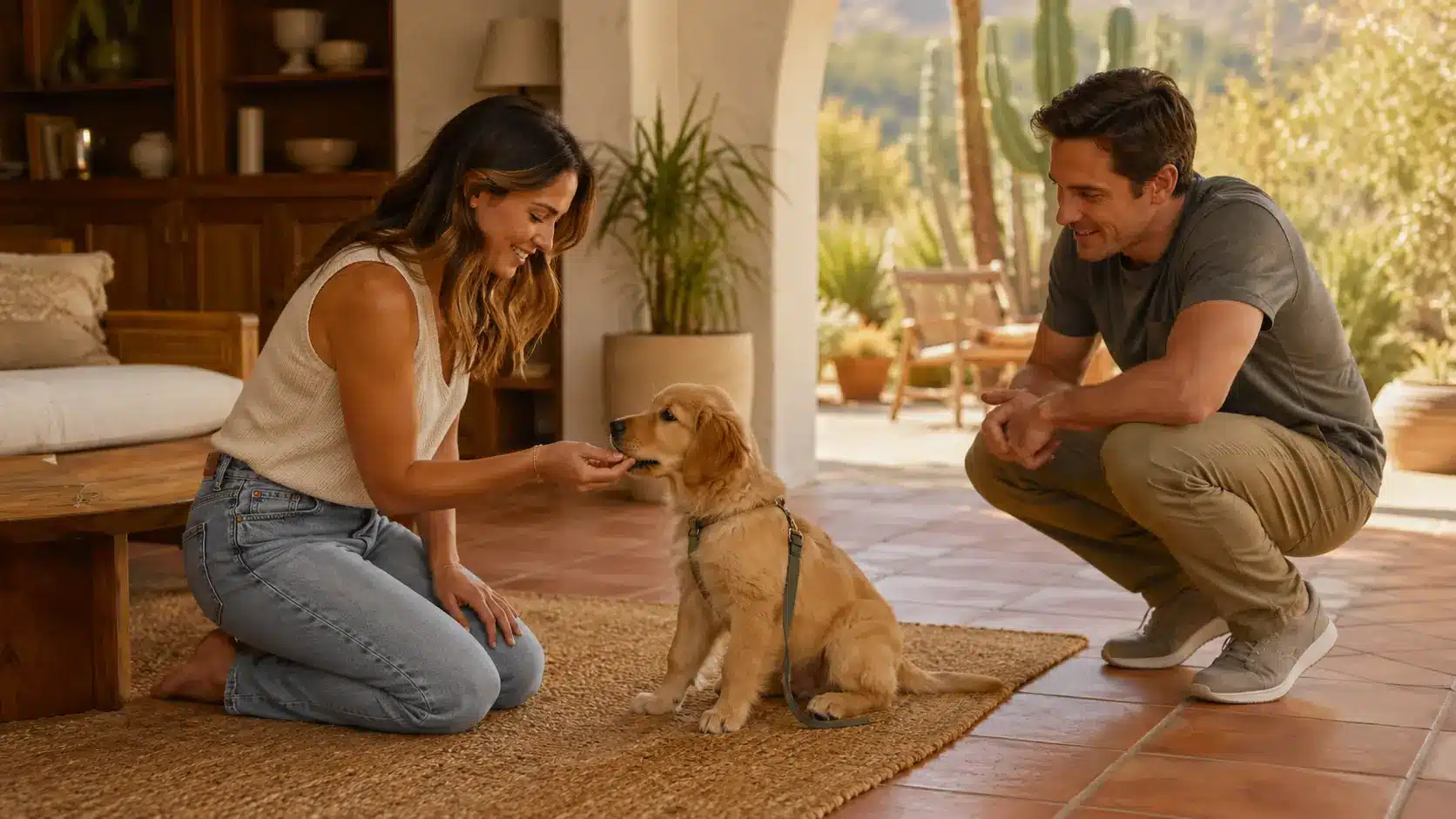
Puppy Training in Phoenix, AZ
Bringing home a new puppy is exciting, but the first weeks can feel overwhelming fast. Potty accidents, nighttime crying, biting, chewing, and the need for constant supervision can leave even the most devoted family exhausted and unsure where to begin.
Whether your puppy is having accidents, struggling in the crate, biting too hard, or you're worried about getting socialization right during this important early window, the goal is the same: a confident, well-mannered puppy and a calm, predictable routine at home. Private, in-home puppy training, built around your puppy, your home, and your family.
No shock. No prong. No fear.

Will Bangura, M.S., CAB-ICB
CBCC-KA, CPDT-KA, FDM, FFCP
A Certified Canine Behaviorist with more than 35 years of experience, Will Bangura helps pet parents across the Phoenix metro raise confident, well-mannered puppies through private, in-home training.
You work directly with Will, never a junior trainer, using science-based, force-free methods that teach your puppy what to do and build habits that last. No shock collars, prong collars, or intimidation.
Start Your Puppy Off Right
The first months of a puppy's life shape how that puppy learns, explores, responds to people, handles new experiences, and adapts to the home. This is the time to build the foundation for confidence, cooperation, and everyday manners.
Puppy training is not only about teaching sit or come. It is about helping your puppy learn how to live successfully with people.
That includes where to potty, how to rest in a crate or confinement area, how to use their mouth gently, how to greet people politely, how to follow simple cues, how to recover from frustration, and how to experience the world safely.
Early training can prevent many common problems from becoming long-term habits. It can also help pet parents understand what is normal puppy behavior, what needs structure, and what may require additional behavior support.
A good puppy plan should do more than teach commands. It should teach routines, confidence, communication, and emotional resilience.
Who Puppy Training Is For
For pet parents with puppies who need help with early learning, socialization, household routines, and everyday manners.
Puppy training is usually the right fit if your puppy needs help with:
- Potty training
- Crate training
- Nighttime routines
- Puppy biting and nipping
- Chewing
- Jumping
- Early leash walking
- Coming when called
- Sit, down, and attention
- Handling and grooming foundations
- Safe socialization
- Confidence around new people, sounds, and surfaces
- Settling calmly
- Learning household rules
- Building a predictable daily routine
This page is primarily for puppies under roughly five to six months of age. If your dog is older and needs help with leash walking, recall, jumping, barking, place, stay, and everyday obedience, visit our adult dog obedience training page.
Adult Dog Obedience Training in PhoenixWhat Puppy Training Includes
Every puppy is different. Some puppies need help with potty training and crate routines. Others need help with biting, chewing, overexcitement, or safe socialization. Some families need a complete plan for daily structure, early obedience, and preventing behavior problems before they start.
Our puppy training is customized around your puppy, your home, and your family's priorities.
The goal is not to rush your puppy through a checklist. The goal is to build a foundation your puppy can actually use as they grow.
A Plan Built Around Your Puppy, Your Home, and Your Routine
A calm, confident puppy starts with a plan built for your puppy and your home. Let's build it together.

Puppy Potty Training
Potty training is one of the most urgent concerns for many new puppy parents. It is also one of the areas where confusion, inconsistency, and unrealistic expectations can create unnecessary frustration.
A successful potty training plan depends on management, timing, supervision, appropriate confinement, reinforcement, and a routine that matches your puppy's age and development. We help you create a clear plan that may include:
- Where your puppy should potty
- How often your puppy should go out
- How to prevent accidents and supervise effectively
- How to use confinement without creating distress
- How to reinforce outdoor potty success
- What to do after accidents
- How to adjust the plan as your puppy matures
Potty training is not about punishment. Puppies do not have adult bladder control, and accidents are information. The plan should make success easier and mistakes less likely.

Will Wrote the Book on Potty Training
House Training 101: Potty-Training Unleashed is Will Bangura's step-by-step, science-based guide to housebreaking your puppy without mess, stress, or punishment. It is the perfect companion to your in-home puppy training.
Get the Book on Amazon
Crate Training and Alone-Time Foundations
Crate training can be helpful when it is introduced carefully and positively. A crate should never be used as a place of fear, isolation, or punishment. For many puppies, crate training works best when it is paired with predictable routines, gradual comfort-building, and appropriate alone-time practice.
We help pet parents teach their puppies to feel safe and comfortable in a crate or confinement area. Depending on the puppy, this may include crate games, feeding routines, calm settling, short absences, nighttime strategies, and gradual alone-time foundations.
The goal is not to force the puppy to cry it out. The goal is to help the puppy learn that rest, confinement, and brief separations can feel safe and predictable. This matters because early confinement struggles can become much harder if the puppy learns that being alone is frightening or overwhelming.

Puppy Biting, Nipping, and Chewing
Puppy biting is normal, but that does not mean it should be ignored. Puppies explore with their mouths, play with their mouths, and often bite more when they are tired, frustrated, overstimulated, or under-structured.
The goal is not to scare, punish, pin, grab, yell, or physically correct the puppy. The goal is to teach appropriate outlets, manage arousal, reinforce better choices, and help the puppy learn how to use their mouth more gently. A biting plan may include:
- Better sleep and rest routines
- Structured play
- Appropriate chew items
- Redirecting to toys
- Teaching calm behavior
- Interrupting without intimidation
- Preventing rehearsal of rough biting
- Helping children interact safely
- Teaching bite inhibition
- Knowing normal biting from a deeper concern
Puppy biting improves faster when the plan addresses the whole picture, not just the moment the puppy's teeth touch skin.

Puppy Socialization Done Safely
Puppy socialization is one of the most misunderstood parts of early puppy development. Socialization does not mean forcing a puppy to meet every person, dog, child, or stranger they see. It does not mean overwhelming the puppy, passing the puppy around, taking the puppy into unsafe environments, or assuming that more exposure is always better.
Good socialization means helping your puppy have safe, positive, controlled experiences with the world at a level they can handle. That may include gentle exposure to:
- Different people
- Different surfaces
- Household sounds
- Vehicles at a safe distance
- Vet-handling foundations
- Grooming-related handling
- Children at a safe distance
- Calm, appropriate dogs
- Novel objects
- New environments
The goal is confidence, not flooding. A puppy who is overwhelmed is not being properly socialized. They are being pushed beyond their ability to cope. We help you build a plan that respects your puppy's age, vaccination status, temperament, and comfort level.
Socialization should create positive associations. If the puppy is frightened, hiding, trembling, trying to escape, or unable to recover, the exposure is too much.

The American Veterinary Society of Animal Behavior emphasizes that early puppy socialization is an important part of helping prevent future behavior problems. We design socialization plans carefully, with safety, vaccination status, temperament, and emotional comfort in mind.
Download the AVSAB Statement (PDF)Early Puppy Obedience and Manners
Puppies can begin learning simple skills early, as long as training is age-appropriate, short, positive, and realistic. Early puppy obedience may include:
- Name response
- Attention
- Sit and down
- Come when called
- Hand targeting
- Leash foundations
- Leave it foundations
- Drop it foundations
- Waiting briefly
- Settling on a mat
- Polite greetings
- Following a lure
- Responding to gentle guidance
- Marker words and release cues
The purpose of early obedience is not perfection. The purpose is to build communication. Your puppy learns that listening is rewarding, training is enjoyable, and people are safe and predictable. As your puppy matures, these early foundations transition into more formal adult obedience skills.
Adult Dog Obedience Training in PhoenixPrivate In-Home Puppy Training vs. Group Puppy Classes
Group puppy classes can be useful for some puppies, especially when the class is well-run, force-free, carefully managed, clean, and appropriate for the puppy's vaccination status and temperament. However, group puppy classes are not the right fit for every puppy or every family.
Many puppy problems happen at home: potty accidents, crate struggles, biting, chewing, jumping, nighttime routines, conflict with children, problems with supervision, and confusion about daily structure. Private in-home puppy training allows us to work directly where those problems are happening.
Private training is often a better fit when:
- You want a customized plan
- Your puppy is struggling at home
- You need help with potty training
- You need help with crate training
- Your puppy is biting hard or often
- Your household has children
- Your puppy is shy or easily overstimulated
- You want coaching for the whole family
- You want a plan that fits your schedule
- You prefer one-on-one instruction
Want a Plan Built for Your Home?
Private in-home lessons meet your puppy exactly where the challenges are happening, with coaching for the whole family.
Science-Based, Force-Free Puppy Training
Puppies should not be trained with fear, pain, intimidation, or force. We do not use shock collars, prong collars, choke chains, leash corrections, alpha rolls, dominance-based methods, or intimidation. Those methods are not necessary for teaching a puppy, and they can create fear, avoidance, stress, and damaged trust.
Our puppy training uses reward-based, science-based methods. We teach the puppy what to do, reinforce the behavior we want, manage the environment to prevent unwanted rehearsal, and help the puppy develop confidence step by step. That means training is not just about stopping unwanted behavior. It is about teaching your puppy how to succeed.
Puppy training should protect your puppy's confidence, curiosity, and trust while building practical skills your family can use every day.

Our methods align with the American Veterinary Society of Animal Behavior Position Statement on Humane Dog Training, which recommends reward-based methods for all dog training, including behavior problems, and advises against pain, fear, intimidation, shock collars, prong collars, and choke chains.
Download the AVSAB Statement (PDF)When Puppy Behavior May Need More Than Basic Training
Many puppy behaviors are normal. Biting, chewing, accidents, jumping, short attention spans, and bursts of energy are common during puppy development. However, some behaviors may need a careful behavior assessment rather than a standard puppy training plan.
A puppy may need additional behavior support if they are:
- Growling intensely
- Biting with unusual force or escalation
- Freezing or hiding frequently
- Panicking when left alone
- Showing extreme fear of people, dogs, or sounds
- Guarding food, toys, or resting places
- Unable to recover after mild stress
- Reacting intensely on leash
- Showing repeated distress in the crate
If that sounds like your puppy, we can help you decide whether puppy training is the right starting point or whether your puppy needs a behavior consultation.
Puppy Training Packages
Every package is built around your puppy, your home, and your family's goals, and every session is taught directly by Will Bangura using force-free, science-based methods. Choose the format that fits your life.
- Customized plan for your puppy and home
- Force-free, science-based methods
- Coaching for the whole family
- Taught directly by Will Bangura
- Virtual flexibility plus hands-on help
- In-home work where the problems happen
- Customized, force-free plan
- Taught directly by Will Bangura
- Full hands-on training in your home
- Work directly where the issues occur
- Customized, force-free plan
- Taught directly by Will Bangura
Just getting started?
The New Puppy 2-Hour Behavior Consultation is a focused session to build your plan, answer your questions, and start your puppy off right.
Not sure which package fits your puppy? Call or text (602) 769-1411 for a free 15-minute consultation.
Puppy Training Across Phoenix and the Metro Area
Phoenix Dog Training provides private puppy training in Phoenix and throughout the surrounding metro area. Where a city page is available, the name below links to it.
Puppy Training FAQ
What age should puppy training start?
Puppy training should begin as soon as your puppy comes home. Early training does not need to be formal or intense. It should focus on routines, potty training, crate comfort, safe handling, socialization, and short positive learning sessions.
What is the most important thing to teach a puppy first?
The first priority is usually structure: potty routines, sleep, confinement, safe supervision, gentle handling, and communication. Simple skills such as name response, coming when called, sit, and attention can be added early.
Do you help with puppy potty training?
Yes. Puppy potty training is one of the most common reasons families contact us. We help create a practical plan based on your puppy's age, schedule, supervision needs, home layout, and routine.
Do you help with crate training?
Yes. We help puppies learn to feel safe and comfortable in a crate or confinement area using gradual, positive methods. We do not recommend forcing puppies to panic or cry for long periods.
Can you help with puppy biting and nipping?
Yes. Puppy biting is common, but it needs the right plan. We help with management, redirection, sleep routines, chew outlets, appropriate play, bite inhibition, and calmer behavior.
Is puppy socialization safe before all vaccines are finished?
Puppy socialization should be planned carefully with your veterinarian's vaccination guidance. The goal is safe, positive exposure, not risky exposure. We help families create controlled socialization plans that reduce unnecessary risk while supporting healthy development.
Are private puppy lessons better than puppy classes?
It depends on the puppy and the family. Puppy classes can be helpful when they are well-run and appropriate. Private in-home training is often better when you need help with potty training, crate training, biting, household routines, children, or a puppy who is shy, overwhelmed, or easily overstimulated.
Do you use shock collars, prong collars, or choke chains with puppies?
No. We do not use shock collars, prong collars, choke chains, leash corrections, dominance-based methods, or intimidation. Puppy training should build confidence and trust.
What if my puppy is fearful or aggressive?
If your puppy is showing intense fear, growling, snapping, guarding, panic, or extreme distress, we may recommend a behavior consultation rather than a standard puppy training plan.
When does a puppy move from puppy training to obedience training?
As a general guide, puppies under about five to six months are best served by puppy training. Dogs older than that who need leash walking, recall, stay, place, jumping, barking, and everyday manners are usually directed to adult dog obedience training.
Ready to Start Puppy Training in Phoenix?
The earlier you build good routines, the easier life becomes for both you and your puppy. If you want help with potty training, crate training, biting, safe socialization, early manners, and a plan that fits your home, we are here to help. Work directly with Will Bangura and give your puppy a foundation built on trust, confidence, and science-based training.