
Dog Body Language: Learning to Hear a Voice That Never Speaks
Your dog is talking to you constantly. Not with words, but with ears, eyes, tail, posture, and breath. This guide teaches you to understand every signal, the way a Certified Canine Behaviorist reads them: in clusters, in context, and in time to help.
Most Bites Are Announced. Most People Never Hear It.
In more than 35 years of working with severe aggression, fear, anxiety, and reactivity, I have reviewed hundreds of bite histories. The story pet parents tell me is almost always the same: "It came out of nowhere." And in almost every case, it did not. The dog had been broadcasting distress for minutes, sometimes for months. A lip lick here. A head turn there. A freeze that lasted half a second. The warnings were fluent, orderly, and completely invisible to the humans in the room.
That is not a criticism of pet parents. Nobody teaches this language. We grow up learning that a wagging tail means happy, that a yawning dog is sleepy, and that a dog who rolls over wants a belly rub. Each of those beliefs is wrong often enough to get somebody hurt. Canine body language is a genuine communication system with its own vocabulary, grammar, and dialects, and like any language, it can be learned.
The stakes go beyond bite prevention. A dog whose signals are consistently missed or overridden learns that communication does not work. Some of those dogs stop warning and go straight to teeth. Others sink into chronic stress, and chronic stress is not a training problem, it is a welfare problem, with measurable effects on health, learning, and quality of life. When you learn to read your dog, you are not just getting safer. You are giving your dog back a voice.
Everything in this guide is grounded in behavioral science: operant and classical conditioning, affective neuroscience, and the modern consensus in applied animal behavior. Problem behavior is driven by fear, anxiety, stress, and frustration, not dominance and not stubbornness. Body language is how those emotional states become visible. Learn to see them, and you can change them.
Single Signals Lie. Clusters Tell the Truth.
Here is the mistake that even experienced dog people make: they read one body part at a time. The tail is wagging, so the dog is friendly. The mouth is open, so the dog is relaxed. But a single signal, isolated from the rest of the body, is close to meaningless. A wagging tail can accompany a joyful greeting or precede a bite. A yawn can mean a dog is tired, or it can mean a dog is drowning in stress. The signal is a word. The cluster is the sentence.
Professional behavior assessment always reads the whole dog at once: eyes, ears, mouth, tail height, tail motion, weight distribution, muscle tension, and movement quality, all together, all in context. A high fast wag paired with a stiff body, hard eyes, and forward-loaded weight is a completely different sentence than the same wag paired with a loose spine, squinty eyes, and a wiggling rear end. Same word, opposite meanings.
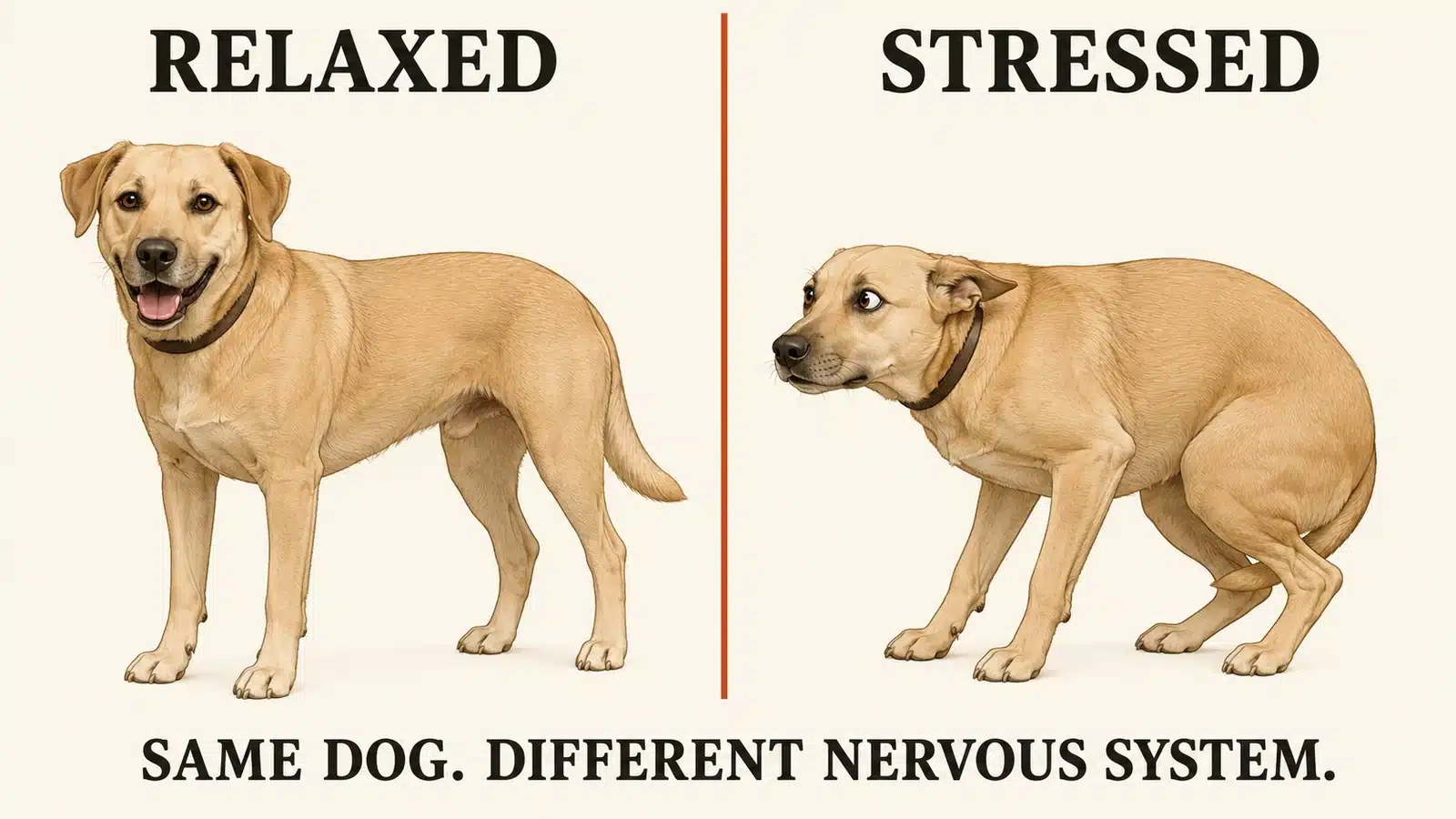
Context is the other half of the grammar. A ground sniff on a leisurely walk is a dog gathering the neighborhood news. The identical ground sniff during a tense greeting with an unfamiliar dog is a calming signal, a deliberate act of social diplomacy. The behavior is the same. The meaning lives in the situation. Throughout this guide you will see the same physical behaviors appear in multiple categories, and that is not sloppy organization. It is how the language actually works.
The clinical habit to build: before you interpret any single signal, scan the whole dog and name the context. Whole dog, then situation, then meaning. In that order, every time. It takes about three seconds once it becomes a habit, and it is the single biggest upgrade you can make to your fluency.
The Escalation Ladder: Why You Must Never Punish a Growl
Canine communication is built on a principle of escalation. Dogs almost never open a conflict with their teeth. They begin with the quietest signals available: a lip lick, an averted gaze, a turned head. If the quiet signals work, the conversation ends there, peacefully. If they are ignored, the dog climbs a rung: freezing, stiffening, a low growl. Ignore those, and the dog climbs again: a snarl, an air snap. The bite sits at the very top of a ladder the dog never wanted to climb.
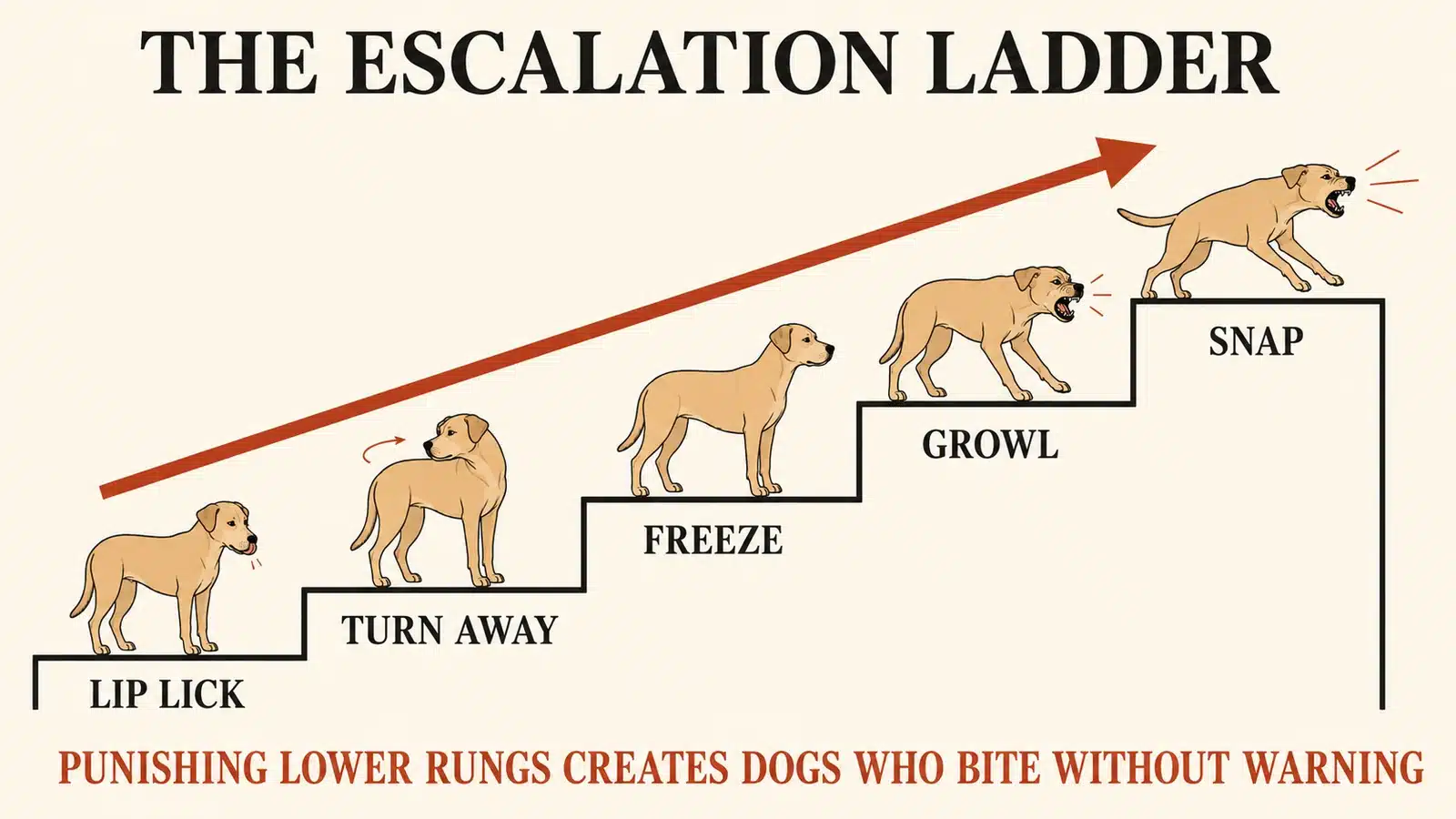
This is why punishing a growl is one of the most dangerous things a pet parent can do, and why you will hear me say it without hedging: never punish the growl. The growl is not the problem. The growl is the smoke alarm. It is honest, it is early, and it gives everyone time to respond safely. Punish it, and the underlying fear does not go anywhere. You have simply taught the dog that the smoke alarm gets him in trouble. The learning mechanism here is straightforward positive punishment: the growl decreases. The emotion driving it does not. What you get is a dog who skips the warning rungs entirely, and those are the dogs whose bites truly do come out of nowhere, because a human dismantled the announcement system.
The ladder also explains why early fluency matters so much. A pet parent who can recognize a lip lick and a head turn can resolve nearly every brewing conflict at the bottom of the ladder, where the solutions are as simple as adding distance or ending an interaction. The families who end up in my consultation room are almost never careless people. They are caring people who were never taught to see rungs one through four.
The Eleven Categories of Canine Communication
Every signal your dog produces belongs to a functional category: what the behavior is trying to accomplish. Explore each category in depth. Every page includes labeled illustrations, the science behind each signal, and exactly what to do when you see it.
Stress Signals
The vocabulary of an overwhelmed nervous system: yawning, lip licking, whale eye, trembling, panting, freezing, and more than a dozen others. The earliest and most important signals to learn.
Calming Signals
The peacekeeping language dogs use to defuse tension: soft eyes, slow blinks, head turns, ground sniffing, shake-offs, and curved approaches. Diplomacy, written in posture.
Distance-Increasing Signals
The warnings: growls, hard stares, raised hackles, stiffening, lunging, and air snaps. Every one is a request for space, and every one deserves an answer.
Appeasement Signals
The language of deference: submissive grins, low wags, rollovers, crouching, and gaze aversion. Often misread as guilt, and sometimes tragically misread as aggression.
Distance-Decreasing Signals
The invitations: friendly wags, curved approaches, leaning, nudging, nose-to-nose greetings, and offered toys. How dogs say "come closer" and mean it.
Play Signals
Play bows, bouncing, zoomies, jaw sparring, and self-handicapping. How to tell healthy play from trouble brewing, and why good play is one of the great sights in dog behavior.
Tail Positions
High, neutral, low, and tucked: what tail carriage reveals about arousal and emotional state, and why every dog's baseline is different.
Tail Wagging
The most misread signal in all of dog behavior. Speed, height, arc width, and even left-versus-right bias each change the meaning of a wag.
Barking
Alarm barks, demand barks, play barks, frustration barks, and fear barks. Different pitches, different rhythms, different messages, and different solutions.
Vocalizations
Howling, whining, crying, and whimpering: the sounds beyond the bark, what drives each one, and when a vocalization warrants a veterinary visit.
Reading Signal Clusters
The clinical heart of the guide: how to read the whole dog at once, the escalation ladder, play versus trouble, and the relaxed-versus-stressed comparison every pet parent should memorize.
Baselines, Breeds, and the Dog in Front of You
Everything in this guide describes the general grammar of canine communication, but fluency means reading the individual. Before you can recognize abnormal, you need to know your own dog's normal. Where does her tail sit when she is genuinely relaxed at home? What do his ears look like on an easy morning? That relaxed baseline is your reference point for everything else, because a signal is always a change from baseline, not an absolute position.
Physical structure complicates the picture, and honesty about that makes you a better reader. A pug cannot furrow its brow the way a shepherd can. A greyhound's neutral tail hangs lower than a beagle's ever will. Docked tails, cropped ears, heavy coats, and flattened faces all remove letters from a dog's alphabet, which means the rest of the cluster has to carry more of the message. None of this makes body language unreadable. It simply means the honest unit of analysis is always the whole dog, measured against that individual dog's own baseline.
One more principle, and it may be the most important sentence in this guide: body language is communication, and communication only works if it changes what the listener does. When your dog turns his head away from a hug, backs up from a stranger's reaching hand, or freezes at the approach of a toddler, the kindest and most scientifically sound response is to make the signal work. Add distance. End the interaction. Advocate for your dog. Dogs who learn that quiet signals work never need loud ones. This becomes especially important when a baby is on the way, and reading your dog well is the foundation of my complete guide to preparing your dog for a new baby, which puts these body-language skills to work through pregnancy, homecoming, and the crawling and toddler stages.
Body Language Is Where Behavior Change Begins
Reading your dog is not the end goal. It is the entry point to everything else. In my practice, body language literacy is the foundation of the EASE Method, the clinical framework I use for every fear, anxiety, aggression, and reactivity case: Evaluate, Arrange, Skill-Build, and Emotional Repatterning.
It starts with Evaluate because you cannot change what you cannot see. A functional behavior assessment is, at its core, an exercise in reading body language with precision: identifying the earliest observable signs of distress, mapping the triggers that produce them, and establishing exactly where a dog's threshold sits. Every signal in this guide is a data point in that assessment.
It matters just as much in the later stages. Effective behavior modification through systematic desensitization and counterconditioning depends on keeping a dog sub-threshold, under the level of intensity where fear takes over and learning shuts down. The only way to know a dog is sub-threshold is to read the body in real time. The lip lick, the weight shift, the first hint of whale eye: these tell you when to add distance, when to end a session, and when a dog is genuinely ready for the next step. Pet parents who master this guide are not just safer companions. They become capable partners in their own dog's treatment plan.
Dog Body Language Questions, Answered
Does a wagging tail mean my dog is happy?
Not by itself. A wag means arousal: emotional energy of some kind. The height, speed, arc width, and the rest of the body tell you whether that energy is friendly or dangerous. A loose, wide, mid-height wag with a wiggly body is friendly. A fast, high, tight wag on a stiff body with hard eyes can immediately precede a bite. Always read the wag against the whole dog.
Why does my dog yawn when he isn't tired?
Out-of-context yawning is one of the most common canine stress signals. A tension yawn tends to be exaggerated and prolonged, often paired with other stress signals like lip licking or pinned ears. Dogs also yawn as a calming signal to defuse social tension. If your dog yawns during handling, training, or greetings, treat it as information about his emotional state.
What is whale eye in dogs?
Whale eye is when a dog turns its head away from something while keeping its eyes locked on it, exposing the white sclera in a visible crescent. It signals significant stress or conflict: the dog wants to disengage but does not feel safe looking away. Whale eye over a food bowl, a toy, or a resting spot is an urgent request for space and a common precursor to escalation if ignored.
Should I punish my dog for growling?
No, never. A growl is a warning, and warnings are what keep everyone safe. Punishing a growl suppresses the warning without changing the fear underneath it, which is how you create a dog who bites without warning. When your dog growls, calmly add distance, then identify and address what caused the discomfort. If growling is happening regularly, that is the time to bring in a qualified, force-free behavior professional.
My dog rolls onto his back. Does he always want a belly rub?
Not always. A loose, wiggly dog who flops over during play or relaxed cuddling is usually inviting contact. A dog who rolls over slowly with a stiff body, tucked tail, closed mouth, and averted eyes is showing passive appeasement: he is saying "please don't," not "pet me." Reaching in to rub that second belly is how well-meaning people get bitten. Check the whole cluster first.
How can I tell if my dogs are playing or fighting?
Look at the geometry and the rhythm. Healthy play is curved, bouncy, and inefficient: play bows, exaggerated movements, role reversals, self-handicapping by the bigger dog, and frequent brief pauses. Trouble looks straight, stiff, fast, and quiet: rigid bodies, hard stares, high still tails, and no breaks. If you are unsure, call the dogs apart cheerfully and see if both choose to re-engage. Willing re-engagement is the signature of real play.
When should I get professional help for my dog's behavior?
Reach out when you see repeated distance-increasing signals (growling, snapping, freezing, hard stares), when fear or anxiety is affecting your dog's daily quality of life, or any time there has been a bite or a near miss. Earlier is always better: behavior problems driven by fear, anxiety, stress, and frustration respond best when they are addressed before long rehearsal histories build. Look for credentialed, force-free professionals who use desensitization and counterconditioning rather than punishment-based tools.
 About the Author
Will Bangura, M.S., CAB-ICB, CBCC-KA, CPDT-KA, FDM, FFCP, is a Certified Canine Behaviorist with over 35 years of experience specializing in severe aggression, fear, anxiety, reactivity, phobias, and compulsive disorders in dogs. He holds a Master's Degree in Psychology and is accredited as a Certified Canine Behaviorist through International Canine Behaviorists, one of only three CAB-ICB Certified Canine Behaviorists in the United States and the only one in Arizona. His additional credentials include Certified Behavior Consultant Canine (CBCC-KA) and Certified Professional Dog Trainer (CPDT-KA) through the Certification Council for Professional Dog Trainers, certification in Applied Ethology through Family Dog Mediation (FDM), and Fear Free Certified Professional (FFCP).
Will is the author of Sniff to Soothe, host of the Dog Training Today podcast, and a court-recognized expert witness in canine behavior. His clinical work is grounded in behavioral psychology, applied behavior analysis, learning theory, and affective neuroscience: every case begins with a functional behavior assessment and is treated through management, skill building, and evidence-based behavior modification using systematic desensitization and counterconditioning. He is a national advocate for force-free, science-based training and a published voice on the welfare risks of aversive training methods.
As the founder of Phoenix Dog Training, Will provides in-home behavior consultations throughout the Phoenix metro area and virtual behavior consultations for pet parents nationwide.
If Your Dog's Signals Are Telling You Something Is Wrong
Fear, anxiety, reactivity, and aggression are treatable. A professional behavior consultation starts with a full functional behavior assessment and ends with a clear, evidence-based plan. Schedule a Behavior Consultation, or start with a free call.