Will Bangura Phoenix Dog Training Schedule a Consultation 602-769-1411

Certified Dog Behaviorist in Phoenix, AZ

Will Bangura, M.S., CAB-ICB, CBCC-KA, CPDT-KA, FDM, FFCP is the Phoenix dog behaviorist and certified canine behaviorist for dog aggression, dog anxiety, dog reactivity, fear, phobias, separation anxiety, dogs fighting in the home, and severe dog behavior problems that ordinary training cannot resolve.

You are not alone. Many dogs with serious behavior problems improve significantly when the work is grounded in accurate assessment, emotional safety, and evidence-based behavior modification. There is a path forward.

35+Years Clinical Practice
OnlyCAB-ICB in Arizona
CCPDTCBCC-KA + CPDT-KA
M.S.Behavioral Psychology
Fear FreeCertified Professional
Virtual + In-HomePhoenix & Worldwide
Start here if you are worried

Behavior Problems I Specialize In

Most pet parents searching for a dog behaviorist in Phoenix are not dealing with basic manners. They are dealing with fear, panic, aggression, bite risk, dogs fighting in the home, or behavior that has not improved with ordinary training. This page is built for those cases.

Dog Aggression Toward People

Dog showing aggression toward a person, illustrating dog aggression toward people Growling, lunging, snapping, biting, defensive aggression, redirected aggression, and aggression toward strangers or family members. Dog aggression training

Dog Aggression Toward Other Dogs

Dog showing aggression toward another dog, illustrating dog aggression toward other dogs Reactive or aggressive behavior toward unfamiliar dogs, neighbor dogs, or dogs on walks. Often driven by fear, frustration, or learning history. Dog aggression training

Dogs Fighting at Home

Two dogs in a tense standoff indoors, illustrating dogs fighting at home Multi-dog household conflict, resource guarding between dogs, arousal-related fights, sibling conflict, and repeated fights that escalate. Intra-household aggression

Leash Reactivity

Dog lunging on a taut leash, illustrating leash reactivity Barking, lunging, pulling, spinning, or explosive behavior toward dogs, people, bikes, or other triggers during walks. Dog aggression training

Anxiety and Fear

Anxious, fearful dog showing stress body language, illustrating canine anxiety and fear Generalized anxiety, hypervigilance, fear of strangers, fear of environments, vet fear, handling sensitivity, and dogs who cannot relax. Anxiety behavior modification

Separation Anxiety

Distressed dog alone at the door, illustrating canine separation anxiety Panic when left alone, destruction, vocalization, escape attempts, self-injury, indoor elimination, and pre-departure anxiety. Separation anxiety treatment

Resource Guarding

Dog guarding a food bowl, illustrating canine resource guarding Guarding food, toys, chews, resting places, people, rooms, or stolen objects with growling, freezing, snapping, or biting. Resource guarding help

Fear-Based Aggression

Frightened dog showing defensive aggression, illustrating fear-based aggression Dogs whose aggressive displays are rooted in fear, defensive arousal, trauma history, or repeated triggering with no safe outlet. Dog aggression training

Noise and Storm Phobias

Dog hiding in panic during a thunderstorm, illustrating noise and storm phobias Panic responses to thunderstorms, fireworks, gunfire, vacuum cleaners, garbage trucks, or other intense sounds. Fearful dog training

We Also Help With

More specialized cases and entry points pet parents reach out for.

Failed Previous Training

Shut-down dog after aversive training, illustrating fallout from failed previous training Dogs whose behavior has not improved or has gotten worse after board-and-train, e-collar, or punishment-based training. Re-evaluate the plan

Compulsive Behaviors

Dog in a compulsive tail-chasing spin, illustrating canine compulsive behaviors Tail chasing, flank sucking, excessive licking, shadow chasing, pacing, and other repetitive behaviors that interfere with daily life. Compulsive disorder help

Vet and Grooming Fear

Fearful dog on a veterinary exam table, illustrating vet and grooming fear Dogs who panic, freeze, snap, or bite at the veterinarian, groomer, or during nail trims, handling, restraint, or husbandry care. Cooperative care and Fear Free protocols rebuild safety. Cooperative care plan

Puppy Behavior Concerns

Fearful puppy showing early stress signals, illustrating puppy behavior concerns Puppies showing early signs of fear, reactivity, resource guarding, handling sensitivity, or abnormal arousal. Early intervention with a behaviorist can change the trajectory. Puppy behavior assessment

Blind and Deaf Dog Behavior

Senior dog with cloudy eyes navigating cautiously, illustrating blind and deaf dog behavior Behavior modification for blind, deaf, or dual-sensory impaired dogs. Tactile and scent-based communication, startle reduction, confidence building, and safety planning. Sensory-impaired support

Senior Dogs and Canine Cognitive Dysfunction

Disoriented elderly dog, illustrating senior dogs and canine cognitive dysfunction Disorientation, sundowning, sleep-wake disturbance, anxiety, house soiling, and other behavioral signs of cognitive decline in aging dogs. Behavior modification and veterinary collaboration support quality of life and reduce distress. Senior behavior support

Schedule a Behavior ConsultationBook a Free 15-Minute Call

understanding behavioral care

What Is a Dog Behaviorist, and When Does Your Dog Actually Need One?

A Phoenix pet parent kneeling calmly beside her dog in a Sonoran desert setting, the dog alert and watchful, showing the kind of real behavior concern that calls for a certified dog behaviorist rather than basic obedience training.

Call a behaviorist when there is:

  • A bite history or escalating bite risk
  • Aggression toward strangers, visitors, children, family members, or other dogs
  • Dogs fighting in the same home
  • Panic-level separation anxiety or confinement distress
  • Severe leash reactivity that obedience has not resolved
  • Fear, phobias, shutdown, avoidance, or chronic anxiety
  • Prior training that failed, suppressed warning signs, or made the behavior worse
  • Discussion of rehoming or euthanasia because the behavior feels unmanageable

If your dog’s behavior has started to frighten you, embarrass you, or quietly take over your daily life, you have probably already been told to train harder, be the boss, use a firmer hand. And yet the aggression, the panic, the fear keeps coming back. That pattern is usually the first real sign that what your dog needs is not more obedience. It is a dog behaviorist.

Who and what is a dog behaviorist?

A dog behaviorist is a clinician trained to evaluate and treat the underlying drivers of complex behavior problems: aggression, anxiety, fear, phobias, reactivity, and compulsive behavior. Where a dog trainer teaches skills, a behaviorist treats the emotional and behavioral health problem underneath them.

How is a dog behaviorist different from a dog trainer?

A dog trainer teaches obedience: sit, stay, recall, loose-leash walking, manners. Those skills have real value. But obedience is not behavior modification. A dog can obey every cue you give and still be hypervigilant, terrified, and genuinely unsafe. Obedience teaches a dog what to do. It does not change how a dog feels, and serious behavior problems are, at their core, emotional problems.

What education does a dog behaviorist have?

Dog training is an unregulated field. Anyone can call themselves a trainer with no degree, no certification, and no clinical study of abnormal behavior at all. A qualified behaviorist has advanced formal education in behavior, psychology, or ethology, often at the master’s or doctoral level, with focused study of aggression, anxiety, fear, and emotional dysregulation. The title alone does not tell you that. The credentials do.

What does a dog behaviorist do?

Rather than simply trying to stop a behavior, I look beneath it, then build an evidence-based behavior modification plan, coach your family through it, and adjust as your dog changes. The goal is not to suppress the visible behavior. It is to change the emotional associations driving it, lower stress and arousal, build real confidence, and help your dog feel safe in the situations that currently overwhelm them. I do not use shock collars, prong collars, choke collars, or fear-based methods.

When should you see a dog behaviorist?

When the behavior is driven by fear, anxiety, stress, or frustration rather than a simple gap in training. Aggression toward people or other dogs, dogs fighting in the same home, severe leash reactivity, separation anxiety, noise phobias, compulsive behaviors, panic. These are not stubbornness or dominance. They are emotional regulation problems, and they call for a different set of questions:
  • What is your dog actually feeling in the moments the behavior happens?
  • What in the environment is triggering and maintaining it?
  • What learning history shaped that response over time?
  • What medical, developmental, or pain-related factors may be contributing?
  • What is a realistic prognosis given this particular dog, this family, and this history?

I am Will Bangura, M.S., CAB-ICB, CBCC-KA, CPDT-KA, FDM, FFCP. I hold a master’s degree in behavioral psychology and am one of only three professionals in the United States certified and accredited as a Canine Behaviorist through International Canine Behaviorists, with more than 35 years of experience in severe aggression, reactivity, fear, anxiety, phobias, and compulsive disorders. If your dog’s behavior feels overwhelming, you are not alone, and it is rarely as hopeless as it feels. Most dogs with serious behavior challenges improve, often dramatically, once the behavior is correctly understood and addressed with the right plan.

A safer decision for your dog

Dog Trainer vs Dog Behaviorist in Phoenix

Most pet parents searching for help with a serious dog behavior problem do not know whether they need a dog trainer or a dog behaviorist. The two roles overlap in name but not in scope, training, or fitness for severe cases. Use this comparison to make a safer decision for your dog.

Dog Trainer
Certified Canine BehavioristWill Bangura
Focus
Obedience, manners, leash skills
Aggression, anxiety, fear, reactivity, separation anxiety, severe behavior problems
Assessment
Surface behavior and training history
History, environment, triggers, emotional state, safety, medical context, learning history
Methods
May include corrections, shock collars, prong collars, or punishment
Force-free, evidence-based behavior modification
Credentials
Varies widely in an unregulated industry
CAB-ICB, M.S., CBCC-KA, CPDT-KA, FDM, FFCP, Harvard postgrad in canine cognition
Best for
Basic skills and manners
Serious behavior cases involving safety, fear, anxiety, or aggression
What working together looks like

The Behavior Modification Process

Clarity reduces anxiety. Below is exactly what happens after you reach out, so you know what to expect before, during, and after the consultation.

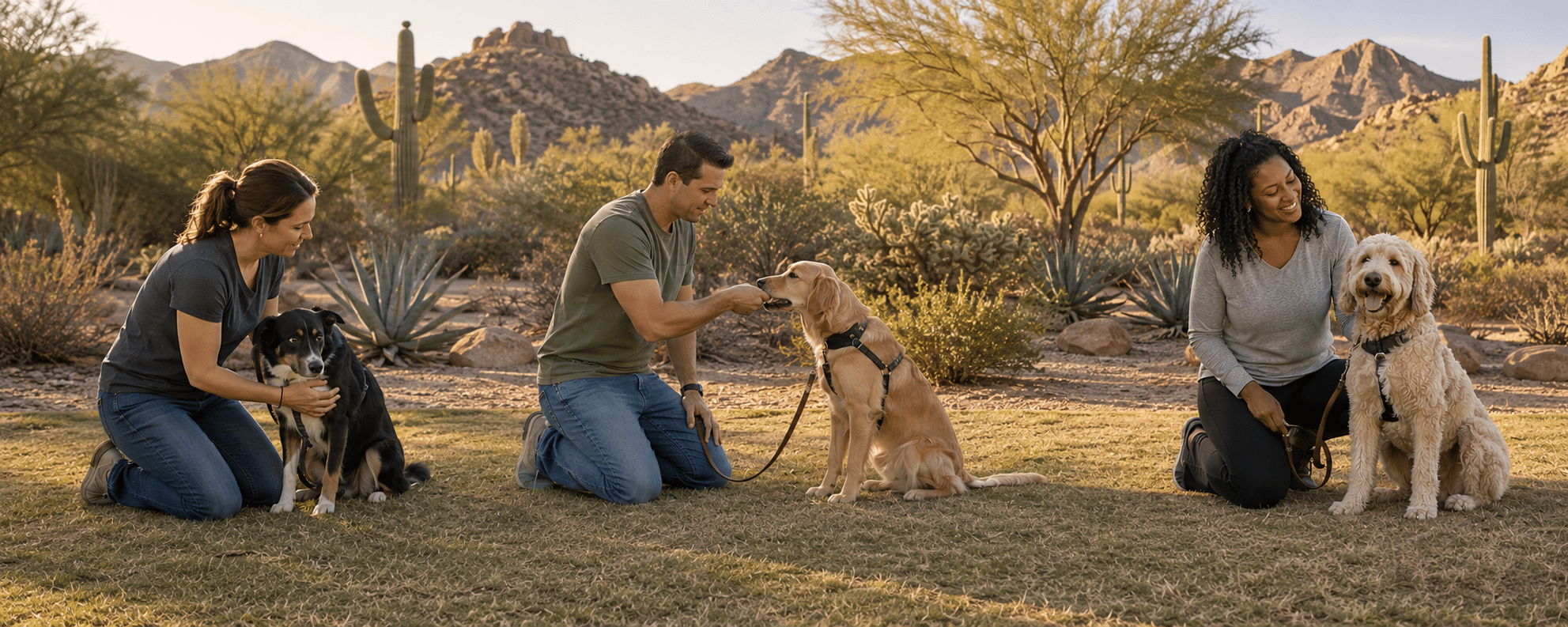
The dog behavior modification process in Phoenix, Arizona: three pet parents working with their dogs in a Sonoran desert setting, showing the progression from an unsure dog to calm focus and a relaxed, confident dog through force-free, evidence-based behavior modification.

Intake

You complete a detailed behavior history so Will can understand what is happening before the consultation begins.

Assessment

Will evaluates triggers, history, environment, risk factors, emotional state, and the behavior patterns maintaining the problem.

Plan

You receive a behavior modification plan designed around your dog, your home, your goals, and your safety needs.

Coaching

You are coached through the exercises so you know what to do, what to avoid, and how to keep your dog below threshold.

Progress Tracking

The plan is adjusted based on observable progress, setbacks, trigger distance, recovery time, and safety.

Maintenance

You learn how to preserve progress, prevent relapse, and manage future changes in your dog’s environment.
Real clinical work, real families

What Behavior Modification Looks Like in Real Life

These real client testimonials show the kinds of serious behavior concerns pet parents bring to Will Bangura and Phoenix Dog Training, including aggression, anxiety, reactivity, separation anxiety, fear, overstimulation, and cases requiring careful behavior modification and veterinary collaboration.

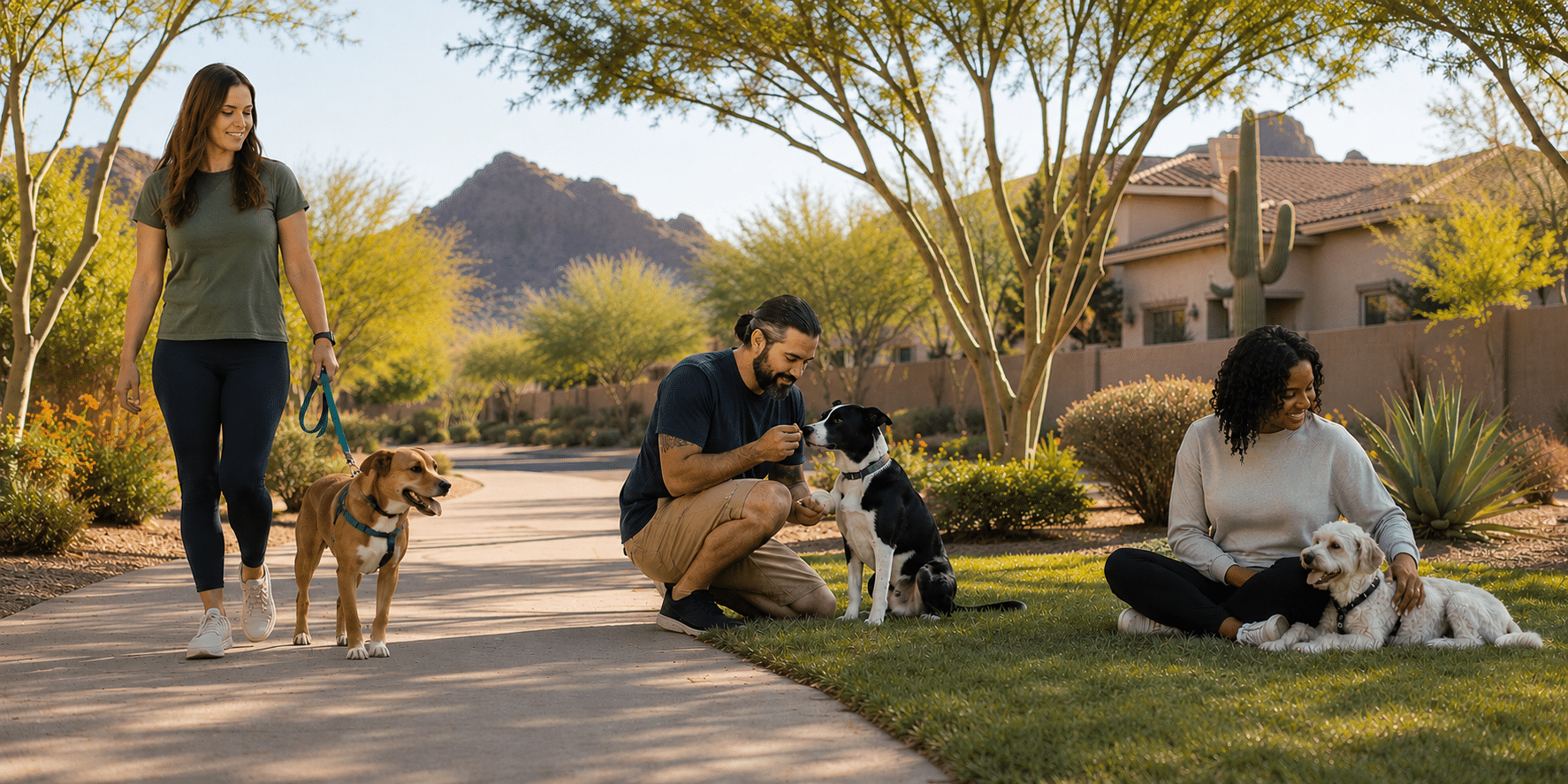
Three Phoenix pet parents with their dogs in a calm desert park, showing what successful dog behavior modification looks like in real life: a relaxed dog walking on a loose leash, a dog calmly taking a reward, and a content dog resting beside its guardian.

“If you have a dog who’s been struggling behaviorally, emotionally, or both, Will is your person. My dog Hank came to him as a genuinely difficult case, and the progress has been remarkable. Will does not just address surface behaviors, he gets to the root of the issue. He has even collaborated with Hank’s veterinarian to make sure his medication is properly equilibrated, understanding that behavior and biology are not separate conversations. That integrative, science-based approach is rare and makes a real difference. Will’s method is thoughtful and effective. He opened my eyes to how much sniffing can help a dog’s nervous system relax, which has been critical to Hank’s progress. The results speak for themselves. Hank is less reactive, handles guests without going off the rails, is far easier to calm down when he gets overstimulated, and the humping situation is significantly more civilized. Will took all of it seriously without judgment and tackled each issue methodically. I’m excited to continue working with Will to help Hank keep making progress.”

Tzivia Masliansky

Case type: Reactivity, guest-related arousal, overstimulation, medication coordination, nervous system regulation

“I cannot recommend Will Bangura enough. My dog struggled with severe fear-based aggression, generalized anxiety, and separation anxiety. After working with several trainers without success, I found Will, and our lives changed completely. His science-based approach and deep understanding of canine behavior made all the difference. Within just a few sessions, my dog became more confident, less reactive, and noticeably calmer. Will taught me how to read my dog’s body language, understand his emotional state, and manage situations that previously triggered fear and anxiety. The fear-based aggression has decreased significantly, and the separation anxiety that once caused daily stress is now manageable. Will’s knowledge, professionalism, and compassion for both dogs and pet parents are exceptional. If you are dealing with aggression, anxiety, fear, or reactivity, I highly recommend working with Will Bangura.”

Dillon Denney

Case type: Fear-based aggression, generalized anxiety, separation anxiety, reactivity

“I cannot thank Will Bangura and Phoenix Dog Training enough for the incredible work they did with my dog, Poolie. Poolie struggled with severe dog aggression, anxiety, and extreme fearfulness. From the very first consultation, Will’s expertise and understanding of canine behavior were obvious. Will created a comprehensive behavior modification plan tailored specifically to Poolie’s needs using evidence-based, force-free methods. He was patient, compassionate, and methodical throughout the entire process. The improvement in Poolie’s confidence, emotional stability, and ability to cope with stressful situations has been remarkable. The personalized sessions were highly effective, and Will’s dedication to our progress never wavered. If you are struggling with dog aggression, fear, anxiety, or serious behavior problems, I highly recommend Will Bangura and Phoenix Dog Training.”

Isaiah Ishmall

Case type: Dog aggression, fearfulness, anxiety, behavior modification

Client experiences reflect individual cases. Outcomes vary depending on case severity, medical contributors, environmental management, family follow-through, and the dog’s individual history. Behavior modification is a clinical process, not a guarantee.

Read More Client Reviews

Specialist practice

The Phoenix Dog Behaviorist for Severe, Complex Cases

A pet parent tenderly embracing her calm, resting dog at home, representing hope for severe and complex dog behavior cases handled by a certified canine behaviorist in Phoenix when other trainers cannot help.

Will Bangura is the professional that veterinarians, dog trainers, and behavior consultants refer to when standard interventions have failed, when bite risk has escalated, when previous training has made things worse, or when rehoming or euthanasia is being discussed as a last resort.

Will Bangura, M.S., CAB-ICB, CBCC-KA, CPDT-KA, FDM, FFCP is Arizona’s only CAB-ICB Certified Canine Behaviorist through International Canine Behaviorists and one of only three professionals in the United States holding this credential. He has more than 35 years of clinical experience working with aggression, anxiety, fear, phobias, reactivity, separation anxiety, compulsive behaviors, and severe behavior cases.

His work combines graduate-level education in psychology, postgraduate education in canine cognition through Harvard University, decades of clinical case experience, expert witness work, public education, published writing, podcast hosting, and force-free behavior modification grounded in evidence-based practice.

Severe and complex cases I take when others cannot:

  • Dogs with documented bite histories
  • Dogs that attack visitors or family members
  • Multi-dog households with intra-pack fighting
  • Severe leash reactivity, lunging, and screaming on walks
  • Redirected aggression toward people or other dogs
  • Cases referred by veterinarians and other trainers
  • Cases where previous interventions have failed or made things worse
  • Cases where rehoming or euthanasia is being considered
  • Panic-level separation anxiety and confinement distress
  • Fear-based aggression toward strangers, children, or family
  • Compulsive disorders that interfere with daily life
  • Resource guarding with bite risk to family or other dogs

Schedule a Behavior ConsultationBook a Free 15-Minute Call

Tell us about your dog

Request a Behavior Consultation

Share a few details about what is happening with your dog and we will respond quickly to discuss next steps.

Tell Us How We Can Help You With Your Dog.

Please Fill Out This Form

Evidence-based behavior modification

A Behaviorist Looks Beneath the Behavior to Change the Emotional Response Driving It

Aggression, reactivity, fear, and anxiety are not resolved by suppressing the visible behavior. Real behavior change requires changing the dog’s emotional response to the trigger.

What you see versus what is really driving it: visible dog behaviors like barking, lunging, growling, and biting are the surface, while fear, anxiety, stress, frustration, pain, and learned associations are the root causes beneath Many dogs stop growling, barking, or lunging temporarily when punished. That does not mean the fear, anxiety, frustration, or defensive arousal has changed. In severe cases, suppressing warning signals can increase risk because the dog appears calmer while the underlying emotional state remains unresolved. The peer-reviewed evidence is clear. Dogs trained with aversive methods show higher cortisol levels, more stress-related behaviors during and after training, lower welfare scores, and poorer long-term outcomes compared to dogs trained with reward-based methods (Vieira de Castro et al. 2020, Casey et al. 2021, China, Mills, and Cooper 2020). Will’s behavior modification plans use systematic desensitization, counterconditioning, environmental management, skill building, reinforcement-based training, and progress tracking. The goal is not forced compliance. The goal is safer behavior because the dog is learning to feel and respond differently.

Core clinical principles

  • Keep the dog below threshold whenever possible.
  • Change the dog’s underlying emotional response through counterconditioning.
  • Use controlled, gradual exposure instead of flooding.
  • Prevent rehearsal of dangerous or escalating behavior.
  • Teach alternative behaviors the dog can perform under stress.
  • Address arousal regulation and nervous system recovery, not just outward behavior.
  • Arrange the environment so the dog can succeed before problems occur.
  • Work at the dog’s pace rather than forcing a human timeline.
  • Track progress with clear, observable behavioral criteria.
  • Reduce cumulative stress through decompression, enrichment, predictable routines, adequate rest, and management.
  • Recognize body language and early stress signals before escalation occurs.
  • Prioritize safety while avoiding methods that rely on fear, pain, intimidation, or behavioral suppression.
  • Coordinate with veterinarians when medical, pain-related, or medication support may be needed.
  • Build the family’s coaching skills so progress is sustained.
  • Protect trust, safety, and the dog-human relationship throughout behavior modification.
From the clinic, in Will’s voice

Seven Clinical Truths About Severe Behavior Cases

After 35 years of clinical work with aggression, anxiety, fear, and severe behavior problems, certain patterns repeat. These are the things every pet parent considering a behaviorist should know.

1. Aggression is rarely about dominance

Most aggression I see in Phoenix is rooted in fear, anxiety, frustration, pain, or learned defensive arousal. Calling it dominance has misled families and trainers for decades. The treatment matches the actual cause, not the outdated label.

2. The stubborn dog is usually the conflicted dog

When a dog ignores cues, freezes, or refuses to engage, the family often hears that the dog is willful. More often, the dog is conflicted, anxious, overstimulated, or in pain. Effective behavior modification reads the emotional state first.

3. Flooding is one of the most common mistakes

Forcing a fearful dog to face its trigger without escape rarely teaches the dog that the trigger is safe. It teaches the dog that resistance is futile. Real treatment uses sub-threshold exposure and emotional change, not forced confrontation.

4. Obedience does not fix behavior problems

A dog can sit, stay, heel, and come on command and still bite a visitor, attack another dog, or panic when left alone. Skills do not change emotions. Behavior modification works at the emotional layer underneath the visible behavior.

5. Warning signals are the dog asking for help

Growling, freezing, hard staring, lip licking, whale eye. These are communication. Punishing them does not change how the dog feels. It only removes the dog’s ability to warn before escalating. In severe cases that escalation is a bite.

6. Even severe cases improve more often than families expect

The dog that was supposed to be euthanized. The household where two dogs cannot be in the same room. The panic-level separation anxiety. With accurate assessment, the right plan, and a family that can follow through, many severe cases have meaningful room for improvement when the plan is accurate, humane, and consistently implemented.

7. Consistency matters more than intensity

The instinct, when the behavior is dangerous or distressing, is to fix it fast and hard. This is exactly backward. Behavior modification works on the dog’s nervous system timeline. Slow, consistent, patient work produces more durable change than fast, hard, intense work.

Schedule a Behavior ConsultationBook a Free 15-Minute Call

Questions pet parents ask

Frequently Asked Questions About Hiring a Dog Behaviorist in Phoenix

What does a dog behaviorist do?A dog behaviorist evaluates and treats the emotional, environmental, medical, developmental, and learning-history factors driving complex canine behavior problems. The work involves clinical behavior assessment, behavior modification planning, family coaching, and ongoing progress tracking. A certified canine behaviorist is the appropriate professional for dog aggression, dog anxiety, fear, phobias, separation anxiety, leash reactivity, and dogs fighting in the home.
What is the difference between a dog trainer and a dog behaviorist?A dog trainer teaches skills such as sit, stay, recall, leash walking, and manners. A dog behaviorist evaluates and treats complex behavior problems such as aggression, anxiety, fear, phobias, separation anxiety, resource guarding, and dogs fighting in the home. The behaviorist works at the emotional and learning layer underneath the visible behavior, not just the visible symptom.
When should I hire a dog behaviorist?Hire a dog behaviorist when there is aggression, bite risk, severe fear or panic, separation anxiety, leash reactivity, dogs fighting in the home, compulsive behavior, or previous training that has not solved the problem or has made it worse. If the issue involves your dog’s emotional state or family safety, you need a behaviorist, not a trainer.
How do I find a certified dog behaviorist in Phoenix?Look for verifiable independent credentials. Relevant independent credentials include CAB-ICB through International Canine Behaviorists, CBCC-KA through CCPDT, CPDT-KA through CCPDT, FFCP through Fear Free, FDM through Family Dog Mediation, and DACVB for veterinary behaviorists. Anyone can call themselves a behaviorist, so independent third-party certification matters far more than self-described titles. Will Bangura at Phoenix Dog Training holds CAB-ICB, CBCC-KA, CPDT-KA, FDM, and FFCP credentials and is the highest credentialed non-veterinary canine behavior professional in Arizona.
Can a dog behaviorist help with aggression?Yes. Dog aggression is one of the primary clinical specialties of a certified canine behaviorist. Treatment uses systematic desensitization, counterconditioning, environmental management, and structured training to change the underlying emotional drivers, rather than suppressing visible warning signals. For an in-depth look at the work, see our dog aggression training in Phoenix page.
Can a dog behaviorist help with anxiety?Yes. Anxiety, fear, and phobias are core clinical specialties. Treatment builds the dog’s confidence through gradual sub-threshold exposure paired with high-value reinforcement, supported by environmental adjustments that reduce overall stress load. See our dog anxiety training in Phoenix page for the methodology.
Can a dog behaviorist help with dogs fighting in the same home?Yes. Intra-household conflict is one of the most complex and emotionally difficult case types. Treatment involves separation protocols, individual behavior modification for each dog, identification of the conflict triggers, environmental management, and a structured reintroduction protocol when appropriate. Some households can be safely reunited; others require ongoing management. Accurate assessment determines the path.
Can a dog behaviorist help with leash reactivity?Yes. Leash reactivity (lunging, barking, screaming, pulling at triggers on walks) is one of the most common reasons families contact a behaviorist. Treatment changes the underlying emotional response to the trigger through structured exposure work at sub-threshold distance, combined with handling techniques that prevent rehearsal of the reactive pattern. See reactive dog training in Phoenix.
Can a dog behaviorist help with separation anxiety?Yes. Separation anxiety is a panic disorder, not a training issue. Treatment uses systematic desensitization to absence, starting below the dog’s panic threshold and building duration gradually based on observable calm behavior during absences. See our separation anxiety treatment for dogs page.
Can an aggressive dog really change?Many aggressive dogs improve significantly with proper assessment, management, systematic desensitization, counterconditioning, environmental changes, and consistent implementation. Prognosis depends on severity, bite history, triggers, medical factors, and the family’s ability to follow the plan. Many severe cases have meaningful room for improvement when the plan is accurate, humane, and consistently implemented.
What credentials should a dog behaviorist have?The dog training industry is unregulated, so credentials matter. Look for independent third-party certification or recognized professional credentials such as CAB-ICB through International Canine Behaviorists, CBCC-KA through CCPDT, CPDT-KA through CCPDT, FFCP through Fear Free, FDM through Family Dog Mediation, or DACVB for veterinary behaviorists. A graduate degree in psychology, animal behavior, or a related field strengthens the credential set. Avoid practitioners whose only credential is their own brand or self-description.
Is Will Bangura a certified dog behaviorist?Yes. Will Bangura is Arizona’s only CAB-ICB Certified Canine Behaviorist through International Canine Behaviorists and one of only three professionals holding this credential in the United States. He also holds CBCC-KA and CPDT-KA through CCPDT, FDM through Kim Brophey’s Family Dog Mediation program, and FFCP through Fear Free, alongside a Master of Science in Psychology and postgraduate education in canine cognition through Harvard University. See the Will Bangura dog behaviorist bio for the full background.
Do you use shock collars, prong collars, or punishment?No. Phoenix Dog Training is exclusively force-free. We use systematic desensitization, counterconditioning, and positive reinforcement methods supported by peer-reviewed evidence. Aversive methods can suppress visible behavior while leaving the underlying emotional state unchanged, which can increase bite risk in severe cases.
Do you offer in-home behavior consultations in Phoenix?Yes. In-home behavior consultations are available throughout the Phoenix Metro area, including Phoenix, Scottsdale, Mesa, Chandler, Gilbert, Tempe, Paradise Valley, Ahwatukee, Fountain Hills, Cave Creek, Glendale, and Peoria. In-home consultations allow the behaviorist to observe the dog in the actual environment where the behavior occurs.
Do you offer virtual dog behavior consultations?Yes. Virtual behavior consultations are available nationwide and worldwide. Many aggression, anxiety, fear, reactivity, and separation anxiety cases can be assessed and coached effectively through structured virtual sessions, often with results equivalent to in-person work.
Do you work with veterinarians?Yes. We coordinate with primary care veterinarians on medical rule-outs and behavior cases that may require medication. For cases requiring prescription pharmacology specifically for behavior, we refer to veterinary behaviorists and continue the behavior modification work in parallel.
How long does behavior modification take?Most behavior modification plans run anywhere from 8 to 24 weeks depending on case complexity, severity, and how consistently the family can implement the plan. Severe aggression or panic-level anxiety cases generally need more time. Mild cases often resolve faster. Behavior modification works on the dog’s nervous system timeline, not the family’s emotional timeline.
What happens during a behavior consultation?The consultation begins with a detailed history, assessment of the dog’s emotional state and triggers, evaluation of the environment and any safety factors, and development of a customized behavior modification plan. You leave with concrete next steps, exercises to practice, and a clear understanding of what changes to make in your home.
What if previous training made my dog worse?This is one of the most common reasons families contact a certified canine behaviorist. Aversive training methods (shock, prong, leash corrections, intimidation) can suppress visible warning signals while leaving the underlying fear or anxiety in place, which often increases bite risk. The starting point is an honest reassessment, followed by force-free behavior modification that addresses the actual emotional driver of the behavior.
What cities near Phoenix do you serve?In-home behavior consultations are available throughout the Phoenix Metro area: Phoenix, Scottsdale, Mesa, Chandler, Gilbert, Tempe, Paradise Valley, Ahwatukee, Fountain Hills, Cave Creek, Glendale, and Peoria. Virtual consultations are available nationwide and worldwide for families outside the Phoenix Metro area.
Specialized service clusters

Behavior Modification Services in Phoenix

Each service below is a clinical specialty grounded in evidence-based behavior modification. Internal links lead to deeper resources on each service.

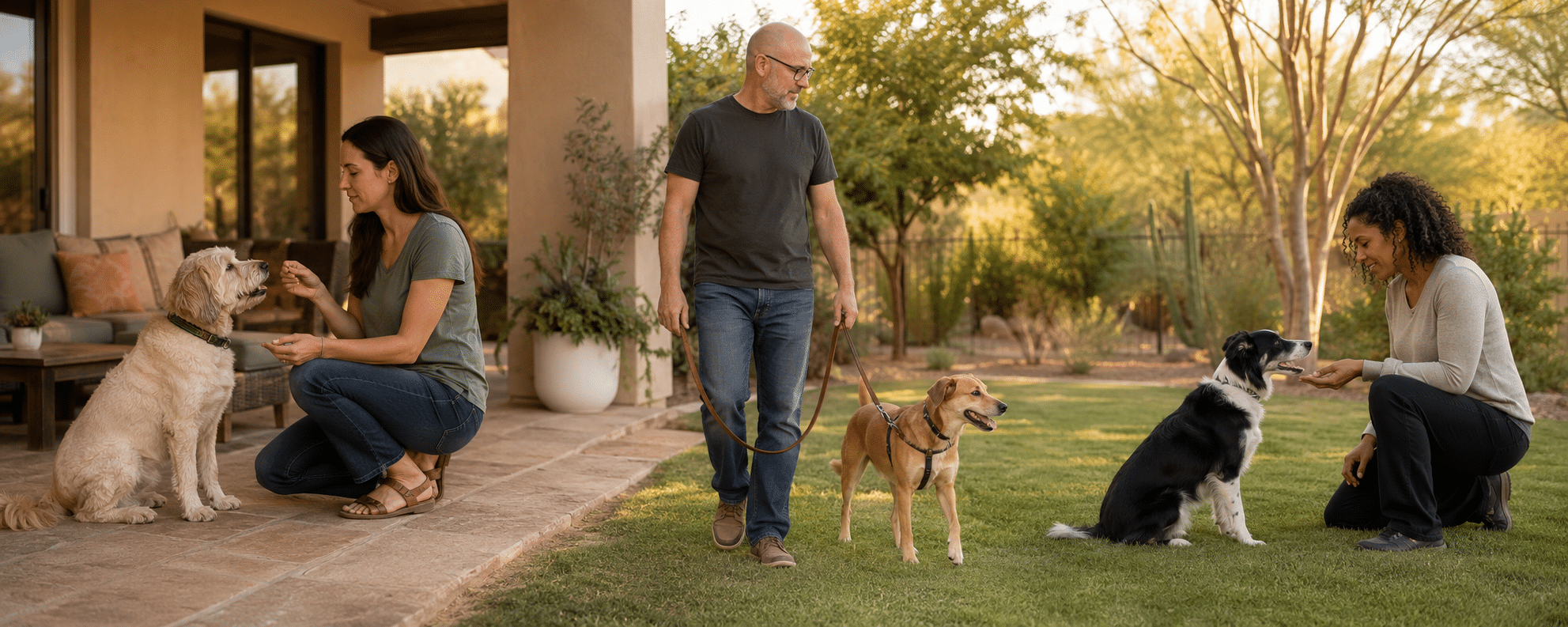
Force-free behavior modification services in Phoenix: three pet parents working with their dogs in a calm desert home setting, practicing counterconditioning, loose-leash walking, and positive reinforcement exercises with relaxed, comfortable dogs.

Dog Aggression Training Phoenix

For dogs who growl, snap, bite, lunge, guard resources, attack other dogs, or show defensive aggression toward people. Force-free, science-based behavior modification. Dog aggression page

Dog Anxiety Training Phoenix

For dogs with generalized anxiety, chronic stress, fear of people, environmental fear, panic, or poor recovery after stressful events. Dog anxiety page

Separation Anxiety Treatment

For dogs who panic when alone, vocalize, destroy doors or crates, self-injure, or cannot tolerate departures. Separation anxiety page

Reactive Dog Training Phoenix

For dogs who bark, lunge, scream, pull, or lose control around dogs, people, vehicles, bikes, or other triggers. Reactive dog page

Fear-Based Dog Aggression

For dogs whose aggression is driven by fear, defensive arousal, avoidance, trauma history, or repeated triggering. Fear-based aggression page

Behavior Modification Methodology

Comprehensive behavior modification for the most complex cases, combining desensitization, counterconditioning, environmental management, and structured training. Behavior modification page

Schedule a Behavior ConsultationBook a Free 15-Minute Call

Will Bangura, M.S., CAB-ICB, CBCC-KA, CPDT-KA, FDM, FFCP, certified canine behaviorist in Phoenix

Will Bangura, M.S.CAB-ICB, CBCC-KA, CPDT-KA, FDM, FFCP

Will Bangura is a Certified Canine Behaviorist, Applied Ethologist, and behavior consultant specializing in severe dog aggression, reactivity, anxiety, fear, phobias, separation anxiety, and complex canine behavior problems. With more than 35 years of experience, he works with pet parents throughout the Phoenix metropolitan area and worldwide through virtual behavior consultations. Will is Arizona’s only CAB-ICB Certified Canine Behaviorist through International Canine Behaviorists, and one of only three professionals in the United States to hold this credential. He holds a Master of Science degree in Psychology and completed postgraduate studies in canine cognition through Harvard University. In addition to his behaviorist credentials, Will is certified through the Certification Council for Professional Dog Trainers (CCPDT) as both a Certified Behavior Consultant Canine (CBCC-KA) and Certified Professional Dog Trainer (CPDT-KA). He is also a Fear Free Certified Professional (FFCP) and certified in Applied Ethology through Kim Brophey’s Family Dog Mediation (FDM) program. Will is the founder of Phoenix Dog Training, host of the Dog Training Today podcast, published author, public speaker, and expert witness in dog behavior and aggression cases. His work focuses on evidence-based, force-free behavior modification that addresses the underlying emotional causes of canine behavior problems rather than simply suppressing behavior through punishment.

Read Full Biography

See the work

Watch Will Bangura’s Dog Behavior Videos

Educational videos and case discussions on dog aggression, reactivity, fear, and how evidence-based, force-free behavior modification actually works.

Severe Aggression Case: A Different Path Forward

A severe aggression case showing how force-free behavior modification can help create a safer, more hopeful path forward.

Severe Aggression: Virtual Behavior Success

Aggression toward the pet parent and a serious bite history made worse by a balanced trainer using aversive tools. Treated entirely through virtual behavior consultations using force-free counterconditioning and desensitization. The case shows how careful virtual coaching, counterconditioning, and desensitization can help families work through serious aggression concerns.

Fear, Not Dominance: Dog Aggression Toward People Explained

When a dog growls at visitors, barks at strangers, lunges, snaps, or bites, the goal is not to suppress the warning signs. It is to understand the emotional state driving the behavior and change that emotional response through evidence-based behavior modification. This video explains fear-based aggression, stranger-directed aggression, and why punishment can make serious behavior problems worse.

Dog Aggression and Reactive Dog Training in Phoenix: Behavior Modification vs Corrections

Will Bangura, M.S., explains the difference between real behavior modification and correction-based training. Stopping a visible behavior is not the same as resolving the fear, anxiety, stress, or perceived threat underneath it. This video covers why a quiet dog can still be unsafe, how aversive methods can worsen fear-based aggression and reactivity, and how counterconditioning and desensitization change the emotional response driving the behavior.

Authority signals

Will Bangura in the Media

Recognized nationally as an authority on canine behavior, force-free methodology, and applied behavior science.

Podcast Host

Host of Dog Training Today, a podcast on canine behavior, force-free training, and applied behavior science. Listen to the podcast

Published Author

Author of Sniff to Soothe and contributing writer on canine behavior, aggression treatment, and ethical training methods. Sniff to Soothe

Expert Witness

Retained as an expert witness in dog bite cases, behavior assessments, and litigation involving canine behavior questions.

Public Advocate

Public advocate for force-free training and against the use of aversive equipment. Author of position papers on aversive dog training methods. Read position papers
There is a path forward

Get Expert Help for Your Dog’s Behavior

If your dog is struggling with aggression, anxiety, fear, separation anxiety, leash reactivity, dogs fighting in the home, or another serious behavior problem, the next step is a careful behavior consultation with a qualified specialist. Phoenix Metro in-home and virtual nationwide.

Email: info@phoenixdogtraining.com

Phoenix Metro and beyond

Dog Behaviorist Serving Phoenix and the Metro Area

In-home behavior consultations available throughout the Phoenix Metro area. Virtual consultations available nationwide and worldwide for aggression, anxiety, fear, separation anxiety, leash reactivity, and related behavior concerns.

Sonoran desert sunset over the Phoenix metro area, with mountains, saguaro cacti, and valley neighborhoods, representing the Phoenix and metro area communities served by certified canine behaviorist Will Bangura.
Schedule a Behavior Consultation