
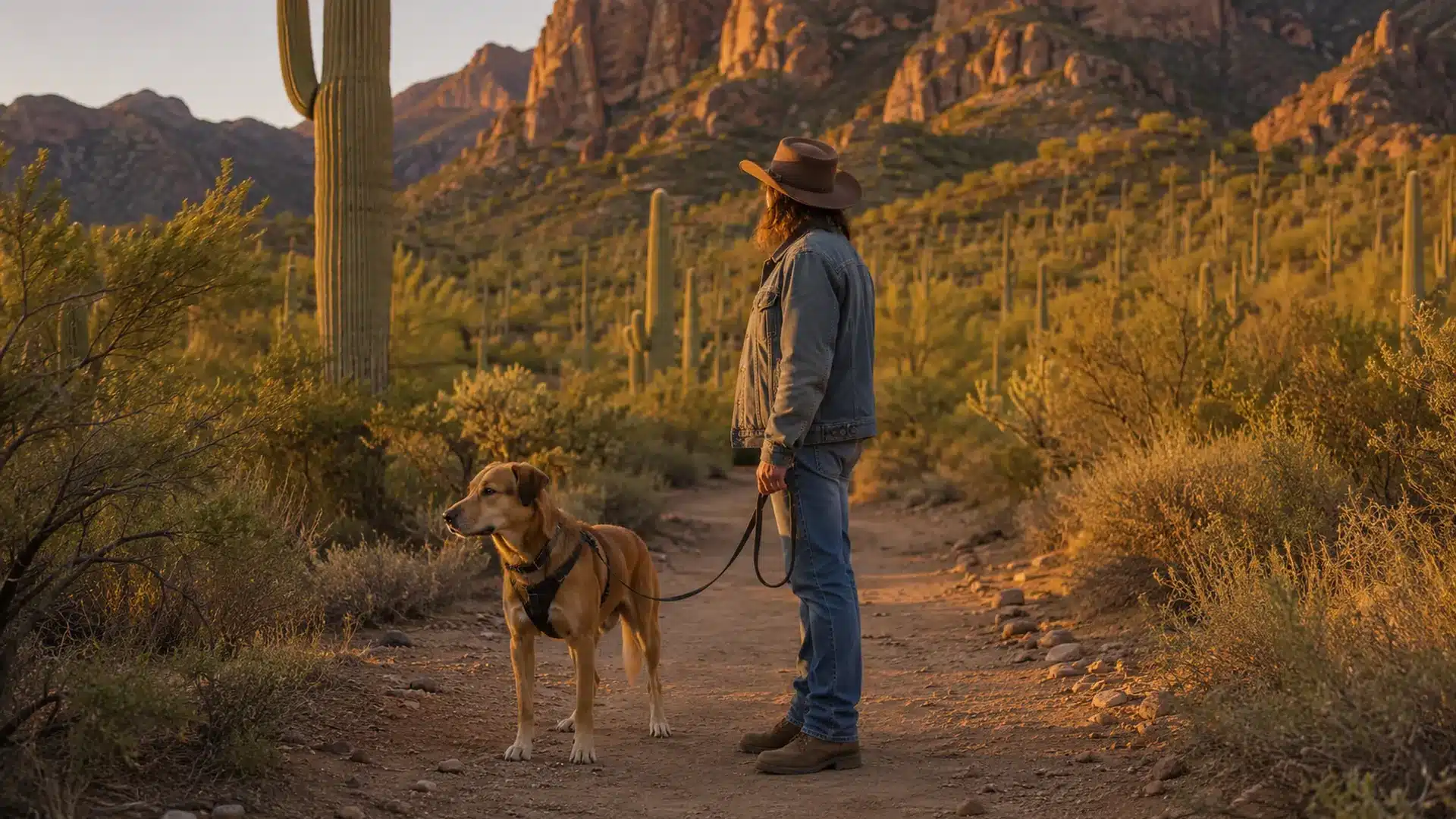
Dog Behaviorist in Cave Creek, AZ for Aggression, Anxiety, and Reactivity
Cave Creek calls itself one of the most dog-friendly towns in Arizona, and it earns the title, with dogs on patios up and down the strip and trailheads in every direction. That makes it a hard place to love a dog who cannot join in: a dog who explodes at other dogs, charges the fence when horses pass, comes apart when the motorcycles roll through, or destroys the house every time it empties. Those are not disobedience problems. They are emotional problems, and no amount of obedience practice changes an emotion.
I am Will Bangura, a Certified Canine Behaviorist with a Master's Degree in Psychology and more than 35 years of clinical experience in serious behavior cases. My work with Cave Creek pet parents targets the fear, anxiety, frustration, or panic underneath the behavior, using force-free, evidence-based behavior modification, because when the emotion changes, the behavior follows and stays that way.
No shock. No prong. No fear.

Arizona's only CAB-ICB Certified Canine Behaviorist through International Canine Behaviourists, and one of only three in the United States, with more than 35 years of experience working with severe aggression, fear, anxiety, reactivity, and complex canine behavior cases. Will holds a Master of Science in Psychology and is certified in Applied Ethology, a Certified Behavior Consultant Canine and Certified Professional Dog Trainer through the CCPDT, and a Fear Free Certified Professional.
By identifying the underlying causes of aggression, anxiety, and other behavior problems and improving emotional regulation, Will helps pet parents across Cave Creek and the Phoenix metro area build safer, calmer, and more predictable relationships with their dogs. He is the author of Sniff to Soothe and the host of the Dog Training Today podcast.
M.S.
Psychology, Behavioral Focus
CAB-ICB
Certified Canine Behaviorist
CBCC-KA
Certified Behavior Consultant Canine
CPDT-KA
Certified Professional Dog Trainer
FDM
Applied Ethology / Family Dog Mediation
FFCP
Fear Free Certified Professional
What People Are Saying


Why the Training You Already Tried Did Not Work
Most Cave Creek families who reach me have already done things right. There was a class. There was a trainer. There were months of practice, and the cues work fine in the kitchen. Then a horse comes around the bend, or another dog appears at the trailhead, and none of it exists anymore. The dog is not being defiant. The dog is over threshold, and skills do not run in a brain that is busy surviving.
Obedience teaches a dog what to do. It cannot teach a dog what to feel, and serious behavior problems are made of feelings: fear, anxiety, frustration, panic. Changing those requires a functional behavior assessment, management that prevents the behavior from being rehearsed, and systematic desensitization and counterconditioning conducted below the threshold where the dog can still learn. That is behavior modification, and it is a different profession from training.
A dog rehearsing panic or rage is not learning anything you are teaching. The emotional state has to change first; the reliable behavior is what grows out of that change.
Serious Behavior Problems I Help Cave Creek Pet Parents Resolve
Every problem in this grid runs on an emotion underneath, and every one has a humane, evidence-based treatment path.

Aggression toward people
Growling at reaching hands, snapping at guests, a bite that changed everything. Aggression is a distance-increasing strategy driven by fear or conflict, and treating the driver, not punishing the display, is what makes homes safe again.

Dog-to-dog aggression and leash reactivity
Barking, lunging, and spinning at the end of the leash while the other handler stares. Reactivity is an emergency response, not rudeness, and it changes fastest through distance, management, and counterconditioning.

Dogs fighting in the same home
Housemate fighting escalates on its own schedule, never on yours. The plan starts with total separation to stop the rehearsal, then rebuilds coexistence step by measured step under an assessment-driven protocol.

Resource guarding
A stiff body over the food bowl, a growl over the bully stick, teeth over a stolen sock. Guarding is a prediction that the good thing is about to vanish, and changing the prediction dissolves the behavior.

Generalized anxiety
Some dogs are never fully off duty: pacing, scanning, startling, shadowing you from room to room. That is a nervous system stuck in high idle, and lowering the baseline comes before anything else can work.

Separation anxiety
Hours of howling nobody hears, gouged door frames, a dog drenched in drool at your return. Separation anxiety is panic, and panic has a specific, gradual, highly effective treatment protocol.

Fear and phobias
The dog who hides from visitors, balks at the truck, or refuses to walk past a certain corral. Fear shrinks a dog's world, and careful sub-threshold work, never flooding, gives that world back.

Storm, fireworks, and noise sensitivity
Between monsoon season, rodeo week, and the packs of motorcycles on a Saturday, this is a loud town. Noise phobias deepen when untreated; safe havens, sound protocols, and veterinary partnership turn the volume down.
Also within scope
- Fixation on horses, goats, and backyard livestock
- Fence-line charging along rail and pipe fencing
- Loose-dog encounters at trailheads and washes
- Overwhelm on busy patios and the downtown strip
- Handling, grooming, and veterinary visit fear
- Compulsive spinning, licking, and light chasing
- Coyote, javelina, and snake arousal
- Doorbell and visitor panic
What a Certified Canine Behaviorist Does That Training Cannot

Anyone in Arizona can print business cards that say dog trainer, and no law asks them to know anything about behavior. That vacuum is exactly why credentials matter when the problem is a bite, a phobia, or a dog in panic. I bring a Master of Science in Psychology, board certification as a canine behaviorist through International Canine Behaviorists, certification in Applied Ethology, both the CBCC-KA and the CPDT-KA through the CCPDT, Fear Free certification, and more than 35 years of casework to these problems.
The starting point is never a technique. It is a functional behavior assessment that maps the antecedents, the behavior itself, the consequences maintaining it, and the job the behavior performs for your dog, with health examined closely, because pain quietly fuels a striking percentage of behavior cases. The plan then layers management, skill building, and structured emotional change, the framework I call The EASE Method, and my behaviorist services across the Phoenix metro area follow the same clinical logic.
If a case needs a veterinary diagnosis or medication support, I will tell you directly and coordinate with your veterinarian. Behavior work that ignores the medical side of the dog is guesswork.
Dog Aggression Help in Cave Creek

On acre lots with open fencing, aggression often announces itself along the property line: charging the rail fence at passing riders, exploding at the neighbor's loose dog, guarding the porch from anyone on foot. Inside the house it looks like growling over space, stiffening around guests, or a bite that arrived, in hindsight, after weeks of ignored warnings. Every one of those behaviors is functional. It is a dog using the only tool that has reliably made frightening things go away.
Treatment begins with an assessment and a genuine safety plan, then management that shuts down the daily rehearsal while the emotional driver is addressed. Sub-threshold exposure and counterconditioning change what the trigger predicts, and reinforcement gives your dog safer behaviors that accomplish the same goal. Nothing in that sequence requires force, and everything in it is measurable. The full clinical breakdown lives on my dog aggression training page.
A dog who has bitten is not a lost cause, and a growl is not defiance. Both are information, and treating the source of the information is how the danger actually goes down.
Leash Reactivity Around Dogs, Horses, and Trail Life

Reactivity in Cave Creek has a longer trigger list than in most towns. Other dogs, yes, but also horses passing on the road shoulder, riders on shared trails, loose dogs drifting out of rural yards, cyclists dropping down Spur Cross Road, and the sensory wall of the downtown strip on a live-music night. Many reactive dogs here trace their story to one bad moment, a loose dog that rushed them at a trailhead or a horse that appeared enormous and far too close. After that, the leash means trapped, and trapped means explode.
The work restores the sense of choice the leash took away. We establish the distance at which your dog can observe a trigger and still think, then pair that trigger with something she values until the emotion underneath flips. Alongside the emotional work, your dog learns usable trail skills: turning away on cue, settling off the path while riders pass, walking a clean arc past another dog on a narrow shoulder. The whole method is laid out in my science-based guide to fearful and reactive dogs.
Anxiety, Fears, and Phobias

Cave Creek is a loud, vivid place for a sensitive dog. Monsoon cells build over the Tonto high country and arrive with wind, pressure drops, and thunder. Rodeo week brings crowds, announcers, fireworks, and the scent of livestock through the whole town. Motorcycles pour up Cave Creek Road most weekends, and coyotes sing at night. A confident dog shrugs all of it off. An anxious or phobic dog lives braced for the next impact, and bracing is exhausting.
Real treatment does two things at once. It stops the fear from being rehearsed, through safe havens, sound management, and planning around the events calendar, and it changes the fear itself through desensitization and counterconditioning at intensities the dog can genuinely process. Some dogs also need medication support, arranged with your veterinarian, before learning is possible at all. The full set of protocols is on my dog anxiety training page.
Separation Anxiety Help for Cave Creek Dogs

Separation anxiety here often hides inside distance. On big lots the howling reaches nobody, the neighbors are too far away to complain, and the panic runs unwitnessed for hours, discovered only through a chewed door frame or a camera. Seasonal households add their own version: a winter of constant company at a golf casita, then a spring of long absences the dog never agreed to. What looks like spite or boredom is neither. It is a dog who cannot regulate alone.
The treatment is not a bark collar, a bigger yard, or a second dog. It is systematic desensitization to absence itself: departures rebuilt from durations the dog truly tolerates, pre-departure cues stripped of their meaning, and the panic never allowed to rehearse while tolerance grows. Progress gets tracked in minutes and then in hours, and because the target behavior only happens when nobody is home, this is the one problem where virtual work is the strongest format. The complete program is on my separation anxiety training page.
Why Shock, Prong, and Intimidation Make Serious Behavior Worse
The argument against shock, prong, and choke tools is not sentimental. It is arithmetic. A tool changes behavior only if the dog works to avoid it, and a dog only works to avoid what hurts or frightens him. Take away the pain and fear, and the tool is inert. Keep them, and you are treating a fear problem by adding fear.
What punishment buys is silence, not safety. The lunge disappears while the feeling that produced it stays, now with a fresh association attached to whatever the dog was looking at when the correction landed. Study after study, across countries, methods, and populations, points the same direction: higher stress markers, greater aggression risk, weaker relationships between dogs and their families. Converging evidence is the strongest kind of evidence, and it is why this practice is force-free without exception.

Behavior Consultations for Cave Creek
Whether a case should begin virtually or in your home is a clinical call based on the behavior, the safety picture, and what needs to be observed. Either way, the plan gets built around your dog's actual life, from a casita at Rancho Mañana to five acres and a barn out toward Lone Mountain.
Virtual Behavior Consultation
Live video sessions, and the clinically preferred format for separation anxiety, since the problem behavior only occurs when the house is empty. Also the right call for many fear cases where a stranger's presence would bury the behavior we need to see. Available to Cave Creek families and to pet parents nationwide.
Book a Virtual ConsultationIn-Home Behavior Consultation
I come to you and read the environment directly: the fence lines, the sight lines to the road, the layout that funnels two dogs into conflict, the doorway where the trouble starts. When the behavior is woven into the property or the household, this is the stronger starting point.
Book an In-Home Consultation
Know what you need? Book directly. Not sure? The free call exists for exactly that.
Behavior Help Across Cave Creek

Cave Creek spreads across nearly thirty-eight square miles, and I work in all of it: Rancho Mañana and the casitas around the golf course, Dove Valley Ranch and Villagio, Tatum Ranch and Tatum Highlands on the south side, the acre-plus horse properties of Lone Mountain and the Desert Foothills, Tonto Hills up against the national forest, Montevista, Surrey Hills, and the bungalows within earshot of the strip, plus neighboring Carefree and the Desert Hills and New River edges of town.
The town's dog-friendly identity deserves honest words. When every patio welcomes dogs and every trailhead fills with them, a pet parent with a reactive or fearful dog ends up living outside the town's entire social life, declining invitations and walking at strange hours. That isolation is part of what I treat. The goal is never a dog who tolerates the strip on day one; it is a steady, criteria-driven path back toward the life this town was built for.

Rural life writes its own case files. Dogs here rehearse fence-line charging at horses and riders every single day, fixate on the neighbor's goats, spin up at coyote song, and sensitize to the wash where the javelina crossed once. None of that is stubbornness. Each is a learned pattern with a trigger, a payoff, and a history, which means each can be mapped by a functional assessment and changed on purpose.
Behavior work is half detective work, and the medical chapter cannot be skipped, since pain and illness sit quietly behind a remarkable number of sudden behavior changes. Cave Creek makes collaboration easy, because the veterinary community is right in town. Dr. Mike Kedrowski at Lovet Pet Health Care in Dove Valley has been a trusted colleague of mine for years on exactly these overlap cases. Pet parents whose dogs are seen at Animal Health Services of Cave Creek, Carefree Animal Hospital, Desert Forest Animal Hospital, which has practiced with a fear-free orientation for decades, or any other local clinic will find that I loop the veterinary team in on rule-outs and, when useful, on medication support for the behavior plan.
Start With Your Dog's Story
A few sentences about your dog and what daily life looks like right now is all it takes, and I will reply personally.
Frequently Asked Questions
Is there a dog behaviorist in Cave Creek, AZ?
Yes. Will Bangura, M.S., CAB-ICB, serves all of Cave Creek with in-home behavior consultations, from Rancho Mañana and Dove Valley Ranch to Tatum Ranch, Lone Mountain, Tonto Hills, and the rural Desert Foothills, plus virtual consultations. He is Arizona's only CAB-ICB Certified Canine Behaviorist through International Canine Behaviourists and one of only three professionals in the United States who hold the credential.
What is the difference between a dog trainer and a dog behaviorist?
A trainer builds skills: sit, stay, recall, loose-leash walking. A certified canine behaviorist treats emotional and clinical problems: aggression, reactivity, anxiety, phobias, panic when left alone, and guarding. Those problems are not caused by missing skills, so more training does not fix them. They are treated through functional assessment, management, and behavior modification that changes how the dog feels about the trigger.
Can dog aggression be fixed without shock or prong collars?
Yes. Modern aggression treatment works through assessment, safety planning, management that prevents rehearsal, and desensitization and counterconditioning that change the emotion driving the aggression. Shock and prong collars can interrupt the display, but the research connects them to elevated stress and increased aggression risk, and a dog punished for warning learns to skip the warning, which makes bites less predictable rather than less likely.
Is board and train a good option for aggression or separation anxiety?
For serious behavior problems, rarely. Aggression, reactivity, and separation anxiety are emotional responses tied to specific triggers and contexts, and most of those triggers exist at home and in your daily routine, not in a kennel. A dog can perform beautifully at a facility and fall apart the first week back, because the emotions were never treated where they live. Results built on suppression tend to decay or resurface as something worse. Lasting change happens in the real environment, with the family coached as part of the plan.
My dog barks and lunges at other dogs on walks. Can that be fixed?
Yes, and leash reactivity is among the most treatable problems I see. Treatment combines distance management, counterconditioning below threshold, and practical skills such as turning away calmly and passing on narrow shoulders. In Cave Creek the plan also has to account for horses, loose rural dogs, and busy trailheads, which is why it gets built around the routes you actually walk.
My dog goes crazy when horses pass our property. Can you help?
Yes. Fixation on horses, whether it looks like fence-line charging, frantic barking, or lunging on the road shoulder, is a mix of arousal, frustration, and sometimes fear, and it rehearses itself daily on a horse property. The plan manages the fence line and sight lines first so the pattern stops practicing, then uses gradual exposure and counterconditioning so a passing horse stops flipping the switch. Dogs can learn genuine calm around horses, and in this town they need to.
How do I stop my two dogs from fighting with each other?
Fighting between household dogs is one of the most urgent cases I take, because every fight makes the next one more likely and more intense. The first move is full separation and a management structure that removes the flashpoints. Then an assessment identifies what actually triggers the conflict, and a staged reintroduction rebuilds safety with clear criteria at every step. Do not test the dogs together to see whether things have improved; that is how the serious injury happens.
Can you help with resource guarding?
Yes. Guarding food, chews, toys, stolen items, resting spots, or a person is a prediction problem: the dog expects the valued thing to be taken. Management first removes the daily confrontations, and then structured exercises teach a new prediction, that a person approaching means something better is coming. Punishing a guarder confirms the fear behind the guarding and reliably makes it worse.
How is separation anxiety treated?
Separation anxiety is treated as what it is, panic, with a systematic desensitization program. Absences are rebuilt from a duration the dog can genuinely handle, the cues that predict departure are defused, and the panic is prevented from rehearsing while alone-time tolerance grows in measured steps. It is gradual and it is very effective, and because the behavior only occurs when nobody is home, it is treated best through virtual consultations with camera observation.
My dog panics during monsoon storms, fireworks, and loud motorcycles. Can that be treated?
Yes. Noise phobias respond to a combination approach: a safe haven the dog chooses, desensitization and counterconditioning to sounds at manageable volumes, planning around predictable noise such as monsoon season, rodeo week, and motorcycle weekends, and medication support through your veterinarian for the dogs who need it. Untreated noise phobia usually broadens and deepens over time, so starting early matters.
Do you work with dogs who have a bite history?
Yes, frequently, and a bite history is exactly when professional help matters most. The assessment reconstructs each incident, the warning signs around it, and any medical contributors, and the plan combines strict prevention of the bite scenario with treatment of the emotion underneath it. A bite changes the safety planning; it does not end the possibility of a safer, calmer dog.
Do you come to homes in Cave Creek?
Yes. In-home consultations cover every part of Cave Creek, including the horse properties, the golf communities, and the town center, along with Carefree, North Scottsdale, and the wider Phoenix metro area. On rural properties an in-home visit often earns its keep immediately, because fence lines, corrals, sight lines, and layouts explain behaviors that no phone description ever could.
How do virtual behavior consultations work?
You complete a detailed history first, and then we meet live on video to review the assessment and build the plan, with follow-up support as the work progresses. Virtual is the top choice for separation anxiety, a strong choice for many fear and aggression cases where a visitor would suppress the behavior, and the practical choice for seasonal residents who split the year between Cave Creek and somewhere else.
How much does a dog behavior consultation cost?
A virtual behavior consultation is $350, and an in-home behavior consultation is $595. If you are unsure where to start, book the free 15-minute call and we will figure out the right format for your dog together.
Meet Your Certified Canine Behaviorist
Will Bangura, M.S., CAB-ICB
CBCC-KA, CPDT-KA, FDM, FFCP
Will Bangura is a Certified Canine Behaviorist and behavior consultant with advanced training in applied ethology, specializing in severe dog aggression, reactivity, anxiety, fear, phobias, separation anxiety, and complex canine behavior problems. With more than 35 years of experience, he works with pet parents throughout Cave Creek and the greater Phoenix metropolitan area, and worldwide through virtual behavior consultations.
Will is Arizona's only CAB-ICB Certified Canine Behaviorist through International Canine Behaviorists, and one of only three professionals in the United States to hold this credential. He holds a Master of Science degree in Psychology and completed postgraduate studies in canine cognition through Harvard University.
In addition to his behaviorist credentials, Will is certified through the Certification Council for Professional Dog Trainers (CCPDT) as both a Certified Behavior Consultant Canine (CBCC-KA) and Certified Professional Dog Trainer (CPDT-KA). He is also a Fear Free Certified Professional (FFCP) and certified in Applied Ethology through Kim Brophey's Family Dog Mediation (FDM) program.
Will is the founder of Phoenix Dog Training, host of the Dog Training Today podcast, published author, public speaker, and expert witness in dog behavior and aggression cases. His work focuses on evidence-based, force-free behavior modification that addresses the underlying emotional causes of canine behavior problems rather than simply suppressing behavior through punishment.
Ready for Real Behavior Help in Cave Creek?
Some of the hardest work a pet parent ever does is invisible: the rerouted walks, the managed doorways, the constant vigilance. You should not have to carry a serious behavior problem alone, and you do not have to choose between your dog and your peace.
Real change starts with an assessment by someone who has spent more than 35 years inside exactly these cases. One conversation is the whole first step.
Or call (602) 769-1411