
← Dog Body Language: The Definitive Guide
The Definitive Guide · Calming SignalsDog Calming Signals: The Diplomacy Written Into Every Dog
Dogs are not just capable of avoiding conflict. They are brilliant at it. Calming signals are the peacekeeping vocabulary dogs use to defuse tension, soothe others, and settle themselves, and once you learn all 16, you can speak some of it back.
A Species Built to Keep the Peace
Dogs are social animals descended from social animals, and social living has one non-negotiable requirement: conflict has to stay cheap. Fights cost energy, injuries, and relationships, so evolution equipped dogs with an entire class of behaviors whose function is to prevent conflict before it exists: to signal peaceful intent, to defuse rising tension in another individual, and to regulate the dog's own arousal. Norwegian trainer Turid Rugaas, whose observational work popularized the term, called them calming signals, and the name has stuck across the profession because it describes exactly what they do.
Here is what makes this category different from the stress signals you may have just read about, and the two overlap enough that the distinction matters. A stress signal is largely involuntary leakage from an aroused nervous system. A calming signal is communication with a job: it is aimed at someone, deployed at a moment of social tension, and its purpose is to change the temperature of the interaction. The same physical behavior, a yawn, a ground sniff, a lip lick, can serve either function, and context tells you which one you are watching. A dog yawning alone in a scary exam room is self-regulating. A dog yawning while a tense, stiff dog approaches him at the park is sending a message: I am no threat, and you can stand down.
Why should a pet parent care about the peacekeeping vocabulary? Three reasons. First, calming signals are your earliest window into social tension, often firing before any stress signal appears, which makes them priceless for reading dog-dog interactions. Second, a dog throwing calming signals at you is giving you feedback about your own behavior: you are looming, you are too loud, the training session is too hard. Third, and this is the part most people never learn, you can use some of these signals yourself. A sideways turn, a slow blink, a deliberate yawn: dogs read our bodies constantly, and speaking even a little of their language changes what you are like to be around, especially for fearful dogs.
Soft Eyes: The Opposite of the Hard Stare
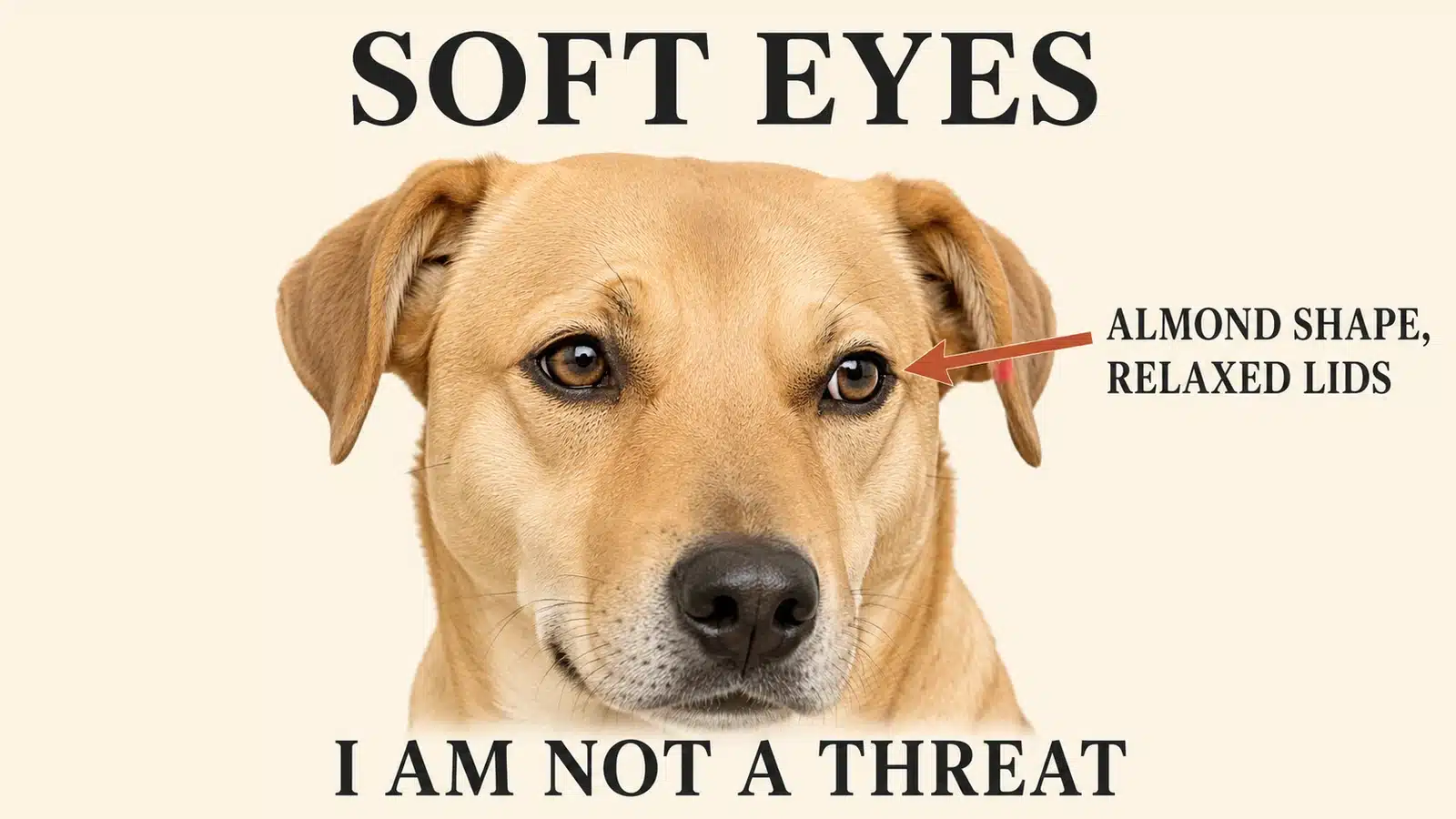
In dog language, the eyes carry enormous social weight, and hardness or softness is the axis that matters. A hard eye is round, fixed, unblinking, and direct: a threat. A soft eye is almond-shaped, loose-lidded, with a gaze that rests near things rather than drilling into them. Soft eyes are the resting face of a comfortable dog and an active signal of peaceful intent when directed at another individual during an interaction that could have gone either way.
For the pet parent, soft eyes are both a reading skill and a speaking skill. Reading: learn what your dog's soft eyes look like, because their disappearance, the moment the eye rounds and fixes, is one of the earliest transitions from comfort into concern you will ever detect. Speaking: your own direct, sustained stare is far more confrontational to a dog than most people realize, particularly to a fearful one. Softening your gaze, looking slightly past the dog, and blinking normally is one of the simplest kindnesses you can offer a nervous animal, and it costs nothing.
The Slow Blink: De-escalation, One Eyelid at a Time
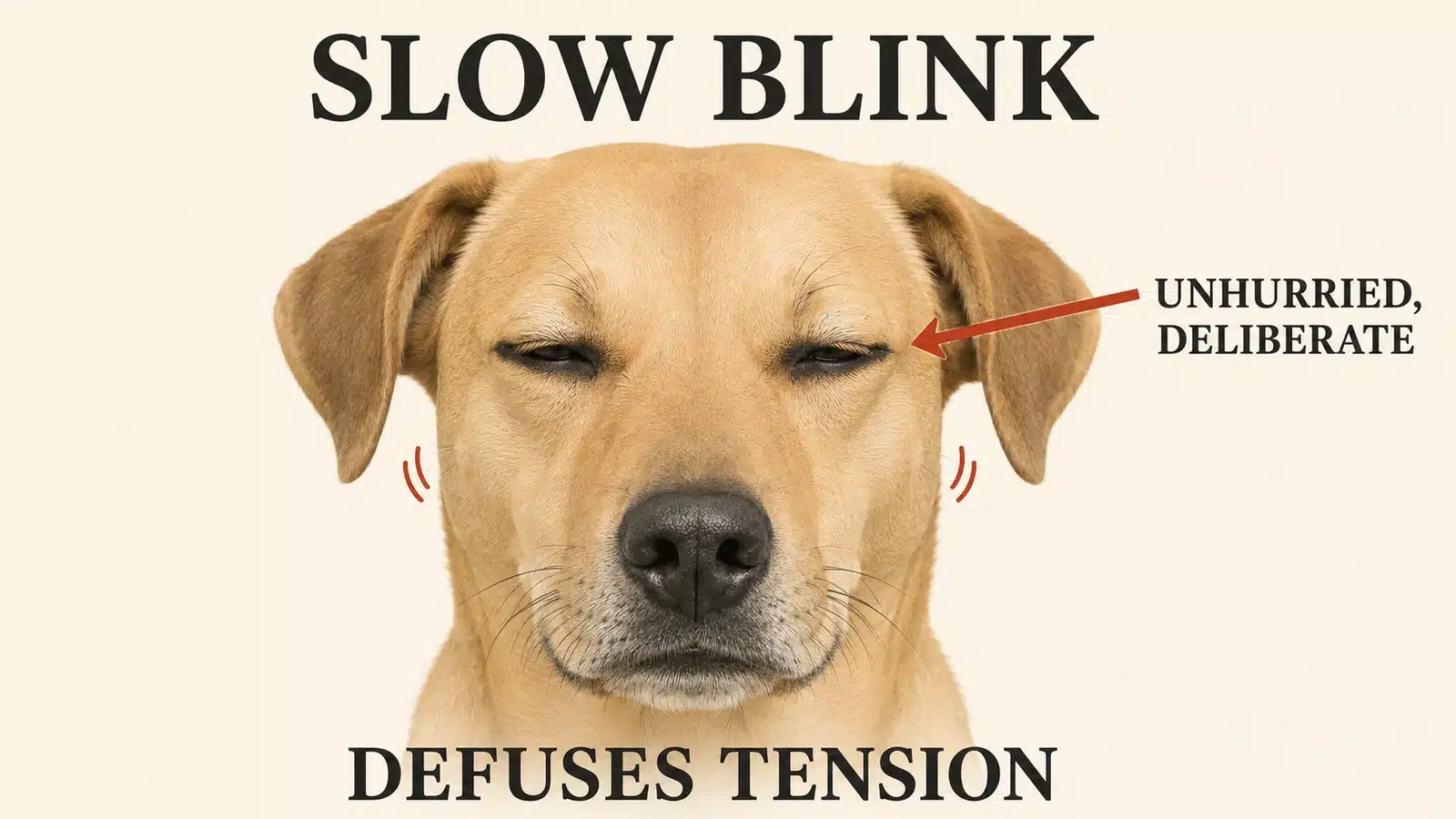
A blink is a fascinating thing to offer another animal, because for the fraction of a second the eyes are closed, the blinker is voluntarily blind. That is precisely what gives the slow, deliberate blink its meaning: I trust this situation enough to stop watching it. Dogs exchange slow blinks with each other during moments of mild tension, and they aim them at people, particularly when the person is staring, as a polite request to lower the intensity.
This is also one of the easiest signals for a human to speak fluently. With a nervous or unfamiliar dog, catch the dog's glance, then blink slowly and look softly away. Many dogs will visibly loosen, and some will blink back, which is one of the small quiet thrills of cross-species conversation. Combined with a sideways body angle and an unhurried manner, the slow blink belongs in the toolkit of every veterinary professional, groomer, shelter volunteer, and pet parent of a fearful dog.
The Head Turn: Looking Away as an Act of Grace
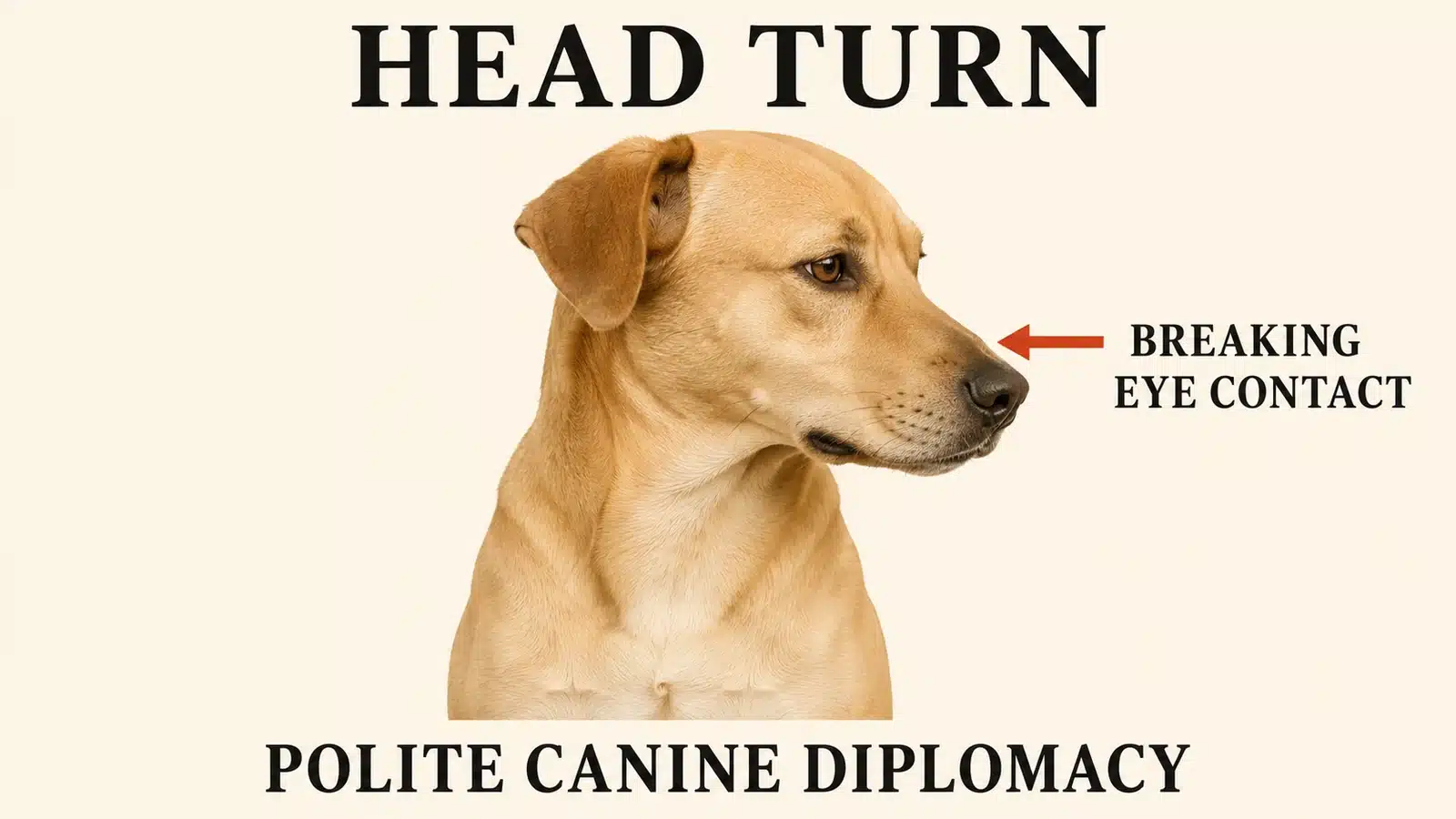
The head turn is the workhorse of canine diplomacy. The dog rotates his head to the side, sometimes a few degrees, sometimes a full ninety, presenting the cheek and breaking eye contact while the body stays put. Between dogs, you will see it constantly during greetings: two well-socialized dogs approaching each other will trade head turns like formal bows, each one declining the confrontation that a sustained face-to-face stare would constitute.
Directed at you, the head turn is feedback. Dogs turn their heads away from cameras pointed at their faces, from children rushing in, from faces looming down for a kiss, and from pet parents delivering a frustrated lecture. The message is consistent: this is too much, and I am politely declining it. The gracious response is to take the note, add a little space or soften your approach, and notice that the dog re-engages on his own almost immediately once the pressure lifts. A head turn honored is trust deposited.
Sitting to Calm: De-escalation by Changing Altitude
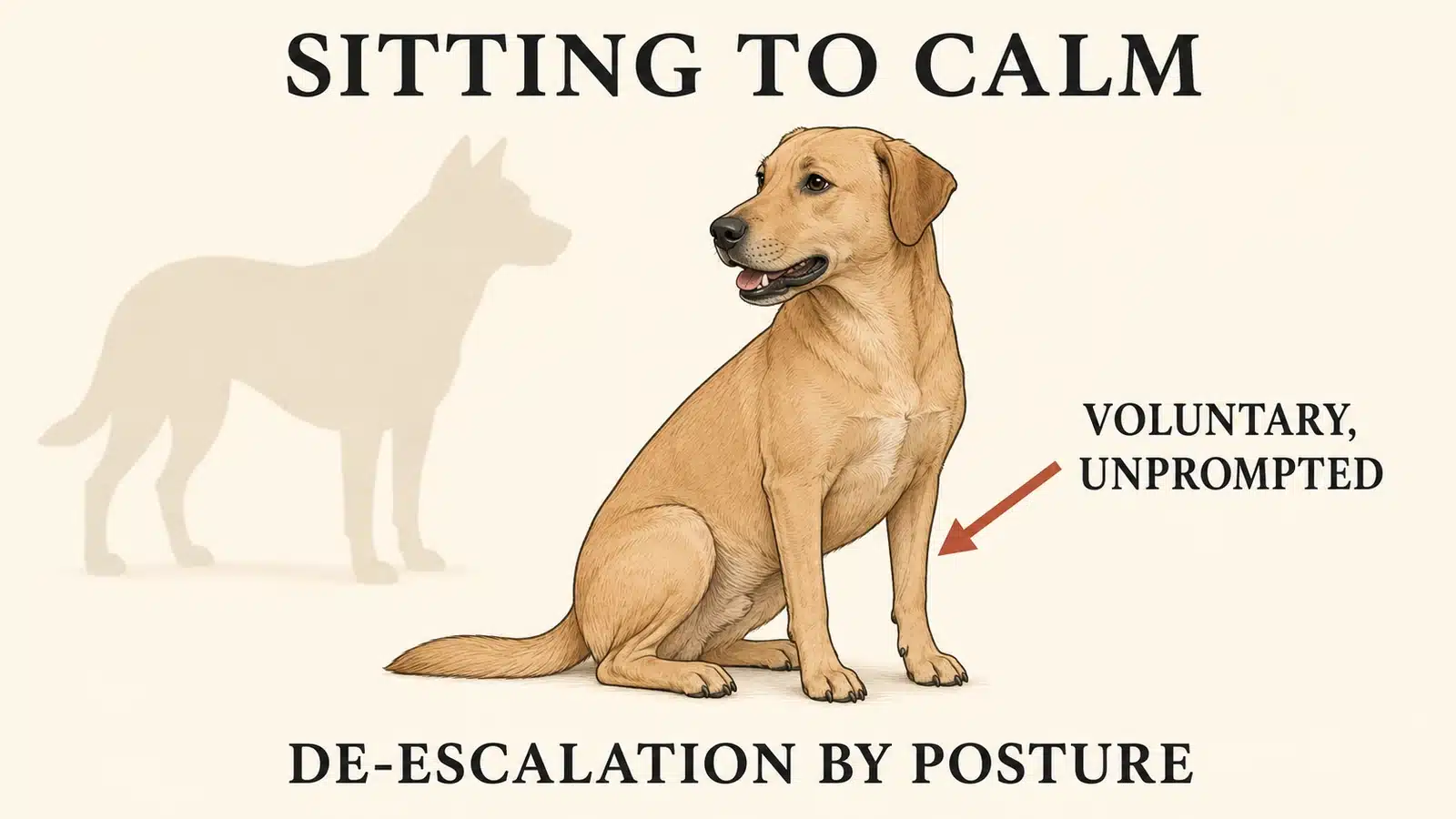
Nobody cued this sit. That is the detail that turns an ordinary posture into a calming signal. In a moment of social tension, an approaching dog, a rambunctious puppy who will not quit, a human argument happening across the room, a dog may simply sit down, sometimes angling his back toward the source of the tension. Lowering the body reduces the dog's own threat profile, and turning away removes the pressure of orientation. It is de-escalation through geometry.
You will see this signal do beautiful work in dog-dog encounters: a mature, socially skilled dog will often sit when a frantic adolescent comes barreling in, and the sit acts like a hand raised gently in a heated meeting. When your own dog offers an unprompted sit during chaos, read it as self-regulation and social effort, and reinforce the world for him by helping: intercept the puppy, calm the room, create the space he was asking for by sitting down in the middle of it.
Lying Down: The Strongest Statement of No Threat
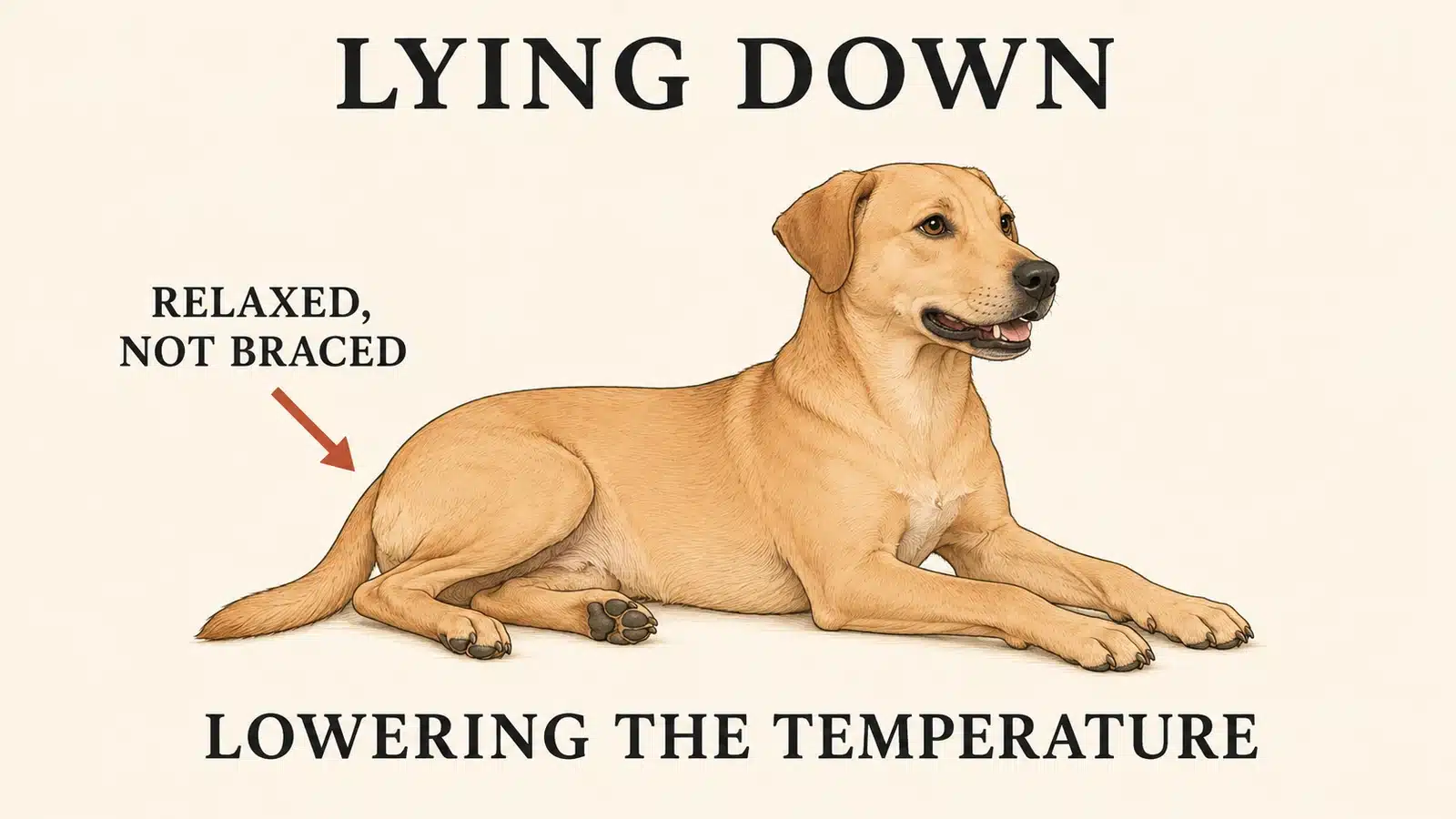
If sitting turns the volume down, lying down unplugs the amplifier. A dog who deliberately drops into a down during a tense interaction has taken the least threatening posture available to a standing animal, and it is a remarkably confident act when you think it through: he has surrendered mobility and height in the middle of uncertainty to make a statement about his intentions. Adult dogs use it liberally with puppies, whose social pardon it grants, and skilled dogs use it to switch off the intensity of a wound-up playmate.
Distinguish this settled, hips-rolled, soft-faced down from two look-alikes: the flattened, pressed-into-the-floor posture of fear, which comes with pinned ears and a clamped tail, and the coiled, frozen, sphinx-straight down of a dog stalking or guarding, which comes with a hard eye and loaded muscles. As always, the face and the muscle tone tell you which sentence the posture belongs to. The calming down is loose everywhere, and it usually arrives with a sigh.
The Ground Sniff: Fascinating Grass at Convenient Moments
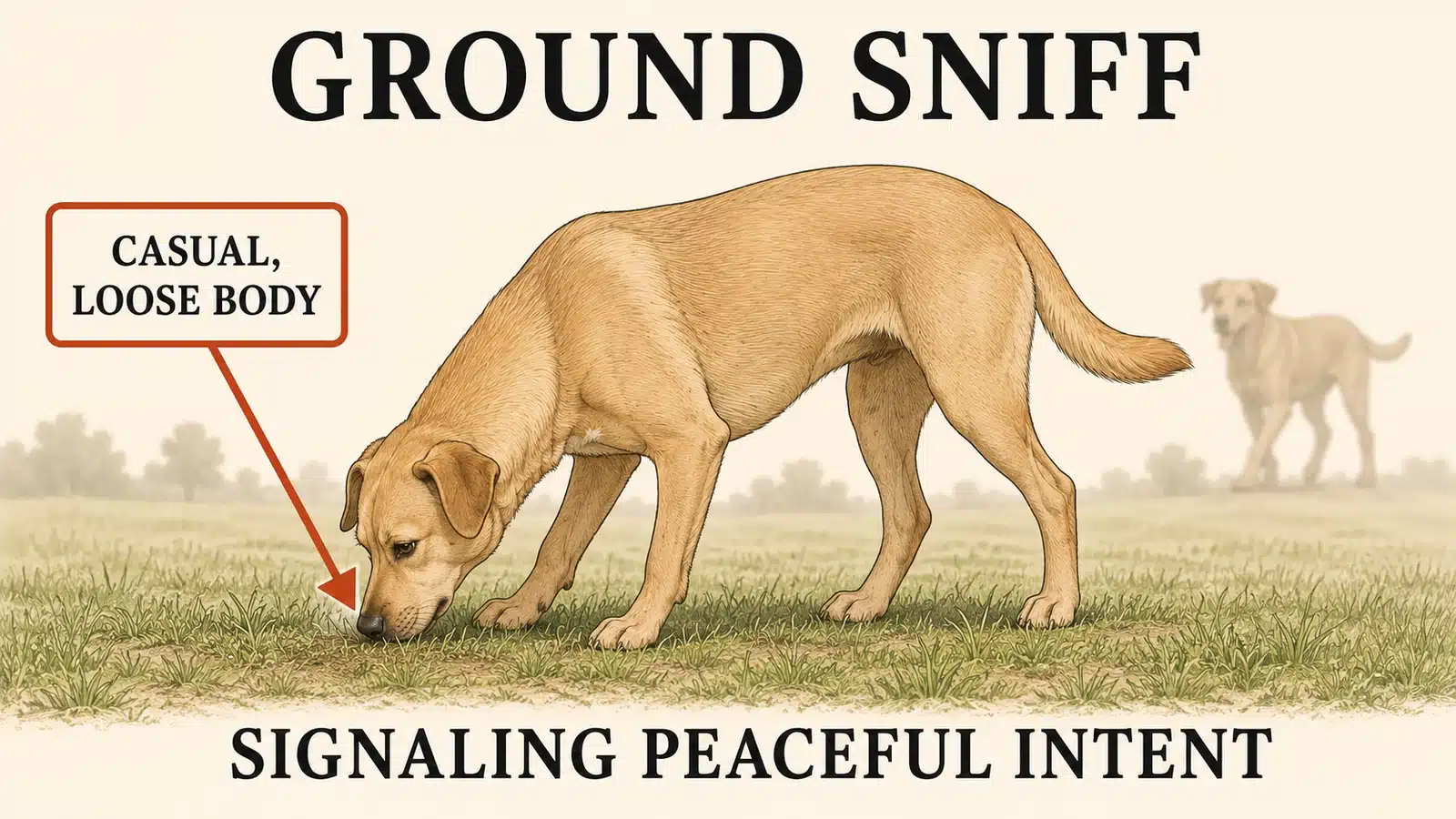
Watch two unfamiliar dogs approach each other in an open field and you will almost always see it: one or both suddenly discover something riveting in the grass, sniff for a few seconds, then continue the approach on a softer angle. The sniff punctuates the encounter, breaks the directness of the approach, and buys processing time, all while displaying total absorption in something other than the other dog. It is the canine equivalent of checking your phone to defuse an awkward elevator.
On leash, this signal is chronically misread as distraction or stubbornness, and pet parents drag their dogs away from exactly the behavior that was managing the encounter. When your dog sniffs as another dog approaches on a walk, he is often working, not dawdling: give him the moment, and better yet, add a curve to your path to help him. The overlap with displacement sniffing from the stress category is real, and the sorting rule is the same one as always: check the rest of the body. Loose and casual is diplomacy; tight and frantic is pressure.
The Shake-Off: A Dry Dog Hitting the Reset Button
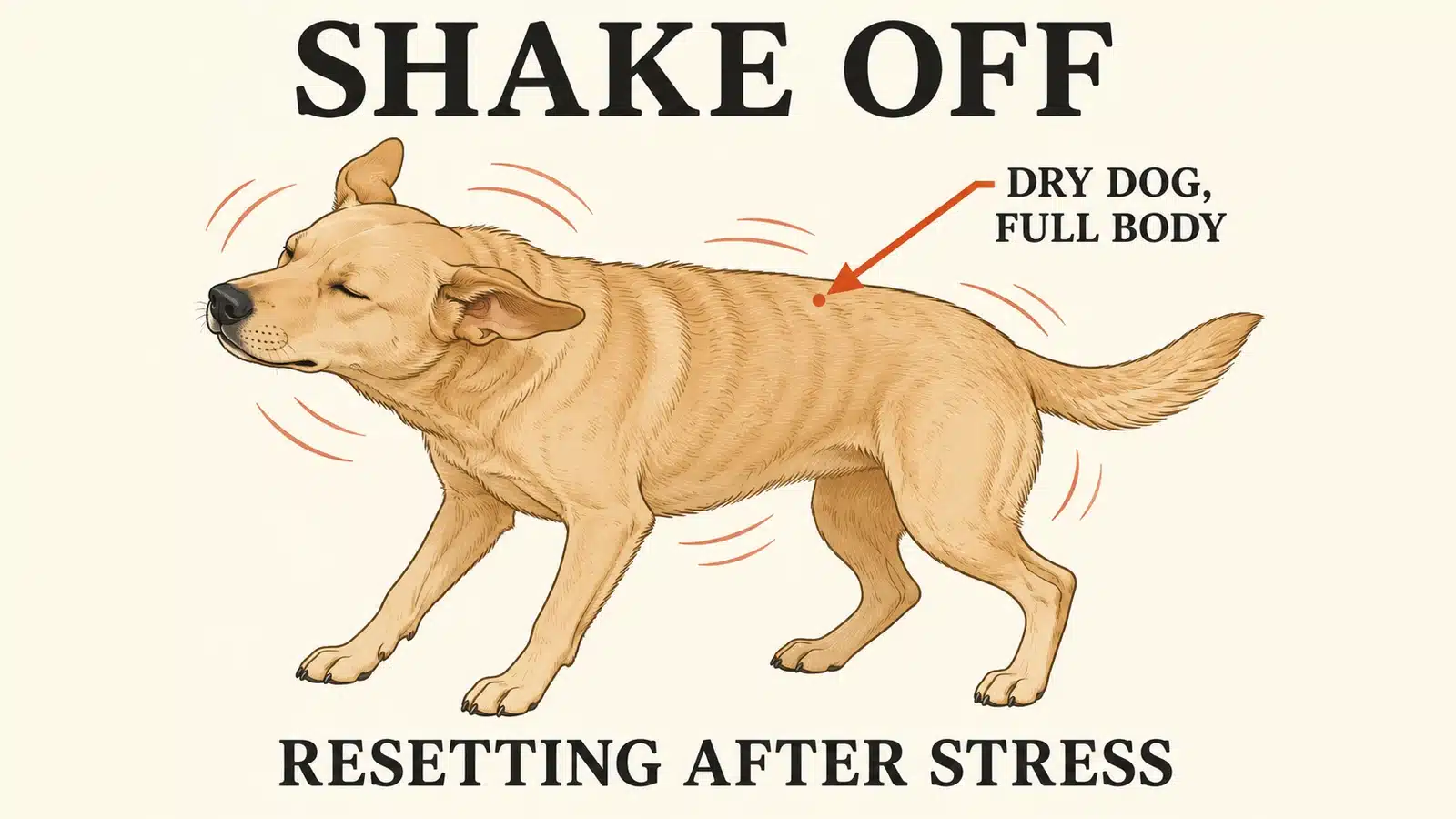
Every pet parent knows the wet-dog shake. The one to learn is the dry one. After a tense moment passes, an intense greeting ends, a hug is released, a wrestling match pauses, the vet's thermometer retreats, a dog will often perform a complete head-to-tail shake-off, exactly as if flinging off water that is not there. What he is flinging off is arousal. The shake marks the end of an emotional chapter, physically discharging the muscular tension the moment left behind, and it often functions socially as a punctuation mark that tells everyone present the episode is over.
The shake-off is one of the most useful signals in this entire guide for one practical reason: it timestamps stress you may not have noticed. If your dog shakes off every time a particular guest lets go of him, every time a certain dog walks away, every time you end a training session, the shake is drawing you a map of what he found stressful. Follow the map. In play, frequent shake-offs are a healthy sign of dogs self-regulating between rounds, one of the markers of good play covered in the play signals guide.
The Paw Lift: Hesitation Made Visible
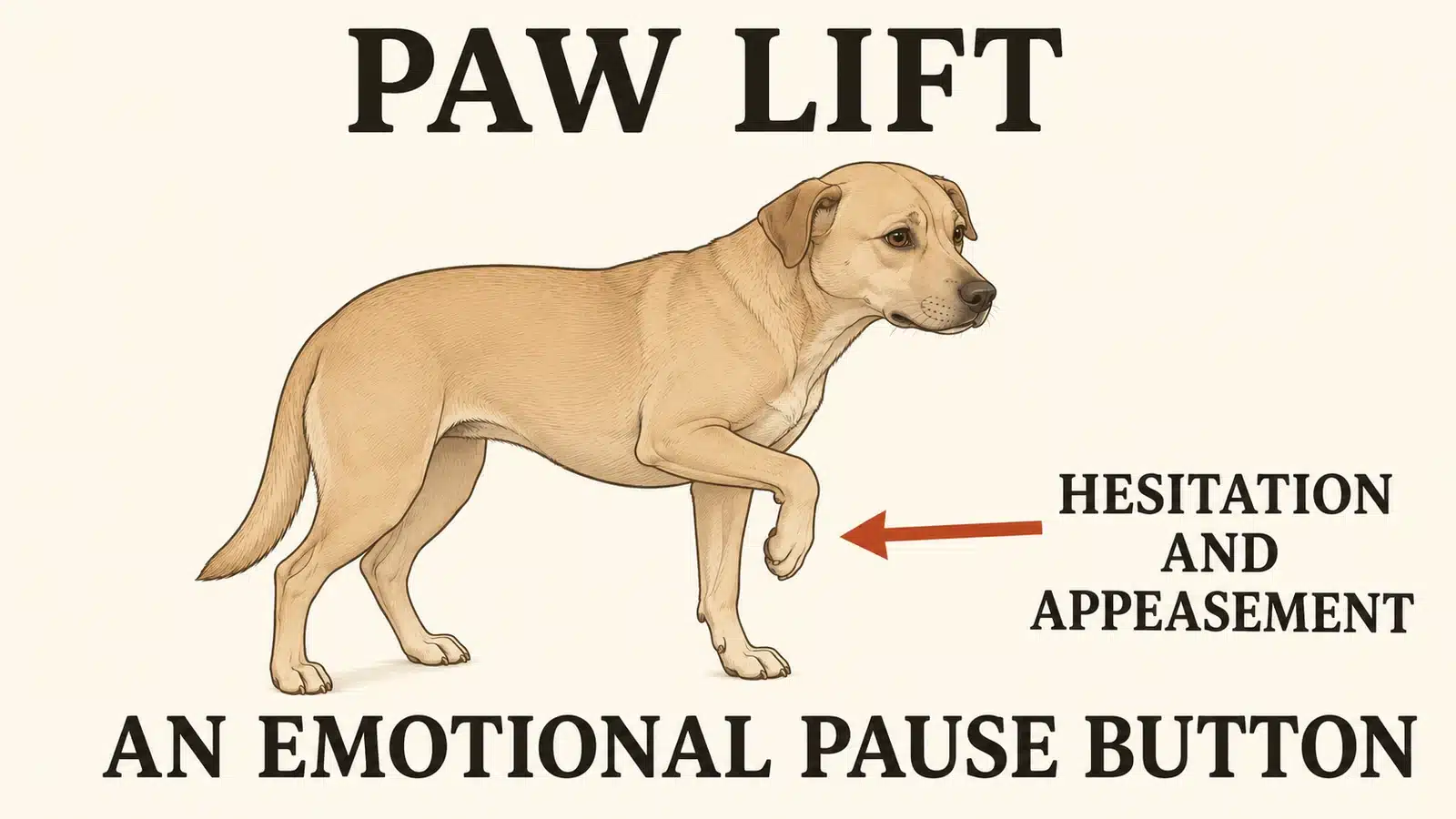
A single front paw rises off the ground and curls slightly at the wrist, and the dog holds it there, weight rocked back, everything else gone still and soft. The paw lift is the posture of a dog mid-calculation: uncertain, appeasing, buying a moment before committing to approach or retreat. You will see it in dogs meeting new people, in dogs being addressed in a tone they cannot decode, and in sensitive dogs any time the social arithmetic gets hard.
Context separates it from its cousins. Pointing breeds lift a paw as part of hardwired predatory sequence, feet freeze mid-stalk, and that version comes with intense forward focus, not softness. A persistently lifted paw on a walk can also mean a thorn, a torn pad, or pain, which is a body check, not a behavior read. The calming-signal version lives inside social moments and travels with soft eyes and half-back ears. When you see it, slow everything down: crouch, angle sideways, and let the dog finish the math on his own schedule.
The Curved Approach: Geometry as Good Manners
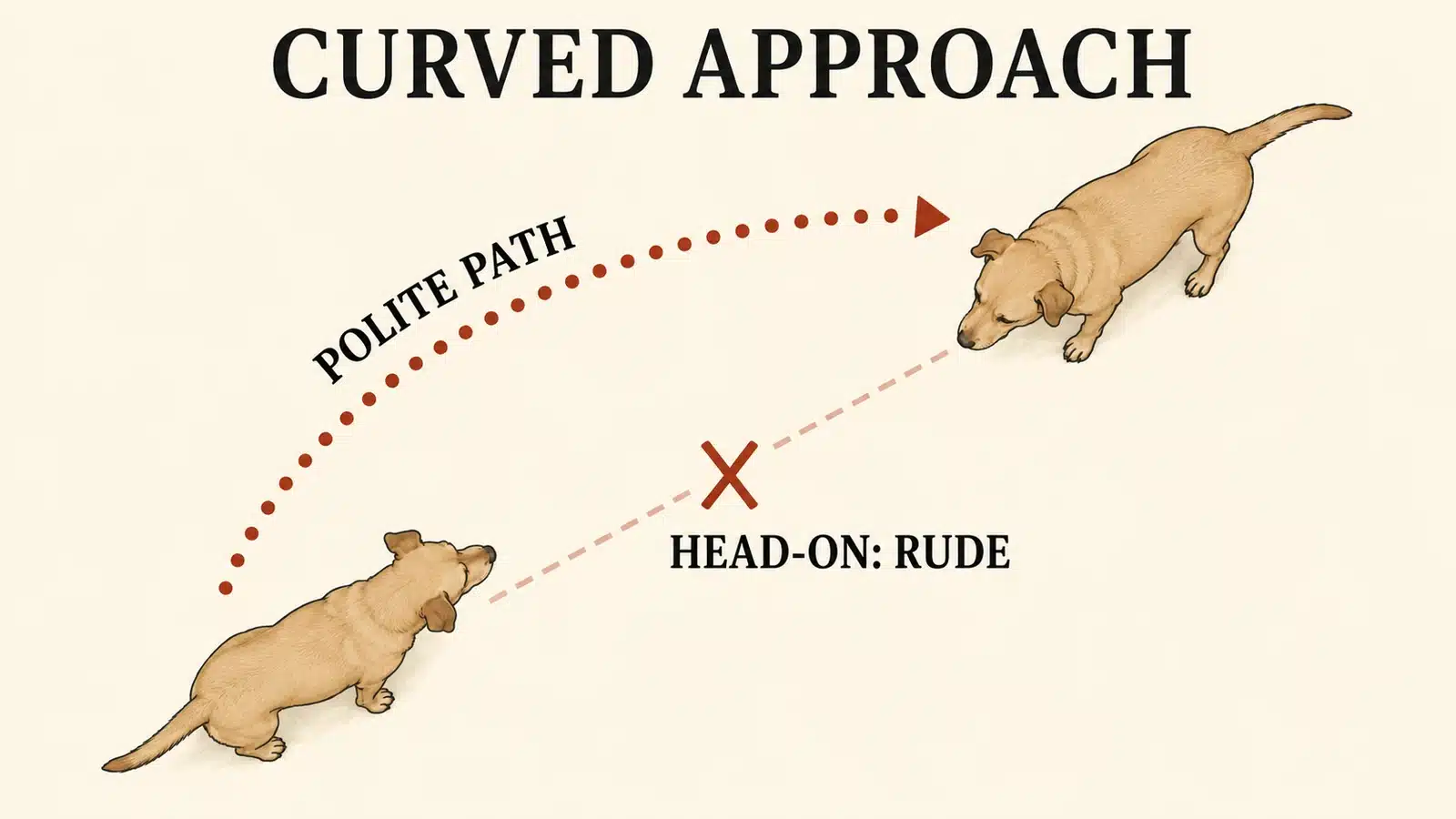
In dog etiquette, the straight line is rude. A direct, head-on, eye-locked approach is the trajectory of confrontation, so socially fluent dogs approach one another on an arc, curving their path, softening their orientation, and often adding a ground sniff or head turn along the way. Watch off-leash dogs with good social skills meet in a park and you will see the geometry drawn on the grass: two curves meeting at an angle, never two arrows meeting point-first.
This single signal explains an enormous amount of leash reactivity. Sidewalks force dogs into exactly the approach their language forbids: straight lines, head-on, no escape angles, tension traveling down the leash. Many dogs labeled reactive are dogs repeatedly forced into rude geometry with strangers. The fix is often literal: put curve back into the picture. Cross the street and arc around oncoming dogs, approach unfamiliar dogs on a banana-shaped path rather than a straight one, and let your own body angle sideways as you come in. You are not avoiding the situation. You are pronouncing it correctly.
Offering the Side: Turning Broadside to Prove a Point
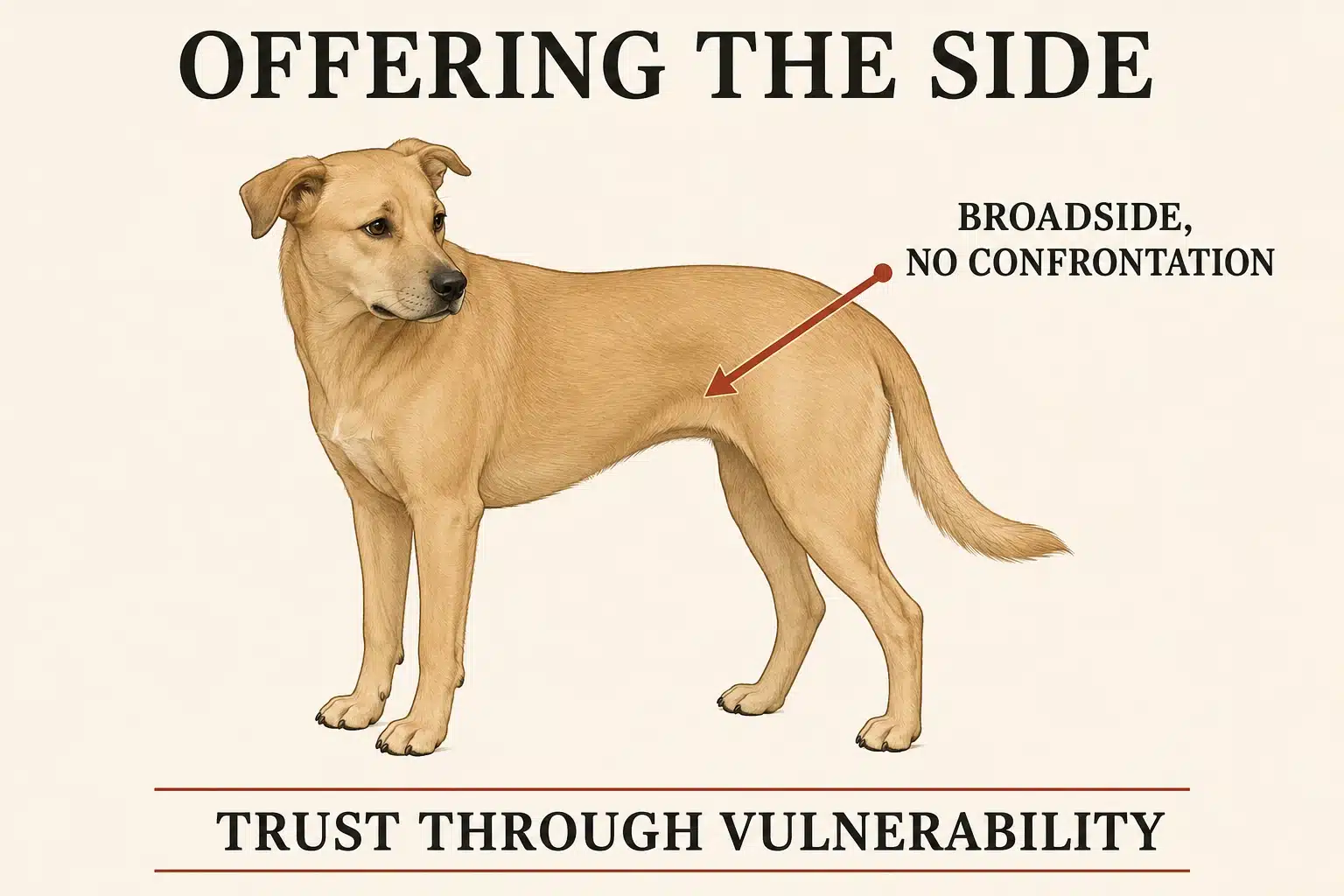
When a head turn is not a big enough statement, a dog rotates the entire body, presenting his flank or even his back to the individual he is calming. Standing broadside gives away every defensive advantage: he cannot see the other party well, cannot brace against contact, cannot respond quickly. That expensiveness is exactly what gives the signal its credibility. Cheap signals can lie; turning your back cannot.
Skilled adult dogs offer the side constantly to puppies, to nervous dogs, and to overwhelming greeters, and the humans who work best with fearful dogs have all learned to do the same thing, whether they learned it from ethology or from experience: you approach a scared dog sideways, or better, you do not approach at all, you angle your body away and let the dog do the approaching. If a strange dog turns broadside to you, understand you have just been paid a compliment and issued an instruction in the same gesture: relax, and dial it down.
The Sigh: The Sound of a Nervous System Standing Down
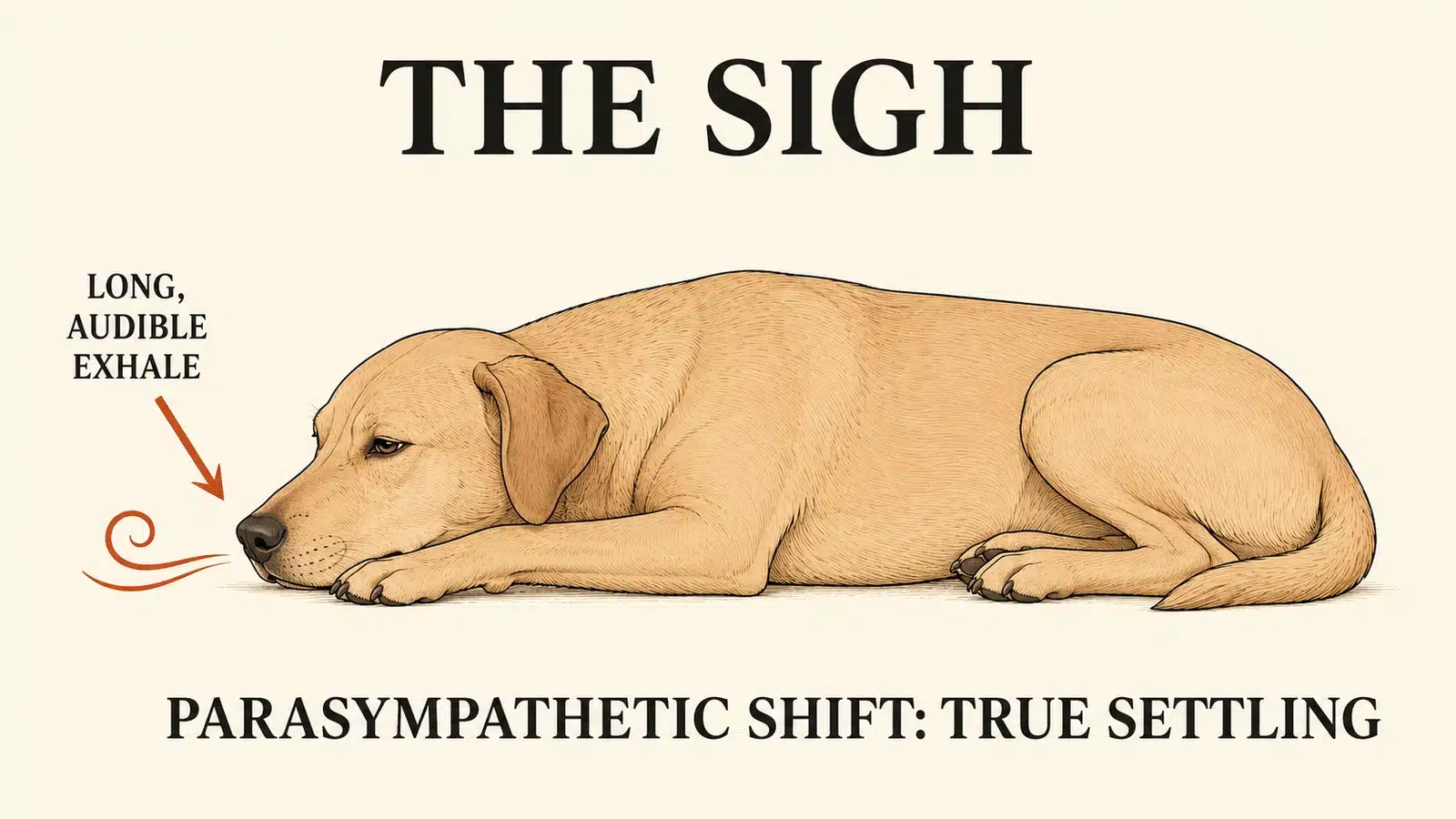
The long, audible exhale of a dog settling onto his bed is more than charming. Slow, extended exhalation is physiologically tied to parasympathetic activation, the rest-and-digest side of the autonomic nervous system, which is why the sigh so reliably accompanies genuine settling: chin dropping onto paws, muscles going slack, eyes softening toward half-mast. When you hear it, you are listening to arousal actually leaving the body, not just pausing.
For anyone doing behavior work, the sigh is a progress marker worth its weight in gold. A fearful dog who sighs and flops onto a hip during a session has told you something no amount of treat-taking can: his nervous system, not just his appetite, accepts the situation. Note what preceded it and build more of that. And enjoy the contented version freely: the sigh as your dog leans into an evening scratch is exactly what it sounds like.
The Relaxed Stretch: Loose Muscles Telling the Truth
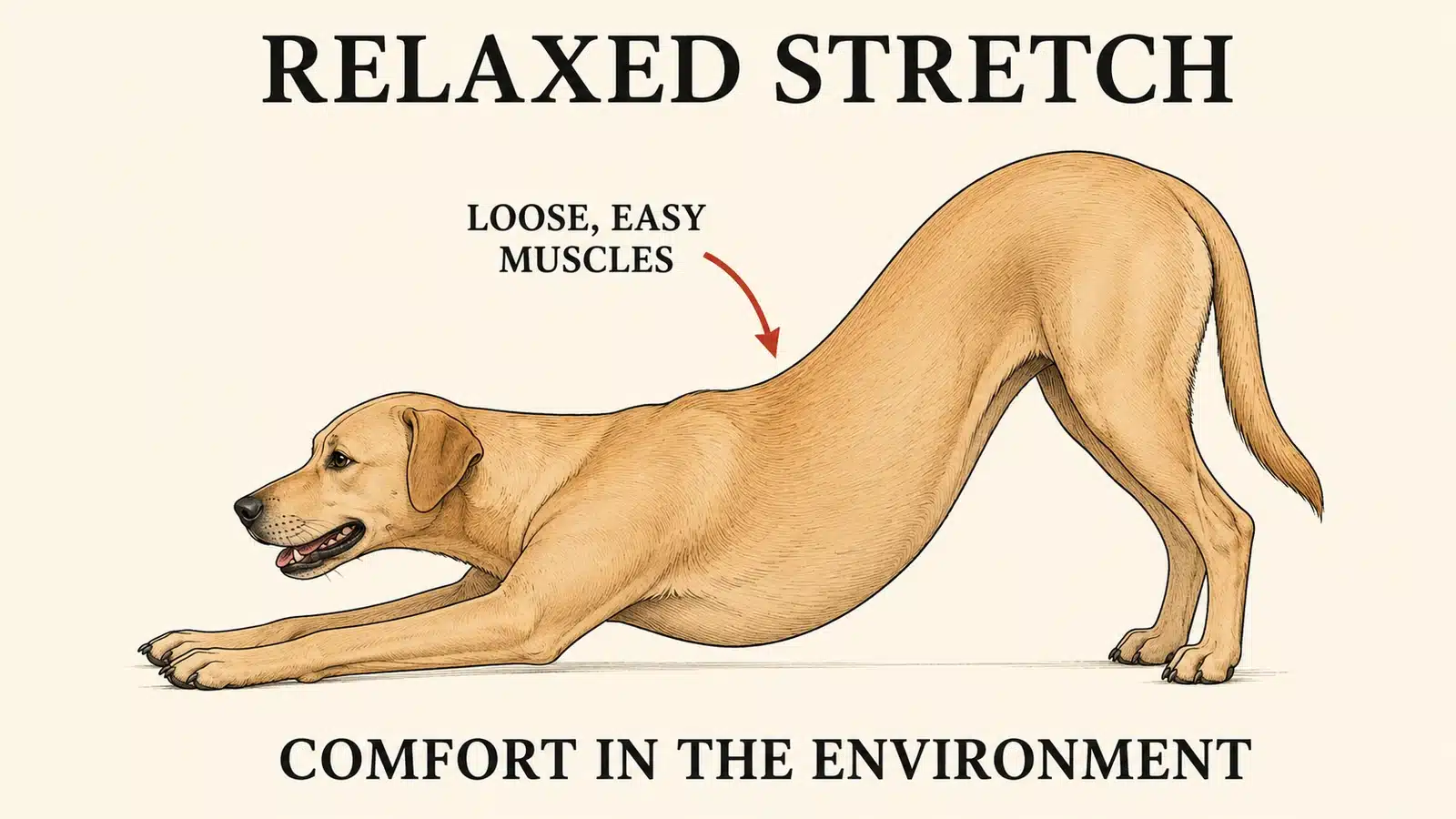
A deep stretch is a small act of vulnerability: for its duration the dog is slow, extended, and defenseless, which is why dogs do not stretch languidly in environments they distrust. The luxurious bow-and-extend on waking, the long forward stretch after settling into a new place, these are readings of environmental comfort as honest as anything on this list. Muscle tone does not lie, and a body willing to be briefly useless is a body that has decided it is safe.
Some dogs also use a stretch socially, aiming a loose play-bow-like stretch at a person or dog during greetings, a friendly, low-pressure opener sometimes called a greeting stretch. Distinguish all of this from its stress-category cousins: the tight repetitive stretching that can accompany gastrointestinal pain, and the stiff, brace-legged posture of a worried dog. The calming version is long, slow, floppy, and usually finished with a shake or a sigh. Tension performs; relaxation just is.
Neutral Ears: The Baseline Worth Memorizing
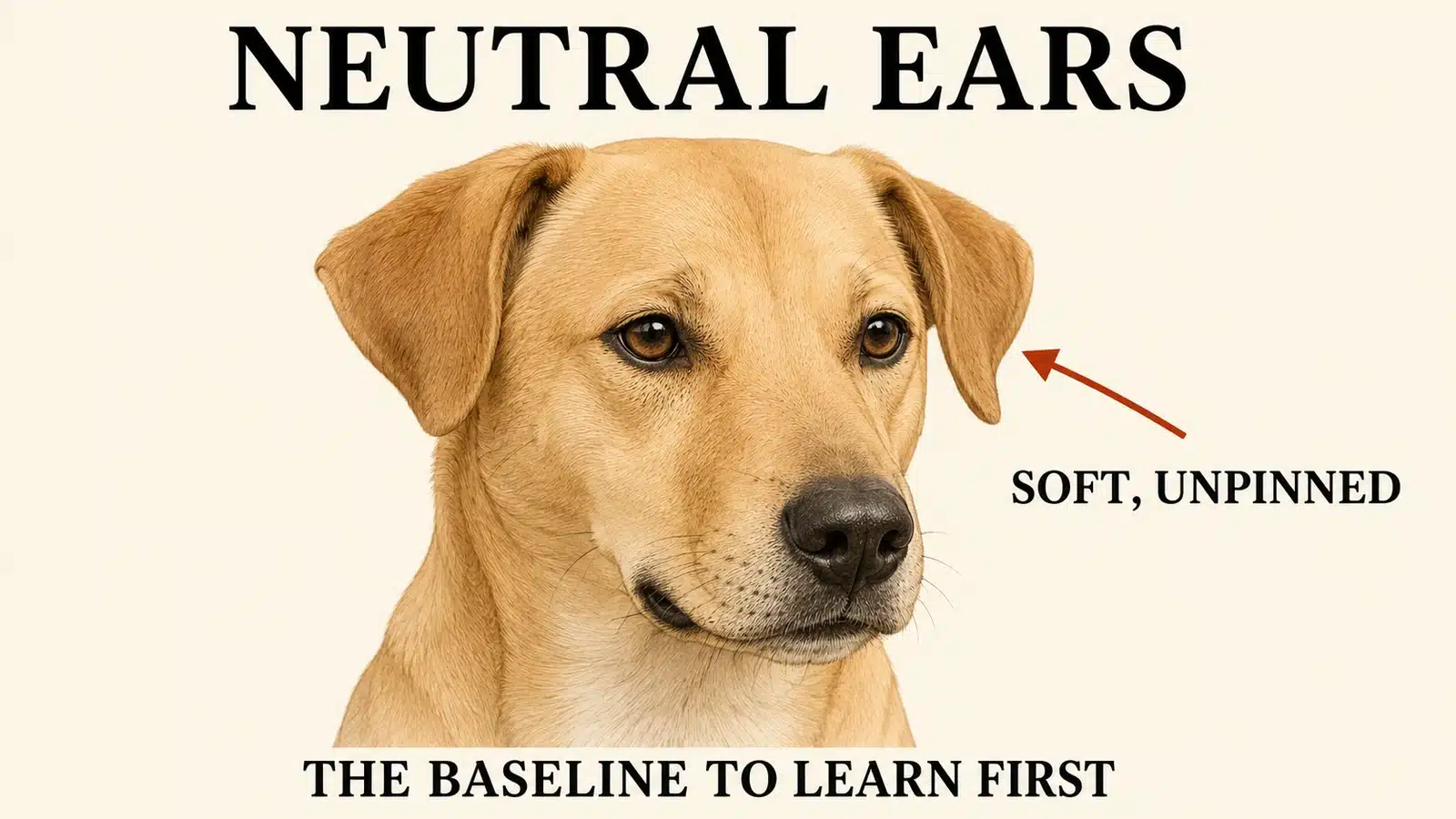
Neutral ears are not a dramatic signal, and that is precisely their value: they are the reference state every other ear position is measured against. At rest, the ears sit in their natural carriage, soft at the base, neither straining forward in arousal nor pressed backward in fear or appeasement. The base of the ear, where the muscles are, matters far more than the flap, which is a mercy for readers of spaniels, hounds, and every other drop-eared dog on earth.
Spend one lazy evening genuinely studying your own dog's neutral ears, and you will have purchased an early warning system for life. Every meaningful ear signal is a departure from this baseline, and departures are visible only to someone who knows the baseline cold. This is the quiet homework of body language fluency, and it pairs with the tail baseline work covered in the tail positions guide: know your dog at rest, and you will never miss your dog under pressure.
The Relaxed Mouth: The Real Canine Smile
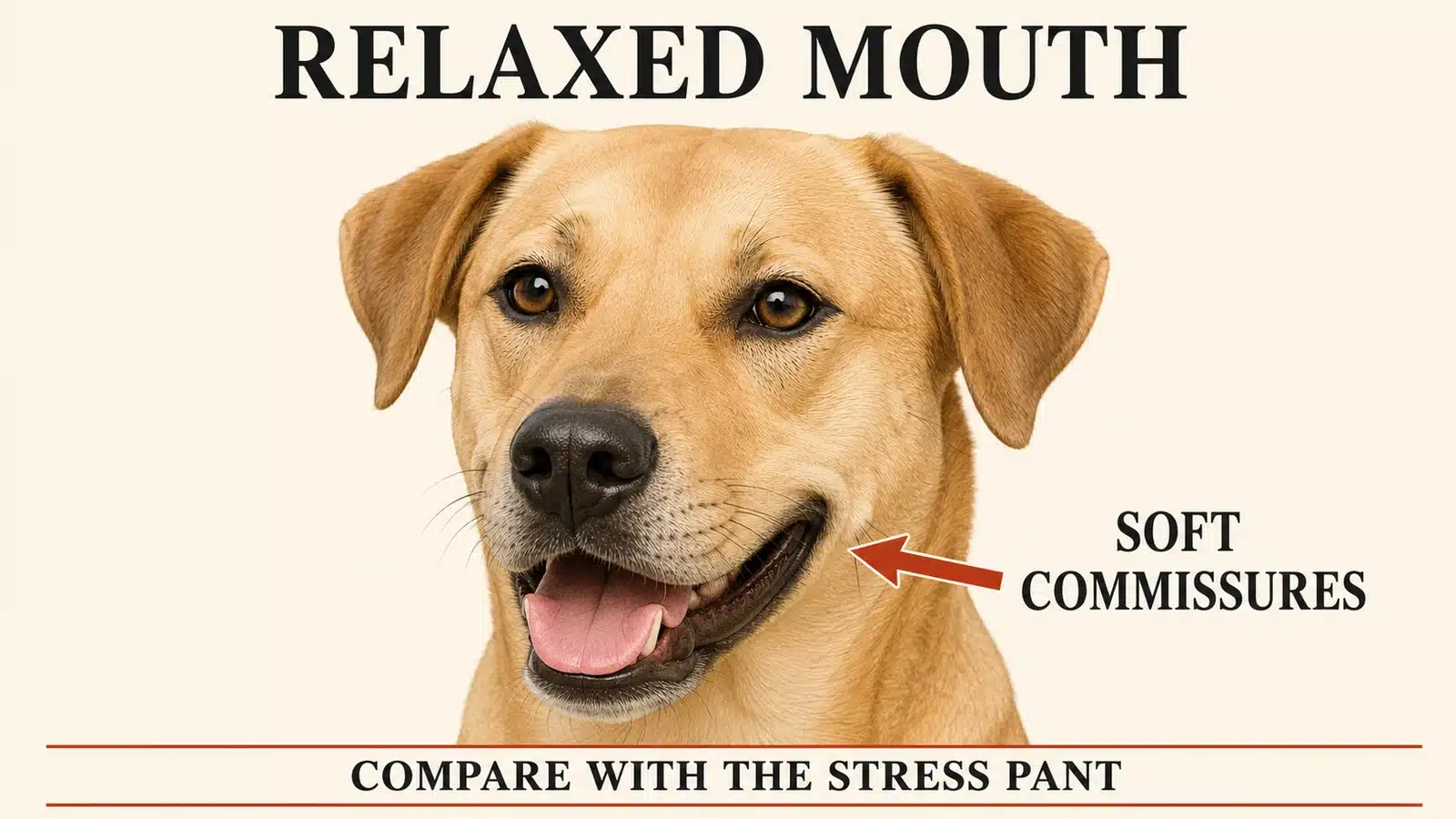
The mouth is one of the most legible instruments on a dog's face. Relaxed, it hangs softly open, the tongue resting loose just past the teeth, the lip corners neutral and unstrained, the whole lower face slack. This is the expression people call a doggy smile, and for once the folk reading is roughly right: a soft open mouth genuinely does indicate comfort, because a worried dog closes his mouth. That closure, mid-play, mid-greeting, mid-petting, is one of the fastest and most reliable early transitions from ease into concern in the entire body language repertoire.
Learn the two impostors. The stress pant pulls the lip corners back hard toward the ears and tightens the face, effort where the relaxed mouth shows ease, as covered in the stress signals guide. And the submissive grin retracts the lips to show front teeth in a squinty, wiggly package that startles people who mistake it for a snarl. The relaxed mouth has neither tension nor teeth on display. It is simply a jaw with nothing to hold onto.
Slow, Deliberate Movement: Speed Is Arousal, Slowness Is Peace
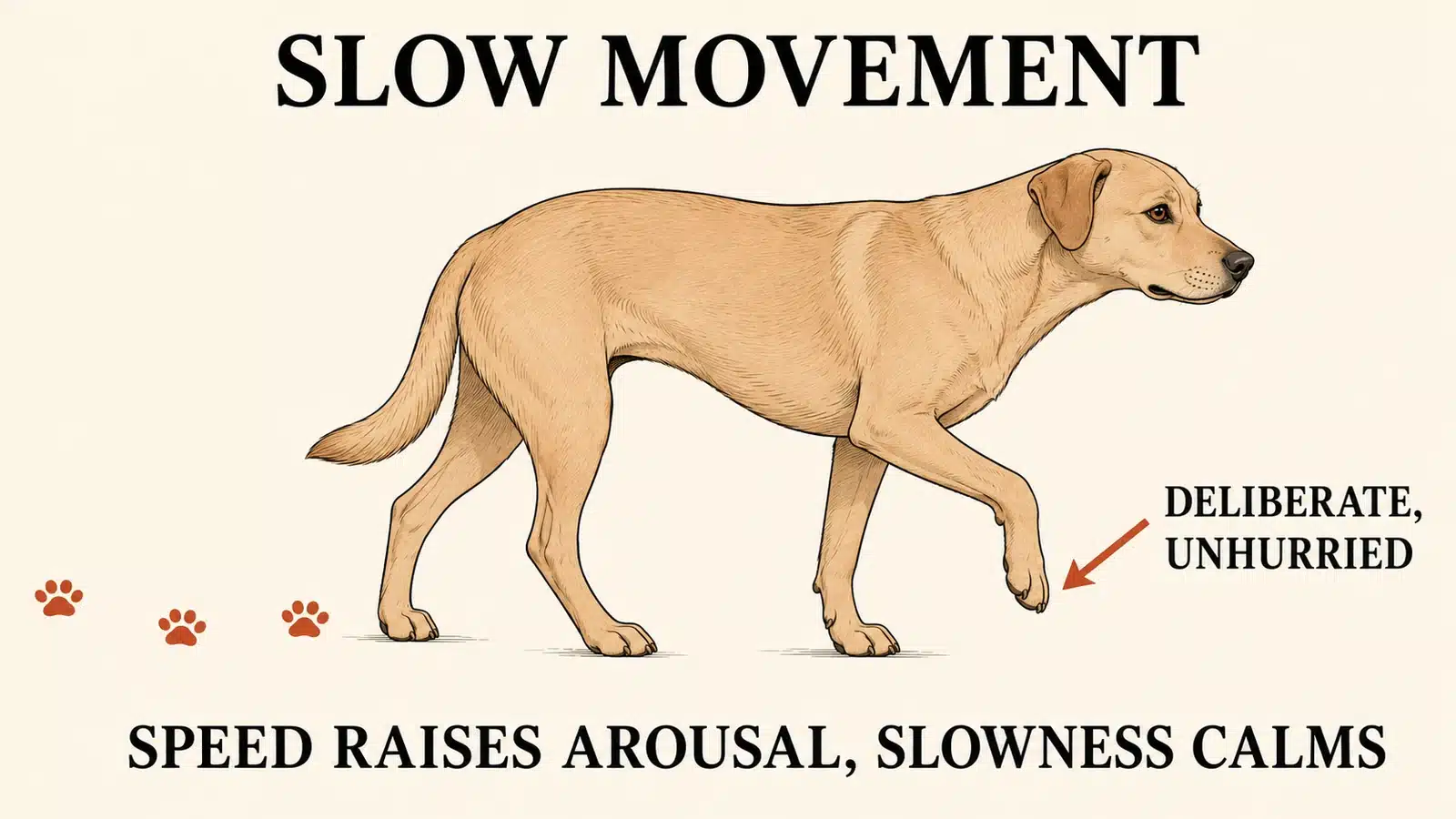
Speed communicates. Fast movement raises arousal in every animal watching it, which is why prey runs and predators chase, and dogs seem to understand the corollary deep in their bones: moving slowly is calming, to others and to themselves. A socially skilled dog entering a charged situation, a room with a nervous dog, a yard with a new puppy, will often downshift visibly, walking in measured, almost exaggerated slow motion until the temperature settles. Some dogs slow down when their pet parent grows agitated, a response owners often misread as guilt or reluctance when it is actually the dog trying to calm them.
Humans should steal this signal outright, and the fastest students are always the ones who work with fearful dogs. Around an anxious animal, cut your movement speed in half: slow hands, slow turns, slow sits. Sudden reaches and quick pivots read as threats regardless of your intent. If a dog slows down dramatically when you call him during a tense moment, resist the interpretation of defiance; he heard you, and he is coming, in the dialect that keeps everyone calm.
The Low, Wide Wag: A Flag of Friendly Intent
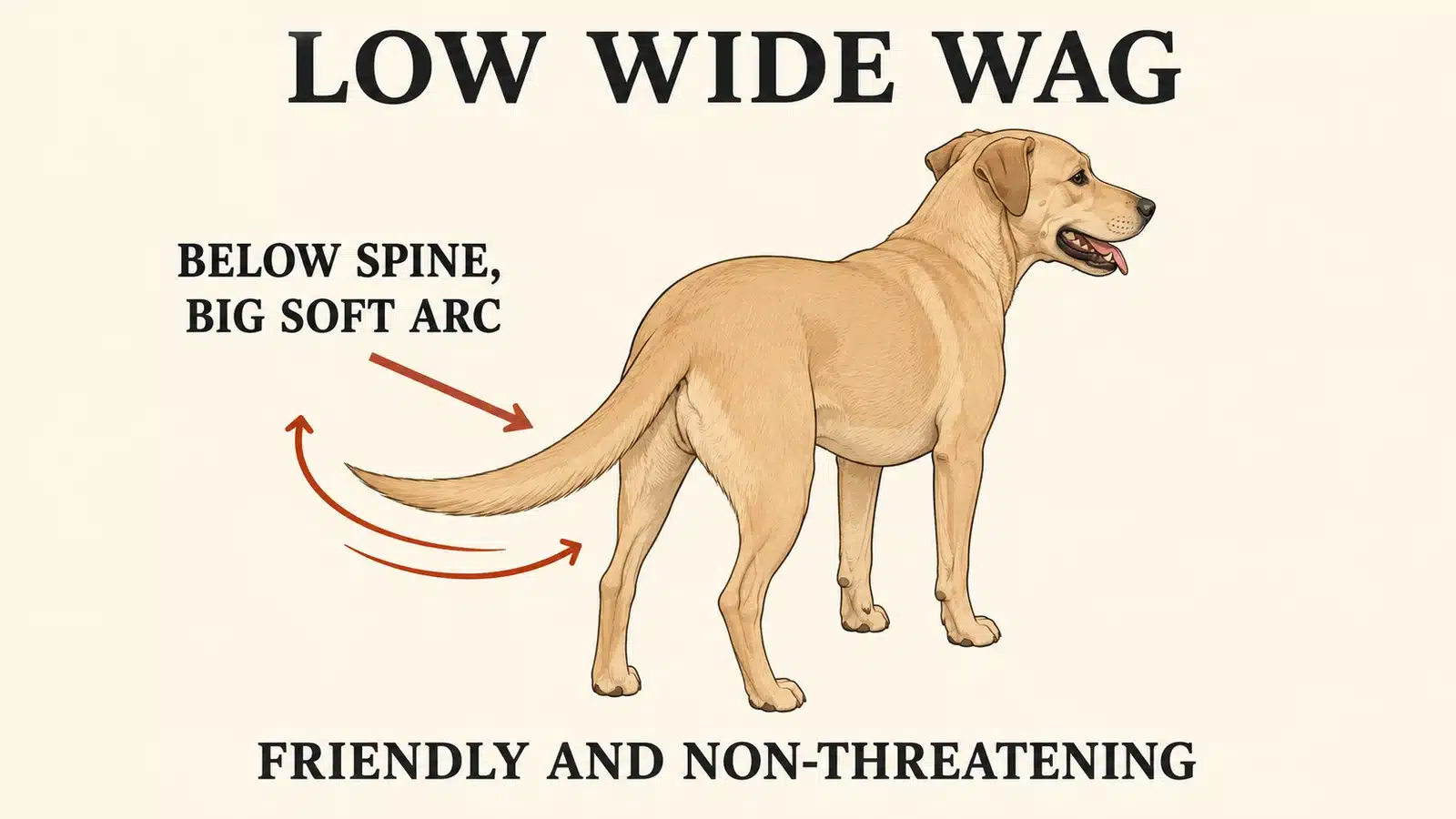
Not all wags are equal, and the calming wag has a specific signature: the tail rides at or slightly below spine level and sweeps in wide, soft, unhurried arcs, usually recruiting the hips into a gentle sway. This is the wag of relaxed friendliness and mild appeasement, the tail equivalent of an easy open-handed wave, and dogs deploy it during greetings precisely to declare that nothing about this encounter needs defending.
Its meaning sharpens by contrast. The high, tight, rapid flag of an aroused dog and the low, small, tentative flutter of an insecure one bracket this signal on either side, and the full taxonomy lives in the tail wagging guide. The reading rule that governs them all: height reflects confidence and arousal, width and looseness reflect friendliness. Low-and-wide is the combination that means well, and when it is aimed at you across a room, the polite reply is soft eyes and a sideways angle, which is to say, answer in kind.
How to Speak a Little Dog: Signals You Can Use Yourself
Here is the part that changes how you move through the world with dogs: this vocabulary runs both directions. Dogs spend their lives studying human bodies, and they read our orientation, speed, gaze, and posture in the same grammar they use with each other. That means the human who angles sideways instead of squaring up, softens the eyes instead of staring, blinks slowly, moves at half speed, approaches on a curve, and yawns deliberately when the tension rises is speaking, imperfectly but intelligibly, a language the dog already knows.
Use it everywhere the stakes are soft, and especially where they are not. Meeting a fearful dog: stop several feet away, turn your side or back, crouch without looming, soften your gaze, and wait to be approached rather than approaching. Your own dog spooked by something on a walk: resist the urge to crowd and coo directly into his face, and instead angle away, breathe out slowly, and give him a curve to follow away from the trigger. In training sessions that hit a wall: check your own body before blaming the dog, because a frustrated human leaning in with a hard stare is broadcasting pressure the dog answers with lip licks and ground sniffs long before he answers the cue.
One honest caveat, because accuracy matters more than charm: mimicking calming signals is a genuine communication aid, not a therapy. A sideways body and a slow blink lower the immediate social pressure; they do not treat the underlying fear of a dog who panics at strangers, thunderstorms, or handling. That work is behavior change science, systematic desensitization and counterconditioning conducted below threshold, and calming signals are the etiquette you practice while the real treatment does its job. Within the EASE Method, this entire page lives inside Evaluate and Arrange: reading the dog precisely, and arranging yourself and the environment so the dog is never pushed past what his nervous system can process.
Dog Calming Signals: Questions, Answered
What are calming signals in dogs?
Calming signals are behaviors dogs use to prevent and defuse conflict, communicate peaceful intent, and regulate their own arousal: head turns, slow blinks, ground sniffing, shake-offs, curved approaches, paw lifts, and about a dozen others. The term was popularized by Norwegian trainer Turid Rugaas and is now standard vocabulary across the behavior profession.
What's the difference between a calming signal and a stress signal?
Function and direction. A stress signal is largely involuntary leakage from an aroused nervous system. A calming signal is communication with a social job: it is aimed at someone during tension and works to lower the temperature. The same behavior, like a yawn or a ground sniff, can serve either role, and the rest of the body plus the context tells you which one you are watching.
Can humans use calming signals with dogs?
Yes, several translate well: turning sideways instead of facing head-on, softening your gaze and blinking slowly, moving at deliberately reduced speed, approaching on a curve, and crouching without looming. These genuinely lower social pressure, especially with fearful dogs. They are a communication aid, though, not a treatment: a dog with significant fear still needs systematic desensitization and counterconditioning.
Why does my dog sniff the ground when another dog approaches?
That is usually a calming signal, not distraction. The sniff breaks the directness of the approach, buys processing time, and signals peaceful intent to the other dog. Give your dog the moment rather than pulling him along, and add a curve to your walking path to make the encounter even easier to pronounce politely.
My dog does a full-body shake but he isn't wet. What does it mean?
The dry shake-off is a reset: it discharges the muscular tension of a moment that just ended, whether that was an intense greeting, a hug, handling, or a round of play. It is healthy self-regulation, and it is also useful data, because whatever immediately preceded the shake is something your dog found at least mildly stressful. Frequent shake-offs during play are a good sign of dogs regulating themselves between rounds.
Next: Tail Wagging
The most famous signal in dog behavior is also the most misread. Speed, height, arc, and even left-versus-right bias each change what a wag means.
 About the Author
Will Bangura, M.S., CAB-ICB, CBCC-KA, CPDT-KA, FDM, FFCP, is a Certified Canine Behaviorist with over 35 years of experience specializing in severe aggression, fear, anxiety, reactivity, phobias, and compulsive disorders in dogs. He holds a Master's Degree in Psychology and is accredited as a Certified Canine Behaviorist through International Canine Behaviorists, one of only three CAB-ICB Certified Canine Behaviorists in the United States and the only one in Arizona. His additional credentials include Certified Behavior Consultant Canine (CBCC-KA) and Certified Professional Dog Trainer (CPDT-KA) through the Certification Council for Professional Dog Trainers, certification in Applied Ethology through Family Dog Mediation (FDM), and Fear Free Certified Professional (FFCP).
Will is the author of Sniff to Soothe, host of the Dog Training Today podcast, and a court-recognized expert witness in canine behavior. His clinical work is grounded in behavioral psychology, applied behavior analysis, learning theory, and affective neuroscience: every case begins with a functional behavior assessment and is treated through management, skill building, and evidence-based behavior modification using systematic desensitization and counterconditioning. He is a national advocate for force-free, science-based training and a published voice on the welfare risks of aversive training methods.
As the founder of Phoenix Dog Training, Will provides in-home behavior consultations throughout the Phoenix metro area and virtual behavior consultations for pet parents nationwide.
If Your Dog's Signals Are Going Unanswered
Fear, anxiety, and reactivity are treatable. A professional behavior consultation begins with a full functional behavior assessment and ends with a clear, evidence-based plan built for your dog. Schedule a Behavior Consultation, or start with a free call.