
← Dog Body Language: The Definitive Guide
The Definitive Guide · Play SignalsDog Play Signals: How to Tell Real Play From Trouble
Good play is one of the finest things a dog does, and one of the most misread. Learn the signals that separate healthy play from a fight in the making, and you will know when to smile, when to step in, and when to let two dogs sort it out themselves.
Play Is Serious Business
It is tempting to treat play as the throwaway part of a dog's day, the goofy stuff that happens between the important things. That gets it exactly backwards. Play is one of the most cognitively and emotionally sophisticated things dogs do, a genuine window into emotional health, social skill, and welfare. Play requires two animals to agree on a shared fiction, that these bites are not real bites, that this chase is not a real chase, and to keep renegotiating that agreement in real time through a constant stream of signals. A dog who plays well is a dog who reads others well, regulates his own arousal, and communicates clearly. Those are the same skills that keep a dog out of my consultation room.
Play also carries a paradox that makes it fascinating to read: it is built almost entirely out of behaviors borrowed from conflict and predation. The stalking, chasing, pouncing, grabbing, biting, pinning, and body-slamming of play are the exact motor patterns of hunting and fighting, run in a different emotional key. This is precisely why play can be hard to read and why well-meaning people so often misjudge it in both directions, breaking up perfectly healthy roughhousing while missing the genuine tension building in a mismatched pairing. The motor patterns look alarming; the emotional frame is everything.
So the reading task for this category is different from the others in the guide. You are not just identifying individual signals, you are assessing a relationship in motion, watching whether two dogs are keeping their shared agreement or drifting out of it. The signals below are the vocabulary. The section at the end, on telling real play from trouble, is the grammar that ties them together. And the master principle that runs underneath all of it is the same one that governs every page here: read the whole dog, and read both dogs, in context. If you have not read the main guide on reading the whole dog, start there.
The Play Bow: The Signal That Makes Play Possible
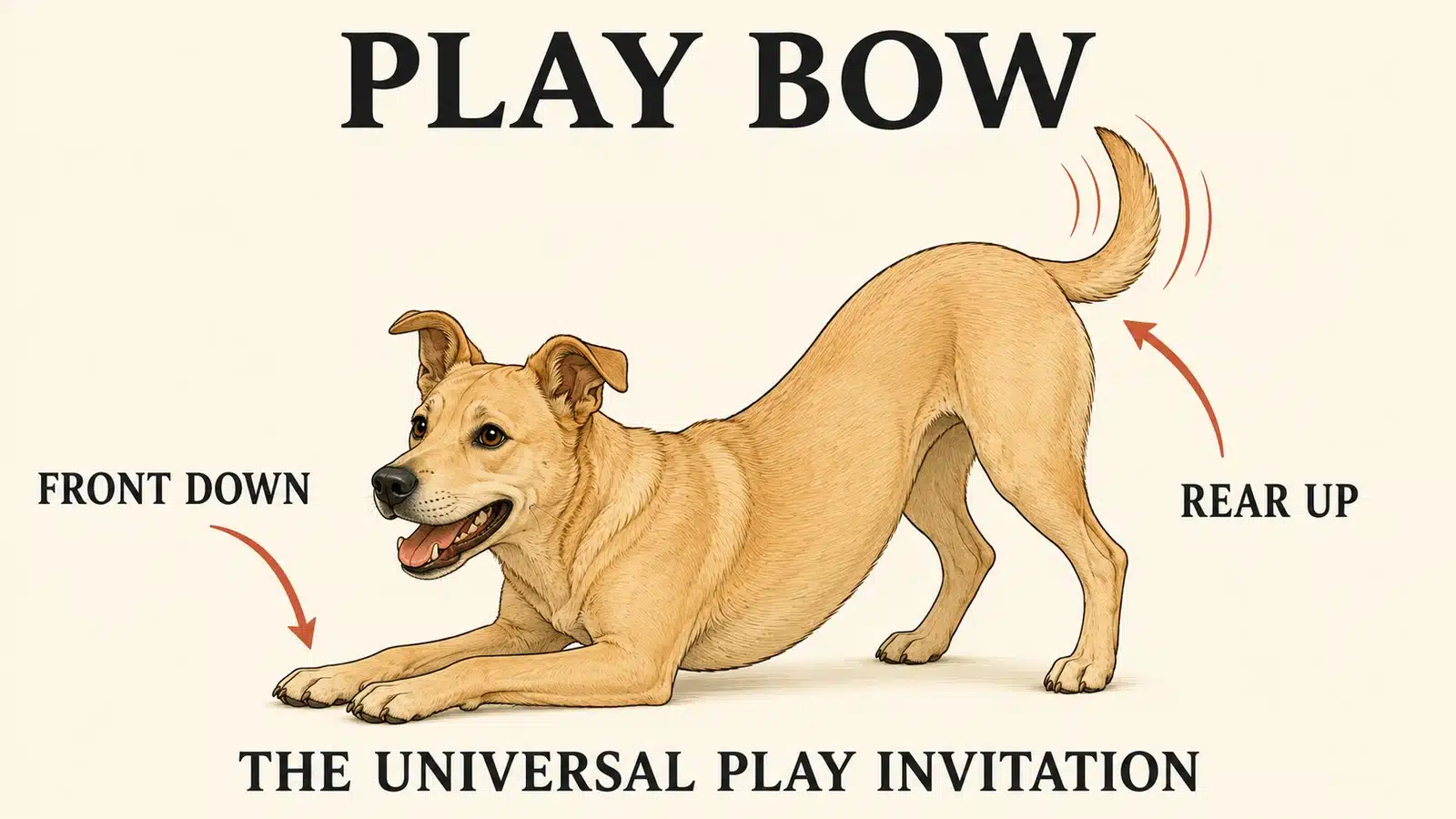
The play bow is the single most important signal in this entire category, because it is the one that makes all the rest possible. Front legs extended and lowered to the ground, chest dropped, rump held high, tail wagging, often with a bright open mouth: this is the near-universal canine invitation to play, and its real genius is not the invitation but the framing. The bow is a metacommunication signal, a signal about other signals. It tells the other dog: everything I am about to do, the biting, the chasing, the slamming, is play. Read it that way.
That framing function is what lets dogs build entire games out of the raw material of aggression and predation without the game tipping into the real thing. A bow before a hard body-slam reclassifies the slam as fun. A bow that reappears after a moment of intensity is a dog checking in and re-confirming the agreement: we are still playing, right? Because the play bow is so unambiguous and so central, it is one of the most useful signals for the watching human, too. Frequent, mutual bowing throughout a play session is one of the clearest signs that both dogs are consenting participants in a shared and well-regulated game.
Bouncy, Exaggerated Movement: Inefficiency on Purpose
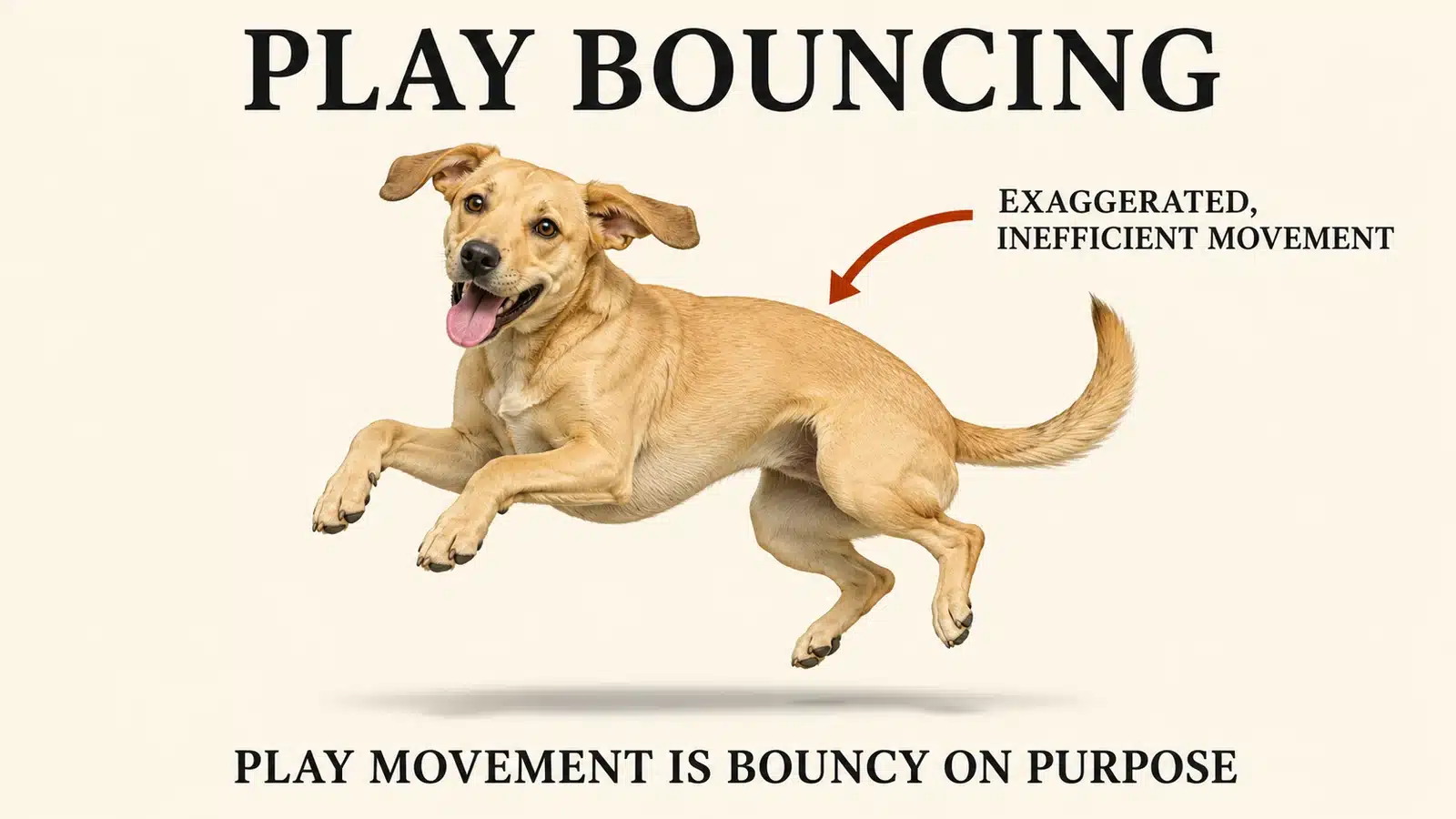
Watch a dog in real play and you will notice the movement itself looks different from purposeful movement: bouncy, springy, loose, exaggerated, almost cartoonish. Dogs bounce sideways, spring off their front feet, fling their bodies around with a wild inefficiency that would be absurd if the goal were actually to catch or defeat anything. That inefficiency is the point. Exaggerated, loose, bouncy movement is itself a play signal, a way of broadcasting non-serious intent through the entire body.
Behavioral scientists describe these as loose, wiggly, and exaggerated movements, and they are among the most reliable markers separating play from its serious cousins. Real aggression and real predation are economical: fast, direct, efficient, aimed. Nothing is wasted. Play is the opposite, deliberately squandering energy on flourishes that announce this is a game. When you see a dog moving like his bones have gone soft, spring-loaded and wasteful and wiggly, you are watching the physical signature of play, and its sudden disappearance, movement snapping from loose to tight and economical, is one of the first signs that a game may be curdling into something else.
Chase Play: Where Role Reversals Tell the Truth
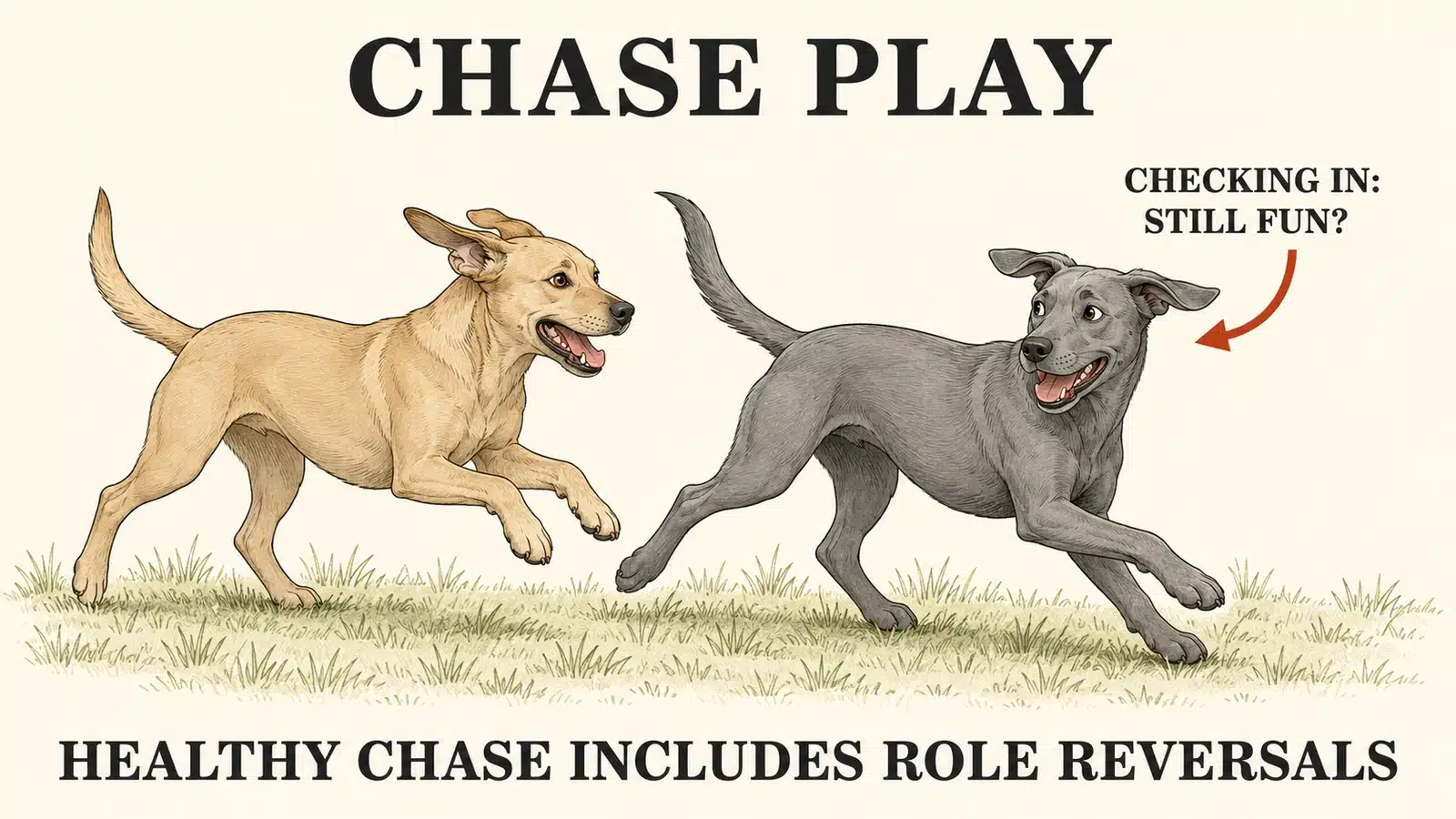
Chase is one of the most common play forms and one of the most important to read correctly, because healthy chase play and genuine predatory or bullying chase can look superficially similar and mean completely different things. The variable that separates them is reciprocity. In healthy chase play, the roles reverse: the dog who was chasing becomes the chased, the dogs swap willingly, and both take turns being pursuer and pursued. That turn-taking is a dog's way of demonstrating that this is a cooperative game rather than a one-sided pursuit.
The warning sign is a chase that never reverses. When one dog is always the pursuer and the other is always fleeing, especially if the fleeing dog is showing stress signals, tail tucked, ears pinned, trying to escape rather than loop back for more, this is not mutual play, it is one dog being harassed or hunted, and it warrants intervention. Watch also for the fleeing dog's willingness: a dog who runs a few steps then bounces back for more is playing, while a dog who is genuinely trying to get away and cannot is in trouble. Group chases in particular can flip from fun to predatory in seconds when several dogs fixate on one, a dynamic every pet parent at a dog park should know how to spot and interrupt.
Jaw Sparring and Play Biting: Inhibited Teeth
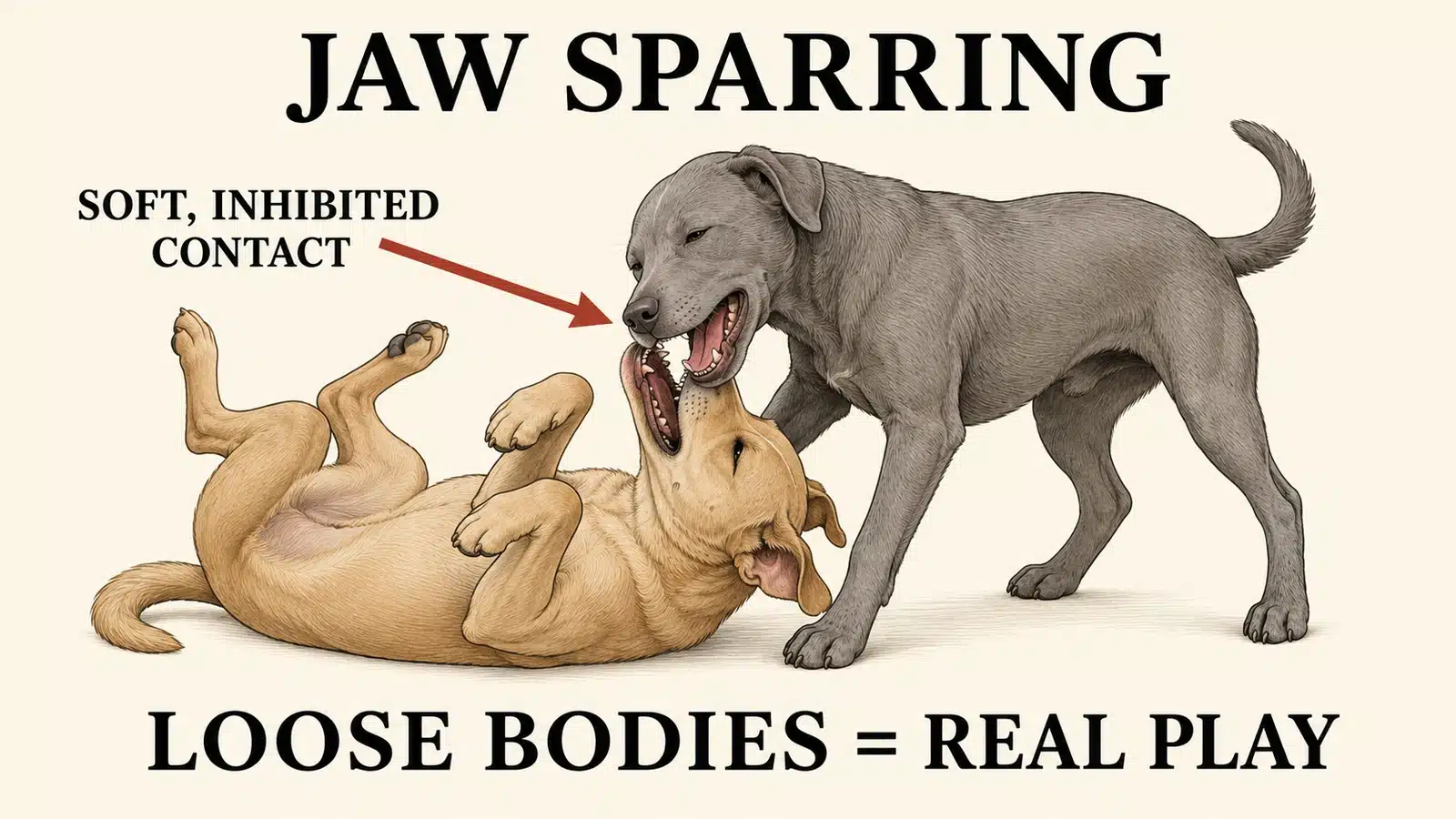
Play fighting looks the most alarming to human eyes and is often the most misunderstood: open mouths, exposed teeth, bodies tangling, a dog on his back with another's jaws around his throat, sometimes with dramatic sound effects. Reframe what you are seeing. This is jaw sparring and play biting, and its defining feature is bite inhibition, the carefully controlled use of a mouth that could do real damage but deliberately does not. The mouths are open and loose, the contact is soft, and the teeth, though visible, are not clamping down.
Bite inhibition is one of the most valuable skills a dog ever develops, and play is where much of it is learned and maintained. During play, dogs constantly calibrate how hard is too hard, and a good playmate who bites down too enthusiastically will often get a yelp and a brief pause from his partner, feedback that teaches him to soften. Watch for looseness in the bodies and openness in the mouths: relaxed, floppy jaw sparring between two loose dogs is normal and healthy, even when it is loud. The concern is not open mouths, it is tension, when the bodies stiffen, the mouths tighten, and the loose sparring hardens into something economical and quiet. Sound, on its own, tells you almost nothing; a great deal of healthy play is noisy.
The Play Paw: Tag, You're It
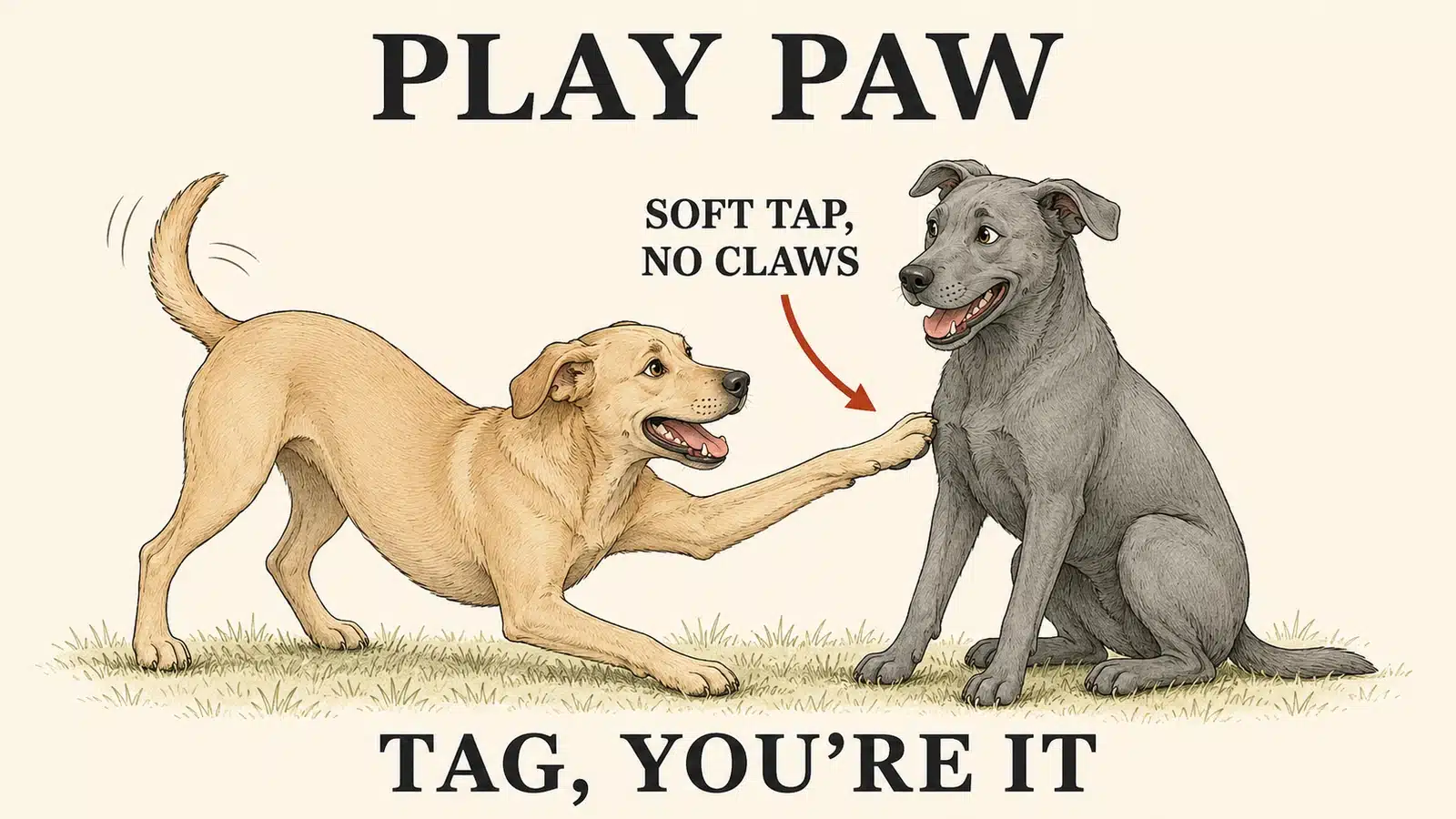
A dog reaches out and bats at another dog, or at a person, with a soft front paw, often from within a half-bow, tail going, mouth open and easy. Pawing is a common play-soliciting behavior, a gentler cousin of the full play bow, and it functions as an invitation and a re-invitation: a way to say let us start, or let us keep going, or your turn. It shows up at the beginning of play and throughout it, punctuating pauses and nudging a flagging game back to life.
Context, as always, does the sorting, because pawing appears in several very different emotional states. The relaxed, soft, bouncy paw of play is unmistakable once you have seen it alongside its companions, the loose body and the open mouth. That is a different behavior entirely from the tense, low paw lift of an uncertain or appeasing dog covered in the calming signals guide, and different again from the insistent pawing some dogs learn to use to demand attention from their people. Read the paw the way you read everything else here: inside the full picture the rest of the body is painting.
The Play Growl: Why Sound Is the Worst Way to Judge Play
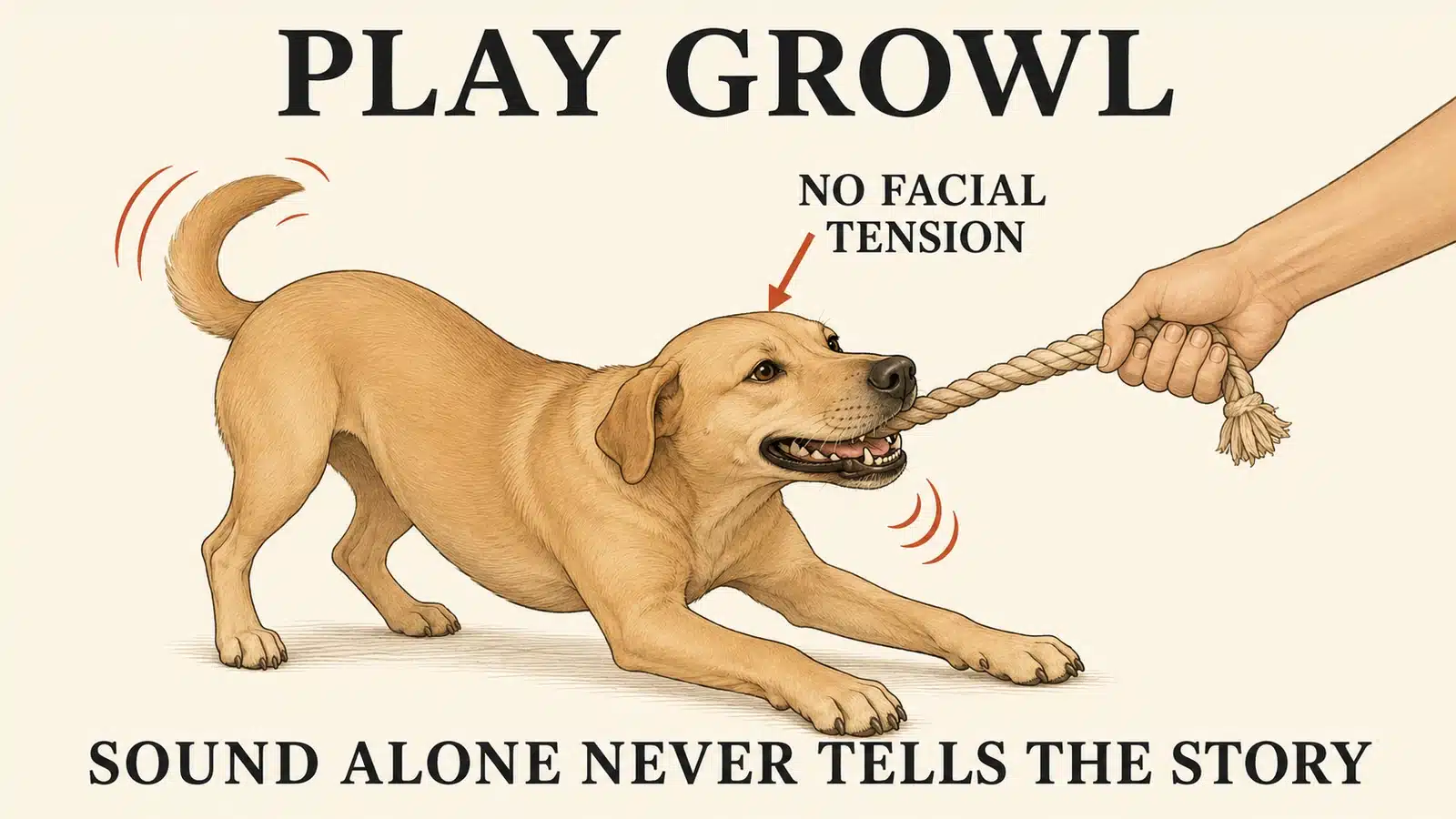
Few things send a pet parent lunging to break up play faster than a growl, and few instincts are more often mistaken. Dogs growl during play, sometimes dramatically, and play growling is a normal, healthy part of many games, especially tug and wrestling. The growl of play is theater, part of the shared fiction, and it is produced by a dog whose body tells a completely different story than his voice: smooth brow, loose frame, wagging tail, open relaxed mouth, the whole apparatus of fun still fully switched on.
This is one of the clearest illustrations of the central lesson of this entire guide, so it is worth stating plainly: sound alone is nearly useless for judging a dog's emotional state, because the same acoustic growl can accompany play, warning, fear, or aggression, and only the body distinguishes them. A warning growl rides on a stiff, still body with a hard eye and a closed or tense mouth, as described in the distance-increasing signals section of the guide. A play growl rides on a loose, wiggly, soft-faced dog who keeps bouncing back for more. If you find yourself unsure, do not referee by ear, watch the bodies. And never punish a growl, in play or out of it, because a growl is information, and a dog taught to suppress the sound is a dog stripped of a warning you will one day wish he had given.
Zoomies: Joy at Full Throttle
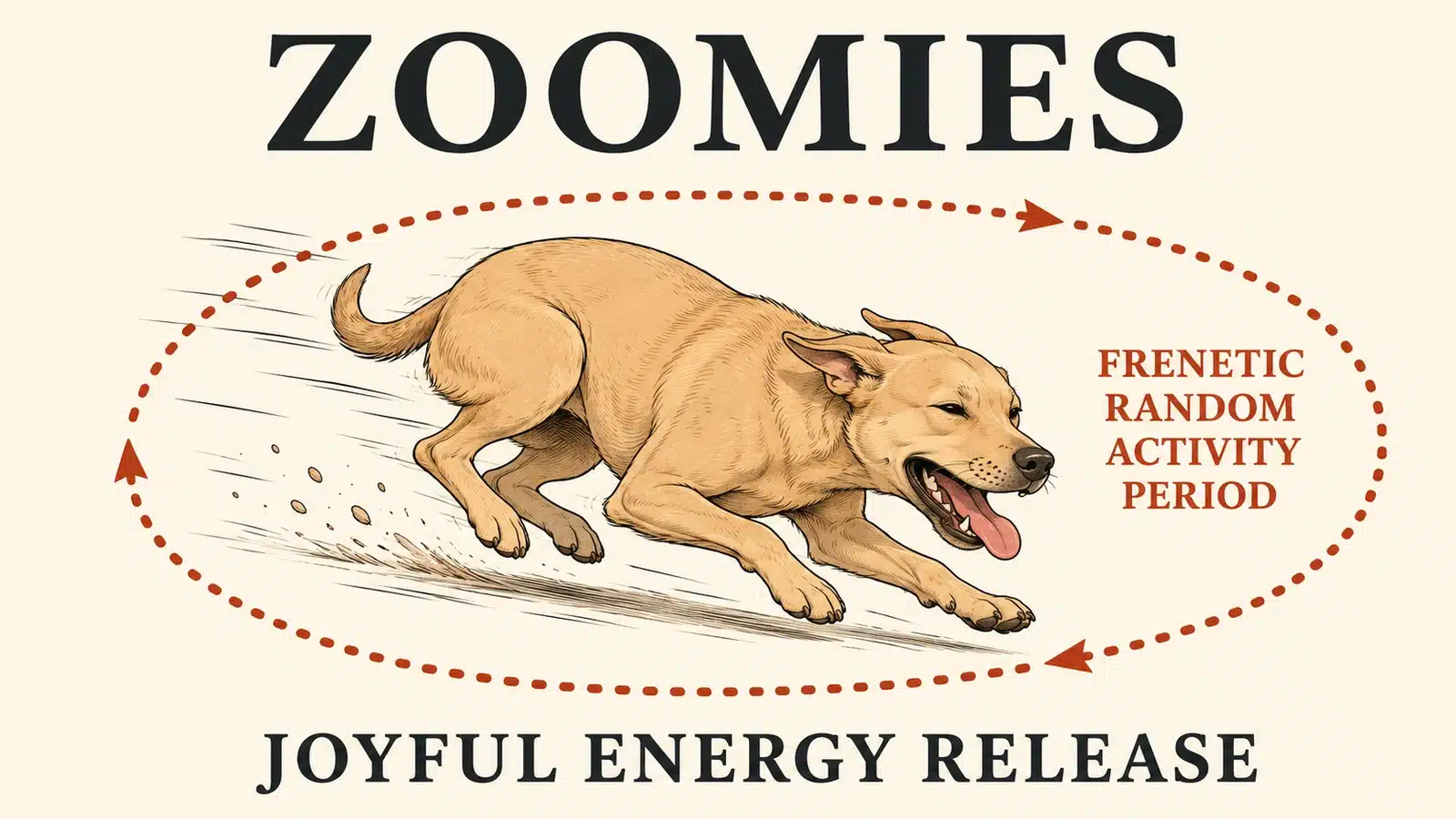
Every pet parent knows the sight: the dog suddenly drops into a crouch, eyes wild with glee, and explodes into a lap of the yard or a series of frantic circles around the living room, ears flattened by his own speed, rear tucked, utterly abandoned to the moment. Behaviorists call these frenetic random activity periods, or FRAPs; everyone else calls them the zoomies. They are a normal, healthy burst of energy and, most often, an expression of pure joy, an emotional overflow the dog discharges through sheer speed.
Zoomies commonly erupt at predictable moments: after a bath, after a period of confinement, in the cool of the evening, and, tellingly, after stressful-but-survived events like a vet visit or a grooming session, where they help the dog discharge accumulated tension. Puppies and young dogs zoomie most, and it usually mellows with age. For the most part the correct response is to enjoy the show and simply make the space safe, clearing obstacles and steering the dog off slick floors or away from roads, since a dog at full zoomie speed is not doing much careful thinking. Only rarely is there cause for concern, if the zoomies are frantic rather than joyful, or if they appear driven by anxiety rather than delight, in which case the surrounding body language, not the running itself, is what tells you something is off.
The Play Roll: Rolling Over as an Offensive Move
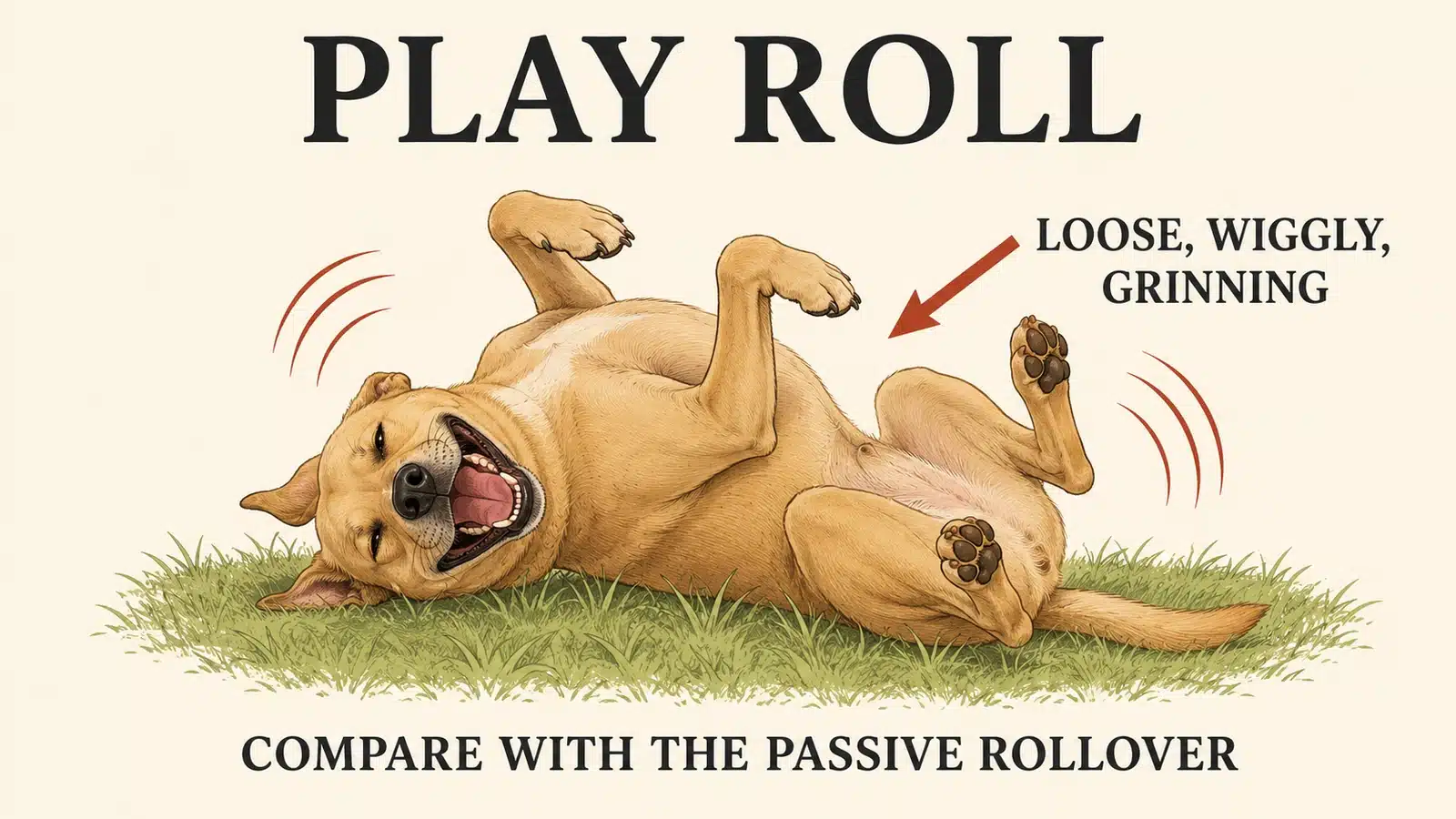
A dog flipping onto his back during play tends to trigger a protective reflex in watching humans, who read it as the dog being overpowered or forced into submission. Research on play behavior tells a more interesting story. Studies of rolling over during play have found that dogs voluntarily flip onto their backs not as an act of surrender but as a strategic play move: to dodge a playmate's neck bite, to launch a counterattack from below, or to solicit continued play. The dog on the bottom is very often the one driving the game, not the one losing it.
The way to read the play roll is by its texture. A play roll is loose, wriggly, and grinning; the dog on his back is springy and engaged, batting upward with soft paws, mouth open, choosing this position and often popping right back up to re-engage. Contrast that with the passive, frozen, stiff-bodied rollover of genuine appeasement or fear covered in the appeasement signals section of the guide, where the head turns away, the mouth stays closed, and the tail clamps. Same posture, opposite meaning, and the difference lives entirely in the tension of the body and the expression on the face. A loose dog choosing to be underneath is playing. A stiff dog frozen on his back is asking for something to stop.
The Play Pounce: Predation, Rerouted Into a Game
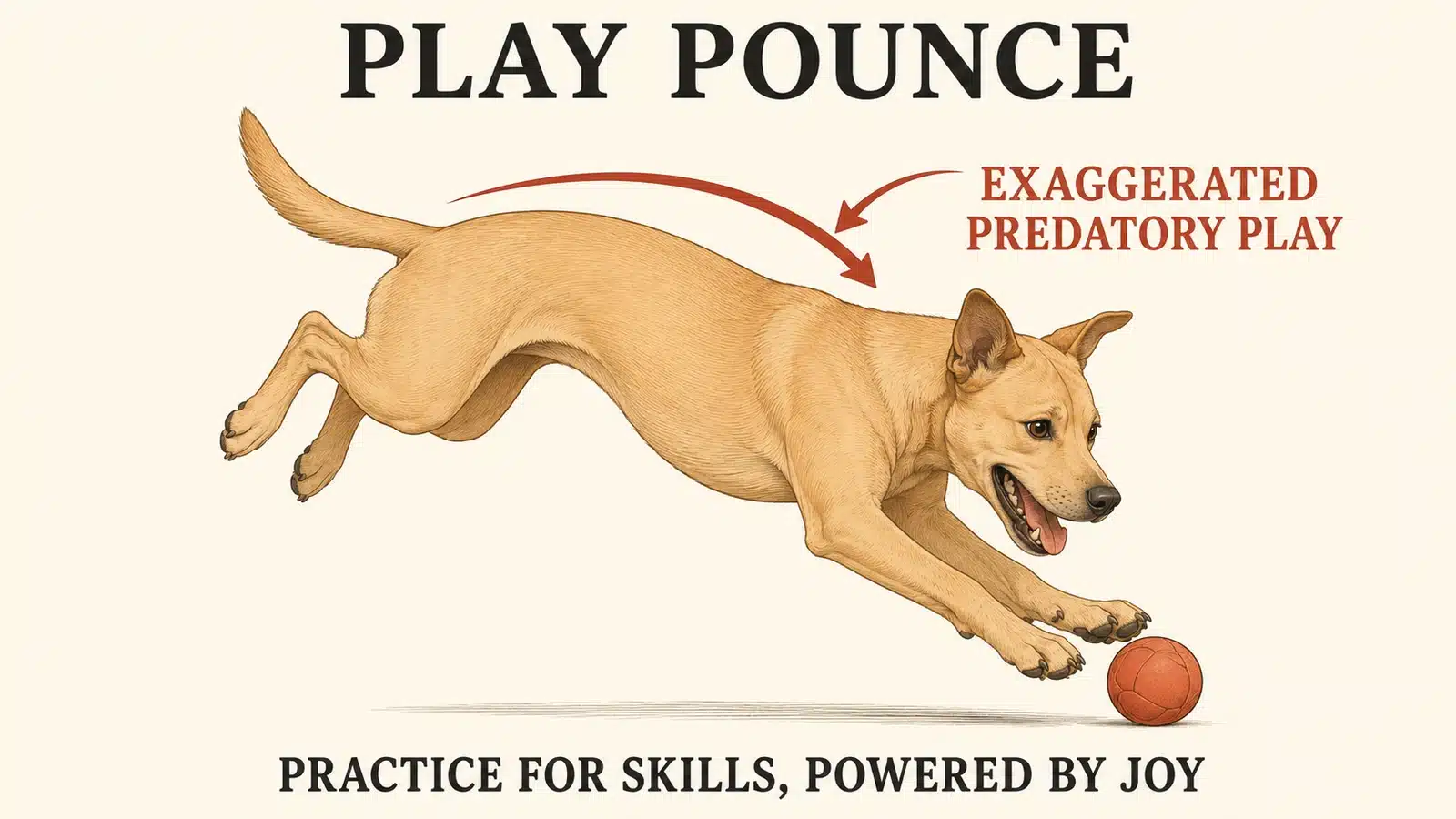
The play pounce lifts a move straight out of the predatory sequence, the front-end stalk followed by the explosive spring, and reroutes it into a game. You will see it with toys, with other dogs, and famously in the mousing pounce dogs use on wiggling objects, front paws slamming down together. This is one of the clearest examples of play recycling the raw material of hunting, and understanding that lineage helps demystify a lot of what dogs do: much of play is predatory motor patterns, disconnected from the killing intent and run for their own emotional reward.
The play version is legible by its exaggeration and its context. A play pounce is bouncy, loose, and often preceded or followed by a play bow, wrapped in the whole apparatus of the game. It is not the silent, economical, intensely focused stalk of a dog in a genuine predatory state, where the body goes tight and still and the eyes lock hard. For most pet parents this signal is simply a delightful part of watching a dog play and a useful outlet to provide through appropriate toys and games. It becomes worth a professional conversation only when predatory motor patterns are directed at inappropriate targets, such as small running animals, cyclists, or fleeing children, in a tight, focused, non-playful frame, which is a management and behavior matter rather than a game.
The Loose, Wiggly Body: The Master Signal of Play
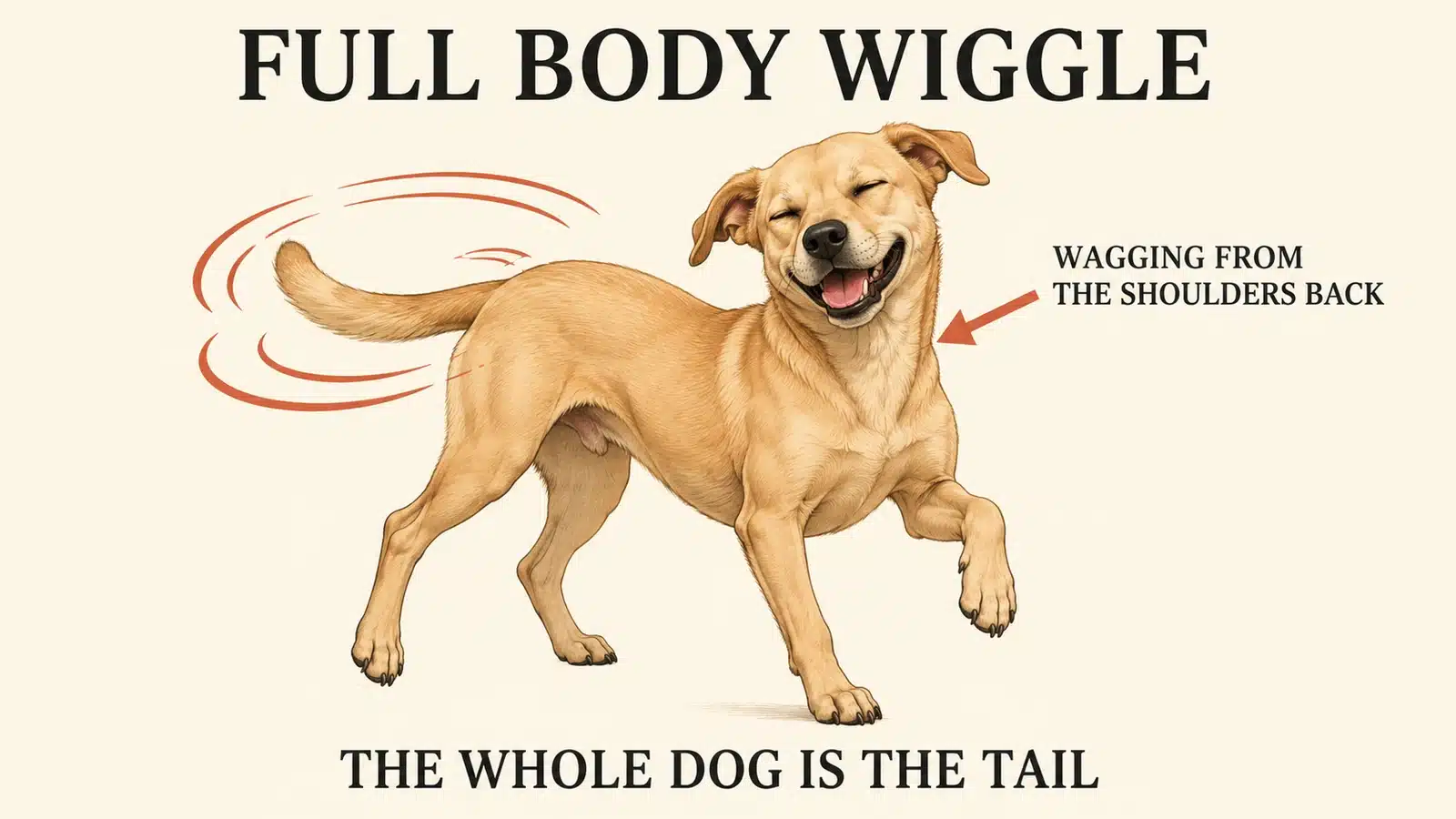
If every other signal on this page vanished from your memory and you retained only one, this is the one to keep: the loose, wiggly body is the master signal of healthy play. When a dog's whole body has gone soft and curved, spine bending into a wagging S, hips swinging, the wag traveling all the way up into the shoulders, the dog is telling you in the plainest possible terms that his emotional state is play and nothing but play. Looseness is the single most reliable indicator that separates fun from trouble across every play form there is.
The reason this works is mechanical and, once understood, impossible to unsee. Fear and aggression are states of the body preparing for a serious outcome, and that preparation requires muscular tension: the stiffening, the bracing, the readiness to strike or flee. Play requires the opposite, a body loose enough to absorb impact and improvise, because nothing serious is actually at stake. You cannot fake a wiggly body under real threat, which is exactly why it is so trustworthy. This gives you a single, portable diagnostic you can apply to any play session in real time: are the bodies loose or are they tight? Loose and wiggly is play. Stiff and still is the warning that the game has changed, and it is the heart of the section that follows.
The Fetch Invitation: Dogs Who Set the Rules of the Game
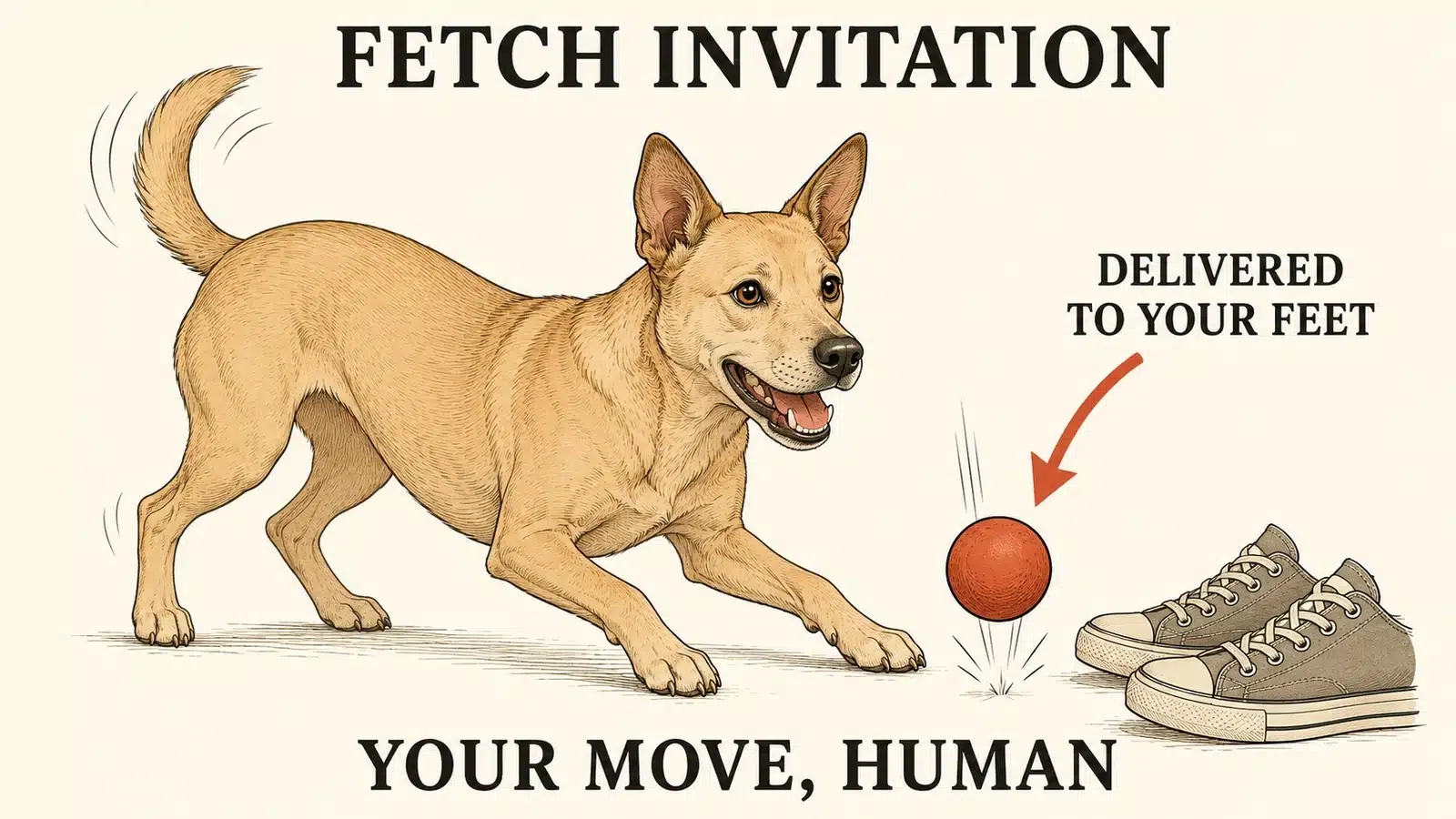
A dog drops a ball at your feet, backs up into a ready crouch, fixes his eyes on the toy, and waits, his whole body vibrating with anticipation. This is a play invitation aimed squarely at a human partner, and it is worth pausing to appreciate how sophisticated it is. The dog is not just expressing a wish to play; he is proposing a specific game with specific rules, communicating those rules through position and posture, and inviting you to take your assigned role in it. Offering a toy is deliberate, structured play solicitation directed at a person.
These human-directed invitations matter for reasons beyond the fun of the moment, and this is where play becomes a clinical tool rather than just a pleasure. Play is one of the most powerful relationship builders available to a pet parent, and it is a genuine barometer of a dog's comfort, because a dog only plays when he feels safe. A dog who solicits play from you is a dog who trusts you, and a fearful or anxious dog beginning to offer play invitations is showing real progress in a behavior program. When I work with fearful dogs, the first spontaneous, human-directed play bow is a milestone worth celebrating, because it tells me the dog's emotional state has shifted from merely tolerating the world to actively enjoying part of it.
Self-Handicapping: The Mark of a Truly Good Player
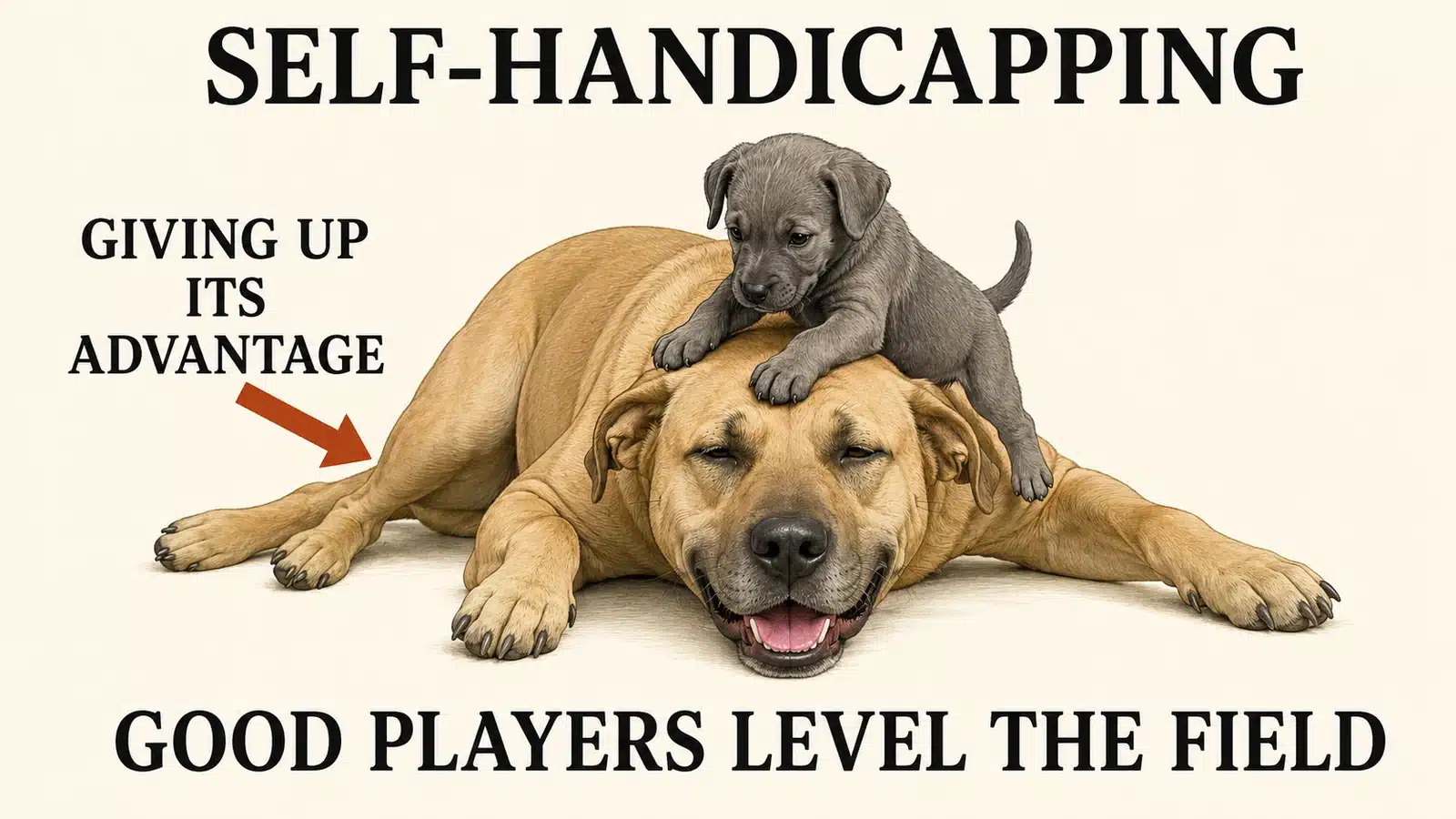
Watch a large, powerful dog play with a small puppy and, if the big dog is socially skilled, you will witness one of the most quietly remarkable behaviors in the canine repertoire. The big dog lies down to bring himself to the puppy's level, mouths with a fraction of his real force, lets himself be caught in a chase he could win in a stride, and rolls onto his back to let the puppy climb triumphantly on top. This is self-handicapping: a dog voluntarily giving up his physical advantages to keep the game fair and fun for a weaker partner, and it is a genuine mark of good play and good social skills.
Self-handicapping matters enormously for reading play between mismatched partners, because its presence or absence is often the clearest signal of whether an unequal pairing is safe. When the bigger, stronger, or more confident dog is visibly moderating himself, taking turns, softening his bites, giving the smaller dog wins, the play is healthy despite the mismatch. When that moderation is absent, when the stronger dog uses his full advantage against a partner who is increasingly stressed and cannot reciprocate, the interaction has stopped being play and become bullying, and it is time to intervene. Good players make the game fair on their own. When they do not, that is your cue to step in, and it is one of the most useful things a watching pet parent can learn to see.
Telling Real Play From Trouble Brewing
Everything on this page converges on one practical skill: knowing, in real time, whether the dogs in front of you are playing or heading for a fight. The good news is that you do not need to track every signal at once. Healthy play has a handful of signatures, and they are visible once you know to look for them. Real play is loose and bouncy rather than stiff and economical. It includes pauses, those brief self-interruptions where dogs break, shake off, and re-solicit, which prove the arousal is staying manageable. It features role reversals, with dogs taking turns chasing and being chased, being on top and on the bottom. It shows self-handicapping by the stronger dog. And it keeps returning to metacommunication, the play bows and pawing that re-confirm the shared agreement. When you see these, relax and enjoy it, even if it is loud and rough.
Trouble announces itself through the disappearance of exactly those features. The bodies stiffen and the loose wiggle vanishes into tight, economical movement. The pauses stop coming, and arousal climbs in a continuous ramp with no self-interruption to bleed it off. The roles freeze, with one dog relentlessly pursuing or pinning while the other stops reciprocating and starts showing genuine stress signals, tucked tail, pinned ears, whale eye, real attempts to escape. Play bows disappear. The mouth commitment changes, from open and loose to closed, tight, and hard. One dog is clearly no longer having fun, and the other is no longer letting him leave. When you see this shift, intervene calmly before it escalates further.
When you do need to interrupt, do it well, because how you break up rising tension matters. Avoid grabbing collars or reaching between two arousing dogs, which risks a redirected bite. Instead, use a cheerful interrupter, call both dogs away in a happy voice, toss a handful of treats to scatter them, or use a body block to calmly separate, then give both dogs a break to come down before deciding whether to let the game resume. A useful field test many professionals rely on is the consent test: gently hold or call away the dog who seems to be the aggressor, and watch the other dog. If he shakes off and immediately re-engages, wanting more, it was mutual play. If he takes the opportunity to leave, retreat, or put distance between them, he was not a willing participant, and you just did him a real kindness.
This same literacy is central to the behavior work I do with dogs who struggle around other dogs. Poorly regulated play, and especially a long history of being bullied or overwhelmed at dog parks, is a genuine contributor to leash reactivity and dog-directed fear, because a dog who has learned that other dogs mean overwhelming, unregulated arousal carries that expectation into every future encounter. Within the EASE Method, reading play accurately belongs to Evaluate and Arrange: assessing how a dog copes with social arousal, and arranging safe, well-matched, appropriately regulated social experiences instead of the free-for-all that a busy dog park too often becomes. Good play is not just a pleasure to watch. It is preventive medicine for a dog's social future.
Dog Play Signals: Questions, Answered
How can I tell if my dogs are playing or actually fighting?
Look for the signatures of healthy play: loose, bouncy bodies rather than stiff ones, frequent pauses and shake-offs, role reversals where dogs take turns chasing and being on top, self-handicapping by the stronger dog, and repeated play bows. Trouble shows the opposite: stiffening bodies, arousal climbing with no pauses, one dog relentlessly pursuing while the other shows stress signals and tries to escape, and mouths going from open and loose to tight and hard. When those healthy features disappear, calmly intervene.
Is growling during play normal?
Yes. Play growling is normal and common, especially in tug and wrestling. The key is that a play growl comes from a loose, wiggly, soft-faced dog who keeps re-engaging, while a warning growl comes from a stiff, still dog with a hard eye and a tense mouth. Sound alone tells you very little; the body tells you everything. And you should never punish any growl, in play or out, because it is valuable information.
My big dog plays with a small dog. How do I know it's safe?
Watch for self-handicapping. A socially skilled larger dog will voluntarily moderate himself, lying down to level the field, softening his bites, taking turns, and letting the smaller dog get wins. When that moderation is present, the mismatch is usually safe. When the stronger dog uses his full advantage against a partner who is stressed and cannot reciprocate, it has become bullying, and you should step in.
Why does my dog roll onto his back during play?
Usually as a strategic play move, not surrender. Research on play rollovers found dogs voluntarily flip onto their backs to dodge bites, launch counterattacks, and solicit more play, and the dog on the bottom is often driving the game. A play roll is loose, wriggly, and grinning. That is completely different from the stiff, frozen, closed-mouth rollover of genuine appeasement or fear, where the body is tense and the head turns away.
What are zoomies and should I worry about them?
Zoomies, or frenetic random activity periods, are sudden bursts of fast, tucked, gleeful running. They are normal and healthy, usually an expression of joy or a way to discharge tension, and they often appear after baths, confinement, or stressful-but-survived events like vet visits. Just make the space safe by clearing obstacles and steering the dog away from roads and slick floors. Only be concerned if the running looks frantic and anxiety-driven rather than joyful, in which case the surrounding body language is what to read.
Next: Distance-Increasing Signals
When play breaks down or a dog needs space, the warnings begin. The distance-increasing signals are the ones every pet parent must learn to respect, and never to punish.
 About the Author
Will Bangura, M.S., CAB-ICB, CBCC-KA, CPDT-KA, FDM, FFCP, is a Certified Canine Behaviorist with over 35 years of experience specializing in severe aggression, fear, anxiety, reactivity, phobias, and compulsive disorders in dogs. He holds a Master's Degree in Psychology and is accredited as a Certified Canine Behaviorist through International Canine Behaviorists, one of only three CAB-ICB Certified Canine Behaviorists in the United States and the only one in Arizona. His additional credentials include Certified Behavior Consultant Canine (CBCC-KA) and Certified Professional Dog Trainer (CPDT-KA) through the Certification Council for Professional Dog Trainers, certification in Applied Ethology through Family Dog Mediation (FDM), and Fear Free Certified Professional (FFCP).
Will is the author of Sniff to Soothe, host of the Dog Training Today podcast, and a court-recognized expert witness in canine behavior. His clinical work is grounded in behavioral psychology, applied behavior analysis, learning theory, and affective neuroscience: every case begins with a functional behavior assessment and is treated through management, skill building, and evidence-based behavior modification using systematic desensitization and counterconditioning. He is a national advocate for force-free, science-based training and a published voice on the welfare risks of aversive training methods.
As the founder of Phoenix Dog Training, Will provides in-home behavior consultations throughout the Phoenix metro area and virtual behavior consultations for pet parents nationwide.
If Your Dog Struggles Around Other Dogs
Reactivity and dog-directed fear are treatable, and they often trace back to overwhelming social experiences. A professional behavior consultation begins with a full functional behavior assessment and ends with a clear, evidence-based plan. Schedule a Behavior Consultation, or start with a free call.