
← Dog Body Language: The Definitive Guide
The Definitive Guide · Tail WaggingDog Tail Wagging: The Most Misread Signal in Dog Behavior
A wagging tail does not mean a friendly dog. It means an emotionally aroused dog, and the height, speed, width, and even the direction of the wag decide whether that arousal is an invitation or a warning. Here is how to read all of it.
A Wagging Tail Is Not a Happy Tail
Ask almost anyone what a wagging tail means and you will hear the same answer: the dog is happy. It is one of the most widely held beliefs about dogs, and it is wrong often enough to be genuinely dangerous. Every experienced behavior professional has met the family whose child was bitten by a dog who was, in their words, wagging the whole time. They were not lying, and they were not careless. They were reading a real signal through a false translation.
Here is the accurate version. A wag is a sign of emotional arousal and a readiness to engage, not a sign of any specific emotion. Think of it as the dog's engine running: it tells you energy is present and the dog is prepared to interact, but it says nothing on its own about whether that interaction will be friendly, fearful, or defensive. A nervous dog wags. An aroused dog on the edge of aggression wags. A conflicted dog who cannot decide whether to approach or retreat wags. The wag is the volume knob, not the song.
To read the song, you have to read four separate variables the wag encodes, and then read them against the rest of the dog. Height tells you about confidence and arousal. Speed tells you about intensity. Width and looseness tell you about friendliness. And direction, remarkably, tells you about the emotional valence happening inside the dog's brain. This page walks through each of the six wags those variables produce. But the master rule never changes, and it is the same rule that governs every page in this guide: the tail is one word, the whole body is the sentence. If you have not yet read the main guide on reading the whole dog, that is the foundation this page is built on.
The Fast, High Wag: Arousal With the Volume Turned Up
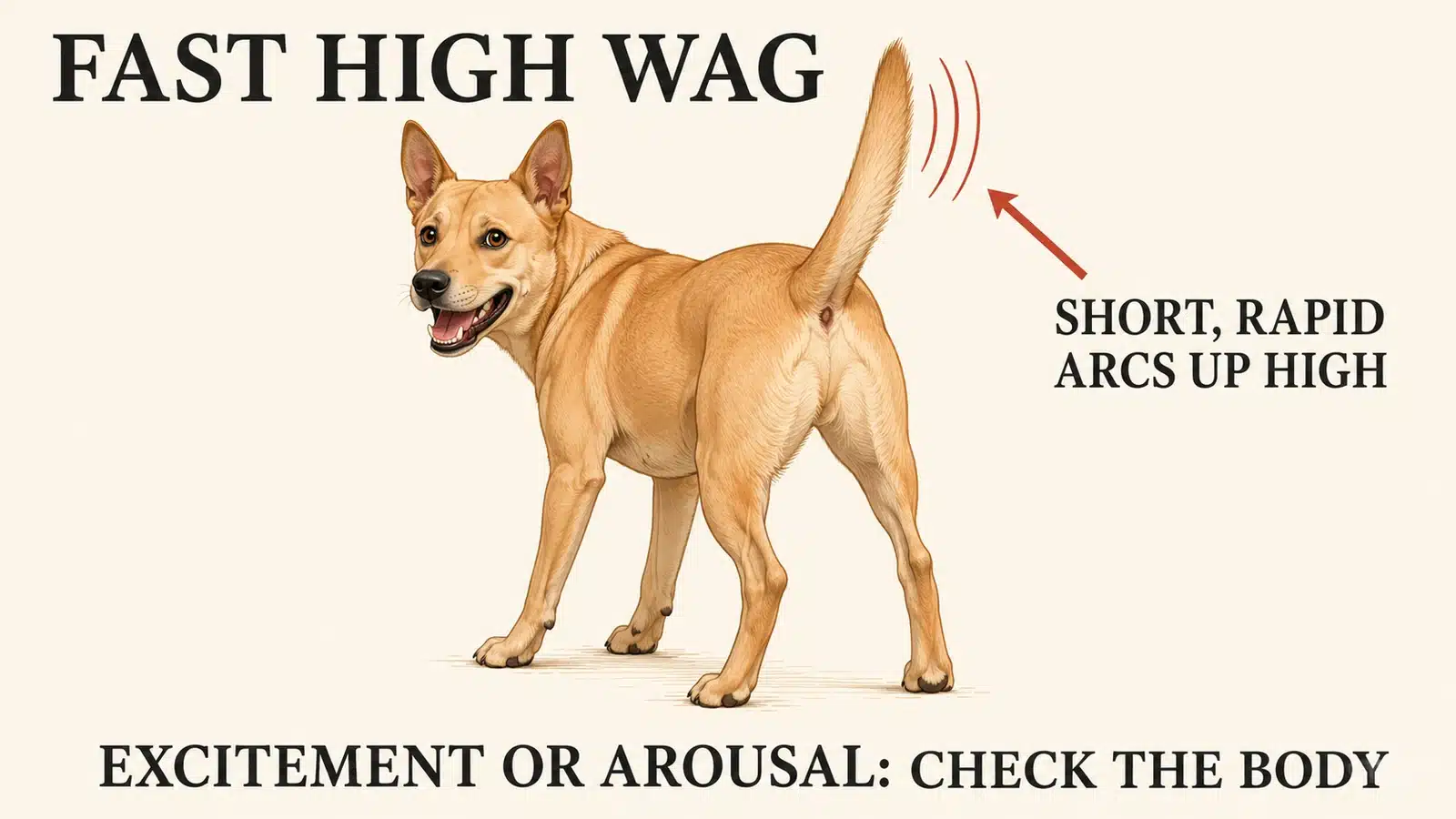
When the tail rides high above the spine and moves in short, fast, tight arcs, you are looking at a highly aroused dog, and this is exactly the wag most likely to be misread as pure enthusiasm. Sometimes it is enthusiasm. A dog greeting a beloved person may wag high and fast, but crucially, the rest of his body will be loose: wiggling hips, soft eyes, a relaxed open mouth. That is the tell that turns a high fast wag into a friendly one.
The dangerous version wears the identical tail on a completely different body. High and fast, but paired with a stiff frame, hard eyes, a closed tense mouth, forward-loaded weight, and raised hackles, is the arousal of a dog on the edge of aggression, and the higher and stiffer the tail base, the more assertive the state. This is why the wag alone can never be trusted, and why the sight of a fast high wag should prompt you to immediately read the body around it rather than relax. Height plus stiffness is a caution flag; height plus looseness is a welcome. Same tail, opposite meanings, and the difference lives everywhere except the tail.
The Loose, Wide Wag: The Gold Standard of Friendliness
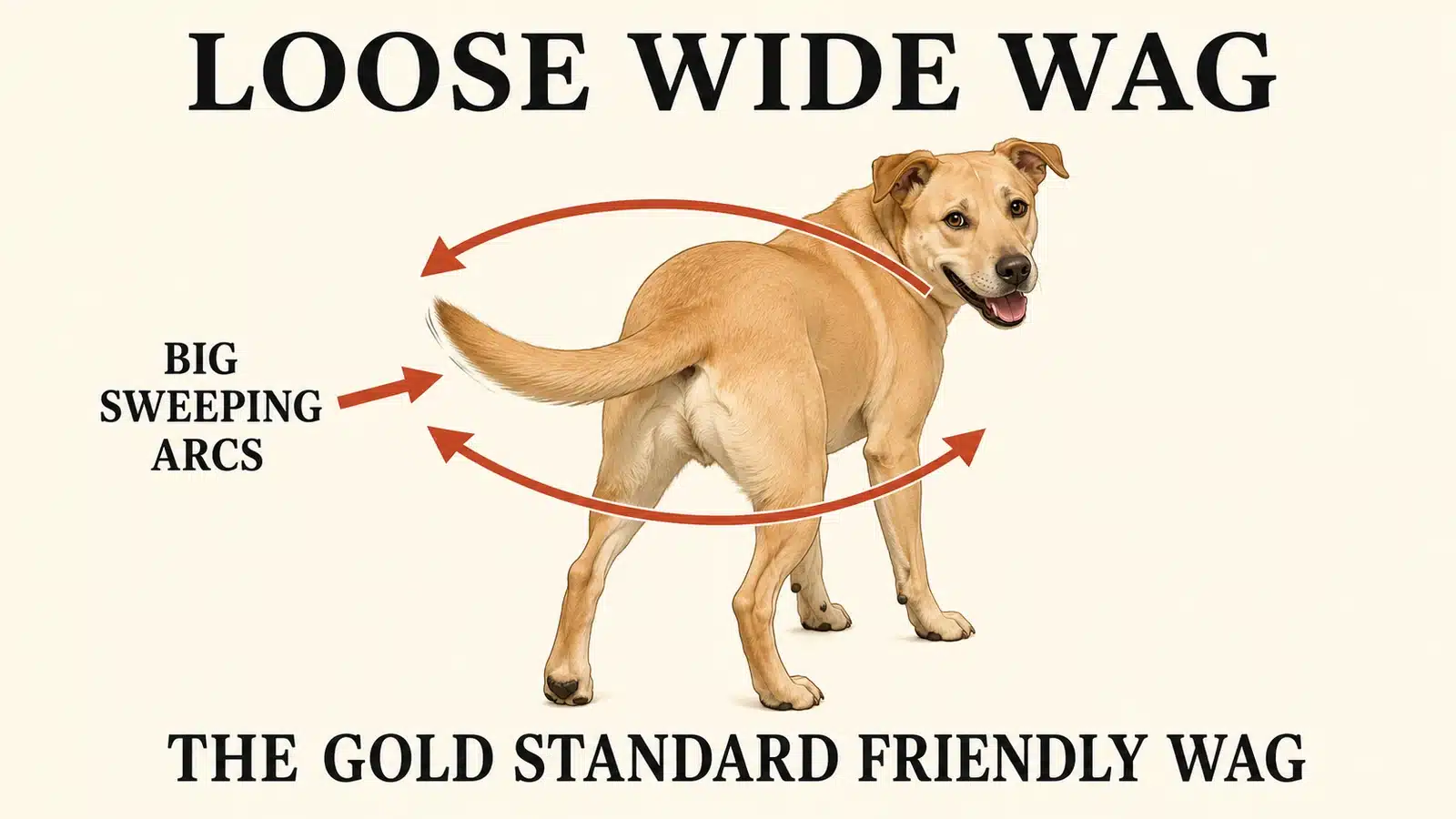
If there is a single wag that comes closest to the folk meaning of happy, this is it: the tail held at a neutral, mid-level height, sweeping in broad, loose, unhurried arcs, with the whole rear end often swaying along for the ride. The width is the key variable. Wide, loose movement is incompatible with the muscular tension that aggression and fear require, which is why this wag reads as genuinely friendly and relaxed across virtually every context you will see it in.
The looseness matters more than any other feature, so train your eye to it. A friendly wag is fluid and floppy; the tail almost seems to have no bones in it, and the motion travels forward into the hips and spine. Compare that to the mechanical, isolated stiffness of an aroused tail, where the tail moves fast but the body stays rigid. When you see the loose wide wag paired with soft eyes and a relaxed open mouth, you are looking at a dog who means exactly what people wish all wags meant. It also overlaps with the low, wide calming wag covered in the calming signals guide, and the two together form the friendly end of the entire tail spectrum.
The Low, Slow Wag: Insecurity, Not Joy
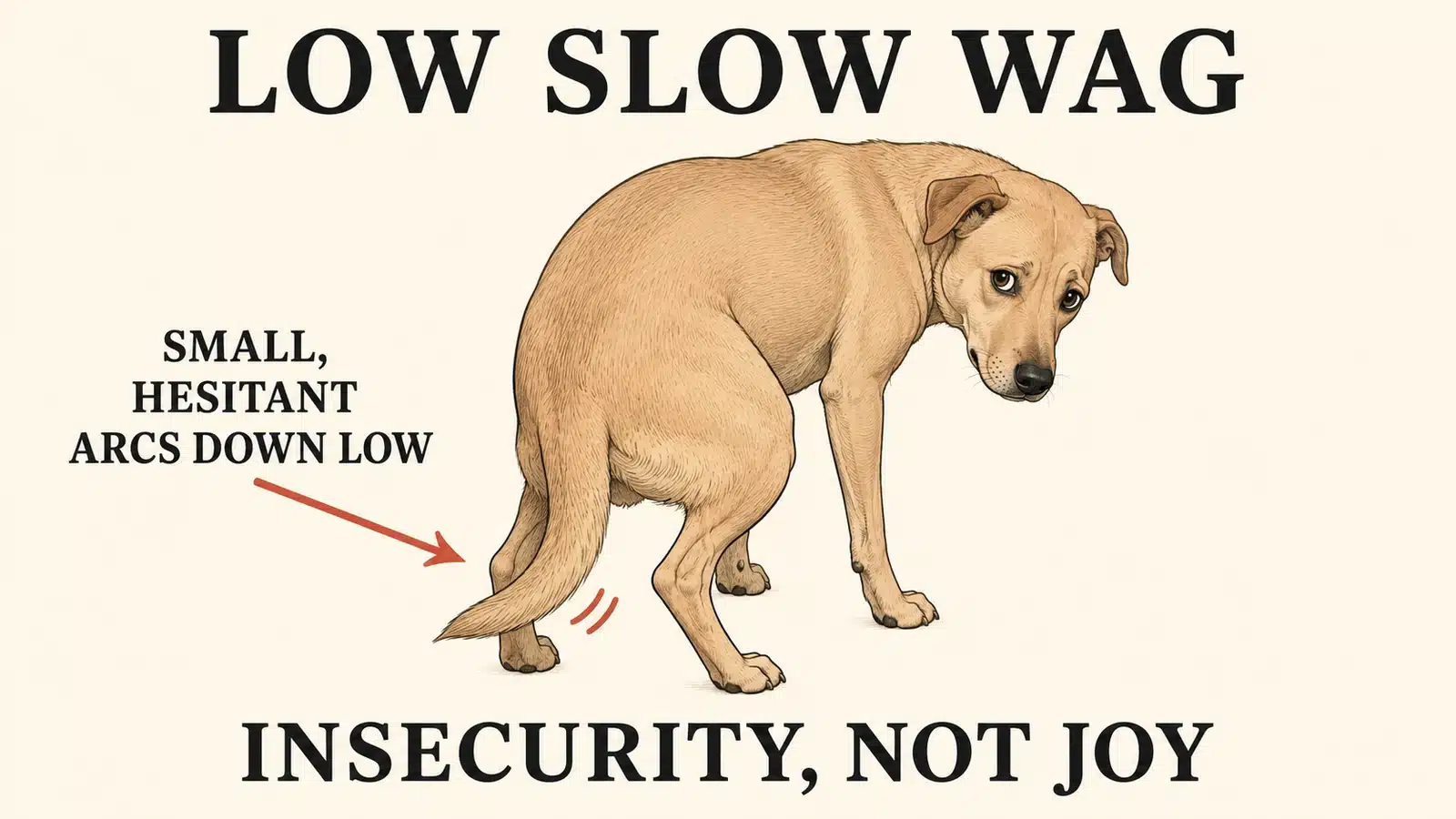
A tail carried low, near or below the level of the hocks, moving in small, slow, tentative arcs, is one of the most commonly misunderstood wags of all, because people see a wag and assume happiness while missing the low carriage and the hesitancy that reframe the entire message. This is the wag of a dog who is uncertain, insecure, or appeasing: he is signaling non-threatening intent and a wish to keep the peace, but he is not comfortable. It is a question mark, not an exclamation point.
You will see this wag in a dog approaching something he is unsure about, in a dog greeting a person who worries him slightly, and in a dog offering appeasement after sensing his pet parent's displeasure, a moment humans routinely mislabel as a guilty wag. Read it as a request for reassurance and for lowered pressure. The worst response is to loom, reach over the head, or intensify, because those add exactly the social pressure the low slow wag is asking you to remove. Soften, angle sideways, slow down, and let the dog gain confidence at his own pace. This wag lives close to the appeasement signals covered elsewhere in the guide, and the response is the same: make the polite signal work.
The Helicopter Wag: Reserved for the Ones They Love Most
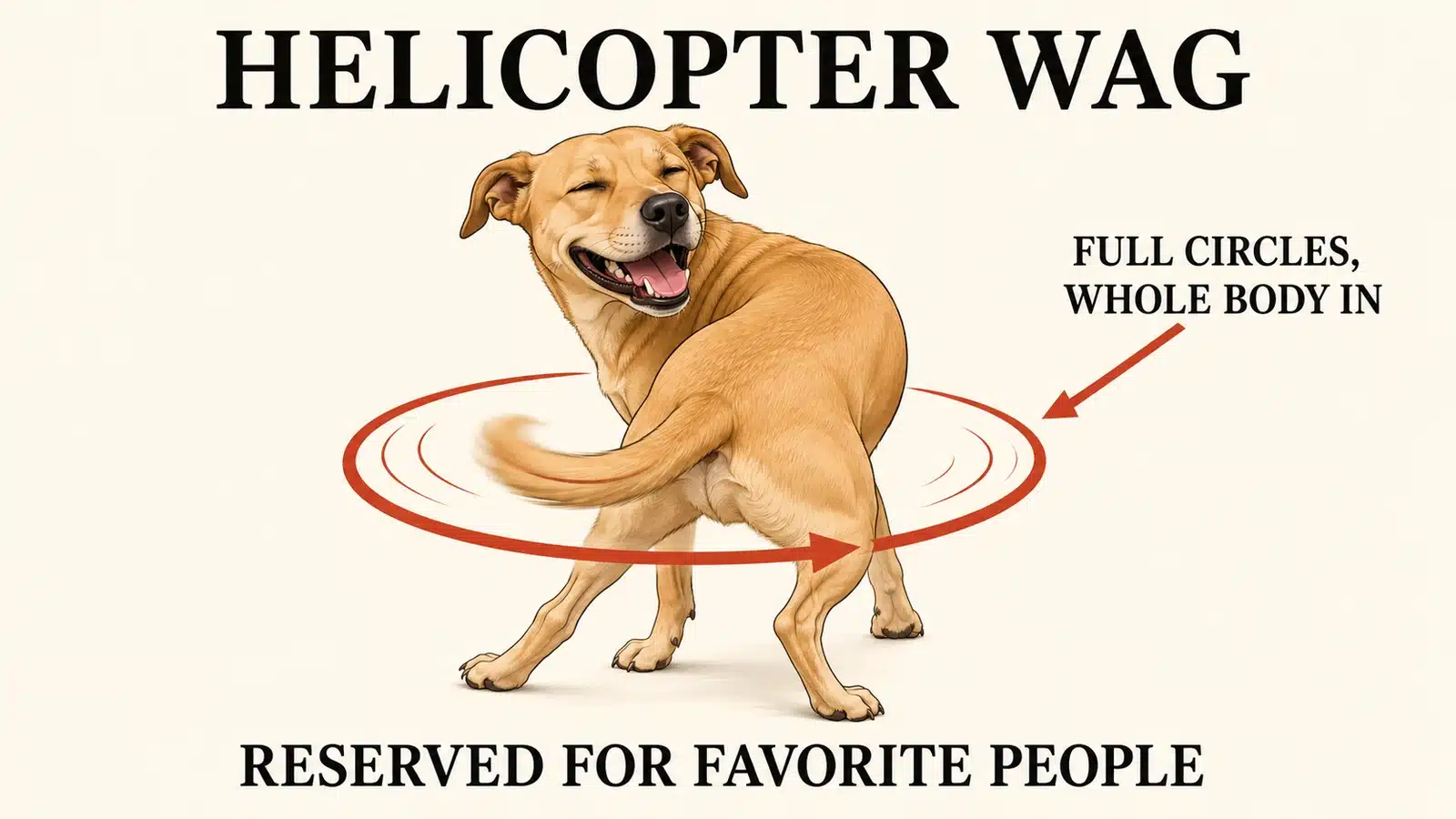
Every so often a dog produces a wag so exuberant the tail stops swinging side to side and begins moving in full circles, a genuine rotary motion, while the entire body folds into a wriggling, boneless curve. Handlers call it the helicopter wag or the circle wag, and it is one of the few tail signals with almost no ambiguity. This is unrestrained, whole-body delight, and dogs tend to reserve it for their favorite people and their favorite moments: the reunion at the door, the reappearance of a beloved person, the instant before a cherished game begins.
What makes the helicopter wag so trustworthy is that it is impossible to fake through tension. The circular motion requires total looseness through the tail, hips, and spine, and looseness is the one thing a fearful or aggressive dog cannot produce, because those states demand muscular rigidity. When the whole body wiggles this way, the friendliness is real by definition. This is the full-body wiggle wag at its most extreme, close kin to the loose wide wag, and the closest thing in the canine repertoire to pure joy made visible. Enjoy it without second-guessing; you have earned it.
The Right-Biased Wag: A Window Into the Left Brain
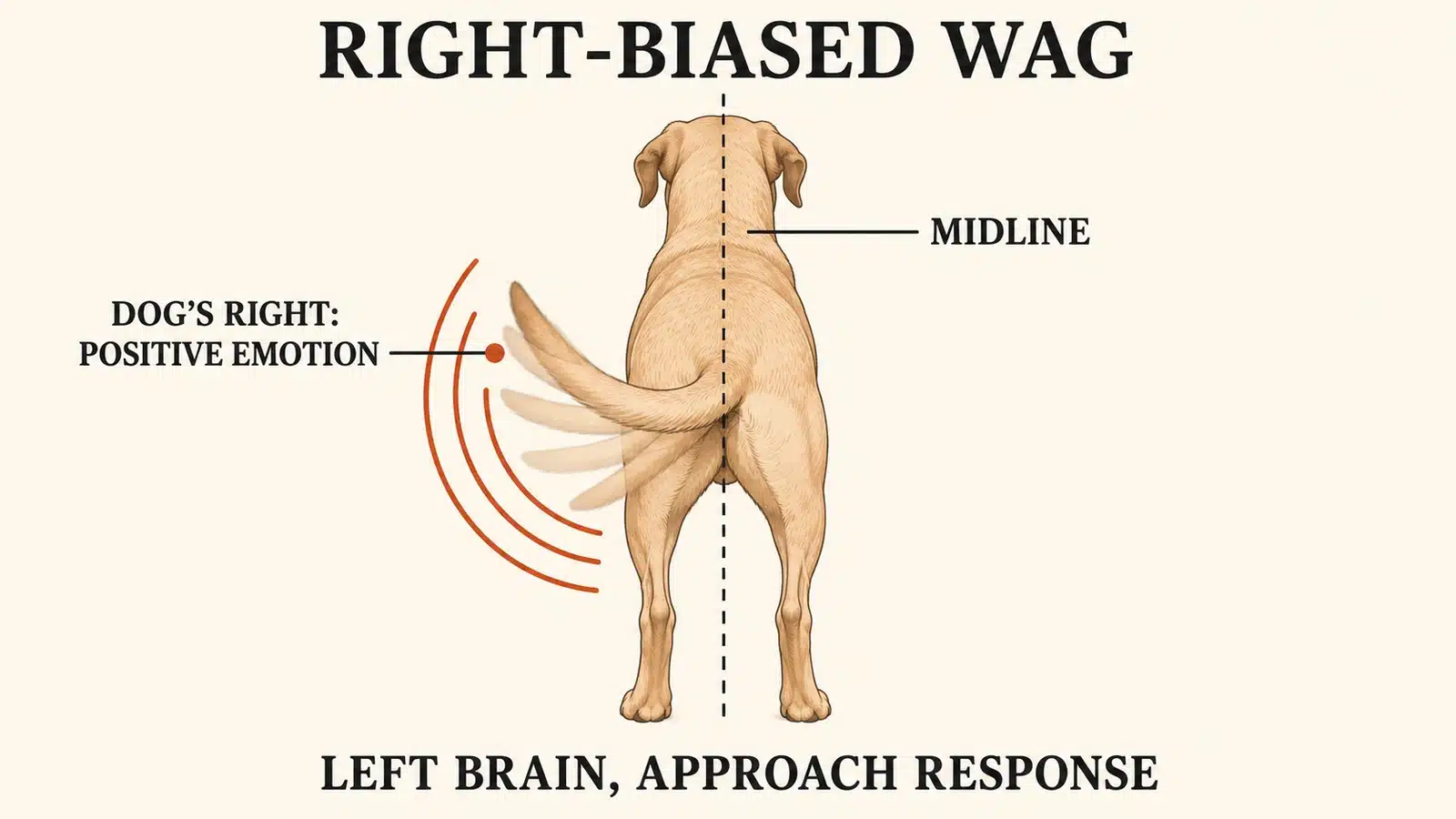
Here is where tail wagging stops being folklore and becomes neuroscience, and it is one of the more remarkable findings in modern canine research. When you watch a dog's tail from directly behind, the wag is often not perfectly symmetrical; it swings slightly farther to one side of the body's midline than the other. That asymmetry is not random. It is a visible readout of which hemisphere of the dog's brain is more active, because of the way the brain's control of the body is laterally organized.
Research on tail-wagging asymmetry, notably work led by Giorgio Vallortigara and colleagues, found that dogs tend to wag with a bias toward their own right side when they encounter something they feel positively about and want to approach, such as their pet parent. The proposed mechanism runs through the left hemisphere of the brain, which is broadly associated with positive affect and approach behavior and which controls the right side of the body. So a right-biased wag is, in effect, the left brain's approach-and-engage state made visible on the outside of the animal. It is worth being precise about this, because the science deserves precision: this is a measurable statistical bias documented across controlled studies, not a party trick you will reliably eyeball on a fast-moving tail in your living room.
Even more striking, follow-up research showed that other dogs actually notice this asymmetry and respond to it, staying relaxed when they watch a right-biased wag and growing more anxious watching a left-biased one, which means tail lateralization is not just an internal signal leaking out, it is information other dogs genuinely read. For the pet parent, the practical takeaway is less about counting sways in real time and more about appreciating what it confirms: the wag is wired directly into the dog's emotional brain, which is exactly why it is such honest information and such a poor fit for the single word happy.
The Left-Biased Wag: A Window Into Withdrawal
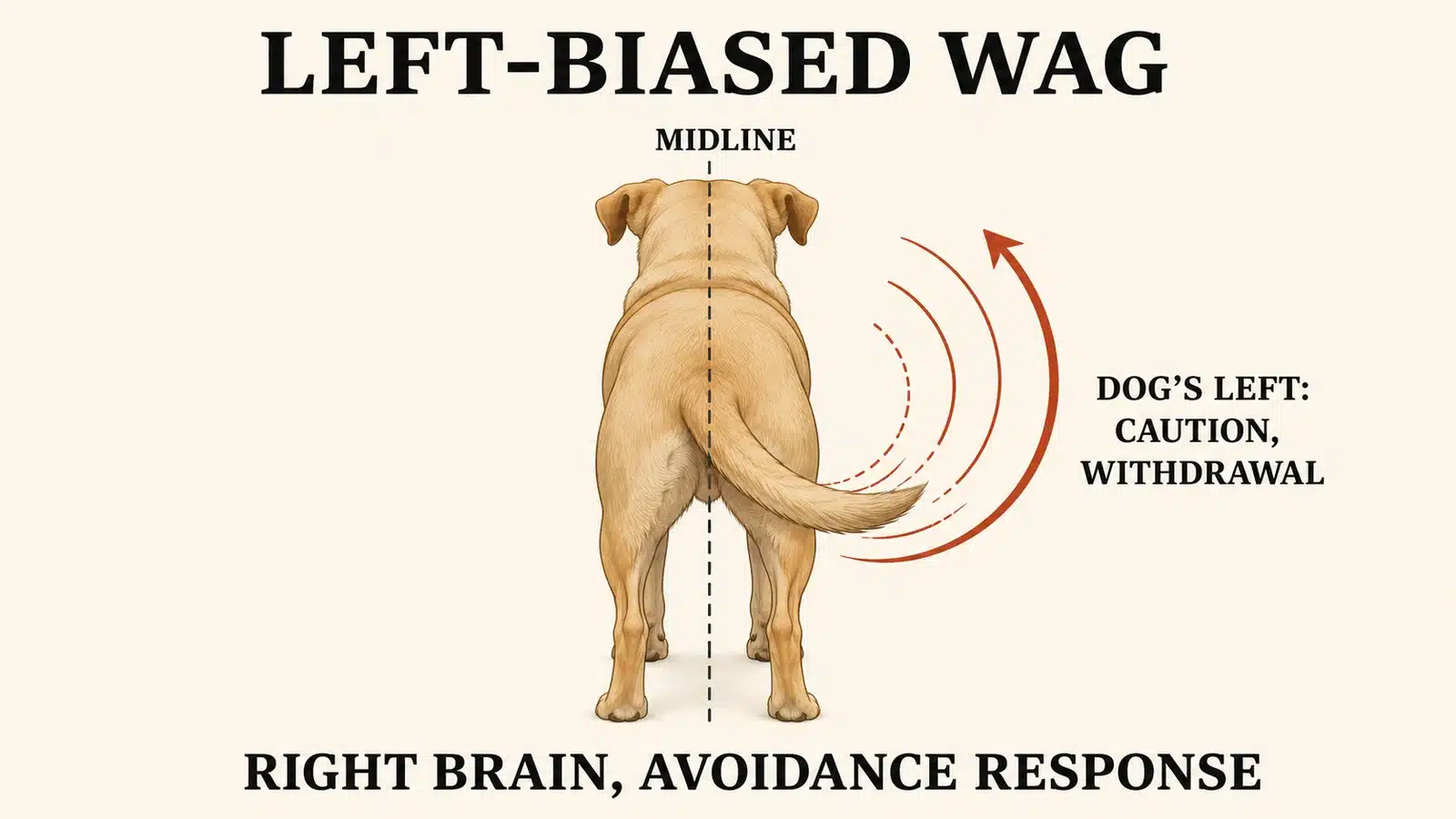
The mirror image of the right-biased wag carries the mirror-image meaning. When a dog encounters something that provokes wariness, caution, or a wish to withdraw, the same research found the wag tends to bias toward the dog's own left side. The mechanism is the other hemisphere: the right side of the brain, broadly associated with withdrawal, avoidance, and negatively valenced states such as fear, controls the left side of the body. A left-biased wag is the right brain's caution state showing on the surface.
This is the finding that should permanently retire the wag-equals-happy myth, because here is a wag that is measurably tied to a negative emotional state. The dog is aroused, the tail is moving, and the internal experience driving it is unease rather than pleasure. It reinforces everything this page has argued: the presence of a wag tells you the emotional engine is running, and only a full reading of direction, height, width, speed, and the rest of the body tells you what emotion is at the wheel.
Two honest cautions keep this genuinely useful rather than gimmicky. First, you observe this reliably from directly behind the dog, and even then it is a subtle statistical lean that researchers measured with slow-motion video, not something to diagnose from a glance. Second, and more important for daily life, you never need the lateralization data to stay safe, because a dog experiencing negative arousal is also telling you through his eyes, ears, mouth, weight, and posture. Read the whole dog, as always, and the tail's direction becomes a fascinating confirmation of what the rest of the body already told you rather than a signal you have to decode on its own.
How to Read Any Wag: Four Variables and a Body
You do not need to memorize a catalog of named wags to read tails well. You need to read four variables and then, without fail, check them against the rest of the dog. Height comes first: a tail carried high signals confidence and high arousal and, at the extreme, assertiveness, while a tail carried low signals uncertainty, insecurity, or appeasement, and a tail tucked signals fear. Speed is your intensity dial: faster means more emotionally aroused, whatever the underlying emotion turns out to be. Width and looseness carry the friendliness reading: broad, loose, fluid movement that recruits the hips leans friendly, while tight, stiff, mechanical movement leans toward tension. And direction, the subtle right-versus-left bias, maps to positive versus negative emotional valence, best appreciated as confirmation rather than diagnosed on the fly.
Then comes the step that matters more than all four variables combined, because it is the step that keeps people safe: read the tail against the whole dog. A wag paired with soft eyes, a relaxed open mouth, loose shoulders, and a wiggling body is friendly almost regardless of its height or speed. The very same wag paired with hard eyes, a closed tense mouth, a stiff frame, forward weight, and raised hackles is a warning, and the wag does nothing to soften it. The tail is a single word. Meaning lives in the sentence.
This is not academic. Most tail-related bites trace back to a person who read the wag in isolation, saw motion, translated it to happy, and reached in. The habit that prevents that outcome is simple and worth building until it is automatic: never let a wag be the only thing you read. When a wag and the rest of the body disagree, believe the body. And when the body is telling you a dog is aroused in a way that could tip toward aggression, particularly if you are seeing this pattern in your own dog around specific triggers, that is precisely the situation a professional functional behavior assessment is built to address, well before anyone gets hurt.
Dog Tail Wagging: Questions, Answered
Does a wagging tail always mean a dog is happy?
No. A wag signals emotional arousal and readiness to engage, not any specific emotion. Nervous dogs wag, conflicted dogs wag, and dogs on the edge of aggression wag. To know what a wag means, you have to read its height, speed, width, and direction, and then read the whole body around it. Many bites happen because someone saw a wag, assumed happiness, and reached in.
What does it mean when a dog wags its tail slowly and low?
A low, slow, tentative wag usually signals uncertainty, insecurity, or appeasement rather than happiness. The dog is communicating non-threatening intent but is not comfortable. Respond by lowering social pressure: soften your posture, angle sideways, slow down, and let the dog gain confidence rather than looming or reaching over his head.
Is it true that the direction of a dog's tail wag means something?
Yes, and it is backed by controlled research. Dogs tend to wag with a bias toward their own right side in response to something positive they want to approach, and toward their own left side in response to something they feel wary about. This reflects lateralized brain activity: the left hemisphere drives approach and controls the right side of the body, the right hemisphere drives withdrawal and controls the left. It is a subtle statistical bias best seen from directly behind, not something to diagnose from a glance.
Why does my dog wag his tail high and fast but still seem tense?
Because a high, fast wag signals high arousal, and high arousal is not always friendly. When it is paired with a stiff body, hard eyes, a closed mouth, and forward-loaded weight, it points toward a dog near the edge of aggression, not an excited-happy dog. Trust the body over the tail. A high fast wag should prompt you to read the rest of the dog carefully, not to relax.
My dog wags his whole body when I come home. What does that mean?
That full-body, sometimes circular helicopter wag is one of the most unambiguous friendly signals a dog produces. It requires total looseness through the tail, hips, and spine, which fear and aggression cannot produce, so the delight is genuine. Dogs tend to reserve it for their most favored people and moments. Enjoy it without second-guessing.
Next: Tail Positions
Before the tail moves, its resting height is already telling you something. The companion guide to tail positions breaks down high, neutral, low, and tucked, and why every dog's baseline is different.
 About the Author
Will Bangura, M.S., CAB-ICB, CBCC-KA, CPDT-KA, FDM, FFCP, is a Certified Canine Behaviorist with over 35 years of experience specializing in severe aggression, fear, anxiety, reactivity, phobias, and compulsive disorders in dogs. He holds a Master's Degree in Psychology and is accredited as a Certified Canine Behaviorist through International Canine Behaviorists, one of only three CAB-ICB Certified Canine Behaviorists in the United States and the only one in Arizona. His additional credentials include Certified Behavior Consultant Canine (CBCC-KA) and Certified Professional Dog Trainer (CPDT-KA) through the Certification Council for Professional Dog Trainers, certification in Applied Ethology through Family Dog Mediation (FDM), and Fear Free Certified Professional (FFCP).
Will is the author of Sniff to Soothe, host of the Dog Training Today podcast, and a court-recognized expert witness in canine behavior. His clinical work is grounded in behavioral psychology, applied behavior analysis, learning theory, and affective neuroscience: every case begins with a functional behavior assessment and is treated through management, skill building, and evidence-based behavior modification using systematic desensitization and counterconditioning. He is a national advocate for force-free, science-based training and a published voice on the welfare risks of aversive training methods.
As the founder of Phoenix Dog Training, Will provides in-home behavior consultations throughout the Phoenix metro area and virtual behavior consultations for pet parents nationwide.
When the Wag and the Body Disagree
If your dog shows arousal that could tip toward reactivity or aggression, do not wait for a bite to find out. A professional behavior consultation begins with a full functional behavior assessment and ends with a clear, evidence-based plan. Schedule a Behavior Consultation, or start with a free call.