
← Dog Body Language: The Definitive Guide
The Definitive Guide · Reading Signal ClustersReading Signal Clusters: The Skill That Makes Everything Else Work
You have learned the vocabulary. This is the grammar. Reading the whole dog at once, in context, against his own baseline, is the difference between knowing signals and actually understanding a dog. It is the clinical heart of this entire guide.
Signals Are Words. Clusters Are Sentences.
Every page in this guide has repeated one rule like a heartbeat: no signal means anything in isolation. A yawn can be sleepiness, stress, or diplomacy. A wag can be joy or a countdown. A rollover can be an invitation or a plea. Ears back can be love or fear. If you tried to build a translation dictionary with one meaning per signal, you would be wrong about half the time, and the half you got wrong would include the moments that matter most. Dogs do not communicate in single signals any more than people communicate in single words. They communicate in clusters: several signals firing together, on one body, in one context, telling one coherent emotional story.
Reading clusters is a genuine skill, and like any skill it decomposes into learnable parts. Part one is simultaneity: taking in eyes, ears, mouth, tail, weight distribution, muscle tone, and movement quality as a single picture rather than a checklist. Part two is context: the same picture means different things at the food bowl, at the door, at the dog park, and on the exam table. Part three is baseline: every reading is a comparison against this individual dog's relaxed normal, which is why the homework assigned in the tail positions guide and the calming signals guide, learning your own dog at rest, is the foundation under everything. And part four is trend: emotional states move, and the direction of movement, loosening or tightening, rising or sinking, often matters more than any snapshot.
This page teaches cluster reading through ten worked examples, the ten most important composite pictures in dog behavior, each one a labeled diagram with the reading walked through in full. By the end you will have the complete method: the three-second scan professionals run automatically, the escalation ladder that organizes every warning in the language, and the comparison skills that separate play from trouble and invitation from plea. This is the page the other eleven were building toward. If you landed here first, start with the main guide, then come back for the graduate course.
The Stress Cluster: Five Signals, One Sentence
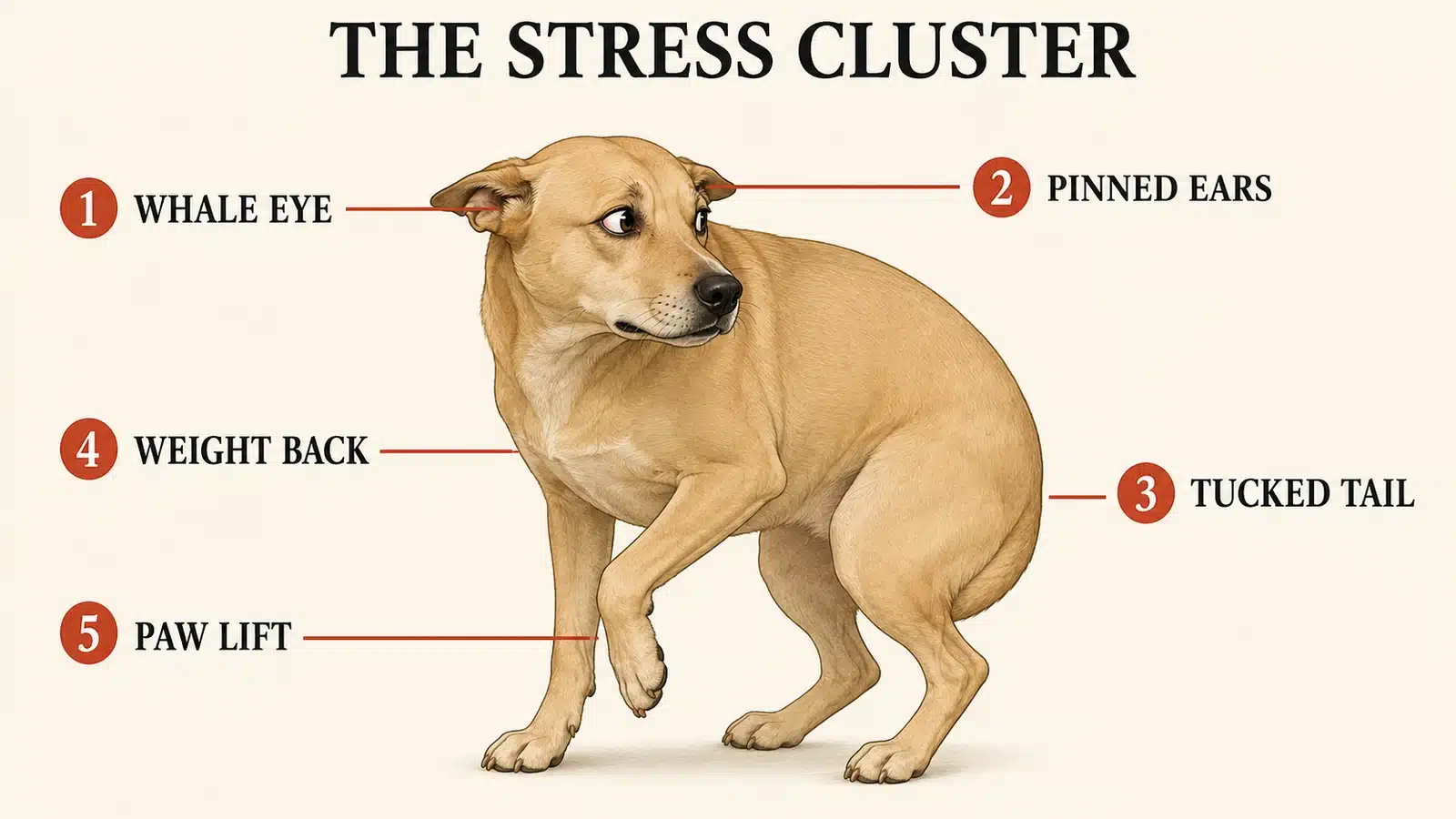
Start with the composite picture that shows up in more bite reports than any other. Head turned away but eyes locked on the trigger, exposing the white crescent of whale eye. Ears pinned flat. Tail tucked. Weight rocked onto the hindquarters. One front paw lifted mid-hesitation. Any one of these signals, alone, is a data point worth noticing. All five together are not five data points; they are one sentence, and the sentence reads: I am seriously stressed, I want out of this situation, and I do not feel safe enough to simply leave. Each signal individually is covered in the stress signals guide. The cluster is what tells you the intensity.
Here is the reading discipline this example teaches: convergence raises confidence. One ambiguous signal deserves attention; three consistent signals deserve action; five consistent signals demand it, immediately. When a cluster this coherent appears, you do not need to identify each component by name before responding, and in the moment you should not try. You respond to the sentence: stop the interaction, add distance, remove the pressure, and only afterward reconstruct which signals you saw. This is also the cluster to burn into the memory of every household with children, because it is the picture a dog makes in the seconds before the bite that the family later swears came from nowhere, and it is the reason my complete guide to preparing your dog for a new baby is built around teaching parents to read exactly this sentence. It never comes from nowhere. It comes from a sentence like this one, spoken clearly, to a room that had not learned to read.
The Fear Posture: A Body Trying to Disappear
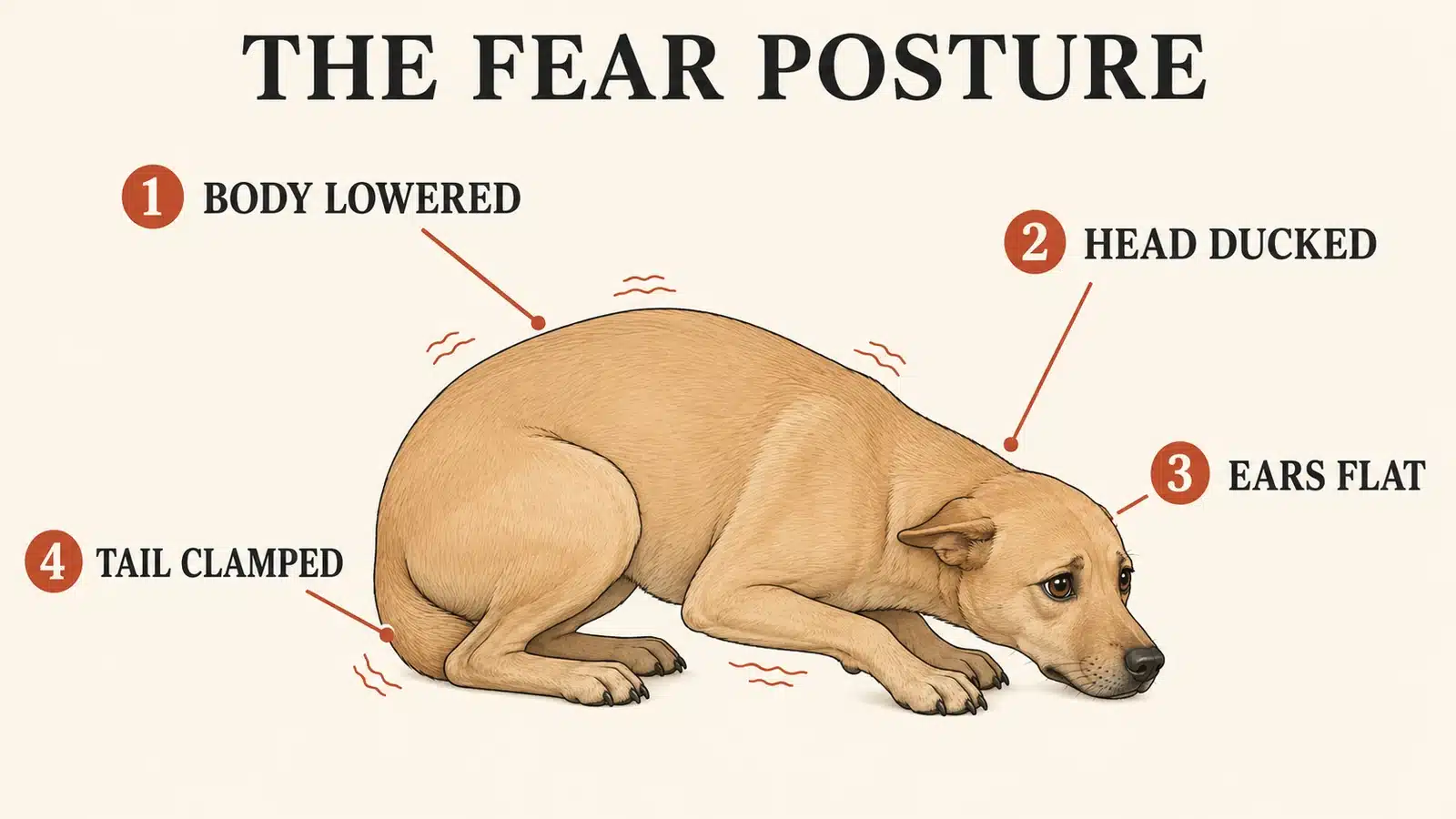
The fear posture is the easiest cluster to read once you see its organizing principle: every single component serves the same project, which is shrinking. The back rounds and the body lowers, reducing height. The head ducks below the shoulders, protecting the throat and cutting the profile. The ears flatten, removing the silhouette's tallest points. The tail clamps, protecting the underside and shutting off the scent broadcast. Sometimes trembling rides on top of all of it, adrenaline with nowhere to go. The dog is doing everything anatomy allows to occupy less of the world, and the coherence of that project is what makes the cluster unmistakable even at a distance.
The reading lesson here is about interpreting through function. When you cannot remember what a specific signal means, ask what the body is trying to accomplish, because posture almost always serves a legible goal. A body getting bigger, taller, more forward is asserting or warning. A body getting smaller, lower, more compressed is afraid or appeasing. A body going loose and curved is comfortable or playful. A body going stiff and straight is loading for something serious. Those four functional directions, bigger, smaller, looser, stiffer, will carry you through nearly every cluster you ever encounter, and they are the fastest possible entry point for a family member who will never read twelve web pages but can learn four directions in one conversation.
The Escalation Ladder: Every Warning, In Order
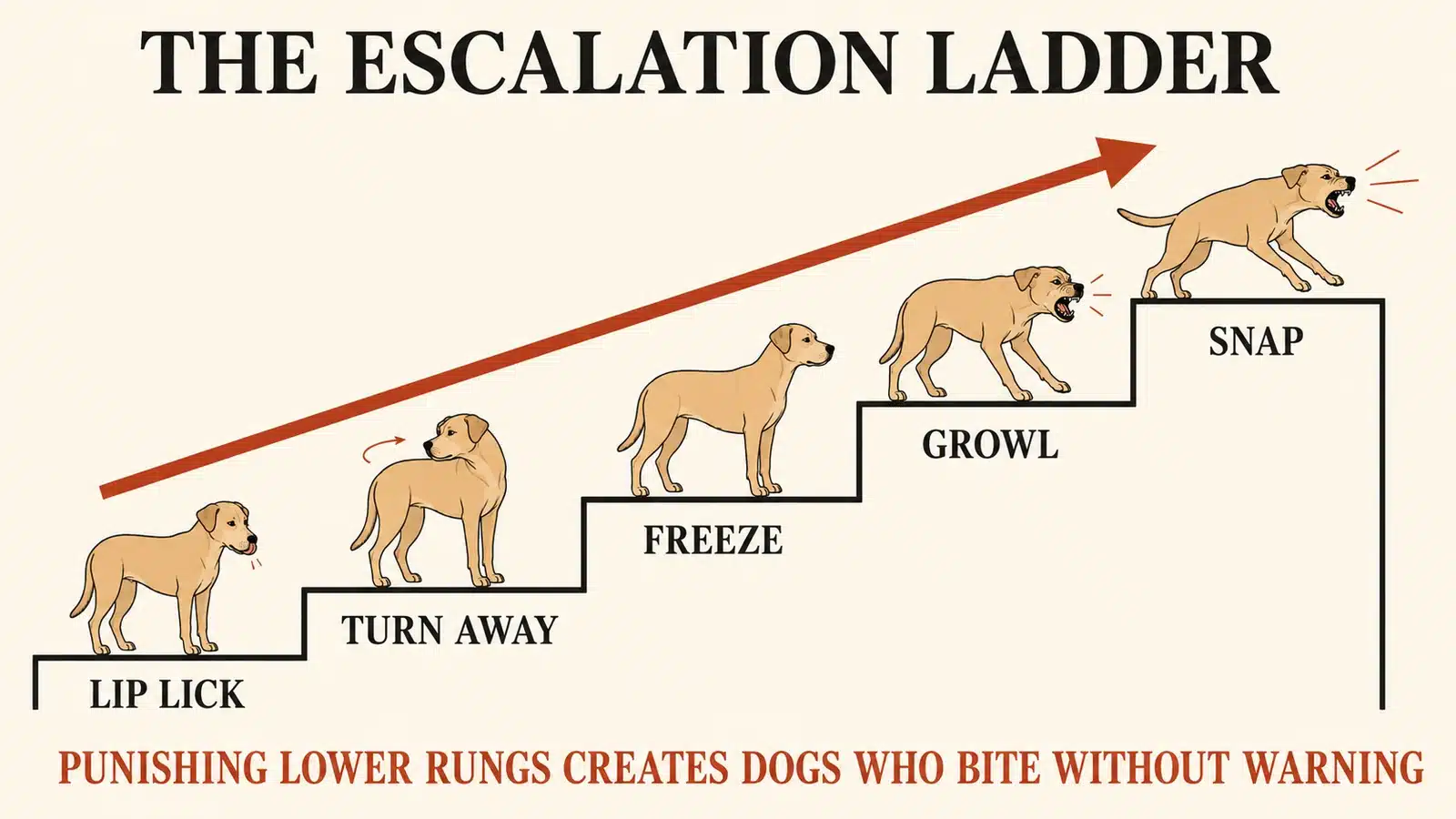
If this guide has a single most important diagram, this is it. Canine warnings are not a menu the dog picks from at random; they are a ladder climbed in rough order, from the quietest signals at the bottom to the bite at the top. A typical climb runs: lip licks and head turns, then avoidance and attempts to leave, then freezing and stiffening, then the growl, then the snarl or snap, and only then, if everything below has failed, contact. The dog's entire strategy is to resolve the situation as low on the ladder as possible, because every rung is cheaper and safer than the one above it, for everyone involved. The individual rungs live in the stress signals guide and the warning signals guide; the ladder is how they connect.
Two consequences follow, and they organize everything a pet parent needs to do. First: answer low rungs and the high rungs never happen. A person who reliably responds to lip licks and head turns, by adding distance and lowering pressure, resolves nearly every situation before it becomes anything at all. Fluency at the bottom of the ladder is bite prevention, full stop. Second, and this is the rule stated at full strength across this guide: never punish a rung. Punishing a growl, a snap, or any warning does not remove the emotion driving the climb; it removes the rung, through simple positive punishment that suppresses the behavior while leaving the fear intact. Do it consistently and you manufacture the most dangerous dog there is, one who climbs from silent discomfort straight to the top with nothing visible in between. Dogs who bite without warning are, overwhelmingly, dogs whose warnings were trained away. Protect the ladder. It is the safety system, and it only works if every rung stays intact and every rung gets answered.
Relaxed Versus Stressed: Same Dog, Two Nervous Systems
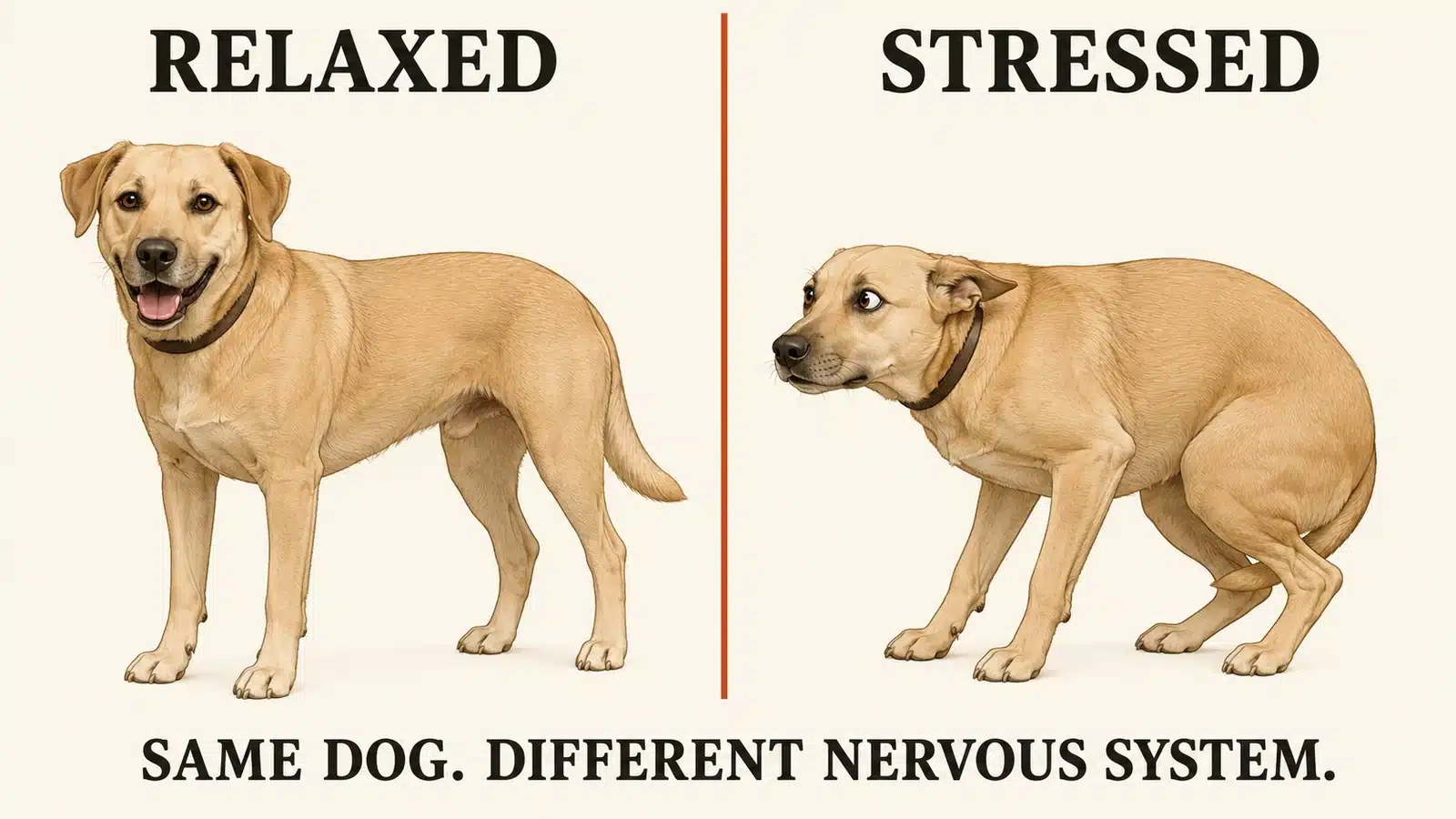
Place the two states side by side and the whole discipline of baseline reading teaches itself. On the left, the relaxed dog: almond eyes with soft lids, ears in their natural neutral carriage, mouth softly open with a loose tongue, tail at baseline, weight distributed evenly over four square legs, every muscle unloaded. On the right, the same dog stressed: eyes rounded with sclera showing, ears pinned, mouth clamped shut, tail dropped and tucking, weight rocked back, tension visible in the brow and the shoulders. Not one feature on the right requires expertise to see, once the left exists as a reference. That is the entire point: stress is not read in absolute terms, it is read as a departure from this dog's own relaxed picture.
This comparison also hands you the single fastest field diagnostic in dog body language: the mouth. Watch a dog's mouth transition from softly open to firmly closed during any interaction, a greeting, a petting session, a photo, a child's approach, and you have just watched his emotional state tighten in real time, seconds before anything louder appears. The open-to-closed mouth transition is quick, reliable, visible from across a room, and almost universally missed by people who were never told to look. Pair it with its reverse, the closed mouth softening back open as pressure lifts, and you have a live readout of whether whatever you just changed actually helped. One dog, two nervous systems, and the mouth is the needle on the gauge.
Play Versus Trouble: Curves Against Straight Lines
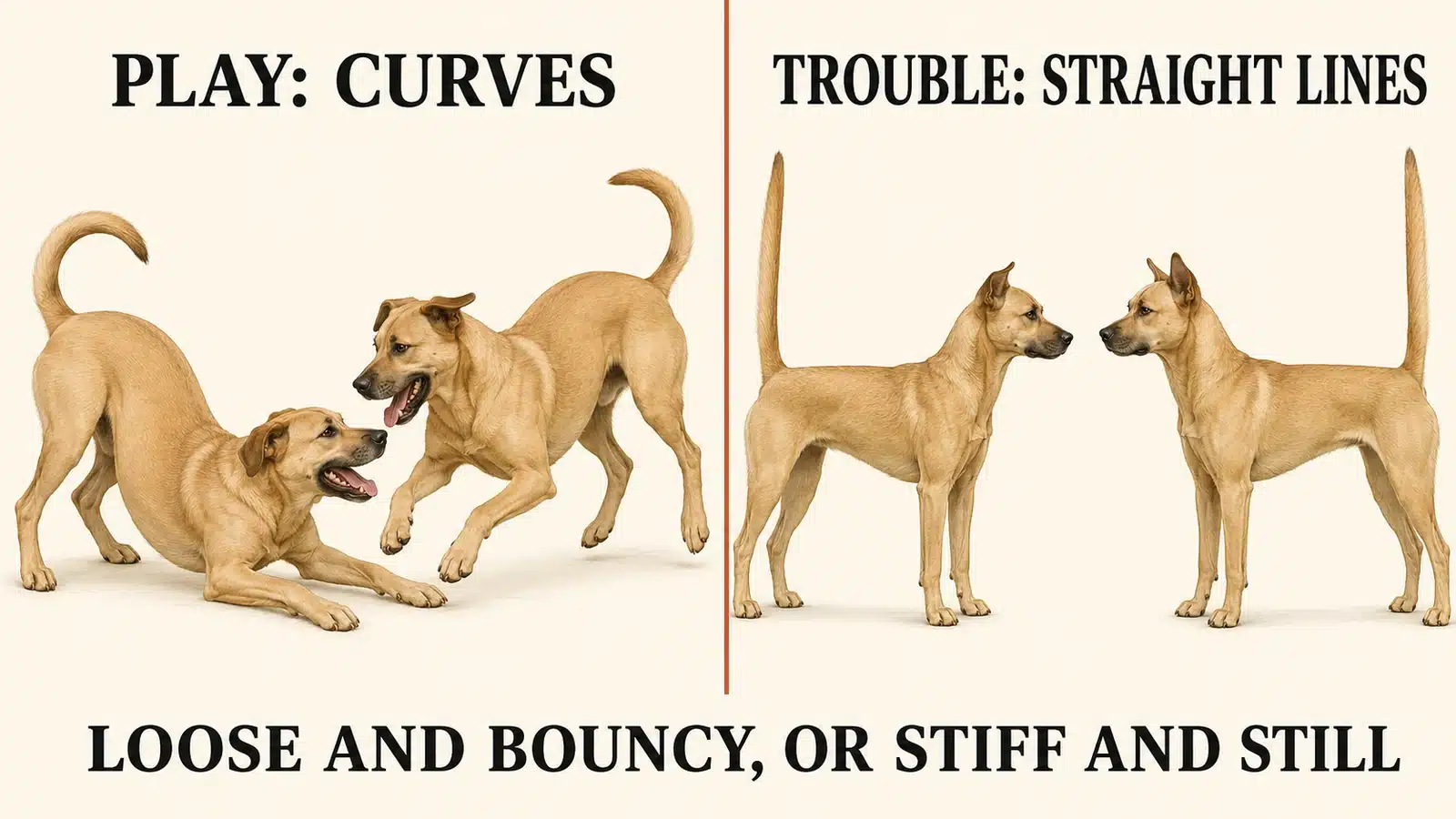
Because play borrows its entire motor vocabulary from fighting and hunting, the biting, chasing, pinning, and slamming look genuinely alarming, and the sorting cannot be done by the actions themselves. It is done by geometry. Play is written in curves: spines bent into wagging arcs, bodies bouncing along inefficient loops, heads tilted, mouths open and floppy, movement that wastes energy on flourish because nothing serious is at stake. Trouble is written in straight lines: bodies squared and rigid, tails high and stiff, movement gone economical and direct, mouths closed, stares locked along the shortest path between two dogs. The curve-versus-line reading works because it rests on mechanics that cannot be faked: real threat requires muscular loading, and loaded muscles produce straight, stiff geometry whether the dog intends to display it or not.
Add the second axis, rhythm, and the diagnosis completes itself. Healthy play breathes: it pauses, shakes off, re-bows, and resumes, with role reversals and self-handicapping keeping the game fair, the full picture drawn in the play signals guide. Trouble stops breathing: the pauses vanish, arousal ramps in one continuous climb, one dog stops reciprocating and starts trying to leave. Geometry plus rhythm gives you a two-question test you can run on any play session from a park bench: are the bodies curved or straight, and is the game still breathing? Curved and breathing, sit back and enjoy one of the best things dogs do. Straight or breathless, step in calmly, call the dogs apart cheerfully, and run the consent test before letting the game resume.
The Polite Greeting: Curve, Sniff, Invite
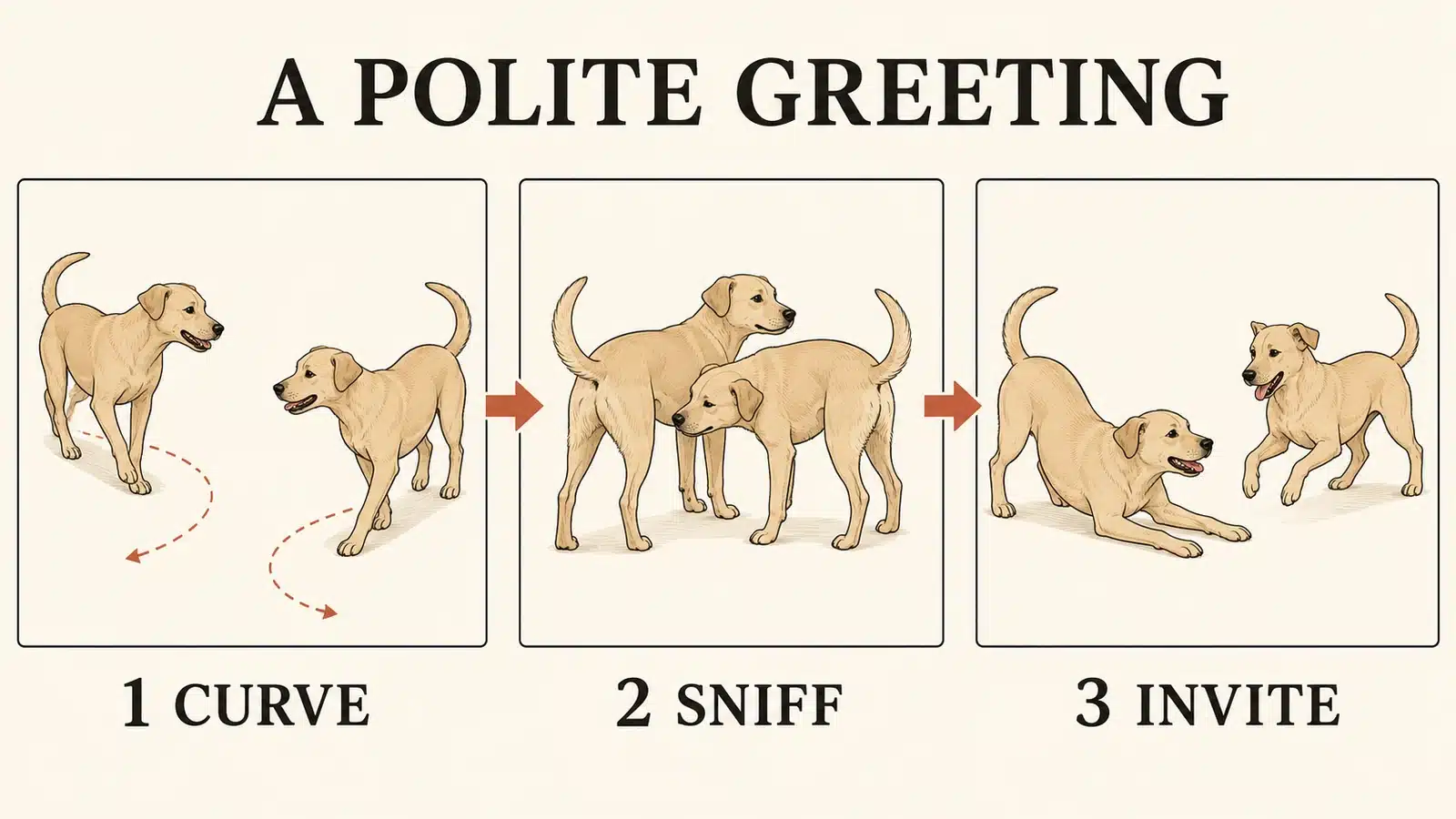
Clusters unfold in time as well as in space, and the polite greeting is the cleanest sequence in the language. Move one: the curved approach, each dog arcing rather than marching head-on, because the straight line is the geometry of confrontation. Move two: the circling sniff, each dog curving toward the other's hindquarters for the information exchange a greeting exists to provide, brief, loose, and mutual. Move three: the resolution, most happily a play bow that reclassifies everything to follow as a game, or simply a soft mutual disengagement as both dogs move along. Three moves, a few seconds, and an entire negotiation completed without a sound. The component signals live in the friendly signals guide and the calming signals guide; the sequence is what they build.
Knowing the healthy sequence gives you the diagnostic for the broken one, and it explains an enormous amount of leash trouble. When the curve is deleted, two dogs dragged straight at each other on tight leashes, when the sniff is prolonged past its polite few seconds into a frozen face-to-face, when the resolution never comes because neither dog can add distance, the greeting has been forced out of its grammar, and tension is the predictable product. Much of what gets labeled leash reactivity begins exactly here, in greetings that violated every rule of the sequence because the humans holding the leashes never knew there was one. Protect the grammar: approach at angles, keep leashes loose, keep the sniff brief, and let either dog end the conversation. Good greetings are not luck. They are syntax.
The Calming Sequence: Watching Diplomacy Work in Order
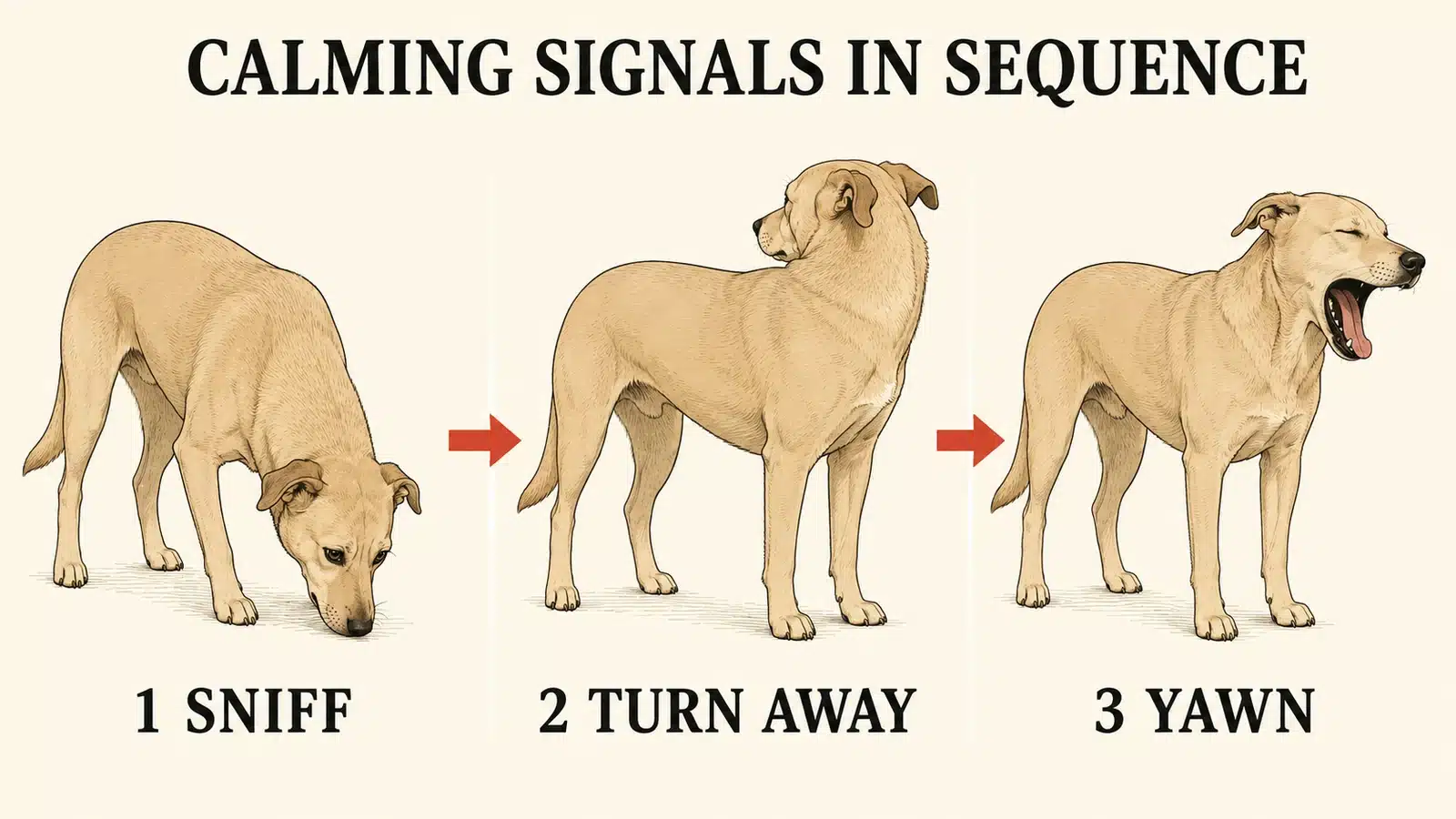
Here is the same dog, three panels, one rising pressure off-frame: first the sudden ground sniff, then the full head turn away, then the tension yawn. Read as isolated behaviors, these are a dog being distractible, rude, and sleepy. Read as a sequence, they are a dog working methodically through his de-escalation toolkit, each signal a slightly louder request than the last: I am not a threat, please lower the intensity, this is becoming too much. The individual signals are cataloged in the calming signals guide. The sequence is where their real diagnostic value lives, because a dog cycling through multiple calming signals in short order is telling you the pressure is not just present but climbing.
The reading lesson is about rate and repetition. One calming signal is a comment; a chain of them is an escalating appeal, and an appeal that keeps escalating is an appeal that keeps failing. When you see a dog burn through sniff, turn, yawn, lip lick, shake-off in the space of a minute, whatever is pressuring him has not let up, and he is running out of quiet vocabulary, which means the ladder's louder rungs are next. This is also the sequence to watch for in your own training sessions and in photos-with-the-dog moments, because it is feedback aimed at you: the session is too hard, the hug is too much, the camera is too close. Diplomacy answered stays diplomacy. Diplomacy ignored becomes something else, and the dog will not be the one who chose the escalation.
The Warning Display: The Body Loaded Forward
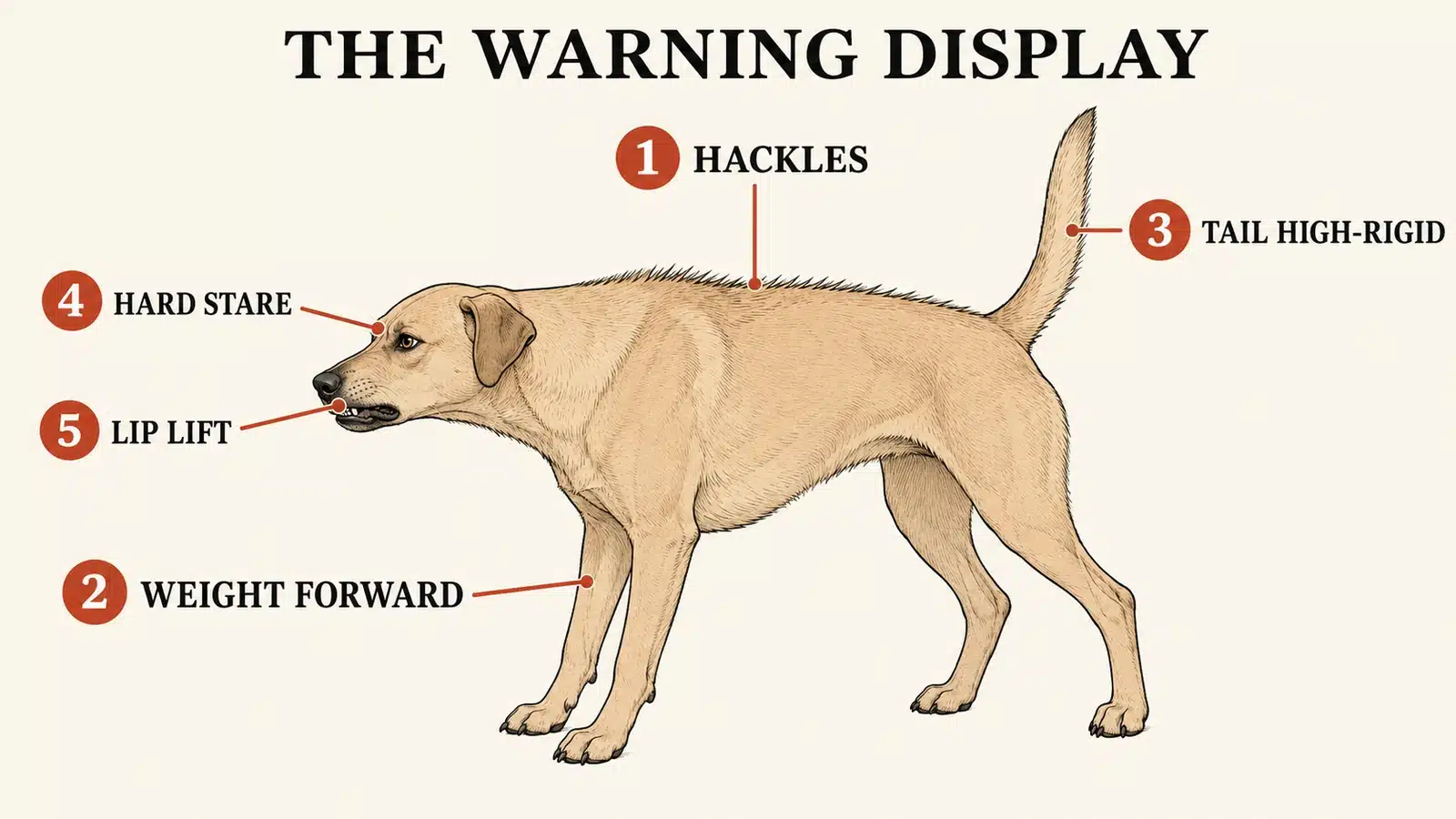
The offensive warning display is the fear posture's mirror image, organized by the opposite project: getting bigger. Weight loads forward over the front legs. The body rises tall, chest lifted. The tail flags high and rigid. Hackles ridge along the spine, involuntary arousal made visible. The stare hardens and fixes. The lip begins its vertical lift. Where the fear cluster compressed every feature downward and inward, this cluster inflates everything upward and forward, and the coherence is again the message: this dog is not conflicted, not retreating, and not bluffing about his willingness to hold the position. Each component is detailed in the warning signals guide; assembled, they are the most serious picture on this page.
The response protocol is worth stating precisely, because instinct gets most of it wrong. Do not stare back, which reads as accepting the challenge. Do not turn and run, which can trigger pursuit. Do not loom, reach, or escalate your own posture. Instead: stop, angle your body sideways, soften your gaze off the dog's eyes, and create distance with slow, boring movement. Every choice removes fuel. And afterward, remember what this cluster is underneath its confidence: even the offensive display is a request for the situation to resolve without contact, from a dog who, in the vast majority of cases, arrived here through fear, resource anxiety, or a long history of quieter signals failing. A dog producing this display on any repeatable basis is describing a serious, treatable behavior condition, and that is a professional functional behavior assessment, urgently, not a confrontation and not a correction.
Passive Submission: The Belly That Is Not an Invitation
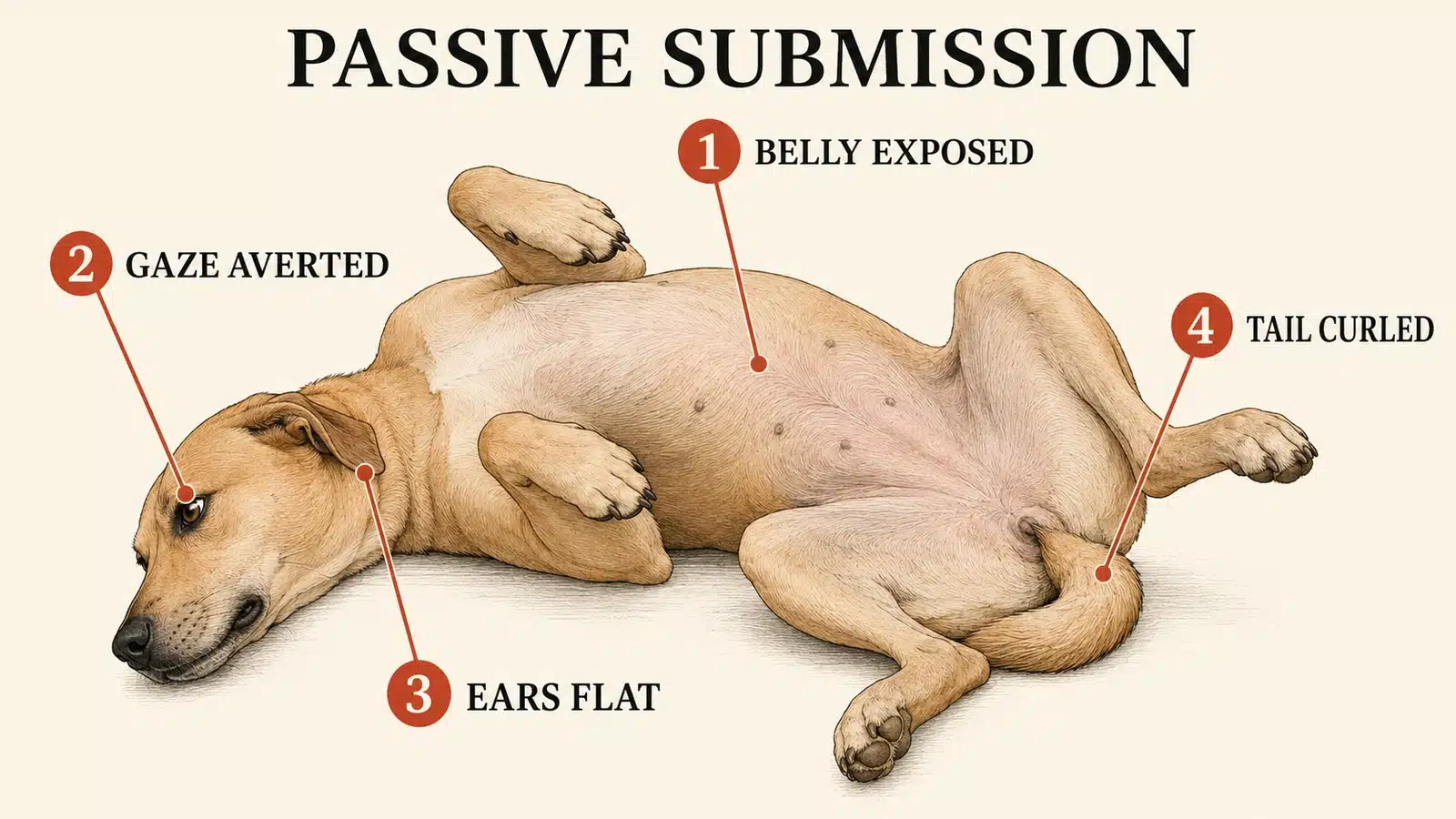
The passive submission cluster exists on this page for one reason: it is the composite picture most reliably misread in the friendly direction, and the misreading has teeth. Belly exposed, yes, but read the rest of the assembly: head turned hard to the side, gaze fully averted, ears pressed flat, tail curled tight between the thighs, paws limp and folded, mouth closed, the whole body still. Every component beyond the belly belongs to the appeasement and fear vocabulary from the appeasement signals guide, and together they turn the exposed belly from an invitation into its opposite: a total, vulnerable plea for an interaction to de-escalate or stop.
The discriminating variable, one final time, is tension against looseness, the master axis of this entire guide. The belly-rub belly is wiggly, floppy, open-mouthed, and springy, on a dog who chose the position and will pop up and re-solicit if you pause. The appeasement belly is rigid, averted, closed-mouthed, and frozen, on a dog holding a posture and hoping. Reach into the second belly and you are overriding the most emphatic non-verbal no a dog can produce while remaining polite, and a dog whose most extreme appeasement is repeatedly overridden is a dog being taught, interaction by interaction, that politeness does not work. The rule that protects everyone fits in one line, and it belongs in every household with children, and in every home preparing a dog for a new baby: before you touch any belly, read the body. Loose and wiggly, pet away. Stiff and averted, back up, soften, and give the dog the space his whole body just requested.
A Conversation in Posture: Reading Both Sides at Once
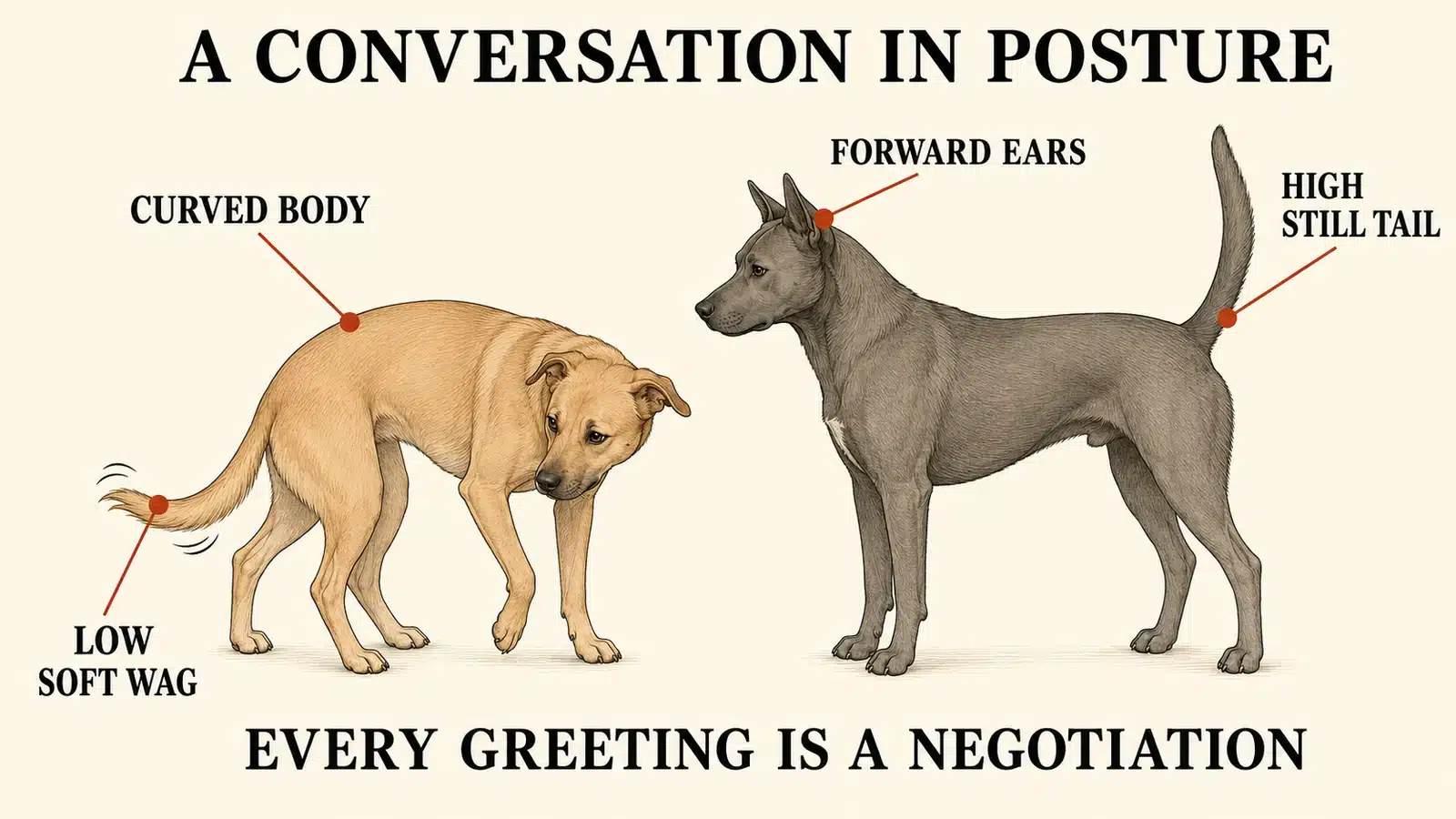
The final skill is stereo. Real encounters involve two dogs, each reading and answering the other in a live exchange, and the meaning lives in the relationship between the two bodies, not in either one alone. In the picture above, the fawn dog speaks first: body curved, gaze softened, tail low and swishing gently, the full diplomatic register saying I come in peace and I acknowledge you. The gray dog answers in a different register: standing tall, ears forward, tail high and still, the posture of assessment, arousal up, verdict pending. Nothing here is wrong yet. This is a negotiation mid-sentence, one party deferring, the other deciding, and thousands of these conversations resolve peacefully every day in every park on earth.
What stereo reading gives you is the ability to see where the conversation goes next, and to know when it needs help. Watch the assessing dog: if his tail begins to swing, his weight settles back to even, and his body softens into a curve, the verdict came back friendly and the sequence flows on toward the sniff and the bow. If instead he hardens, tail rigid, stillness deepening, weight easing forward, the negotiation is failing despite the fawn dog's best diplomacy, and a calm, cheerful interruption now costs nothing and prevents everything. This is the summit of the skill this guide teaches: not just reading a dog, but reading an interaction, tracking both emotional states and the direction each is moving, and lending a hand precisely when one dog's polite vocabulary stops being enough. Every greeting is a negotiation. Fluent humans make honest brokers.
The Three-Second Scan: Whole Dog, Situation, Direction
Everything on this page compresses into a protocol that takes three seconds once it becomes habit, and building that habit is the last assignment of this guide. Second one, the whole dog: sweep eyes, ears, mouth, tail, weight, and muscle tone as a single picture, and sort it along the two master axes, loose against stiff, and bigger against smaller. Second two, the situation: name the context, because the same picture means different things at the food bowl, at the front door, on the exam table, and in the yard, and note what just changed, since the trigger is usually the most recent variable. Second three, the direction: is this dog loosening or tightening, rising or sinking, opening or closing? The trend outranks the snapshot, and it is the earliest information you will ever get. Whole dog, situation, direction. Then, and only then, meaning.
Run the scan constantly and two things happen. First, you catch everything early, at the bottom of the ladder where responses are cheap: a step back, a softened posture, an ended interaction, a cheerful call-away. The dramatic moments this guide has spent twelve pages preparing you for mostly stop occurring, because you now resolve them while they are still a lip lick and a sinking tail. Second, your dog notices. Dogs live with the volume of their communication turned to whatever level their humans require, and a dog whose quiet signals reliably work becomes a quieter, softer, more confident communicator, because he has learned the astonishing thing: someone in the house speaks the language. That change, visible within weeks in most households, is the entire promise of this guide made real.
And when the scan keeps returning the same troubling sentence, when one context reliably produces the stress cluster, the warning display, the ladder climbing rung by rung, that is the moment this skill hands off to professional work, and the handoff is seamless because you have already done the first job. Reading clusters accurately is the Evaluate stage of the EASE Method, Evaluate, Arrange, Skill-Build, and Emotional Repatterning, the clinical framework behind every behavior case I take: a functional behavior assessment identifies the triggers and thresholds your scanning revealed, management stops the daily rehearsal, skill building gives the dog better options, and systematic desensitization and counterconditioning, run below threshold, changes the emotional response underneath the clusters. Pet parents who have mastered this page do not arrive at a consultation as spectators. They arrive as the most valuable instrument in their own dog's treatment, already fluent in the data the whole plan runs on. That is what this guide was for.
Reading Signal Clusters: Questions, Answered
What is a signal cluster in dog body language?
A cluster is several signals appearing together on one body in one context, and it is the actual unit of canine communication. Single signals are ambiguous: a yawn, a wag, or ears back each carry multiple possible meanings. Clusters resolve the ambiguity, because five signals converging on the same emotional story leave little doubt. The rule of thumb: convergence raises confidence. One signal deserves attention, three consistent signals deserve action, five demand it.
What order do dogs escalate their warnings in?
Roughly: subtle stress and calming signals first (lip licks, head turns, yawns), then avoidance and attempts to leave, then freezing and stiffening, then growling, then snarling or air snapping, and only after all of that fails, a bite. This is the escalation ladder, and it has two rules: answer the low rungs and the high rungs never happen, and never punish any rung, because suppressing warnings creates dogs who skip straight from silence to a bite.
How can I tell the difference between a scared dog and an aggressive dog?
Read the project the body is running. Fear compresses: lowered body, ducked head, flat ears, tucked tail, weight shifting away, the dog making himself smaller. Offensive warning inflates: tall posture, weight forward, high rigid tail, hard stare, hackles, the dog making himself bigger. Both deserve space and neither deserves punishment, and importantly, most aggression is fear underneath: a dog who learned that bigger displays work after smaller signals failed.
What's the fastest way to check if a dog is comfortable?
The mouth, read against looseness. A softly open mouth with a loose tongue on a loose body is a comfortable dog. Watch for the transition: a mouth closing firmly during an interaction is the fastest, most reliable early sign that the dog's emotional state just tightened, visible seconds before anything louder. Pair it with the tail drifting below the dog's own baseline and you have caught stress at the earliest readable moment.
I've learned the signals. How do I actually practice reading clusters?
Run the three-second scan everywhere: whole dog first (loose or stiff, bigger or smaller), situation second (what context, what just changed), direction third (loosening or tightening). Practice on your own dog at rest to lock in his baseline, then narrate dogs at parks, in videos, and on walks. Fluency arrives fast because the grammar is small: two master axes, one ladder, and a handful of sequences. Within weeks the scan becomes automatic, and you will catch in real time what you used to reconstruct after the fact.
Fluency Is a Practice. Start Today.
Twelve chapters, more than eighty signals, one skill: reading the whole dog. Revisit any category from the main guide whenever a signal puzzles you, and run the three-second scan until it runs itself.
 About the Author
Will Bangura, M.S., CAB-ICB, CBCC-KA, CPDT-KA, FDM, FFCP, is a Certified Canine Behaviorist with over 35 years of experience specializing in severe aggression, fear, anxiety, reactivity, phobias, and compulsive disorders in dogs. He holds a Master's Degree in Psychology and is accredited as a Certified Canine Behaviorist through International Canine Behaviorists, one of only three CAB-ICB Certified Canine Behaviorists in the United States and the only one in Arizona. His additional credentials include Certified Behavior Consultant Canine (CBCC-KA) and Certified Professional Dog Trainer (CPDT-KA) through the Certification Council for Professional Dog Trainers, certification in Applied Ethology through Family Dog Mediation (FDM), and Fear Free Certified Professional (FFCP).
Will is the author of Sniff to Soothe, host of the Dog Training Today podcast, and a court-recognized expert witness in canine behavior. His clinical work is grounded in behavioral psychology, applied behavior analysis, learning theory, and affective neuroscience: every case begins with a functional behavior assessment and is treated through management, skill building, and evidence-based behavior modification using systematic desensitization and counterconditioning. He is a national advocate for force-free, science-based training and a published voice on the welfare risks of aversive training methods.
As the founder of Phoenix Dog Training, Will provides in-home behavior consultations throughout the Phoenix metro area and virtual behavior consultations for pet parents nationwide.
When the Clusters Keep Telling the Same Story
If one context reliably produces the stress cluster, the warning display, or the climbing ladder, your dog is describing a treatable condition. A professional behavior consultation begins with a full functional behavior assessment and ends with a clear, evidence-based plan. Schedule a Behavior Consultation, or start with a free call.