
← Dog Body Language: The Definitive Guide
The Definitive Guide · Stress SignalsDog Stress Signals: The Earliest Words in the Language
Stress signals are how a dog's nervous system becomes visible. Learn all 22 of them and you will see distress minutes, sometimes months, before it ever becomes a growl, a snap, or a bite.
The Body Never Lies About the Nervous System
When a dog perceives a threat, real or imagined, the sympathetic nervous system fires. Heart rate climbs, pupils dilate, muscles load with blood, stress hormones flood the system, and the body prepares to fight, flee, or freeze. None of that is a choice. It is physiology, and physiology leaks. It leaks through the mouth as a tension yawn, through the tongue as a lip lick, through the eyes as a flash of white sclera, through the tail, the ears, the paws, the coat. Stress signals are that leakage, and they are the most honest information your dog will ever give you.
Two things make this category the most important one in the entire guide. First, stress signals come earliest. They sit on the bottom rungs of the escalation ladder, long before growling and snapping, which means they give you the largest possible window to respond while responding is still easy. Second, they are the signals people miss most reliably. A yawn looks like sleepiness. A sniff looks like curiosity. A shake-off looks like a wet dog's habit. Every one of them hides in plain sight inside a normal behavior.
One reading rule before we begin, and it applies to all 22 signals below: context and clusters decide meaning. A single lip lick after dinner is a dog tasting his own chops. A lip lick when a toddler crawls toward the dog's bed is a data point, and a lip lick plus a head turn plus a freeze is a sentence that says get me out of here. Read the whole dog, name the situation, then interpret. If you have not read the main guide on reading the whole dog, start with the definitive guide to dog body language, then come back.
The Stress Yawn: Tension Wearing a Sleepy Disguise
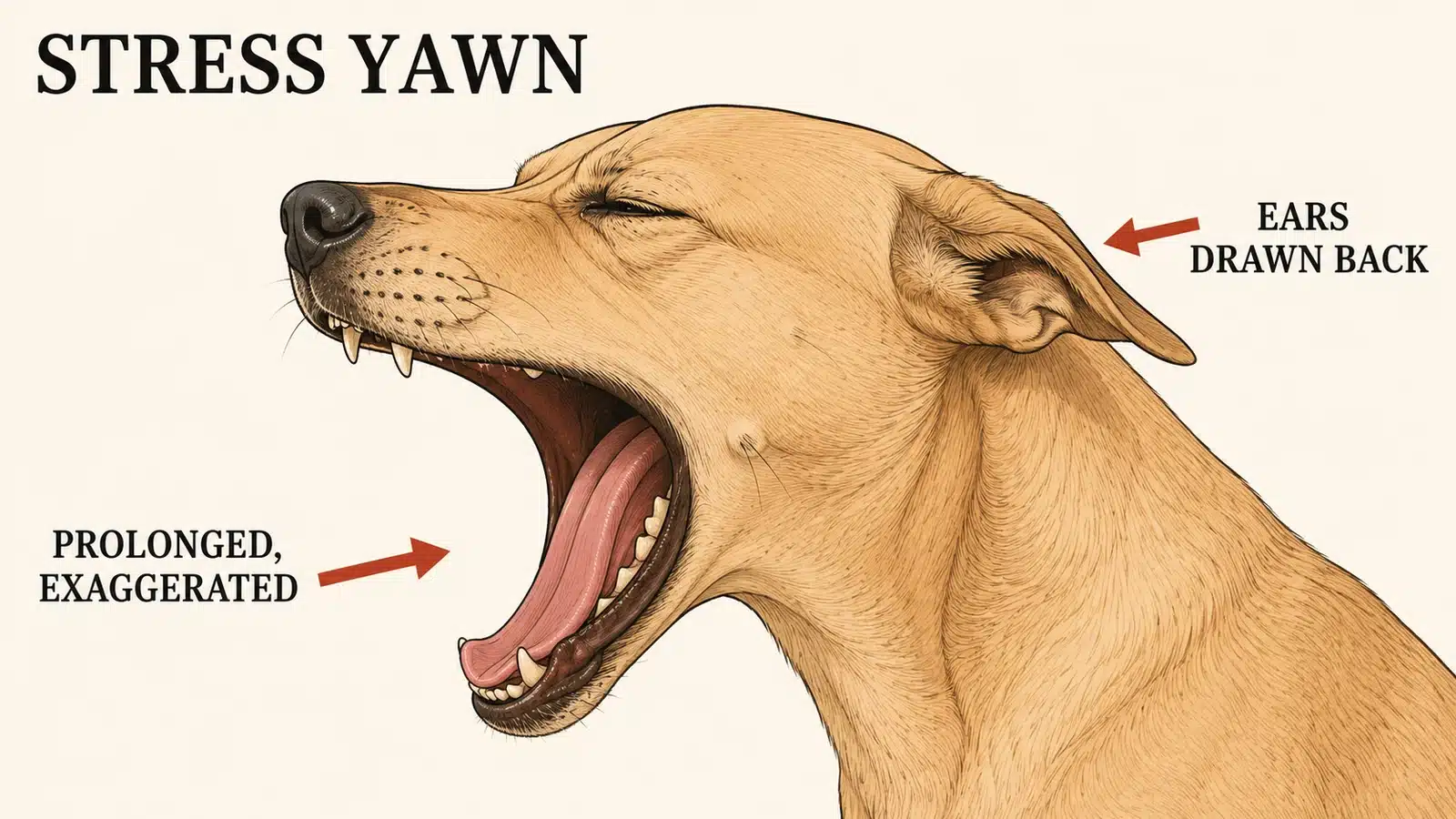
The stress yawn is probably the most frequently misread behavior in all of dog body language. It looks exactly like fatigue, and it is nothing of the kind. Watch for the tells: a tension yawn is exaggerated and prolonged, the jaw stretches wider than a drowsy yawn ever needs to, the facial muscles stay tight through the whole motion, and the timing is wrong. Dogs do not get sleepy in the middle of a nail trim, a vet exam, a training session that has gone on too long, or a hug from a visiting child. They get stressed, and the yawn is the pressure valve.
Mechanistically, yawning under stress appears to serve a self-regulatory function, a physical discharge of rising arousal, and dogs also deploy it socially as a calming signal to defuse tension around them. When you see it out of context, do the simple thing: lower the pressure. Pause the handling, add distance from whatever is looming, and give the dog a genuine choice to disengage. If the yawning stops when the pressure drops, you have your answer, and you have just had a successful conversation with your dog.
Stress Panting: When Breathing Becomes a Broadcast
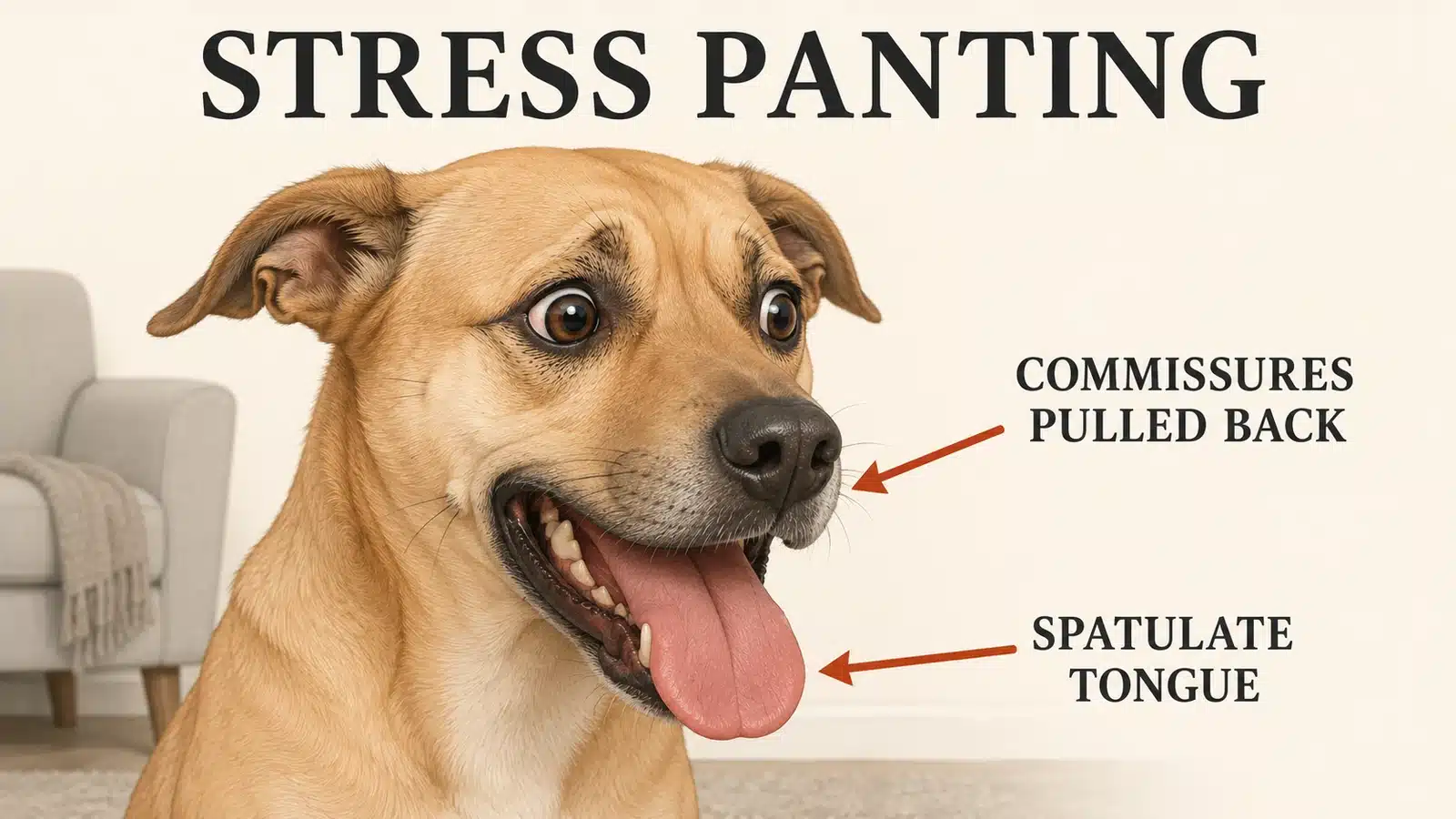
Panting cools a hot dog. That is its job. So when a dog starts panting in a cool room with no exercise in the last hour, the panting is not about temperature, it is about the sympathetic nervous system driving up respiration. Stress panting has a distinctive look once you know it: the lip corners, called the commissures, pull back hard toward the ears, the facial muscles ridge with tension, and the tongue often flattens and widens at the tip into what behavior professionals call a spatulate tongue. A relaxed pant is loose and floppy. A stress pant looks like effort.
The pattern matters as much as the picture. Stress panting starts and stops with the trigger: it appears when the carrier comes out, in the car, in the exam room, during fireworks, and it can shut off instantly when the dog gets truly frightened, because acute fear closes the mouth. A dog who was panting hard and suddenly goes silent and still has not calmed down. He has escalated. Track the context, reduce the stressor where you can, and if car rides or vet visits reliably produce this, that is a solvable problem through desensitization and counterconditioning, not something a dog just has to endure.
The Lip Lick: A Flick of the Tongue, a Volume of Information
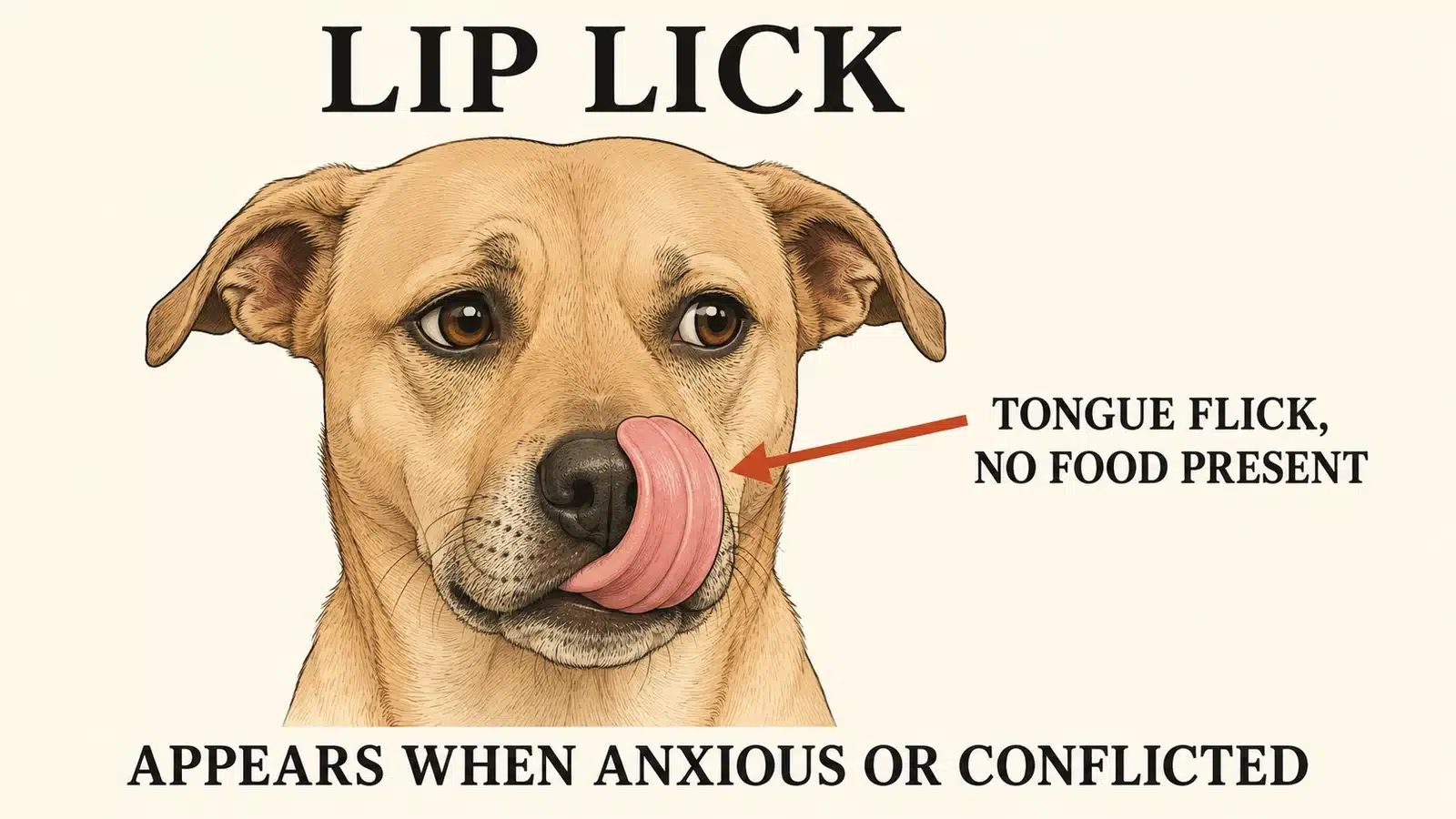
The lip lick is fast, subtle, and everywhere once you start looking. The tongue darts up and over the nose or across the lips in a fraction of a second, usually while the dog's attention is fixed on whatever is worrying him: an approaching stranger, a raised camera, a child reaching over his head. The diagnostic question is simple. Is there food? A dog licking his chops beside the dinner bowl is anticipating. A dog lip licking while being hugged is not thinking about dinner.
This is one of the very first signals on the escalation ladder, which makes it disproportionately valuable. A pet parent who reliably catches lip licks can resolve most brewing situations before they become anything at all, simply by adding distance or ending the interaction. Photographers and groomers see this signal constantly and most never learn its name. When you see repeated lip licking during any interaction, treat it as your dog raising a hand politely. Answer the hand, and the dog never needs to raise his voice.
Pinned Ears: The Skull Tells You What the Mind Is Doing
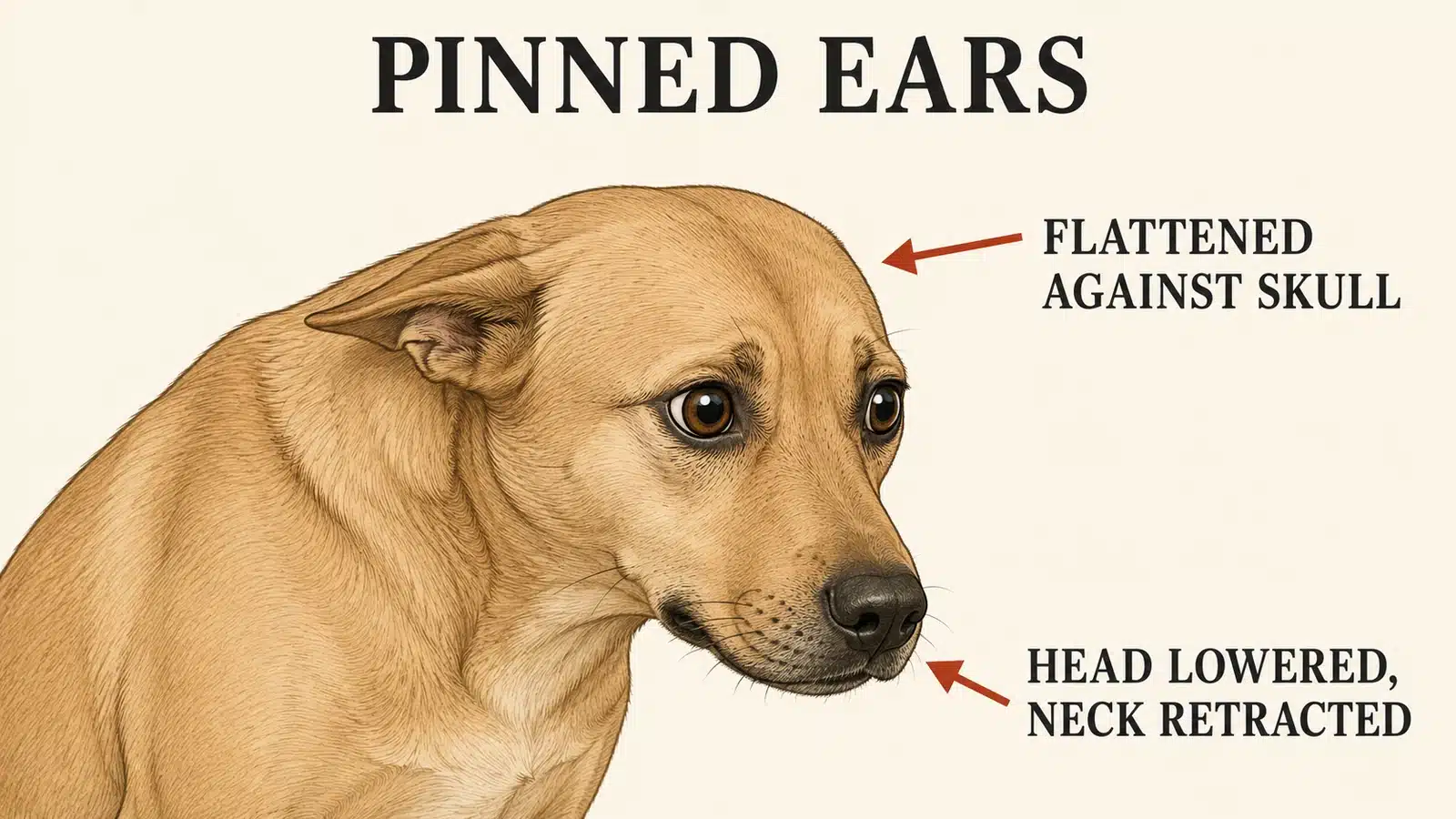
Ear position is one of the fastest-moving indicators on a dog's body, and pinned ears, pressed flat and back against the skull, are among the clearest stress markers there are. The posture has ancient logic: flattened ears protect vulnerable tissue and shrink the dog's silhouette, both part of the body's attempt to look smaller and less provocative. You will usually see the head lower slightly and the neck retract into the shoulders at the same time, the beginning of the whole-body compression that ends in cowering.
Read ears against the individual dog's baseline, because anatomy varies enormously. A shepherd's pinned ears are unmistakable; a spaniel's take practice, and you learn to read the ear base rather than the flap. Also distinguish the soft, loose ears-back of a friendly, appeasing greeting (paired with squinty eyes and a wiggly body) from the tight, pressed pin of fear (paired with a closed mouth and a still body). Same ears, different sentence. The cluster, as always, is the meaning.
Whale Eye: The White Crescent That Should Stop You Cold
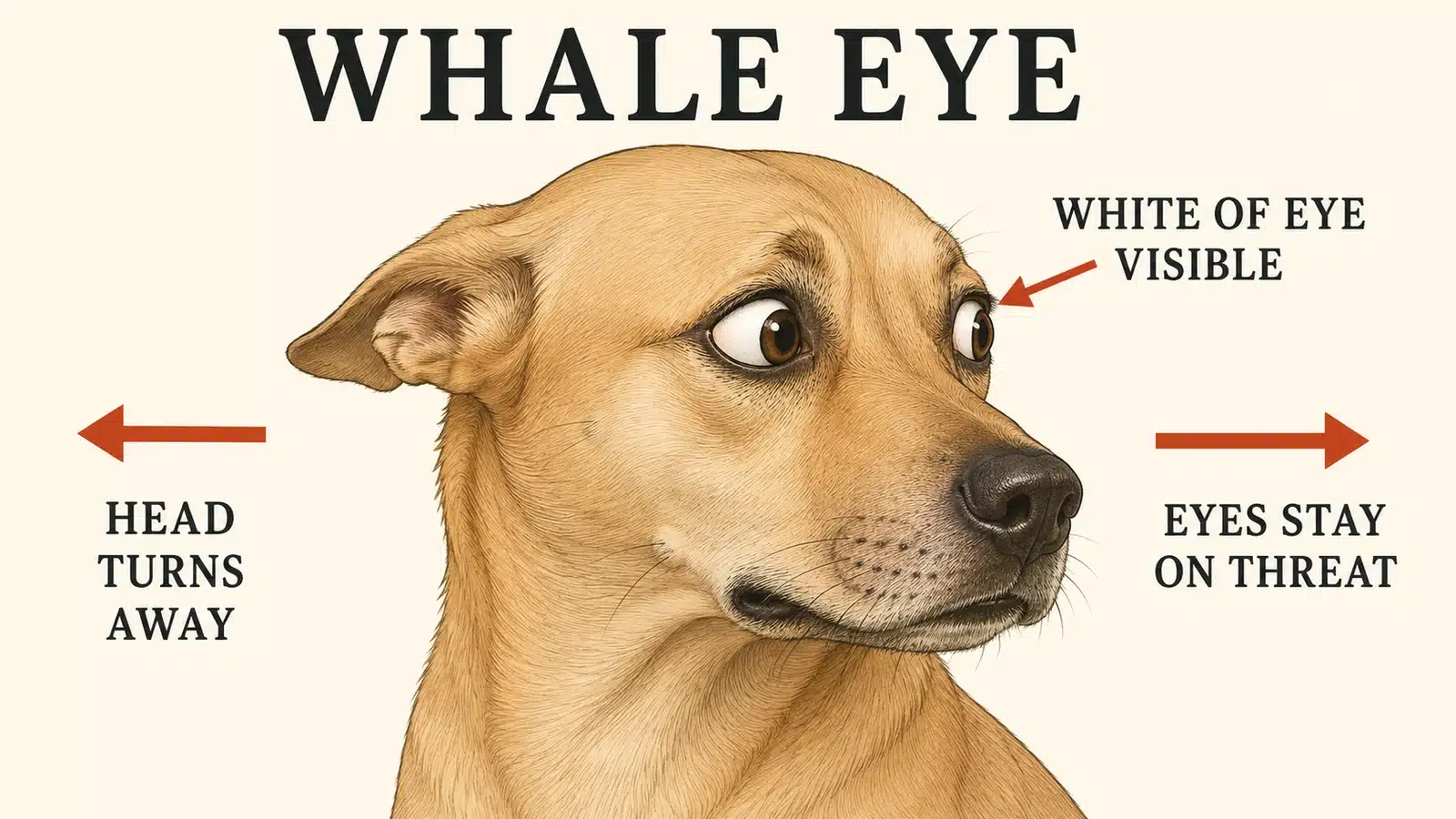
Whale eye is the visible white of the eye, the sclera, appearing in a crescent because the dog has turned his head away from something while keeping his eyes locked on it. That geometry is the whole story. The head turn says I want to disengage. The locked eyes say I do not feel safe enough to actually do it. The dog is caught between avoidance and vigilance, and that internal conflict is one of the most reliable indicators of serious stress in all of canine body language.
Where you see whale eye matters enormously. Over a food bowl, a bone, a stolen sock, or a resting spot, it is frequently the first visible sign of resource guarding, and it is the moment to calmly stop, back away, and trade rather than reach. Around children climbing on a dog, it is the signal most often photographed in the seconds before a bite that the family swears came out of nowhere, which is exactly why it features so heavily in my complete guide to preparing your dog for a new baby. Whale eye is a stop sign. Honor it immediately, then figure out what put it there. If it is appearing regularly around resources or handling, that is precisely the situation a professional functional behavior assessment exists for.
The Furrowed Brow: Worry, Written on the Forehead
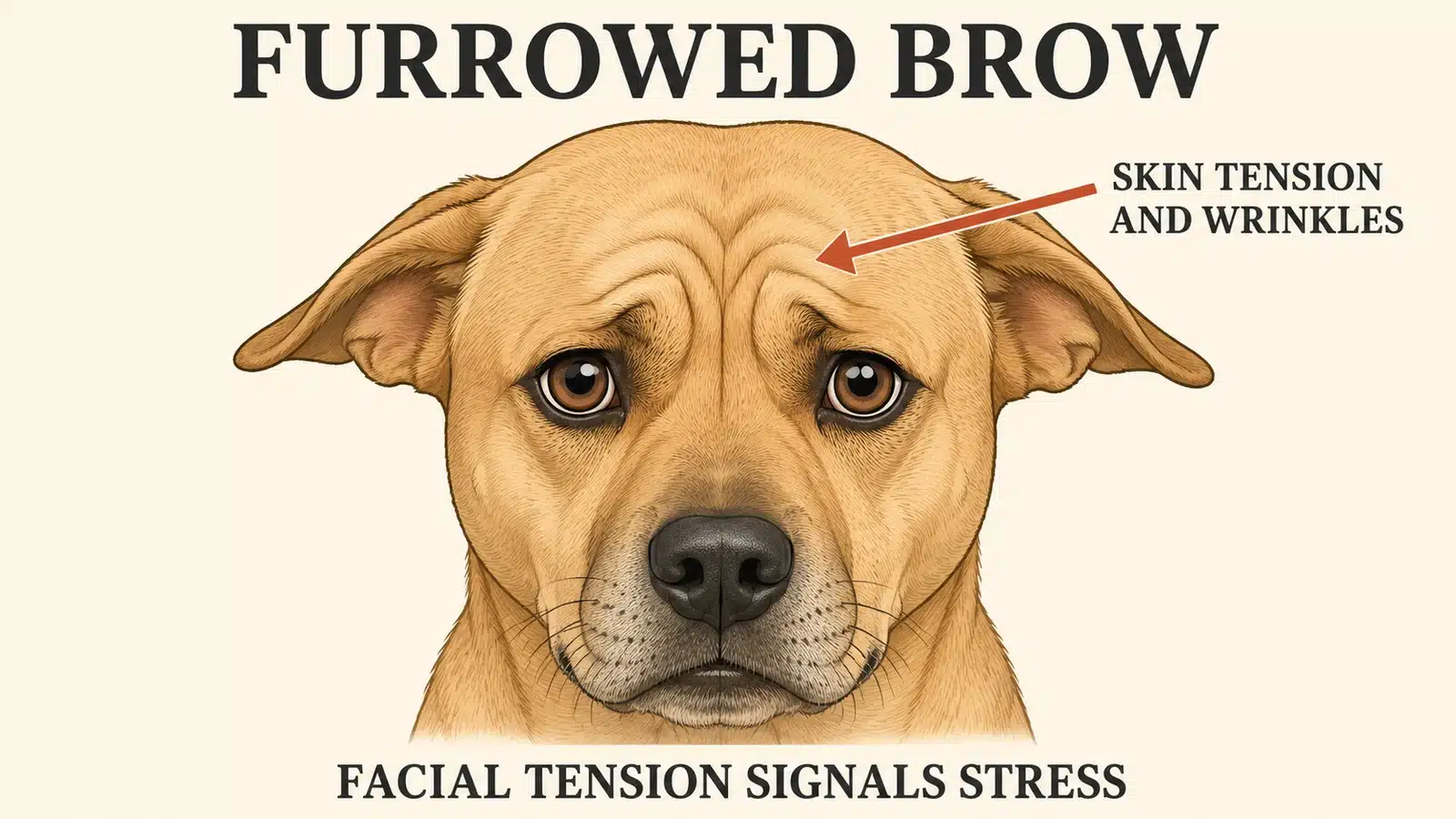
Dogs carry tension in their faces the way people do, and the brow is where it shows first. Under stress, the muscles of the forehead and the ridge between the eyes contract, producing visible wrinkles, furrows, and a knitted, worried expression that most pet parents can feel before they can name it. Something just looks off about the face. That intuition is real: you are perceiving muscular tension that does not exist when the dog is genuinely relaxed.
This signal demands baseline literacy more than most, because some breeds wear permanent wrinkles and some faces never show any. Learn what your own dog's forehead looks like on a lazy Sunday morning, smooth and loose, and the departures become obvious. A furrowed brow rarely travels alone; look for it alongside pinned ears, a closed tight mouth, and whale eye. When the whole face tightens at once, the nervous system behind it has tightened first.
Trembling and Shivering: Adrenaline You Can See
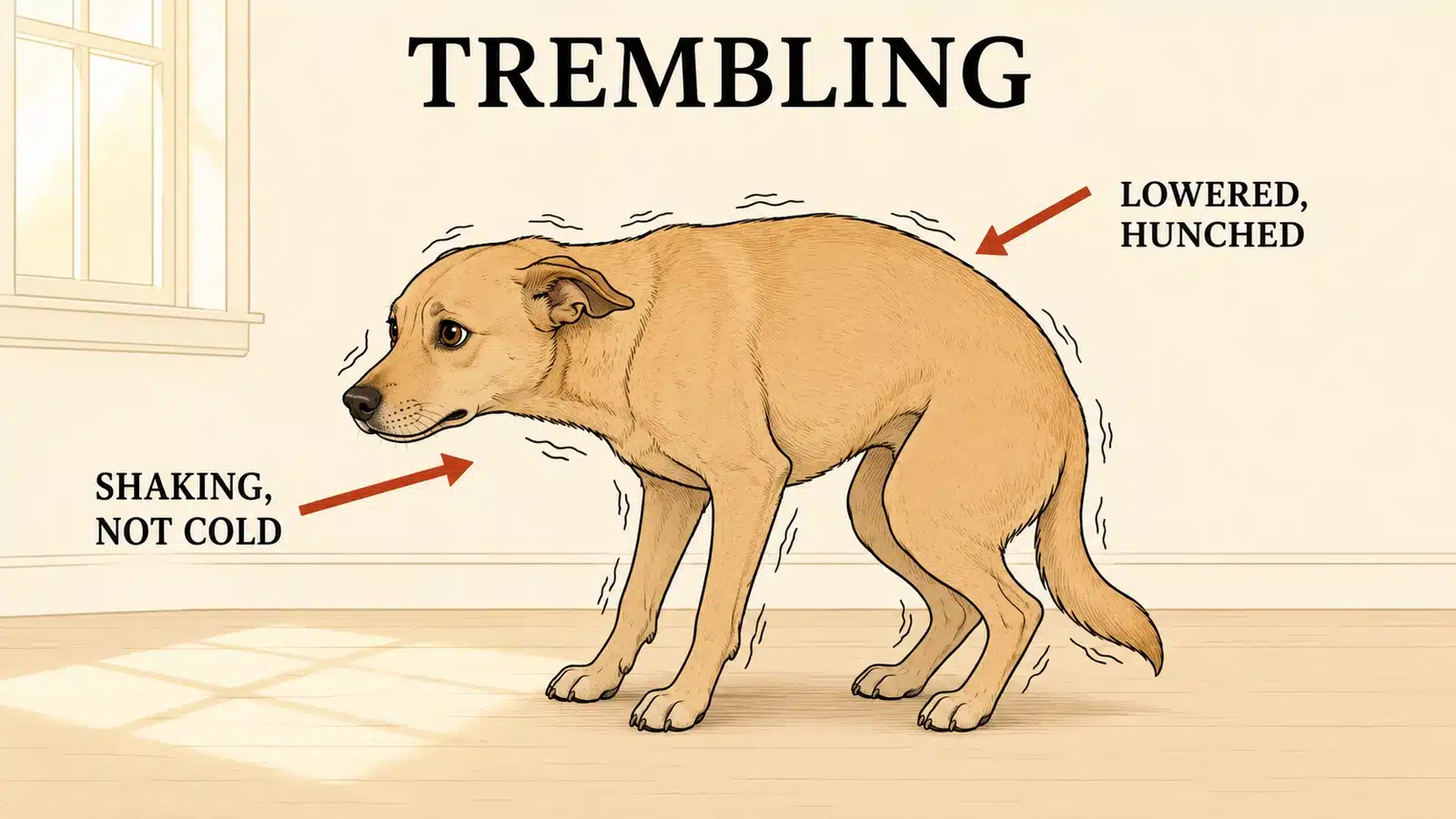
A dog shaking in a warm living room during a thunderstorm is not cold. Trembling under stress is the visible product of a body flooded with adrenaline: muscles primed for emergency action with nowhere to put the energy. You will see it during fireworks and storms, in veterinary waiting rooms, after a frightening encounter, and in chronically anxious dogs at surprisingly low levels of provocation. The posture around the shake tells you the rest: lowered body, tucked tail, ears back, weight shifted away from the trigger.
Rule out the physical first, always. Cold, pain, fever, and certain medical conditions cause trembling too, and a dog who trembles without an identifiable trigger, or whose trembling is new, needs a veterinarian before a behaviorist. Once medical causes are excluded and the pattern maps to identifiable stressors, respond with comfort and protection, not tough love. The old myth that comforting a scared dog reinforces fear is exactly backwards: fear is an emotion, not an operant behavior, and you cannot reinforce an emotional state into growing stronger by providing safety. Be your dog's safe harbor, then work on the trigger itself through systematic desensitization.
Pacing and Restlessness: A Body That Cannot Find Off
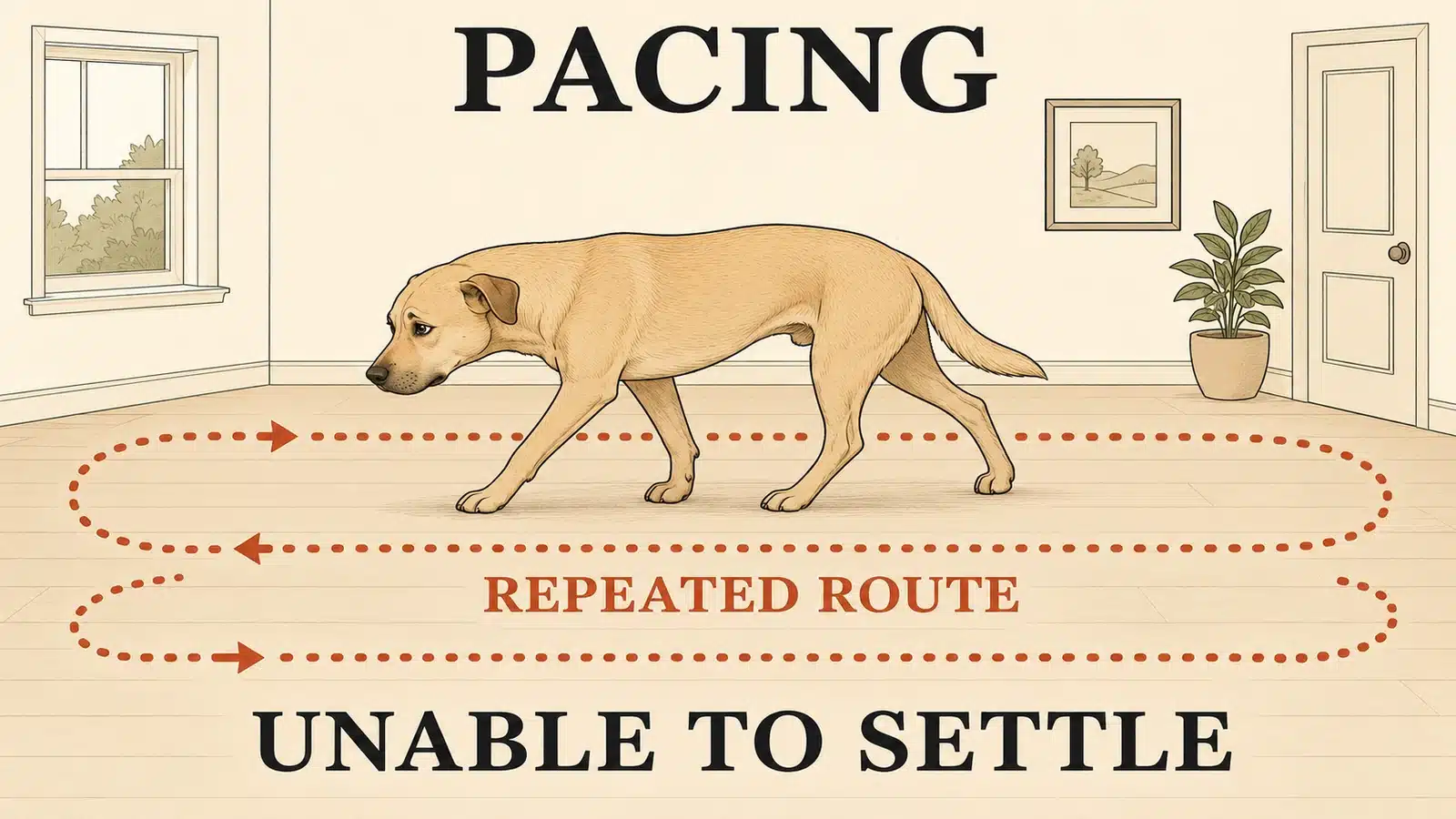
A relaxed dog settles. He finds a spot, circles once or twice, and drops into rest. A stressed dog orbits. Pacing is repeated, patterned movement with no destination: the same loop through the kitchen, the same track along the fence line, up and down the hallway while guests are over. It is what rising arousal looks like when it has no behavioral outlet, and it frequently escalates alongside panting, whining, and hypervigilance as the stressor persists.
Ask what changed. Pacing that appears before storms, during a pet parent's departure routine, or when unfamiliar people are in the home is mapping its own trigger for you. Pacing at night in a senior dog is a different animal entirely and warrants a veterinary conversation about pain and cognitive decline. For situational pacing, the intervention is rarely "more exercise," which is the reflexive advice and often just produces a fitter, still-anxious dog. The intervention is identifying the stressor and changing the dog's emotional response to it, while managing the environment so the rehearsal loop stops running.
Dilated Pupils: Windows Into Sympathetic Arousal
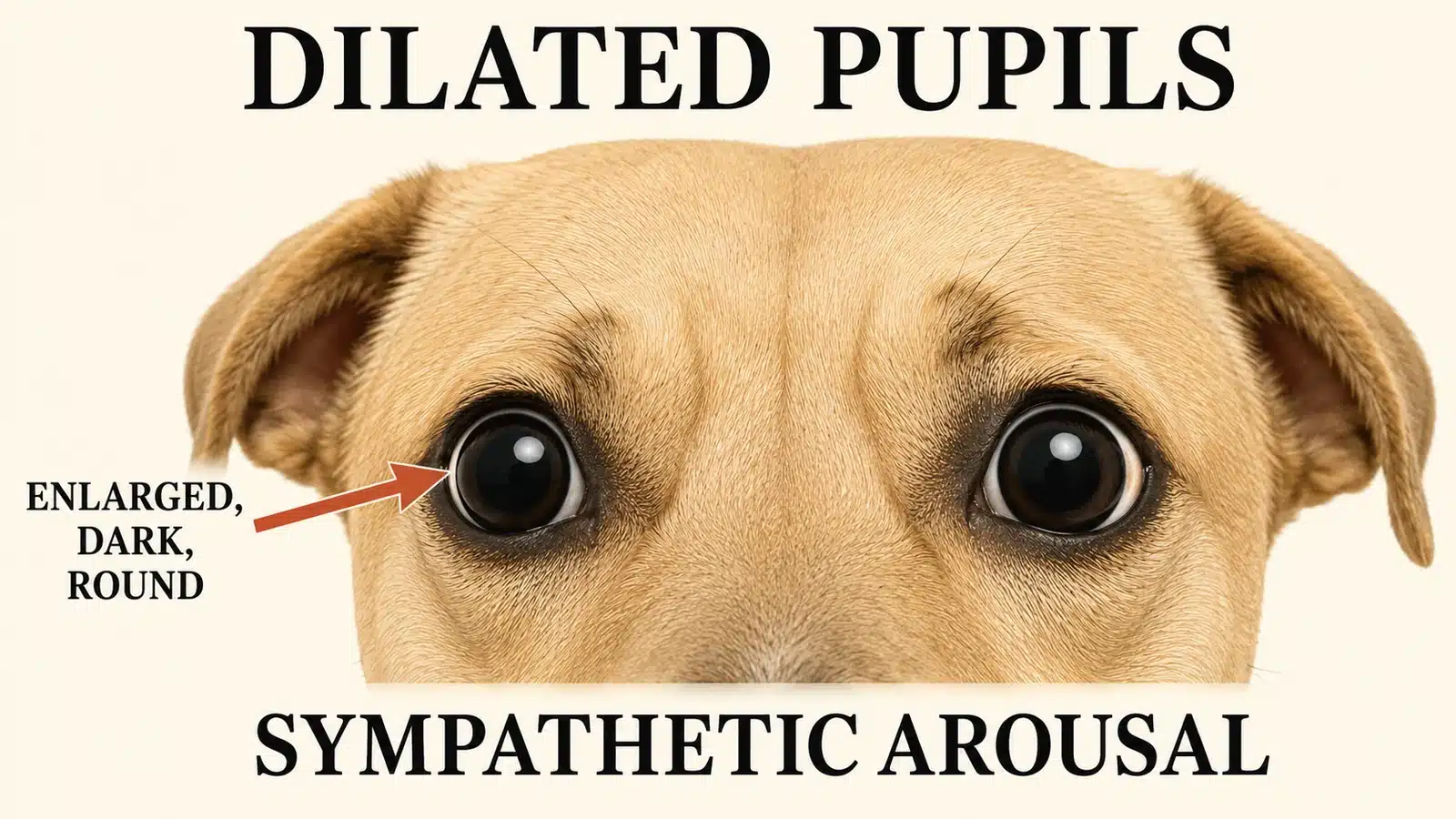
Pupil dilation is pure autonomic physiology, which makes it one of the few signals a dog cannot modulate at all. When the sympathetic nervous system activates, the pupils open wide to pull in maximum visual information about the threat. In normal indoor light, a stressed dog's eyes go noticeably dark, round, and glassy, sometimes with the iris nearly swallowed. Combined with wide lids, this produces the hard, "seeing through you" look that experienced handlers learn to take seriously.
Because you have to be fairly close to see pupils, treat this as a confirming signal rather than an early-warning one, something you notice while already reading an escalating cluster: dilated pupils plus a freeze plus a closed mouth is a dog very near the top of the ladder. Light conditions obviously matter, and pupils dilate in dim rooms for ordinary optical reasons, so read them in context. If the room is bright and the pupils are black saucers, believe the eyes.
Cowering: The Architecture of Making Yourself Small
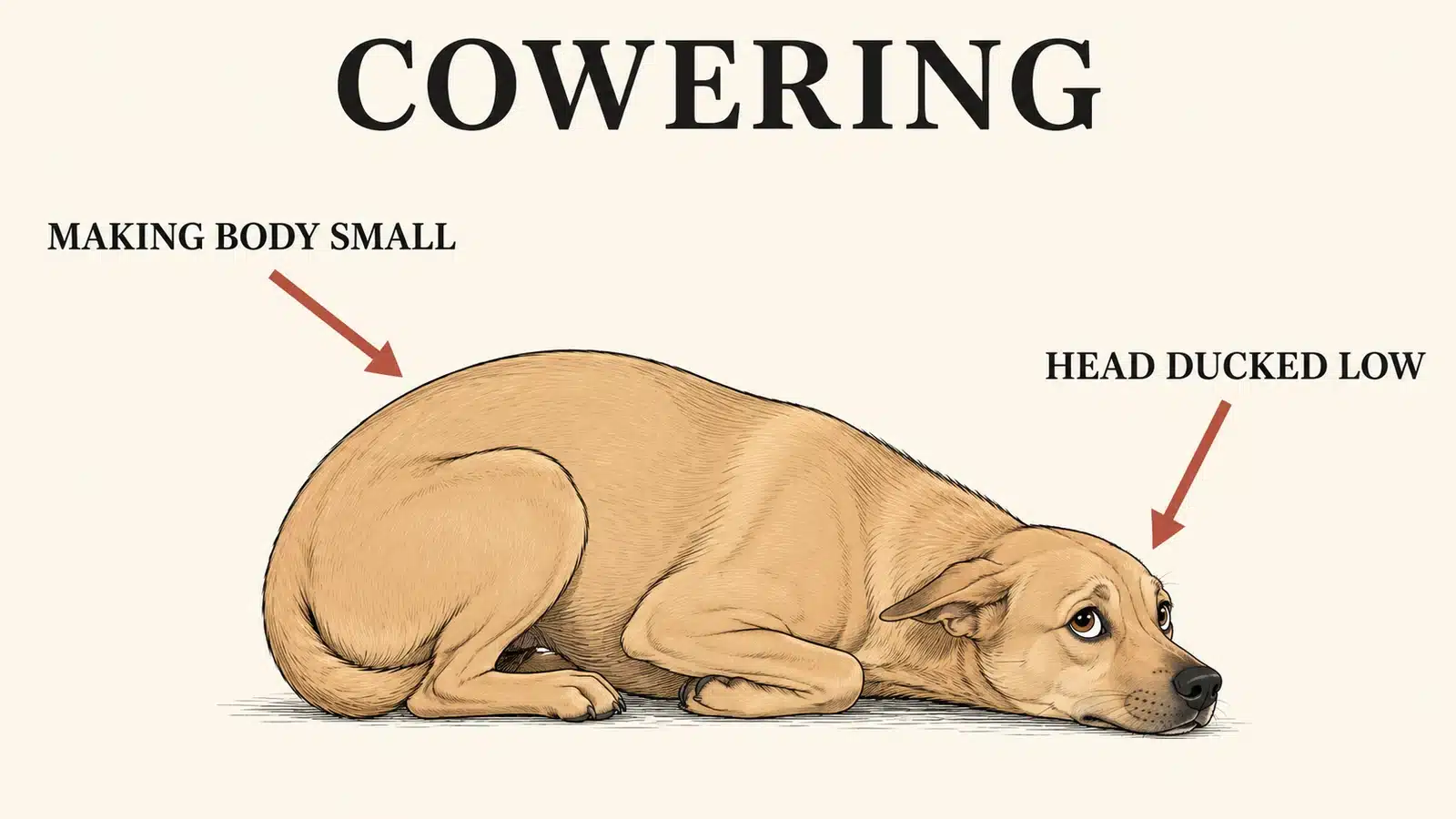
Cowering is whole-body compression: legs deeply bent, belly dropped toward the floor, head ducked below the shoulders, tail tucked, ears flat. Evolution wrote this posture, and its message is universal across mammals: I am small, I am no threat, please do not hurt me. A cowering dog has moved beyond subtle signaling into open, unmistakable fear, which means every earlier rung on the ladder either fired unseen or was skipped because the trigger hit too hard and too fast.
What you do next matters more than almost any other moment in your relationship with the dog. Do not loom, do not reach over the head, do not drag the dog out from wherever he has wedged himself, and do not "flood" him by forcing him to confront the scary thing, a method that reliably makes fear worse. Turn sideways, lower yourself, soften your voice, and let the dog choose to approach or retreat. A dog who cowers regularly, at specific people, at hands, at raised voices, at particular rooms, is describing his learning history and his triggers with perfect clarity. That pattern deserves a professional assessment, and it responds well to patient counterconditioning.
Avoidance: The Politest No a Dog Knows How to Say
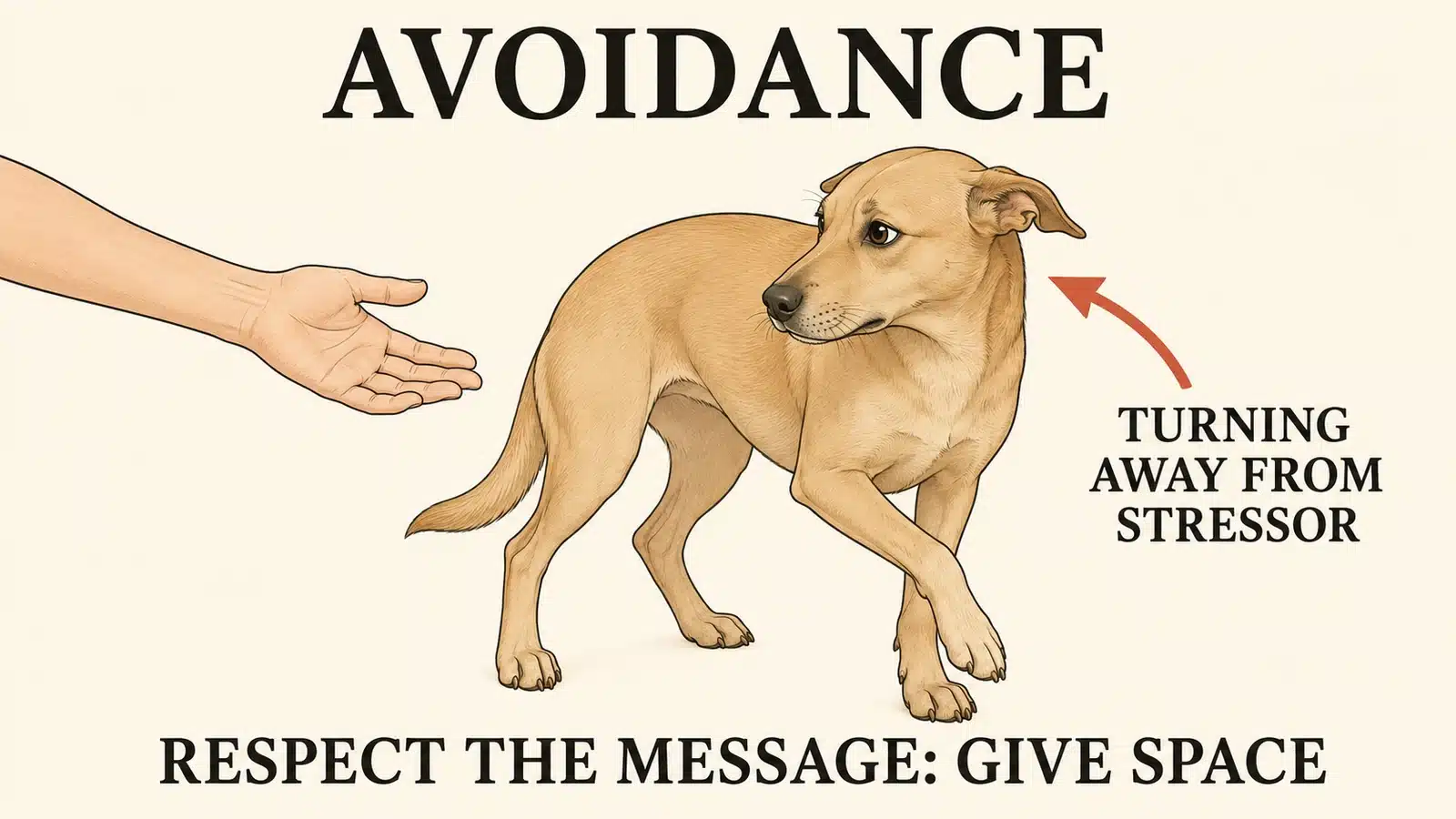
Avoidance is the dog voting with his body: turning the head away from a reaching hand, rotating the shoulders away from an approaching person, stepping behind the pet parent's legs, drifting to the far side of the room when the toddler wakes up. Nothing about it is dramatic, which is exactly why it gets overridden constantly. The dog says no, and the human, meaning nothing but affection, follows and pets him anyway.
Here is the behavioral economics of that moment: every time avoidance fails to produce relief, the dog learns that polite refusal does not work, and behavior that does not work gets abandoned. What replaces it is whatever does work, and further up the ladder, what works is growling. Dogs who "suddenly" growl at handling almost always spent months politely avoiding it first. So make avoidance succeed. When your dog turns away, stop. When he leaves, let him. Teach children in the home the one-sentence rule that prevents a remarkable share of household bites: when the dog walks away, the game is over. Consent is not a human luxury. It is the foundation of a safe dog.
The Flattened Body: Pressed Into the Floor by Fear
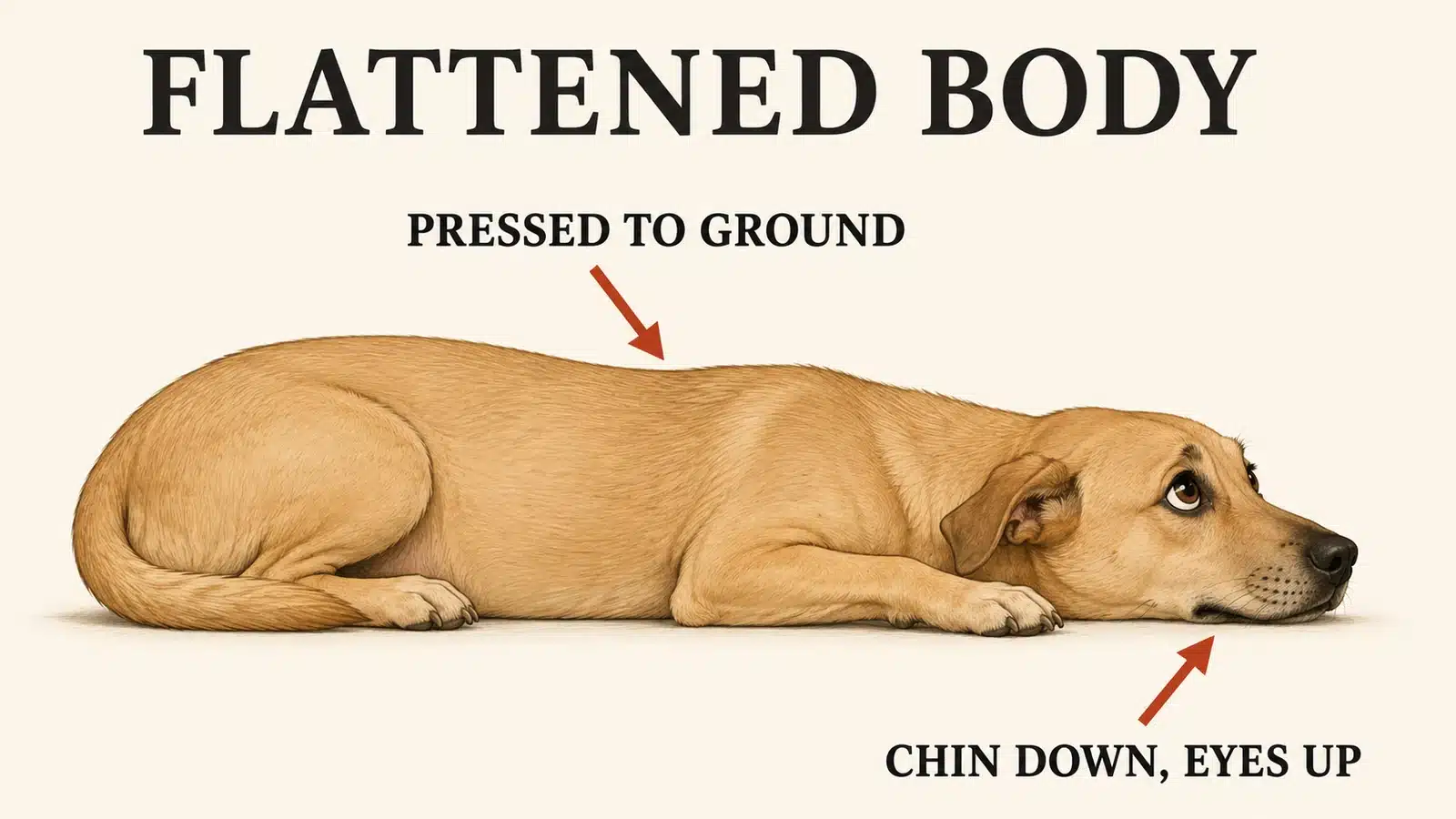
Past cowering lies flattening: the dog presses his entire body into the ground, chin on the floor, limbs tucked or splayed flat, eyes rolled upward to keep watching without lifting the head. Where cowering is a crouch that can still move, flattening is closer to a full stop, and it often shades into freezing. You will see it in shut-down shelter dogs, in puppies overwhelmed by their first busy sidewalk, and in dogs pinned between a frightening thing and nowhere to go.
A flattened dog is not being stubborn, and this matters enormously on leash. The dog who pancakes on a walk and refuses to move is not defying you, he is telling you the environment has exceeded what his nervous system can process. Dragging him forward by the leash adds pain and pressure to an animal already past his limit and teaches him that the leash predicts being forced toward frightening things. Instead: add distance from whatever he is oriented toward, crouch low, wait, and let him volunteer movement. Then take the lesson seriously and rebuild his comfort with that environment gradually, at intensities he can actually handle.
Freezing: The Most Dangerous Silence in Dog Behavior
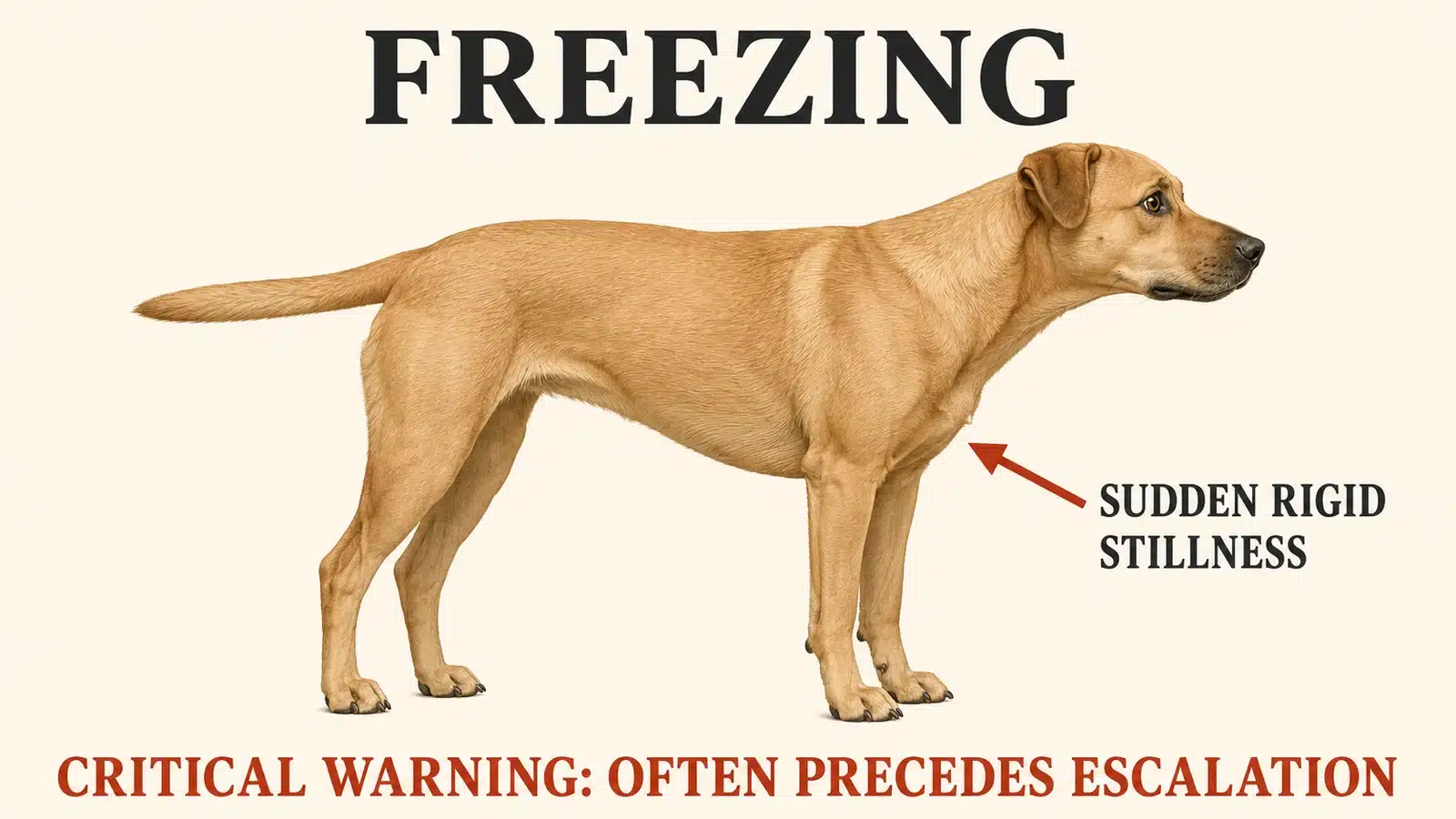
Of the classic responses to threat, fight, flight, and freeze, the freeze is the one humans misread with the worst consequences, because stillness photographs like calm. It is not calm. A freeze is sudden, rigid, total immobility: muscles locked, tail stopped mid-motion, mouth clamped shut, breath shallow or held, eyes fixed. The dog's nervous system has hit a decision point, and everything is on pause while it chooses between escape and defense.
The freeze sits one rung below the growl, and in dogs whose growls have been punished away it is often the last visible warning before teeth. The classic scenarios repeat themselves with terrible consistency: a dog freezes over a food bowl as a hand reaches in, freezes as a child wraps arms around his neck, freezes on the exam table just before the muzzle grab. If a dog suddenly goes still during any interaction, stop the interaction that instant. Do not test it, do not push one more second. Withdraw calmly, create space, and treat what just happened as priceless intelligence about that dog's thresholds. A pet parent who respects the freeze will almost never meet what lives above it.
Hypervigilance: A Sentry Who Never Gets Relieved
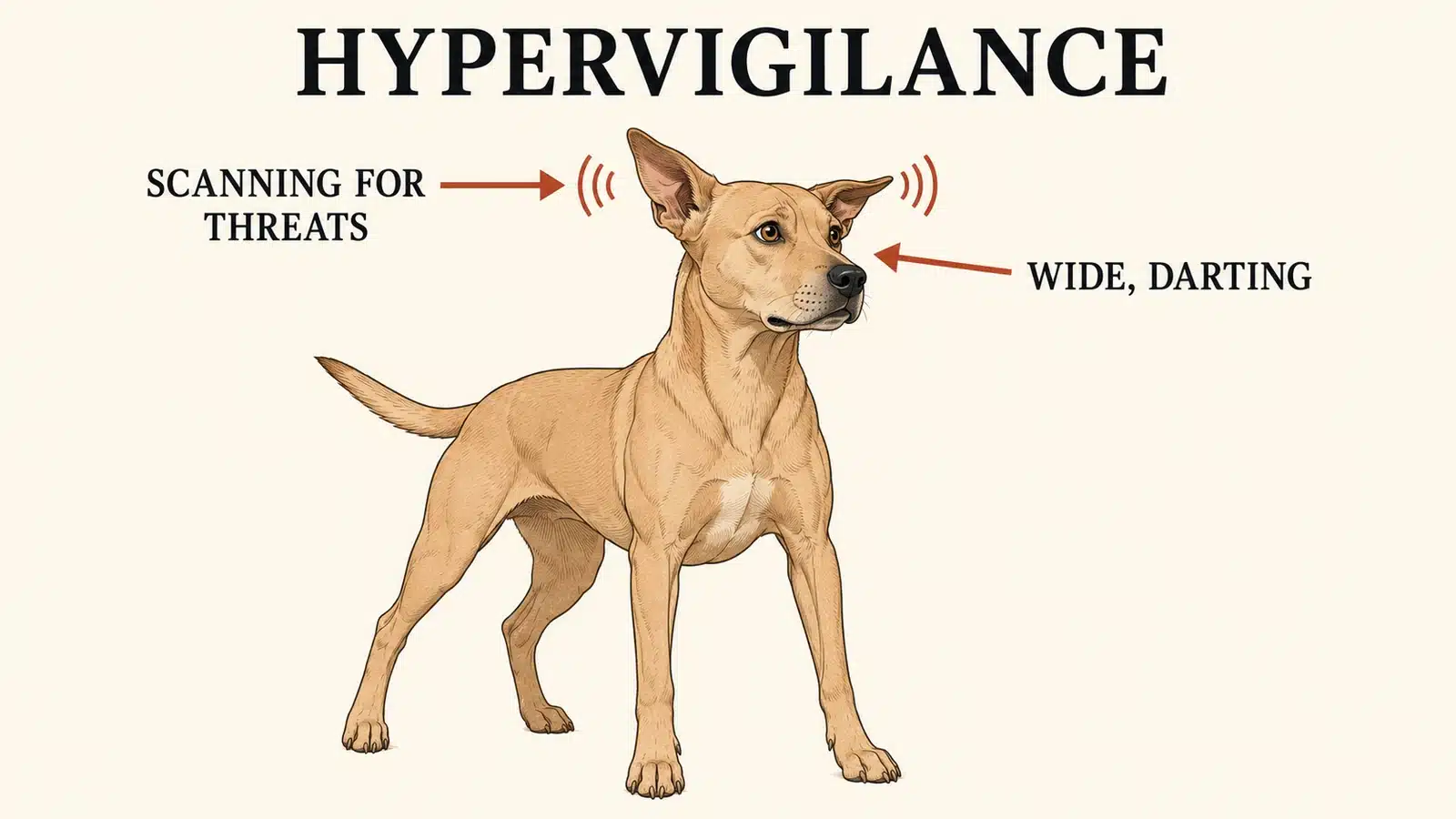
Hypervigilance is environmental scanning that never switches off: head high, ears swiveling like independent radar dishes, eyes sweeping doorways and windows, the dog startling toward every sound the house makes. In the moment it can look like alertness, even like a good watchdog. As a standing state, it is one of the clearest markers of chronic anxiety, because a dog who is monitoring cannot simultaneously rest, play, eat with ease, or learn. Vigilance is expensive, and the currency is welfare.
The tell is what the dog cannot do. He lies down but never uncoils. He takes a treat but scans while chewing. He is on the walk but not in it, too busy sweeping the horizon to sniff. Chronic hypervigilance rarely resolves through management alone because the problem is the dog's threat-detection setting, not any single trigger, and this is a case where a thorough professional workup matters: a functional behavior assessment, an honest look at the home environment's predictability, and often a conversation with a veterinarian or veterinary behaviorist, because persistent anxiety at this level is a medical-behavioral condition, not a training defect.
Stress Drooling: When the Body Overflows
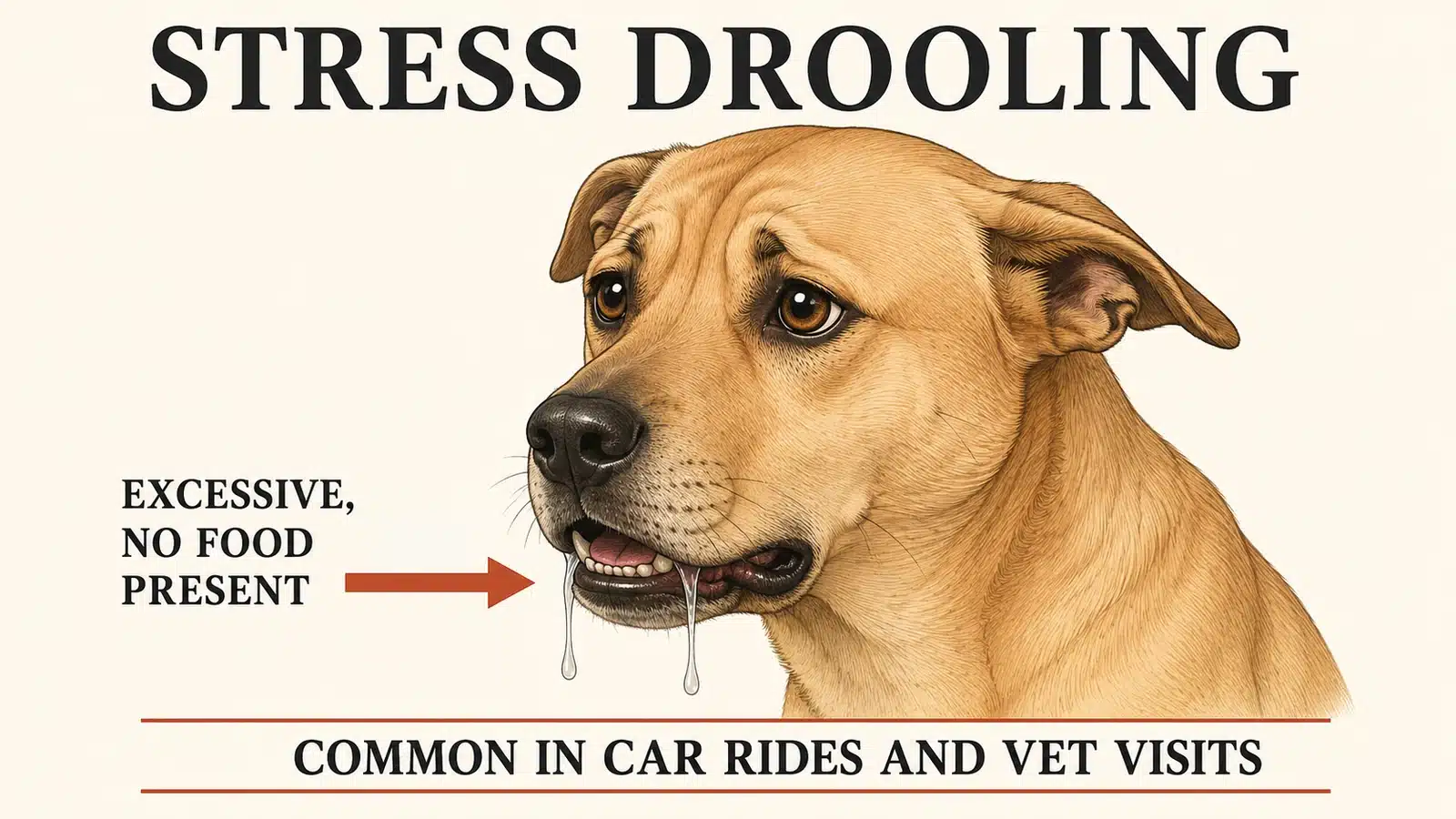
Salivation belongs to the autonomic nervous system, which is why acute stress can produce sudden, dramatic drooling in a dog with no food anywhere near him. The car is the classic theater for this signal: a dog who soaks the back seat in ropes of saliva on every ride is not carsick in the simple sense, or not only carsick, he is in a state of significant autonomic distress, and the drooling frequently arrives alongside trembling, panting, and pacing as part of a cluster.
As always with a bodily signal, medicine gets the first look: nausea, dental disease, oral foreign bodies, and toxin exposure all cause drooling, and sudden unexplained hypersalivation is a veterinary call, not a behavior one. But when the drooling is reliably situational, appearing in the car, at the clinic, during storms, and nowhere else, you are looking at conditioned fear, and conditioned fear is precisely what counterconditioning was built for. Dogs who flooded the back seat as passengers can genuinely learn to ride dry and easy, but the path there is gradual, systematic, and starts far below the intensity that produces the drool.
The Air Snap: A Bite That Chose to Miss
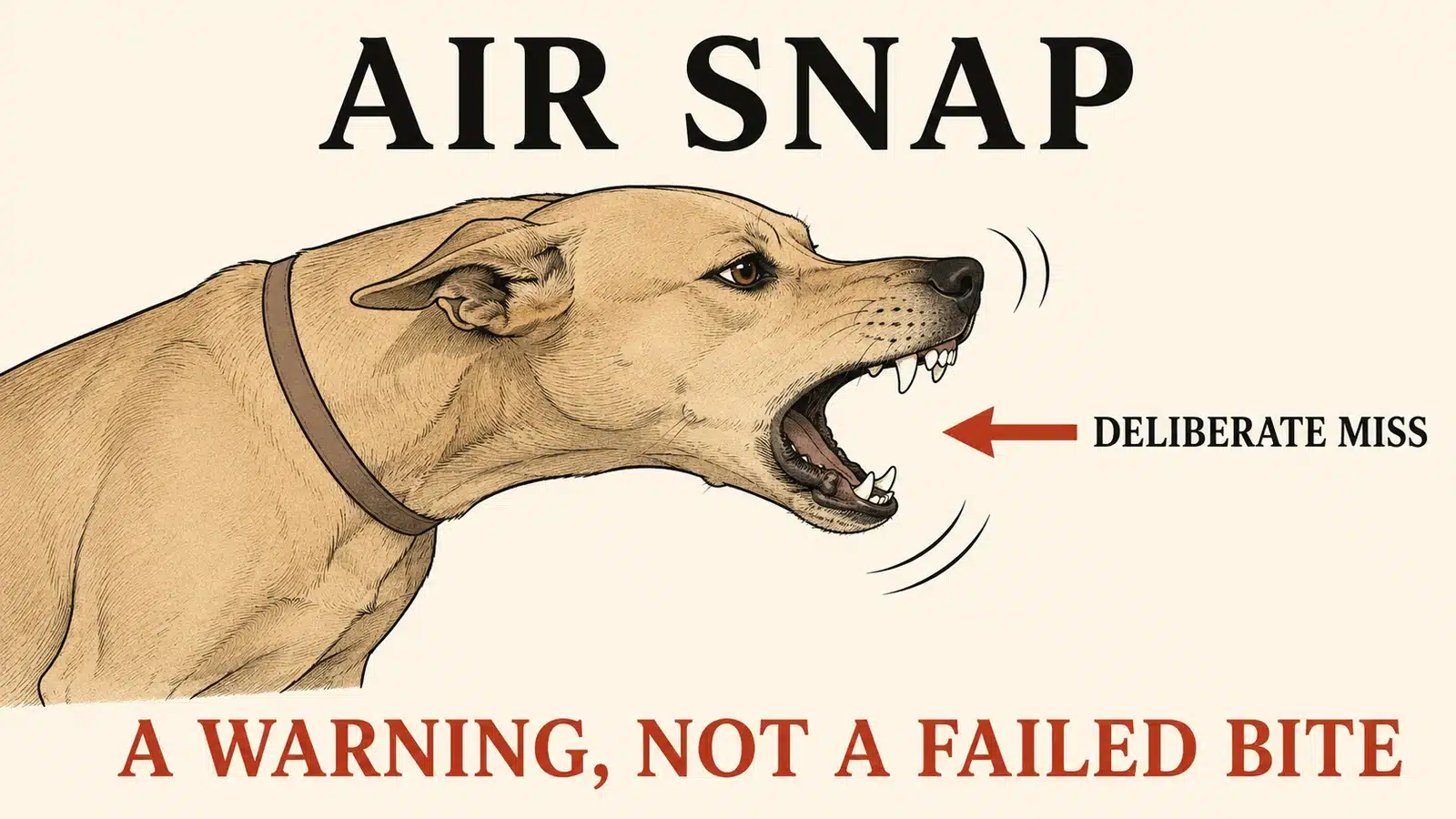
An air snap is a rapid, open-mouthed bite at nothing, teeth clacking shut on empty air near whatever the dog needs to move away from him. Understand this about canine jaw accuracy: dogs catch flies out of the air. When a dog snaps and misses a human hand by two inches, that was not poor aim, it was extraordinary restraint. The snap is a deliberately inhibited warning, the second-to-last rung on the ladder, deployed when everything quieter has already failed or been ignored.
Treat an air snap as the emergency communication it is: stop the interaction immediately, give the dog space, and resist the reflex to punish, because punishing the snap removes the final warning and leaves nothing between silence and contact. Then work backwards through what happened. What was the trigger? Which quieter signals came first, the lip licks, the head turns, the freeze, and who missed them? An air snap directed at people is past the point of do-it-yourself troubleshooting. That is the moment to bring in a credentialed behavior professional for a full functional behavior assessment, while managing the situation so the trigger and the dog stop colliding.
Displacement Behaviors: Normal Acts at Abnormal Moments
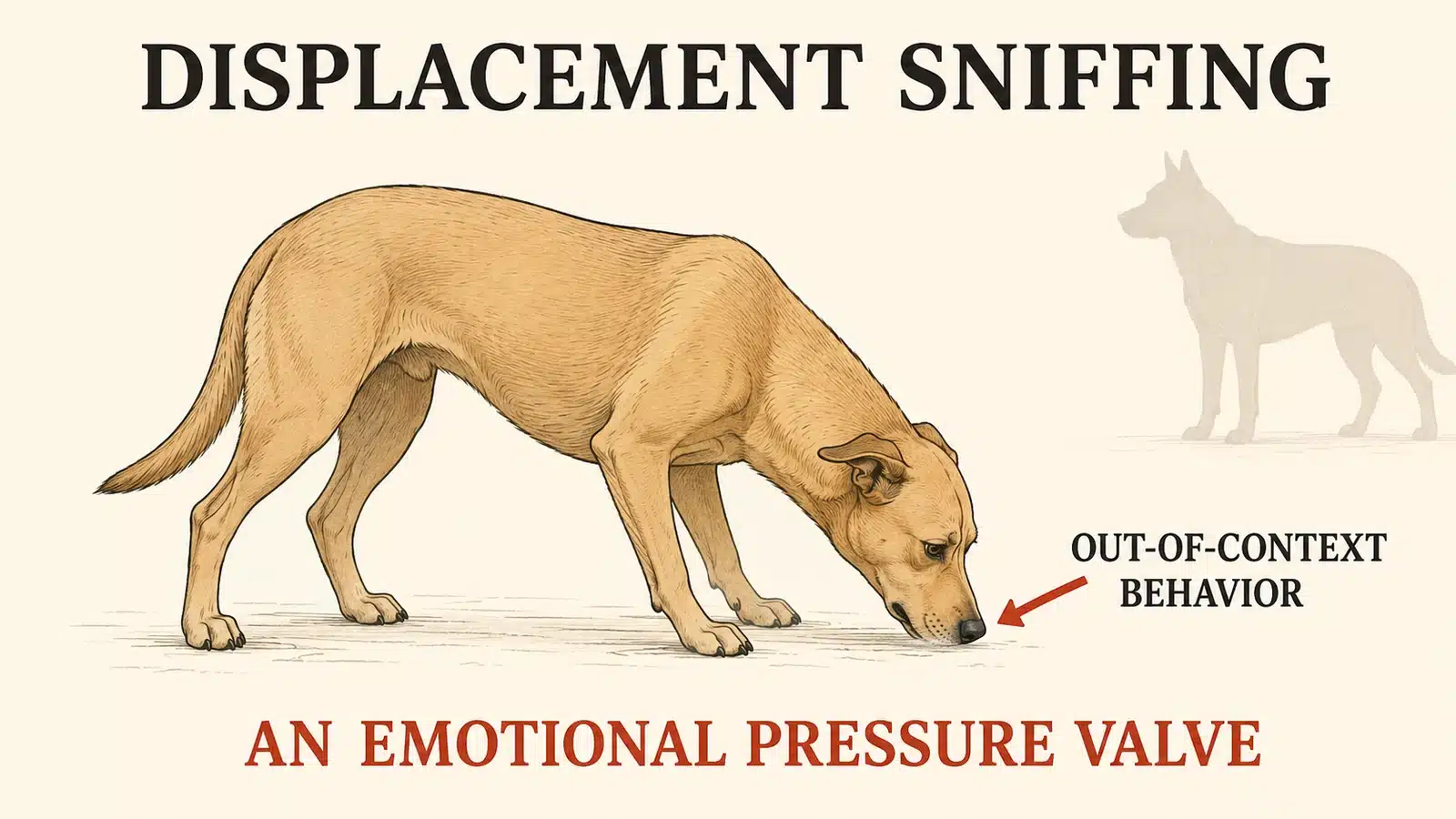
Displacement behaviors are perfectly ordinary actions, sniffing, scratching, grooming, sudden intense interest in one's own paw, performed at moments when they make no sense, because the dog is caught between two competing drives and the pressure has to go somewhere. The dog called to come while anxious about the tone of your voice suddenly finds the grass fascinating. The dog in a tense greeting abruptly sits and scratches his collar. Nothing is wrong with the behavior. Everything is in the timing.
Ethologists have documented displacement activities across species for decades, and in dogs they function as a pressure valve for internal conflict: approach versus avoid, obey versus escape. For the pet parent, they are a gift, because they are easy to see once you know the trick. Ask one question: does this behavior make sense right now? A dog who scratches after a nap is scratching an itch. A dog who scratches every time training gets frustrating is telling you the session is too hard, the criteria too steep, or your energy too intense. Lower the difficulty, brighten your delivery, shorten the session. Displacement behaviors are feedback about your teaching, delivered honestly and free of charge.
Clinginess: Velcro, With a Nervous System Behind It
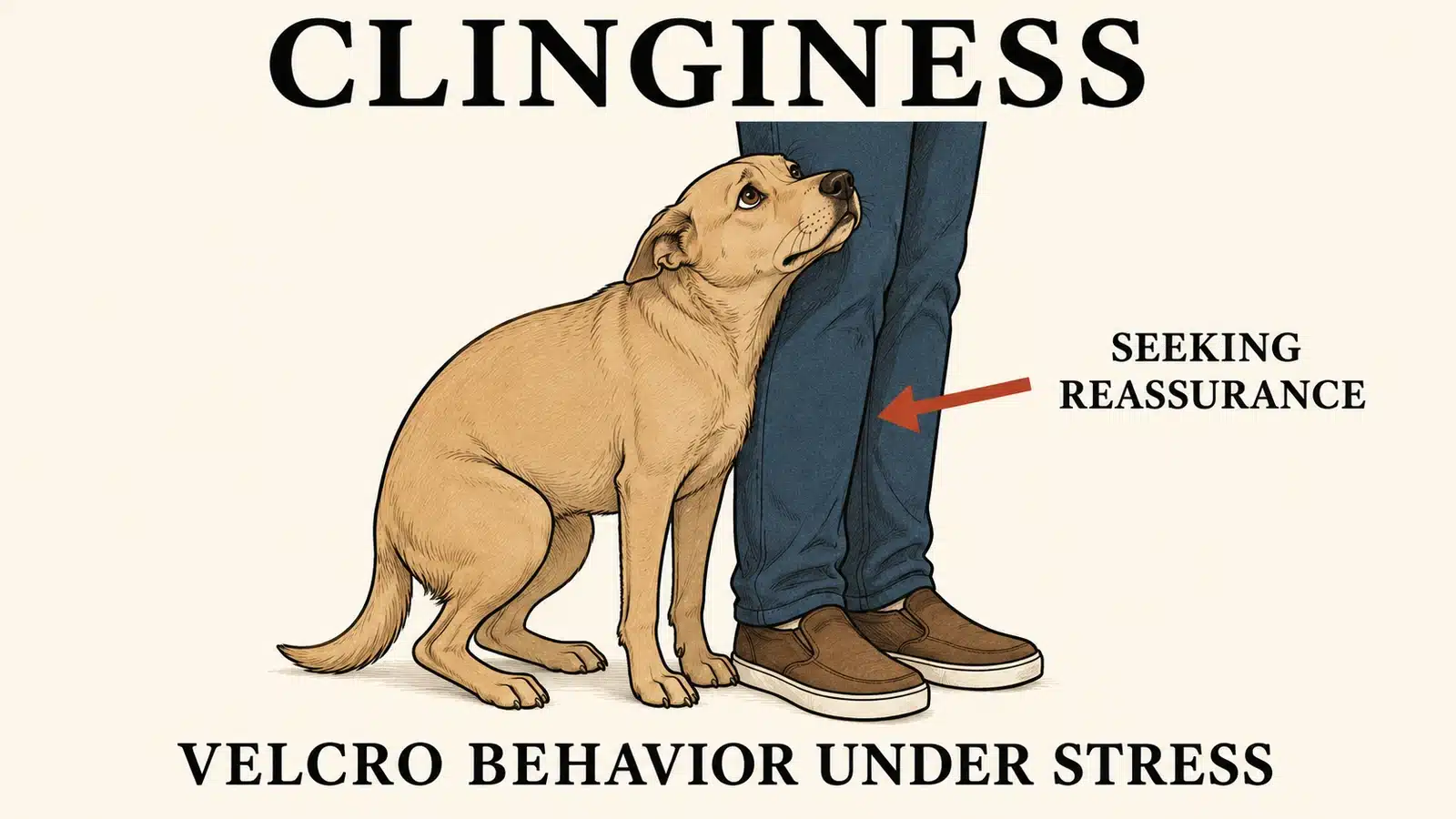
Plenty of dogs enjoy being near their people; that alone is affection, not pathology. Stress-driven clinginess looks different in quality and in context: the dog shadows the pet parent room to room with urgency rather than ease, presses hard against legs during storms or visits, cannot settle unless in physical contact, and shows a worried face while doing it, ears back, brow tight, checking upward again and again. Proximity has stopped being a pleasure and become a coping strategy.
Watch when it spikes. Clinginess that intensifies before departures and dissolves the moment you return sits inside the separation-related cluster. Clinginess during storms and fireworks points at sound sensitivity. A sudden clinginess in a previously independent dog is a flag for pain or illness and belongs in front of a veterinarian first. And to retire the myth one more time: comforting an anxious dog does not reinforce anxiety. Fear is an emotional state, not a behavior being paid a wage. Provide the safety, then treat the underlying trigger, so the dog eventually no longer needs the lifeline.
Escape Attempts: Flight, Chosen and Blocked
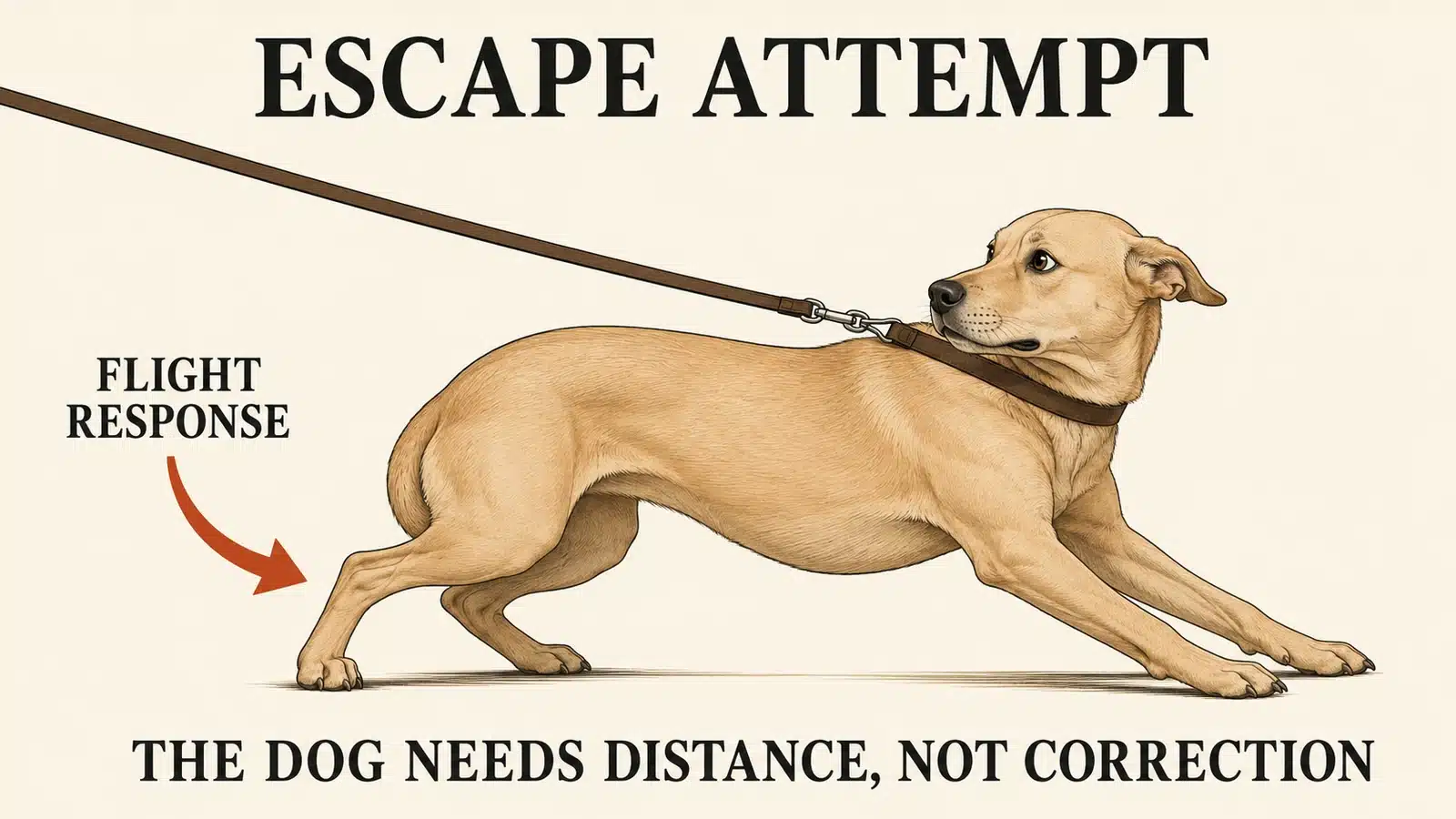
When a frightened dog chooses flight and the environment blocks it, you get escape behavior: the backward alligator-roll against the leash, bolting for the car at the clinic door, scrambling behind the couch when the nail clippers appear, digging at the door during fireworks. The dog is not misbehaving. He is executing the oldest survival program there is and discovering it does not work, which is its own kind of distress on top of the original fear.
Two responses matter, one immediate and one structural. Immediately: safety. A panicking dog on leash can slip a flat collar in a heartbeat, and a bolting dog near a road is a life-threatening emergency, which is why fearful dogs belong in a properly fitted Y-front harness with secure hardware, and why forcing a panicking dog toward the trigger is never acceptable. Structurally: every full escape attempt marks a threshold that was catastrophically exceeded. The plan that follows is not about teaching the dog to endure the trigger, it is about shrinking the trigger's intensity, through distance, duration, and gradual exposure, until the dog's nervous system never needs the exit at all.
The Tucked Tail: The Flag of Surrender
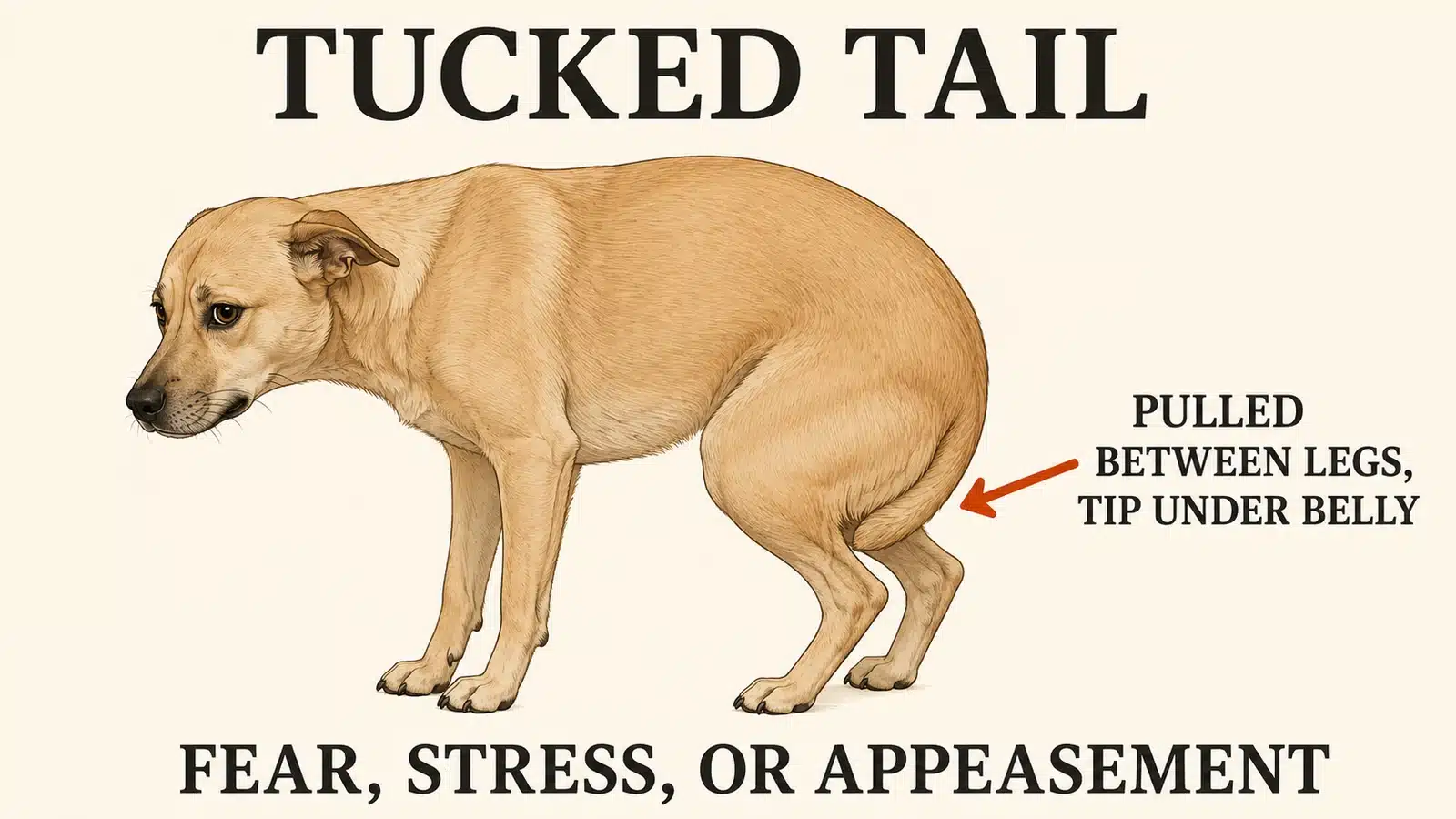
The tucked tail is the stress signal everyone already half-knows, and the anatomy is worth understanding anyway. A frightened dog clamps the tail down between the hind legs, often curling the tip forward beneath the belly, which simultaneously protects vulnerable anatomy, cuts off the scent broadcast from the anal glands, and completes the body-shrinking project the ears and crouch began. It is fear, stress, or profound appeasement, and the tighter the clamp, the stronger the emotion.
The degree matters, so read the whole spectrum: a tail carried just lower than baseline whispers unease, a tail pressed flat against the thighs states fear plainly, and a tail wrapped under the belly on a crouched, trembling dog is a five-alarm reading. Remember, too, that some dogs, sighthounds among them, carry a naturally low tail, which is why the reference point is always this dog's baseline rather than a textbook diagram. A tucked tail should redirect your attention immediately to the environment: something in it is too much, and your job is to find it and dial it down. For the full grammar of tail heights, see the companion page on tail positions.
Chattering Teeth: A Small Strange Tremor With a Big Meaning
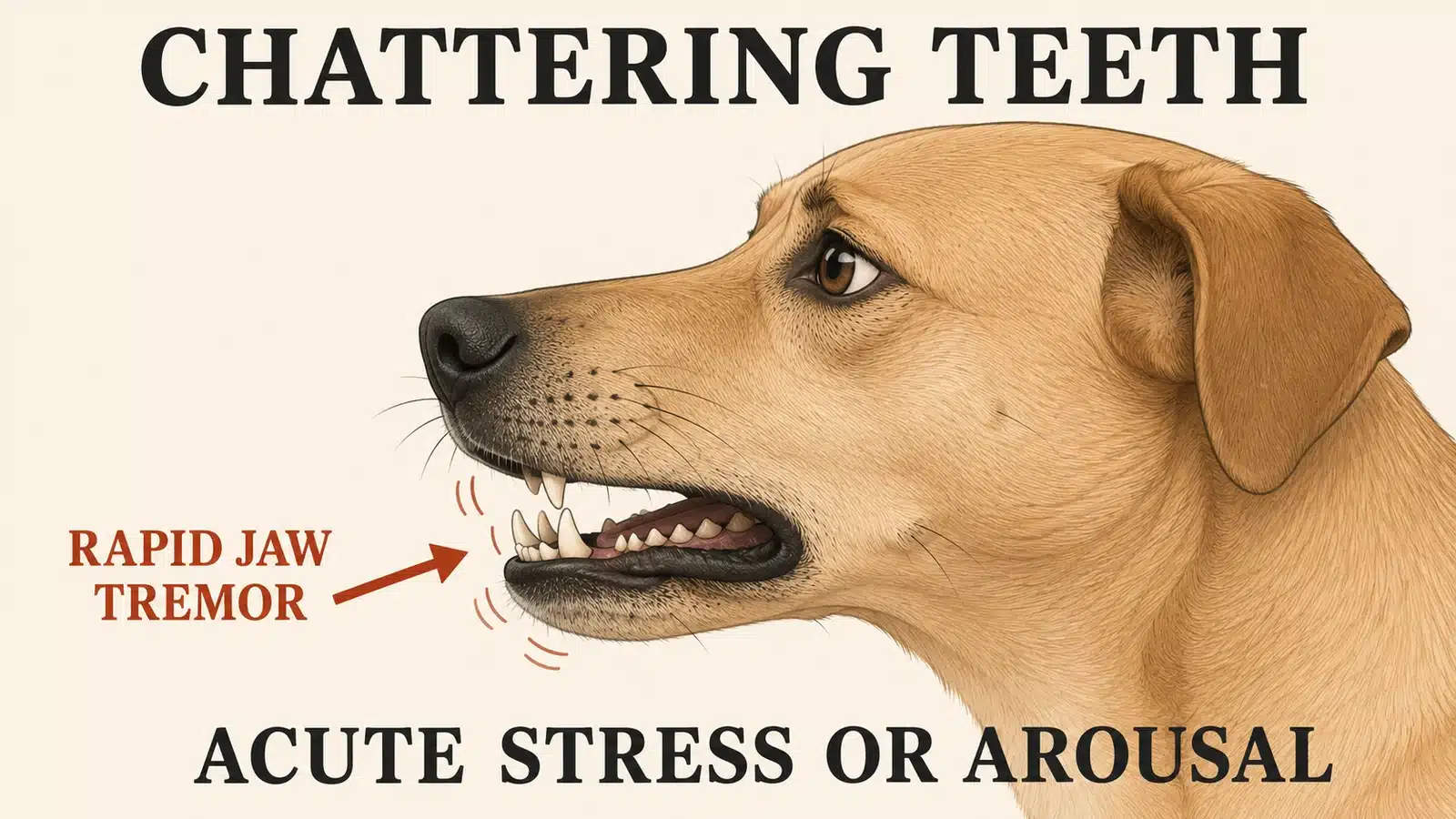
Teeth chattering is one of the odder items in the canine repertoire: a rapid tremor of the lower jaw, teeth clicking audibly, sometimes lasting only a few seconds. It appears in moments of acute stress and in moments of intense arousal generally, and male dogs will also chatter after investigating interesting scent, which is a normal part of processing chemical information through the vomeronasal organ. Once again, context does the sorting: chattering at the scent post on a walk is chemistry, chattering in the corner of the exam room is nerves.
When the context says stress, the chatter usually keeps company with trembling, a tucked tail, and pinned ears, and it tells you arousal is high enough to be leaking out through the jaw. Persistent or frequent chattering with no plausible trigger, particularly in an older dog, earns a dental and neurological check, because oral pain produces the identical picture. Behavioral chattering resolves the way all acute stress signals resolve: identify the trigger, create distance, and stop expecting the dog to simply get over an environment his body is visibly protesting.
Sudden Scratching: The Itch That Isn't
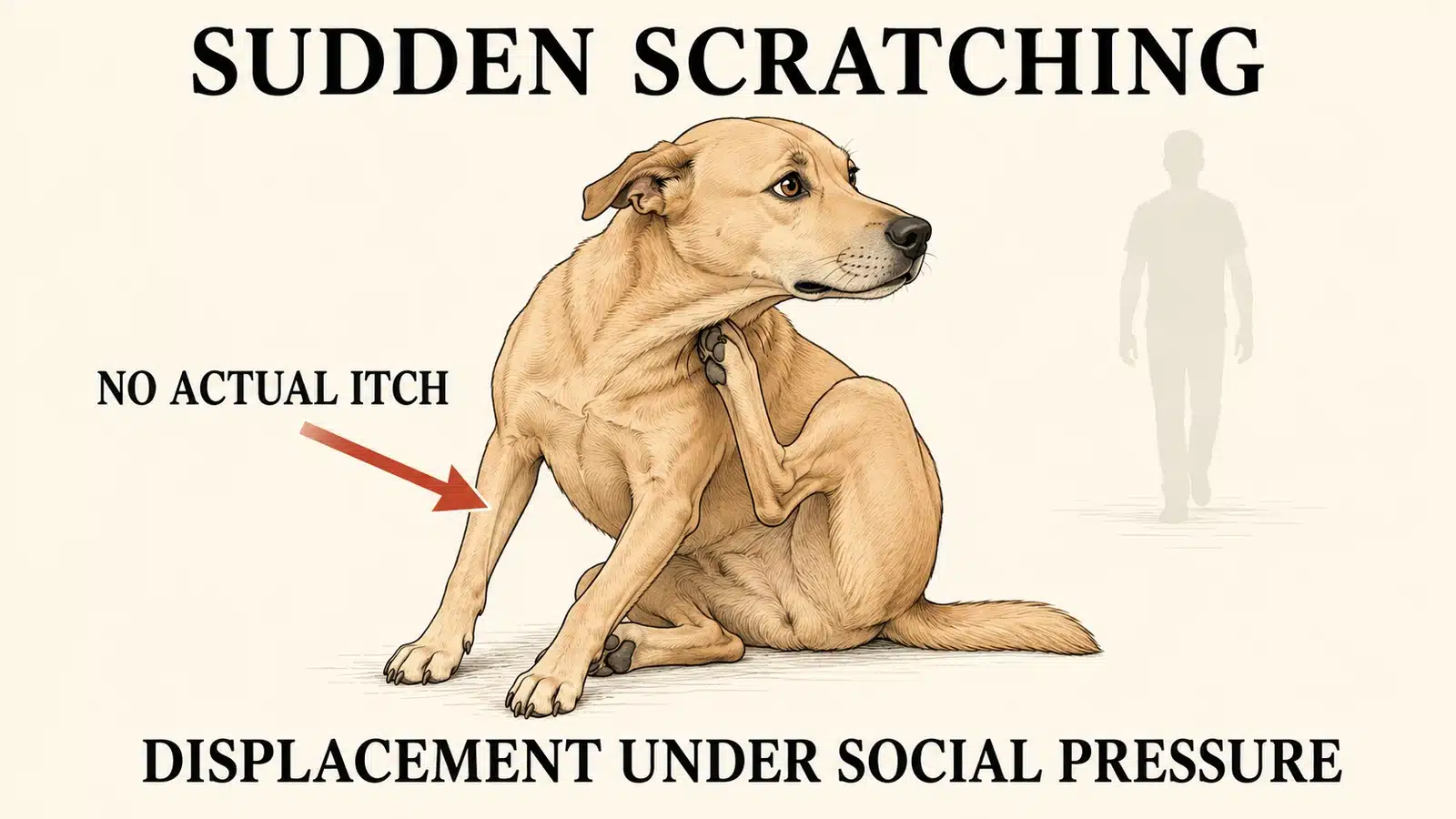
Sudden scratching is displacement's most familiar costume. Mid-training-session, mid-greeting, mid-photo-shoot, the dog abruptly sits and works a hind leg at his collar or neck, and the tell is everywhere except the leg: his eyes stay oriented on the situation, his ears stay tuned to it, and the scratching starts precisely when the social or task pressure peaked, then stops the moment the pressure lifts. An itch does not read the room. Displacement scratching does nothing but.
Trainers should treat this signal as free coaching. A dog who scratches every time you raise criteria is reporting that your steps are too big; a dog who scratches when strangers lean over him is reporting that greetings are too close. Rule out the dermatological, of course, because fleas and allergies scratch on their own schedule, and a dog who scratches at rest, at night, and in every context has a skin problem, not a stress problem. But when the scratching keeps perfect time with pressure, believe the timing, and change what you are doing.
What to Do in the Moment, and What to Do About the Pattern
In the moment, the protocol is almost embarrassingly simple, which is exactly why it works: see the signal, lower the pressure. Add distance from the trigger. End the interaction. Give the dog an exit and let him use it. You do not need to diagnose which of the 22 signals you just saw with clinical precision; you need to respond to the category, and the category always means the same thing: this is too much, right now, for this dog. A pet parent who does nothing else but honor that message will prevent the majority of escalations before they start.
Never punish a stress signal, and be careful not to do it by accident. Scolding the whine, jerking the leash on the pancaked dog, forcing the avoidant dog to be petted anyway: each of these teaches the dog that communicating distress makes things worse, and communication that makes things worse gets abandoned in favor of behaviors much higher on the ladder. Protect the quiet signals. They are the safest ones you will ever be offered.
The pattern is a different project than the moment. A stress signal that recurs in the same context, the car, the grooming table, the presence of children, visits from strangers, is a map of a conditioned emotional response, and conditioned emotional responses change through behavior change science, not through repetition and hope. That work follows a clinical sequence: a functional behavior assessment to identify triggers and thresholds precisely, management to stop the daily rehearsal of fear, skill building to give the dog reliable alternative behaviors, and behavior modification through systematic desensitization and counterconditioning, always conducted sub-threshold, at intensities the dog can experience without tipping into the very signals this page catalogs. That sequence is the spine of the EASE Method: Evaluate, Arrange, Skill-Build, and Emotional Repatterning, and this page is the Evaluate skill in your hands. The pet parents who master these 22 signals do not just prevent bad moments. They become the most valuable instrument in their own dog's treatment.
Dog Stress Signals: Questions, Answered
What are the most common signs of stress in dogs?
The most frequent are the subtle ones: yawning out of context, lip licking with no food present, panting without heat or exercise, pinned ears, whale eye, a tucked tail, trembling, pacing, and freezing. The subtle signals matter most because they come earliest, giving you time to help before the dog escalates to growling or snapping.
How do I tell a stress yawn from a tired yawn?
Timing and tension. A stress yawn is exaggerated and prolonged, the facial muscles stay tight, and it appears at moments that make no sense for sleepiness: during handling, training, vet visits, or greetings. A tired yawn is loose, soft, and shows up at rest. When in doubt, look at the rest of the body for companion signals like lip licking or pinned ears.
Should I comfort my dog when he's stressed, or will that reward the fear?
Comfort your dog. The idea that comforting reinforces fear is a myth: fear is an emotional state, not an operant behavior, and providing safety does not strengthen it. What actually maintains fear is continued exposure to triggers at full intensity. Be a safe harbor in the moment, then address the trigger itself through gradual desensitization and counterconditioning.
My dog freezes when my child hugs him. Is that okay?
No, that freeze is one of the most serious warnings in dog body language, and it is the signal most often reported in the moments before bites to children. Stop the hugs entirely, teach your child that the dog decides about contact, and bring in a credentialed, force-free behavior professional to assess the dog's comfort with the child and build a safe plan. If you are expecting a baby or already have young children in the home, my guide to preparing your dog for a new baby walks through exactly how to build that safety, stage by stage. Freezing means the dog is very close to running out of polite options.
When do stress signals mean I need professional help?
Get help when stress signals are frequent, when they recur predictably in specific contexts, when you see the serious ones (freezing, whale eye over resources, air snapping), or when fear is limiting your dog's daily life. Look for credentialed professionals who begin with a functional behavior assessment and use desensitization and counterconditioning, never punishment-based tools, which suppress the warning signals while making the underlying fear worse.
Next: Calming Signals
Stress signals show you a nervous system under load. Calming signals show you a dog actively working to keep the peace. Together they are the foundation of reading the whole dog.
 About the Author
Will Bangura, M.S., CAB-ICB, CBCC-KA, CPDT-KA, FDM, FFCP, is a Certified Canine Behaviorist with over 35 years of experience specializing in severe aggression, fear, anxiety, reactivity, phobias, and compulsive disorders in dogs. He holds a Master's Degree in Psychology and is accredited as a Certified Canine Behaviorist through International Canine Behaviorists, one of only three CAB-ICB Certified Canine Behaviorists in the United States and the only one in Arizona. His additional credentials include Certified Behavior Consultant Canine (CBCC-KA) and Certified Professional Dog Trainer (CPDT-KA) through the Certification Council for Professional Dog Trainers, certification in Applied Ethology through Family Dog Mediation (FDM), and Fear Free Certified Professional (FFCP).
Will is the author of Sniff to Soothe, host of the Dog Training Today podcast, and a court-recognized expert witness in canine behavior. His clinical work is grounded in behavioral psychology, applied behavior analysis, learning theory, and affective neuroscience: every case begins with a functional behavior assessment and is treated through management, skill building, and evidence-based behavior modification using systematic desensitization and counterconditioning. He is a national advocate for force-free, science-based training and a published voice on the welfare risks of aversive training methods.
As the founder of Phoenix Dog Training, Will provides in-home behavior consultations throughout the Phoenix metro area and virtual behavior consultations for pet parents nationwide.
If Your Dog Is Living in These Signals Every Day
Chronic stress is treatable. A professional behavior consultation begins with a full functional behavior assessment and ends with a clear, evidence-based plan built for your dog. Schedule a Behavior Consultation, or start with a free call.