
Resource Guarding a Family Member or Pet Parent: Understanding When a Dog Guards Access to a Person
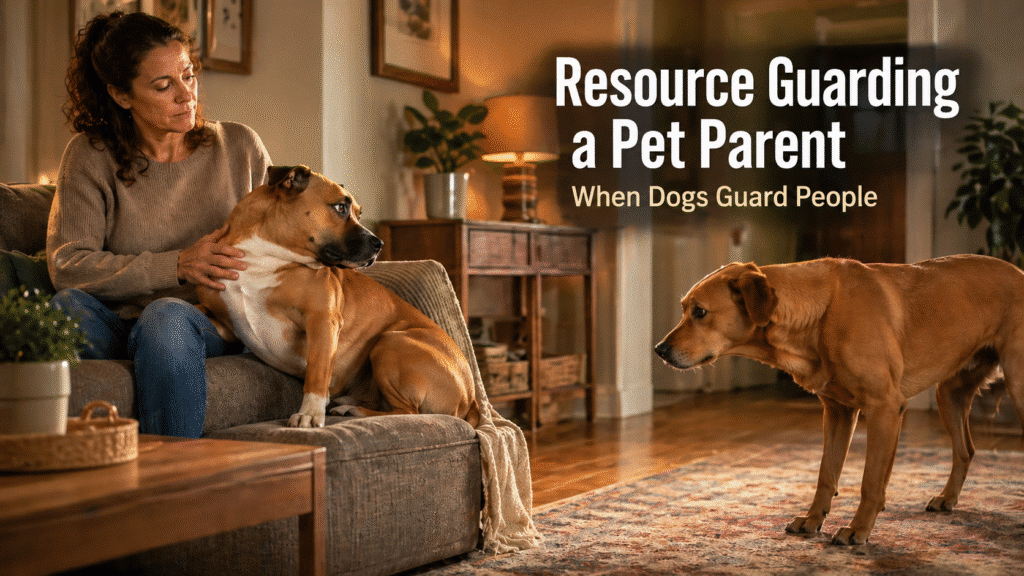
A dog can resource guard more than food, toys, bones, beds, or stolen objects. In some cases, a dog may guard access to a family member, pet parent, resting location, social interaction, or a preferred person. This can happen when another dog, visitor, child, spouse, partner, or unfamiliar person comes within a certain distance of the individual the dog values.
At first, the behavior may be subtle. The dog may become still. The mouth may close. The eyes may harden. The dog may lean into the pet parent, move between the pet parent and the approaching individual, or stiffen while watching another dog or person move closer. If the approach continues, the behavior may escalate into growling, barking, snapping, lunging, biting, or fighting.
Many families describe this behavior as “protectiveness,” “jealousy,” or the dog “claiming” a person. Those words may describe how the behavior feels to the human family, but they do not fully explain what is happening behaviorally. A more useful explanation is that the dog may be using avoidance, threatening behavior, or aggression to retain access to something valuable or to prevent another individual from coming closer.
What Resource Guarding Means
The scientific definition of resource guarding describes it as avoidance, threatening, or aggressive behavior used by a dog to retain control of food or non-food items in the presence of a person or another animal (Jacobs et al., 2018). Veterinary clinical references describe resource guarding in dogs as occurring when a dog is approached while in possession of something the dog wants to retain, or when the dog is near a valued object, including food, treats, chew toys, stolen items, resting places, or preferred individuals (Merck Veterinary Manual, 2025).
That last point is especially important. A preferred person can function as part of the dog’s valued resource context. This does not mean the dog is morally possessive, dominant, spoiled, or intentionally trying to control the household. It means the dog’s behavior may be functioning to preserve access, increase distance, avoid conflict, or prevent an approach that the dog perceives as threatening, intrusive, or risky.
When the guarded resource is a person, the behavior often becomes emotionally confusing for the family. Pet parents may interpret the behavior as loyalty or devotion because the dog appears to be guarding them from others. However, from a behavior perspective, the more important question is not whether the dog loves the person. The more important question is what the dog is trying to make happen or prevent from happening when another individual approaches.
A dog who growls when another dog approaches the pet parent may be trying to keep that dog away. A dog who snaps when a spouse approaches the bed may be trying to prevent access to the bed, the pet parent, or the physical contact occurring in that moment. A dog who blocks a child from approaching a seated parent may be attempting to control proximity. In each case, the behavior should be evaluated by looking at the setting, the trigger, the dog’s body language, the consequence of the behavior, and the risk to people or other animals.
Resource Guarding a Person Is Not Healthy Attachment
Dogs are social animals, and many form strong attachments to their families. A dog who enjoys being near a pet parent, follows them from room to room, rests beside them, or seeks reassurance from them is not automatically resource guarding. Healthy attachment still allows flexibility. The dog can move away, allow others to approach, recover from interruptions, and tolerate shared social access.
Resource guarding becomes a concern when the dog uses tension, blocking, growling, snapping, lunging, or biting to prevent another individual from approaching the pet parent or entering a certain distance zone.
This distinction matters because families sometimes romanticize the behavior. They may say, “He is just protecting me,” or “She only does that because she loves me.” While affection and attachment may be part of the relationship, the guarding behavior itself is not a safe or healthy expression of attachment. It is a conflict behavior. It can create stress for the dog, the pet parent, other family members, visitors, children, and other dogs in the home.
A more accurate way to understand the behavior is this: the dog is not simply saying, “I love this person.” The dog may be saying, “I am uncomfortable with you coming closer while I have access to this person.”
That discomfort may involve fear, anxiety, frustration, conflict over access, pain, learned reinforcement, or prior experiences in which aggressive behavior successfully caused another individual to retreat.
Why a Dog May Guard a Family Member or Pet Parent
Person-directed guarding is usually not caused by one single factor. It may involve learning history, emotional state, household routines, proximity, competition, pain, or the behavior of the approaching person or dog.
A dog may learn that growling makes another dog back away. A bark may stop a spouse from approaching the bed. A lunge may cause a visitor to step back. When aggressive behavior helps a dog retain a resource or remove a perceived threat, that consequence can strengthen the behavior. The Merck Veterinary Manual notes that learning plays an important role in aggression, including situations in which aggression helps a dog retain a resource or remove a threat (Merck Veterinary Manual, 2025).
This is why the behavior often becomes more intense over time. If a small warning works, the dog may use it again. If a small warning is ignored, the dog may escalate. If escalation works more reliably than subtle communication, the dog may begin escalating sooner. The dog is not doing this because the dog is “bad.” The dog is behaving in a way that has produced a meaningful outcome.
Distance is one of the most important variables. A dog may be relaxed when another dog is across the room but become tense when that dog crosses an invisible boundary. That boundary may be twelve feet for one dog, six feet for another, and two feet for another. The exact distance can change depending on the context. The dog may tolerate another dog approaching while everyone is standing in the kitchen but react when the pet parent is seated on the couch. The dog may tolerate a spouse walking through the room but growl when the spouse approaches the bed. The dog may be comfortable with a child across the room but tense when the child runs directly toward the pet parent.
The closer the approaching individual comes, the more likely the guarding dog may be to escalate, especially if early signs of discomfort are missed or ignored.
What Person-Directed Resource Guarding Can Look Like
Resource guarding is easiest to address when it is recognized early. Unfortunately, many families miss the early signs because they are waiting for growling, barking, lunging, or biting. By the time those behaviors appear, the dog is usually already over threshold.
Early signs may include sudden stillness, a hard stare, a closed mouth, body blocking, leaning into the pet parent, moving between the pet parent and the approaching individual, whale eye, lip licking, increased muscle tension, a hard tail carriage, a lowered head with fixed gaze, or refusal to move away.
Some dogs climb higher onto the pet parent. Some press their body against the person. Some quietly stare at the approaching dog long before they vocalize. Others may appear to “freeze” while the pet parent is petting them. That freeze can be easy to miss, but it is often a meaningful sign that the dog is no longer relaxed.
More serious signs include growling, snarling, barking, air snapping, lunging, chasing another dog or person away, biting, or attacking another dog near the pet parent.
A growl should be treated as important information. It is a warning signal, not disrespect. Suppressing the growl through punishment does not necessarily change the dog’s emotional state or the perceived value of the resource. It may only remove an early warning sign.
The growl is not the true problem to eliminate. The growl is the alarm. The deeper issue is the emotional state, learning history, and environmental context that made the dog feel a warning was necessary.
Common Situations Where This Behavior Occurs
Person-directed guarding often appears in predictable contexts. The most common include couches, beds, recliners, laps, narrow hallways, doorways, greetings, and moments when the pet parent is giving another dog or person attention.
Couches and beds are especially common because they combine several valuable resources at once. The dog may have comfort, physical contact, warmth, elevation, access to the pet parent, and a predictable resting routine. The pet parent is often less mobile in these contexts, which can make the space feel more controllable to the dog. Another person or dog approaching that space may therefore carry more emotional weight.
Lap guarding is often discussed in small dogs, but dogs of any size can guard close body contact. A large dog leaning against a pet parent can create the same conflict as a small dog sitting in a lap. The issue is not the dog’s size. The issue is whether the dog uses behavior to prevent others from approaching.
Guarding against a spouse, partner, or child can be particularly distressing for families. A dog may growl when a partner enters the bedroom, sits on the couch, hugs the pet parent, or reaches toward them. A dog may also guard a parent from a child who approaches quickly, climbs into the parent’s lap, hugs, squeals, or moves unpredictably. In homes with children, this should always be treated as a serious safety concern.
Person-directed guarding may also appear during walks. A dog may bark, lunge, or block when other people or dogs approach the handler. In these cases, the behavior may overlap with leash reactivity, fear of strangers or dogs, frustration, and guarding of the handler. When the behavior occurs on leash, structured Dog Reactivity Training in Phoenix can help identify the trigger distance, prevent rehearsal, and teach the dog safer emotional and behavioral responses.
Why Punishment Is Risky
Punishment and confrontational responses can be dangerous in aggression cases. Herron et al. (2009) surveyed dogs presented for behavior problems and found that several confrontational methods, including hitting or kicking, growling at the dog, physically forcing release of an item, alpha rolls, staring the dog down, and similar techniques, elicited aggressive responses in at least one quarter of the dogs on which those methods were attempted. The study concluded that confrontational methods were associated with aggressive responses in many cases and that veterinary professionals should advise pet parents about the risks of such methods (Herron et al., 2009).
This matters directly in resource guarding cases. If a dog growls when another dog approaches the pet parent and the pet parent punishes the growl, the dog may learn that the other dog’s approach predicts conflict or punishment. That can make the approach even more emotionally negative. The dog may also learn that early warnings are unsafe. In some cases, this produces a dog who appears “better” because the growling stops, but the underlying discomfort remains.
Punishment may stop a visible warning today, but it can increase risk tomorrow if the dog still feels threatened and has fewer safe ways to communicate discomfort.
This is especially important around children, visitors, and other dogs in the home. A dog who has been punished for growling may not become safer. The dog may simply become quieter before escalating.
Management Comes First
The first step is safety and prevention. Management is not failure. Management prevents the dog from rehearsing the guarding sequence while a behavior modification plan is developed.
If the dog guards the pet parent on the couch, the dog may need to be prevented from having couch access when other dogs, children, visitors, or family members are moving nearby. If the dog guards the bed, the dog may need a separate sleeping location. If the dog guards a lap, lap access may need to stop temporarily when other dogs or people are present.
Management may include baby gates, closed doors, exercise pens, separate resting areas, crates for dogs who are already comfortable being crated, leashes used only as safety lines, structured turn-taking, and preventing visitors or children from approaching the dog in high-risk contexts.
Pet parents should not test the dog by repeatedly allowing someone to approach “to see what happens.” Testing is not treatment. It usually rehearses the behavior and increases risk.
Dogs also should not be forced to “work it out.” This is particularly dangerous in multi-dog homes. Allowing dogs to settle conflict through threats, fights, or corrections can lead to injury and worsening aggression. A safer plan uses distance, reinforcement, predictable routines, and environmental separation when needed.
Behavior Modification Should Change the Emotional Response
The goal is not simply to stop the dog from growling. The goal is to change what the approach of another dog or person predicts.
If another dog approaching the pet parent currently predicts loss of access, conflict, crowding, or threat, the training plan should teach the guarding dog that the approach is safe, predictable, and associated with good outcomes. This is typically done through carefully controlled counterconditioning and differential reinforcement.
A simple controlled setup might begin with the guarding dog near the pet parent but not physically crowded against them. The approaching dog or person appears at a distance where the guarding dog notices but remains relaxed. The guarding dog receives high-value food. The approaching dog or person then moves away, and the food stops.
Over time, the approach begins to predict something good instead of conflict or loss. The distance must be carefully controlled. If the dog stiffens, growls, lunges, refuses food, stares hard, or cannot disengage, the setup is too difficult.
Positive reinforcement-based behavior modification can improve predictability and comfort in aggression-related contexts. The Merck Veterinary Manual describes positive reinforcement-based behavior modification for increasing a dog’s comfort with people approaching valued objects (Merck Veterinary Manual, 2025). The same principle can be clinically adapted to situations in which the valued context includes proximity to a preferred person, but that adaptation should be done cautiously, especially when there is bite risk.
Teach Alternative Behaviors
The dog also needs safer behaviors to perform when someone approaches. Useful foundation behaviors may include going to a mat, moving away from the pet parent on cue, touching a hand target, coming when called, relaxing on a station, or remaining settled while another dog receives attention.
For example, a dog who guards the pet parent on the couch may first learn that a mat several feet away predicts high-value reinforcement. The dog is not being pushed away as punishment. Instead, the mat becomes a safe, predictable place where good things happen. Once that station behavior is strong, carefully controlled approach exercises can begin at a distance the dog can handle.
In multi-dog homes, the approaching dog may also need training. That dog may need to learn not to rush, crowd, stare, climb onto the pet parent, or push into the guarding dog’s space. Both dogs should have clear reinforcement opportunities and enough distance to succeed.
A common mistake is focusing only on the guarding dog while allowing the other dog to continue crowding, staring, or invading space. In many cases, both dogs are part of the pattern. The guarding dog needs to learn that approaches are safe, and the approaching dog needs to learn how to move calmly and respect distance.
The goal is not forced sharing. The goal is safe, predictable access and reduced conflict.
Children Require Special Caution
A dog who guards a pet parent from a child presents a serious safety concern. Children move quickly, make sudden sounds, climb, hug, reach, stare, and often miss early canine warning signals. A child should not be used in behavior modification setups for a dog who growls, blocks, snaps, or lunges when the child approaches a pet parent.
In these cases, environmental management and professional help are strongly recommended. The child should be protected from exposure to the dog’s guarded space, and the dog should be protected from situations that push the dog into defensive behavior.
A dog who growls at a child is communicating discomfort. That warning should be taken seriously immediately. Waiting to see whether the dog “really means it” is unsafe.
Medical and Pain Factors Must Be Considered
Pain and medical problems can contribute to irritability, aggression, and reduced tolerance. Mills et al. (2020) argue that pain is under-recognized in relation to problem behavior in dogs and cats and that pain should be considered when problem behavior is present. The Merck Veterinary Manual also notes that pain and discomfort can increase irritability and aggression and can exacerbate aggression-related behavior problems, including possessive aggression (Merck Veterinary Manual, 2025; Mills et al., 2020).
A sudden onset of guarding, rapid worsening, inconsistent aggression, new sensitivity to touch, reluctance to move, sleep disruption, appetite change, or changes in mobility should prompt veterinary evaluation.
Medical assessment is especially important when the behavior appears suddenly in a dog with no prior history of guarding, when the dog is older, when the dog resists being moved from furniture, when the dog guards resting spaces, or when the dog reacts more intensely during handling or physical contact.
When Professional Help Is Needed
Professional help is warranted when the dog has bitten a person or another dog, caused punctures, guarded a pet parent from a child, attacked another dog in the household, guards multiple resources, blocks access to rooms or furniture, or causes anyone in the home to feel unsafe. In these cases, working with a qualified Dog Behaviorist in Phoenix can help pet parents identify the function of the behavior, reduce risk, and develop a humane, evidence-based behavior modification plan.
Professional help is also important when the dog’s behavior is increasing in frequency or intensity, when multiple dogs are involved, when the household includes children, when visitors are at risk, or when the pet parent cannot safely manage the environment. When the guarding has escalated to growling, lunging, snapping, biting, or fights between dogs, specialized Dog Aggression Training in Phoenix may be necessary.
The professional should use humane, evidence-based methods and should evaluate antecedents, consequences, emotional state, trigger distance, medical history, bite history, household routines, environmental layout, and the behavior of the approaching person or dog.
Avoid any approach that relies on confrontation, intimidation, forced exposure, shock collars, prong collars, choke collars, alpha rolls, or letting dogs “work it out.” Those methods are not necessary to treat resource guarding and may increase fear, conflict, and aggression risk.
Frequently Asked Questions About Resource Guarding a Pet Parent
Why does my dog guard me from other dogs?
A dog may guard a pet parent from other dogs because access to that person has become highly valuable, emotionally important, or associated with safety. The dog may be trying to prevent another dog from coming closer, interrupting contact, taking attention, or creating social conflict. In some cases, the behavior is related to anxiety, insecurity, competition in a multi-dog household, prior reinforcement, or fear of losing access to the pet parent.
The most important point is that the behavior should not be dismissed as cute loyalty. A dog who stiffens, stares, growls, blocks, lunges, or snaps when another dog approaches is showing a behavior pattern that can escalate if it is not managed and modified carefully.
Is my dog being protective or resource guarding me?
A dog who resource guards a pet parent may look “protective,” but the behavior is usually better understood as control of access rather than true protection. The dog may not be protecting the pet parent from actual danger. Instead, the dog may be trying to keep another dog, person, child, spouse, or visitor from entering the dog’s preferred space near the pet parent.
One way to tell the difference is to look at the trigger. If the dog reacts when safe, familiar people or household dogs approach the pet parent, especially on the couch, bed, lap, or during affection, resource guarding should be strongly considered.
Why does my dog growl when my other dog comes near me?
Your dog may growl because the other dog approaching predicts loss of space, attention, comfort, safety, or access to you. Growling is communication. It is the dog’s way of saying that the situation is uncomfortable and that more distance is needed.
The growl should not be punished. Punishing a growl may suppress the warning without changing the underlying discomfort. Instead, the situation should be managed so the approaching dog does not continue crowding, and a behavior modification plan should be used to help the guarding dog feel safer when the other dog is nearby.
Why does my dog guard me on the couch or bed?
Couches and beds often make resource guarding more likely because they combine several valued things at once. The dog may have physical comfort, close contact with the pet parent, warmth, elevation, a resting place, and predictable access to attention. When another dog or person approaches that space, the guarding dog may perceive the approach as a threat to something valuable.
If guarding happens on couches or beds, unrestricted access to those areas may need to be temporarily changed. This is not punishment. It is management. The goal is to prevent rehearsal of the guarding behavior while teaching the dog safer alternatives.
Should I punish my dog for growling when someone comes near me?
No. Punishing the growl is risky because it may remove an early warning sign while leaving the dog’s discomfort unchanged. A dog who learns that growling is unsafe may stop growling but still feel threatened. That can increase the risk of sudden snapping or biting.
Instead of punishing the warning, increase distance, reduce pressure, and identify what triggered the growl. Then work below threshold with a humane behavior modification plan that changes the dog’s emotional response to people or dogs approaching.
Should I let my dogs work it out?
No. Letting dogs “work it out” can be dangerous, especially when resource guarding involves access to a pet parent. Dogs may rehearse threats, intimidation, chasing, snapping, or fighting. Each rehearsal can make the pattern stronger and more dangerous.
A safer approach uses management, distance, reinforcement, station training, structured turn-taking, and professional help when needed. The goal is not to let conflict decide the outcome. The goal is to prevent conflict and teach both dogs safer ways to behave around valued resources.
Can resource guarding a person be fixed?
Many cases can improve significantly with the right plan, but the word “fixed” should be used carefully. The goal is to reduce risk, change the dog’s emotional response, prevent rehearsal, teach alternative behaviors, and create safer household routines.
Some dogs may always need management in certain contexts, especially if there has been a bite history, severe intra-dog conflict, children in the home, pain, or multiple guarded resources. Improvement is possible, but success depends on the severity of the behavior, the household environment, consistency, safety planning, and whether the dog is kept below threshold during training.
What should I do first if my dog is guarding me?
The first step is management. Prevent the situation from repeating. Do not allow the dog to guard you on the couch, bed, lap, or in narrow spaces while other dogs, children, or visitors approach. Use gates, separate resting areas, leashes as safety lines, station training, and structured routines to prevent rehearsal.
The second step is observation. Write down when it happens, who approaches, how close they get, where the dog is located, what you are doing, and what the first body language change looks like.
The third step is behavior modification. Teach the dog that another dog or person approaching predicts safety, distance, and good outcomes rather than conflict or loss of access.
When should I call a professional?
Professional help is strongly recommended if the dog has bitten, snapped, lunged, guarded you from a child, fought with another dog, caused injuries, blocked access to rooms or furniture, guarded multiple resources, or made anyone in the home feel unsafe.
You should also seek help if the behavior is increasing, if multiple dogs are involved, if visitors are at risk, or if you are unsure how to manage the dog safely. Resource guarding a person can escalate quickly, and early professional intervention is usually safer than waiting until the dog bites.
Is resource guarding a pet parent a dominance problem?
No. Resource guarding is not best explained as dominance. It is more accurately understood by looking at access, distance, learning history, emotional state, and consequences. The dog may be trying to retain something valuable, increase distance from another individual, avoid conflict, or prevent loss of access.
Thinking of the behavior as dominance often leads to punishment, confrontation, and forced exposure. Those approaches can increase fear and aggression risk. A safer and more accurate approach is to identify the function of the behavior and teach the dog that approaches are safe, predictable, and rewarding.
A Practical Example
Consider a dog named Milo. Milo rests beside his pet parent on the couch every evening. When the second dog in the household enters the room, Milo becomes still, closes his mouth, and stares. If the second dog moves closer, Milo growls. If the second dog keeps coming, Milo lunges.
At first, the family believes Milo is being protective. After observing the pattern, they realize the behavior happens only when the pet parent is seated on the couch and the second dog comes within about six feet. Milo does not react the same way when the pet parent is standing in the kitchen or when both dogs are outside.
The behavior plan begins with management. Milo no longer has unrestricted couch access when both dogs are loose. Each dog is taught to relax on a separate station. Milo receives high-value reinforcement when the other dog appears at a safe distance. The second dog is reinforced for moving calmly and going to his own mat instead of rushing the couch.
Over time, the other dog’s approach becomes less threatening and more predictable. Milo learns that the second dog entering the room does not mean he will lose safety or access. The family does not force the dogs to share the couch. Instead, they build a safer routine around distance, turn-taking, and calm reinforcement.
The goal is not forced closeness. The goal is emotional safety, predictable access, and reduced conflict.
For complex cases involving resource guarding, aggression, reactivity, children, visitors, or conflict between dogs in the same household, it is important to work with a professional who understands canine behavior, aggression, learning theory, emotional conditioning, and safety planning. Dog Behaviorist and Global Dog Aggression Expert Will Bangura provides evidence-based behavior consultations for dogs with aggression, anxiety, reactivity, and complex behavior problems.
Conclusion
Resource guarding a family member or pet parent is not a cute sign of loyalty. It is a behavior concern involving access, distance, emotional arousal, learning history, and perceived threat or loss. A dog may guard a person because that person is highly valued, because another dog or person approaching feels unsafe, or because the dog has learned that threatening behavior successfully controls distance.
The safest approach begins with management, observation, distance control, veterinary consideration when appropriate, and humane behavior modification. Do not punish warning signs. Do not force the dog to tolerate close approaches. Do not wait for a bite before taking the behavior seriously.
The goal is to teach the dog that people and dogs approaching the pet parent are safe, predictable, and not a threat to access or security. That change does not come from intimidation or forced submission. It comes from safety, structure, careful observation, and evidence-based behavior modification.
References
Herron, M. E., Shofer, F. S., & Reisner, I. R. (2009). Survey of the use and outcome of confrontational and non-confrontational training methods in client-owned dogs showing undesired behaviors. Applied Animal Behaviour Science, 117(1–2), 47–54. https://doi.org/10.1016/j.applanim.2008.12.011
Jacobs, J. A., Coe, J. B., Pearl, D. L., Widowski, T. M., & Niel, L. (2018). Defining and clarifying the terms canine possessive aggression and resource guarding: A study of expert opinion. Frontiers in Veterinary Science, 5, Article 115. https://doi.org/10.3389/fvets.2018.00115
Merck Veterinary Manual. (2025, September 3). Behavior problems of dogs. Merck & Co., Inc. https://www.merckvetmanual.com/behavior/behavior-of-dogs/behavior-problems-of-dogs
Mills, D. S., Demontigny-Bédard, I., Gruen, M., Klinck, M. P., McPeake, K. J., Barcelos, A. M., Hewison, L., Van Haevermaet, H., Denenberg, S., Hauser, H., Koch, C., Ballantyne, K., Wilson, C., Mathkari, C. V., Pounder, J., Garcia, E., Darder, P., Fatjó, J., & Levine, E. (2020). Pain and problem behavior in cats and dogs. Animals, 10(2), Article 318. https://doi.org/10.3390/ani10020318