
When the Sky Explodes: Helping a Dog Terrified of Fireworks
The complete science-based guide to noise phobia and the Fourth of July. How to desensitize and counter-condition your dog to the sounds that frighten them, what to do when there is not enough time, and exactly how to get your dog through the night.
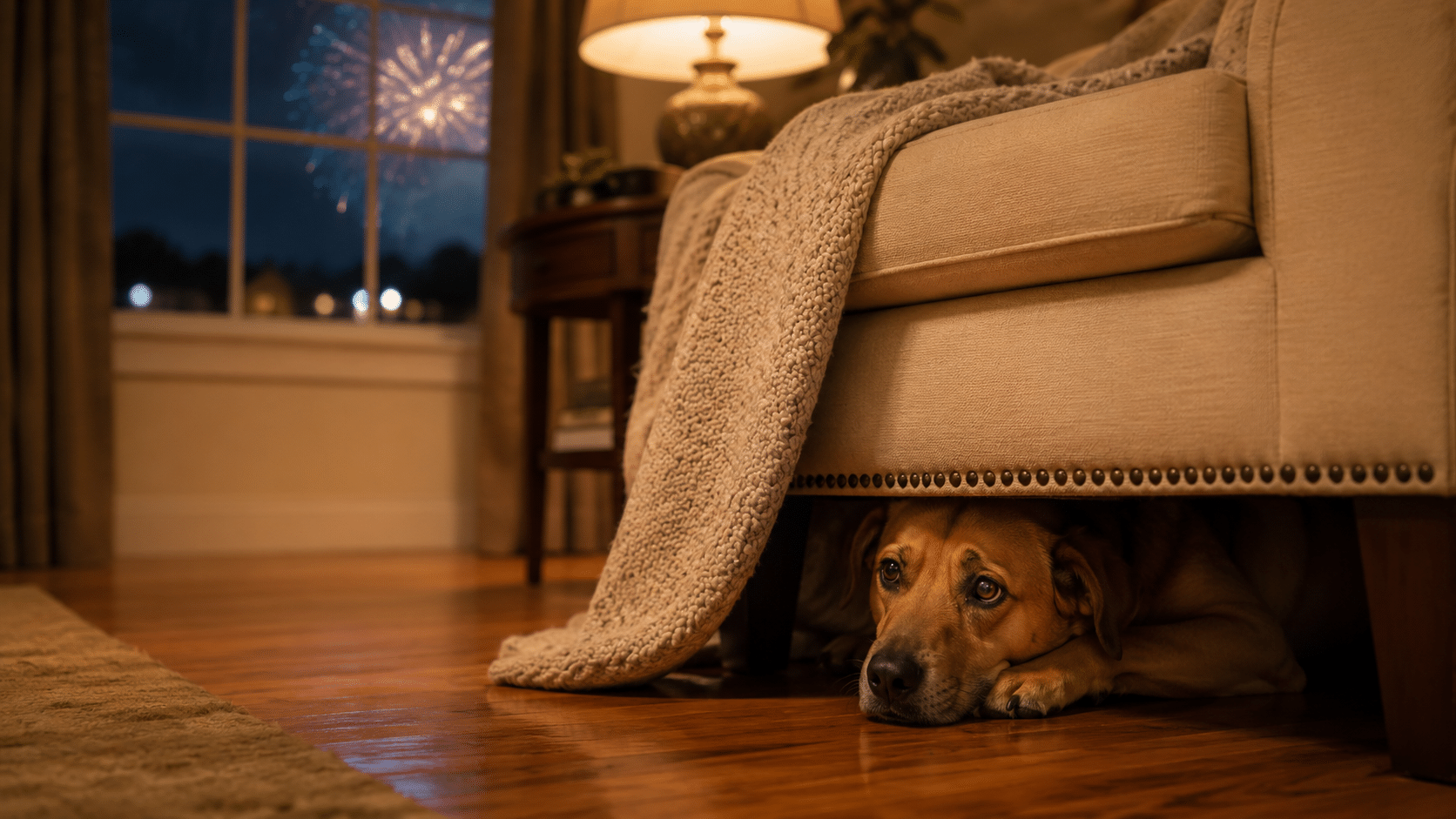
Fireworks tonight? Your five-minute plan.
If you found this page hours before the show, skip the training for now. Tonight is about safety and comfort. Do these six things, in this order.
- Secure identification. Put a current ID tag on your dog and confirm the microchip registration is up to date. The Fourth of July is the single highest-risk night of the year for lost dogs.
- Build a safe room now. Choose the most interior room you have, close the windows, draw the curtains, and turn on a fan or white noise to soften the booms. (how to set one up)
- Call your veterinarian. Ask whether a fast-acting anti-anxiety medication can still be filled today, and exactly how early to give it. (what to ask)
- Last potty break before dark. Take your dog out on a harness and leash before the first fireworks start. Once they begin, going outside becomes dangerous.
- Stay with your dog. Do not leave a frightened dog alone tonight. Your calm, steady presence is part of the treatment, not a luxury.
- Comfort freely. You cannot reinforce fear with comfort. Pet your dog, speak softly, and let them lean on you as much as they need.
For sound-sensitive dogs, the Fourth of July is an ambush
For a sound-sensitive dog, the Fourth of July is not a celebration. It is an ambush that arrives every few seconds, from nowhere, with no warning and no end in sight. This guide is the foundational article on desensitizing and counter-conditioning your dog to fireworks, the gold-standard approach for changing the emotional response that drives noise phobia.
The science is solid, the method is proven, and it starts today. If you only have days left until the Fourth, focus first on the management and safety section, then start the training protocol whenever you can. The long game changes how your dog feels. The short game keeps your dog safe through the night.
I have spent more than three decades working with fearful, anxious, and phobic dogs at Phoenix Dog Training. Noise phobia is one of the most common and most heartbreaking conditions I see. The good news is that systematic desensitization to sound is one of the most well-validated applications of behavior modification we have. You can change how your dog feels about fireworks. Real change takes time, but it is real, and it lasts.
Training and management are not the same thing
Track One: Desensitization and counter-conditioning. This rewires your dog's emotional response. Start now, continue year-round.
Track Two: Preparing your home and managing the night safely. Do this regardless of training progress, every single Fourth of July.
Want a Short Overview First?
Here's a brief podcast episode from Dog Training Today with Will Bangura that gives you a quick overview of fireworks fear in dogs. It's a high-level summary, not the deep dive. For the full protocol, the safe-room setup, the medication conversation, the myths, and the night-of plan, keep scrolling. The real work lives in the rest of this article.
Startle, anxiety, or true phobia?
Not every reaction to fireworks is a phobia. Knowing where your dog falls tells you how gently to proceed and when to call for help.
Normal startle
A flinch at the first boom, ears back for a moment, a glance toward the sound, then settles within seconds on their own. Still eats, still takes treats, still follows you around the house.
What to do: Stay relaxed and carry on normally. Toss a treat after a boom if you like. Light counter-conditioning is plenty here.
Anxiety
Pacing, panting, whining, clinginess, trembling that comes and goes. Hides but is still reachable. Slow to settle, but settles with your help. May turn down food at the worst moments.
What to do: Set up the safe room, run sound masking, comfort freely, and begin the protocol after the holiday. Ask your vet about situational medication for next time.
True phobia
Frantic escape attempts, breaking through doors or windows, relentless trembling or drooling, dilated pupils, refusing food they would normally inhale, eliminating indoors, or freezing and shutting down. Fear that does not stop when the noise does.
What to do: Treat this as a welfare emergency. Secure every exit, never leave your dog alone, get a veterinary medication plan in place, and bring in a behavior professional.
How much time do you have?
The right plan depends entirely on the calendar. Find the scenario that matches you, then follow the links into the detailed sections below.
- Skip training. Tonight is pure management.
- Run the five-minute plan: ID, safe room, vet call, final potty break before dark, stay close, comfort freely.
- Call your vet about a fast-acting medication you can give an hour before the noise starts.
- Keep your dog away from doors and windows all night.
- Build and rehearse the safe room daily so it already feels safe.
- Call your vet now. A week is enough to fill a prescription and run a quiet-day test dose.
- Begin very gentle counter-conditioning at barely audible volume, only if your dog tolerates it. Do not push.
- Confirm ID and microchip, and secure every exit and gate.
You will not cure the phobia in a week, but you can make the night dramatically safer and calmer.
- Start the desensitization and counter-conditioning protocol now, in short daily sessions.
- Thirty days is enough to make real progress for mild to moderate cases.
- Have the veterinary conversation and test-dose early.
- Build safe-room habits and secure the home well before the holiday.
- This is the ideal. You have time to change how your dog actually feels.
- Work the full protocol at your dog's pace across months, raising volume slowly and adding new recordings.
- For severe or long-standing fear, partner with a veterinary behaviorist or a qualified force-free behavior consultant.
- Keep the safe room and management as a permanent backstop, even as the training takes hold.
The printable Fourth of July checklist
Everything on this page, condensed into a quick-reference plan you can print, post on the fridge, or hand to a pet sitter. Triage, severity, escape prevention, the do-not list, the vet questions, and the day-after plan on two pages.
Download the checklist (PDF)Share it with anyone whose dog dreads the Fourth.
Why Fireworks Break Dogs
Why Fireworks Are Uniquely Terrifying

Fireworks press every button the canine threat system has. Look at what your dog actually experiences. Each explosion is loud enough to physically vibrate the chest. Each one is sudden, with no ramp-up and no warning. Each one is unpredictable, with no pattern your dog can learn to anticipate. And there is nowhere to go. The sounds come from above, from every direction, often for hours on end.
This is not a training failure. This is a predictable response from one of the oldest and most powerful systems in the mammalian brain. If you wanted to design a stimulus capable of overwhelming a dog's nervous system, you could not do much better than fireworks.
Most dogs who panic at fireworks also panic at thunder, gunshots, and other percussive sounds. The neural circuitry involved in fear responses to sudden loud noises is highly conserved across mammals, including humans. Your dog is not being dramatic. Your dog is responding the way a healthy mammalian brain responds to what registers as an existential threat.
A dog's fear of fireworks is not a training failure. It is a predictable response from one of the most ancient systems in the mammalian brain.
The Threat System at Work
When fireworks begin, the threat-detection circuitry in your dog's brain activates within milliseconds. The amygdala flags the sound as dangerous. The hypothalamic-pituitary-adrenal axis dumps cortisol and adrenaline into the bloodstream. The sympathetic nervous system prepares the body for survival action.
Heart rate spikes. Breathing becomes rapid and shallow. Muscles tense. Blood is redirected away from digestion and toward the legs. The prefrontal cortex, the thinking, problem-solving part of the brain, goes quiet so that faster reflexive systems can take over. This is the same physiological response a human has during a panic attack. It is involuntary. It is not chosen. It cannot be reasoned with.
The dog's behavior follows from this state. Panting. Pacing. Trembling. Drooling. Hiding. Trying to escape. Some dogs become destructive, chewing through doors or crashing through windows. Some dogs urinate or defecate involuntarily. Some go into a frozen, dissociated state and shut down completely. All of these are expressions of a nervous system in maximum threat response.
This is also why suppression-based methods fail. You cannot tell a dog to stop being afraid. You cannot correct a dog out of a panic state. The thinking brain has gone offline. The amygdala has taken over. Adding pain, intimidation, or aversive equipment in this state does not stop the fear. It layers additional unpleasant input on top of an already overwhelmed system, and the brain takes notes. Next year's fireworks will be worse, not better.
Behavior Begins With Emotion
Here is the single most important sentence in this entire guide. Behavior change in fearful, anxious, and phobic dogs starts with emotional change. Everything else is downstream of that.
The barking, the pacing, the trying to escape, the chewing through the bedroom door, none of those are really the problem. They are symptoms of an emotional response. Your dog's nervous system has decided fireworks predict danger, and the body is doing what evolution designed bodies to do under threat. Get loud. Look big. Get away. Hide. The behavior is the engine's exhaust. The emotion is the engine.
This is why obedience training, no matter how good, does not solve noise phobia. You can teach a dog a beautiful stay. You have not, however, changed what the dog feels when the sky starts exploding. When the boom hits, the emotion takes over. The stay falls apart. The dog you spent years training disappears, and a terrified animal is what remains.
To create lasting change, we have to work upstream of the behavior. We have to go to the emotion itself. The clinical name for what we are working with is a Conditioned Emotional Response, often shortened to CER. The CER is what your dog feels, automatically and involuntarily, the instant a trigger appears. The fireworks predict danger. The body responds before thought ever enters the picture.
The job of this protocol is to change the prediction. The trigger that currently predicts something terrible will, through patient and systematic work, predict something wonderful. When that prediction flips, the behavior takes care of itself. We are not suppressing anything. We are removing the fuel underneath it.
Severe fireworks panic? Get personalized help.
If your dog truly panics, hurts themselves, or tries to escape, you do not have to face it alone. Phoenix Dog Training helps pet parents address severe noise phobia and complex fear and anxiety cases in person throughout the greater Phoenix area and virtually worldwide.
Schedule a Consultation Or call 602-769-1411The Protocol
The Protocol Walkthrough, and the Fireworks Sounds
The method below has a name, systematic desensitization paired with counter-conditioning, and the sections that follow break down every step. The recording here is its companion, and there is nothing to watch, so press play and listen. I talk through the protocol and the steps, and the rest of it, most of its length, is fireworks sound recorded for this exact purpose. It runs over an hour, because the work is patient and the sound has to run long enough to actually train against.
Those recorded sounds are your audio source. They cover the full frequency range dogs truly react to, from the distant pops to the deep low-frequency boom that rolls in behind the crack, which is the part cheap phone-speaker clips miss entirely. Listen through once to hear the method, then come back and play the sound portion for your daily sessions.
Start far below the volume that worries your dog
Begin with the sound turned down low, low enough that your dog notices it but stays loose, keeps eating, and can still look away from the speaker. Pair every pop and boom with something your dog finds genuinely wonderful, delivered the instant the sound plays. Keep each session short, and end while your dog is still relaxed. If you see the first quiet signs of worry, a lip lick, a freeze, a turn away, the volume is too high, so lower it or stop for the day. Raise the volume across days and weeks only as fast as your dog stays comfortable, never faster. And remember, the night of the Fourth is never a training session. Save the sound work for calm days well ahead of time, and on the holiday itself focus on safety and comfort instead.
The Desensitization Protocol
The protocol for fireworks fear is the same protocol we use for any sound-based phobia. It pairs two methods that have been studied and validated for decades, and the two are inseparable in practice.
Systematic desensitization is the process of exposing the dog to the feared sound at an intensity low enough that the threat system does not fully activate. We stay just below threshold, the line where the thinking brain goes offline. The volume is low enough that the dog notices the sound but is not overwhelmed by it.
Classical counter-conditioning is the process of pairing that sound with something the dog finds wonderful. Almost always, that means high-value food. The sound used to predict danger. Repetition by repetition, the sound now predicts something good. Done correctly, the dog's emotional response actually changes.
Together, this is called DS/CC. The desensitization gives you a brain that can still learn. The counter-conditioning rewrites what that brain learns. Without desensitization, counter-conditioning has no foothold. Without counter-conditioning, you are just repeatedly exposing the dog to something scary, which can actually make it worse. This is called sensitization, and it is the trap most well-meaning pet parents fall into when they try to fix noise phobia on their own. Done apart, both fail. Done together, they change lives.
Recordings, Speakers, and Setup
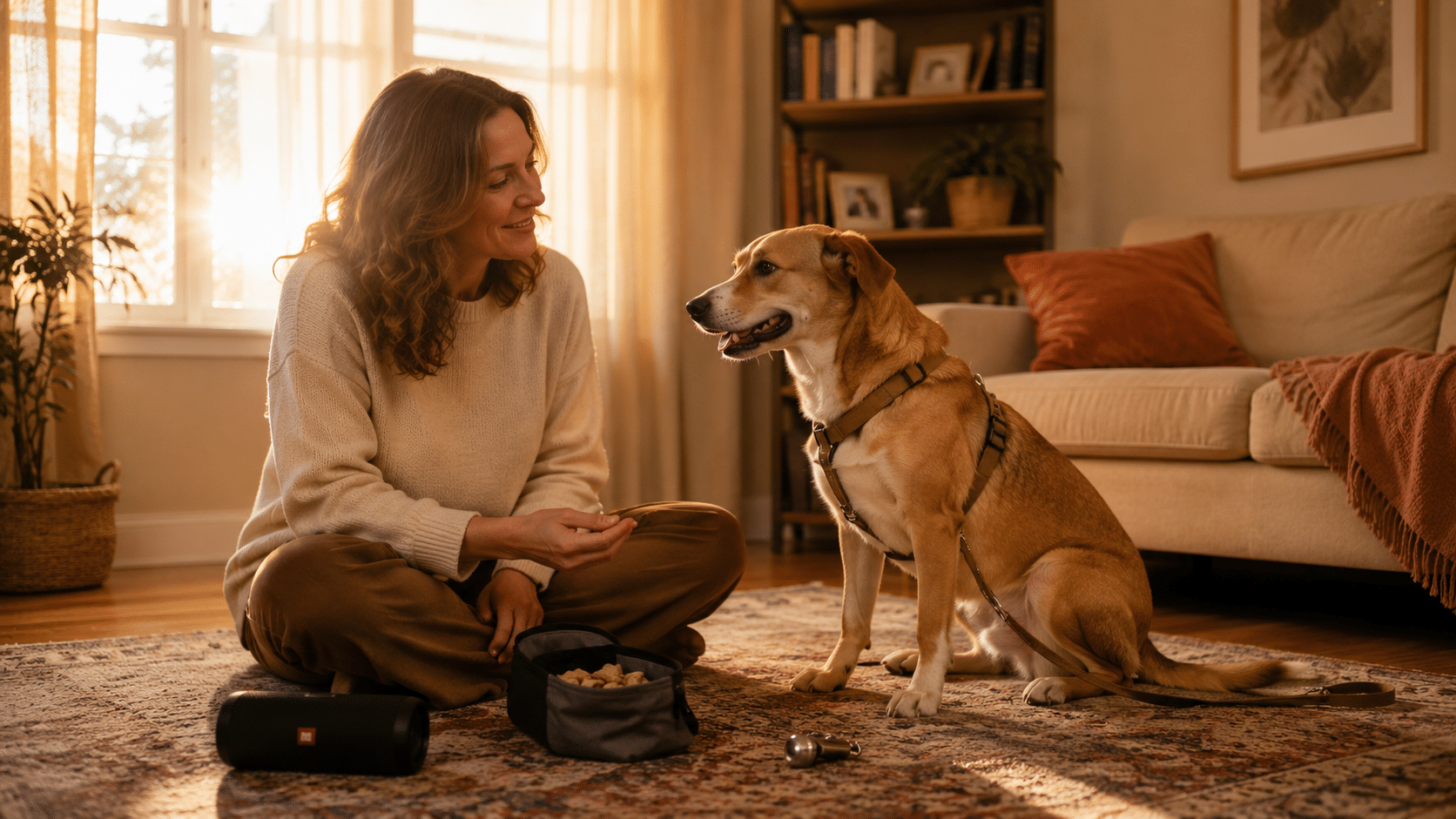
Setup matters more than pet parents realize. The quality of your recordings, the speakers you use, and the room you work in all affect whether the protocol succeeds or stalls out.
The recordings
You need high-quality recordings of the specific sound your dog fears. For fireworks, find recordings with the full frequency range, from distant pops to overhead explosions, including the deep low-frequency rumble that follows the higher-pitched crack. Cheap phone-speaker recordings of consumer-grade fireworks footage are not enough. Most of what dogs respond to in real fireworks is the low-frequency component, and tinny phone speakers do not reproduce it. I maintain a free library of trigger-sound recordings for canine desensitization work that covers the most common phobia triggers.
The speakers
Use good speakers. A decent home stereo, a quality Bluetooth speaker, or a soundbar with a real subwoofer will work. The goal is to reproduce the low-frequency content faithfully at low volume. If you only have a phone or tablet, do the work but understand that you are missing part of the trigger.
High-value food
Ordinary kibble will not cut it for this work. The food has to be something your dog finds genuinely wonderful. Small pieces of fresh-cooked chicken or turkey, soft training treats with low crumb, freeze-dried liver broken into small bits, mild cheese, or food paste in a refillable silicone squeeze tube. Save these for counter-conditioning sessions only. They are not table scraps. They are clinical-grade reinforcers, and they retain their special status only if you reserve them for the work.
A clicker or conditioned verbal marker
A marker is a brief, clear signal that tells your dog the exact instant they got it right. In counter-conditioning, the moment we are marking is your dog noticing the sound while still calm. A clicker is sharper and more consistent than your voice across days and moods. If you prefer a verbal marker, use a calm, neutral "yes" delivered the same way every time.
The room
Start in a quiet, familiar room with no distractions, no other animals, no children running through. Your dog should be relaxed before the first sound is ever played. If you can sit on the floor with the dog at your level, even better.
Find the volume where your dog still eats normally
The starting volume is whatever level lets your dog notice the sound but continue to take food calmly. For severely phobic dogs, that starting volume may be barely audible to you. That is fine. That is exactly where the work happens. If your dog refuses food, freezes, or cannot disengage from the sound, the volume is too high. Lower it. Always.
Running Counter-Conditioning Sessions
Once the equipment is ready and the dog is relaxed, the core sequence is straightforward. Burn it into memory.
Sound appears. Mark. Food. Sound stops. Food stops.
That order is not arbitrary. The sound has to come first, because the sound is the predictor. The food follows the sound, because the food is what the sound now predicts. When the sound stops, the food stops, because the sound is what makes the food happen.
Practically, here is what a session looks like. Your dog is relaxed in the room with you. You have the recording ready at a volume low enough that your dog will notice but not react. You have your clicker in one hand and a piece of high-value food in the other.
Play a single firework boom at low volume. The moment your dog's ears or eyes acknowledge the sound, click. Within a second, deliver the food. The boom is over. Wait several seconds in silence. Then play another. Click. Food. Repeat. Eight to fifteen presentations make a session. Short and frequent beats long and infrequent.
If your dog will not take food, or grabs it sharply, or cannot disengage from the sound source, you are over threshold. Lower the volume. End the session. Try again tomorrow at an easier setting.
What to watch for
- Soft body language. Loose mouth, soft eyes, normal breathing, willingness to take food gently.
- Re-engagement with you. Your dog looks at the sound, then back to you, expecting food.
- The Pavlovian tell. After enough repetitions, your dog hears the sound and immediately looks to you with happy anticipation, before you even click. This is the signal that the conditioned emotional response is flipping.
What it means if you cannot get this far
If your dog will not take food at any volume, or shows fear behaviors the instant the speaker turns on, you are dealing with severe phobia that may need professional support and possibly veterinary medication before behavior work can begin. That is not a failure. That is information about where your dog actually is.
When to Increase Volume
Going too fast is the single most reliable way to wreck the work you just did. Going too slow rarely causes problems. When in doubt, go slower than you think you need to.
The signal that your dog is ready for a small increase in volume is the Pavlovian tell. When your dog hears the sound and immediately looks to you with relaxed, happy anticipation, across multiple sessions, with clean food acceptance and soft body language, you can move the volume up by a small notch.
How small? Smaller than feels meaningful. If your stereo has a numeric volume display, move up by one or two units, not five. If your dog handles it well across the next several sessions, move up another notch. If your dog regresses, drop back to the level that worked and stay there longer.
A realistic progression for moderate noise phobia might look like this:
- Week one through two. Barely audible volume. Multiple short sessions daily. Building the basic association.
- Week three through four. Slightly higher volume. Adding a second sound clip with slightly different character.
- Week five through eight. Volume that an adult would call normal indoor listening level. Adding distance variation, where you play sounds from different speakers or rooms.
- Month three and onward. Higher volumes approaching real-world intensity. Adding novel firework recordings the dog has not heard before.
These are illustrative. Severe cases move much more slowly. Mild cases sometimes move faster. There is no prize for finishing early. The prize is a dog whose emotional life around fireworks has actually changed.
When your dog hears the sound and immediately looks to you with happy anticipation, the conditioned emotional response is flipping. That look is the most important signal in the entire process.
Generalizing from recording to real event
Here is an honest warning. The recording is not the real thing. Real fireworks include barometric pressure changes from the concussion, ground vibration, the smell of gunpowder, visual flash, and the social tension your own body produces because you know what is coming. Your dog will respond more to the real event than to the recording, even after the recording no longer triggers them. Plan for that. The recording-based work is essential foundation, but the night itself still requires the management strategies in Part Three.
The Night Itself
Building a Sound-Buffered Safe Room

Every noise-phobic dog needs a designated safe space, and the Fourth of July is the night that space matters most. Build this room before the holiday. Practice using it for low-stress activities like meals and chewing sessions so that your dog already associates it with comfort before the panic ever starts.
Choose the right room
Pick an interior room with as few exterior walls and windows as possible. Bathrooms, closets, basement rooms, or interior bedrooms work best. The more walls between your dog and the outside, the better. If you live in a small home or apartment, the bathroom is often the best option. Tile walls absorb sound oddly, but the location is usually the most insulated.
Manage what your dog hears
Close windows, draw curtains, and run sound masking. White noise machines, fans, calming music designed for anxious dogs, or any familiar background sound that runs continuously will help. The goal is to soften the contrast between silence and explosion. If your dog hears nothing for thirty seconds and then a boom, the boom is maximally jarring. If your dog hears a steady wash of fan or music, the boom is partially absorbed.
Block what your dog sees
The visual flash of fireworks is part of the trigger picture. Heavy curtains, blackout shades, or even a sheet pinned over windows can reduce this. If your dog can see the flashes, the threat picture is reinforced. If they cannot, you have removed one channel of the trigger.
Make it cozy
Set up your dog's favorite bed, a blanket they sleep on regularly, a long-lasting chew or food puzzle, and water. Soft warm lamp lighting works better than overhead lights. Some dogs prefer enclosed spaces like crates or under-the-bed nooks. Other dogs need to be near you and only feel safe with you in the room. Follow what your specific dog wants.
Practice the safe room before you need it
The Fourth of July is not the day to introduce your dog to a new space. Spend the weeks leading up to the holiday giving meals, special chews, and quiet time in the safe room so your dog already associates it with calm. By the night itself, the room should feel like a familiar refuge, not an unfamiliar restriction.
When Medication Is the Right Call
For severe noise phobia, veterinary anti-anxiety medication is not a shortcut or a cop-out. It is appropriate welfare care, and for many dogs it is the difference between getting through the night and not.
The science is clear. A dog in maximum threat response cannot learn. The amygdala has hijacked the system. The prefrontal cortex is offline. Repeated exposure to overwhelming stimuli in this state can sensitize the response, meaning each year the panic gets worse rather than better. Medication does not replace behavior modification. It makes behavior modification possible by lowering baseline anxiety enough that learning can happen.
The current veterinary standard for fireworks and noise-event anxiety is the use of specifically approved short-acting anti-anxiety medications administered before the event, not during it. There are also longer-term anxiolytic medications used as part of comprehensive treatment for dogs whose noise phobia is part of broader anxiety. Your veterinarian or a veterinary behaviorist is the right person to make these decisions. They will consider your dog's specific medical history, the severity of the phobia, other medications, and what is most appropriate.
Two practical points pet parents often miss. First, plan ahead. Talk to your veterinarian several weeks before the Fourth of July. Prescriptions need to be filled. Many medications work best when a test dose is given on a quiet day, both to confirm the dog responds well and to verify the dose. Second, give medication early. Anti-anxiety medications work best when they are on board before the fear response begins. Once the panic is full-blown, medication is far less effective. Give the medication an hour or more before fireworks typically begin in your area.
For dogs whose distress extends beyond specific noise triggers, comprehensive canine anxiety help from a qualified behavior consultant addresses the broader nervous system state that makes specific phobias worse.
Acepromazine alone is not the answer
For many years, dogs with noise phobia were sent home with acepromazine. The current veterinary consensus has shifted significantly. Acepromazine is a sedative, not an anxiolytic. It can immobilize a dog while leaving the underlying fear fully intact and possibly amplified, since the dog cannot move to seek comfort or escape. This is sometimes called a "chemical straitjacket" effect. If your veterinarian is recommending acepromazine alone, ask about current alternatives or seek a second opinion from a veterinary behaviorist.
Questions worth asking before the Fourth
If medication is part of your plan, a focused conversation with your veterinarian makes all the difference. The modern options work well, but timing and individual fit matter enormously. Bring these questions to the appointment, ideally two to four weeks ahead.
- How long before fireworks should I give this, and how long does it last? Onset varies. Sileo (the only medication FDA-approved specifically for canine noise aversion) and alprazolam are usually given thirty to sixty minutes ahead, while trazodone and gabapentin often need one to two hours. Knowing the window is everything.
- Can we do a test dose on a quiet day? A trial run on a calm day confirms your dog tolerates the medication and lets your vet fine-tune the dose, with no fireworks pressure.
- Can I give a second dose if the night runs long, and how much? Fireworks in many neighborhoods stretch over hours. Ask whether redosing is safe and what the ceiling is.
- Are there contraindications with my dog's other medications or health conditions? Heart conditions, age, and other prescriptions all shape the choice. Your vet needs the full picture.
- What do I do if the first medication does not work? Have the plan B conversation now. Some dogs need a different drug or a combination. Knowing it in advance prevents a scramble on the night.
- Is an event-only medication enough, or does my dog need daily anti-anxiety support? Dogs whose fear reaches beyond fireworks may benefit from a longer-acting medication taken daily for several weeks, used alongside the situational one.
- What does a good response look like, and what are the warning signs of a bad reaction? Know what calm-but-aware should look like, and which signs mean you should call the clinic right away.
The Night of the Fourth
Here is your night-of checklist, in the order you should do things.
Earlier in the day
- Exercise your dog well in the morning. A tired dog manages stress better than a fresh one. A long sniff walk in a familiar quiet area is ideal. Skip the dog park.
- Feed dinner early. Your dog should be neither hungry nor uncomfortably full by the time fireworks start.
- Confirm ID tags and microchip information. The Fourth of July is the single highest-risk day of the year for lost dogs. Panicked dogs jump fences, dig under gates, and break through windows. Make sure your dog is wearing a current ID tag, and verify your microchip registration is up to date.
- Take a final outdoor potty break before sunset. Once fireworks start, going outside becomes dangerous and stressful.
An hour before fireworks typically begin
- Administer prescribed anti-anxiety medication if applicable. Earlier is better than later.
- Move into the safe room. Close windows, draw curtains, turn on sound masking.
- Set up your dog's bed, chew, water, and any comfort items.
- Stay calm yourself. Your dog reads your body language continuously. Tight shoulders, held breath, and pacing transmit directly through the leash and through proximity. Calm breathing, relaxed posture, and a normal tone of voice tell your dog the situation is manageable.
During fireworks
- Stay with your dog if your dog wants you there. Many dogs feel safer in physical contact with their pet parent. Lean against them. Pet them slowly. Let them rest their head on your leg.
- Do not force interaction if your dog wants to hide. Some dogs cope by burrowing under furniture or going into a closet. Let them. Forcing a frightened dog out into the open makes things worse.
- Continue counter-conditioning if your dog can still take food. If your dog is calm enough to eat, occasional treats paired with the distant booms can continue the conditioning even on the night itself. If your dog is too overwhelmed to eat, stop trying. Eating is the threshold marker.
- Comfort your dog freely. You will read more on this in the myths section below, but the short version is this. You cannot reinforce fear with comfort. Fear is an involuntary emotional state, not a behavior you reward.
If your dog is in true panic
True panic looks like inability to settle, extreme drooling, dilated pupils, frantic attempts to escape, destructive behavior, or vocalizing with a quality you have never heard before. If this is happening, the strategies above are not enough. Sit with your dog. Stay calm. Wait it out. After the event, contact your veterinarian. This is not a dog who should go through another Fourth of July at this level of distress without a comprehensive behavior and medication plan in place.
Keeping a panicked dog from bolting
More dogs go missing on the Fourth of July than on any other day. A dog in full panic can clear a six-foot fence, shatter a window, or slip a flat collar in seconds. Treat containment as seriously as comfort.
- Leash before you open any door. Clip the leash on before a door or gate opens, every single time, even for a quick step outside.
- Use baby gates as airlocks. Place a gate between your dog and any exterior door, so there are two barriers between a bolting dog and the open night.
- Block the dog door. Lock or board over any dog door for the evening. A panicked dog will push straight through it and keep running.
- Brief your guests. Tell everyone, including children, not to open exterior doors without checking where the dog is first. Most escapes happen when someone props a door.
- Walk your fence line before dark. Check every gate latch, loose board, and dig spot. Lock gates that are normally just closed.
- Harness plus leash for the final potty break. Use a well-fitted harness, not just a collar, and keep the leash short. A frightened dog can back out of a flat collar instantly. A second person at the door is a real help.
- Layer your identification. A current ID tag, an up-to-date microchip, and, for severe cases, a GPS tracker clipped to the harness give you three separate ways to bring your dog home.
Myths That Make Things Worse
Several persistent myths about fireworks fear continue to circulate in dog training communities, and each one makes the problem worse rather than better.
"Comforting your dog rewards fear."
This is one of the most damaging pieces of advice still circulating in dog culture. It is also flatly wrong. Fear is an emotional state, not a voluntary behavior. You cannot reinforce an emotion with comfort the way you reinforce a sit with a treat. The neuroscience here is clear. The amygdala does not learn the way the operant systems do. Comforting a frightened dog by leaning into them, petting them slowly, or letting them lean on you provides exactly the calming social input mammals are wired to seek under threat. Comfort your dog. Freely.
"You just need to expose them to fireworks more."
Flooding a fearful dog with the trigger they fear, without a structured counter-conditioning protocol and sub-threshold setup, almost always produces sensitization, not recovery. The dog gets worse, not better. This is the trap. Repeated unstructured exposure is what created many noise phobias in the first place. More of the same is not the answer.
"They will grow out of it."
The opposite is true. Untreated noise phobia typically worsens with age. Each unmanaged event reinforces the conditioned emotional response. By the time pet parents come to a behavior consultant, the dog has often had eight or ten Fourth of Julys of escalation. Early intervention is dramatically easier than late intervention.
"It's just fireworks. They need to toughen up."
This framing reveals a misunderstanding of what is happening neurologically. Your dog is not weak. Your dog has a healthy mammalian threat system that is doing exactly what evolution designed it to do under a stimulus that ticks every box. Toughness is not the variable. The dog's nervous system is.
"A shock collar will fix the running."
Adding electronic stimulation, prong pressure, or any aversive correction to a dog in panic does not stop the panic. It layers additional unpleasant input on top of an already overwhelmed system, and the brain takes notes. Next year's fireworks predict pain in addition to the original fear. The aversive equipment does not solve the problem. It deepens it, and it can damage your dog's trust in you in the process. Force-free, evidence-based behavior modification is not the soft choice. It is the effective choice.
What not to do during fireworks
Good intentions can backfire on the night itself. Steer clear of these, every time.
- Do not crate a dog who panics in a crate. For some dogs a crate is a den. For a dog who panics in confinement, a closed crate becomes a trap that can cause real injury. Use an open safe room instead.
- Do not force your dog outside. A frightened dog dragged into the open learns that the outdoors is dangerous, and is at the highest risk of bolting.
- Do not scold or punish the fear. Barking, pacing, and trembling are symptoms of panic, not disobedience. Correction simply adds fear on top of fear.
- Do not reach for an aversive tool. A shock, prong, or choke correction layered onto panic does not stop the panic. It teaches your dog that fireworks now predict pain too, and next year is worse.
- Do not leave a panicking dog alone. Isolation intensifies fear and raises the odds of a destructive escape attempt. Stay with them.
- Do not start sound training during active fireworks. Real fireworks are far over threshold. Trying to train through them sensitizes the fear. Save the protocol for controlled, low-volume sessions.
Helping your dog recover
Stress hormones do not vanish when the last firework fades. Cortisol can stay elevated for hours, sometimes into the next day. Give your dog a low-demand recovery window.
- Keep the day quiet. No big outings, no visitors, no training drills. Let the nervous system come back down on its own time.
- Offer a calm sniff walk. A relaxed walk in a familiar, quiet place lets your dog decompress through their nose, which is genuinely calming. Skip busy areas and the dog park.
- Do not ask for much. Avoid demanding obedience or anything frustrating for a day or two. A stressed brain learns poorly and frustrates easily.
- Watch appetite and elimination. A skipped meal or a loose stool the next morning is common after a hard night. If it lingers beyond a day, call your vet.
- Watch for lingering or spreading fear. Notice whether the fear is bleeding into new triggers, like distant traffic or a closing door. Generalization is a signal to get help sooner rather than later.
- Write down what happened. Record the date, how severe it was, when it started and stopped, and what helped. This record is gold for your vet or behavior consultant, and for planning next year.
- Reach out if there was true panic. If your dog hurt themselves, tried to escape, eliminated indoors, or shut down, do not wait for next June. Contact a behavior professional now, while the night is still fresh.
When to Bring In Professional Help
Some fireworks fear cases need professional support, and pride is not a treatment plan. Reach out for help if any of the following describe your dog.
- Your dog has hurt themselves trying to escape, including breaking through windows, chewing through doors, or running into traffic.
- Your dog has eliminated indoors during fireworks despite being house-trained.
- Your dog enters a frozen or dissociated state and stops responding to you.
- Your dog's panic extends well beyond the actual fireworks, sometimes for hours or into the following day.
- Your dog's fear has generalized to other sounds, like distant traffic, doors slamming, or wind, that did not used to trigger them.
- You have tried recordings and management and have seen no real progress over multiple sessions.
The right professional partner for severe noise phobia is either a qualified force-free behavior consultant or, ideally, a veterinary behaviorist (a Diplomate of the American College of Veterinary Behaviorists, or DACVB). Veterinary behaviorists are board-certified veterinary specialists who can diagnose anxiety disorders, prescribe behavioral medication, and coordinate behavior modification protocols with medical rigor. For severe cases, this is the gold standard. Phoenix Dog Training behavior consultations work directly with veterinary behaviorists when medical management is part of the picture.
Look for credentials that mean something: CAB-ICB through International Canine Behaviorists, CBCC-KA or CPDT-KA through the Certification Council for Professional Dog Trainers, ACAAB or CAAB through the Animal Behavior Society, or DACVB. Avoid anyone who promises fast fixes for behavior problems or uses electronic collars, prong collars, or any tool that delivers an unpleasant consequence. Avoid language about dominance, alpha, or showing the dog who is boss. None of that applies to noise phobia, and trainers who use that framework rarely understand the neuroscience involved.
Your dog deserves better than a tradition that does not understand what is happening inside their nervous system.
Ready for the last Fourth of July like this?
If your dog truly suffers through fireworks every year, this can change. Phoenix Dog Training builds individualized behavior plans for severe noise phobia and complex fear cases, in-home throughout the Phoenix metro area and virtually worldwide.
Schedule a Consultation Or call 602-769-1411Frequently Asked Questions
How far in advance should I start preparing my dog for fireworks?
The earlier the better. Thirty days is enough to make meaningful progress for mild to moderate cases, but severe noise phobia usually needs several months of consistent work. Starting now is always better than not starting. If the Fourth is days away, shift your focus to management, the safe room, and a veterinary consultation about medication.
My dog is already terrified and the Fourth is days away. What do I do?
Focus on management and safety. Set up a sound-buffered safe room, secure every exit and gate, confirm ID tags and microchip registration, and talk to your veterinarian about anti-anxiety medication. Comfort your dog freely during the event. Start the counter-conditioning protocol after the holiday for next year.
Will comforting my dog during fireworks reinforce the fear?
No. This is one of the most persistent and damaging myths in dog culture. Fear is an involuntary emotional state, not a voluntary behavior. You cannot reinforce an emotion with comfort. Petting, leaning against, or staying close to a frightened dog provides exactly the calming social input mammals are wired to seek under threat. Comfort your dog freely.
Should I give my dog medication for fireworks?
That is a decision for your veterinarian or a veterinary behaviorist. For dogs whose fear rises to panic, medication is often appropriate welfare care, not a shortcut. Modern veterinary anxiolytics, given before the event begins, can dramatically reduce suffering and make learning possible. Acepromazine alone is no longer the standard recommendation. Talk to your veterinarian several weeks in advance so prescriptions can be filled and a test dose can be given on a quiet day.
What kind of recordings should I use for desensitization?
Use high-quality recordings that include the full frequency range of real fireworks, from sharp pops to deep low-frequency rumble. Cheap phone-speaker recordings are not enough. Most of what dogs respond to is the low-frequency component, which tinny speakers cannot reproduce. The free sound library at Phoenix Dog Training covers the most common phobia triggers and is designed specifically for counter-conditioning work.
How do I know if my dog has a true phobia versus normal nervousness?
True phobia involves panic, not nervousness. Signs include trembling that does not stop, drooling beyond normal, dilated pupils, hiding or attempts to escape, destructive behavior, vocalizing in a quality you have never heard, refusing food in situations where they would normally eat, and elimination indoors. A nervous dog may startle and recover. A phobic dog cannot recover until the trigger ends, and sometimes not even then.
Can older dogs be desensitized to fireworks?
Yes. The brain remains plastic throughout life. Older dogs can absolutely change their conditioned emotional responses through counter-conditioning. Severe long-standing phobias may move more slowly than newly developed ones, and medication is more often part of the plan, but real change is possible at any age.
What about anxiety wraps and pheromone products?
Anxiety wraps like the Thundershirt help some dogs and not others. Research findings are mixed. They are inexpensive, low-risk, and worth trying. Dog appeasing pheromone products, often sold as Adaptil or similar, also help some dogs and not others. Both can be useful additions to a comprehensive plan but neither replaces counter-conditioning or, where appropriate, medication.
This article is for educational purposes and does not replace veterinary or behavioral consultation for your specific dog. For severe noise phobia or behavior that has escalated despite home efforts, contact Phoenix Dog Training to schedule a behavior consultation with Will Bangura. Always consult your veterinarian about your dog's health and any medication.