
Canine Behavior · Pet Parent Education
The Truth About Board and Train
Why sending your dog away rarely fixes the real problem, what those two-week transformations are actually doing, and what creates change that lasts.
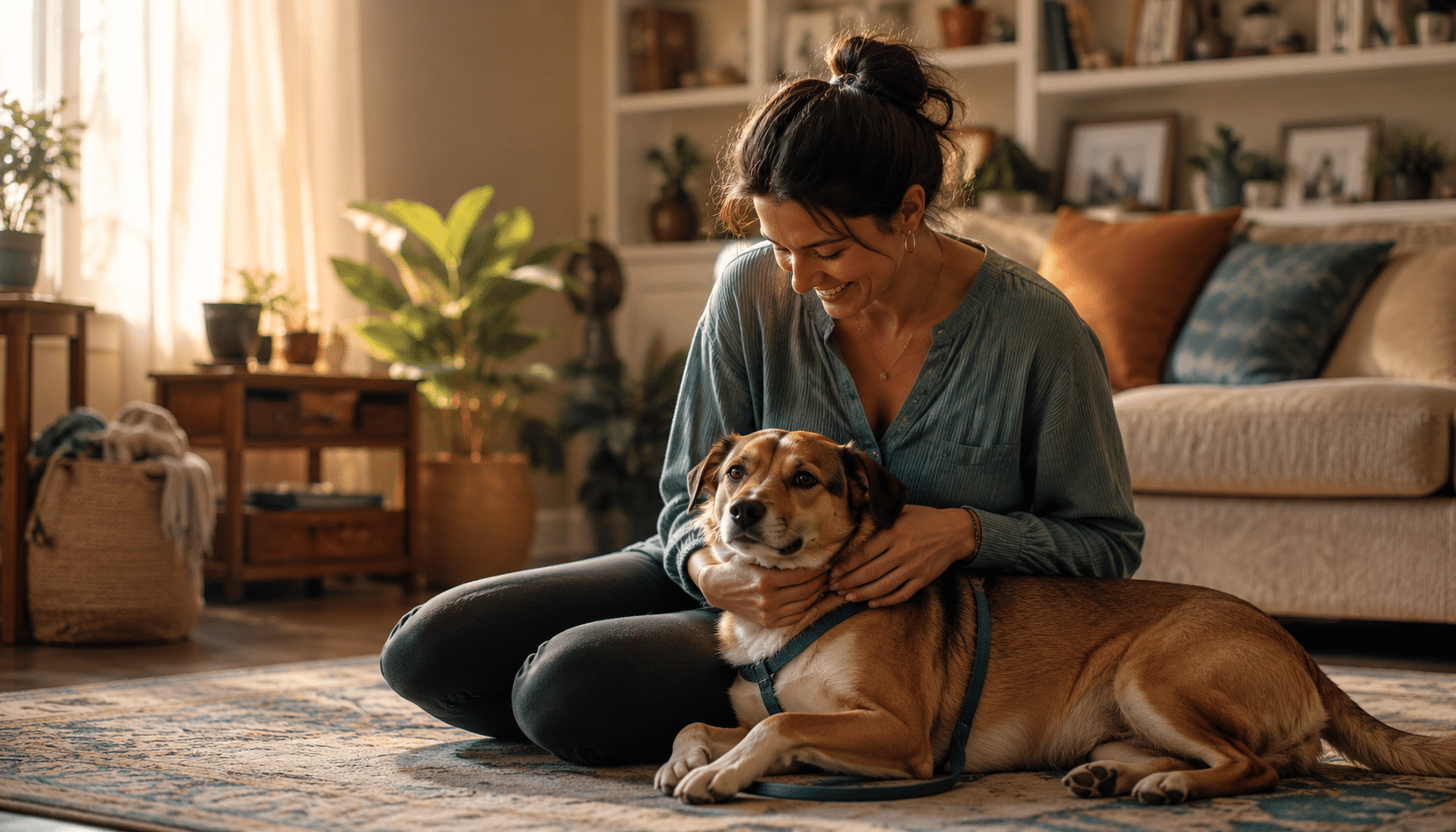
It usually starts late at night. The house is finally quiet, the dog is asleep, and you are on your phone again, reading one more article, watching one more video, searching for the thing that will finally work. You have tried the group class. You have tried the advice from the neighbor, the breeder, the trainer at the pet store, the loudest voice in the Facebook group. You are worn down by frustration and bitten by guilt, and somewhere underneath all of it is a quieter fear you do not say out loud: that this might simply be who your dog is.
Then you find it. A program that promises to take the problem off your hands. Drop your dog off for two weeks, maybe three, maybe four, and pick up a different animal. Calm. Obedient. Fixed.
I want to be honest with you, because you deserve honesty more than reassurance. I understand the appeal completely. After more than thirty-five years of working with dogs who bark, lunge, growl, snap, panic, and unravel daily life for the families who love them, I have sat across from thousands of pet parents at exactly the moment you are in right now. The promise of board and train is not seductive because you are lazy, or because you do not love your dog. It is seductive because you are exhausted, and because someone finally said the words you have been desperate to hear: let me handle it.
So let me tell you what I have learned about that promise. Not to shame anyone who has considered it or used it, but because the decision to send your dog away touches the three things that matter most: your dog's welfare, your relationship with your dog, and whether the problem actually gets solved or simply goes underground for a while.
The misconceptionThe most important student was never the dog
Here is the single biggest misconception in all of dog training, and it quietly shapes nearly every board and train decision: the belief that the dog is the one who needs the training.
I know how that sounds, so let me be clear that it is not a criticism. It is arithmetic. Your dog might spend two weeks with a trainer. Maybe three. Maybe four. But your dog is going to spend the next ten, twelve, fifteen years living with you. Not with the trainer. With you.
You are the one who will be holding the leash when another dog rounds the corner. You are the one in the room when a guest reaches down too fast. You are the one who has to read the situation, recognize the early flickers of stress, and know what to do before things escalate. Those are not skills a trainer can install in your dog and ship home. They are skills you build, and once you have them, they do not just solve today's problem. They carry you through every challenge that comes after it.
This is the part almost no one tells you. The most valuable thing that comes out of working with a good behavior professional is not what the dog learns. It is what the pet parent learns. When you start to understand behavior, the whole picture changes. You notice the lip lick before the lunge. You feel the shift in your dog's body before the growl. You stop reacting to symptoms and start preventing them. That knowledge stays useful for the entire life of the dog.
Board and train, by its very design, removes you from that education. And the usual remedy, a transfer lesson or two once the dog comes home, does not close the gap. Think about what actually happened during those weeks away. Your dog received training. You received a demonstration. Those are not the same thing, and your dog will spend the next decade living with the difference.

The distinction that explains everythingObedience training is not behavior modification
To understand why two weeks away so rarely produces lasting change, you have to understand a distinction the industry blurs constantly. It may be the most important idea in this entire article, so I am going to say it plainly.
Obedience training is not behavior modification.
Teaching a dog to sit is obedience training. Teaching a dog to stay is obedience training. Teaching a dog to walk on a loose leash, to lie down, to come when called, all of that is obedience training. These are behaviors. They are skills layered onto a dog who is, underneath, emotionally okay.
Behavior modification is something else entirely. It is the work of changing how a dog feels. And here is why that matters so much: aggression is not an obedience problem. Reactivity is not an obedience problem. Fear, anxiety, panic, and compulsive behaviors are not obedience problems. They are emotional problems.
The barking, the lunging, the growling, the snapping, the pacing, the whining, the destruction when left alone, none of that is the problem. It is the symptom of the problem. It is the visible surface of an emotional state running underneath.
Think of a fever. The fever is not the illness. The fever is the body's signal that something deeper is wrong. If you bring the fever down but never treat the infection, you have not made the person well. You have only hidden the evidence. Behavior works the same way. The reactive dog is not choosing to bark and lunge for sport. The anxious dog is not choosing to panic. The aggressive dog is not choosing to feel cornered, conflicted, and afraid. The behavior is what spills out when the emotion has nowhere else to go.
And emotions cannot be drilled away in a fortnight. They change slowly, through carefully arranged experiences that teach the dog, at a level beneath conscious choice, that the thing he feared is safe after all. That process takes time. It takes patience. It takes consistency. And it takes the people the dog actually lives with.
The timelineWhy two weeks should make you nervous
Whenever I evaluate a training program or a bold claim, the very first question I ask is almost embarrassingly simple: how long is this supposed to take?
If someone tells me they can resolve serious aggression, intense reactivity, deep fear, the kind of dog anxiety that never lets a dog settle in his own home, or true dog separation anxiety in two weeks, an alarm goes off. Not because I doubt the trainer's sincerity, but because I understand what emotional change actually requires. The nervous system does not rewrite a fear in fourteen days because a dog spent those days somewhere new. Fear loosens its grip through repetition and predictability, through many small experiences that quietly contradict the dog's expectation of danger. There are no shortcuts to that. There is only the work, done well, over time.
So when a timeline sounds too fast for the problem it claims to fix, it is worth asking what is being changed in those two weeks. Because if the emotion underneath cannot be changed that quickly, and it cannot, then something else is being changed instead. Usually it is the behavior on the surface. And that brings us to the uncomfortable mechanics of how fast results actually get made.
The mechanicsWhen speed becomes the priority, punishment becomes the tool
Here is where many board and train programs run into real trouble, and it is less about bad people than about bad incentives.
The pressure is enormous. Families are paying significant money. The facility has a fixed, short window. Results have to be visible by pickup day, because a calm dog at the end of two weeks is what gets recommended to the next family. And when speed becomes the priority, punishment becomes the tool.
Let me say that again, because it is the hinge of this whole conversation. When speed becomes the priority, punishment becomes the tool. Not always. But far more often than the marketing admits. Electronic collars. Prong collars. Sharp leash corrections. Flooding a frightened dog with the very thing he fears. Intimidation. Compulsion. Why do these methods surface under time pressure? Because they are fast, at least on the surface.
If you punish barking hard enough, the barking can stop. If you punish lunging hard enough, the lunging can stop. If you punish growling hard enough, the growling can stop. The behavior goes quiet, the dog looks transformed, and everyone exhales.
But stopping a behavior and changing an emotion are not the same thing. A dog can stop growling and still be terrified. A dog can stop barking and still be flooded with anxiety. A dog can stop reacting and still be drowning in stress. The feeling has not gone anywhere. The dog has simply learned that showing the feeling now carries a consequence. That is not behavior modification. That is behavior suppression, and the gap between the two is the gap between a problem solved and a problem hidden.
What the research actually shows
This is not my opinion alone. It is one of the most consistent findings in the entire body of research on dog training, and it converges from many directions at once.
In a study of dogs already showing problem behaviors, confrontational techniques such as the alpha roll, the stare-down, and physically forcing a dog into submission each provoked an aggressive response from roughly a quarter of the dogs they were used on.1 A review of the broader literature concluded that aversive methods, the umbrella term for training built on positive punishment and escape-avoidance, can jeopardize both the physical and the mental health of dogs, with no evidence they work any better than reward-based methods.2
In a controlled comparison, dogs trained without electronic collars did at least as well as those trained with them, leading the researchers to conclude there was no evidence the e-collar was even necessary.3,4 And when scientists measured stress directly, dogs trained with aversive methods showed more stress-related behavior, higher cortisol, and a more pessimistic outlook on a cognitive test, evidence that the harm reached beyond the training session and into the dog's general emotional life.5
Different countries. Different researchers. Different methods, from surveys to controlled trials to hormone assays to tests of mood. They keep arriving at the same place. The fast route works by making the dog feel worse, not better.
The hidden dangerA quiet dog is not always a safe dog
There is one consequence of suppression that worries me more than any other, and it is the reason I am willing to be this direct. With aggression, suppression does not just fail to solve the problem. It can make the dog more dangerous.
To see why, you have to understand what a dog's warning signals are actually for. Long before most dogs ever bite, they tell us they are uncomfortable. They look away. They lick their lips. They yawn when nothing is tiring. They go still and stiff. They show the whites of their eyes. They growl. We tend to treat these as bad behavior, but they are not behavior to be eliminated. They are communication. They are a dog saying, as clearly as a dog can, please, I am not okay with this, give me space.
Now think about what happens when a program punishes those signals away. The dog learns that growling brings pain or fear, so the growl disappears. The lip lick disappears. The freeze gets shorter. From the outside, the dog looks calmer, even cured. But nothing has changed underneath. The fear is still there. The conflict is still there. All we have done is sever the warning system from the emotion that was driving it.
We have not made the dog safer. In many cases we have made the dog more dangerous, because we have taught him that the early warnings do not work, while leaving every reason for the aggression fully intact. A dog who has learned that growling gets punished does not stop feeling threatened. He just stops announcing it. And a dog who goes straight from calm to bite, with the warning stages trained out of him, is far more frightening to live with than the dog who growled. This is one reason fear-based aggression toward people responds so poorly to intimidation: the fear underneath is still there, only now without a warning attached to it.
This is why I care so much about how a dog gets to quiet. Quiet that comes from feeling safe is the goal. Quiet that comes from being afraid to speak is a loaded situation wearing the costume of success.

Learning to listen
The signals a dog usually gives long before a bite. These are not misbehavior. They are your dog asking for space.
- Looking away or turning the head, breaking eye contact to defuse the situation
- Lip licking and yawning when there is no food and the dog is not tired
- A hard freeze, the body going still and tense for a beat
- "Whale eye," the whites of the eyes showing as the head stays fixed
- A low growl or a lifted lip, the clearest request to stop that a dog has
The relapseThe pattern you can almost set your watch to
If suppression were stable, this would be a smaller concern. It is not. And the pattern is so familiar that I can often finish the story before the pet parent does.
The call goes like this. The dog went away to a board and train. He came home looking like a different animal. The barking was gone. The lunging was gone. The reactivity seemed to have evaporated. The family was thrilled, and relieved, and finally hopeful. And then, somewhere around two weeks later, or a month, or two months, it began to come back. Sometimes a little at a time. Sometimes all at once. And often, it came back worse than before.
The reason is exactly what we have been building toward. The behavior was suppressed; the emotion was never addressed. Suppression is a lid, not a cure, and pressure held down does not disappear. It waits. As the dog returns to his real life, his familiar triggers, his ordinary routines, the lid slips, and the original problem surfaces again, having gained nothing in the meantime except, sometimes, a fresh lesson that the warning signs are not safe to use.
Lasting behavior change requires lasting emotional change. There is no version of this where the feeling stays the same but the behavior stays gone.
The blind spotWhat you cannot see
There is one more concern with board and train, and it has nothing to do with methods or timelines. It has to do with what you are not there to see.
When you work alongside a behavior professional, you are present. You watch what is done to your dog. You ask why. You see the technique, you feel your own reaction to it, and you decide, in real time, whether it is something you are comfortable with. That transparency is its own form of protection.
Board and train removes it. Your dog is somewhere else, often for weeks. You are not in the room for the sessions. You are not watching the corrections. You are trusting someone you may barely know to make moment-to-moment decisions about your dog, out of your sight, under exactly the time pressure we just discussed.
I want to be fair here, because most trainers are good people who genuinely love dogs. But I would not be honest if I left this out: some of the most disturbing abuse cases this industry has ever seen have come out of board and train facilities. Every year there are stories of dogs neglected, frightened, injured, or worse while enrolled in a program. I am not telling you that every facility is dangerous. I am telling you that a lack of transparency creates risk, and that risk deserves a place in your decision. When you cannot see, you cannot truly consent. You can only hope.
In fairnessSo is there ever a place for board and train?
After all of that, you might expect me to say board and train should never happen. I will not, because it would not be true, and you have not read this far for slogans.
There are real situations where it makes sense. A pet parent with a significant physical disability that makes hands-on training impossible. Someone facing a serious illness, or a stretch of life so disrupted that direct involvement simply cannot happen. Certain specialized sport or performance goals, where the work is genuine skill-building rather than emotional healing, can also be a reasonable fit. In those cases board and train can be a sensible tool, and even then, the education and transfer of skills to the humans should stay at the center, not get bolted on at the end.
But these are the exceptions, and it is worth being honest about how narrow they are. For the great majority of pet parents, and especially for those facing aggression, reactivity, fear, anxiety, or separation anxiety, the best outcomes come from being in it, not from handing it off.
The path that worksWhat real change looks like, and why it lasts
So if not two weeks away, then what? Here, in plain terms, is what real behavior modification for aggression and reactivity actually looks like, and why it holds.
It begins with understanding the dog rather than correcting him. A thorough history. A careful look at the antecedents and consequences around the behavior, the specific situations that set it off and the things that follow it. An honest consideration of medical contributors, because pain and illness drive far more behavior than most people realize. From there, the first job is not training at all. It is management: arranging the dog's world so he stops rehearsing the behavior we are trying to change, because every repetition makes it stronger.
Then comes the skill-building, teaching the dog what to do instead, giving him a different response that genuinely works for him, building focus and the capacity to stay calm. For a reactive dog who barks and lunges on leash, that often means teaching him to turn and check in with you instead of erupting at the trigger. And running underneath all of it is the real engine of change: systematic desensitization and counterconditioning. That is the patient, gradual work of exposing the dog to his triggers at an intensity low enough that he never tips into fear, and pairing those triggers with good things, again and again, until the trigger itself begins to predict safety instead of threat. We keep him under threshold. We move at the speed of his nervous system, not our calendar. We raise the difficulty only when he is ready, with clear criteria for what ready means.
It is rarely dramatic. There is no pickup-day reveal. It is gradual, and sometimes slow, and that is exactly why it lasts: because it changes the cause, not the symptom. And the person learning to do all of this, learning to read the dog, manage the environment, time the reinforcement, and recognize progress, is you. That is not a burden. That is the entire point. It is how you become the one person your dog needs you to be for the next fifteen years.

If you remember one thingYou cannot outsource a relationship
If you take only one thing from all of this, let it be this.
Training is not something that gets done to a dog. It is something a dog and a pet parent learn together. The goal was never simply to stop a behavior. The goal is to understand it. The goal is not obedience for its own sake. It is a dog who feels safe enough that the hard behaviors fade, because the fear behind them has faded. It is not a quick fix. It is change that is durable because it is real.
And that kind of change is built, not bought. It comes from education, patience, consistency, and a willingness to look underneath the behavior at the dog who is struggling. You can outsource a sit. You can outsource a stay. You cannot outsource a relationship, and at the end of the day, the relationship is the thing that heals the dog.
Your dog does not need to be sent away to become who you hoped he could be. He needs you to understand him. That is harder than dropping him off. It is also the only thing that works.
Common questionsWhat pet parents ask me about board and train
Q.Are board and train programs bad?
Not automatically, and not all of them. The honest answer is that board and train is usually the wrong tool for emotional behavior problems, the aggression, reactivity, fear, anxiety, and separation anxiety that make up the bulk of the cases I see. The structure of the model creates time pressure, removes the pet parent from the learning, and reduces transparency. For a narrow set of situations it can be reasonable. For the problems most families are trying to solve, it tends to suppress symptoms rather than change the underlying emotion.
Q.Can aggression be fixed with a board and train?
Aggression can be suppressed quickly. It cannot be resolved quickly. Aggression is almost always rooted in fear, conflict, frustration, or pain, and changing those emotional states takes time and the involvement of the people the dog lives with. A program that makes aggression disappear in two weeks has usually muted the warning signals without touching the cause, which can leave you with a dog that bites without the growl that used to precede it. Real aggression work means assessment, management, safety planning, and behavior modification over time, which is the foundation of how I approach aggressive dog training in Phoenix.
Q.Do board and train programs use shock collars and prong collars?
Many do, though practices vary widely and not every facility discloses its methods up front. The reason aversive tools show up so often in this model is speed: when results have to be visible by pickup day, punishment is the fastest way to make a behavior go quiet. If you are considering any program, ask directly and specifically what equipment and techniques will be used on your dog, and treat vague or evasive answers as an answer in themselves.
Q.My dog came back from board and train much better. Why would it come back?
Because, in many cases, the behavior was suppressed rather than the emotion changed. Suppression is a lid on a feeling, and lids slip. As your dog settles back into his real life, with all his familiar triggers and routines, the original emotional state resurfaces, and the behavior usually comes with it, sometimes weeks later, sometimes months, and sometimes more intensely than before. If the improvement was real and emotional, it lasts. If it was surface compliance under pressure, it tends not to.
Q.How long does real behavior modification take?
It depends on the dog, the problem, its history, and how consistently the plan is carried out at home. What I can tell you is that meaningful emotional change is measured in weeks and months, not days. That is not a flaw in the process. It is the process. We are reshaping how a dog feels, and feelings do not turn on a calendar. The upside is that change built this way is durable, because it addresses the cause.
Q.What should I do instead?
Work with a qualified behavior professional in a format where you are an active participant, in-home or virtual, so that you are learning alongside your dog. The goal is for you to walk away able to read your dog, manage his environment, and run the behavior plan yourself. That is the difference between renting a temporary result and owning a lasting one. If you are in the Phoenix area and dealing with aggression, reactivity, fear, anxiety, or separation anxiety, that is exactly the work I do, in-home and online, through one-on-one dog behavior consultations.

About the Author
Will Bangura, M.S., CAB-ICB, CBCC-KA, CPDT-KA, FFCP, is a Clinical Animal Behaviorist and Certified Canine Behaviorist, published author, expert witness, and founder of Phoenix Dog Training®. He is one of only three Clinical Animal Behaviorists in the United States and the only Clinical Animal Behaviorist in Arizona. Will is also certified and accredited as a Certified Canine Behaviorist through International Canine Behaviourists.
With more than 35 years of professional experience, Will specializes in severe dog aggression training in Phoenix, leash reactivity, fear-based behavior, anxiety disorders, phobias, separation anxiety, obsessive-compulsive behaviors, resource guarding, intra-dog aggression, and complex canine behavior cases involving emotional dysregulation, chronic stress, maladaptive learning, and underlying medical or environmental contributors.
Will has helped thousands of dogs and pet parents throughout Phoenix, Arizona, across the United States, and internationally through both in-home and virtual behavior consultations. His work focuses on identifying and changing the underlying emotional, neurological, environmental, and behavioral drivers of behavior rather than merely suppressing outward symptoms. Drawing from behavioral psychology, applied ethology, affective neuroscience, canine cognition, learning theory, stress physiology, and applied behavior analysis, Will integrates modern interdisciplinary science into humane, practical behavior modification programs designed to create long-term emotional and behavioral change.
Will holds a Master of Science degree in Behavioral Psychology and has completed advanced coursework in canine cognition and behavioral science. He is certified in Applied Ethology through Kim Brophy's Family Dog Mediation® LEGS® Applied Ethology program and also holds the CBCC-KA and CPDT-KA credentials through the Certification Council for Professional Dog Trainers. He is also a Fear Free Certified Professional.
Will is the author of multiple books and more than 100 published articles on canine behavior, aggression, anxiety, learning theory, and behavior modification. He is the host of Dog Training Today and previously hosted Pet Talk Today on 1100 KFYI in Phoenix. He has also served as an expert witness and consultant in dog bite and canine behavior cases.
His work emphasizes compassionate, science-based behavior modification that prioritizes emotional safety, trust, resilience, predictability, and long-term behavioral wellness without fear, intimidation, pain, shock collars, prong collars, or choke collars.
To learn more or get help, visit Will Bangura's biography or schedule a dog behavior consultation.
Have a dog you are worried about? Call 602-769-1411 or book a behavior consultation.
References
- Herron, M. E., Shofer, F. S., & Reisner, I. R. (2009). Survey of the use and outcome of confrontational and non-confrontational training methods in client-owned dogs showing undesired behaviors. Applied Animal Behaviour Science, 117(1-2), 47-54. https://doi.org/10.1016/j.applanim.2008.12.011
- Ziv, G. (2017). The effects of using aversive training methods in dogs: A review. Journal of Veterinary Behavior, 19, 50-60. https://doi.org/10.1016/j.jveb.2017.02.004
- China, L., Mills, D. S., & Cooper, J. J. (2020). Efficacy of dog training with and without remote electronic collars vs. a focus on positive reinforcement. Frontiers in Veterinary Science, 7, 508. https://doi.org/10.3389/fvets.2020.00508
- Cooper, J. J., Cracknell, N., Hardiman, J., Wright, H., & Mills, D. (2014). The welfare consequences and efficacy of training pet dogs with remote electronic training collars in comparison to reward-based training. PLOS ONE, 9(9), e102722. https://doi.org/10.1371/journal.pone.0102722
- Vieira de Castro, A. C., Fuchs, D., Morello, G. M., Pastur, S., de Sousa, L., & Olsson, I. A. S. (2020). Does training method matter? Evidence for the negative impact of aversive-based methods on companion dog welfare. PLOS ONE, 15(12), e0225023. https://doi.org/10.1371/journal.pone.0225023
This article is educational and is not a substitute for an individualized behavior assessment. Aggression and severe behavior cases can involve safety risk and are best addressed with a qualified professional.