Fear-Based Dog Aggression: Early Warning Signs Most Owners Miss
Fear is the most powerful driver of canine behavior. Learn to read the signals long before a bite ever happens.
By Will Bangura·Behavior & Training·Updated May 14, 2026·12 min read
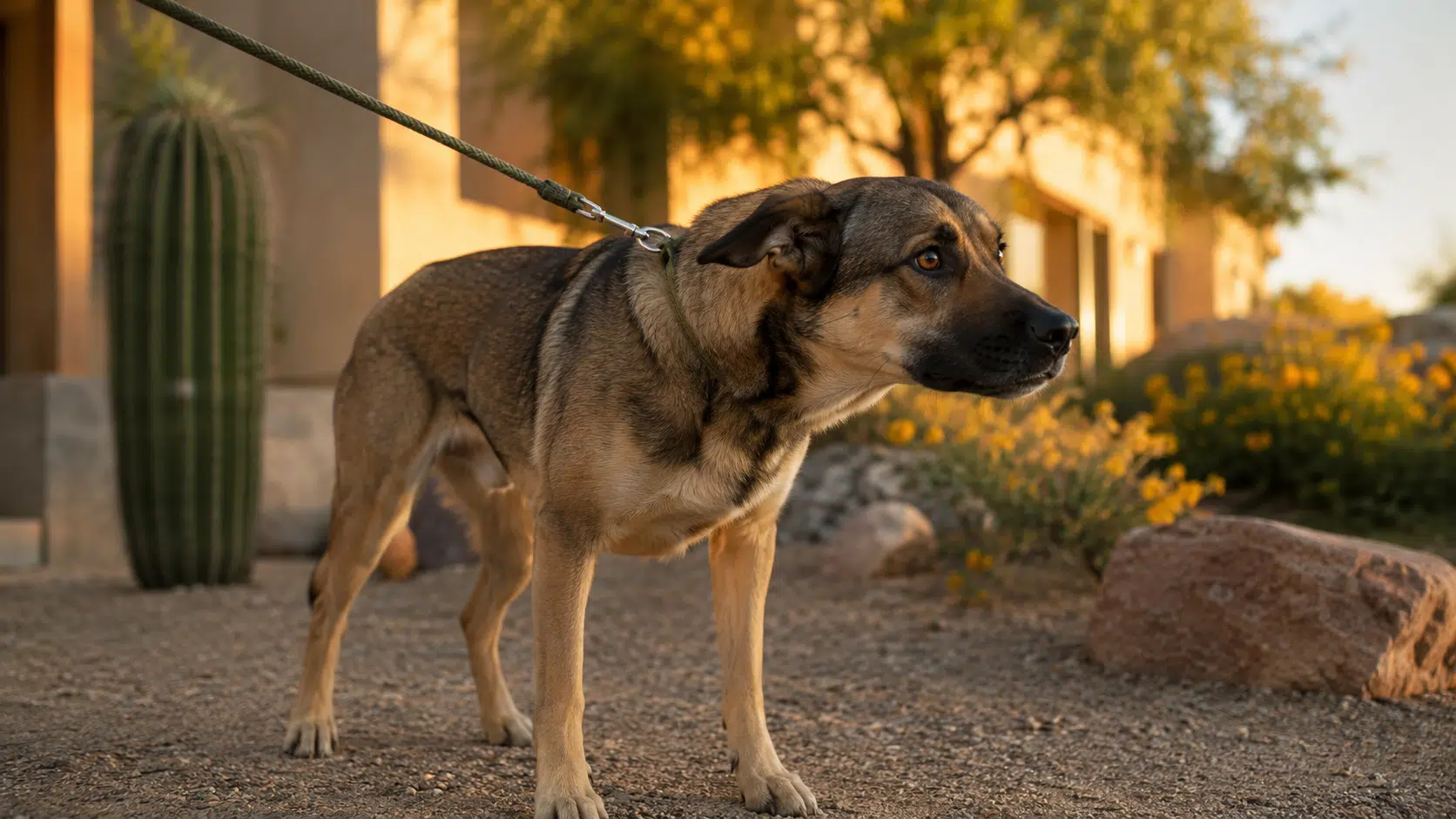
Fear-based defensive body language in a Phoenix residential front yard.Introduction
Why fear is the most powerful driver of canine behavior
Fear is the most powerful driver of canine behavior. When a dog feels threatened and cannot escape, the body shifts into a defensive state designed to protect itself. That defensive state is the foundation of most aggression cases we see at Phoenix Dog Training.
Fear based dog aggression is not stubbornness, dominance, or a character flaw. It is a survival response built into the dog's nervous system. The problem is that most pet parents do not recognize the early signs until a bite has already happened. By the time a dog growls, lunges, or snaps, that dog has usually been telling everyone around them for weeks or months that they were uncomfortable. The signals were just too subtle to be noticed.
This guide breaks down the body language signals that come long before a serious incident, the science behind why fear turns into aggression, and what to do if you are seeing these patterns in your own dog.
Part One
Foundations
Foundations · One
What Is Fear-Based Dog Aggression?
Fear based dog aggression is an emotional defensive response. When a dog perceives something as threatening (a stranger, another dog, sudden movement, a hand reaching toward the head, an unfamiliar environment), the threat detection system in the brain activates. The amygdala flags the trigger, the hypothalamic pituitary adrenal axis releases stress hormones, and the sympathetic nervous system prepares the body for action.
That action falls into four categories often called the four F responses: fight, flight, freeze, and fidget (sometimes called appease). When flight is blocked by a leash, a wall, a fence, or a hovering person, fight becomes the next available strategy.
This is the core mechanism behind dog aggression training cases involving fear. The dog is not angry. The dog is not trying to take over the household. The dog is trying to make a perceived threat go away because they do not feel safe.
Many pet parents are surprised to learn that fear is the most common underlying driver of aggression in companion dogs. Veterinary behaviorists, including those represented by the American College of Veterinary Behaviorists, consistently identify anxiety and fear as the foundation of the majority of reactive and aggressive cases in pet dogs.
A growl is not the start of a problem. It is the moment the problem finally becomes loud enough for people to notice.
Foundations · Two
Why Fear Aggression Happens in Dogs
Fear aggression has multiple contributing factors. There is rarely one single cause.
Genetics play a meaningful role. Some dogs are born with nervous systems that react more strongly to novelty. Research on breed and individual temperament shows clear hereditary patterns in fearfulness and noise sensitivity.
Early socialization, or the lack of it, has a massive impact. The critical socialization window in puppies closes around 12 to 14 weeks. Puppies who do not encounter a wide variety of people, surfaces, sounds, and environments during that window often develop fear responses to novelty later in life. A puppy raised in isolation during this period is at significantly higher risk of fear-based behavior as an adult.
Traumatic events shape behavior as well. A single overwhelming experience (a dog attack, a harsh punishment, a frightening veterinary visit, a fall, fireworks at close range) can create lasting fear associations that generalize to similar contexts.
Chronic stress also matters. Dogs living in environments with frequent unpredictable stressors develop a baseline of physiological arousal that lowers their threshold for reactive behavior. Pain from undiagnosed medical issues is a common and under-recognized contributor.
Learning history compounds everything. A dog who growls and is then punished learns that warnings are unsafe to give. That dog often progresses straight to biting because the early warning signals have been suppressed.
Part Two
Reading the Signs
Reading the Signs · One
Early Dog Body Language Warning Signs
A brindle dog showing classic defensive body language in a Phoenix front yard.
Dogs communicate constantly through body language. The signs that a dog is moving toward defensive aggression are almost always present long before any vocalization happens. Pet parents who learn to read these signals can intervene early and prevent escalation.
Watch for these signals:
A closed mouth in a context where the dog is normally relaxed. Most dogs hold their mouths slightly open when comfortable. A suddenly closed mouth signals tension.
Lip licking when there is no food present. Tongue flicks toward the nose are classic stress signals.
Yawning outside of normal sleep cycles. A stress yawn is often slow and exaggerated.
Turning the head away from the trigger while keeping the body oriented toward it. This is a deliberate attempt to defuse the situation.
Tail position. A lowered or tucked tail, or a tail held stiff and high with only the tip wagging, signals stress. Tail wagging does not equal happiness. The position and quality of the wag matter.
Weight shifted backward, ears pulled back or pinned, body slightly crouched.
Slow, deliberate movement or sudden stillness.
Air-scenting while moving slowly, often combined with rapid blinking or "hard" eye contact.
These are the signals pet parents need to learn. They are subtle. They are easy to miss. And they are the dog asking for space before anything escalates. When you see two or three of these stacking together, the dog is telling you they are over their coping capacity for the situation.
Work With Will
Need help with a fear reactive dog in Phoenix?
Phoenix Dog Training helps pet parents understand canine behavior, reduce fear-based reactivity, and build safer communication through professional training and behavior modification.
Freeze is one of the most dangerous body language signals because it looks calm to the untrained eye.
When a dog freezes, the body becomes completely still. Breathing may stop briefly. The eyes lock onto the trigger. Muscles tense across the shoulders, neck, and jaw. The dog may appear to be tolerating what is happening when in fact the nervous system is in a peak threat state.
A frozen dog is a dog who has reached the edge of their coping capacity. The next behavior is often a snap, lunge, or bite.
Pet parents frequently misread this signal. Children are told the dog is being "good" because the dog is not moving. Visitors are told the dog is "fine" because the dog is not growling. In reality, the dog has shut down externally while remaining hyperaroused internally. Many serious bite incidents shown on social media include several seconds of clear freeze behavior immediately before the bite.
Defensive posturing accompanies freezing. The body weight shifts to the rear legs to prepare for retreat or a forward strike. The head may lower. The lips may pull back tightly. Some dogs will show a hard stare, with the whites of the eyes visible and the pupils dilated.
Important
What to do if your dog freezes
End the interaction immediately. Calmly increase distance from the trigger. Do not punish. Do not force the dog to "work through it." A frozen dog cannot learn, cannot think clearly, and is one micro-stimulus away from a defensive bite.
Reading the Signs · Three
Whale Eye, Facial Tension, and Hypervigilance
Whale eye describes the moment when a dog turns their head slightly away from a trigger while keeping their eyes locked on it. The result is a visible crescent of white sclera around the iris.
This is a clear stress signal. It tells you the dog is monitoring the trigger while attempting to avoid direct confrontation. Many bite incidents on social media show whale eye in the seconds before contact.
Facial tension is another high-value signal. Look at the corners of the mouth (the commissure). In a relaxed dog, the commissure is loose and pulled slightly forward. In a stressed dog, the commissure pulls back and tightens. The forehead may wrinkle. The whiskers may push forward. The skin around the eyes may pull tight, giving the face a "hard" appearance.
Hypervigilance refers to a dog who scans the environment constantly, unable to settle, reacting to small sounds and movements that a relaxed dog would ignore. This pattern often indicates a dog living in a chronic state of elevated arousal. Their threshold for reactivity drops because the nervous system is already running hot.
A dog in this state cannot learn well. They cannot think clearly. The thinking part of the brain (the prefrontal cortex) goes offline when the threat system is fully activated. Training in this state is largely ineffective until arousal comes down.
Reading the Signs · Four
Common Mistakes Owners Make
Defensive body language can appear in any breed, this pit bull mix shows clear signs of distress.
Several common mistakes make fear aggression worse rather than better. We see these patterns repeatedly in cases that come to us after months of frustrated effort.
Punishing growling. A growl is information. It is the dog telling you they are uncomfortable. Punishing the growl does not change the underlying emotion. It only teaches the dog that warnings are unsafe to give. The fear remains. The bite becomes more likely, and it often arrives without any obvious warning.
Forcing interactions. Telling a fearful dog to "say hi" to a stranger, holding them in place for petting, or moving them into close proximity with another dog rarely produces positive associations. It produces flooding, which the scientific literature consistently links to sensitization rather than recovery.
Using aversive tools. Electronic collars, prong collars, and choke chains add pain and fear to situations the dog already finds threatening. Aversive tools function through positive punishment and negative reinforcement. They activate stress and threat systems, and they risk classical conditioning the dog to associate other dogs, strangers, or environments with pain. The AVSAB Humane Dog Training Position Statement reviews the evidence and explicitly recommends against shock, prong, and choke collars for behavior modification.
Mislabeling the behavior as dominance. Calling a fearful dog "dominant" or "stubborn" leads to the wrong intervention. Dominance theory has been thoroughly discredited in the scientific literature for decades and does not explain fear aggression. The AVSAB Position Statement on the Use of Dominance Theory walks through why pack-leader and alpha-based frameworks fail both scientifically and ethically.
Leash tension and handler stress. Dogs read their pet parents in real time. A tight leash, a held breath, or a shoulder shrug right before a trigger appears tells the dog something bad is coming. Handler tension classically conditions reactive responses faster than most pet parents realize. A loose leash, calm breathing, and confident pace matter more than any specific cue you give.
Waiting too long. Many pet parents tell us they noticed something was off months or years before reaching out. Early intervention is significantly more effective than waiting until a bite occurs and the behavior pattern is deeply rehearsed.
Reading the Signs · Five
When Fear Turns Into Aggression
There is a moment when fear crosses into aggression. That moment is governed by something behavior professionals call threshold.
Threshold is the level of stimulation a dog can handle before their nervous system tips into a reactive state. Below threshold, the dog can still observe, think, and learn. Above threshold, the thinking brain disengages and the survival brain takes over.
Several factors affect threshold:
Proximity to the trigger. The closer the trigger, the higher the arousal.
Duration of exposure. Sustained exposure increases arousal even at moderate distances.
Trigger stacking. Multiple stressors layered together push a dog over threshold faster than any single stressor would on its own.
Recovery time. Stress hormones like cortisol can remain elevated for days after a significant trigger event. A dog who had a frightening experience yesterday is more reactive today, even in completely different contexts.
The bridge between fear and aggression is built when avoidance fails. Avoidance is the dog's first strategy. They turn away, they back up, they hide behind a pet parent's legs. If those strategies work, the trigger goes away and the dog stays in flight or freeze mode.
Defensive aggression takes over when avoidance is repeatedly blocked. If a fearful dog learns through experience that backing away, hiding, or signaling discomfort does not increase distance from the trigger, they switch strategies. They learn that lunging, barking, or biting does work. The trigger retreats. The behavior is reinforced.
This is why so many reactive dogs escalate over time. It is not because they are getting "more dominant." It is because the original fearful behavior was never resolved, and aggression has become the strategy that produces the outcome the dog needs, which is distance and safety.
Part Three
Working Through Fear
Working Through Fear · One
How Professional Training Helps Fear Reactive Dogs
Professional behavior modification for fear aggression follows a structured clinical process. This is not the same as obedience training, and it should not be approached as a one-size-fits-all program. Working with a qualified professional dog behaviorist gives the case the clinical depth it requires.
The work begins with a functional behavior assessment. We identify the specific triggers, the antecedents that predict reactive behavior, the behavior itself, and the consequences that maintain it. Without this assessment, training becomes guesswork.
Next comes environmental management. Before any modification can happen, the dog needs to stop rehearsing the unwanted behavior. Every reactive episode strengthens the neural pathway and raises baseline arousal. Management strategies might include adjusting walk routes, using visual barriers at home, controlling guest arrivals, or modifying yard access.
Skill building comes next. We teach alternative behaviors the dog can perform instead of reacting. These include attention behaviors, pattern games, structured engagement work, and impulse control exercises. The goal is to give the dog a toolkit of behaviors that produce safety and reinforcement without requiring aggression.
Then comes the heart of the work: systematic desensitization and counterconditioning. We expose the dog to triggers at distances and intensities below threshold while pairing those triggers with something the dog values (high-value food, play, calm reinforcement). Over time, the emotional response changes. The trigger no longer predicts danger. It predicts something good. This is the same clinical framework used in dog anxiety training programs that address fear and anxiety in dogs.
Progression is gradual. We move at the dog's pace, not the human's timeline. Pushing too fast is one of the most common reasons behavior modification fails.
The goal is not to make a fearful dog look calm through suppression. The goal is genuine emotional change so the dog no longer needs the defensive response in the first place. Suppression and modification are not the same thing, and the difference shows up in long-term outcomes.
Work With Will
Need help with a fear reactive dog in Phoenix?
Phoenix Dog Training helps pet parents understand canine behavior, reduce fear-based reactivity, and build safer communication through professional training and behavior modification.
A black Lab mix displaying defensive posture, a familiar scene in dense Phoenix neighborhoods.
Phoenix presents some specific environmental factors that affect fear reactive dogs, and these factors shape the way we build behavior plans locally.
Dense residential neighborhoods. Many Valley neighborhoods place dogs in close proximity to constant pedestrian and dog traffic. Front yard fences, gates, and patios become high-arousal zones where dogs rehearse reactive behavior dozens of times per week. Barrier frustration combined with fear creates a particularly difficult pattern to unwind.
Sidewalks and delivery drivers. The combination of narrow sidewalks, sudden joggers, off-leash dogs in front yards, and constant package delivery activity (Amazon, FedEx, UPS, food delivery, mail carriers) gives fearful dogs an unending series of trigger events. Many reactive dogs in Phoenix develop intense responses to the sound of delivery vehicles before any human even approaches the door.
Heat and dawn or dusk walking. Summer heat changes routines in ways that matter behaviorally. Most pet parents walk their dogs at dusk or dawn, when wildlife activity (coyotes, javelinas, rabbits, owls, bobcats) and other neighborhood dogs are also more active. The combination of low light, sudden movement, and heat-related physiological stress can amplify reactivity.
Close housing density. Tight housing with shared walls, alleys, or close yards means dogs hear, smell, and sometimes see other dogs constantly. This creates chronic low-grade stress that lowers threshold across all triggers, not just the immediate ones.
Hard surfaces and sound reflection. Concrete, block walls, and pavers reflect sound, which amplifies environmental noise. Sound-sensitive dogs in dense Phoenix neighborhoods often live in a heightened arousal state without their pet parents realizing why.
Understanding these local factors is part of what makes effective behavior work in Phoenix different from a generic training program. A protocol that works in a quiet rural setting often needs significant modification to succeed in a busy Valley neighborhood.
Working Through Fear · Three
When to Seek Professional Help
You should reach out for professional help if any of the following are happening with your dog:
Your dog has bitten or attempted to bite a person or another animal.
Your dog growls, lunges, or barks reactively at common triggers (people, dogs, vehicles, deliveries, visitors).
Your dog freezes, stares, or shows whale eye in routine situations.
Your dog has become more reactive over time rather than less.
You feel unsafe walking your dog or having people in your home.
You have tried general training advice and the behavior is not improving.
Your dog avoids family members or hides for extended periods after specific events.
Fear aggression rarely resolves on its own. The longer the patterns rehearse, the more entrenched they become. Working with a qualified canine behaviorist or certified behavior consultant gives you a structured, science-based path forward and protects everyone in the household.
Behavior consultations are the next step. A consultation gives you a full functional assessment of your specific dog, an individualized written behavior plan, and a realistic timeline for change. At Phoenix Dog Training, consultations are led by Will Bangura, a certified canine behaviorist with more than three decades of experience working with fear, anxiety, reactivity, and aggression cases. For families dealing with more advanced cases, our aggressive dog training in Phoenix program addresses these patterns directly.
Look for credentials from accredited certifying bodies, evidence-based methods, and a willingness to do a full assessment before recommending a plan. Avoid anyone who promises fast results through dominance, intimidation, or correction-based methods. Real change takes structured, humane work. No ethical professional will guarantee specific outcomes in behavior cases, because every dog and every household is different.
Aggression is rarely about who your dog is. It is almost always about how your dog feels.
Work With Will
Need help with a fear reactive dog in Phoenix?
Phoenix Dog Training helps pet parents understand canine behavior, reduce fear-based reactivity, and build safer communication through professional training and behavior modification.
Fear-based aggression is caused by a combination of genetics, early socialization gaps, traumatic experiences, chronic stress, undiagnosed pain, and learning history. When a dog perceives a threat and cannot escape, the nervous system shifts into defensive aggression as a survival response. It is an emotional response, not a character problem.
Can fearful dogs become aggressive?
Yes. Fear is the most common underlying driver of aggression in companion dogs. When subtle warning signals are repeatedly ignored or punished, fearful dogs often escalate to growling, lunging, snapping, or biting because aggression becomes the strategy that successfully creates distance from the trigger.
What does defensive dog body language look like?
Defensive body language includes a lowered or tucked tail, ears pinned back, weight shifted backward, a closed mouth with a tight commissure, whale eye, freezing, and hypervigilance. Lip licking, yawning out of context, and head turns away from a trigger are common early signals. These signs usually appear well before any growl or bark.
Should you punish a fear-reactive dog?
No. Punishment adds fear and pain to situations the dog already finds threatening. It can suppress warning signals, which often results in bites that appear to come out of nowhere, and it worsens the underlying emotional response. Evidence-based behavior modification focuses on changing the emotional state, not punishing the visible symptom.
Can professional training help fear aggression?
Yes. Structured behavior modification using systematic desensitization, counterconditioning, environmental management, and skill building produces measurable improvement in most fear aggression cases. The earlier intervention begins, the better the outcomes. Phoenix Dog Training builds individualized plans for each dog based on a full functional behavior assessment.
What should you do if your dog freezes and stares?
End the interaction immediately and calmly increase distance from the trigger. Freezing combined with a hard stare is a high-arousal warning that often precedes a snap or bite. Do not punish the dog. Do not force them to work through it. Get the dog to a calmer environment and contact a qualified behavior professional.
This article is for educational purposes and does not replace an individualized assessment by a qualified canine behavior professional. If your dog has a bite history or is showing escalating reactive behavior, contact Phoenix Dog Training to schedule a behavior consultation with Will Bangura.