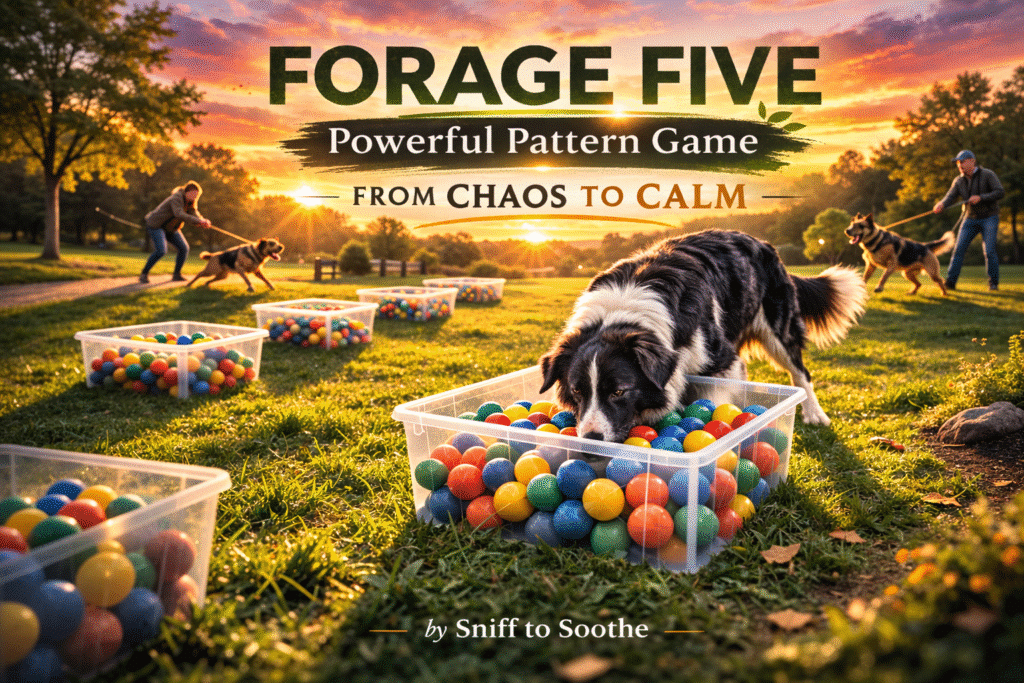
From chaos to calm, the seeking state is where learning becomes possible again.Introduction
Sniff to Soothe Forage Five
Before we talk about bins and balls, I want to give credit where it belongs. Pattern games have changed the dog training world in a way that is hard to overstate. Leslie McDevitt’s Control Unleashed work gave pet parents and pet professionals a humane, practical way to create predictability and emotional safety for dogs who used to unravel in the real world. Her pattern games helped thousands of dogs feel steadier, helped pet parents feel less helpless, and helped trainers build plans that were not built on intimidation, pain, or hoping the dog “gets used to it.” I am genuinely grateful for what she created, and I want that gratitude to be obvious throughout this guide.
Sniff to Soothe Forage Five is my pattern game. It is inspired by that tradition, but it was built to solve a specific problem I see constantly in behavior cases. Many dogs do not just need a predictable interaction with the handler. They need a reliable way to drop into nose-led work for long enough that their entire system changes pace. In my world, that is when training becomes possible again. Not because the dog has been forced into compliance, but because the dog has entered a state where learning is accessible.
Here is the honest positioning. Formal scent work and detection style training can create longer, more complex searches than this game, and I love that work. The problem is not effectiveness, the problem is accessibility. Formal scent work takes time to teach well, it requires foundations that many pet parents do not have yet, and it is not always something you can deploy quickly when you are trying to survive walks, visitors, and daily life triggers. Forage Five sits in the gap between quick food games and full-scent sport style training. It is engineered to create sustained, nose-led engagement with a simple setup most pet parents can learn quickly and duplicate reliably.
Part One
Foundations
Foundations · One
Why sustained nose work changes the dog’s state
When I say this game is built around scent work, I do not mean that in a vague, motivational way. Olfaction is wired differently from the other senses. In mammals, smell has unusually direct connections with brain systems involved in emotion and memory, and it does not route through the same relay pathway that many other senses do. In plain language, odor has a fast track into the parts of the brain that assign meaning and emotional tone. That helps explain why scent can shift how an animal feels before there is time for any deliberate decision-making.
Now add the species-specific reality. Dogs are built for scent. Their sensory world is not primarily visual, the way ours is. Their brains are equipped to gather information through odor, interpret it, and act on it. The more we respect that, the more we can build training that feels intuitive to the dog rather than effortful. Forage Five is designed around a job the dog already understands. Search. Seek. Find. Repeat.
The other piece that matters is motor pattern. A dog that is scanning and reacting is often moving in a very different way than a dog that is foraging. Scanning is typically upright and externally locked. Foraging tends to be nose down, rhythmic, repetitive, and organized. I am not claiming nose work is a guaranteed off switch. Nothing is. I am saying that sustained foraging often changes the body’s tempo, reduces the frequency of rapid visual checking, and creates a steadier behavioral rhythm that supports recovery. This is why duration matters. A three-second sniff is not the same thing as ninety seconds of sustained searching. The bin and ball design is meant to make sustained searching easier for pet parents to produce consistently.
If you want the simplest way to say it, Forage Five is a predictable pattern game that repeatedly puts the dog into the seeking mode, where dogs do best. When the dog stays in that mode long enough, the dog is often more available for learning, less vulnerable to sudden spirals, and more capable of choosing calm responses.
Foundations · Two
What Forage Five is
Five stations, five searches, five opportunities to re-enter the seeking state.
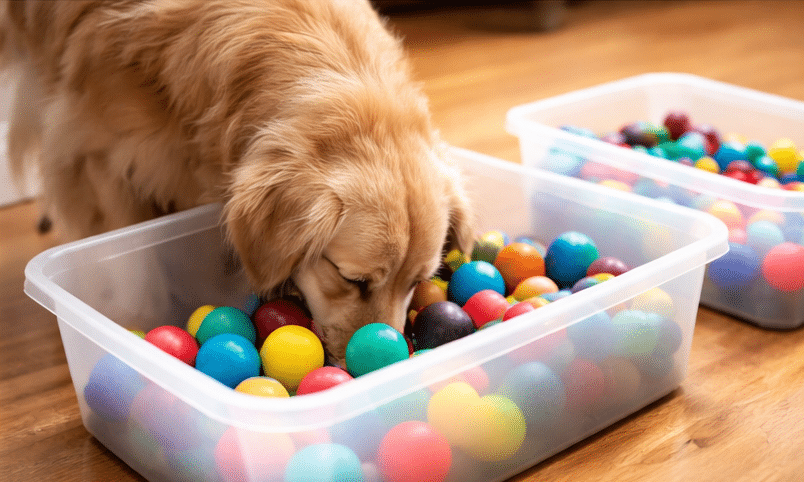
Forage Five uses five rectangular plastic bins. Each bin contains plastic balls, and hidden under and between the balls are tiny, high-value food rewards. The dog moves through the stations and searches, either in a predictable loop or in a choice-based layout where the dog decides which bin to visit next.
The bins are visible, but the work is not visual. Once the dog commits to a bin, dogs do what dogs do best, they default to their nose. They search, they sift, they problem solve, and they stay in that nose-led state longer than they typically do with a quick scatter or a single snuffle mat rep, especially outdoors. The balls are not there to be cute. They create friction. They slow the dog down. They create enough effort that the dog must stay engaged to keep finding food.
It is called Forage Five because it is five stations, five searches, five opportunities to succeed. It also has five chances to re-enter the same regulated motor pattern, which is a big part of why it can be so useful.
Foundations · Three
Who this is for
This protocol is especially useful for dogs who struggle with reactivity toward dogs or people, fear-based behaviors that show up as freezing, avoidance, barking, growling, or lunging, frustration-based reactivity where the dog looks angry but is really dysregulated, and dogs who become overaroused or distracted so fast that they cannot stay available for learning. It is also useful for dogs who can eat indoors but lose food interest outside, and for pet parents who want something practical they can do repeatedly without needing perfect timing.
Foundations · Four
What this is not
Forage Five is not a replacement for a full behavior modification plan, and it is not a shortcut around management and distance. If a dog is already over threshold, this is not a magic button that makes the dog safe or calm. It is also not just enrichment, even though it will feel enriching. The difference is that we treat this as a structured pattern game with progression rules, safety rules, and clear decision points. That is what makes it trainable, repeatable, and useful in behavior work.
Foundations · Five
Why this game can be powerful
A predictable job that belongs to the dog, autonomy inside structure.
Pattern games are powerful because predictability matters. Predictability reduces uncertainty, and uncertainty is a major driver of escalation in sensitive dogs. Many pattern games, including many of the Control Unleashed pattern games, are intentionally interactive. They build a rhythm between dog and handler and strengthen the dog’s ability to follow a familiar sequence even when the world is distracting.
Forage Five keeps that gift of predictability, but it combines it with something I care about just as much, sustained nose-led work. That pairing matters because it gives you a predictable pattern that also pulls the dog into a different behavioral state. When the dog is truly searching, you often see the state change. The breathing slows. The pace becomes steadier. The eyes soften. The body stops pinging between scanning and reacting. When you see that, you are not watching obedience. You are watching regulation.
Forage Five is also different in a way that is easy to miss unless we say it clearly. During the active portion of the game, it reduces handler dependence. The handler is still essential, but the dog is not being guided through every moment. The dog has a job that belongs to the dog. That autonomy is not a philosophical bonus, it is a practical feature. Some dogs regulate better when they do not feel directed. Some dogs spiral when pet parents get tense and start cueing, prompting, and micromanaging. For those dogs, a self-directed task can be the difference between a dog who can recover and a dog who cannot.
This is not a claim that Forage Five is better than other pattern games. It is a claim that it is built for a particular kind of dog, the dog who needs a predictable job, a longer stay in nose mode, and a little more control over how they engage.
Foundations · Six
Why autonomy and choice can change the emotional tone
When you set up a predictable loop, bin one through bin five, the dog learns a routine. When you set up a choice-based layout, the dog learns something deeper, that they have agency inside the routine. The dog can choose which bin to approach, how long to stay, and when to move on. That sense of choice can change how the dog feels about the session. It can turn the work from something the dog endures into something the dog owns.
This matters for fearful dogs in particular. Fear often shows up as hesitation, conflict, scanning, and a constant attempt to control distance. When we offer a task where the dog controls some of the movement and still stays within a predictable structure, we often get a more confident dog. Not because the dog is being pushed, but because the dog is being invited
Foundations · Seven
Where Forage Five fits among other tools
Many tools are cousins. That does not reduce their value. It just means we should be clear about what each tool is best at.
Enrichment stations can be wonderful because variety can help a dog regulate in different ways. The tradeoff is that variety can be harder to standardize and harder for pet parents to replicate consistently across environments. Forage Five is deliberately uniform. It is the same style of station repeated five times, which makes it easier to teach, easier to duplicate, and easier to progress with clear criteria.
Forage boxes and shred boxes can be excellent decompression tools at home. They often lean into novelty, deep engagement, and a rich sensory experience. Forage Five is different because it is designed to be a portable, tidy protocol you can deploy in real-life training situations. It is five stations, not one, and the substrate remains consistent, which allows you to adjust difficulty intentionally and measure progress over time. Many forage boxes are built primarily for enrichment. Forage Five is built to be a repeatable coping loop inside behavior work.
Snuffle mats are helpful, and for some dogs, they are a great starting point. The limitation is that many dogs clear them quickly, especially once they are experienced, and outside the engagement can be even shorter. The ball substrate in Forage Five tends to slow the dog down. It creates friction and small problems to solve, which often produces a more sustained search state.
Sniffari-style decompression walks can be a gift. They allow dogs to explore, gather information, and decompress in a low-pressure way. The difference is structure and repeatability. Sniffaris are open-ended, which is part of their beauty, but that also means they are not always predictable enough to function as a rapid, repeatable reset in the moment you need one. Forage Five gives you a structured routine you can set up and run with clear criteria, while still allowing the dog autonomy inside that structure.
Station circuits that include long licking or chewing can also be very helpful. Licking and chewing are often stationary, consumption-based behaviors. They can support calm, but they do not always recruit the same whole body seeking pattern that active foraging recruits. Forage Five is not just consumption. It is seeking. The dog is locating food, shifting balls, problem-solving, and searching again. That active seeking pattern matters because it can create a different kind of organization in the dog’s body and behavior. For some dogs, that seeking state is the bridge back to learning.
Part Two
The Protocol
Protocol · One
Safety comes first
If you are working with aggression, intense fear, or severe reactivity, the goal is not bravery. The goal is safety and stability. You build progress by keeping the dog under threshold often enough that learning can occur.
Use equipment that supports safety and comfort, such as a well-fitted harness that does not restrict shoulder movement, and a leash that allows slack instead of constant tension. If there is any bite risk, muzzle conditioning should be handled thoughtfully and gradually. Choose balls that are large enough to prevent swallowing, and bins that are stable with smooth edges.
Pick training environments where triggers are unlikely to appear suddenly at close range. If you cannot control distance, you cannot train safely. And here is a rule I want you to remember because it removes a lot of guessing. If your dog cannot forage, you are too close, the setup is too hard for that day, or the environment is too intense. Increase distance, simplify the setup, or leave. Leaving is not failure. Leaving is how you protect the dog’s brain from overload.
Protocol · Two
A note for shy or fearful dogs who find the balls scary
Some fearful dogs are startled by the clacking and shifting movement of the balls. If that happens, do not push through it. Shape comfort the same way you would shape any new skill.
Start with an empty bin. Drop a few tiny, high-value treats into it and let the dog approach and leave freely. Then add one ball, then two, then three. At first, place treats beside the balls rather than under them. The goal is for the dog to experience the sound and movement as safe. If the dog startles, you go back a step and slow down. Over multiple sessions, build to five balls, then ten, then a partial fill, then a full bin. Once the dog is comfortable, begin hiding food just under the top layer and keep the reinforcement rate high.
You can make this easier by using softer, quieter balls, anchoring the bin so it does not slide, and practicing on grass so the setup feels more stable.
Protocol · Three
The Forage Five protocol
The searching is not a side activity, it is the intervention.
Set up five bins in a line, gentle arc, or L shape, with a few feet between bins. Fill each bin with balls and hide tiny, high-value treats. Early on, make the hides easy. Food near the top, plenty of pieces. You are teaching the game, not testing the dog.
Your role as the handler is calm and predictable. Keep the leash loose. Stand slightly behind and to the side so the dog does not feel crowded. Approach the first bin, pause briefly, give a calm cue if you want one, such as “Find it,” and then let the dog search. When the dog naturally disengages, you calmly move to the next bin. Repeat through all five bins and then leave the area.
Here is a subtle point that is worth saying out loud. We are not rushing. We are not trying to get through five bins as fast as possible. We are trying to keep the dog in the seeking state long enough for the state itself to do its work. In other words, the searching is not a side activity, it is the intervention.
Protocol · Four
The Orientation Reset
Between bins, add a micro pause that keeps transitions smooth without turning this into an obedience routine. When the dog finishes a bin and lifts their head, pause for one breath with a loose leash. Do not talk. Do not lure. Wait for one soft moment, even one second, then walk calmly to the next station.
This reset does more than prevent frantic hopping. It protects the state change we are trying to create. A reactive dog often shifts states in a split second, from searching to scanning, from scanning to loading, from loading to exploding. The breath pause is a tiny buffer that helps the dog stay organized as they move between stations, so the dog spends more of the session in nose mode and less of it in rapid environmental monitoring.
Protocol · Five
The Distance Dial
Distance is part of the protocol, not a side note. Treat distance like a volume knob. Start far enough away from triggers that your dog can complete the loop easily. If triggers appear and your dog continues to forage, you can calmly maintain distance and, over multiple sessions, gradually work closer as the dog’s skills grow.
If triggers appear and your dog stops searching, freezes, hard stares, vocalizes, or cannot re-engage, treat that as the clearest information you are going to get. The dog has lost the seeking state. That means the nervous system has shifted back toward survival mode. Your job is not to talk the dog out of it. Your job is to create distance or end the session. Then, next time, you start farther away, or you simplify the setup so the dog can stay in nose mode longer.
Protocol · Six
The Choice Setup
The default version is a predictable loop, bin one through bin five. That structure is easy for pet parents to replicate. The choice version adds agency.
Arrange the bins in a shallow arc or semi-circle. Start the dog near the center and allow the dog to choose which bin to approach. Your job is to follow calmly on a loose leash. If the dog bounces rapidly between bins without committing to searching, use the Orientation Reset, one breath pause, then allow the dog to re-commit.
The choice version can deepen the emotional benefit for some dogs because it adds control. Control is not just a training concept. For many fearful and reactive dogs, control is the difference between coping and panicking. When the dog can choose the station, the dog often stays more willing, more curious, and more engaged in the seeking state.
Protocol · Seven
When a trigger shows up unexpectedly
Sometimes the environment changes fast. A dog appears from behind a car, a rabbit darts across a path, a jogger comes closer than planned. If your dog can keep foraging, you are still in a workable zone, and you can calmly continue while quietly creating more distance.
If your dog cannot forage, treat that as a state change signal, not a moral failing, and not a training failure. The dog has left nose mode and returned to scanning and threat assessment. Increase distance immediately, simplify, or leave. The usefulness of this protocol is that it gives you a clear yes or no in real time. Can the dog stay in seeking mode? That clarity helps pet parents make better decisions, protects the dog’s nervous system, and prevents rehearsing the very behaviors you are trying to change.
Part Three
In Practice
In Practice · One
Why Forage Five helps training
Forage Five helps training because it keeps the dog in a learning zone more often. It gives you an observable threshold gauge, can the dog search or not, and it supports regulation through a self-directed task that many dogs find organizing. Over time, it can become an alternate default routine in the presence of distant triggers, not because the handler is controlling the dog, but because the dog has a familiar pattern they can choose.
It also gives pet parents a script. When pet parents have a script, they stop freezing, stop improvising, and stop accidentally escalating pressure. That predictability helps the dog. From a trainer’s perspective, it often makes sessions more efficient. You get more high-quality reps with less spiraling between exposures because the dog has a dependable path back to seeking.
In Practice · Two
Teaching the game from scratch
Start small. Session one can be a single bin with easy food and a short, successful experience. Session two can be two bins. Session three can be three bins, and only if the dog is confident, do you begin to hide food a little deeper. Build to four bins, then five.
If the dog struggles, simplify. Increase treat density, reduce hide depth, reduce ball count, lower distraction, and increase distance. The goal is not to make it hard. The goal is to make it reliable. Reliability is what builds emotional safety.
In Practice · Three
Treat strategy and progression variables
Use tiny pieces of high-value food so you can create volume without filling the dog up. Progress the game by adjusting variables deliberately, treat density, treat depth, ball count, station spacing, environment intensity, and distance to triggers. If you change too many variables at once, you will not know what helped or what hurt. Keep it simple and intentional.
In Practice · Four
Layout options
Line, arc, and L layouts, each one offering a different built-in safety advantage.
A line layout can be useful when you want a clean escape route, especially in parks where you may need to move away quickly. An arc layout often helps because the dog naturally turns slightly away as they move through stations. An L shape can be particularly useful because the later stations can be placed farther from the trigger line, creating a built-in safety advantage.
In Practice · Five
Troubleshooting
If the dog will not engage, make it easier. Use higher value food, place treats on top, shorten the session, and reduce the environmental difficulty. If the dog becomes frantic and throws balls, the setup is too hard, or the dog is too activated. Increase treat density, reduce depth, reduce ball count, and increase distance.
If the dog has resource guarding tendencies around food or containers, do not lean over the dog or reach into bins, keep other dogs away, and use a guarding-informed plan. If the dog tries to eat the balls, stop immediately and change the substrate or ball size. Safety always wins.
Part Four
Transitioning Off the Bins
Transition · One
Why the bins were never the destination
The Forage Five bins were the entry door, not the room you live in. Most dogs with reactivity, fear, anxiety, or aggression cannot begin behavior modification in raw real-world conditions, because their nervous system is too dysregulated to be available for learning. The bins solve that problem. They drop the dog into the seeking state, they reduce handler dependence, they create predictability, and they buy us the brain we need to do the actual behavior change work.
But here is the question that matters. Where are the bins when you are out walking? Where are they when a delivery driver appears around a corner? Where are they when a child runs past on the sidewalk? The honest answer is, the bins are not coming with you. They cannot. And they should not. The goal of behavior modification is a dog who can function in real life without specialized equipment, not a dog who depends on carrying bins of plastic balls everywhere.
The transition is where Forage Five hands the work off, primarily to Look At That, and eventually to no protocol at all. The dog learns to do in real life what they learned to do in structured sessions. Notice the trigger, stay regulated, look back to the handler, and receive reinforcement. By the end of the transition, the dog can do that anywhere, with or without bins.
If you have not yet read the underlying science behind why this works, the classical counterconditioning and desensitization guide is the place to start. Everything in this section assumes you already understand that foundation.
Transition · Two
Phase one, spreading the bins apart
Where the work begins. Bins close, structure tight, regulation high.
Once your dog is reliably working the protocol through all five bins in any environment you choose, with consistent foraging and clean transitions, you are ready to begin transitioning.
The first change is simple. Increase the distance between bins. Where the five bins used to sit a few feet apart in a tight line or arc, start spacing them further. Six feet apart. Then ten. Then fifteen. The exact spacing depends on your dog and your environment, and your job is to add distance only as fast as the dog can absorb it.
What this change does is build a walking period between bins. Where the dog used to move from one bin straight to the next, the dog now has more space to traverse, which means more time without a bin in their face. That time is where something interesting becomes available. The dog can look up. The dog can notice the environment. The dog can notice the trigger.
When the dog looks at the trigger, this is the moment we have been building toward. We do not use the bin to manage this. We use Look At That. The protocol is simple. The dog looks at the trigger, mark and reward. Or the dog looks at the trigger, looks back to you, and you mark and reward the moment they look back. Both timings work. Both produce the same conditioned emotional response over time.
This same approach applies if the dog looks at the trigger while their head is still in a bin. The instant the head comes up out of the bin and the dog looks at the trigger, that is a Look At That moment. Mark and reward.
The dog continues to forage when their head is in a bin. The dog uses Look At That when their head is out of a bin or they are walking between bins. The bins still handle the regulation work. Look At That handles the trigger work.
A Note on LAT
If you are not yet familiar with the Look At That protocol, please read the dedicated Look At That guide before going further. The transition does not work without it.
Transition · Three
Phase two, removing bins
Once your dog is moving comfortably between widely spaced bins and using Look At That cleanly during the walking portions, the next step is reducing the number of bins.
Start in the middle. Remove the third bin first. You are now working four stations, still spread apart. Run the protocol the same way. The dog forages bin one, walks to bin two, walks further across the empty space where bin three used to be, continues to bin four, and finishes at bin five.
In the gap where bin three used to be, the dog has additional unstructured time. Additional time for the dog to potentially notice the trigger. Additional opportunity for Look At That.
After a few sessions at four bins, you remove another. Now you are at three. Then two. Then one. Each reduction creates more walking time, more unstructured time, more opportunity for Look At That to take over the work the bins were doing.
The pace of reduction is dictated by the dog, not the calendar. If the dog regresses, add a bin back. If the dog stays steady, continue reducing. There is no prize for reaching zero bins quickly. The point is to make sure the dog can hold the work as the scaffolding comes away.
Transition · Four
Phase three, no bins at all
Where the work goes. No bins, real environment, the dog notices the trigger and looks back. Pure Look At That.
Eventually you reach the point of no bins. The protocol has fully transitioned. You are now doing Look At That work without any of the original Forage Five structure.
The session looks like this. You and your dog walk in an environment where the trigger may appear, at a working distance you know is sustainable. When the dog notices the trigger, you mark and reward. Or the dog notices the trigger, returns their gaze to you, and you mark and reward at the return. Same protocol. Same reinforcement.
The dog has been doing this work for weeks or months under the structured scaffolding of the bins. Now they do the same emotional work without the scaffolding. This is not a different protocol. It is the same counterconditioning that started with bins, applied through a different mechanism. The trigger still predicts food. The dog still gets paid for noticing the trigger. The emotional response continues to shift in the direction it has been shifting all along.
Transition · Five
Varying the reinforcement schedule
Up to this point, every clean look at the trigger has earned a mark and reward. Continuous reinforcement is what builds the behavior in the first place. Once the behavior is solid, we shift to a variable schedule.
Begin mixing it up. Sometimes the first look earns a reward. Sometimes the second. Sometimes the third. Sometimes the fourth. The dog never knows when reinforcement is coming, only that it is coming. A typical working range during transition is one to four looks per reward, varied across the session.
Variable ratio reinforcement does two important things. It builds resistance to extinction, so the behavior keeps happening even when reinforcement is intermittent. And it builds endurance, so the dog can sustain the right response across longer periods of exposure to triggers.
Variable schedules are for behaviors that are already reliable. If your dog is still inconsistent on continuous reinforcement, do not vary the schedule yet. Get the behavior solid first, then vary it.
Transition · Six
Weaning the food, layering in life rewards
The next layer of transition moves from food reinforcement toward life rewards.
Life rewards are anything your dog values that does not come out of a treat pouch. Calm praise. Affection. Gentle play. A favorite toy presented briefly. Access to an interesting sniff spot. Permission to greet a familiar friendly person at a distance. The chance to roll in the grass. Anything the dog finds genuinely good, that is naturally available in life.
The shift does not happen all at once. Food remains in the picture for a long time, especially around new triggers, harder distances, and unfamiliar environments. What changes is the ratio. You start substituting life rewards for food on some repetitions, gradually building until food is reserved for the hardest moments and life rewards handle the rest.
The criteria also shift during this period. The behavior expected for any given reward becomes more substantial. Early on, a single look at the trigger earned a high-value food piece. Later, you might be looking for a longer sustained look, a quicker return of gaze, two or three looks before a reward, or a more relaxed body posture during the work. The reinforcer evolves to match what the dog can sustainably handle in actual life.
Transition · Seven
Monthly Forage Five as maintenance
After the transition is complete, after the dog is working Look At That in real environments with intermittent reinforcement and a mix of food and life rewards, the Forage Five bins do not disappear from your life entirely.
I recommend running the full Forage Five protocol with the trigger present once a month. Use the bins. Use high-value food rewards even though you have largely weaned off them in daily life. Treat it like a maintenance session.
This monthly run does several things. It keeps the protocol fresh in the dog's emotional repertoire. It reminds the dog that good things are still associated with the trigger picture. It gives you an honest check on any regression that may have crept in. And it gives the dog a deep, sustained dose of the regulating seeking state.
Maintenance Forage Five is also useful as a post-session decompression tool. If you and your dog have just finished a particularly demanding Look At That session in a busy real-world environment, running the bins afterward gives the nervous system a chance to come fully down. The bins do not appear during the session, because we are no longer working in that phase, but they can appear after, as recovery work.
The bins were the entry door. They are also the maintenance check and the recovery tool. They sit in the toolbox, ready when needed, even after they are no longer the daily protocol.
Transition · Eight
Practical realities of the transition period
A few practical points worth saying out loud.
Carry a treat pouch on every outing during the transition period and well into the life-rewards phase. You will be using Look At That often, in moments you did not plan for, and food remains the most reliable reinforcer for unexpected real-world triggers. Eventually, as life rewards take over and the dog's responses become more reliable, the treat pouch can phase out too. But not yet, and not on a calendar. The dog tells you when.
Set realistic timelines. The transition off the bins is not a two-week project. For most dogs with significant reactivity, fear, or aggression histories, the full transition from structured Forage Five through Look At That into a life-rewards model takes several months. Some dogs move faster. Some move slower. The dog dictates the pace.
If you skipped any phase of the foundation, expect the transition to expose that. Dogs who never fully developed reliable foraging in the original protocol will struggle when bins are removed. Dogs who never built a clean conditioned response to the marker will struggle with Look At That. The transition is not the place to discover gaps in the foundation. It is the place where the foundation gets tested and applied in real life.
One more thing. If you have not yet read the dedicated Look At That guide or the broader article on classical counterconditioning and desensitization, read both before you start the transition. The work makes more sense, runs more cleanly, and produces better outcomes when you have the underlying science in hand before you start.
§
Video Walkthrough
Forage Five Pattern Game for Reactive, Anxious, and Fearful Dog Behavior and Emotional Regulation, Part 1
Video Walkthrough
Forage Five Pattern Game for Reactive, Anxious, and Fearful Dog Behavior and Emotional Regulation, Part 2
§
Closing · One
How this connects to Sniff to Soothe
Sniff to Soothe, structured scent work as a pathway to emotional regulation.
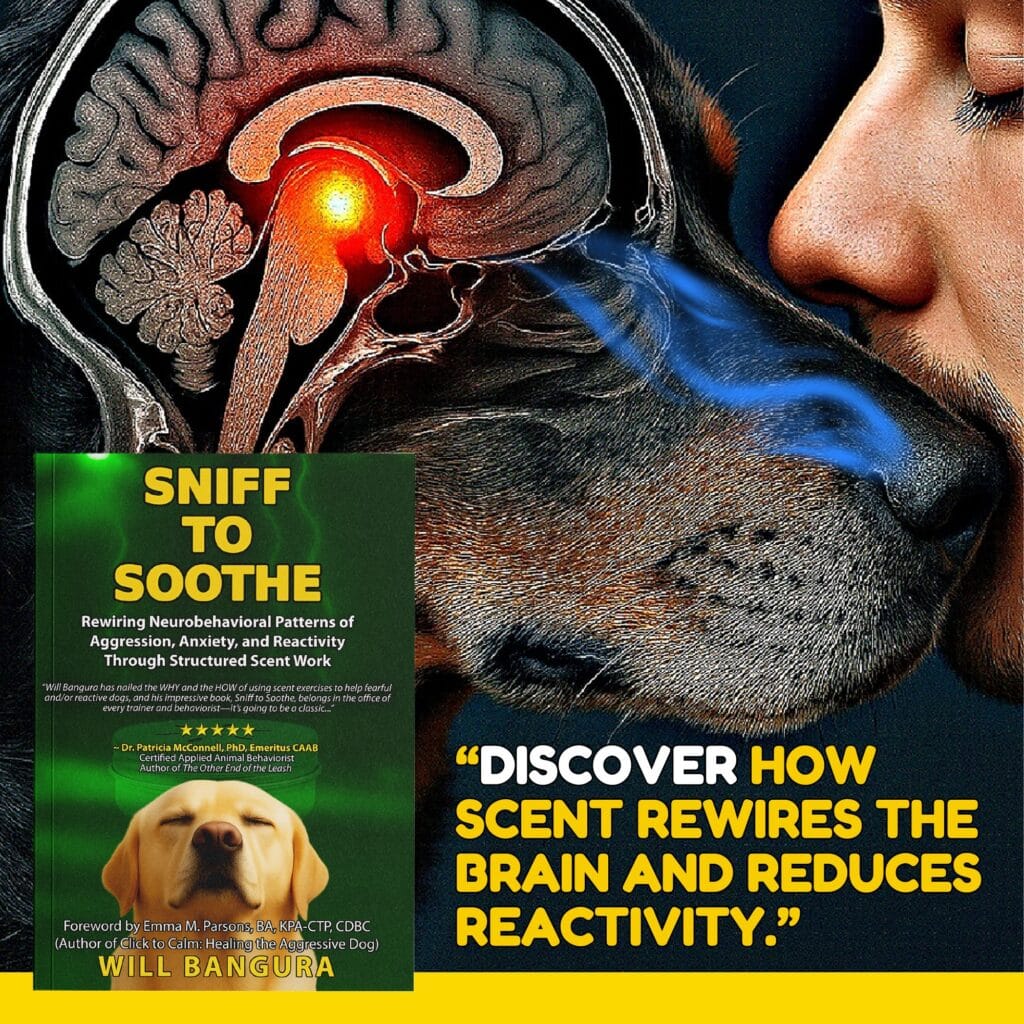
I do not want to turn this into an ad, but I do want to connect the dots. In Sniff to Soothe, I talk about structured sniffing and scent work as a practical way to support emotional regulation and recovery for dogs with reactivity, fear, anxiety, and aggression. Forage Five is one simple way to apply that concept without specialized odors or sport equipment, and without requiring pet parents to learn the full structure of formal scent work before they can benefit from a nose-led state change.
Closing · Two
The real goal
This is not about keeping a dog busy. It is about giving the dog a reliable path back to calm. It is about giving pet parents something to do besides hold their breath and hope. It is about giving trainers a tool that supports decompression while preserving autonomy and minimizing handler dependence in the moment. Most importantly, it is about protecting the dog’s nervous system so learning can happen.
Work With Will
Ready to bring real change to your reactive, fearful, or aggressive dog?
If your dog struggles with reactivity, fear, anxiety, or aggression, you do not have to navigate this alone. Schedule a behavior consultation with a nationally recognized Certified Canine Behaviorist who specializes in the cases other trainers say cannot be helped.
Bangura, W. (2025). Sniff to Soothe: Rewiring neurobehavioral patterns of aggression, anxiety, and reactivity through structured scent work. Pet Scientifics LLC.
McDevitt, L. (2007). Control unleashed: Creating a focused and confident dog. Clean Run Productions.
McDevitt, L. (2019). Control unleashed: From reactive to relaxed. Clean Run Productions.