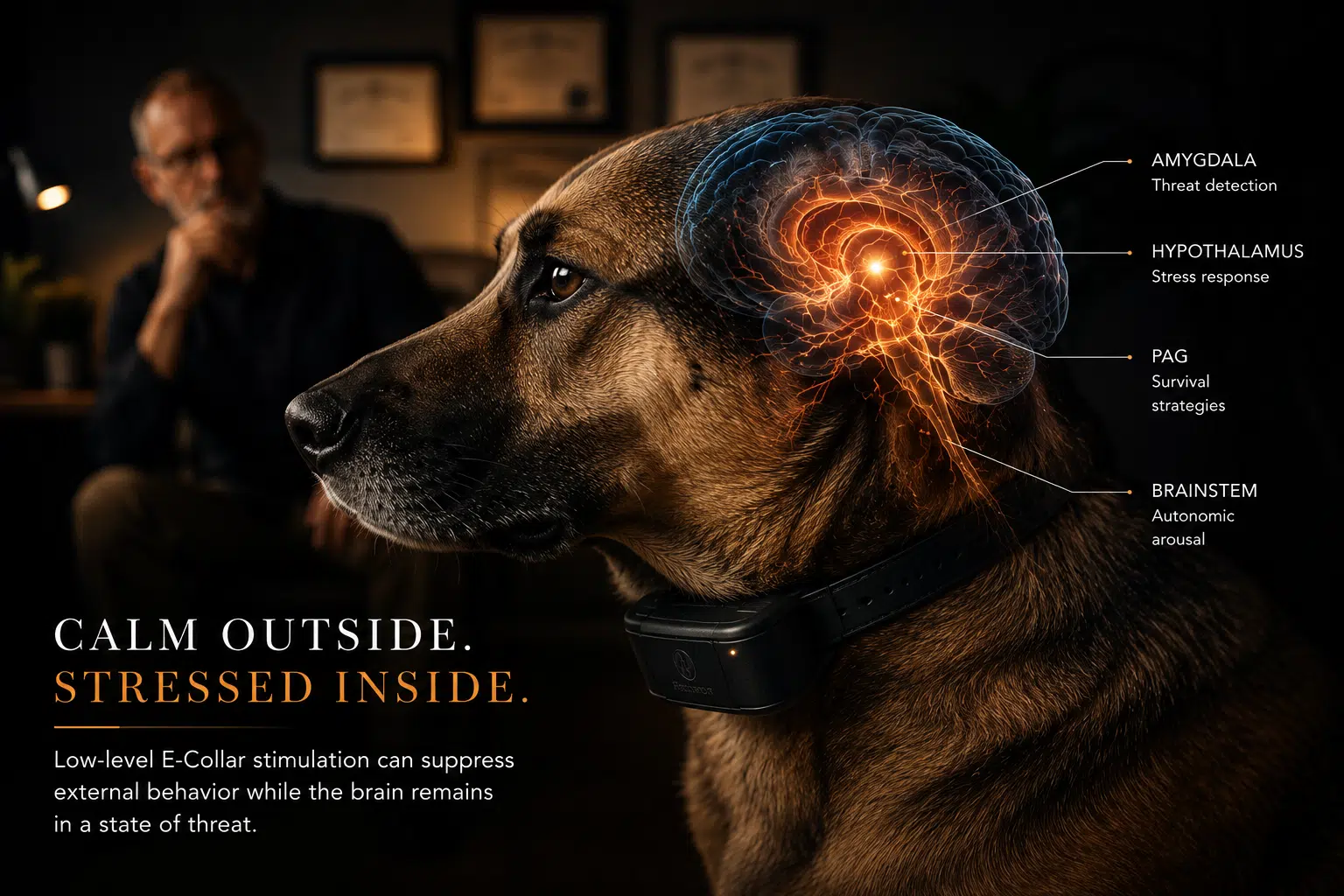
Last week, a pet parent called me in tears. She had hired a "balanced" trainer six months ago for her shepherd mix, Cooper. The trainer told her low level e-collars are safe. He told her her dog never yelped. He told her the science was on his side.
She wanted to know if any of that was true.
Cooper used to bark and lunge at other dogs on walks. Now he doesn't. The trainer pointed to this as proof the low level e-collar worked. He said the dog "got over it." He said the modern, low stim approach was nothing like the old shock collars.
I listened. Then I told her what I always tell people in that moment. I said, "Your dog didn't get over it. Your dog stopped showing you the problem. Those are two different things, and the new 2026 brain science is very clear about which one happened."
Because here is the thing. While balanced trainers spent the last twelve months on social media insisting the welfare research is "outdated" or "biased" or "based on bad methodology," the actual scientists were not on social media. They were in labs. Running studies. Imaging brains. Publishing data. And what they found in 2026 should end the debate about whether low level e-collars are safe, even though it will not, because the debate was never really about the science to begin with.
But for those of us who do care about the evidence, let me walk you through what just dropped.
Part One
The 2026 Evidence
Four studies from 2026, and what each one means for the dog in your home.
The Evidence · One
"Learning Fast, Forgetting Slow"
The amygdala does not forget.
The biggest study of the year, at least for our work, came out of Science Advances in March. A team led by Sjoerd Meijer at Radboud University in the Netherlands did something we have never been able to do in humans before. Using transcranial ultrasound stimulation, a non-invasive way to directly modulate deep brain structures, they manipulated the amygdala while people were learning to associate a cue with a mild aversive event.
What they found is the cleanest causal evidence we have ever had that the amygdala drives an emotional learning state best described as "learning fast, forgetting slow."
Let me translate that for the pet parent reading this.
When a dog experiences something aversive, even something mild like a low level e-collar correction, the amygdala does not just record what happened. It tags the memory with emotional weight. It fast-tracks the association. And then it makes that memory resistant to fading. The amygdala is biologically engineered to make sure your dog remembers the things that scared, startled, or hurt them. Forever.
This is why the "my dog got over it" claim is so dangerous. Your dog did not get over it. Your dog's amygdala filed it away with a giant red flag, and the only reason you cannot see the fear anymore is because your dog has learned to suppress the visible parts of the behavior. The fear is still there. The memory is still there. The threat tag is still there. You stopped seeing the surface symptoms. The amygdala did not stop doing its job.
That distinction matters. And the 2026 neuroscience just put a causal stake in it.
The Evidence · Two
"But Will, I Only Use It on a Low Level"
Low visibility is not low impact.
I can already hear the balanced trainer reading this. Here it comes.
"Will, you're talking about high-level shock. That's not what I do. I only use the lowest setting the dog can feel. My dog isn't yelping. My dog isn't screaming. There's no fallout because there's no pain. The studies you're citing don't apply to my training because I'm not hurting the dog. I'm just getting their attention."
Okay. Let's actually sit with that argument for a minute. Because I want to give it a fair hearing before I take it apart.
Here is the problem.
If the stim is not aversive to the dog, it does not work. Period. That is not my opinion. That is the textbook definition of negative reinforcement. The one you cannot escape no matter how the tool is marketed.
Negative reinforcement increases a behavior by removing an aversive stimulus. If the stim is not aversive, the dog has no motivation to perform the behavior that turns it off. The whole mechanism collapses. You cannot have it both ways. You cannot say "the low level e-collar works through negative reinforcement" and "the stim is not aversive to the dog." Those two statements cannot both be true. One of them has to give.
Same thing with positive punishment. Positive punishment decreases a behavior by adding an aversive stimulus. If the dog is not finding the stim aversive, the behavior does not go down. So when a trainer says, "I just tapped the button and the dog stopped lunging," what they are actually telling you, whether they realize it or not, is that the dog found that stim aversive enough to change their behavior. The dog wanted it to stop. The dog felt threatened enough to choose differently. That is the mechanism. That is what "aversive" means.
Now here is where they pivot. The balanced trainer will say, "Okay, technically aversive, but only mildly. The dog is not suffering. It is like a tap on the shoulder, like a TENS unit." And I want to address that directly, because the 2026 neuroscience has something very specific to say about it.
The threat circuit in the mammalian brain does not require the animal to scream for the amygdala to engage. Meijer and his team used a stimulation intensity that participants, after the experiment, described as uncomfortable but tolerable. Nobody was yelping. Nobody was begging it to stop. Most participants would have rated the level somewhere between "annoying" and "I would like that to end." And the amygdala still tagged those memories as persistent threat. The "learning fast, forgetting slow" signature did not require severe pain. It required modest, repeatable, conditioned aversiveness.
Read that again. Modest. Repeatable. Conditioned. That is exactly what your balanced trainer is producing when they use a low level e-collar at a setting the dog can just barely feel and tap the button enough times to shape the behavior.
The Sears work, which I will get to in a minute, makes a similar point from a different angle. The researchers did not have to crank the aversiveness to push avoidance behavior out of the thinking brain and into the rigid habit circuit. They just had to keep training. The shift happens under sub-traumatic conditions. The lower the level, the more reps you need, but the circuit ends up in the same place.
So when a balanced trainer tells me, "My dog is fine because I use a low level," what I hear, in plain English, is, "I have found the precise intensity that bypasses the obvious distress signals without bypassing the underlying threat circuit." That is not a defense. That is a description of what makes the practice harder to detect.
And here is what I really want pet parents to walk away with.
The visible behaviors are the loud ones. The yelps. The flinches. The submissive urination. Those are the easy signs. The 2026 neuroscience says the absence of those loud signs does not mean the absence of the underlying neural processes. The amygdala is still tagging. The threat memory is still consolidating. The avoidance circuit is still being trained.
Low level does not mean low impact. It means low visibility.
That is the whole game.
The Evidence · Three
What Overtraining Avoidance Actually Does to the Brain
A reliable response is not a choice.
In February, Nature Communications published a study by Sears and his colleagues that I am going to be quoting in every rebuttal I write for the rest of the year.
What they showed, in a clean rat protocol using a combination of behavioral and chemogenetic methods, is that avoidance behavior starts out goal-directed. The animal is reasoning through the contingency. They are thinking about the relationship between their action and the outcome. They are flexible. They are weighing alternatives.
Then training continues. And at a certain point, the response migrates out of the thinking system, the dorsomedial striatum, and into the rigid, automatic system, the dorsolateral striatum. The dog is no longer making a choice. The dog is running a motor program that was burned in through repeated avoidance.
This is the same neural circuit researchers have implicated in obsessive-compulsive disorder in humans. The same circuit implicated in rigid habit pathology after developmental stress. Three different research populations. Three different methodologies. Same circuit.
Here is what this means for dog training.
When a balanced trainer brags that their low level e-collar produces a "reliable" response, what they are describing, in brain terms, is the moment the dog's behavior moved out of the thinking system and into the rigid habit system. The dog stopped considering alternatives. The dog stopped reasoning. The dog is now running a fear-driven motor program.
Proponents call this "communication." It is not communication. It is the neurobiological signature of trapped, repetitive, inflexible behavior. And this is exactly why dogs trained with aversive methods often look "calm" in the moment but cannot generalize, cannot handle novel problems, and fall apart when the equipment comes off. They were never reasoning their way through the behavior. They were running a habit.
The Evidence · Four
What the Veterinary Literature Is Now Saying
The academic record is not mixed.
In January, DeLeeuw and Williams published a major study of professional dog trainers in Frontiers in Veterinary Science. The paper is mostly qualitative, but the literature review they used to frame the work is where I want to focus.
They summarize the field this way. The body of peer-reviewed evidence consistently shows that positive reinforcement is associated with fewer behavioral issues, including aggression, with reduced distress and fear, and with effectiveness comparable to or exceeding aversive techniques.
That is not me saying that. That is the formal academic framing in a 2026 veterinary science journal. The convergence has been clear for years, and the field has now formalized it.
The same paper documents something else worth knowing. Even among trainers who use mixed methods, certain practices are uniformly condemned across the profession. Alpha rolls. Dominance-based physical manipulation. Hitting. There is no real debate about those anymore. The remaining division is over e-collars and prong collars, and even there, the trainers who defend them tend to admit that injuries occur and tend to draw their justifications from personal experience rather than from the published literature.
In May, the same journal published Ridgway's review of physical risks from dog-worn equipment. This one is less about behavior and more about the body. Pressures. Leash forces. Gait effects. Intraocular pressure. Equipment-related trauma. The peer-reviewed catalog of physical harm from collars and similar equipment keeps growing, and the proponents who insist their tools are "humane when used correctly" are now arguing against an expanding mountain of clinical evidence.
Of course, you would not know any of this from listening to some of the loudest voices on social media. I recently published a detailed fact-check on Dr. Melanie Uhde's e-collar claims, showing how one social media influencer has been misrepresenting the very neuroscience research she cites to defend aversive training. You can read more scientific studies on electronic collar dog training here.
Part Two
What This Means For You
From the research to the dog in your living room.
In Practice
So What Do You Do with This?
There is a path forward.
If you are a pet parent who has been told by a balanced trainer that low level e-collars are safe, here is what the 2026 science actually says.
Aversive training installs threat memories that are biologically designed to persist, not fade. Your dog did not "get over it." Their amygdala filed it under permanent.
Low level does not mean low impact. The mechanism of negative reinforcement and positive punishment requires the stim to be aversive to the dog, by definition. If it works, it is aversive. The 2026 neuroscience shows that subjectively mild aversiveness still engages the threat circuit and still installs persistent threat memories. The dog does not have to yelp for the damage to be real.
What looks like a "reliable" response is, at the brain level, a habitual avoidance circuit that has hijacked your dog's ability to think flexibly. Your dog is not obeying. Your dog is running a fear-driven motor program.
The peer-reviewed veterinary literature, in 2026, frames the body of evidence on training methods as convergent in favor of reward-based approaches. The supposed scientific controversy you keep hearing about on social media does not exist in the actual academic record.
If you are a trainer or behavior consultant reading this, the 2026 publications are not optional reading. They are the spine of the next round of public conversation. The names to know are Meijer, Sears, DeLeeuw, and Ridgway. Save them. Use them. Cite them when the next balanced trainer tells you the science is "mixed."
It is not mixed. It is converging.
It has been converging for years. And 2026 just dropped another stack of bricks on the wall.
Closing
A Final Word for the Pet Parent Who Got Bad Advice
Your dog is not broken.
I have been doing this for thirty-five years, and I have sat across from too many people who were told they had to "be the alpha," or "show the dog who is boss," or that their gentle, frightened dog needed a low level e-collar to "respect" them. They came to me ashamed. They came to me afraid that the damage was permanent.
Here is what I want you to hear.
You did the best you could with the information you had. The trainers who sold you those methods knew, or should have known, that the science did not support them. That is on them, not on you. And while your dog's amygdala may have filed the bad experiences as permanent memories, that does not mean recovery is impossible. It means the path forward looks different. It means we work with the nervous system, not against it. It means we give your dog the one thing aversive training never offered, which is the experience of agency, of safety, of being able to predict good outcomes from their own behavior.
That is what reward-based work does. That is what desensitization and counterconditioning do. That is what scent work does. That is what the science, in 2026, keeps confirming.
Your dog is not broken. Their nervous system is doing exactly what mammalian nervous systems do. The job now is to give them better experiences to layer on top of the old ones.
And the science is finally, fully, unambiguously on your side.
Work With Will
Get Expert Help for Your Dog
Phoenix Dog Training helps pet parents address aggression, anxiety, fear, reactivity, and the fallout of aversive training methods through force-free, evidence-based behavior modification. Phoenix Metro in-home consultations and virtual consultations worldwide.
No. The 2026 neuroscience confirms that even mild aversive stimulation engages the amygdala, the part of the brain that tags fear memories as persistent threat. A low level e-collar still has to be aversive enough to motivate the dog to change their behavior, or it would not work. That is the textbook definition of negative reinforcement. If the stim is doing its job, the dog finds it aversive. And the mammalian brain processes mild aversiveness the same way it processes worse: by installing a threat memory that resists extinction.
Do e-collars actually work on the lowest setting?
Only if the dog finds the stimulation aversive. That is how negative reinforcement and positive punishment work. The dog has to want the stim to stop, or want to avoid it happening again. So when a trainer says the e-collar works "on a low level," what they are actually telling you is that they have found the minimum intensity the dog finds unpleasant enough to change their behavior. The mechanism requires aversiveness. There is no version of e-collar training that works without it.
Does a low level shock collar hurt a dog?
Pain and harm are not the same thing. A low level e-collar may not produce the intense pain that makes a dog yelp, but the 2026 brain imaging research shows that subjectively mild aversive stimulation still engages the threat circuit and still installs persistent fear memories. Pet parents often confuse the absence of obvious distress signs, like yelping, flinching, or cowering, with the absence of harm. The neuroscience tells us the dog's brain is recording the experience as threat regardless of whether they vocalize.
What does the 2026 science say about e-collars?
The 2026 peer-reviewed literature is converging on the same conclusion. Aversive training, including low level e-collar use, installs persistent threat memories, shifts behavior into rigid habitual circuits, and produces measurable welfare costs. Four major studies this year from Science Advances, Nature Communications, and Frontiers in Veterinary Science all reinforce the case for reward-based training. The veterinary academic record now frames the evidence base as convergent in favor of positive reinforcement methods.
Is balanced training scientifically supported?
The peer-reviewed veterinary literature, in 2026, frames the body of evidence on dog training methods as convergent in favor of reward-based approaches. Balanced training relies on aversive tools, including e-collars, prong collars, and choke chains. The 2026 neuroscience shows these tools engage the same threat circuit at modest stimulation levels as they do at higher levels. There is no scientific framework that supports aversive methods being as welfare-safe as reward-based training. The supposed controversy exists on social media, not in the academic record.
What should I do if I have already used a low level e-collar on my dog?
First, do not panic. Your dog's nervous system is doing what mammalian nervous systems do, and recovery is possible. The next step is to stop using the tool and work with a credentialed force-free trainer or veterinary behaviorist who can help you build new positive associations to replace the aversive history. Reward-based methods, desensitization, counterconditioning, and structured scent work all give your dog the experience of agency and safety that aversive training never offered. The damage is not always permanent. The path forward just looks different.
About the Author
Will Bangura, M.S.
Will Bangura, M.S., CAB-ICB, CBCC-KA, CPDT-KA, FFCP, is a Clinical Animal Behaviorist and Certified Canine Behaviorist, published author, expert witness, and founder of Phoenix Dog Training®. He is one of only three Clinical Animal Behaviorists in the United States and the only Clinical Animal Behaviorist in Arizona. Will is also certified and accredited as a Certified Canine Behaviorist through International Canine Behaviourists.
With more than 35 years of professional experience, Will specializes in severe dog aggression training in Phoenix, leash reactivity, fear-based behavior, anxiety disorders, phobias, separation anxiety, obsessive-compulsive behaviors, resource guarding, intra-dog aggression, and complex canine behavior cases involving emotional dysregulation, chronic stress, maladaptive learning, and underlying medical or environmental contributors.
Will has helped thousands of dogs and pet parents throughout Phoenix, Arizona, across the United States, and internationally through both in-home and virtual behavior consultations. His work focuses on identifying and changing the underlying emotional, neurological, environmental, and behavioral drivers of behavior rather than merely suppressing outward symptoms. Drawing from behavioral psychology, applied ethology, affective neuroscience, canine cognition, learning theory, stress physiology, and applied behavior analysis, Will integrates modern interdisciplinary science into humane, practical behavior modification programs designed to create long-term emotional and behavioral change.
Will holds a Master of Science degree in Behavioral Psychology and has completed advanced coursework in canine cognition and behavioral science. He is certified in Applied Ethology through Kim Brophy's Family Dog Mediation® LEGS® Applied Ethology program and also holds the CBCC-KA and CPDT-KA credentials through the Certification Council for Professional Dog Trainers. He is also a Fear Free Certified Professional.
Will is the author of multiple books and more than 100 published articles on canine behavior, aggression, anxiety, learning theory, and behavior modification. He is the host of Dog Training Today and previously hosted Pet Talk Today on 1100 KFYI in Phoenix. He has also served as an expert witness and consultant in dog bite and canine behavior cases.
His work emphasizes compassionate, science-based behavior modification that prioritizes emotional safety, trust, resilience, predictability, and long-term behavioral wellness without fear, intimidation, pain, shock collars, prong collars, or choke collars.
DeLeeuw, J. L., & Williams, T. J. (2026). Professional dog trainers' perspectives on training methods: Ethical and evidentiary insights. Frontiers in Veterinary Science, 13, 1744448. https://doi.org/10.3389/fvets.2026.1744448
Meijer, S., Carpino, E., Kop, B. R., Lam, J., de Voogd, L. D., Roelofs, K., & Verhagen, L. (2026). The human amygdala in threat learning and extinction. Science Advances, 12(13), eaea8233. https://doi.org/10.1126/sciadv.aea8233
Ridgway, M. (2026). Health implications of dog-worn equipment: A review of known and alleged physical risks. Frontiers in Veterinary Science, 13, 1711781. https://doi.org/10.3389/fvets.2026.1711781
Sears, R. M., et al. (2026). Devaluation of response-produced safety signals reveals circuits for goal-directed versus habitual avoidance in dorsal striatum. Nature Communications, 17, 2542. https://doi.org/10.1038/s41467-026-69119-3