

What Behavior Modification Is and What It Is Not: A Phoenix Guide for Aggressive and Reactive Dogs
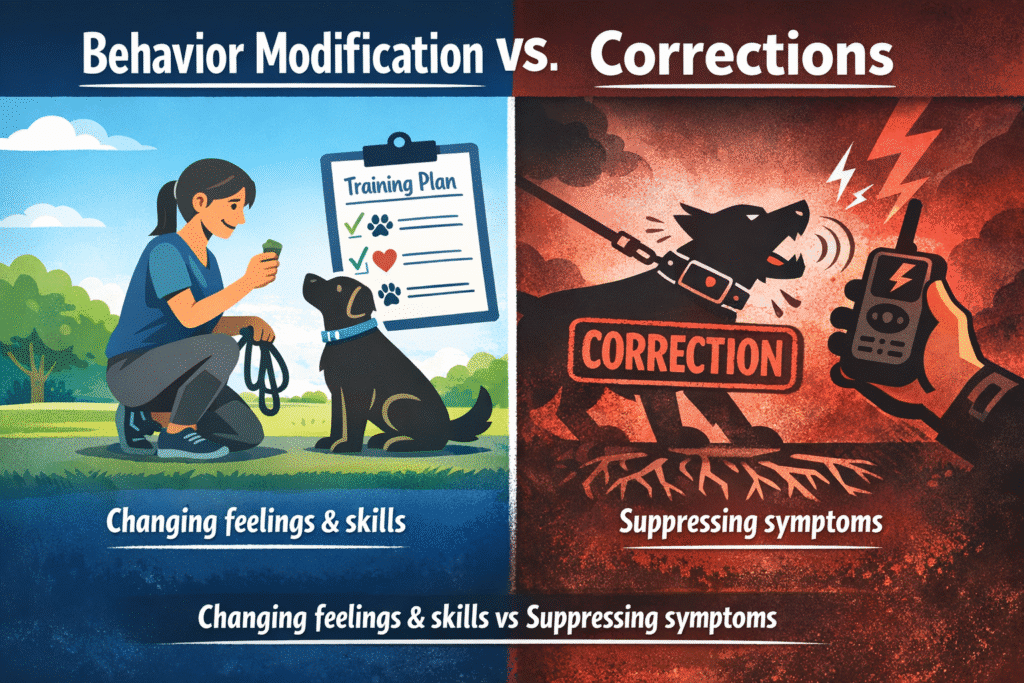
What Behavior Modification Is and What Behavior Modification Is Not
A practical, science based guide for pet parents trying to find the right help
If you are dealing with dog aggression training in Phoenix, barking, lunging, growling, snapping, panic when left alone, resource guarding, chasing wildlife, or a dog who loses their mind around strangers, you have probably heard the phrase behavior modification. It gets thrown around like it is a magic credential. It sounds advanced, and it sounds like whoever says it must have a higher level plan.
Sometimes they do. A lot of times, they do not.
Here is the clean truth. Real behavior modification is not a buzzword, and it is not obedience training with a fancier name. It is a structured process built to change behavior patterns by changing what sets the behavior off, what the behavior accomplishes for the dog, and what the dog learns over repeated experiences. And when fear or anxiety is part of the picture, behavior modification must also change the dog’s emotional learning about the trigger, because fear based behavior does not disappear just because you can cue a sit (Bouton, 2007; Domjan, 2014).
What behavior modification is, in plain language
Behavior modification is a plan that changes problem behavior by changing the conditions that produce it and the outcomes that keep it going. Done correctly, it is not guesswork. It starts with defining the behavior in observable terms, identifying patterns, identifying function, then building a plan that changes the environment, changes the consequences, teaches replacement behaviors, and uses reinforcement strategically. That structure, including careful measurement and planning for generalization, is straight out of applied behavior analysis, which is the science of producing meaningful behavior change (Cooper et al., 2020).
If you want a simple way to remember the difference, think of it like this. Training teaches skills. Behavior modification changes behavior patterns. Good professionals use both, but they do not pretend that skills alone solve fear, panic, or aggression.
Why behavior problems keep showing up
A lot of behavior that looks “bad” is behavior that works. Barking and lunging can create distance. Growling can stop a hand from reaching. Snapping can end pressure. Panic can be an escape response. When a behavior reliably produces an outcome that matters to the dog, it is very likely to repeat. This is why real behavior modification focuses on function, not labels, and why two dogs can look similar on the outside but need totally different plans (Cooper et al., 2020).
The part most people miss, behavior has an emotional engine
Most serious behavior challenges have two layers. There is the outward behavior you can see, and there is what the dog feels and predicts in that moment. In many aggression and reactivity cases, the dog is not trying to be dominant or stubborn. The dog is reacting because the dog’s nervous system is treating the trigger like a threat, even if you and I know there is no real danger. Those emotional responses are learned through associative processes, and if you want lasting change, you have to change the association, not just the outward behavior (Domjan, 2014).
What real behavior modification usually includes
A legitimate plan has a backbone. The language may vary, but the structure is there.
It starts with clarity. You should hear a description of the problem in plain, observable terms, not just a label like aggressive. Then there is a functional assessment, meaning the professional is trying to determine what reliably triggers the behavior and what is maintaining it. From there, a good plan uses management strategically. Management is not giving in. Management is how you prevent constant rehearsal of the problem behavior while new learning is being installed.
Then comes the teaching. Real behavior modification teaches the dog what to do instead, and that replacement behavior is reinforced heavily and practiced in the same contexts where the problem used to happen. And when fear or anxiety is part of the issue, the plan must include controlled exposure and counterconditioning. The whole goal is to keep the dog under threshold and shift what the trigger predicts, because that is how the dog’s emotional response changes over time. Learning research on extinction and relapse helps explain why overwhelming exposure and “just let them get over it” approaches are unreliable and can backfire, especially in sensitive dogs (Bouton, 2007; Domjan, 2014). Finally, the plan should include generalization and maintenance, because if it only works in one setting under perfect conditions, it is not finished (Cooper et al., 2020).
Corrections are not behavior modification
Now we need to talk about the word correction, because it is one of the most misleading words in all of dog training. Correction sounds helpful, like you are correcting a mistake the way you correct a typo. But in a lot of training culture, correction is just a nicer sounding label for punishment.
In behavioral science, punishment has a very specific definition. It is a consequence that decreases the future probability of a behavior. Positive punishment means something unpleasant is added after the behavior to reduce it. Negative punishment means something the dog wants is removed after the behavior to reduce it. Negative reinforcement is different. That is when the dog performs a behavior to make something unpleasant stop, which increases that behavior in the future (Cooper et al., 2020).
Here is why this matters for pet parents.
Punishment can reduce the outward behavior without changing the reason the behavior was happening. That means you can make a dog look calmer while the dog is still feeling the same fear, anxiety, or conflict inside. That is suppression. Suppression is not a complicated concept. It simply means the symptoms are pushed down while the root cause stays in place. And if the root cause stays in place, you are often forced to keep “correcting” forever, because you did not actually build new learning. You just kept the lid on the pot.
The growl example is where this becomes a safety issue.
If a dog growls because they are uncomfortable or afraid, and you punish the growl, you can absolutely get less growling. But that does not mean the dog is safer. It means the dog learned that warning has a cost. Veterinary behavior guidance has warned about this problem for a long time, because punishing warning signals can leave fear intact while reducing the signals that help people predict escalation (American Veterinary Society of Animal Behavior, 2007). In plain language, you are not fixing aggression. You are often teaching the dog to skip the warning.
And when you skip the warning, you create a more dangerous situation for everyone, including the dog. If the dog is still afraid and still feels trapped, the dog may eventually bite without the same early signals, not because the dog became “worse,” but because the dog learned that communication is unsafe. That is exactly the opposite of what behavior modification is supposed to do. Always kep this in mind when looking for a dog behaviorist in Phoenix
The superstitious association problem, why aversives can make reactivity worse
There is another piece that rarely gets explained to pet parents, and it is one of the most important reasons correction based approaches can backfire.
Dogs learn by association, and those associations are not always neat and tidy. Events that happen close together can get linked, even when the human believes the timing was perfect. Skinner described this as superstitious behavior, and in modern terms it maps onto accidental, adventitious learning, where an animal connects what is happening in the environment with what happens to them, even when the connection was not intended (Skinner, 1948).
Now picture a common real world case. A dog is fearful or reactive on leash. Another dog appears. Your dog stiffens, barks, lunges. A correction is delivered through an electronic collar, a leash pop, a prong collar, or some other aversive. The trainer believes they punished barking. The dog may learn something very different. The dog may learn that other dogs make pain happen.
If the dog already thinks dogs are threatening, now dogs are not just threatening. Dogs predict discomfort. That is classical conditioning working against you. You are making the trigger more negative, not less, and you are doing it repeatedly, day after day, walk after walk (Domjan, 2014).
This is why you can see dogs that look quieter for a while, but become more tense, more watchful, and more explosive over time. The outward behavior got suppressed, but the emotional response got worse. Now you have a pressure cooker. The dog is still afraid, the dog has learned that expressing that fear is punished, and the dog has also learned that the trigger predicts pain. That is a terrible learning history to create.
What the evidence says about aversives and why “necessary for severe cases” is a myth
Pet parents are often told that shock collars, prong collars, choke chains, and other aversives are necessary for “serious” cases. They are told positive reinforcement is fine for easy dogs, but real problems need real corrections.
That claim does not hold up to the best available evidence and professional veterinary guidance.
Studies have found that aversive based training is associated with poorer welfare indicators and more stress related behaviors compared with reward based approaches (Vieira de Castro et al., 2020). Research specifically examining electronic collars has documented stress related effects associated with their use in common training situations (Schalke et al., 2007). Survey research has also found that confrontational and aversive methods can elicit aggressive responses in some dogs, which matters a lot if you are working with fear, guarding, or bite risk cases (Herron et al., 2009). Reviews of the literature have concluded that aversive training methods carry welfare risks and that there is not persuasive evidence they produce superior outcomes compared with reward based approaches (Ziv, 2017).
And beyond the studies, major veterinary behavior guidance is clear. The American Veterinary Society of Animal Behavior has stated there is no evidence aversive methods are more effective than reward based methods, and it recommends that only reward based methods be used for dog training and behavior problems (American Veterinary Society of Animal Behavior, 2021). That position is consistent with the idea that behavior modification should not just stop behavior, it should reduce fear, build coping skills, and improve welfare.
So if someone tells you they are doing behavior modification, but their plan is mostly corrections, the most honest translation is this. They are using suppression as the primary strategy. They may get quiet. They are not necessarily getting safer.
How to spot real behavior modification quickly
When you talk to a professional, do not get distracted by fancy terms. Ask questions that force them to show you the structure of their plan. Ask how they define the behavior in observable terms. Ask what triggers it. Ask what they think the dog gets from it. Ask what management steps they recommend to prevent rehearsal. Ask what the dog will be taught to do instead and how that will be reinforced. Ask how progress will be measured, even if the measurement is simple, like distance to trigger, intensity ratings, frequency, or recovery time (Cooper et al., 2020). Then ask the question that matters most if fear or reactivity is involved. How are you going to change how my dog feels about the trigger.
A professional who is truly doing behavior modification can answer that without getting defensive and without promising miracles.
The simplest way to remember the difference
If someone is mainly trying to make the behavior stop, you are watching suppression.
If someone is changing the setup, changing consequences, teaching functional alternatives, and changing the dog’s emotional learning over time, you are watching behavior modification.
That difference is not philosophical. It is practical. It is the difference between a dog who is quiet because they are afraid, and a dog who is quiet because they genuinely feel safe.
If you are looking for dog training in Phoenix, contact us today at (602) 769-1411
References
American Veterinary Society of Animal Behavior. (2007). AVSAB position statement: The use of punishment for behavior modification in animals.
American Veterinary Society of Animal Behavior. (2021). AVSAB position statement on humane dog training.
Bouton, M. E. (2007). Learning and behavior: A contemporary synthesis. Sinauer Associates.
Cooper, J. O., Heron, T. E., & Heward, W. L. (2020). Applied behavior analysis (3rd ed.). Pearson.
Domjan, M. (2014). The principles of learning and behavior (7th ed.). Cengage Learning.
Herron, M. E., Shofer, F. S., & Reisner, I. R. (2009). Survey of the use and outcome of confrontational and non-confrontational training methods in client-owned dogs showing undesired behaviors. Applied Animal Behaviour Science, 117(1–2), 47–54.
Schalke, E., Stichnoth, J., Ott, S., & Jones-Baade, R. (2007). Clinical signs caused by the use of electric training collars on dogs in everyday life situations. Applied Animal Behaviour Science, 105(4), 369–380.
Skinner, B. F. (1948). “Superstition” in the pigeon. Journal of Experimental Psychology, 38(2), 168–172.
Vieira de Castro, A. C., Fuchs, D., Morello, G. M., Pastur, S., de Sousa, L., Olsson, I. A. S., & de Oliveira, L. (2020). Does training method matter? Evidence for the negative impact of aversive-based methods on companion dog welfare. PLOS ONE, 15(12), e0225023.
Ziv, G. (2017). The effects of using aversive training methods in dogs: A review. Journal of Veterinary Behavior, 19, 50–60.